


Community hub
Recent from talks
Contribute something to knowledge base
Content stats: 0 posts, 0 articles, 1 media, 0 notes
Members stats: 0 subscribers, 0 contributors, 0 moderators, 0 supporters
Subscribers
Supporters
Contributors
Moderators
Hub AI
Synthetic fuel AI simulator
(@Synthetic fuel_simulator)
Hub AI
Synthetic fuel AI simulator
(@Synthetic fuel_simulator)
Synthetic fuel
Synthetic fuel or synfuel is a liquid fuel, or sometimes gaseous fuel, obtained from syngas, a mixture of carbon monoxide and hydrogen, in which the syngas was derived from gasification of solid feedstocks such as coal or biomass or by reforming of natural gas.
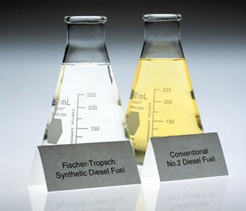
Common ways for refining synthetic fuels include the Fischer–Tropsch conversion,[better source needed] methanol to gasoline conversion,[better source needed] or direct coal liquefaction.[better source needed]
There is a range of meanings for the terms 'synthetic fuel' or 'synfuel'.
Synthetic fuels are produced by the chemical process of conversion. Conversion methods could be direct conversion into liquid transportation fuels, or indirect conversion, in which the source substance is converted initially into syngas which then goes through additional conversion processes to become liquid fuels. Basic conversion methods include carbonization and pyrolysis, hydrogenation, and thermal dissolution.
The process of direct conversion of coal to synthetic fuel originally developed in Germany. Friedrich Bergius developed the Bergius process, which received a patent in 1913. Karl Goldschmidt invited Bergius to build an industrial plant at his factory, the Th. Goldschmidt AG (part of Evonik Industries from 2007), in 1914. Production began in 1919.[citation needed]
Indirect coal conversion (where coal is gasified and then converted to synthetic fuels) was also developed in Germany - by Franz Fischer and Hans Tropsch in 1923. During World War II (1939-1945), Germany used synthetic-oil manufacturing (German: Kohleverflüssigung) to produce substitute (Ersatz) oil products by using the Bergius process (from coal), the Fischer–Tropsch process (water gas), and other methods (Zeitz used the TTH and MTH processes). In 1931 the British Department of Scientific and Industrial Research located in Greenwich, England, set up a small facility where hydrogen gas was combined with coal at extremely high pressures to make a synthetic fuel.
The Bergius process plants became[when?] Nazi Germany's primary source of high-grade aviation gasoline, synthetic oil, synthetic rubber, synthetic methanol, synthetic ammonia, and nitric acid. Nearly one third of the Bergius production came from plants in Pölitz (Polish: Police) and Leuna, with 1/3 more in five other plants (Ludwigshafen had a much smaller Bergius plant which improved "gasoline quality by dehydrogenation" using the DHD process).
Synthetic fuel grades included "T.L. [jet] fuel", "first quality aviation gasoline", "aviation base gasoline", and "gasoline - middle oil"; and "producer gas" and diesel were synthesized for fuel as well (converted armored tanks, for example, used producer gas). By early 1944 German synthetic-fuel production had reached more than 124,000 barrels per day (19,700 m3/d) from 25 plants, including 10 in the Ruhr Area. In 1937 the four central Germany lignite coal plants at Böhlen, Leuna, Magdeburg/Rothensee, and Zeitz, along with the Ruhr Area bituminous coal plant at Scholven/Buer, produced 4.8 million barrels (760×103 m3) of fuel. Four new hydrogenation plants (German: Hydrierwerke) were subsequently erected at Bottrop-Welheim (which used "Bituminous coal tar pitch"), Gelsenkirchen (Nordstern), Pölitz, and, at 200,000 tons/yr Wesseling. Nordstern and Pölitz/Stettin used bituminous coal, as did the new Blechhammer plants. Heydebreck synthesized food oil, which was tested on concentration camp prisoners. After Allied bombing of Germany's synthetic-fuel production plants (especially in May to June 1944), the Geilenberg Special Staff used 350,000 mostly foreign forced-laborers to reconstruct the bombed synthetic-oil plants, and, in an emergency decentralization program, the Mineralölsicherungsplan (1944-1945), to build 7 underground hydrogenation plants with bombing protection (none were completed). (Planners had rejected an earlier such proposal, expecting that Axis forces would win the war before the bunkers would be completed.) In July 1944 the "Cuckoo" project underground synthetic-oil plant (800,000 m2) was being "carved out of the Himmelsburg" north of the Mittelwerk, but the plant remained unfinished at the end of World War II. Production of synthetic fuel became even more vital for Nazi Germany when Soviet Red Army forces occupied the Ploiești oilfields in Romania on 24 August 1944, denying Germany access to its most important natural oil source.
Synthetic fuel
Synthetic fuel or synfuel is a liquid fuel, or sometimes gaseous fuel, obtained from syngas, a mixture of carbon monoxide and hydrogen, in which the syngas was derived from gasification of solid feedstocks such as coal or biomass or by reforming of natural gas.
Common ways for refining synthetic fuels include the Fischer–Tropsch conversion,[better source needed] methanol to gasoline conversion,[better source needed] or direct coal liquefaction.[better source needed]
There is a range of meanings for the terms 'synthetic fuel' or 'synfuel'.
Synthetic fuels are produced by the chemical process of conversion. Conversion methods could be direct conversion into liquid transportation fuels, or indirect conversion, in which the source substance is converted initially into syngas which then goes through additional conversion processes to become liquid fuels. Basic conversion methods include carbonization and pyrolysis, hydrogenation, and thermal dissolution.
The process of direct conversion of coal to synthetic fuel originally developed in Germany. Friedrich Bergius developed the Bergius process, which received a patent in 1913. Karl Goldschmidt invited Bergius to build an industrial plant at his factory, the Th. Goldschmidt AG (part of Evonik Industries from 2007), in 1914. Production began in 1919.[citation needed]
Indirect coal conversion (where coal is gasified and then converted to synthetic fuels) was also developed in Germany - by Franz Fischer and Hans Tropsch in 1923. During World War II (1939-1945), Germany used synthetic-oil manufacturing (German: Kohleverflüssigung) to produce substitute (Ersatz) oil products by using the Bergius process (from coal), the Fischer–Tropsch process (water gas), and other methods (Zeitz used the TTH and MTH processes). In 1931 the British Department of Scientific and Industrial Research located in Greenwich, England, set up a small facility where hydrogen gas was combined with coal at extremely high pressures to make a synthetic fuel.
The Bergius process plants became[when?] Nazi Germany's primary source of high-grade aviation gasoline, synthetic oil, synthetic rubber, synthetic methanol, synthetic ammonia, and nitric acid. Nearly one third of the Bergius production came from plants in Pölitz (Polish: Police) and Leuna, with 1/3 more in five other plants (Ludwigshafen had a much smaller Bergius plant which improved "gasoline quality by dehydrogenation" using the DHD process).
Synthetic fuel grades included "T.L. [jet] fuel", "first quality aviation gasoline", "aviation base gasoline", and "gasoline - middle oil"; and "producer gas" and diesel were synthesized for fuel as well (converted armored tanks, for example, used producer gas). By early 1944 German synthetic-fuel production had reached more than 124,000 barrels per day (19,700 m3/d) from 25 plants, including 10 in the Ruhr Area. In 1937 the four central Germany lignite coal plants at Böhlen, Leuna, Magdeburg/Rothensee, and Zeitz, along with the Ruhr Area bituminous coal plant at Scholven/Buer, produced 4.8 million barrels (760×103 m3) of fuel. Four new hydrogenation plants (German: Hydrierwerke) were subsequently erected at Bottrop-Welheim (which used "Bituminous coal tar pitch"), Gelsenkirchen (Nordstern), Pölitz, and, at 200,000 tons/yr Wesseling. Nordstern and Pölitz/Stettin used bituminous coal, as did the new Blechhammer plants. Heydebreck synthesized food oil, which was tested on concentration camp prisoners. After Allied bombing of Germany's synthetic-fuel production plants (especially in May to June 1944), the Geilenberg Special Staff used 350,000 mostly foreign forced-laborers to reconstruct the bombed synthetic-oil plants, and, in an emergency decentralization program, the Mineralölsicherungsplan (1944-1945), to build 7 underground hydrogenation plants with bombing protection (none were completed). (Planners had rejected an earlier such proposal, expecting that Axis forces would win the war before the bunkers would be completed.) In July 1944 the "Cuckoo" project underground synthetic-oil plant (800,000 m2) was being "carved out of the Himmelsburg" north of the Mittelwerk, but the plant remained unfinished at the end of World War II. Production of synthetic fuel became even more vital for Nazi Germany when Soviet Red Army forces occupied the Ploiești oilfields in Romania on 24 August 1944, denying Germany access to its most important natural oil source.
Recent media
Recent media