Hubbry Logo
CarntonCarntonMain
Open search
Carnton
Community hub
Carnton
logo
8 pages, 0 posts
0 subscribers
Be the first to start a discussion here.
Carnton
Carnton
from Wikipedia

Carnton
Carnton
Carnton is located in Tennessee
Carnton
Carnton is located in the United States
Carnton
Location1345 Eastern Flank Circle,
Franklin, Tennessee
Coordinates35°54′11″N 86°51′30″W / 35.90309°N 86.85834°W / 35.90309; -86.85834
Area48 acres (19 ha)
Built1826
Architectural styleFederal; Greek Revival
NRHP reference No.73001857 [1]
Added to NRHPJanuary 18, 1973

Carnton is a historic plantation home built in 1826 in Franklin, Williamson County, Tennessee, United States. The property, comprising 1,420 acres (5.7 km2), played an important role during and immediately after the Battle of Franklin during the American Civil War.[2] Carnton was situated less than one mile (1.6 km) from the location of the 1864 battle's Union Army eastern flank, and it became the principal temporary field hospital for tending the wounded. More than 1,750 Confederate soldiers lost their lives at Franklin, and on Carnton's back porch four deceased Confederate generals' bodies were laid out for a few hours after the battle.[3] The life of Carrie McGavock, who lived at Carnton during the civil war, was the subject of a best-selling novel in 2005 by Robert Hicks, entitled The Widow of the South.[4] The house was listed on the National Register of Historic Places in 1973, and became a museum managed by The Battle of Franklin Trust, a non-profit organization.

Mansion and grounds

[edit]

Architecture

[edit]
Carnton's Greek Revival style back porch

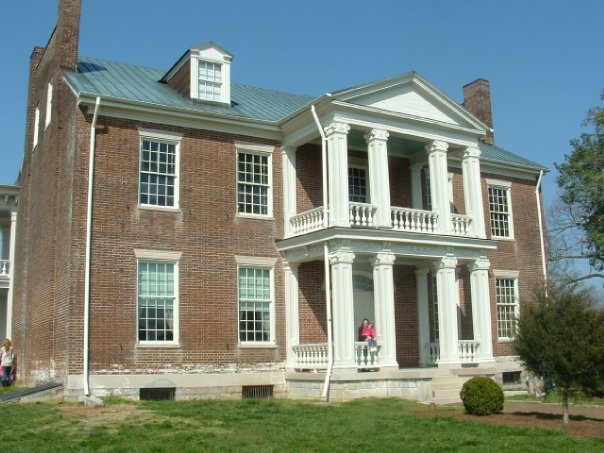
Carnton is a red brick Federal-style 11-room residence, that was completed in 1826 by Randal McGavock using slave labor. Built on a raised limestone foundation, the southern facing entrance façade is a two-story, five-bay block with a side-facing gabled roof, covered in tin, with two dormer windows, and slightly projecting end chimneys. A central two-story pedimented portico in the Greek Revival-style was added in 1847 by McGavock's son John McGavock. The two-story portico contains four, square Ionic columns with beveled recessed panels, and a simple vase shape balustrade on each level. The balustrade encloses the second-story balcony. Decorative corbels and scrollwork are found on the fascia above the first level, and the columns at the corners of the portico are matched by pilasters on the front façade. The doorway is flanked by engaged columns and sidelights, with a semi-circular fanlight above. A two-level Greek Revival gallery with seven two-story Doric columns, and using the same balustrade as seen on the front portico, is located on the rear of the house. The gallery runs the length of the house, extending at one end to take advantage of southerly breezes.[5]

Interior

[edit]

The interior has Greek Revival touches due to the remodeling done by John McGavock in 1847, including then-fashionable wallpapers, faux-painting and carpets in most every room. Three distinct wallpaper patterns have been discovered on the third floor. The central passage downstairs appears much as it did in 1864 during the Civil War. The wallpaper design, though a reproduction, is based on a popular design for the time. The parlor also saw a Greek Revival upgrade in the form of a fireplace mantel, new wallpaper and carpeting. The working clock on the parlor mantel and the 200-piece china set in the dining room is original to the McGavock family, as well as a rocking chair given by President Andrew Jackson. Many of the floors in Carnton are stained due to the house being used as Confederate hospital after the Battle of Franklin. The heaviest stains are found in one of the southern facing bedrooms which was used as an operating room, as a result of the blood soaking through the carpets and seeping into the wood floors.

Grounds

[edit]
Garden at Carnton

Randal McGavock planted cedars along the driveway leading up to the house, while his son extended the planting of cedars and boxwood along the herringbone patterned brick walkway that he had installed between the portico and the driveway. In preparation for his marriage in 1847 to Carrie Winder, John McGavock created a 1-acre (0.40 ha) garden to the west of the house based on the writings of Andrew Jackson Downing, the "father of American landscape architecture." The working garden had vegetable squares, each surrounded by ornamental borders, but the presence of a large Osage orange tree in the center of the southeast quadrant suggests that vegetable growing was eventually discontinued in garden plots nearest the house.[6] The garden was surrounded by a white picket fence as well as a high board fence on the north side, to protect the plants from animals and severe weather. The fence also gave a degree of privacy to the occupants of the house from the outbuildings and the many slaves moving about on the grounds.[5]

The garden was neglected throughout the 20th-century, but enough physical evidence remained through archeological research, photographs and letters to indicate its extent and layout, that the garden was recreated in 1996–97 to how it looked in 1869. The daffodil, hosta, and peony collection is composed entirely of varieties available in Middle Tennessee prior to 1869. Carnton is believed to house the largest historic daffodil collection in the South, representing 40 varieties in use before 1869.

McGavock Confederate Cemetery

[edit]

To the northwest of the house on a 2-acre (0.81 ha) section of the property is the McGavock Confederate Cemetery, the largest privately owned military cemetery in the United States. Donated by the McGavock family as a permanent burial ground for the soldiers killed in the Battle of Franklin, the cemetery is organized by state resulting in thirteen sections separated by a 14-foot (4.3 m) pathway. The cemetery is maintained by The Franklin Chapter of the United Daughters of the Confederacy.

History

[edit]

19th century

[edit]

Randal McGavock (1768-1843), migrated from Virginia and settled in Nashville, Tennessee becoming a prominent local politician.[7] He served as Mayor of Nashville for a one-year term in 1824 and was acquainted with President James K. Polk and good friends with President Andrew Jackson, who resided at The Hermitage near Nashville. Jackson was a guest of the McGavocks on more than one occasion. McGavock named his property near Franklin after his father's birthplace in County Antrim, Ireland. The name "Carnton" was derived from the Gaelic word cairn which means "a pile of stones." A cairn sometimes marks a burial site.

The first construction at Carnton was a smokehouse constructed in 1815 that was adjoined to the main house built in 1826 by a two-story kitchen wing. The mansion sat on 1,400 acres (6 km2) of which 500 acres (2 km2) was used for farming. Among the crops the McGavocks grew in the mid-19th century in middle Tennessee were wheat, corn, oats, hay, and potatoes. The McGavocks were also involved in raising and breeding livestock and thoroughbred horses. Randal McGavock's daughter, Elizabeth, married William Giles Harding of Belle Meade Plantation that became an internationally renowned thoroughbred farm.

Randal McGavock died in 1843, leaving Carnton to his son John (1815–1893). In December 1848, John married his cousin Carrie Winder (1829–1905) of Ducros Plantation in Thibodaux, Louisiana. Carrie Winder McGavock became the subject of a 2005 Robert Hicks novel entitled "The Widow of the South" based on her life.[4] The book became a New York Times bestseller.[4] She brought with her the slave Mariah Reddick.[8] The couple had five children but only two would survive to adulthood. Upon marriage the McGavocks started renovating the house, preferring the then fashionable Greek Revival-style.[7] Just prior to the Civil War, John McGavock's net worth was about $339,000 in 1860, which is about $6 million in 2007 dollars.

Battle of Franklin

[edit]

John McGavock was 46 when the Civil War began and was too old to enlist, but he helped outfit and organize groups of Southern soldiers. Carrie contributed to the war effort by sewing uniforms for relatives and friends. As the war got closer to home, John McGavock sent most of his slaves to Louisiana so they wouldn't be taken by Federal authorities. When Federal troops took control of Middle Tennessee, and learned of the McGavocks' efforts to aid the South, they took thousands of dollars' worth of grain, horses, cattle and timber from the plantation.

On November 30, 1864, Carnton became the largest temporary field hospital for tending the wounded and dying after the Battle of Franklin. The home was situated less than one mile (1.6 km) from the location of the activity that took place on the far Union Eastern flank. More than 1,750 Confederates lost their lives at Franklin, and on Carnton's back porch four Confederate generals' bodies—Patrick Cleburne, John Adams, Otho F. Strahl and Hiram B. Granbury—were laid out for a few hours after the battle.

The McGavocks tended for as many as 300 soldiers inside Carnton alone, though at least 150 died the first night. Hundreds more were spread throughout the rest of the property, including in the slave cabins. Carrie McGavock donated food, clothing and supplies to care for the wounded and dying, and witnesses say her dress was blood soaked at the bottom. Carrie's two children, Hattie (then nine) and son Winder (then seven) witnessed the carnage as well, providing some basic assistance to the surgeons.

McGavock Cemetery with Carnton in background

After the battle, on December 1, Union forces under Maj. Gen. John M. Schofield evacuated toward Nashville, leaving all the dead, including several hundred Union soldiers, and the wounded who were unable to walk as well. The residents of Franklin were then faced with the task of burying over 2,500 soldiers, most of those being Confederates. According to George Cowan's "History of McGavock Confederate Cemetery," "All of the Confederate dead were buried as nearly as possible by states, close to where they fell, and wooden headboards were placed at each grave with the name, company and regiment painted or written on them."[9] Many of the Union soldiers were re-interred in 1865 at the Stones River National Cemetery in Murfreesboro, Tennessee.

Over the next eighteen months many of the markers were either rotting or used for firewood, and the writing on the boards was disappearing. To preserve the graves, John and Carrie McGavock donated 2 acres (8,100 m2) of their property to be designated as an area for the Confederate dead to be re-interred. The citizens of Franklin raised the funding and the soldiers were exhumed and reburied in the McGavock Confederate Cemetery for the sum of $5.00 per soldier. A team of individuals led by George Cuppett took responsibility for the reburial operation of 1,481 soldiers, and one civilian, Marcellus Cuppett, George's brother who had died during the process of the reburials, in the spring of 1866. The original names and identities of the soldiers were recorded in a cemetery record book by Cuppett, and the book fell into the watchful hands of Carrie McGavock after the reinterments.

After the war, McGavock continued to farm Carnton under sharecropping arrangements with former slaves until his death in 1893.

20th century

[edit]

Carrie McGavock managed the maintenance of the cemetery with African-American workers for 41 years until her death in 1905. A prayer in the Confederate Veteran magazine mentioned Carrie McGavock in 1905:[10]

We thank thee for the . . . feeble knees she lifted up, for the many hearts she comforted, the needy ones she supplied, the sick she ministered unto, and the boys she found in abject want and mothered and reared into worthy manhood. In the last day they will rise up and call her blessed. Today she is not, because thou hast taken her; and we are left to sorrow for the Good Samaritan of Williamson County, a name richly merited by her.

— Rev. John W. Hanner[11]

Living history re-enactors

The McGavock's son, Winder, inherited the home on the death of his mother, however he died only two years later in 1907. His widow and children then left Carnton and moved into Franklin. In 1909, the eastern kitchen wing of the house was destroyed by a tornado, and the roofline can still be clearly seen where it abutted the mansion. Winder's widow sold the house in 1911 ending a century of family ownership. Carnton then passed through the hands of several owners, and by the late 1960s and 1970s, the property was in disrepair. In 1977, the Carnton Association was formed to raise money to buy, restore and maintain the mansion. The following year, the house and ten acres were given to the association by Dr. and Mrs. W.D. Sugg who had owned the property since the 1950s. Subsequently, the Association acquired an additional 38 acres (150,000 m2), and began a restoration of the house and grounds that were completed by the late 1990s.[5]

21st century

[edit]

Listed on the National Register of Historic Places in 1973, Carnton has never received any funding or support from local, state or the Federal government. The site is maintained and managed by The Battle of Franklin Trust, a non-profit organization which also manages another historic Battle of Franklin historic home, the Carter House. Today, Carnton receives visitors from all over the world as many people visit to learn the true story of the Widow of the South, Carrie McGavock.[1]

[edit]
  • The Widow of the South (2005) Carnton is the setting for the novel by author Robert Hicks.[12]

See also

[edit]

References

[edit]

Further reading

[edit]
[edit]
Revisions and contributorsEdit on WikipediaRead on Wikipedia
from Grokipedia
Carnton is a historic Greek Revival located in Franklin, , constructed in 1826 by Randal McGavock, a former of Nashville, on a 1,420-acre property originally used for production. The estate, owned by the McGavock family for generations, became a pivotal site during the when it served as the largest Confederate field hospital following the on November 30, 1864, treating thousands of wounded soldiers amid the engagement's brutal five-hour clash that inflicted approximately 9,500 casualties, nearly 7,000 of them Confederate. Overlooking the battlefield from its elevated position, Carnton received waves of injured troops shortly after fighting began, with bloodstains still visible on its porch floors and grounds expanded into makeshift wards; the McGavocks, including matriarch Carrie McGavock, personally aided the effort, later burying hundreds of Confederate dead in the family cemetery to prevent desecration. Today, preserved by the Battle of Franklin Trust since 1977, Carnton functions as a offering tours of the house, outbuildings, and grounds, emphasizing its role in illuminating the Franklin-Nashville Campaign's devastating toll on the , which lost six generals in the assault.

Architecture and Grounds

Mansion Design and Construction

The Carnton mansion, a red brick Federal-style residence, was constructed in 1826 by Randal McGavock, a former of Nashville, on his plantation south of . The building featured an 11-room layout typical of early 19th-century Southern plantation homes, emphasizing symmetry and restraint in ornamentation characteristic of the Federal style, with brick masonry following regional precedents like Thomas Hardin Perkins's Meeting of the Waters. Enslaved laborers produced the bricks by hand and performed much of the construction work. Originally, the main house connected to a two-story smokehouse and kitchen wing dating to around , forming a functional compound for operations. In 1847, under the ownership of McGavock's son John, significant expansions included a two-story Greek Revival at the front entrance and dormers to enhance light and ventilation, blending neoclassical elements with the original Federal framework. A two-story rear was added shortly thereafter to capture southerly breezes, improving comfort in the humid . Interior refinements in the 1850s involved new wallpapers, carpets, and paint, though these were minor compared to the structural changes. The smokehouse wing was later removed following a 1909 tornado, but the core mansion retains its 1826 footprint with 19th-century modifications.

Interior Layout and Features

The interior of Carnton exemplifies Federal-style architecture from its 1826 construction, with subsequent Greek Revival modifications introduced during John McGavock's 1847 remodeling, including fashionable wallpapers and faux-painting techniques. The central passage has been restored to its Civil War-era configuration, featuring wallpaper reproduced from surviving fragments and paint colors matched through historical analysis. Key public rooms include the parlor, upgraded in the 1850s with a Greek Revival mantel, new patterned , and wall-to-wall carpeting—luxuries reflecting the home's status as a premier plantation. The dining room, which also served as an office for the McGavock family, retains period furnishings alongside antiques and original family artifacts displayed throughout the house. Bedrooms on the upper floors feature fireplaces in every room, each flanked by two small, shallow built-in closets—a rarity in antebellum homes of the period, which typically lacked such storage. The third floor preserves fragments of original bright, patterned wallpapers, while many interior floors bear permanent bloodstains from the home's conversion into a Confederate on November 30, 1864, where hundreds of wounded soldiers were treated. A room-by-room restoration commencing in the mid-1980s aimed to replicate 19th-century , incorporating deep, rich historic paint tones identified via chemical conducted in the early 1990s. These efforts emphasize the home's dual role as a residence and wartime medical site, with no major structural alterations beyond the 19th-century additions.

Surrounding Grounds and Outbuildings

The surrounding grounds of Carnton originally spanned approximately 1,400 acres, supporting a cotton-based plantation economy reliant on enslaved labor. Enslaved individuals, numbering up to 39 at the property's peak, maintained the fields and auxiliary structures. Key outbuildings included eleven slave quarters for housing the enslaved workforce, with one two-story example preserved and restored by 1987. A smokehouse facilitated meat preservation through salting and smoking processes essential to plantation self-sufficiency, while a springhouse provided cool storage for dairy products, vegetables, and water drawn from an adjacent spring. These structures, constructed primarily by enslaved labor, supported daily operations and food preservation. The grounds also featured formal adjacent to the mansion for the McGavock family's use, alongside a dedicated period slave cultivated by the enslaved for their sustenance. Cedars planted along the entrance drive enhanced privacy from the working areas and outbuildings. Today, the extant grounds and restored outbuildings are accessible via self-guided exploration and specialized tours focusing on plantation life and .

McGavock Confederate Cemetery

The McGavock Confederate Cemetery comprises two acres of the Carnton grounds, located adjacent to the McGavock family cemetery south of the mansion. It contains 1,480 graves of Confederate soldiers killed in the on November 30, 1864. Of these, 1,256 are identified by state, while 224 remain unknown, with names of the identified preserved in a known as the "" compiled by Carrie McGavock. The layout organizes burials by military structure, divided into 12 sections primarily by state, such as and , and further subdivided by corps, divisions, and brigades. Graves follow a formation of two columns with 15 markers per row, reflecting the soldiers' units; for example, Lt. Gen. A.P. Stewart's Corps accounts for 334 graves, Maj. Gen. Benjamin F. Cheatham's for 380, and Lt. Gen. Stephen D. Lee's for 55. Originally marked with wooden headboards, the graves received headstones in 1890 and granite cornerstones by 2018. A central statue of a Confederate soldier and a monument to unknown soldiers mark key points within the cemetery. An iron fence, erected in , encloses the site, which has been maintained since the McGavocks' era by groups including local veterans and, since , the McGavock Confederate Cemetery Corporation. This arrangement makes it the largest privately owned military cemetery in the United States by number of burials.

Pre-Civil War History

McGavock Family Acquisition and Residences

Randal McGavock, a prominent Nashville politician and former , acquired the land for Carnton in , during the 1820s, with initial construction of outbuildings such as the smokehouse beginning around 1815. He relocated his family to the property circa 1826, where he oversaw the completion of the main Federal-style brick mansion that year, naming the plantation after his ancestral estate in Ireland and establishing it as a farming operation focused on crops and horse breeding. McGavock resided in the mansion with his family until his death on February 20, 1843. Following Randal's death, the passed by inheritance to his son, John McGavock, who assumed management and made improvements to the house, including the addition of a Greek Revival and dormers in 1847, as well as a rear in the early 1850s. On December 6, 1848, John married Caroline Elizabeth "Carrie" Winder at her family's Ducros Plantation in ; the couple then established their primary residence at Carnton. John and Carrie McGavock lived in the 11-room mansion, where they raised five children—three of whom died in infancy—leaving surviving offspring Hattie and Winder McGavock by the eve of the Civil War in 1860. The McGavocks' occupancy centered on the central mansion, which served as the family's domestic hub amid the plantation's expansion to approximately 700 acres by 1860, though John expressed reservations about and did not enlist in Confederate service. No secondary family residences are documented on the property during this period, with the household structured around the main house and associated outbuildings.

Plantation Economy and Enslaved Labor

Carnton operated as a mixed agricultural under the McGavock family, focusing on staple crops and to generate wealth in antebellum . Established around 1815 and expanded by Randal McGavock, the property initially encompassed about 288 acres by the mid-1820s, producing corn, grain, , and other commodities through intensive field labor. By 1850, operations yielded 9,000 bushels of corn, 200 bushels of , 4,000 bushels of oats, and substantial including 41 horses, 63 , and 250 pigs, alongside hay and potatoes. cultivation supplemented these outputs, aligning with regional economics where enslaved labor enabled exports. The farm's value reached $150,000 by 1860, bolstered by ancillary enterprises like a operational by 1849, which produced 2,000 feet of daily using skilled enslaved workers. Enslaved labor formed the backbone of Carnton's economy across three generations of McGavock ownership, with workforce numbers growing from 11 individuals in 1820 to 44 by 1860 on roughly 700 cultivated acres. Enslaved men, women, and children performed grueling tasks including plowing, planting, harvesting crops, tending , felling trees, shearing sheep, spinning wool, preserving food, and slaughtering hogs, directly sustaining family wealth and comfort. Domestic roles encompassed cooking, cleaning, childcare, , , and blacksmithing, while specialized skills—such as operating the —commanded high purchase prices, with one skilled sawyer acquired for $2,500 in 1859. Construction of the mansion and outbuildings in 1826 also relied on enslaved hands, reflecting standard plantation practices in Williamson County where slaveholdings expanded with land improvements. Upon Randal McGavock's death in 1843, son John inherited the operation, maintaining its scale until the Civil War disrupted labor systems.

Civil War Involvement

Prelude to the Battle of Franklin

Following the Union victory at on September 1, 1864, Confederate General launched an invasion of with approximately 30,000 troops, aiming to disrupt Union supply lines and defeat isolated Federal forces before they could consolidate under Maj. Gen. George H. Thomas at Nashville. Maj. Gen. John M. Schofield's , numbering around 30,000 including detachments, withdrew northward across the Duck River, prompting Hood to pursue aggressively in hopes of forcing a decisive engagement. On November 29, 1864, Hood attempted to interpose his army between Schofield and Nashville at Spring Hill, but Confederate coordination faltered, allowing Union troops to slip past under cover of darkness along the Columbia Turnpike, evading encirclement despite heavy skirmishing that resulted in about 400 Confederate and 100 Union casualties. Hood, enraged by the "miracle" escape, ordered an immediate dawn pursuit on November 30, with his exhausted divisions—marching 20 miles overnight—closing on Franklin by midmorning. Schofield's vanguard had arrived in Franklin around 6:00 a.m., rapidly fortifying a two-mile line south of town with breastworks, , and , anchored on the Harpeth River bridges to their north. Carnton plantation, owned by John McGavock and situated about two miles southwest of Franklin's defenses near the Lewisburg Pike, lay directly in the path of the Confederate right wing under Maj. Gen. . As Hood's corps deployed—Cheatham's to the west and Stewart's to the east—thousands of Confederate soldiers streamed through the fields and roads adjacent to Carnton, foraging for supplies and positioning for assault amid reports of Union entrenchments. Cleburne's division, comprising around 6,000 men from , , and other states, advanced from the southeast, passing near the plantation as Hood surveyed the field and rejected alternatives like flanking maneuvers, insisting on a frontal attack to punish Schofield before nightfall. The McGavocks, who had maintained Carnton as a 1,380-acre cotton and dairy operation with 44 enslaved laborers in 1860, witnessed the ominous buildup from their Gothic Revival home; John McGavock, a Unionist sympathizer skeptical of who declined Confederate service, sheltered his family including wife Carrie and children amid the encroaching armies. Local civilians, including the McGavocks, evacuated some and prepared for upheaval as Confederate unlimbered and formed ranks roughly 2,000 yards from Union works, setting the stage for commencing around 4:00 p.m. This prelude underscored Hood's tactical impatience, prioritizing immediate pressure over rest or reconnaissance despite his army's fatigue from prior clashes at Columbia and Spring Hill.

Role During the Battle

On November 30, 1864, during the , Carnton plantation was situated about one mile west of the primary Union defensive lines centered around the Carter House and in , placing it near the Confederate army's line of advance from the south. As ordered his forces forward in multiple assaults starting around 4:00 p.m., Confederate troops from corps under and maneuvered through and engulfed the grounds of Carnton, using the surrounding fields and approaches as part of their approach to the Union eastern and western flanks. This positioning exposed the property to the chaos of the Confederate advance, with soldiers traversing the plantation amid artillery fire and skirmishing that intensified toward dusk. The McGavock family, owners of Carnton, were present at the house during the engagement, but contemporary accounts provide limited details on their immediate responses amid the ongoing , which lasted approximately five hours until after nightfall. Carnton's elevated location offered a partial vantage over the to the east, though no primary sources confirm its use as an official by Confederate command. By late afternoon, as the first waves of assaults faltered against Union entrenchments, the began receiving initial wounded Confederate soldiers ferried from the front lines, marking the onset of its transformation into a medical site even as volleys and charges continued nearby. Over 6,000 Confederate casualties occurred in the fighting, with Carnton's proximity facilitating the rapid transport of some of these men to its outbuildings and yard during the battle's active phase.

Field Hospital Operations

Following the on November 30, 1864, Carnton was rapidly converted into the largest Confederate in the vicinity, with surgeons and medical staff treating hundreds of wounded soldiers transported there during and immediately after the fighting. The house, back porches, yard, and outbuildings overflowed with casualties, primarily from Maj. Gen. William W. Loring's division, amid the battle's total of approximately 9,500 casualties, including nearly 7,000 Confederates killed, wounded, captured, or missing. Operations commenced amid the chaos of the evening retreat, continuing through the night of November 30 and into subsequent days, as Confederate forces evacuated the area. On the morning of December 1, 1864, the bodies of four Confederate generals slain in the battle—Patrick R. Cleburne, Hiram B. Granbury, , and Otho F. Strahl—were placed on Carnton's back porch for temporary repose before further disposition. The McGavock family, owners of the property, permitted the full use of their home for medical purposes; John McGavock and his wife, Carrie, along with household staff, assisted in nursing the injured, providing aid amid severe conditions that left permanent bloodstains on the interior floors. Surgical procedures, including amputations, were performed under rudimentary field conditions, reflecting the overwhelmed state of Confederate medical resources following the disastrous assault. Hospital functions persisted for months, with the last wounded soldiers departing Carnton by July 1865, as recovery efforts extended beyond the immediate post-battle period. This prolonged operation underscored Carnton's central role in mitigating the human toll of the engagement, which claimed around 2,300 lives overall.

Post-Battle and

Cemetery Establishment and Burials

Following the on November 30, 1864, approximately 1,500 Confederate soldiers who perished in the engagement were initially interred in shallow, unmarked graves across the battlefield and nearby properties, including Carnton plantation grounds, due to the overwhelming casualties and limited resources for proper amid winter conditions. In early 1866, as efforts intensified to consolidate and honor the dead amid concerns over desecration and erosion of temporary sites, John McGavock and his wife Carrie designated two acres of their land adjacent to the family cemetery for a permanent Confederate burial ground, marking of what became the McGavock Confederate Cemetery—the largest privately owned Confederate cemetery in the United States. Over roughly ten weeks in spring 1866, a team led by Confederate veteran George W. Cuppett exhumed and reinterred the remains of 1,481 identified soldiers, organizing the cemetery into 12 sections by state affiliation to reflect regimental origins, with headstones bearing names, units, and states where possible, though many remained unknown. The McGavocks personally funded initial maintenance, ensuring the site's upkeep as a distinct from federal national cemeteries, which prioritized Union dead; this private initiative preserved Southern casualties overlooked by postwar federal policies. By completion, the cemetery encompassed graves for soldiers from states including , , , and others, with Cuppett's own brother among those reburied, underscoring the familial and communal labor involved.

McGavock Family's Post-War Efforts

In the immediate aftermath of the , the McGavock family provided ongoing care for hundreds of wounded Confederate soldiers who convalesced at Carnton for up to a year, managing the estate's resources without external governmental or state support. This included medical attention, shelter, and sustenance amid the broader disruptions of the war's end, reflecting a commitment to Southern casualties despite the family's own financial strains from damaged and disrupted . Carrie McGavock assumed primary responsibility for preserving the memory of the fallen by maintaining the adjacent Confederate cemetery, which held nearly 1,500 burials, and compiling a comprehensive that recorded each soldier's name, , , and personal effects where known. She oversaw its upkeep with the assistance of African-American laborers until her death on February 22, 1905, ensuring the site remained a dignified amid Reconstruction-era challenges. John McGavock supported these initiatives until his death on June 7, 1893, after which Carrie continued the work independently. To adapt the plantation's operations to the post-emancipation economy, the McGavocks negotiated labor contracts with former enslaved individuals, including agreements with Franky and Miles McConnico and Thomas Neely, establishing terms for or wage labor on the remaining farmland. These arrangements helped sustain the 700-acre property through the turbulent Reconstruction period, though yields and profitability declined due to regional economic upheaval. The family retained ownership until 1911, when the estate passed out of their hands following the death of Winder McGavock.

20th and 21st Century Preservation

Decline and Early Restoration Attempts

Following the death of Winder McGavock in 1907, his widow Susie Lee McGavock sold Carnton out of the family in 1911. Over the subsequent decades, the property changed hands multiple times among absentee landlords and was leased to tenant farmers, leading to progressive deterioration of the mansion and grounds. By the mid-20th century, the once-grand Greek Revival structure had fallen into severe disrepair, with peeling paint, structural weaknesses, and neglect threatening its survival amid encroaching urban development pressures in . Tenant occupancy persisted into the late 1970s, exacerbating the decay as the site risked demolition for commercial use. In 1973, Carnton was added to the , highlighting its architectural and Civil War significance amid growing recognition of preservation needs. This prompted local action: in 1977, concerned citizens established the Carnton Association, a nonprofit dedicated to for acquisition, stabilization, and restoration. The following year, in 1978, the Association successfully obtained the mansion and approximately ten surrounding acres from its then-owners, Dr. and Mrs. W. D. Sugg, averting immediate threats of destruction. Initial restoration efforts focused on basic stabilization rather than full reconstruction due to limited funds, with the site opening to the public in June 1981 in a partially restored state. Progress was incremental; by the mid-1980s, volunteers and donors supported room-by-room interior work to replicate 19th-century appearances, including period furnishings and wallpapers, though comprehensive exterior and landscape rehabilitation remained ongoing challenges into the 1990s. These early attempts laid the groundwork for Carnton's transition from abandonment to interpretive historic site, relying on community philanthropy and volunteer labor to combat decades of .

Battle of Franklin Trust Management

The Battle of Franklin Trust, a 501(c)(3) established in 2009, assumed management of Carnton to integrate its operations with those of Carter House and Rippa Villa, enabling a more cohesive interpretation of the and its broader Civil War context. Prior to this, Carnton had been preserved through the efforts of the Carnton Association, formed in 1977 to acquire the property from private owners Dr. and Mrs. W.D. Sugg and undertake initial restorations that stabilized the dilapidated structure and restored elements of its antebellum appearance. Under the Trust's oversight, Carnton has served as a key site for public education, emphasizing the plantation's role as a Confederate during the November 30, 1864, battle, where it treated thousands of wounded soldiers and became the final resting place for nearly 1,500 Confederates in its backyard . The Trust's management prioritizes ongoing physical preservation, including targeted restoration projects such as reconstructions, roofline repairs, reproduction carpeting installations, and stabilization at Carnton, with major phases executed between 2021 and 2022 to combat weathering and maintain structural integrity. These efforts build on earlier Association-led work that rescued the site from further decay, reflecting a sustained commitment to authenticity informed by archaeological and historical rather than speculative reconstruction. Complementing preservation, the Trust operates guided tours at Carnton, including standard house tours, specialty programs on the field operations, and broader Campaign battlefield walks that connect the site to regional military events, attracting visitors to engage with primary accounts and artifacts like bloodstained floors preserved . Leadership under Executive Director has expanded the Trust's scope to include research initiatives, inclusive programming that addresses the battle's human costs across combatants and civilians, and advocacy for adjacent battlefield land acquisition to prevent urban encroachment in . While the Trust maintains a focus on factual and site-specific narratives, it has faced external pressures to reinterpret elements like the McGavock family's slaveholding past, though management emphasizes evidence-based storytelling over ideological overlays. Annual events, such as commemorative programs marking the battle's 160th anniversary in , underscore Carnton's role in public memory, drawing on artifacts and eyewitness testimonies to convey the engagement's staggering casualties—over 8,000 in five hours—without diminishing the strategic context of Confederate General John Bell Hood's assaults.

Recent Developments and Expansions

In 2021 and 2022, the Trust conducted targeted restoration at Carnton, focusing on the porches and along the roofline, alongside repairs and to preserve structural integrity. These efforts also incorporated historic paint analysis to ensure authenticity in appearance, drawing on grants, donations, and partnerships with state and local entities for funding. Such maintenance addressed ongoing wear from environmental exposure and visitor traffic while adhering to preservation standards for the 19th-century structure. The site marked the 160th anniversary of the Battle of Franklin with expanded public programming in November 2024, including free tours and the largest reenactment event in Carnton's history, involving over 700 participants on November 29-30. This initiative heightened educational outreach, featuring living history demonstrations post-event to illustrate post-battle convalescence and family experiences at the plantation. Under the Trust's management, broader expansions include plans for a new 6,500-square-foot to enhance interpretation across its sites, incorporating context on the battle, , and Reconstruction to support Carnton's role in Civil War narratives. These developments aim to sustain long-term preservation amid growing , without altering core historic features.

Historical Significance and Interpretations

Military and Strategic Legacy

The , centered on positions near Carnton plantation, represented a pivotal engagement in Confederate General John Bell Hood's Tennessee Campaign, launched in late 1864 to reclaim , disrupt Union supply lines via the Nashville & Chattanooga Railroad, and potentially draw William T. Sherman's forces northward from Georgia following the fall of . Hood's strategy aimed to intercept John M. Schofield's Union detachment of approximately 30,000 troops before it could reinforce George H. Thomas in Nashville, but a missed opportunity at Spring Hill on allowed Schofield to fortify defenses south of Franklin, including breastworks along the Columbia Pike adjacent to Carnton. On , Hood committed roughly 20,000 Confederate troops to a across open fields against these entrenched lines, a maneuver exceeding the scale of at Gettysburg in intensity and resulting in over 6,000 Confederate casualties within five hours, compared to 2,326 Union losses. Carnton's military role emerged post-assault as Confederate forces retreated northward, transforming the McGavock family plantation—situated on the battle's eastern flank—into a primary for hundreds of wounded soldiers, where four generals (Patrick Cleburne, Hiram Granbury, , and George Strahl) succumbed to injuries, marking the highest single-battle loss of Confederate general officers in the war. This concentration of command casualties at Carnton exemplified the battle's tactical devastation, as Hood disregarded subordinates' counsel against the assault, prioritizing immediate pressure over flanking maneuvers despite the evident defensive advantages of Union positions supported by from Fort Granger. Strategically, the Franklin debacle irreparably weakened the , stripping it of seasoned leadership and reducing its effective strength by nearly a third, which precipitated its decisive rout at Nashville on December 15–16, 1864, and effectively ended organized Confederate resistance in . The engagement underscored the obsolescence of massed infantry charges against fortified lines in the war's later stages, contributing to the broader collapse of Confederate offensive capabilities in the Western Theater and accelerating Union momentum toward Appomattox. Carnton's legacy as a repository of this failure—evidenced by persistent bloodstains on its floors and the adjacent McGavock Cemetery's interment of nearly 1,500 unidentified Confederates—serves as a stark of Hood's campaign miscalculations, which prioritized audacity over logistical realism amid dwindling resources.

Confederate Memorialization vs. Modern Reassessments

The McGavock Confederate Cemetery, established in 1866 on two acres donated by John and Carrie McGavock adjacent to Carnton, serves as the largest privately owned Confederate burial ground in the United States, interring approximately 1,500 soldiers killed in the November 30, 1864, . Organized by state and unit, with identified graves marked by headstones and unknowns in mass sections, the cemetery has historically functioned as a to Southern martial sacrifice during the war's "five bloodiest hours," emphasizing the scale of Confederate losses—over 6,000 casualties in a single frontal assault larger than . This memorialization aligns with post-war Lost Cause narratives that highlighted valor and tragedy while downplaying slavery's centrality to , as evidenced by the site's early iron fence installation by 1869 and ongoing veneration through involvement in maintenance. Under the Battle of Franklin Trust's management since 1977, Carnton's preservation has sustained this Confederate focus, with annual commemorations and tours underscoring the battle's tactical futility and human cost without altering the cemetery's dedication to rebel dead. However, since the early 2010s, the Trust has incorporated reassessments integrating the plantation's pre-war reliance on enslaved labor—Randal McGavock owned over 30 enslaved people in 1860—through expanded programming, including dedicated slavery tours launched around 2015 that detail forced labor in cotton and corn production. These efforts mark graves of at least three unidentified enslaved individuals in a segregated section of the McGavock grounds and address interpretive challenges by contextualizing the war's causes, countering myths like minimal slaveholding among Confederate ranks (actual rates exceeded 25-30% in many units). This dual approach reflects tensions in Civil War site interpretation: traditional emphasis on battlefield heroism persists amid broader scholarly consensus on as the conflict's root cause, per primary documents, yet Carnton avoids iconoclastic removals seen elsewhere, opting instead for layered narratives that preserve artifacts like bloodstained floors from use while interrogating the McGavocks' Confederate sympathies alongside their wartime aid to wounded soldiers regardless of side. No major public controversies over Confederate symbols at Carnton have emerged, distinguishing it from national debates, as the Trust prioritizes empirical site-specific history over ideological reframing.

Achievements in Preservation and Criticisms

The Battle of Franklin Trust, which assumed management of Carnton in 2000, has undertaken extensive restoration efforts adhering to historical preservation standards, including the meticulous refurbishment of the main house in the 1990s that preserved original bloodstains on the floors from its use as a Confederate during the 1864 . These works transformed the property from a neglected tenant farmstead into a nationally recognized , with the Trust's mission emphasizing the preservation, understanding, and interpretation of Civil War impacts on local families and landscapes. Key achievements include the safeguarding of the McGavock Confederate Cemetery, established in early 1866 when John and Carrie McGavock donated two acres adjacent to their family plot for the reburial of approximately 1,500 Confederate soldiers, creating the largest privately owned Confederate cemetery in the United States. The cemetery has been maintained since 1905 by the local chapter of the United Daughters of the Confederacy, ensuring the graves' integrity amid broader site expansions. Complementary land acquisitions, such as the 2020 preservation of 2.3 acres of original battlefield terrain through partnerships and grants totaling $107,500, have expanded protected acreage and prevented development encroachment. The restoration of ancillary features, like the 19th-century garden by 1869 with its cast-iron fencing, further underscores successful adaptive reuse while retaining evidentiary artifacts from the era. Criticisms of preservation efforts have centered on interpretive completeness and initial restoration priorities; early 20th-century work faced rebuke for insufficient cosmetic enhancements and furnishings, prompting subsequent private initiatives to furnish outbuildings like the smokehouse. Broader challenges involve balancing Confederate-focused memorialization with fuller contextualization of the site's pre-war operations, including enslaved labor, as noted in scholarly assessments of Civil War sites' interpretive struggles. In 2017, the decision to drop "Plantation" from the site's official name—described by state Carroll Van West as a site-specific choice to mitigate associations with —drew implicit contention for potentially softening historical terminology tied to the property's antebellum agricultural economy. Despite these, the Trust's collaborative funding successes, including over $18 million in state grants since 2018 for battlefield protections encompassing Franklin-area sites, affirm robust ongoing commitments amid interpretive debates.

Cultural Depictions

Literature and Media Representations

Carnton features prominently in centered on the and its aftermath. Robert Hicks' novel The Widow of the South (2005) dramatizes the experiences of Carrie McGavock, depicting her transformation of the grounds into a for nearly 1,500 soldiers following the , 1864, engagement, where bloodstains reportedly soaked the back porch after treating the wounded. Hicks, drawing from McGavock's diaries and period accounts, portrays her as a devoted steward of the dead amid personal loss, though the narrative incorporates fictionalized relationships and emotional interiority not verifiable in primary sources. A , The Orphan Mother (2016), shifts focus to post-war racial tensions through Mariah Reddick, a formerly enslaved woman connected to Carnton, exploring Reconstruction-era dynamics while referencing the site's as a symbol of unresolved Confederate legacy. Tamera Alexander's Carnton series, including Christmas at Carnton (2017), With This Pledge (2019), and Colors of Truth (2020), embeds romantic subplots within the plantation's wartime role as a . These works, classified as Christian , emphasize themes of faith, redemption, and interpersonal reconciliation against the backdrop of the 1864 battle, with characters interacting amid the McGavock home's bloodstained floors and makeshift surgeries; Alexander consulted site archives for authenticity but prioritizes inspirational narratives over strict . In paranormal media, Carnton is represented as one of Tennessee's most haunted Civil War sites, with accounts of apparitions, footsteps, and unexplained cold spots attributed to lingering soldier spirits. The premiere episode of the series Southern Haunts (2005) investigates these claims at the mansion, interviewing witnesses and using electronic voice phenomena to capture purported evidence from the battle's casualties. A 2017 compilation, Carnton Plantation Ghost Stories: True Tales of the Unexplained, aggregates eyewitness reports from staff and visitors, linking phenomena to specific events like the treatment of dying Confederates, though skeptics attribute them to suggestion and structural acoustics rather than causes. Documentary treatments, such as the PBS segment in Tennessee Civil War 150: Carnton Mansion (2018), focus on factual restoration and battlefield context without sensationalism, while local programs like Tennessee Crossroads (2009) highlight preservation efforts tied to its medical history. No major feature films depict Carnton centrally, though its cemetery appears briefly in The Adventures of the Adventures (2020) for atmospheric effect. These representations often amplify Carnton's role in Confederate memory, sometimes critiqued for romanticizing the Lost Cause while underemphasizing enslaved labor on the plantation prior to 1865 emancipation.

Tourism and Public Engagement

Carnton attracts thousands of visitors annually as a preserved Civil War site in , emphasizing its role as a Confederate during the on November 30, 1864. Managed by the Battle of Franklin Trust, the property offers guided tours of the 1826 plantation house, outbuildings, and grounds, with self-guided access to the latter included in most tickets. Tour options include the daily 60-minute House Tour, priced at $22 for adults and $14 for children aged 6-15, available from 9 a.m. to 4 p.m. through Saturday and 10 a.m. to 4 p.m. on Sundays. Specialty 90-minute tours, such as the & the Enslaved Tour, Battlefield Tour, and Extended Tour, cost $29 each and delve into targeted historical themes like the experiences of enslaved individuals and military strategies. A discounted $10 Tuesday tour mirrors the format, while the Tennessee Campaign Ticket at $40 grants access to tours at Carnton, Carter House, and Rippa Villa. Public engagement extends beyond standard tours through educational programs, events, and commemorative activities, including anniversary reenactments of the and the Spring Hill engagement. The Trust organizes the Franklin Civil War Round Table for scholarly discussions, descendants' reunions, and outreach initiatives to interpret the Civil War's broader impacts, encompassing , Reconstruction, and personal stories of affected families. These efforts align with the organization's mission to preserve sites while promoting nuanced understanding of the conflict's human dimensions.

References

Add your contribution
Related Hubs
User Avatar
No comments yet.