



Community hub
Recent from talks
Contribute something to knowledge base
Content stats: 0 posts, 0 articles, 1 media, 0 notes
Members stats: 0 subscribers, 0 contributors, 0 moderators, 0 supporters
Subscribers
Supporters
Contributors
Moderators
Caspase 1
Caspase-1/Interleukin-1 converting enzyme (ICE) is an evolutionarily conserved enzyme that proteolytically cleaves other proteins, such as the precursors of the inflammatory cytokines interleukin 1β and interleukin 18 as well as the pyroptosis inducer Gasdermin D, into active mature peptides. It plays a central role in cell immunity as an inflammatory response initiator. Once activated through formation of an inflammasome complex, it initiates a proinflammatory response through the cleavage and thus activation of the two inflammatory cytokines, interleukin 1β (IL-1β) and interleukin 18 (IL-18) as well as pyroptosis, a programmed lytic cell death pathway, through cleavage of Gasdermin D. The two inflammatory cytokines activated by Caspase-1 are excreted from the cell to further induce the inflammatory response in neighboring cells.
Caspase-1 is evolutionarily conserved in many eukaryotes of the Kingdom Animalia. Due to its role in the inflammatory immune response, it is highly expressed in the immune organs such as the liver, kidney, spleen, and blood (neutrophils). Following infection, the inflammatory response increases expression of Caspase-1, by a positive feedback mechanism that amplifies the response.
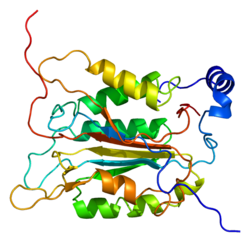
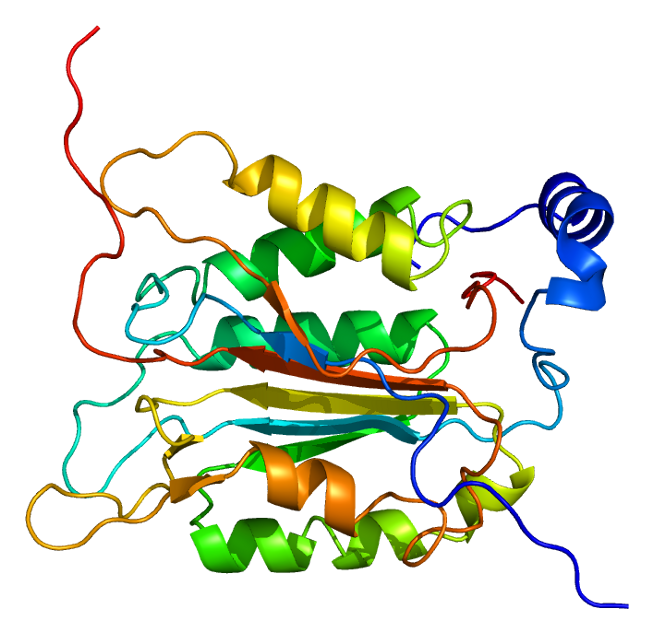
Caspase-1 is produced as a zymogen that can then be cleaved into 20 kDa (p20) and 10 kDa (p10) subunits that become part of the active enzyme. Active Caspase 1 contains two heterodimers of p20 and p10. It contains a catalytic domain with an active site that spans both the p20 and p10 subunits, as well as a noncatalytic Caspase Activation and Recruitment Domain (CARD) . It interacts with other CARD containing proteins such as Apoptosis-Associated Speck-like Protein Containing a CARD (ASC) and Nod-Like Receptor (NLR) Family CARD Domain-Containing Protein 4 (NLRC4) through CARD-CARD interactions in the formation of inflammasomes.
Caspase-1, normally in its physiologically inactive zymogen form, autoactivates when it is assembled into the filamentous inflammasome complex by autoproteolysis into the p10 and p20 subunits. The inflammasome complex is a ring complex composed of trimers of a signal specific sensor protein such as those of the NLR family and the AIM-1 (Absent in Melanoma) like receptors, an adaptor protein such as ASC, and a caspase, in this case Caspase-1. In some cases, where the signaling proteins contain their own CARDs, like in NLRP1 and NLRC4, the CARD–CARD interaction is direct, meaning there is no adaptor protein in the complex. There are a variety of sensor and adaptor proteins, the various combinations of which confer the inflammasomes' responses to specific signals. This allows the cell to have varying degrees of inflammatory responses based on the severity of the danger signal received.
CARD only proteins (COPs) as their name implies, are proteins that only contain the non-catalytic CARDs. Owing to the importance of CARD-CARD interactions in inflammasome formation, many COPs are known inhibitors of Caspase activation. For Caspase-1, genes for specific COPs—ICEBERG, COP1 (ICE/Pseudo-ICE), and INCA (Inhibitory Card)—are all found near its locus, and are thus thought to have emerged from gene duplication events and subsequent deletions of the catalytic domains. Though they all interact with the inflammasomes using CARD–CARD interactions, they differ in the way they carry out their inhibitory functions as well as in their effectiveness at doing so.
For example, ICEBERG nucleates the formation of Caspase-1 filaments and is thus incorporated into the filaments, but lacks the ability to inhibit the activation of inflammasomes. Instead, it is thought to inhibit Caspase-1 activation by interfering with the interaction of Caspase-1 with other important CARD containing proteins.
INCA, on the other hand, directly blocks inflammasome assembly by capping Caspase-1 CARD oligomers, thus blocking further polymerization into the inflammasome filaments.
Similarly, some POPs (Pyrin only proteins) are also known to regulate Caspase-1 activation through inhibition of inflammasome activation by binding to and blocking PYD interactions, which also play a role in the formation of the inflammasomes, though the exact mechanisms are not yet well established.
Caspase 1
Caspase-1/Interleukin-1 converting enzyme (ICE) is an evolutionarily conserved enzyme that proteolytically cleaves other proteins, such as the precursors of the inflammatory cytokines interleukin 1β and interleukin 18 as well as the pyroptosis inducer Gasdermin D, into active mature peptides. It plays a central role in cell immunity as an inflammatory response initiator. Once activated through formation of an inflammasome complex, it initiates a proinflammatory response through the cleavage and thus activation of the two inflammatory cytokines, interleukin 1β (IL-1β) and interleukin 18 (IL-18) as well as pyroptosis, a programmed lytic cell death pathway, through cleavage of Gasdermin D. The two inflammatory cytokines activated by Caspase-1 are excreted from the cell to further induce the inflammatory response in neighboring cells.
Caspase-1 is evolutionarily conserved in many eukaryotes of the Kingdom Animalia. Due to its role in the inflammatory immune response, it is highly expressed in the immune organs such as the liver, kidney, spleen, and blood (neutrophils). Following infection, the inflammatory response increases expression of Caspase-1, by a positive feedback mechanism that amplifies the response.
Caspase-1 is produced as a zymogen that can then be cleaved into 20 kDa (p20) and 10 kDa (p10) subunits that become part of the active enzyme. Active Caspase 1 contains two heterodimers of p20 and p10. It contains a catalytic domain with an active site that spans both the p20 and p10 subunits, as well as a noncatalytic Caspase Activation and Recruitment Domain (CARD) . It interacts with other CARD containing proteins such as Apoptosis-Associated Speck-like Protein Containing a CARD (ASC) and Nod-Like Receptor (NLR) Family CARD Domain-Containing Protein 4 (NLRC4) through CARD-CARD interactions in the formation of inflammasomes.
Caspase-1, normally in its physiologically inactive zymogen form, autoactivates when it is assembled into the filamentous inflammasome complex by autoproteolysis into the p10 and p20 subunits. The inflammasome complex is a ring complex composed of trimers of a signal specific sensor protein such as those of the NLR family and the AIM-1 (Absent in Melanoma) like receptors, an adaptor protein such as ASC, and a caspase, in this case Caspase-1. In some cases, where the signaling proteins contain their own CARDs, like in NLRP1 and NLRC4, the CARD–CARD interaction is direct, meaning there is no adaptor protein in the complex. There are a variety of sensor and adaptor proteins, the various combinations of which confer the inflammasomes' responses to specific signals. This allows the cell to have varying degrees of inflammatory responses based on the severity of the danger signal received.
CARD only proteins (COPs) as their name implies, are proteins that only contain the non-catalytic CARDs. Owing to the importance of CARD-CARD interactions in inflammasome formation, many COPs are known inhibitors of Caspase activation. For Caspase-1, genes for specific COPs—ICEBERG, COP1 (ICE/Pseudo-ICE), and INCA (Inhibitory Card)—are all found near its locus, and are thus thought to have emerged from gene duplication events and subsequent deletions of the catalytic domains. Though they all interact with the inflammasomes using CARD–CARD interactions, they differ in the way they carry out their inhibitory functions as well as in their effectiveness at doing so.
For example, ICEBERG nucleates the formation of Caspase-1 filaments and is thus incorporated into the filaments, but lacks the ability to inhibit the activation of inflammasomes. Instead, it is thought to inhibit Caspase-1 activation by interfering with the interaction of Caspase-1 with other important CARD containing proteins.
INCA, on the other hand, directly blocks inflammasome assembly by capping Caspase-1 CARD oligomers, thus blocking further polymerization into the inflammasome filaments.
Similarly, some POPs (Pyrin only proteins) are also known to regulate Caspase-1 activation through inhibition of inflammasome activation by binding to and blocking PYD interactions, which also play a role in the formation of the inflammasomes, though the exact mechanisms are not yet well established.
Recent media
Recent media