Hubbry Logo
Holly blueHolly blueMain
Open search
Holly blue
Community hub
Holly blue
logo
8 pages, 0 posts
0 subscribers
Be the first to start a discussion here.
Holly blue
Holly blue
from Wikipedia

Holly blue
Male
Female
both Cumnor Hill, Oxford, England
Scientific classification Edit this classification
Kingdom: Animalia
Phylum: Arthropoda
Class: Insecta
Order: Lepidoptera
Family: Lycaenidae
Genus: Celastrina
Species:
C. argiolus
Binomial name
Celastrina argiolus
Synonyms
  • Papilio cleobis Sulzer, 1776
  • Papilio thersanon Bergstrasser, 1779
  • Papilio argyphontes Bergstrasser, 1779
  • Papilio argalus Bergstrasse, 1779
  • Papilio (Argus) marginatus Retzius, 1783
  • Lycaenopsis argiolus calidogenita Verity, 1919
  • Lycaenopsis argiolus britanna Verity, 1919

The holly blue (Celastrina argiolus)[2] is a butterfly that belongs to the lycaenids or blues family and is native to the Palearctic.

Description

[edit]
Figs 1, 1a, 1b larva after last moult, from holly 1c, 1d larva after last moult, from ivy 1e pupa from holly

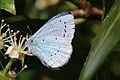
The holly blue has pale silver-blue wings spotted with pale ivory dots. Seitz describes it "Male above shining violet blue, only the apical portion of the costal margin being minutely edged with white. The female has both wings broadly bordered with dark, the margin of the hindwing bearing vestiges of ocelli. Underside silver-white, in the disc a row of black dots, some of which are elongate, and before the margin blackish shadowy dots. Egg very flat, whitish. Larva green or brown, marked with yellowish white, bearing catenulate (chain-like) stripes on the back, on segment 7 a gland to attract ants; head brown. On Ivy, Ilex, Euonymus, Rhamnus, Robinia, Genista, Spartium, Astragalus, Rubus, Erica, Pyrus and many other plants; in Europe visited usually by ants of the genus Lasius; in June and the autumn. Pupa mostly fastened to the underside of a leaf, ochreous with brown spots and markings. The butterflies in the spring and again in July, occasionally a third time at the end of August and in September, everywhere common, particularly at the flowers of ivy and brambles."[3] In Europe, the first generation feeds mainly on the holly species Ilex aquifolium but the second generation uses a range of food plants.[4]

The holly blue is the national butterfly of Finland.[5]

Taxonomy

[edit]

This species was originally described as Papilio argiolus by Carl Linnaeus in 1758, and refers to the examples flying in Europe. In their monograph on the Lycaenopsis group of polyommatine genera, Eliot & Kawazoe, 1983, list 14 taxa as valid subspecies names, plus many further synonyms to which they accord lesser status. According to Eliot & Kawazoe, 1983, these 14 subspecies are divided into four groups as follows:

Common names

[edit]

In India, C. argiolus is known as the hill hedge blue.[6]

Range

[edit]

Found in Eurasia. In South Asia, it occurs from Chitral in Pakistan to Kumaon in India.[6]

Population cycle

[edit]

The holly blue is subject to marked population cycles which appear to be caused by interactions with the parasitoid ichneumon wasp Listrodromus nycthemerus. The wasp lays an egg on a holly blue caterpillar, inserting the egg into the caterpillar's body and the adult wasp emerges from the chrysalis, killing the chrysalis before its emergence. The population of the butterfly is tracked by that of the wasp, when butterfly populations are low the wasp population falls and this allows the butterfly population to increase and the population of L. nycthemerus can increase as there are more hosts available to be parasitised. As more caterpillars are parasitised the butterfly population crashes.[7]

See also

[edit]

References

[edit]
[edit]
Revisions and contributorsEdit on WikipediaRead on Wikipedia
from Grokipedia
The holly blue (Celastrina argiolus) is a small belonging to the family , native to the , recognized for its bright blue upperwings—violet-blue in males and edged with black borders in females—paired with silvery-blue undersides dotted with small black spots. With a wingspan of 26–34 mm, it is distinguished as the first blue to emerge in spring and the most common species observed in urban and suburban gardens across its range. This species inhabits a variety of semi-natural and human-modified environments, including woodlands, hedgerows, parks, churchyards, and gardens, where it tends to fly high around bushes and trees rather than low to the ground like many other . Its distribution spans much of and parts of , from to , and is widespread in , particularly , , and , though rarer in and subject to northward expansion in recent decades. In the British Isles, populations have shown a +109% abundance increase and +34% distribution expansion from 1976 to 2019, reflecting its adaptability to changing landscapes. The holly blue typically produces two generations per year in temperate regions, with adults emerging from to May for the spring brood and July to September for the summer brood, though a partial third brood may occur in warmer conditions. Caterpillars feed primarily on the flower buds of holly () in spring and ivy () in summer, but also utilize spindle, dogwoods, gorse, bramble, and snowberries; adults nectar on ivy and bramble flowers, as well as tree sap, rotting fruit, and occasionally carrion. Population numbers fluctuate cyclically due to by the ichneumon wasp Listrodromus nycthemerus, which targets caterpillars and can cause sharp declines followed by recoveries. Overall, it holds Least Concern status on the GB Red List (2022) and is not considered threatened across , serving as Finland's national .

Physical description

Adults

The adult Holly blue (Celastrina argiolus) is a small with a of 26–34 mm. The upperwings display a bright coloration, often with a subtle violet sheen in males, while females exhibit broader dark borders along the edges. The underwings are pale grey-blue with scattered black spots and small ivory dots, providing effective against lichen-covered surfaces. The body is covered in fine hairs, giving it a soft, velvety appearance, and the antennae are black with white tips. is pronounced in wing patterning: males possess brighter blue upperwings lacking extensive black margins, whereas females show more extensive black borders on the forewings, which can appear brownish in certain lights. Spring brood adults are typically paler and smaller than the darker summer brood, with females of the latter showing broader black margins.

Immature stages

The eggs of the Holly blue are small and white, typically measuring about 0.6 mm in diameter, and are laid singly by the female on the undersides of flower buds or young leaves of host plants. Newly hatched larvae are pale in color with a black head and sparse light hairs, measuring around 1 mm in length. As they progress through five instars, feeding primarily on flower buds and developing fruits, the larvae adopt a light green or brownish hue, featuring variable white and pinkish-brown markings along with yellowish-white chain-like dorsal stripes; the head remains dark brown or black. Fully grown larvae attain a length of approximately 12 mm before wandering to pupate. In common with many lycaenid butterflies, the larvae possess a dorsal nectar organ on the seventh abdominal segment that secretes honeydew, attracting attendant ants such as those of the genus Lasius for protection against predators. The , or chrysalis, measures about 9-10 mm in length and is ochreous to light brown with scattered darker brown spots, providing among leaf litter or stems. It is suspended upright or horizontally from the host via a silken pad at the cremaster and a around the . Pupae of the first generation (spring) develop for approximately 10-14 days, while those of the second generation (autumn) overwinter in sheltered locations before adult emergence the following spring. The larval stage generally spans 2-3 weeks per generation, influenced by temperature and food availability, during which the caterpillars undergo several molts while remaining concealed within host plant structures.

Taxonomy and nomenclature

Taxonomy

The Holly blue (Celastrina argiolus (Linnaeus, 1758)) is a species within the family , subfamily Polyommatinae, and genus in the . This classification places it among the gossamer-winged butterflies, characterized by their small size and vibrant blue coloration in many species. The genus encompasses several similar azure-like butterflies distributed across the Holarctic region. The species was first described by in the 10th edition of Systema Naturae (1758) as Papilio argiolus, based on specimens from . In subsequent classifications, it was reassigned to the genus Lycaena by in 1787, reflecting early 19th-century understandings of lycaenid relationships, before being transferred to Celastrina by Tutt in 1908 to better align with morphological and distributional patterns among blue butterflies. This taxonomic history highlights the evolving understanding of polyommatine , with revisions driven by and geographic variation. Fourteen subspecies of C. argiolus are currently recognized, grouped into four primary complexes based on morphological, ecological, and geographic distinctions: the argiolus group (primarily ), the kollari group (), the ladonides group (), and additional peripheral forms across and . Notable examples include the nominal subspecies C. a. argiolus (widespread in northern and central ) and C. a. extremus (restricted to southern European populations, showing subtle wing pattern variations). These groupings stem from detailed revisions emphasizing genitalic and wing venation differences. Phylogenetically, C. argiolus clusters closely with other Celastrina species within the Polyommatini tribe, sharing a common inferred from molecular on mitochondrial and nuclear genes. It exhibits particularly strong affinities to Nearctic taxa such as the spring azure (C. ladon) and summer azure (C. neglecta), with historical taxonomic debates proposing some North American forms as conspecific due to overlapping genetic markers and hybridization potential. This relationship underscores the genus's transcontinental dispersal patterns during the Pleistocene.

Common names

The holly blue (Celastrina argiolus) is primarily known in English by its common name "holly blue," derived from its association with the holly plant (Ilex aquifolium), which serves as a key larval host for the spring brood, and the distinctive pale blue coloration of its wings. In regions outside Europe, particularly in India, it is occasionally referred to as the "hill hedge blue," reflecting its occurrence in hilly terrains and hedgerow habitats. Internationally, the species bears various names tied to its appearance or host plants, such as "Azuré des nerpruns" in French (referring to buckthorn, Rhamnus spp., another host), "Faulbaum-Bläuling" in German (alluding to alder buckthorn, ), and "Náyade" in Spanish. Culturally, the holly blue holds significance as the national butterfly of , selected in 2017 through a public vote to commemorate the country's centenary of independence, highlighting its widespread presence across the Palearctic and appeal as an early-spring species.

Distribution and habitat

Geographic range

The Holly blue (Celastrina argiolus) is native to the , with its distribution spanning —including the , , and much of the —eastward across to and , and southward through central and to and , as well as . Since the 1970s, the species has expanded its range northward in Europe, colonizing southern Scandinavia, northern England, and Scotland in the UK, where it was previously absent or rare. This expansion has increased its UK distribution by 34% between 1976 and 2019. In 2023–2024, populations exploded in Scotland, particularly on the east coast, continuing the northward expansion trend. Several subspecies occupy distinct parts of the native range, including the nominate C. a. argiolus across much of , C. a. kollari in the of and , and C. a. ladonides in the . The species occurs from to elevations of up to 2,500 m in mountainous areas, such as the . As of 2024, monitoring data confirm ongoing northward range shifts in the UK and Europe, linked to climate warming.

Habitat preferences

The Holly blue (Celastrina argiolus) primarily inhabits deciduous woodlands, hedgerows, gardens, and parks, where the presence of host plants such as holly (Ilex aquifolium) and ivy (Hedera helix) is essential for its larval development. These environments provide the structural diversity of bushes and trees that the species favors, allowing it to exploit varied microhabitats across temperate regions. Within these habitats, the Holly blue prefers sunny, sheltered microhabitats for basking and flights, often utilizing elevated perches on foliage or branches above eye level. Proximity to nectar-rich flowering plants, particularly ivy during the summer brood, supports adult feeding and enhances site suitability. The species avoids dense undergrowth, instead favoring open rides in woodlands or sunny edges of shrubby areas that offer protection from strong winds while maximizing solar exposure. The butterfly demonstrates strong adaptation to urban and suburban settings, thriving in gardens and parks where ornamental holly and ivy are commonly planted, thereby contributing to local biodiversity in built environments. It tolerates temperate climates with mild winters, as evidenced by its northward expansion in response to warming conditions, but it generally avoids extreme arid deserts or severely cold boreal regions. Monitoring data indicate an abundance increase of 109% in the UK from 1976 to 2019, with ongoing northward expansion in northern Europe linked to climate warming and urban habitats, as observed in studies up to 2024.

Life history

Life cycle

The Holly blue (Celastrina argiolus) exhibits a bivoltine life cycle in most of its range, completing two generations annually: the spring brood emerges from overwintered pupae between and May, while the summer brood appears from July to September. In northern regions, such as , populations are typically univoltine, producing only a single generation due to cooler conditions. can increase to three broods in warmer southern areas, allowing an additional partial generation under favorable temperatures. The cycle begins with the stage, where females lay eggs singly on the underside of host plant leaves; these hatch after about 5–8 days. Larvae then enter a feeding and growth phase lasting 2–3 weeks (16–29 days), during which they molt four times to progress through instars, with the resulting immature forms varying in color and patterning as described in physical accounts. Pupation follows, with the pupal stage enduring 1–2 weeks (10–16 days) in non-overwintering broods, forming a chrysalis in sheltered locations such as leaf litter or crevices. The first generation's pupae develop rapidly to produce summer adults, completing the cycle in 4–6 weeks overall. In contrast, pupae from the second generation enter , overwintering for several months before spring emergence, ensuring synchronization with seasonal host availability. This overwintering pupal stage is the primary dormant phase, protecting the species through colder periods.

Reproduction and behavior

The Holly blue (Celastrina argiolus) exhibits distinct behaviors centered around male territorial patrols. Males actively defend small areas near host plants, perching on elevated points such as tree tops or high landscape features to scan for females, and pursue them in aerial chases upon detection. involves visual displays using the males' iridescent blue wing coloration, with receptive females leading pursuing males to a mating site where pairs remain coupled for several hours. Oviposition occurs shortly after mating, with females laying 50-100 eggs singly on suitable host plants to minimize competition and predation risk. In spring generations, eggs are typically deposited at the base of unopened flower buds on holly (Ilex spp.), while summer generations favor ivy (Hedera helix) buds, though other plants like spindle (Euonymus europaeus), gorse (Ulex spp.), or bramble (Rubus spp.) may also be used. Flight behavior is characterized by a weak, fluttering style that allows navigation through edges and gardens, often at heights above ground level around bushes and trees, distinguishing it from lower-flying blue butterflies. Individuals bask on leaves during sunny periods, typically holding wings closed while feeding on aphid honeydew or , though they may open them slightly in cooler morning conditions to absorb heat. The shows no migratory tendencies and is largely sedentary, with local dispersal limited to approximately 1 km, enabling population establishment in suitable habitats without long-distance movements. Activity is strictly diurnal and sunlight-dependent, with adults active from to in temperate regions, aligning with the two main broods per year.

Ecology and interactions

Food plants

The larvae of the Holly blue (Celastrina argiolus) primarily utilize holly (Ilex aquifolium) as a host plant for the spring brood, feeding on flower buds, berries, and terminal leaves, while the summer brood predominantly uses ivy (Hedera helix) for similar feeding. Secondary host plants include dogwood (Cornus sanguinea), spindle (Euonymus europaeus), and gorse (Ulex europaeus), among others such as broom (Cytisus scoparius), heather (Calluna vulgaris), and alder buckthorn (Frangula alnus), which support occasional larval development in suitable habitats. Adult Holly blues nectar on a variety of open flowers, including bramble (Rubus fruticosus), honeysuckle (Lonicera spp.), and heather (Calluna vulgaris and Erica spp.), often foraging high in bushes and trees where these plants occur. Larvae initially mine flowers and buds before transitioning to leaf consumption, a behavior facilitated by mutualistic interactions with ants, which protect the larvae from predators in exchange for honeydew secretions. In some northern European populations, such as in Finland, additional host plants include Vaccinium species, such as bilberry (Vaccinium myrtillus). Through adult pollination of nectar sources and larval herbivory on host plants, the Holly blue contributes to maintaining ecological balance in woodland and garden ecosystems.

Predators and parasites

The Holly blue (Celastrina argiolus) is preyed upon by a range of natural enemies throughout its life stages. Adult butterflies and larvae are commonly targeted by birds, particularly passerines such as blue tits (Cyanistes caeruleus) and great tits (Parus major), which actively hunt and consume them in woodland and garden habitats. Spiders also pose a threat to resting adults, capturing them in webs during periods of inactivity. These predation pressures contribute to mortality rates, especially in exposed larval stages on host plants like holly and ivy. The most significant parasitic threat to the Holly blue is the specialist ichneumonid wasp Listrodromus nycthemerus, a that targets first-instar e. The female wasp oviposits directly onto young caterpillars, after which the wasp develops internally, eventually killing the host as it pupates. This interaction can lead to substantial larval mortality during years of high wasp abundance, driving localized population declines. The wasp's life cycle is tightly synchronized with that of its sole host, the Holly blue, resulting in characteristic boom-bust that repeat every 4–6 years, with numbers peaking followed by sharp crashes as intensifies. In contrast to these antagonistic interactions, Holly blue larvae engage in mutualistic associations with , notably the ( niger). The caterpillars secrete a sugary honeydew from specialized dorsal nectaries, which attracts ants that, in return, defend the larvae against predators and parasitoids, including birds and other wasps. This myrmecophilous relationship enhances larval survival, particularly in dense vegetation where ant colonies are prevalent. Additional non-biological threats include incidental human activities, such as the application of pesticides in urban and settings, which can directly harm adults and larvae through contact or ingestion via sources. These impacts exacerbate natural pressures, contributing to observed fluctuations in population abundance.

Population dynamics and conservation

The populations of the Holly blue (Celastrina argiolus) exhibit pronounced cyclic fluctuations, typically occurring on a 4-6 year boom-bust cycle primarily driven by the Listrodromus nycthemerus, which targets the larval stage and causes sharp declines following periods of high butterfly abundance. In peak years, butterfly numbers surge as the wasp population lags, but crashes follow when rates peak, reducing larval survival dramatically. These cycles have been observed consistently across the , with the wasp's numbers typically trailing the butterfly's by one or two generations. Over the longer term, Holly blue abundance has shown a positive trajectory since the UK Butterfly Monitoring Scheme (UKBMS) began in the 1970s, with overall populations increasing by 174% (1976–2024), reflecting successful adaptation to changing environments. In urban gardens, a key , abundance increased by 180% from 2007 to 2020 based on data from over 4,600 sites, highlighting the species' resilience in human-modified landscapes. Historical recoveries, such as the 151% national increase recorded in the Big Butterfly Count following a period of , exemplify how the cyclic nature allows rebounds after parasitoid-induced lows. Recent trends illustrate ongoing variability, with a strong uptick in 2023—numbers rose 66% nationally in the Big Butterfly Count compared to 2022, and sightings in surged 118%, marking the species' best performance there on record. However, the 2025 Big Butterfly Count revealed a sharp downturn, with Holly blue recording its second-worst result historically, amid broader pressures on UK butterfly populations. This northward expansion into and beyond, with a 34% increase in occupied range across the over recent decades, is facilitated by warming, which creates suitable conditions for range shifts, alongside boosts from urban gardens providing and host plants like ivy. Population monitoring relies heavily on initiatives, including the UKBMS, which tracks abundance through standardized walks at over 1,000 sites, and the annual Big Butterfly Count, which has documented these cycles and expansions via millions of public sightings since 2010. These efforts reveal that while short-term crashes persist due to , long-term gains underscore the species' adaptability to warmer conditions and garden habitats.

Conservation status

The Holly blue (Celastrina argiolus) is classified as Least Concern on the , with the assessment conducted in 2010 indicating a stable population across its wide Palearctic range and no major changes reported by 2025. In , the species remains not threatened overall, with populations stable or increasing in many regions due to its adaptability to varied habitats. Regionally, the Holly blue holds Least Concern status in under the 2022 Red List and is assigned low conservation priority by Butterfly Conservation, though it is monitored for natural population cycles. It receives full protection under the Northern Ireland 1985 Wildlife (Northern Ireland) Order, prohibiting intentional killing or disturbance, but lacks specific legal protections in , , or most other EU countries, as it is not listed in the EU . Key threats include habitat loss from and agricultural intensification, which fragment suitable edges and gardens, as well as use that affects larval food plants and adult nectar sources. Climate-induced shifts, such as altered and range expansion northward, may stress southern populations through increased or stress, though the species shows resilience in temperate zones. Conservation actions focus on habitat enhancement, such as encouraging the planting of holly () and ivy () in gardens and green spaces to support larval development and adult foraging. Efforts also promote reduced application in urban and rural areas to minimize direct mortality and sublethal effects on reproduction. Ongoing research addresses influenced by to inform monitoring protocols. The future outlook suggests the Holly blue could benefit from warming climates by expanding into newly suitable northern ranges, as evidenced by recent colonizations in the UK, but faces risks from extreme weather events like prolonged droughts that could disrupt breeding cycles.

References

Add your contribution
Related Hubs
User Avatar
No comments yet.