Hubbry Logo
search
logo
2249530

Checkpoint Charlie

logo
Community Hub0 Subscribers
Read side by side
from Wikipedia

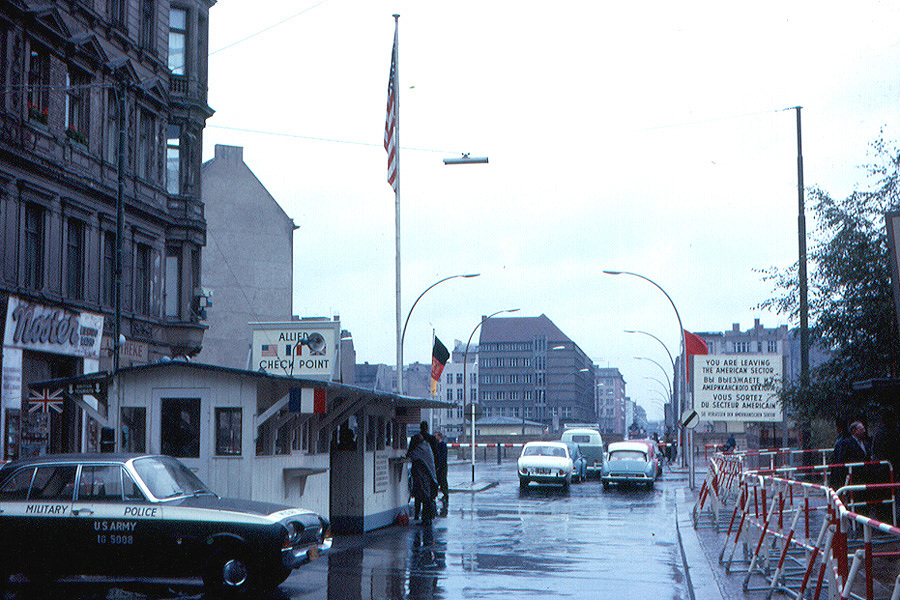
A view of Checkpoint Charlie in 1963, from the American sector
Map of Berlin Wall with location of Checkpoint Charlie

Checkpoint Charlie (or "Checkpoint C") was the Western Bloc's name for the best-known Berlin Wall crossing point between East Berlin and West Berlin during the Cold War (1947–1991),[1] becoming a symbol of the Cold War, representing the separation of East and West.

East German leader Walter Ulbricht agitated and maneuvered to get the Soviet Union's permission to construct the Berlin Wall in 1961 to prevent brain drain, emigration and defection from East Berlin and the wider German Democratic Republic into West Berlin.[2]

Soviet and American tanks briefly faced each other at the location during the Berlin Crisis of 1961. On 26 June 1963, U.S. President John F. Kennedy visited Checkpoint Charlie and looked from a platform onto the Berlin Wall and into East Berlin, the same day he gave his famous Ich bin ein Berliner speech.[3]

After the dissolution of the Eastern Bloc and the reunification of Germany, the American guard house at Checkpoint Charlie became a tourist attraction. It is now located in the Allied Museum in the Dahlem neighborhood of Berlin.52°30′27″N 13°23′25″E / 52.50750°N 13.39028°E / 52.50750; 13.39028

Background

[edit]
Sign at Checkpoint Charlie on the way into West Berlin, as it appeared in 1981

Emigration restrictions, the Inner German border and Berlin

[edit]

Between 1949 and 1961, over 2½ million East Germans fled to the West.[4] The numbers increased during the three years before the Berlin Wall was erected,[4] with 144,000 in 1959, 199,000 in 1960 and 207,000 in the first seven months of 1961 alone.[4][5] The 3.5 million East Germans who had left by 1961 totaled approximately 20% of the entire East German population.[6]

The emigrants tended to be young and well educated,[7] including many professionals — engineers, technicians, physicians, teachers, lawyers and skilled workers.[6] The brain drain became damaging to the political credibility and economic viability of East Germany.[8]

By the early 1950s, the Soviet method of restricting emigration was emulated by most of the rest of the Eastern Bloc, including East Germany.[9] However, in occupied Germany, until 1952, the lines between East Germany and the western occupied zones remained easily crossed in most places.[10] Subsequently, the inner German border between the two German states was closed and a barbed-wire fence erected.

Even after closing of the inner German border officially in 1952,[11] the city sector border in between East Berlin and West Berlin remained considerably more accessible than the rest of the border because it was administered by all four occupying powers,[10] so Berlin became the main route by which East Germans left for the West.[12]

Berlin Wall constructed

[edit]

On 13 August 1961, a barbed-wire barrier that would become the Berlin Wall separating East and West Berlin was erected by the East Germans.[8] Two days later, police and army engineers began to construct a more permanent concrete wall.[13] Along with the wall, the 830-mile (1336 km) zonal border became 3.5 miles (5.6 km) wide on its East German side in some parts of Germany with a tall steel-mesh fence running along a "death strip" bordered by mines, as well as channels of ploughed earth, to slow escapees and more easily reveal their footprints.[14]

Checkpoint

[edit]
Soviet Zone from Checkpoint Charlie observation post, 1982

Checkpoint Charlie was a crossing point in the Berlin Wall located at the junction of Friedrichstraße with Zimmerstraße and Mauerstraße (which for older historical reasons coincidentally means Wall Street). It is in the Friedrichstadt district. Checkpoint Charlie was the only "designated crossing point for foreign tourists and dignitaries and for members of the Allied armed forces",[15] who were not allowed to use the other sector crossing point designated for use by foreigners, the Friedrichstraße railway station.

"The GDR had closed the border in Berlin ten weeks earlier and created a border crossing at the corner of Friedrichstrasse and Zimmerstrasse. It was meant to be used exclusively by Western Allied military personnel, diplomats and people from abroad. The Western Allies protested against this restriction on their freedom of movement, which was guaranteed to them through the city’s four-power status. But eventually they accepted it and set up their own checkpoint on the West Berlin side."[16]

The name Charlie came from the letter C in the NATO phonetic alphabet; similarly for other Allied checkpoints on the Autobahn from the West: Checkpoint Alpha at Helmstedt and its counterpart Checkpoint Bravo at Dreilinden, Wannsee, in the south-west corner of Berlin. The Soviets simply called it the Friedrichstraße Crossing Point (КПП Фридрихштрассе, KPP Fridrikhshtrasse). The East Germans referred officially to Checkpoint Charlie as the Grenzübergangsstelle ("Border Crossing Point") Friedrich-/Zimmerstraße.[citation needed]

As the most visible Berlin Wall checkpoint, Checkpoint Charlie was featured in movies[17] and books. A famous cafe and viewing place for Allied officials, armed forces and visitors alike, Cafe Adler ("Eagle Café"), was situated right on the checkpoint.

The development of the infrastructure around the checkpoint was largely asymmetrical, reflecting the contrary priorities of East German and Western border authorities. During its 28-year active life, East Germany significantly expanded its infrastructure to include not only the wall, watchtowers, and zig-zag barriers, but also a multi-lane shed where guards checked cars and their occupants. Nevertheless, the Allied authority never erected any permanent buildings. A wooden shed, initially used as the guardhouse, was replaced in May 1976 with a larger metal container, now displayed at the Allied Museum in western Berlin. They reasoned that they did not consider the inner Berlin sector boundary an international border and did not treat it as such.[18][19][20]

[edit]

Stand-off between Soviet and U.S. tanks in October 1961

[edit]
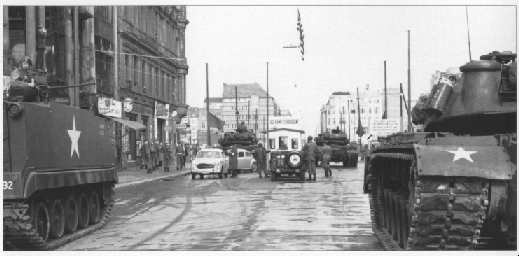
US M48 Patton tanks facing Soviet T-55 tanks at Checkpoint Charlie in October 1961

Soon after the construction of the Berlin Wall in August 1961, a stand-off occurred between US and Soviet tanks on either side of Checkpoint Charlie. It began on 22 October as a dispute over whether East German border guards were authorized to examine the travel documents of a US diplomat based in West Berlin named Allan Lightner heading to East Berlin to watch an opera show.

According to the agreement between all four Allied powers occupying Germany, there was to be free movement for Allied forces in all of Berlin, and no German military forces from either West Germany or East Germany were to be based in the city. The Western Allies also did not initially recognise the East German state and its right to remain in its self-declared capital of East Berlin, and only recognised the authority of the Soviets over East Berlin.

By 27 October, ten Soviet and an equal number of American tanks stood 100 yards apart on either side of the checkpoint. This stand-off ended peacefully on 28 October following a US-Soviet understanding to withdraw tanks and reduce tensions. Discussions between US Attorney General Robert F. Kennedy and Soviet intelligence officer Georgi Bolshakov played a vital role in realizing this tacit agreement.[21]

Early escapes

[edit]

The Berlin Wall was erected with great speed by the East German government in 1961, but there were initially many means of escape that had not been anticipated. For example, Checkpoint Charlie was initially blocked only by a gate, and a citizen of the GDR (East Germany) smashed a car through it to escape, so a strong pole was erected. Another escapee approached the barrier in a convertible, the windscreen removed prior to the event, and slipped under the barrier. This was repeated two weeks later, so the East Germans duly lowered the barrier and added uprights.[22]

Death of Peter Fechter

[edit]
Fechter's body lying next to the Berlin Wall after being shot in 1962 while trying to escape to the West

On 17 August 1962, a teenaged East German, Peter Fechter, was shot in the pelvis by East German guards while trying to escape from East Berlin. His body lay tangled in a barbed wire fence as he bled to death in full view of the world's media. He could not be rescued from West Berlin because he was a few metres inside the Soviet sector. East German border guards were reluctant to approach him for fear of provoking Western soldiers, one of whom had shot an East German border guard just days earlier. More than an hour later, Fechter's body was removed by the East German guards. A spontaneous demonstration formed on the West German side of the checkpoint, protesting against the action of the East and the inaction of the West.[23]

A few days later, a crowd threw stones at Soviet buses driving towards the Soviet War Memorial, located in the Tiergarten in the British sector; the Soviets tried to escort the buses with armoured personnel carriers (APCs). Thereafter, the Soviets were only allowed to cross via the Sandkrug Bridge crossing (which was the nearest to Tiergarten) and were prohibited from bringing APCs. Western units were deployed in the middle of the night in early September with live armaments and vehicles, in order to enforce the ban.[citation needed]

Today

[edit]
On the night of 9 November 1989 when a part of the Wall was opened

Although the wall was opened in November 1989 and the checkpoint booth removed on 22 June 1990,[24] the checkpoint remained an official crossing for foreigners and diplomats until German reunification in October 1990.

Checkpoint Charlie has since become one of Berlin's primary tourist attractions, where some original remnants of the border crossing blend with reconstructed parts, memorial and tourist facilities.

The guard house on the American side was removed in 1990; it is now on display in the open-air museum of the Allied Museum in Berlin-Zehlendorf.[25] A copy of the guard house and the sign that once marked the border crossing was reconstructed later on roughly the same site. It resembles the first guard house erected during 1961, behind a sandbag barrier toward the border. Over the years this was replaced several times by guard houses of different sizes and layouts. The one removed in 1990 was considerably larger than the first one and did not have sandbags.

Tourists used to be able to have their photographs taken for a fee with actors dressed somewhat as Allied military police standing in front of the guard house but Berlin authorities banned the practice in November 2019 stating the actors had been exploiting tourists by demanding money for photos at the attraction.[citation needed]

Former Berlin Wall marker

The course of the former wall and border is now marked in the street with a line of cobblestones.[citation needed] An open-air exhibition was opened during the summer of 2006. Gallery walls along Friedrichstraße and Zimmerstraße give information about escape attempts, how the checkpoint was expanded, and its significance during the Cold War, including the confrontation of Soviet and American tanks in 1961, and an overview of other important memorial sites and museums about the division of Germany and the wall.[citation needed]

Developers demolished the last surviving major original Checkpoint Charlie structure, the East German watchtower, in 2000, to make way for offices and shops. The city tried to save the tower but failed, as it was not classified as a historic landmark,[citation needed] but the development was never realised.

New plans since 2017 for a hotel on the site stirred a professional and political debate about appropriate development of the area. After the final listing of the site as a protected heritage area in 2018, plans were changed towards a more heritage-friendly approach,[26] but the area between Zimmerstraße and Mauerstraße/Schützenstraße remains vacant, providing space for a number of temporary tourist and memorial uses.

BlackBox Cold War Exhibition

[edit]

The "BlackBox Cold War" exhibition has illuminated the division of Germany and Berlin since 2012. The free open-air exhibition offers original Berlin Wall segments and information about the historic site. However, the indoor exhibition (entrance fee required) illustrates Berlin's contemporary history with 16 media stations, a movie theatre and original objects and documents. It is run by the NGO Berliner Forum fuer Geschichte und Gegenwart e.V..[27]

Checkpoint Charlie Museum

[edit]
Checkpoint Charlie Museum

Near the location of the guard house is the Haus am Checkpoint Charlie. The "Mauermuseum - Museum Haus am Checkpoint Charlie" was opened on 14 June 1963[citation needed] in the immediate vicinity of the Berlin Wall. It shows photographs and fragments related to the separation of Germany. The border fortifications and the "assistance of the protecting powers" are illustrated. In addition to photos and documentation of successful escape attempts, the exhibition also showcases escape devices including a hot-air balloon, escape cars, chair lifts, and a mini-submarine.

From October 2004 until July 2005, the Freedom Memorial, consisting of original wall segments and 1,067 commemorative crosses, stood on a leased site.[28][29]

The museum is operated by the Arbeitsgemeinschaft 13. August e. V., a registered association founded by Dr. Rainer Hildebrandt. The director is Alexandra Hildebrandt, the founder's widow. The museum is housed in part in the "House at Checkpoint Charlie" building by architect Peter Eisenman.[citation needed]

With 850,000 visitors in 2007, the Checkpoint Charlie Museum is one of the most visited museums in Berlin and in Germany.[30]

[edit]

Checkpoint Charlie figures in numerous Cold War-era espionage and political novels and films.

Film

[edit]

Checkpoint Charlie is featured in the opening scene of the 1965 film The Spy Who Came in from the Cold (starring Richard Burton and Claire Bloom), based on the John le Carré novel of the same name, which does not use the checkpoint.

James Bond (played by Roger Moore) passed through Checkpoint Charlie in the film Octopussy (1983) from West to East.[31]

The 1985 film Gotcha! includes a scene where the protagonist (Anthony Edwards) transits through Checkpoint Charlie into West Berlin.

In the 2015 film Bridge of Spies, imprisoned American student Frederic Pryor is released at Checkpoint Charlie as part of a deal to trade Pryor and U-2 pilot Francis Gary Powers for convicted Soviet spy Rudolf Abel. Pryor's release happens offscreen while the trade of Powers for Abel takes place at the Glienicke Bridge.

It was depicted in the opening scene of the film The Man from U.N.C.L.E (2015).

Music

[edit]

Elvis Costello mentions Checkpoint Charlie in his hit song "Oliver's Army".[32]

The song Checkpoint Charlie from Steven Van Zandt's 1984 album Voice of America makes a plea for the wall to be torn down.

The 69 Eyes mentions Checkpoint Charlie in their song Feel Berlin, from the album Devils.

Video games

[edit]

Checkpoint Charlie is shown in the Call of Duty: Black Ops map "Berlin Wall". The CIA and Spetsnaz fight each other near Checkpoint Charlie.[33]

Trivia

[edit]

At the border crossing from Hyder in Alaska, USA to Stewart in British Columbia, Canada, there is a humorous imitation of the Checkpoint Charlie sign with the inscription "You are leaving the American Sector" in English, French, and German, as well as a sign reading "Eastern Sektor",[34] as Stewart is located east of Hyder. Hyder is the only place in the USA that can be legally entered without any border control. The sign was erected in 2015 as a protest after the Canadian administration announced plans to close the border control at night.[35]

See also

[edit]

References

[edit]
[edit]
Revisions and contributorsEdit on WikipediaRead on Wikipedia
from Grokipedia
Checkpoint Charlie was the most prominent border crossing between West Berlin's American sector and East Berlin's Soviet sector, operational from 1961 until 1990 as part of the Berlin Wall's control regime designed by the German Democratic Republic to halt mass emigration to the West.[1][2] Named using the NATO phonetic alphabet's "Charlie" for the third Allied checkpoint (after Alpha at Helmstedt-Marienborn and Bravo at Drewitz), it exclusively handled non-German foreigners, diplomats, and Allied forces, distinguishing it from checkpoints for Germans like those at Friedrichstraße or Invalidenstraße.[1] The site epitomized Cold War tensions, most acutely during the October 1961 tank standoff, when U.S. and Soviet armored units positioned cannons mere meters apart for nearly two days following a dispute over access rights for Western diplomats, averting escalation only through backchannel de-escalation ordered by both Kennedy and Khrushchev.[3][4] Though rendered obsolete by the Berlin Wall's breaching on November 9, 1989, Checkpoint Charlie's booth was ceremonially dismantled on June 22, 1990, amid German reunification, leaving its location as a preserved historical marker amid subsequent commercialization.[2][5]

Historical Context of Division

Post-WWII Division of Germany and Berlin

Following the Yalta Conference held from February 4 to 11, 1945, the leaders of the United States, United Kingdom, and Soviet Union agreed to partition Germany into three occupation zones administered respectively by each power, leaving open the addition of a French zone.[6] [7] Berlin, situated approximately 100 miles inside the Soviet zone, was stipulated for joint Allied occupation to ensure unified control over the former Nazi capital.[8] This arrangement reflected wartime compromises but sowed seeds for future friction, as the city's isolation in Soviet-controlled territory granted Moscow leverage to pressure Western access.[9] The Potsdam Conference, convened from July 17 to August 2, 1945, among the United States, United Kingdom, and Soviet Union (with France later incorporated), formalized Germany's division into four zones by reallocating portions of the American and British sectors to France.[10] [11] Berlin's four-sector split mirrored this structure, with each occupying power controlling a distinct area despite the city's encirclement by the Soviet zone; the accords explicitly affirmed Western Allies' rights to unimpeded access via designated highways, railways, and air corridors.[10] These provisions aimed to sustain administrative unity under the Allied Control Council, but deepening ideological rifts—particularly Soviet insistence on heavy reparations from current production—undermined cooperation.[11] Soviet policies in the eastern zone prioritized reparations, involving the systematic dismantling of over 3,000 industrial plants between 1945 and 1948, with machinery, rolling stock, and infrastructure shipped to the USSR to offset war damages estimated at 30% of Soviet national wealth.[12] This extraction, which reduced East Germany's fixed capital by up to 40% in key sectors like machinery and chemicals, stifled reconstruction and perpetuated shortages, fostering systemic inefficiencies under centralized planning.[13] In the Western zones, the introduction of the Deutsche Mark on June 20, 1948, replaced the inflationary Reichsmark at a 10:1 conversion rate for most holdings, slashing black-market premiums from 100% to near parity and igniting a rapid rebound in output, with industrial production doubling by 1949.[14] [15] Such reforms, aligned with market incentives, contrasted sharply with eastern stagnation, accelerating skilled labor migration westward—over 1 million East Germans fled by mid-1949—via Berlin's open sector boundaries, amplifying pressures on Soviet control.[12] These divergences precipitated the Berlin Blockade, launched by Soviet authorities on June 24, 1948, which severed all road, rail, and canal routes to West Berlin, ostensibly to protest the Western currency reform but primarily to coerce Allied withdrawal from the city and consolidate Soviet dominance.[16] [17] The Western response, the Berlin Airlift from June 1948 to May 1949, ferried 2.3 million tons of essentials—including 1.5 million tons of coal—via 278,000 flights to sustain 2 million residents, demonstrating logistical resolve without capitulation.[17] The blockade's failure, lifted on May 12, 1949, exposed the limits of Soviet coercion amid Western economic vitality but entrenched Berlin's status as a Cold War flashpoint, with the enclave's dependence on vulnerable corridors incentivizing future containment measures.[16]

Soviet Imposition of Emigration Controls and the Inner German Border

Following the formal establishment of the German Democratic Republic (GDR) in 1949, open movement across the intra-German border persisted initially, but mass emigration soon ensued as East Germans sought superior economic prospects and freedoms in the Federal Republic of Germany (FRG). Between 1949 and 1961, West German authorities registered over 2.6 million refugees from the GDR, representing roughly 20% of East Germany's population and disproportionately including skilled professionals, engineers, and young adults—exacerbating a severe brain drain.[18] This exodus stemmed primarily from the GDR's centrally planned economy, which stifled productivity through forced collectivization of agriculture starting in the early 1950s, leading to inefficient resource allocation, harvest shortfalls, and chronic food shortages that contrasted sharply with the FRG's postwar Wirtschaftswunder.[19] Political repression by the Ministry for State Security (Stasi), founded in 1950, further alienated citizens via surveillance, arbitrary arrests, and suppression of dissent, driving many to flee before full border fortifications could trap them.[20] To counteract this hemorrhage of human capital and prevent systemic collapse, the Soviet-occupied zone's leadership, under directives influenced by Moscow, imposed stringent emigration controls culminating in the fortification of the Inner German Border in 1952. On May 25, 1952, the GDR's Socialist Unity Party (SED) issued a "police directive for establishing special security arrangements in the border zone," designating a 5-kilometer-wide prohibited Sperrzone along the 1,393-kilometer frontier, enforced by barbed-wire fences, patrol paths, guard towers, and armed border troops.[21] Subsequent enhancements included anti-vehicle ditches, signal fencing, and minefields by the late 1950s, transforming the boundary into a lethal barrier that reduced but did not eliminate crossings—over 200,000 still escaped annually in the mid-1950s via less-secured routes, often toward Berlin. These measures targeted the "Republikflucht" (flight from the republic), which GDR economists quantified as costing billions in lost labor productivity, underscoring the regime's dependence on coerced retention to sustain its socialist model amid industrial lags and consumer goods deficits.[22] GDR propaganda justified these controls as an "anti-fascist protective barrier" against Western "imperialist sabotage," revanchist spies, and economic lures designed to undermine socialism, echoing Soviet narratives that framed the border as a bulwark preserving peace from alleged Nazi remnants in the FRG.[23] In reality, such rhetoric masked the causal failures of Marxist-Leninist policies: collectivization quotas ignored local incentives, yielding persistent agricultural underperformance (e.g., grain yields stagnating at 1950s levels while FRG output doubled), and Stasi files later revealed internal admissions that emigration reflected irrepressible popular rejection of the state's utopian promises.[19] Independent analyses post-reunification confirm the border's role not in defense but in propping up a viably uncompetitive system, where per capita GDP in the GDR trailed the FRG by over 50% by 1960, compelling citizens to "vote with their feet" toward market-driven prosperity.[20]

Construction and Purpose of the Berlin Wall

Events Leading to the Wall's Erection in August 1961

In November 1958, Soviet Premier Nikita Khrushchev issued an ultimatum to the Western Allies, demanding their withdrawal from Berlin within six months and the transformation of West Berlin into a demilitarized "free city," while pressuring recognition of East German sovereignty over access routes.[3] This demand aimed to undermine Allied rights in Berlin established post-World War II, threatening a separate peace treaty with the German Democratic Republic (GDR) that would transfer control to East German authorities.[24] Khrushchev renewed these pressures in 1961, particularly at the Vienna Summit with U.S. President John F. Kennedy in June, where he reiterated demands for a German peace treaty and Allied concessions on Berlin, escalating tensions without achieving agreement.[3] By early 1961, the GDR faced a severe refugee crisis, with monthly escapes to West Berlin exceeding 20,000 by mid-year, driven by economic stagnation and political repression; in July alone, 30,415 East Germans fled, the highest since 1953, threatening the regime's viability.[25] GDR leader Walter Ulbricht repeatedly urged Soviet backing for border closure measures, including in a June 15 public statement demanding West Berlin halt refugee inflows, and in private talks with Khrushchev in early August, where they coordinated logistics to seal East Berlin's sector borders.[26] On August 12, Ulbricht signed an order to implement the closure, framing it as anti-fascist protection but primarily to stem the exodus that had seen over 2.7 million departures from East Germany since 1949.[4] Overnight from August 12 to 13, 1961—known as "Barbed Wire Sunday"—East German forces, numbering around 14,500 troops, erected barbed wire fences and coils along the 155-kilometer border encircling West Berlin, blocking roads, railways, and the S-Bahn subway system that previously allowed unrestricted travel between sectors.[27] This initial barrier instantly separated thousands of families, workers, and commuters, with construction crews working under armed guard to prevent defections, marking the abrupt physical division demanded by Ulbricht and enabled by Khrushchev's ultimatums rather than a mere response to external threats.[3] In the preceding half of August, refugee registrations had already reached 36,800, underscoring the urgency behind the GDR's action to preserve its population and authority.[28]

Strategic Role in Halting Mass Exodus from East Germany

The construction of the Berlin Wall on August 13, 1961, represented a desperate measure by the German Democratic Republic (GDR) to stem the hemorrhage of its population to the West, following the flight of approximately 2.7 million East Germans between 1949 and 1961, many via Berlin's open sector border.[29] This exodus, equivalent to about 20% of the GDR's population, included disproportionate numbers of skilled workers, professionals, and youth, exacerbating labor shortages and undermining the socialist economy's viability.[30] The Wall's erection immediately curtailed legal and semi-legal crossings, reducing successful defections from over 200,000 annually pre-1961 to roughly 5,000 over the subsequent 28 years, despite more than 100,000 attempts.[31][32] To enforce this containment, the GDR evolved its border fortifications across four generations, beginning with barbed-wire fences and concrete posts, progressing to dual concrete slab walls (up to 3.6 meters high by the 1970s), expansive "death strips" cleared of cover and raked for footprints, anti-vehicle trenches, and over 300 watchtowers manned by Volkspolizei (Vopos) border guards.[33] Guards operated under explicit Schießbefehl (shoot-to-kill) orders, requiring them to fire on escapees without warning after a failed verbal challenge, a policy documented in GDR military directives and only formally rescinded in 1989.[34][35] This system, combined with minefields in early variants and automatic firing devices, prioritized deterrence through lethality over mere prevention, reflecting the regime's prioritization of population retention amid systemic economic underperformance. The Wall's efficacy came at a profound human toll, with at least 140 confirmed deaths directly attributable to the Berlin border regime between 1961 and 1989, primarily from shootings, though also drownings in associated waterways or vehicle impacts during pursuits.[32] These fatalities, verified through archival research by German historical commissions post-reunification, underscore the coercive lengths to which the GDR went to suppress emigration, an implicit concession to the uncompetitiveness of its centrally planned economy—evidenced by West Germany's GDP per capita exceeding East Germany's by roughly a factor of two in the 1960s, driven by market incentives absent in the East.[36][37] The barrier's necessity arose from "voting with feet," as citizens rejected socialism's material privations and political repression in favor of Western prosperity, rendering open borders untenable for the regime's survival.[38]

Establishment and Functioning of the Checkpoint

Designation as Checkpoint Charlie for Allied Access

Checkpoint Charlie was designated in August 1961 as the principal border crossing point controlled by Western Allied forces into East Berlin, following the erection of the Berlin Wall on August 13, 1961, to regulate access for military personnel, diplomats, and other non-German foreigners while upholding the Allies' legal rights to the city under postwar agreements.[39] The name derived from the NATO phonetic alphabet, with "Charlie" standing for the letter C as the third designated checkpoint—after Alpha on the Helmstedt autobahn route and Bravo at Drewitz airfield—standardized by NATO in 1956 for clear radiotelephony communication.[40][41] Situated at the intersection of Friedrichstraße and Zimmerstraße in Berlin's Mitte district, the checkpoint faced East German Democratic Republic (GDR) border controls directly across the dividing line, near the elevated U6 line's Friedrichstraße station, which functioned as a sealed "ghost station" for Western transit trains under Soviet oversight.[5][42] This location on a key north-south artery maximized its utility for asserting Western presence amid escalating tensions, without encroaching on civilian East-West family visits handled elsewhere.[43] The initial infrastructure was rudimentary: a prefabricated wooden guard shack, approximately 10 feet by 10 feet, fortified with sandbags and basic barriers to demarcate the American sector's control zone, embodying a deliberate minimalism that projected resolve without provocation.[39][44] U.S. Army personnel manned the post from the outset, with the setup expandable via typewriters and passport stamps but reliant on portable structures to adapt to the fluid crisis.[45] This outpost symbolized the Allies' commitment to freedom of access in Berlin, as guaranteed by the 1944–1945 Yalta and Potsdam protocols, countering Soviet attempts to isolate the Western sectors.[46]

Operational Procedures for Crossings by Diplomats, Military, and Civilians

Checkpoint Charlie served as the designated crossing point for Western Allied military personnel, diplomats, and foreign civilians seeking access to East Berlin, in accordance with post-World War II agreements guaranteeing free movement for Allied forces across Berlin's sectors.[47] East German authorities, operating under Soviet oversight, conducted rigorous passport verifications, vehicle inspections, and personal searches on all entrants, often imposing deliberate delays to assert de facto control despite lacking jurisdiction over Allied personnel under the four-power framework. These procedures applied exclusively to non-East Germans, as ordinary East German citizens were prohibited from crossing westward, with rare exceptions requiring special authorization from GDR officials.[47] To uphold access rights and deter encroachments, U.S. and Allied forces maintained routine patrols and convoys through the checkpoint, including armored elements from the Berlin Brigade such as the 287th Military Police Company, which manned operations and tested unrestricted passage into the Soviet sector.[48] These crossings emphasized compliance with protocols like presenting identification and adhering to speed limits, while soldiers carried briefing materials outlining conduct to preserve diplomatic leverage under the agreements.[49] East German guards, known as Volkspolizei, monitored from guard towers and barriers but refrained from direct interference with military traffic to avoid escalation, though bureaucratic scrutiny persisted for diplomatic and civilian vehicles. Civilian crossings were incidental and tightly regulated, primarily accommodating foreign tourists and divided families under limited diplomatic arrangements. In a notable exception, the December 17, 1963, border-crossing agreement between Berlin's mayoral offices enabled West Berlin residents to obtain one-day passes for visits to relatives in East Berlin, facilitating over 170,000 crossings—many via Checkpoint Charlie—between December 19, 1963, and January 5, 1964.[50][51] These passes required approval from East German authorities and were subject to the same inspections, marking a temporary easing amid economic pressures on the GDR rather than a policy shift.[52] Such allowances remained exceptional, reverting to restrictions barring unauthorized East-West German travel thereafter.[50]

Major Incidents and Confrontations

U.S.-Soviet Tank Standoff in October 1961

The standoff at Checkpoint Charlie escalated on October 27, 1961, when East German border guards attempted to inspect the passport of U.S. diplomat Allan Lightner, the principal officer of the U.S. Mission in Berlin, as he attempted to cross into East Berlin.[24] This action violated established Allied access rights, which did not permit such checks on Western military or diplomatic personnel. In response, U.S. military commander General Lucius D. Clay ordered an armed escort of jeeps and tanks to accompany Lightner on a subsequent crossing, prompting the Soviets to deploy tanks of their own.[46] By midday, ten U.S. M48 Patton tanks faced ten Soviet T-55 tanks across a barricade, positioned approximately 100 yards apart along Friedrichstraße.[53] President John F. Kennedy, briefed on the situation, instructed U.S. forces to respond in kind to any Soviet tank movements, authorizing combat-ready postures including loaded weapons and readiness to fire if fired upon first.[46] The confrontation lasted about 16 hours, with tank crews maintaining high alert amid fears of accidental escalation that could trigger broader conflict.[54] This direct superpower tank face-off tested Western commitment to Berlin's status, as Soviet leader Nikita Khrushchev sought to pressure the Allies over access protocols following the recent erection of the Berlin Wall.[3] De-escalation began that evening through parallel telephone communications between U.S. and Soviet tank commanders, facilitated by a backchannel approved by Kennedy, leading to the simultaneous withdrawal of tanks starting with one Soviet vehicle pulling back, followed by its U.S. counterpart.[55] The incident concluded without shots fired or concessions on access rights, affirming Allied prerogatives and demonstrating that Soviet threats were a bluff rather than intent for immediate military action.[56] This resolution averted crisis escalation while underscoring U.S. resolve against Soviet brinkmanship in divided Berlin.[57]

Escape Attempts and Successful Defections via the Checkpoint

Checkpoint Charlie, designated primarily for Allied military personnel, diplomats, and foreigners, presented limited opportunities for East German civilians to defect legally, as East Berlin authorities tightly controlled exits to prevent emigration. However, the checkpoint became the site of ingenious escape attempts involving deception, modified vehicles, and smuggling, often aided by Western individuals risking arrest or diplomatic incidents. These efforts underscored widespread dissatisfaction with East German socialism, where over 3.5 million had fled to the West before the Wall's construction in 1961, prompting the barrier's erection to stem the exodus. Successful defections via the checkpoint numbered in the dozens, contrasting sharply with the Wall's overall record of approximately 5,000 escapes and over 140 deaths across all methods from 1961 to 1989.[31][58] One early and audacious success occurred on May 5, 1963, when East German Heinz Meixner drove an Austin Healey Sprite convertible through the checkpoint after removing its windshield and deflating the tires to simulate severe damage from an accident. This improvisation prevented guards from inspecting the interior closely or requiring the driver to exit, allowing Meixner to cross undetected into West Berlin. Such vehicle modifications exemplified defectors' resourcefulness, as East German border controls at checkpoints involved meticulous document checks and vehicle searches, but physical alterations could exploit procedural gaps. Western intelligence agencies, including the CIA, occasionally supported similar operations by providing technical advice on hidden compartments or forged credentials for select high-value defectors, though most checkpoint escapes relied on individual initiative rather than organized extraction.[59][60] Smuggling East Germans concealed in vehicle trunks or custom compartments proved another viable tactic, with Western allies playing a crucial facilitative role. For instance, American serviceman Eric Yaw assisted teacher Peter Spitzner and his seven-year-old daughter Peggy in defecting on January 30, 1989, by hiding them in the trunk of his Toyota Corolla despite heat sensors at the crossing; Spitzner's wife had already escaped legally for medical treatment. This marked the last verified family defection via Checkpoint Charlie before the Wall's fall, highlighting how U.S. military presence enabled such risks amid easing tensions. Earlier, groups like seven Humboldt University students were reportedly smuggled westward in multiple vehicle trips through the checkpoint by sympathetic drivers, demonstrating repeated use of the route for low-profile escapes. These cases, often involving forged travel invitations or posing as aides to Westerners, totaled dozens of successes, as documented in exhibits of escape artifacts, though exact figures remain elusive due to secrecy.[39][61][62] The rarity of legal routes for East Germans—requiring special invitations rarely granted—made checkpoint defections emblematic of the regime's coercive emigration controls, where citizens faced imprisonment for attempting flight. Western facilitation, including by U.S. personnel who faced court-martial risks, reflected ideological commitment to individual liberty over East Berlin's collectivist suppression. While most escapes elsewhere involved tunnels or ladders, checkpoint successes via deception affirmed the Wall's porousness at controlled points, fueling propaganda victories for the West and exposing the human cost of division.[58][63]

Border Shootings and the Death of Peter Fechter in 1962

On August 17, 1962, 18-year-old East Berlin masonry apprentice Peter Fechter was shot and left to bleed to death in the border strip adjacent to the Berlin Wall near the Friedrichstrasse/Zimmerstrasse crossing, known in the West as Checkpoint Charlie.[64] Fechter and his colleague Helmut Kulbeik attempted to scale the wall during their lunch break from a nearby construction site, with Kulbeik reaching the Western side while Fechter was struck by gunfire from East German border guards (Volkspolizei or Vopos) as he climbed a ladder.[64] He fell into no-man's land, wounded in the pelvis, and lay there for approximately one hour, calling out "Help! The guards shot me!" before succumbing to blood loss from an estimated 7.62mm bullet wound.[65] East German guards, positioned nearby, neither provided aid nor retrieved his body immediately, adhering to protocols that prohibited assistance to escapees to deter further attempts.[64] This incident exemplified the East German Democratic Republic's (GDR) Schießbefehl policy, which authorized border troops to use lethal force without warning against individuals attempting to cross the inner German border or Berlin Wall, a directive rooted in efforts to stem the exodus of citizens to the West.[32] By 1962, such orders had contributed to dozens of fatalities at the Berlin Wall alone, with guards incentivized through promotions, bonuses, and decorations for preventing escapes, fostering a culture of unaccountable enforcement where hesitation could lead to punishment for the guards themselves.[66] Fechter's death occurred amid heightened border security measures following the Wall's construction in 1961, where Vopos fired a total of 35 rounds during the episode, underscoring the policy's emphasis on deterrence over restraint.[64] Western observers, including U.S. soldiers and West Berlin police stationed at Checkpoint Charlie, photographed Fechter's prone body and the gathering crowd of protesters, images that were disseminated globally and sparked immediate outrage, including chants of "Murderers!" directed at East German forces.[66] Despite diplomatic protests from Western allies, the GDR faced no immediate repercussions, and similar shootings persisted, highlighting the inefficacy of international condemnation in altering the regime's border control practices.[64] Fechter's prolonged agony in plain view amplified anti-communist sentiment worldwide, with his case becoming a poignant symbol of the human cost of the GDR's emigration blockade, though it did not prompt policy changes or accountability for the involved guards at the time.[65]

Dismantling and Immediate Post-Cold War Legacy

Role in the Fall of the Berlin Wall in November 1989

The opening of the Berlin Wall on November 9, 1989, stemmed from the German Democratic Republic's (GDR) deepening economic crisis, characterized by chronic shortages, foreign debt exceeding $20 billion, and industrial inefficiency that left the regime unable to maintain its repressive apparatus without risking total collapse. Peaceful mass protests, peaking at over 300,000 demonstrators in Leipzig by early October, further delegitimized the Socialist Unity Party (SED) leadership, compelling concessions amid Gorbachev's refusal to intervene militarily as in prior suppressions. Checkpoint Charlie, long a focal point of Cold War tensions due to its status as the primary Allied military crossing into East Berlin, became a site of spontaneous breach when crowds, galvanized by Politburo member Günter Schabowski's televised announcement of new travel regulations—misconstrued as permitting immediate unrestricted passage—gathered in the thousands by evening.[67] East German border guards, lacking explicit orders to fire and overwhelmed by the surging numbers demanding exit stamps, began processing and then waiving formalities, allowing the first major influx of East Berliners into the American sector without resistance.[68] This event at Checkpoint Charlie exemplified the regime's cascading failure to enforce borders, as unsustainable central planning and suppressed dissent eroded enforcement capacity, leading to ad hoc openings rather than orchestrated reform. Unlike crossings such as Bornholmer Straße, where guards initially hesitated before yielding under pressure, Checkpoint Charlie saw no shots fired or physical confrontations, attributable to its high-profile location under perpetual Western military and media observation, which amplified the risks of violence for GDR forces already demoralized by internal unrest.[68] By midnight, jubilant East Germans crossed en masse, hammering at barriers and symbolizing the Eastern Bloc's unraveling through economic inviability and popular non-violent insistence on freedom, rather than violent overthrow or Western orchestration.[67] The checkpoint's role underscored how visibility constrained repression, contributing to the Wall's effective nullification within hours across multiple sites.[5]

Relics and Artifacts Preserved from the Original Site

Few physical relics from the original Checkpoint Charlie endure, as the site's infrastructure was largely dismantled following the opening of the Berlin Wall on November 9, 1989, and formal German reunification on October 3, 1990. The principal surviving element is the metal guardhouse employed by U.S. military personnel, installed in the 1980s to supersede an initial wooden structure and operational until its removal on June 22, 1990. This guardhouse was subsequently transported to and displayed at the Allied Museum in Berlin's Zehlendorf district, where it preserves the austere, provisional character of Western Allied border operations.[5][69][70] The multilingual warning sign declaring "You Are Leaving the American Sector" in English, French, and German—erected to alert travelers crossing into Soviet-controlled territory—represents another key artifact, with originals or period exemplars retained in historical collections. Replicas of this sign have been positioned at the former site since the post-reunification era, maintaining visual continuity with the checkpoint's appearance during its active years from 1961 to 1990. Such signage underscored the segmented administration of Berlin under the Four Powers Agreement, serving as a stark reminder of the ideological divide.[71][39] Additional preserved items encompass fragments of concrete barriers, barbed wire entanglements, and uniforms from border guards, dispersed across specialized repositories. These scarce artifacts authenticate the checkpoint's role in regulating crossings amid the East German government's efforts to stem an exodus that saw approximately 3.5 million citizens depart for the West between 1949 and 1961, countering official GDR portrayals of the barrier system as a defensive measure against external aggression rather than internal containment. Their materiality refutes attempts to minimize the Wall's coercive purpose, offering empirical substantiation for the human costs of division.[35][72]

Modern Site as Memorial and Tourist Attraction

Checkpoint Charlie Museum and BlackBox Cold War Exhibition

The Museum Haus am Checkpoint Charlie, established in 1962 by Rainer Hildebrandt four months after the Berlin Wall's erection on August 13, 1961, documents the human efforts to overcome the barrier through dedicated exhibits on escape attempts.[71] Located at the former crossing site, it houses artifacts such as models of subterranean tunnels dug for defections, original tools like reinforced cars and hot-air balloons employed in successful crossings, and photographs detailing over 1,000 recorded escapes from East to West Berlin between 1961 and 1989.[62] These displays underscore the technical and personal risks involved, providing empirical evidence of individual agency against state-enforced division.[73] Complementing the museum, the BlackBox Cold War Exhibition, inaugurated in September 2012 adjacent to the site, offers an interactive exploration of the Berlin Wall's historical context from 1945 to 1990 through 16 media stations with film footage, survivor interviews, and authentic relics like propaganda materials and border surveillance equipment.[74] [75] The exhibition focuses on personal narratives of division, including stories of families separated by the Wall and the covert support networks that aided defectors, fostering visitor engagement with the causal mechanisms of Cold War tensions.[76] Both institutions preserve primary sources and eyewitness accounts that highlight Western facilitation of escapes, such as radio broadcasts encouraging defections and logistical aid from Allied sectors, thereby educating on the Wall's role in suppressing East German mobility while revealing the inefficacy of communist border controls against determined individuals.[77] Annual attendance at the Museum Haus am Checkpoint Charlie exceeds hundreds of thousands, sustaining public awareness of these events amid evolving historical interpretations.[78]

"Ohne Titel" (Untitled) Light Box Installation

In 1998, artist and photographer Frank Thiel installed a light box artwork titled "Ohne Titel" (Untitled) at Checkpoint Charlie. The piece consists of two illuminated, larger-than-life portraits facing each other across the former border line: one of an American soldier (identified as Jeff Harper, a U.S. Army sergeant and tuba player photographed in 1994) gazing toward the former East, and one of a Russian soldier (wearing the post-1991 Russian Federation uniform, identity unknown) gazing toward the former West. The portraits, taken just before the final withdrawal of Allied forces from Berlin, serve as a symbolic representation of the Cold War confrontation at the site, echoing historical events like the 1961 tank standoff. The installation remains a prominent visual element for visitors today, though the portraits have faded over time due to exposure.

Commercialization, Fake Reenactments, and Preservation Challenges

Following German reunification, the Checkpoint Charlie site has undergone significant commercialization, with actors in replica U.S. Army uniforms posing for paid photographs with tourists since at least the mid-2000s.[79] [80] These reenactments, often involving mock passport stamps for additional fees, have been criticized for reducing a symbol of Cold War brinkmanship to kitsch entertainment, thereby eroding the site's inherent solemnity.[81] [79] The surrounding area features dense clusters of souvenir vendors peddling items like faux Soviet hats and Berlin Wall fragments, alongside fast-food establishments such as a McDonald's outlet that opened in December 2009.[82] [83] This proliferation has prompted descriptions of the location as a "Disneyfied" attraction, where commercial imperatives overshadow reflective commemoration of the division's human costs.[84] [85] In response to authenticity erosion complaints, Berlin's public order office enacted a ban on the uniformed actors in November 2019, prohibiting the practice due to tourist exploitation and traffic hazards.[80] [86] The Berlin Wall Foundation has similarly pushed for regulatory measures to integrate the site into a broader memorial network, emphasizing preservation of historical gravity against unchecked vendor encroachments.[87] Despite such interventions, tensions persist between tourism-driven revenue—drawing over 10 million visitors annually—and the dilution of the checkpoint's role as a stark reminder of ideological confrontation.[88]

Controversies in Commemoration and Development

Debates Over Historical Authenticity vs. Tourism Exploitation

Historians and preservationists have criticized the commercialization of Checkpoint Charlie since at least 2008, when Gabriele Gast, former director of the Berlin Historical Museum, described the site as a "tacky tourist trap" due to surrounding souvenir stalls, fast-food vendors, and actors in faux military uniforms charging for photographs, arguing that such elements neglected the site's historical gravity as a symbol of Cold War division.[79] These critiques intensified in the 2010s, with actors posing as Allied soldiers exploiting visitors by demanding payments for staged passport stamps and photos, prompting Berlin authorities to ban the practice in November 2019 to curb tourist exploitation and restore dignity to the location.[80][89] Tensions peaked around urban redevelopment proposals, particularly a 2019 plan for a 3.2-acre site encompassing apartments, commercial spaces, and a new museum, which faced public and expert backlash for potentially overshadowing the original checkpoint replica with high-rise structures and private interests, thereby eroding visual and historical integrity.[82][81] Opponents, including local historians, contended that profit-driven alterations risked commodifying the site's empirical role in documenting East German border regime atrocities, prioritizing economic gain over authentic commemoration of division-era realities.[82] Counterarguments from site advocates, such as Alexandra Hildebrandt, director of the adjacent museum, framed commercialization accusations as a politically motivated tactic by left-leaning critics to relativize the crimes of the Socialist Unity Party (SED) regime, emphasizing the location's function as a testament to Western resolve and capitalism's victory over communism without sanitizing the human costs of the Wall.[90] This perspective underscores a broader causal divide: empirical preservation demands unaltered spatial cues to convey the checkpoint's role in real defections and standoffs, whereas unchecked tourism risks diluting those facts into performative spectacle, as evidenced by the persistence of kitsch vendors despite intermittent regulatory efforts.[79][90]

Urban Redevelopment Proposals and Cultural Memory Conflicts

In the 2010s, urban redevelopment initiatives in Berlin's Mitte district, encompassing areas near Checkpoint Charlie, increasingly emphasized high-density residential and commercial construction to capitalize on the city's post-reunification economic momentum, yet these plans ignited tensions with advocates for historical preservation who viewed the site as an irreplaceable emblem of Cold War division and the human costs of authoritarian border controls.[82] Preservationists contended that unchecked vertical development risked encasing the checkpoint's remnants in a modern skyline, thereby diminishing its visceral function as a cautionary artifact against ideological barriers and state repression, drawing parallels to heritage protection standards akin to those applied by international bodies for sites of collective trauma.[87] A pivotal flashpoint emerged in June 2019 when the Berlin Senate unveiled a comprehensive redevelopment scheme for a 3.2-acre parcel at the intersection of Friedrichstraße and Zimmerstraße, proposing a public square, enhanced Cold War museum, residential apartments, and commercial facilities to replace the area's longstanding clutter of souvenir vendors and makeshift exhibits.[82] Critics, including historians and memorial foundations, decried the inclusion of profit-oriented elements as a concession to developers that could erode the site's authenticity, arguing that economic rationales should not supersede the imperative to maintain an unaltered spatial narrative of confrontation and escape.[91] Following public consultations, the plan advanced in December 2019 with modifications prioritizing a dignified remembrance space, though debates persisted over whether such hybrid models adequately honored the checkpoint's legacy without succumbing to gentrification pressures.[92] Into the 2020s, conflicts intensified as the Berlin Wall Foundation pushed for a "Forum Checkpoint Charlie" straddling the historic crossing, envisioned as an educational hub reinforcing the Berlin Wall's role as a stark relic of failed collectivism, directly countering developer interests in maximizing land value through mixed-use towers.[93] In October 2022, the Senate's acquisition of two key plots flanking Friedrichstraße for a dedicated memorial and plaza signaled a tilt toward preservation, aiming to integrate urban vitality with uncompromised historical fidelity amid rising property demands.[94] These frictions underscore broader causal tensions: while tourism to Checkpoint Charlie—estimated at 850,000 visitors annually pre-2020—plummeted during the COVID-19 lockdowns before rebounding alongside Berlin's 13.5 million citywide visitors in 2024, affirming the site's economic pull, proponents of cultural memory insist that redevelopment must prioritize evidentiary integrity over revenue to avert sanitization of the era's stark lessons in freedom's fragility.[95][96]

Symbolism and Cultural Representations

Iconic Status in Cold War History and Western Resolve

The tank standoff at Checkpoint Charlie on October 27–28, 1961, epitomized U.S. deterrence against Soviet attempts to assert dominance in Berlin. Following East German restrictions on Allied access, ten American M48 Patton tanks positioned themselves opposite ten Soviet T-55 tanks across the checkpoint, creating a 16-hour face-off at point-blank range.[46] [97] This confrontation arose amid the broader Berlin Crisis, where Soviet Premier Nikita Khrushchev sought to challenge Western rights in the city, but U.S. resolve under President John F. Kennedy matched the escalation without retreat.[3] The crisis resolved casualty-free when Soviet tanks withdrew first on the morning of October 28, followed shortly by U.S. forces, through back-channel communications that preserved both sides' positions.[46] [98] This outcome validated a deterrence strategy rooted in demonstrable military strength, compelling de-escalation without concessions and preventing Soviet consolidation of control over West Berlin.[46] Unlike earlier appeasement perceptions, the standoff affirmed that firm posture could check aggression short of war, aligning with principles later formalized as "peace through strength" by emphasizing credible threats over negotiation alone.[46] Checkpoint Charlie's legacy endures as a symbol of Western commitment to counter totalitarianism, underscoring the Iron Curtain's fragility when confronted by unified resolve. The visible American presence at the checkpoint reinforced Allied guarantees, deterring further encroachments and contributing to the sustained ideological pressure on communist regimes across Eastern Europe.[1] Empirical evidence from the era shows such displays of strength eroded Soviet confidence in coercive tactics, fostering internal dissent that accelerated the USSR's dissolution in 1991 by exposing the limits of force against determined opposition.[99] Checkpoint Charlie frequently appears in Cold War espionage fiction as a site of high-stakes border crossings, symbolizing the Iron Curtain's divide and the human cost of communist repression. The 1965 film The Spy Who Came in from the Cold, adapted from John le Carré's novel and directed by Martin Ritt, opens with a dramatic escape attempt at the checkpoint, where a British agent is shot while aiding a defector, setting a tone of moral ambiguity amid East German surveillance brutality. This depiction draws on real risks documented in declassified intelligence reports, contrasting the West's relative freedoms with the East's coercive apparatus, though le Carré's narrative has been critiqued for injecting leftist skepticism toward Western intelligence motives.[100] Similarly, Billy Wilder's One, Two, Three (1961) incorporates Checkpoint Charlie intrigue in a satirical take on defection schemes, portraying the East's absurdity through a Coca-Cola executive's frantic efforts to smuggle a bride across amid Soviet inefficiencies.[101] In literature, le Carré's original 1963 novel The Spy Who Came in from the Cold establishes Checkpoint Charlie as a narrative fulcrum for themes of betrayal and escape, with the protagonist navigating the checkpoint's guarded barrier to orchestrate operations against the Stasi-like security state. The checkpoint recurs in spy thrillers like Len Deighton's Funeral in Berlin (1964), where agent Harry Palmer facilitates a high-ranking defection, reflecting documented cases of East German officials fleeing to the West due to regime disillusionment. These works, grounded in firsthand accounts from defectors, counter revisionist portrayals that minimize Eastern Bloc oppression by emphasizing the checkpoint's role in thousands of verified escape attempts prior to and despite the Berlin Wall's erection on August 13, 1961. Later media extends this symbolism into action and gaming. The James Bond film Octopussy (1983) features 007 crossing Checkpoint Charlie into East Berlin to thwart a smuggling plot, blending thriller elements with the site's historical tension during a period when over 190 people died attempting Wall crossings.[102] In video games, Call of Duty: Black Ops Cold War's 2021 Zombies map "Mauer der Toten" reimagines Checkpoint Charlie as a zombie-infested outbreak zone near the death strip, incorporating authentic details like guard huts and barricades to evoke Cold War paranoia.[103] Such representations, while fictionalized, align with empirical records of the site's lethality—evidenced by incidents like the 1962 shooting of Peter Fechter—over leftist cultural narratives that occasionally romanticize the GDR as a "misunderstood" workers' state, ignoring the causal link between central planning failures and mass emigration pressures.[104]

References

User Avatar
No comments yet.