Hubbry Logo
Chinese musical notationChinese musical notationMain
Open search
Chinese musical notation
Community hub
Chinese musical notation
logo
8 pages, 0 posts
0 subscribers
Be the first to start a discussion here.
Chinese musical notation
from Wikipedia

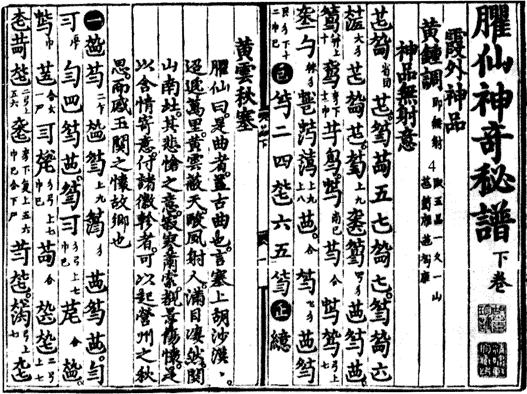
Chinese Guqin notation, 1425

Systems of musical notation have been in use in China for over two thousand years. Different systems have been used to record music for bells and for the Guqin stringed instrument. More recently a system of numbered notes (Jianpu) has been used, with resemblances to Western notations.

Ancient

[edit]

The earliest known examples of text referring to music in China are inscriptions on musical instruments found in the Tomb of Marquis Yi of Zeng (d. 433 B.C.). Sets of 41 chime stones and 65 bells bore lengthy inscriptions concerning pitches, scales, and transposition. The bells still sound the pitches that their inscriptions refer to. Although no notated musical compositions were found, the inscriptions indicate that the system was sufficiently advanced to allow for musical notation. Two systems of pitch nomenclature existed, one for relative pitch and one for absolute pitch. For relative pitch, a solmization system was used.[1]

Guqin notations

[edit]

The earliest music notation discovered is a piece of guqin music named Jieshi Diao Youlan (碣石調·幽蘭) during the 6th or 7th century. The notation is named "Wenzi Pu", meaning "written notation".

The Tang manuscript, Jieshidiao Youlan (碣石調·幽蘭)

The tablature of the guqin is unique and complex. The older form is composed of written words describing how to play a melody step-by-step using the plain language of the time, i.e. descriptive notation (Classical Chinese). The early pieces of music are all written by words to explicitly explain the fingerings. Later on, to simplify the method of recording, "Jianzi Pu", which means "abbreviated character" notation, is invented in the late Tang dynasty by Cao Rou (曹柔), a famous Guqin player.

This newer form of guqin notation is composed of bits of Chinese characters put together to indicate the method of play is called prescriptive notation. Rhythm is only vaguely indicated in terms of phrasing. It is used to record fingering actions and string orders, without recording the pitch and tempo, thus make the piece look simpler and give more flexibility to guqin players.

Tabulatures for the qin are collected in what is called qinpu.

Gongche notation

[edit]

Gongche notation, dating from the Tang dynasty, used Chinese characters for the names of the scale.

Octave positions are sometimes shown by the addition of an affix or small mark. A chromatic scale could be produced from this by the use of the prefixes gao- (high) to raise a note, or xia- (low) to lower it, by a semitone; but after the 11th century, gao- ceased to be used.[2]

Traditionally, the Gongche notation was written vertically from right to left, but horizontally is also accepted nowadays.

Additionally, this system was also introduced to Korea, aka gong jeok bo in ancient music, and also Kunkunshi, a Ryukyuan musical notation still in use for sanshin.[3]

Jianpu (numbered musical notation)

[edit]

The Jianpu system uses numbers to notate music. It is common in East Asia, including Myanmar (Burma), Japan, Mainland China and Taiwan.

The notation was invented by Enlightenment thinker Jean-Jacques Rousseau in 1742.[2] It had gained widespread acceptance by 1900.[citation needed] It uses a movable do system, with the scale degrees 1, 2, 3, 4, 5, 6, 7 standing for do, re, mi, fa, sol, la, si, while rests are shown as a 0. Dots above or below a numeral indicate the octave of the note it represents. Key signatures, barlines, and time signatures are also employed. Many symbols from Western standard notation, such as bar lines, time signatures, accidentals, tie and slur, and the expression markings are also used. The number of dashes following a numeral represents the number of crotchets (quarter notes) by which the note extends.

Note C D E F G A B
Solfege do re mi fa sol la si
Number 1 2 3 4 5 6 7

The table above shows how the numbers represent the note respectively. The Jianpu uses dots above or below the number to show its octave. They also represent the number of octaves. For example, a dot below the number "6" is an octave lower than "6". It also uses dashes (–) to represent the note length.

References

[edit]
Revisions and contributorsEdit on WikipediaRead on Wikipedia
from Grokipedia
Chinese musical notation encompasses a variety of traditional and modern systems developed over more than a millennium to record pitches, rhythms, and performance techniques for Chinese instruments and ensembles, distinct from Western staff notation in its emphasis on flexibility, cultural transmission, and instrument-specific instructions. The earliest systematic notations emerged during the Tang Dynasty (618–907 CE), building on ancient pitch standards like the (律) system from the Zhou and Han periods, which defined 12 tones using bamboo pipes and mathematical ratios for ritual music. One of the oldest and most influential systems is gongchepu (工尺谱), originating in the Sui and Tang eras and maturing in the Ming (1368–1644) and Qing (1644–1912) dynasties, which uses Chinese characters—such as 上 for "do," 尺 for "re," and 工 for "mi"—to denote pitches in a vertical format, often leaving rhythm and ornamentation to performers' improvisation for use in opera, folk, and orchestral music. In contrast, jianzipu (减字谱), a tablature system for the guqin (ancient seven-string zither), was formalized in the Tang Dynasty by scholar Cao Rou, employing abbreviated characters to specify string numbers, finger positions, and techniques like plucking or pressing, preserving over 1,000 pieces of solo repertoire that embody Confucian aesthetics and philosophical depth. In the modern era, jianpu (简谱), or , gained prominence in the late 19th and early 20th centuries as a simplified alternative to gongchepu, assigning 1 through 7 to the (e.g., 1 for "do," 2 for "re"), with dots for octaves and lines for durations, making it accessible for , folk songs, and contemporary compositions in Chinese schools and orchestras. These systems highlight China's pentatonic foundation and oral traditions, evolving alongside instruments classified in the ancient bayin (八音) categories—based on materials like , bamboo, and metal—while adapting to global influences without fully adopting Western five-line staff notation. Today, hybrid uses persist, with digital tools aiding preservation of ancient scores.

Historical Background

Early Origins

The earliest evidence of Chinese musical notation emerges from archaeological discoveries dating to the (475–221 BCE), particularly the of Marquis Yi of Zeng, excavated in 1978 near Suizhou, Province, and dated to approximately 433 BCE. This tomb yielded an extraordinary ensemble of musical instruments, including a set of 65 tuned bronze bells (bianzhong) and 32 stone chimes (bianqing), which together represent the most complete surviving example of ancient Chinese court music apparatus. The instruments bear extensive inscriptions—totaling 3,755 characters, many inlaid with gold—that detail tuning specifications, pitch relationships, and performance guidelines, marking the inception of systematic notation in Chinese music history. These inscriptions primarily denote absolute and relative pitches using specialized terminology derived from bell names, with "huangzhong" (yellow bell) serving as the foundational standard pitch, corresponding to a low tone often equated to modern G♯ or A♭. The notations employ characters and numerical indicators to specify intervals within a 12-tone chromatic framework, though the underlying structure implies a organized into modes (e.g., equivalents to do-re-mi-sol-la in Western , such as huangzhong, taicu, guxi, and wuyi). For instance, each bell and chime is labeled with its primary and secondary tones—produced by striking different parts of the instrument—along with references to regional tuning standards from states like , , and Zhou, facilitating precise calibration during ensemble play. This system prioritized harmonic consonance and modal variety, reflecting the theoretical foundations of early Chinese music as outlined in later texts but evidenced here archaeologically. In the context of Warring States ritual music, these notations functioned not as portable scores for composition but as practical engravings for instrument construction, tuning, and ritual performance, ensuring uniformity in ceremonial ensembles that accompanied state sacrifices and ancestral worship. The bells and chimes, arranged in graduated sets on wooden frames, were struck in sequence to produce layered harmonies, with inscriptions guiding musicians on pitch placement and modal shifts to evoke cosmic order and political legitimacy. This inscription-based approach laid the groundwork for later formalized notations during the Han dynasty and beyond.

Evolution Through Dynasties

During the (206 BCE–220 CE), the establishment of the Yuefu Music Bureau in 120 BCE represented a major advancement in musical documentation, as it systematically collected folk songs and whose metrical structures implied rhythmic notations for accompaniment and performance. These Yuefu compositions, often chanted with music, preserved oral traditions in written form and emphasized rhythmic patterns tied to poetic lines. Complementing this, bamboo slips from the period, including examples from Han sites, describe ensemble scales based on the pentatonic system, offering early textual insights into coordinated group music for rituals and . In the subsequent Wei, Jin, and Southern and Northern dynasties (220–589 CE), musical theory shifted toward more abstract and systematic explorations, with texts emphasizing cyclical pitch systems derived from the 12 lü pipes, using mathematical ratios to approximate a chromatic scale and enable mode rotations. This period's theoretical works built on Han foundations by detailing how the lü pipes—starting from the foundational huangzhong pitch—generated a full chromatic cycle through proportional length adjustments, allowing for versatile ensemble tuning. The integration of Buddhism during these dynasties further enriched theory by introducing ritual elements that adapted cyclical systems to new devotional contexts. The Sui and early Tang dynasties (581–907 CE) achieved greater institutionalization of musical notation within court rituals, standardizing symbols for the core modes—, shang, zhi, and yu—to guide large ensembles in performances of ritual . These notations, often comprising simple ideographic symbols indicating pitch and mode, ensured uniformity across imperial ceremonies involving dozens of musicians on wind, string, and percussion instruments. A key development was the influence of and foreign exchanges via the , which introduced exotic scales and timbres documented in foundational texts like the Yueji chapter of the Liji, providing cosmological justification for blending them with indigenous systems.

Guqin Notation

Principles and Symbols

Guqin notation employs a specialized system tailored to the seven-stringed , prioritizing prescriptive instructions for fingering, string selection, and performance techniques over fixed pitches or rhythms. This approach distinguishes it from staff-based systems, focusing instead on guiding the player's physical interaction with the instrument to produce idiomatic sounds. The notation evolved historically from wenzi pu, a verbose descriptive form using full to detail actions, which emerged in the 6th to 7th centuries during the Sui and early Tang dynasties, to jianzi pu, a streamlined variant developed in the late (around the 8th-9th centuries) by figures such as Cao Rou. Wenzi pu relied on lengthy textual explanations for each note, while jianzi pu condensed these into composite characters, enhancing readability and portability for solo performance. In jianzi pu, the core symbol for each note is a numeric indicator for the string, numbered 1 through 7 from the thickest (lowest pitch) to the thinnest (highest pitch), often combined with characters specifying the left-hand finger position relative to the instrument's 13 hui (position markers). For instance, the left-hand component might include a finger identifier (e.g., symbols derived from "thumb" or "ring finger") followed by a hui number, such as the 7th hui on the 1st string, forming a ligature like a modified Chinese character. Right-hand techniques are denoted by affixes or surrounding radicals, drawing from a set of approximately 18 basic symbols for plucking actions, including gou (hook, downward stroke with thumb), ti (upward flick with index), mo (downward stroke with index), and pi (split, outward thumb motion). Harmonics are indicated by encircling the string number or using a dedicated symbol like fan (overtone), while slides and presses incorporate directional radicals. These elements cluster vertically or horizontally to form compact, readable notation. Pitch in guqin notation is relative, defined within modal frameworks rather than absolute frequencies, allowing flexibility in tuning while maintaining intervallic relationships central to Chinese music theory. Modes such as (starting on the open 1st string as the tonic) or shang (emphasizing the 2nd string) guide the perceptual hierarchy, with the (e.g., 5-6-1-2-3-5-6 in solfege) producing pentatonic structures across the strings. This contrasts with notations for instruments like bianzhong bells, which often specify fixed pitches via gongche symbols. Rhythm and duration are not rigidly quantified in traditional jianzi pu, leaving interpretation to the performer based on ; however, relative lengths may be suggested through horizontal lines or spacing between symbols, with longer lines implying sustained notes. Ornamentation, including (yinyin) and trills, is conveyed via auxiliary symbols or repeated radicals, while sectional is marked by descriptive affixes such as man (slow) or kuai (fast), often appearing at the piece's outset or transitions.
CategoryKey Symbols/ExamplesMeaning
Strings1–7 (numeric characters)String selection, 1 (lowest) to 7 (highest)
Left-Hand Positions徽 (hui) + number (e.g., 七徽 for 7th hui); finger radicals (e.g., 拇 for thumb)Pressing location relative to hui markers
Right-Hand Techniques勾 (gou), 挑 (ti), 抹 (mo), 剔 (te)Plucking directions and manners (e.g., hook, flick, wipe, pick)
Harmonics/OpenCircle around number or 泛 (fan)Open string or production
Tempo Affixes慢 (man), 快 (kuai)Slow or fast pace indicators
This table illustrates primary symbol categories, emphasizing the notation's efficiency in encoding technique over metric precision.

Historical Examples

One of the earliest surviving examples of notation is the score for Jieshi Diao Youlan (碣石調·幽蘭, "Solitary Orchid in the Jieshi Mode"), originating from the in the CE and preserved in a manuscript now held by the . This piece, traditionally attributed to the scholar Qiu Ming (493–590 CE) during the , employs the ancient wenzi pu (文字譜, "written notation") system, which uses descriptive to specify techniques such as right-hand plucking (bo 擘 for outward stroke and tiao 挑 for inward flick) on particular strings and left-hand s (fan yin 泛音) at specific positions along the instrument's 13 hui (徽, studs). For instance, a typical excerpt might read "乙十一" (yi shi yi), indicating a sounded by lightly touching the 11th hui on the second string while plucking, producing a resonant, ethereal tone that evokes the melody's contemplative mood. This notation not only captures the piece's structure but also its poetic essence, drawing from Cao Zhi's ancient verse to symbolize isolation and . A pivotal anthology illustrating the evolution of guqin notation is Shen Qi Mi Pu (神奇秘譜, "Wondrous and Secret Score"), compiled in 1425 CE during the Ming dynasty by Prince Zhu Quan (1378–1448). This collection features 64 pieces, many composed or arranged by Zhu himself, and demonstrates the transition to more concise jianzi pu (減字譜, "reduced character notation"), where abbreviated symbols layer instructions for rhythm—often implied through repetition and grouping—mood via tuning modes (diao 調), and expressive effects like the "dragon chant" (long yin 龍吟), rendered with trilling harmonics and sliding tones symbolized by characters such as "龍" combined with position markers. Pieces like Gaoshan (高山, "High Mountains") showcase these elements, with notations guiding performers to create cascading arpeggios that mimic flowing water and towering peaks, blending technical precision with emotional depth. Zhu Quan's Shen Qi Mi Pu marked a key standardization of notation in the early , refining approximately 19 core symbols for right-hand techniques (such as mo 抹 for inward stroke and gua 刮 for scraping) that became foundational for later handbooks and influenced publications like Wuyin Qinpu (無射琴譜, 1722). This codification facilitated wider dissemination among literati, ensuring consistency across regions and generations. Guqin notation has been instrumental in preserving the refined music of Chinese literati , safeguarding aesthetic ideals of subtlety and introspection against oral transmission's fragility; by the , over 1,000 unique pieces had been documented in various handbooks, forming a vast repertoire that reflects philosophical and poetic traditions.

Gongche Notation

Structure and Usage

Gongche notation employs a system of Chinese characters to denote pitches within the traditional , primarily using characters such as 工 (gōng) for the first degree (do), 尺 (chě) for the second (re), 上 (shàng) for the third (mi), 凡 (fán) for the fifth (sol), 六 (liù) for the sixth (la), and 五 (wǔ) for the seventh (ti) in extended scales. These characters cycle to represent higher or lower pitches, with dots placed above or below them to indicate — a single dot for one octave above or below the central range, and multiple dots for further extensions. Additional symbols like 上 and 乙 extend for higher octaves. Rhythmic values are marked by horizontal lines or flags attached to the characters, where longer lines signify sustained notes and shorter ones indicate quicker durations, though exact interpretations can vary by regional practice; circles or other introductory symbols often denote beats and tempo. This character-based approach allows for a compact, vertical writing style that aligns with script, facilitating its use in ensemble scores. The notation originated during the (618–907 CE) as a simplified system for transcribing music in court ensembles, evolving from earlier informal notations used in banquet and ritual music. Over subsequent dynasties, it incorporated additional symbols for to accommodate hexatonic or heptatonic scales, such as "pan" (攀), which raises the fourth degree to create a sharpened fa in certain modes. This development enabled greater expressive range while maintaining the pentatonic foundation, making it suitable for both fixed-pitch instruments and modal variations in imperial performances. In traditions, integrates directly with lyrics, where characters are inscribed alongside or above the text to guide pitch and rhythm, often specifying the starting mode (e.g., mode) and through introductory symbols like circles for beats. For instance, in opera scores such as those from "," the notation aligns melodic lines with poetic verses, allowing singers to follow the undulating contours that evoke natural imagery while adhering to the specified rhythmic structure. A defining feature of gongche notation is its cyclical design, where the sequence of characters shifts relative to the tonic to denote key or mode changes, functioning as a movable-do system that adapts to different pentatonic starting points without fixed pitch assignments. This contrasts with Western , which assigns consistent syllables to absolute pitches, enabling gongche to emphasize modal flexibility and contextual interpretation in .
CharacterPinyinScale Degree (Movable-Do)Example Pitch Correspondence
gōng1 (do)C
chě2 (re)D
shàng3 (mi)E
fán5 (sol)G
liù6 (la)A
7 (ti)B
Note: For pentatonic focus, fa (4) is often omitted or altered via accidentals like pan (攀); higher octaves use repeated or extended characters like 乙 (yǐ) for high ti.

Regional Variations

In Korea, gongche notation was adapted for chongak court music during the Joseon Dynasty, particularly from the 15th century onward, influencing the notation for instruments like the gayageum. This adaptation culminated in the jeongganbo system, developed under King Sejong in 1447, which incorporated gongche-derived characters for pitches within a grid-based mensural framework to precisely denote rhythm and harmony in ensemble pieces such as those for the pungryu gayageum. Examples from Joseon court scores, like those in the Akhak gwebeom, demonstrate this system's use in formal performances, blending Chinese pitch symbols with Korean temporal organization. In the , now , gongche notation evolved into the kunkunshi system by the 18th century, tailored for the sanshin lute and integrated into kumiodori theater traditions. This adaptation used to indicate finger positions on the sanshin rather than absolute pitches, with early collections like the Yakabi Kunkunshi (1775) providing scores for accompaniments that emphasized melodic flow over strict . By the early , as seen in the Chinen Kunkunshi (1804), the system incorporated additional symbols for ensemble elements, reflecting cultural exchanges with while suiting local theatrical genres. Within , regional variations of gongche notation appeared in opera traditions, particularly , where 19th-century scores introduced specialized rhythmic marks such as downward slashes extending note characters to denote lower octaves and faster tempos. These modifications, evident in late handwritten manuscripts, allowed for nuanced expression in vocal and instrumental parts, with slashes and dots indicating beat subdivisions to accommodate the genre's intricate pacing. Such adaptations built on the foundational gongche of pitch-representing characters while enhancing rhythmic clarity for . Gongche notation experienced a significant decline in the , largely supplanted by jianpu and Western staff systems amid modernization efforts, but saw revival in heritage performances starting in the post-1980s cultural preservation movement. This resurgence, supported by institutions documenting traditional repertoires, has integrated gongche into contemporary stagings of regional musics like Naxi dongjing ensembles and revivals, ensuring its transmission through oral and written practices.

Jianpu Notation

Fundamentals

Jianpu, also known as or simplified notation (jiǎnpǔ, 简谱), originated from European developments in the 18th and 19th centuries before being adapted in . The system traces its roots to a proposal by French philosopher and composer in 1742, who suggested using numbers to represent musical pitches for easier learning. This idea evolved into the more structured Galin-Paris-Chevé method in the early 19th century, a sight-singing system first published by Pierre Galin in 1818, which emphasized numerical representation of scale degrees. Introduced to in the early via Japanese influences—stemming from American educator Luther Whiting Mason's adaptations in since the 1880s—jianpu was popularized by reformers such as Li Shutong, who incorporated it into school songs and around 1912, facilitating the shift from traditional during 's musical modernization. At its core, jianpu represents pitches using the numbers 1 through 7, corresponding to the syllables do, re, mi, fa, sol, la, and si (or ), respectively, within a given key. These numbers denote relative scale degrees rather than fixed pitches, allowing the notation to adapt flexibly to different tonalities. Octaves are indicated by dots: a dot below a number lowers it by one (e.g., .1 for the do an below middle do), while a dot above raises it (e.g., 1̇ for the do an higher). Note durations are marked by horizontal lines or dashes: a plain number without lines represents a (one beat), a single underline denotes an (half a beat), two underlines a (quarter beat), and additional horizontal dashes after a number extend its duration by full beats (e.g., 1- for a ). Rests are shown with a 0, modified similarly for length. Keys and modes in jianpu are specified at the beginning of a score by indicating the pitch for "1" (e.g., 1=D for D major, where 1 is D), enabling quick adjustments for transposition without altering the numbers themselves—a feature that enhances its utility for ensemble playing and teaching. Accidentals are applied using standard symbols like # (sharp) or b (flat) placed before the affected number (e.g., #4 for fi), temporarily altering the pitch within the scale. This numerical solfège-based approach is particularly compatible with pentatonic scales prevalent in Chinese music, where the primary notes often align with 1, 2, 3, 5, and 6 (do, re, mi, sol, la), omitting fa and si for a five-tone structure; transposition remains straightforward by simply redefining the starting pitch for 1, preserving the relative intervals and cultural idioms without rewriting the score.

Modern Applications

Jianpu notation underwent significant standardization in during the early , with its adoption accelerating in the 1920s as it replaced the older gongchepu system, facilitated by major publishers such as the Commercial Press. By the mid-20th century, jianpu became integrated into formal and performance practices, often in hybrid forms combining it with Western staff notation for orchestral settings. This evolution positioned jianpu as a core component of curricula, where it remains a mandatory element through high school, emphasizing its role in teaching folk songs and promoting nationalistic musical identity. In military and community bands, jianpu served as the primary system by the 1950s, enabling efficient ensemble playing in educational and ceremonial contexts across . In popular and film music, jianpu has been extensively applied since the late 20th century, particularly in during its golden era of the , where it facilitated quick transcription and performance of melodic lines. For instance, songs by iconic artists like , such as "Tears as Light Rain" (1970), were notated in jianpu and remain staples in amateur and professional repertoires, influencing hybrid scoring that layers numerical notation over staff for harmony in film soundtracks. This approach extended to large-scale compositions, including themes for national events, where jianpu's simplicity allowed for broad accessibility while accommodating complex arrangements in multimedia productions. Digital integration has further expanded jianpu's applications since the 2000s, with software tools enabling its generation, editing, and conversion for contemporary use. Plugins for notation programs like , such as the Jianpu Numbered Notation extension, allow users to output jianpu scores directly from Western staff inputs, supporting composition and playback in educational settings. Specialized apps for instruments like the , including NoteAbility Pro and EOP NMN Master, facilitate learning by converting traditional to numerical formats, providing interactive tutorials and playback for beginners. These tools have democratized access, enabling users to create and share jianpu-based arrangements via mobile platforms. A key trend in jianpu's modern role is its global dissemination through Chinese diaspora communities, where it serves as a unifying standard for preserving and performing across borders. In places like , jianpu underpins amateur ensembles, brass bands, and opera troupes, with over 40 active musicians in groups like the Chinatown Music Ensemble relying on it for transnational repertoires as of the late . In worldwide, including Mandarin immersion programs, jianpu is increasingly adopted for its intuitive numerical structure, fostering cultural continuity among younger generations in the .

Comparisons and Influences

Differences from Western Notation

Chinese musical notations, such as gongche, jianpu, and tablature, differ fundamentally from Western staff notation in their approach to pitch representation, employing relative and modal systems rather than absolute fixed pitches. In , characters like 合 (hé), 尺 (chě), and 工 (gōng) denote scale degrees within a cyclical mode, allowing performers to interpret pitches relative to a tonal center, which facilitates easy transposition across keys without altering the symbols. Jianpu, or numbered notation, similarly uses digits 1 through 7 to represent solfege degrees (e.g., 1 for "do"), with octave shifts indicated by dots above or below, emphasizing a movable "do" system that simplifies adaptation to different modes or instruments. In contrast, Western staff notation fixes pitches on a five-line staff using clefs and lines, providing precise vertical positioning that reflects absolute pitch heights but requires adjustments like key signatures for transposition. tablature (jianzipu) further diverges by specifying finger positions and string numbers rather than pitches, aligning with the instrument's modal framework where exact intonation varies by performer intent. Rhythm and duration in Chinese notations prioritize interpretive flexibility through symbolic markers, unlike the precise, mensural structure of Western staff systems. Gongche employs minimal rhythmic indicators, such as lines or dots, relying heavily on and performer to determine timing, which allows for expressive variations in and phrasing. Jianpu denotes durations with underlines (e.g., a single line under a number for an ) or dots for extensions, but these serve as guidelines rather than rigid measures, fostering a fluid performance style. tablature is non-mensural, omitting explicit time signatures and note values to encourage rhythmic freedom that enhances the music's meditative quality. Western notation, however, uses standardized stems, flags, beams, and note head shapes to define exact durations (e.g., quarter notes with stems), enforcing metrical accuracy that supports complex but limits personal expression. A key distinction lies in instrument specificity, where Chinese notations like tablature function as detailed guides for physical actions tailored to particular instruments, contrasting with the Western staff's abstract universality. jianzipu includes over 200 symbols for techniques such as plucking, sliding, and harmonics, directly instructing hand positions on the qin's seven strings to produce specific , making it inseparable from the instrument's mechanics. Gongche and jianpu, while more general, often incorporate instrument-specific adaptations in practice, such as adjustments for bowing or plucking. Western staff notation abstracts music into a pitch-rhythm framework applicable to any instrument via transpositions or supplements, prioritizing melodic and harmonic structure over tactile execution. This reflects broader cultural emphases: Chinese systems highlight , mode, and individual aura through and , embodying a philosophical unity between performer and cosmos, whereas Western notation centers on , , and polyphonic precision to enable orchestral cohesion.

Adoption in East Asia

Chinese musical notation systems, particularly gongche, were transmitted to in the alongside court music imported from Tang China, where notation practices incorporated to indicate pitches and rhythms in ensemble scores. These gongche elements served as starting points for regional variations and influenced the development of Japanese notations. Reverse influences emerged as Western staff notation was introduced via 19th-century , prompting hybrids in Korea. Jeongganbo, a grid notation system developed in the during the dynasty, incorporated gongche-style characters for pitches within mensural grids, and later adaptations in the 19th and 20th centuries blended it with Western rhythmic precision for court music. A key event in this adoption was the post-WWII standardization of jianpu in and , where it became the preferred system for multicultural ensembles combining Chinese instruments with local and Western elements, supporting and performance in diverse communities.

References

Add your contribution
Related Hubs
User Avatar
No comments yet.