Hubbry Logo
Chow testChow testMain
Open search
Chow test
Community hub
Chow test
logo
7 pages, 0 posts
0 subscribers
Be the first to start a discussion here.
Chow test
Chow test
from Wikipedia

The Chow test (Chinese: 鄒檢定), proposed by econometrician Gregory Chow in 1960, is a statistical test of whether the true coefficients in two linear regressions on different data sets are equal. In econometrics, it is most commonly used in time series analysis to test for the presence of a structural break at a period which can be assumed to be known a priori (for instance, a major historical event such as a war). In program evaluation, the Chow test is often used to determine whether the independent variables have different impacts on different subgroups of the population.

Illustrations

[edit]
Applications of the Chow test
Structural break (slopes differ) Program evaluation (intercepts differ)
At there is a structural break; separate regressions on the subintervals and delivers a better model than the combined regression (dashed) over the whole interval. Comparison of two different programs (red, green) in a common data set: separate regressions for both programs deliver a better model than a combined regression (black).

First Chow Test

[edit]

Suppose that we model our data as

If we split our data into two groups, then we have

and

The null hypothesis of the Chow test asserts that , , and , and there is the assumption that the model errors are independent and identically distributed from a normal distribution with unknown variance.

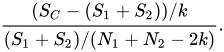
Let be the sum of squared residuals from the combined data, be the sum of squared residuals from the first group, and be the sum of squared residuals from the second group. and are the number of observations in each group and is the total number of parameters (in this case 3, i.e. 2 independent variables coefficients + intercept). Then the Chow test statistic is

The test statistic follows the F-distribution with and degrees of freedom.

The same result can be achieved via dummy variables.

Consider the two data sets which are being compared. Firstly there is the 'primary' data set i={1,...,} and the 'secondary' data set i={+1,...,n}. Then there is the union of these two sets: i={1,...,n}. If there is no structural change between the primary and secondary data sets a regression can be run over the union without the issue of biased estimators arising.

Consider the regression:

Which is run over i={1,...,n}.

D is a dummy variable taking a value of 1 for i={+1,...,n} and 0 otherwise.

If both data sets can be explained fully by then there is no use in the dummy variable as the data set is explained fully by the restricted equation. That is, under the assumption of no structural change we have a null and alternative hypothesis of:


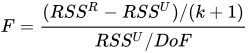
The null hypothesis of joint insignificance of D can be run as an F-test with degrees of freedom (DoF). That is: .

Remarks

  • The global sum of squares (SSE) is often called the Restricted Sum of Squares (RSSM) as we basically test a constrained model where we have assumptions (with the number of regressors).
  • Some software like SAS will use a predictive Chow test when the size of a subsample is less than the number of regressors.

References

[edit]
[edit]
Revisions and contributorsEdit on WikipediaRead on Wikipedia
from Grokipedia
The Chow test, also known as the Chow structural break test, is a statistical procedure in econometrics used to assess whether the coefficients of a linear regression model remain stable across two distinct subsamples or time periods, thereby detecting potential structural changes or breaks in the underlying relationship. Developed by economist Gregory C. Chow in his seminal 1960 paper, the test employs an F-statistic to compare the residual sum of squares from a restricted model (assuming coefficient equality across subsamples) against an unrestricted model (allowing coefficients to differ), with the null hypothesis of no structural break rejected if the F-statistic exceeds a critical value from the F-distribution. This framework is particularly applicable when the potential break point is known a priori, such as policy shifts or economic events, and assumes homoscedastic and independent errors in the regressions. Originally formulated to test equality between sets of coefficients in two linear regressions—addressing scenarios like comparing pre- and consumption patterns—the Chow test systematizes earlier approaches by integrating them with and prediction intervals, extending to subsets of coefficients and providing exact finite-sample distributions under normality assumptions. In practice, it has become a for empirical in and , evaluating model stability amid events like financial crises or regime changes, though it requires sufficient observations per subsample and performs best with exogenously specified break points to avoid bias. Limitations include sensitivity to misspecified break dates and reduced power against gradual shifts, prompting extensions like sup-Wald tests for unknown breaks in modern applications.

Overview

Definition and Purpose

The Chow test is a statistical procedure designed to determine whether the coefficients in two models, estimated on separate subsets of data, are equal to each other. This equality implies the absence of a , meaning the underlying relationship between the remains stable across the subsets. Originally formulated to compare regression parameters from different samples, the test operates under the that a single regression model adequately describes both datasets, against the alternative that distinct models are required for each. The primary purpose of the Chow test is to evaluate parameter stability in linear regressions, particularly when assessing whether economic or statistical relationships have changed due to external factors. It is widely applied in to detect structural breaks in time series data, such as shifts caused by interventions, economic crises, or technological innovations that alter the regression coefficients at a known point in time. For instance, the test can identify if the impact of variables like interest rates on GDP growth differs before and after a major event. Additionally, it facilitates comparisons across subgroups in , such as testing whether treatment effects in program evaluations vary between demographic groups, thereby supporting in . By partitioning the data and comparing the from restricted and unrestricted models, the Chow test provides a framework to assess if the functional form of the relationship between variables has shifted at a specific or between groups. This makes it a foundational tool for ensuring model validity in applied , where unaccounted structural changes could lead to biased estimates and erroneous conclusions.

Historical Background

The Chow test was introduced by economist Gregory C. Chow in his seminal 1960 paper, where he developed statistical procedures to test the equality of coefficients across two models. Published in , the work addressed the need to assess whether additional observations followed the same regression relationship as an initial sample, extending concepts from prediction intervals and to broader hypothesis testing frameworks. This development occurred amid the rapid expansion of econometric modeling in the post-World War II era, particularly during the 1950s and 1960s, when large-scale macro-econometric models, such as those by , gained prominence for analyzing economic relationships using data. The period saw heightened focus on dynamic economic structures, influenced by advancements in and Keynesian frameworks, fostering interest in tools for analysis and model stability. Chow's test was first applied to detect structural changes in economic models, such as shifts in demand functions triggered by external events like wars or policy changes. For instance, it examined the stability of automobile demand equations by comparing pre- and post-World War II data, excluding wartime years (1942–1946) to account for disruptions, thereby highlighting potential breakpoints in regression parameters. Building on prior hypothesis testing methods in , such as F-tests for coefficient equality, Chow's contribution formalized the detection of structural breaks at specific points, providing a rigorous framework for econometricians to evaluate model consistency across subsets of data.

Theoretical Foundation

Model Assumptions

The Chow test relies on the classical assumptions of the model to ensure the validity of its . Specifically, the error terms in the regressions are assumed to be independent and identically distributed (i.i.d.) with a , mean zero, and constant variance, implying homoscedasticity across all observations. This normality assumption is crucial for the test statistic to follow an exact under the of coefficient equality. Additionally, the errors must exhibit no , as the condition precludes serial correlation in the disturbances. In terms of model setup, the Chow test applies to two models sharing the same explanatory variables but potentially differing in intercepts and slopes between subsamples: for the first subsample, y1=X1β1+ϵ1y_1 = X_1 \beta_1 + \epsilon_1, and for the second, y2=X2β2+ϵ2y_2 = X_2 \beta_2 + \epsilon_2, where X1X_1 and X2X_2 consist of the identical set of regressors. The full-sample regression pools both subsamples into a single model y=Xβ+ϵy = X \beta + \epsilon, assuming this combined specification correctly captures the relationship without introducing that could arise from structural differences unaccounted for in the regressor matrix. Violations of these assumptions, such as heteroscedasticity where error variances differ across subsamples, can distort the distribution of the , rendering the standard critical values from the unreliable and potentially leading to incorrect rejection or acceptance of the . Likewise, non-normality of the errors invalidates the exact finite-sample , although asymptotic approximations may hold under certain conditions like weak dependence.

Relation to Other Tests

The Chow test is fundamentally a specialized application of the designed to assess the equality of regression coefficients across two or more linear models, such as when comparing subsamples or periods suspected of structural differences. Under the of coefficient stability, the follows an with determined by the number of restrictions and sample sizes, enabling direct inference on whether pooled estimation is appropriate or if regime-specific models are needed. Under the assumption of normally distributed errors, the Chow test is equivalent to a likelihood ratio test for the same hypothesis of coefficient equality, as the F-statistic in linear regression models maximizes the likelihood under normality; however, the Chow approach is computationally simpler, relying on residual sum of squares comparisons rather than full maximum likelihood estimation. In contrast to Ramsey's RESET test, which detects model specification errors such as omitted variables or incorrect functional forms by augmenting the regression with powers of fitted values, the Chow test specifically targets differences in coefficient vectors across predefined groups or time segments without addressing functional misspecification. Similarly, the Chow test differs from the CUSUM test, which monitors cumulative sums of residuals to detect gradual or multiple instances of parameter instability over time without requiring a priori specification of a break point, whereas the Chow test assumes the break location is known in advance. The Chow test serves as a foundational precursor to more advanced structural break detection methods, notably the supF test proposed by Andrews, which extends the framework to cases of unknown break points by taking the supremum of over a range of potential breaks, addressing a key limitation of the original Chow procedure in empirical applications involving uncertain change dates.

Formulation

Basic Chow Test Statistic

The basic Chow test statistic is derived from the framework of models applied to two distinct subsamples of data, testing the that the regression coefficients are identical across both subsamples. Consider a model for the first subsample with n1n_1 observations: y1=X1β1+ϵ1y_1 = X_1 \beta_1 + \epsilon_1, where y1y_1 is the n1×1n_1 \times 1 vector of dependent variables, X1X_1 is the n1×kn_1 \times k , β1\beta_1 is the k×1k \times 1 vector of coefficients, and ϵ1N(0,σ2In1)\epsilon_1 \sim N(0, \sigma^2 I_{n_1}) is the term. Similarly, for the second subsample with n2n_2 observations: y2=X2β2+ϵ2y_2 = X_2 \beta_2 + \epsilon_2, where the components are defined analogously, and the errors are independent across subsamples. The combined or pooled model assumes equal coefficients: y=Xβ+ϵy = X \beta + \epsilon, where y=(y1y2)y = \begin{pmatrix} y_1 \\ y_2 \end{pmatrix}, X=(X1X2)X = \begin{pmatrix} X_1 \\ X_2 \end{pmatrix}, β=β1=β2\beta = \beta_1 = \beta_2, and ϵ=(ϵ1ϵ2)\epsilon = \begin{pmatrix} \epsilon_1 \\ \epsilon_2 \end{pmatrix}. To compute the test statistic, obtain the residual sum of squares (RSS) from three ordinary least squares regressions: the pooled model yielding RSScRSS_c, the first subsample yielding RSS1RSS_1, and the second subsample yielding RSS2RSS_2. The Chow test statistic is then given by F=(RSSc(RSS1+RSS2))/k(RSS1+RSS2)/(n1+n22k),F = \frac{(RSS_c - (RSS_1 + RSS_2)) / k}{(RSS_1 + RSS_2) / (n_1 + n_2 - 2k)}, where kk is the number of parameters in the regression (including the intercept). This F-statistic measures the proportional increase in unexplained variation when imposing the restriction of equal coefficients compared to estimating them separately. The derivation of this statistic follows from the general theory of testing linear restrictions in models. Under the β1=β2\beta_1 = \beta_2, the difference RSSc(RSS1+RSS2)RSS_c - (RSS_1 + RSS_2) represents the additional sum of squared residuals attributable to the kk restrictions, which is distributed as σ2χk2\sigma^2 \chi^2_k. Dividing by the unbiased estimate of σ2\sigma^2 from the unrestricted model, (RSS1+RSS2)/(n1+n22k)(RSS_1 + RSS_2) / (n_1 + n_2 - 2k), yields the F-statistic, which standardizes the test for the specified . Under the null hypothesis of no structural break (i.e., β1=β2\beta_1 = \beta_2) and assuming the standard Gauss-Markov conditions hold, including homoskedasticity and no , the test statistic follows an with kk numerator and n1+n22kn_1 + n_2 - 2k denominator .

Dummy Variable Approach

The dummy variable approach offers an equivalent method to the standard Chow test for detecting structural breaks in linear regression models by augmenting the full-sample regression with indicator variables that capture potential differences across subsamples. This technique integrates the test into a single estimation framework, making it particularly suitable for implementation in econometric software. To implement this approach, define a dummy variable DD that equals 1 for all observations in the second subsample and 0 for those in the first subsample. The explanatory variables XX (including a ) are then interacted with DD to allow for subsample-specific coefficients. The augmented model is estimated over the entire sample as follows: y=Xβ+(DX)δ+ϵy = X \beta + (D X) \delta + \epsilon Here, β\beta represents the coefficients for the first subsample, δ\delta is the k×1k \times 1 vector of coefficient differences for the second subsample relative to the first (δ=β2β1\delta = \beta_2 - \beta_1), including the intercept difference, and ϵ\epsilon is the error term assumed to satisfy standard OLS conditions. The of parameter stability across subsamples is H0:δ=0H_0: \delta = 0, implying no in the coefficients. This hypothesis is tested using the conventional F-statistic for the significance of the coefficients on the interaction terms (DX)(D X), which follows an with kk in the numerator (corresponding to the number of restrictions) and n1+n22kn_1 + n_2 - 2k in the denominator under the null. Under the assumptions of the model, the F-statistic from this dummy variable regression is mathematically equivalent to the Chow test statistic obtained by comparing from restricted and unrestricted models. This equivalence holds because the unrestricted form of the dummy variable model replicates the separate regressions for each subsample, while the restriction δ=0\delta = 0 imposes the pooled model. The approach is computationally advantageous, as it avoids the need for multiple model estimations and directly leverages built-in F-tests in regression routines. Additionally, it facilitates simultaneous assessment of intercept and slope shifts, providing a unified framework for examining comprehensive structural instability.

Implementation

Steps to Perform the Test

To perform the for in a model, begin by specifying the potential or subgroups of interest, which divides the into two subsamples based on a hypothesized , such as a time period or categorical division. This step requires ensuring the subsamples are of sufficient size relative to the number of parameters to allow reliable estimation, typically with each subsample having more observations than regressors. Next, estimate ordinary (OLS) regressions separately for each subsample to obtain the (RSS) for the first subsample (RSS₁) and the second subsample (RSS₂). If one subsample is small—specifically, if its size nn is less than the number of regressors kk—direct estimation may be infeasible; in such cases, use a predictive residuals approach by estimating the model on the larger subsample and computing residuals for the smaller one based on those coefficients. This predictive method, detailed in the original formulation, tests equality by comparing observed values in the small subsample to predictions from the larger one, adjusting for the covariance structure. Then, estimate a single OLS regression on the combined full sample to obtain the restricted (RSS_c), assuming no . The choice between this separate-regressions approach and the dummy variable method—where interactions with a dummy are included in a single regression—depends on software availability, as the dummy approach simplifies computation in some packages but requires careful handling of . Finally, compute the F-statistic using the difference in RSS values as per the standard Chow formulation, which follows an under the of no . Compare this statistic to the critical value from the F-distribution table (with based on the number of restrictions and sample size) or compute the using statistical software to determine significance.

Interpretation of Results

The of the Chow test posits no in the regression model, meaning the coefficients are equal across the two subsamples. To interpret the results, the computed F-statistic is compared to the critical value from the with equal to the number of restrictions and the residual from the unrestricted model; the null is rejected if the F-statistic exceeds this critical value at the chosen significance level (commonly α = 0.05), or equivalently if the associated is less than α. The power of the Chow test—the probability of detecting a true —increases with larger overall sample sizes and with greater magnitudes of the differences (clearer breaks). While the F-statistic follows a one-tailed under the null, the test effectively evaluates a two-sided alternative of inequality in either direction; in time series applications, the temporal structure may emphasize breaks in one direction, but the standard formulation remains two-sided for equality. Upon rejection of the null, separate regression models are estimated for each subsample to capture the ; failure to reject indicates the pooled model across the full sample is appropriate.

Examples

Illustrative Example

Consider a hypothetical consisting of 20 observations for a model y=β0+β1x+ϵy = \beta_0 + \beta_1 x + \epsilon, where the potential occurs after the first 10 observations (n1=10n_1 = 10 pre-break, n2=10n_2 = 10 post-break). The explanatory variable xx takes integer values from 1 to 10 in the pre-break period and from 11 to 20 in the post-break period. This data is designed to reflect an intercept shift from 5 to 8 across the periods, while maintaining a constant slope near 2, with normally distributed errors to produce nonzero residuals. The ordinary least squares (OLS) regression on the pre-break data yields estimated coefficients of β^0=5.0\hat{\beta}_0 = 5.0 and β^1=2.0\hat{\beta}_1 = 2.0, with a (RSS) of 40. For the post-break data, the OLS estimates are β^0=8.0\hat{\beta}_0 = 8.0 and β^1=2.0\hat{\beta}_1 = 2.0, with RSS = 40. Thus, the unrestricted sum of squares (separate regressions) is RSSU_U = 80. The restricted (pooled) OLS regression across all 20 observations under the of no produces β^0=6.5\hat{\beta}_0 = 6.5 and β^1=2.0\hat{\beta}_1 = 2.0, with RSSR_R = 122. The Chow test statistic is then calculated as F=(RSSRRSSU)/qRSSU/(n1+n22q)=(12280)/280/16=42/25=215=4.2,F = \frac{(\text{RSS}_R - \text{RSS}_U)/q}{\text{RSS}_U / (n_1 + n_2 - 2q)} = \frac{(122 - 80)/2}{80 / 16} = \frac{42/2}{5} = \frac{21}{5} = 4.2, where q=2q = 2 is the number of parameters tested (intercept and slope). This follows an with 2 and 16 . The critical value for F(2, 16) at the 5% significance level is approximately 3.63. Since 4.2 > 3.63, the null hypothesis of parameter stability is rejected, indicating evidence of a , consistent with the designed intercept shift.

The First Chow Test

In his 1960 paper introducing the test, Gregory C. Chow applied it empirically to functions for automobiles, using U.S. data to test for stability between the periods 1921–1953 and 1954–1957. The analysis involved linear regressions for automobile and new car purchases. For , the model regressed (XtX_t) on relative price index (PtP_t), real disposable income (IdtI_{dt}), real expected income (IetI_{et}), and lagged (Xt1X_{t-1}). For purchases, a similar model included an additional variable. The test results showed no significant evidence of , with of 0.45 (3, 26 df) for the ownership function and 0.95 (4, 24 df) for the purchase function, both failing to reject the of coefficient stability. This application demonstrated the test's use in checking regression stability over time, though the paper also discussed theoretical scenarios like pre- and post-war consumption patterns to illustrate potential structural breaks in economic relationships.

Limitations and Extensions

Key Limitations

The Chow test relies on several key assumptions inherent to the classical model, including normality of errors, homoscedasticity, and absence of . Violations of these assumptions can render the test's p-values invalid and lead to incorrect inferences about . For instance, under non-normality of the error terms, the exact of the does not hold, resulting in size distortions particularly in finite samples, although asymptotic validity may still apply under mild conditions. Similarly, heteroscedasticity—where error variances differ across subsamples—distorts the test's significance level, causing the actual rejection probability to exceed the nominal level (e.g., up to twice as high in small samples with moderate variance differences), thereby inflating Type I error rates. in the errors also compromises the test, as the standard errors and become misspecified, leading to unreliable s and potential over-rejection of the of no . The test further requires adequate sample sizes in each subsample to ensure reliable estimation and sufficient for the F-statistic. Specifically, the number of observations in each subsample (n_i) must exceed the number of parameters (k), typically n_i > k + 1, to avoid singular matrices and enable full-rank estimation; otherwise, the restricted or unrestricted models cannot be fitted properly, and the test becomes infeasible. In cases of small subsamples, the Chow test exhibits low power to detect true breaks and may produce unstable results, prompting the use of alternatives such as predictive tests that rely on out-of-sample forecasts rather than direct parameter comparisons. A fundamental limitation is the assumption of a single, known , which restricts its applicability in scenarios where the timing of a potential break is uncertain or endogenous to the . When the breakpoint must be specified a priori, the test lacks power against alternatives involving multiple breaks or breaks at unknown locations, as it cannot systematically search the sample for instability points and may fail to detect changes that do not align with the presumed split.

Variants and Advanced Uses

The predictive Chow test addresses scenarios where one subsample, typically the post-break period, is too small to estimate the model parameters reliably using the standard approach. In such cases, residuals for the smaller subsample are forecasted from the full sample regression, and the test compares these predicted residuals against the actual ones to assess . This variant, derived from the original framework, maintains the F-statistic form but adjusts accordingly to account for the step. Extensions for detecting multiple structural breaks build on the Chow test through sequential procedures, where the test is applied iteratively across potential break points to identify and date several changes in . For instance, the sup-Wald test framework allows testing for by taking the supremum of Chow-like statistics over a range of possible break dates, enabling the detection of one or more breaks without prior specification. These methods, such as those in the Bai-Perron approach, refine the sequential application by estimating break locations via dynamic programming and testing for the optimal number of breaks using information criteria or sup tests. In settings, the Chow test has been adapted to detect cross-sectional structural breaks, where may differ across units or over time due to heterogeneous shocks. This involves pooling the data and interacting time or unit dummies with regressors to test for breaks in slopes or intercepts within the panel framework, accommodating fixed effects or clustering to handle dependence. Bayesian variants incorporate prior distributions on break locations and , providing posterior probabilities for the presence and timing of breaks, which quantifies in a way classical tests cannot. These approaches use model averaging over possible break models to robustly estimate regime shifts under . The Chow test and its variants are integrated into statistical software for automated break detection; for example, the R package strucchange implements fluctuation and F-based tests, including sequential Chow statistics, to scan time series for changes without manual breakpoint specification. Similarly, Stata's xtbreak command extends these to panel data, estimating multiple breaks with confidence intervals via sup-LM and Wald tests derived from the Chow framework. Post-2000 applications in climate econometrics have employed these methods to identify regime shifts, such as abrupt changes in temperature means across agroclimatic zones or hydrologic correlations linked to climate drivers like the Pacific Decadal Oscillation.

References

Add your contribution
Related Hubs
User Avatar
No comments yet.