



Community hub
Recent from talks
Knowledge base stats:
Talk channels stats:
Members stats:
Cicutoxin
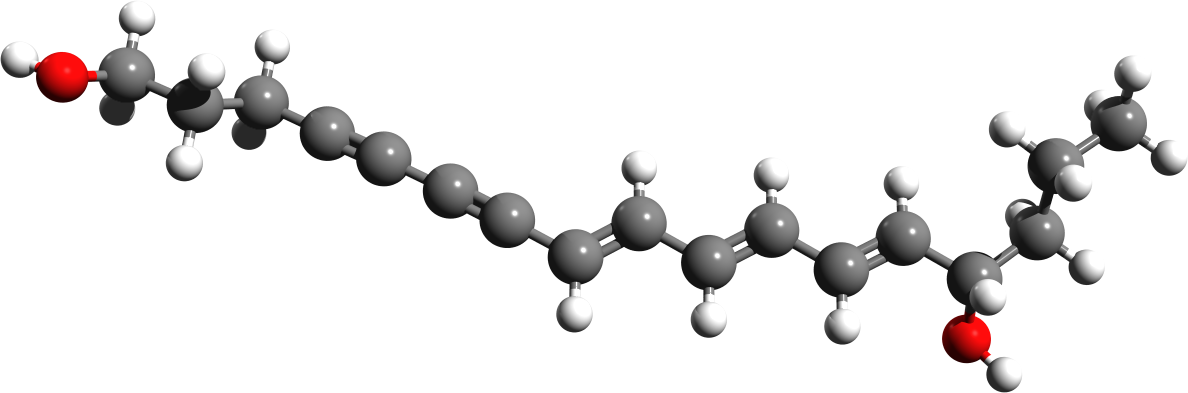
Cicutoxin is a naturally-occurring poisonous chemical compound produced by several plants from the family Apiaceae including water hemlock (Cicuta species) and water dropwort (Oenanthe crocata). The compound contains polyene, polyyne, and alcohol functional groups and is a structural isomer of oenanthotoxin, also found in water dropwort. Both of these belong to the C17-polyacetylenes chemical class.
It causes death by respiratory paralysis resulting from disruption of the central nervous system. It is a potent, noncompetitive antagonist of the gamma-aminobutyric acid (GABA) receptor. In humans, cicutoxin rapidly produces symptoms of nausea, emesis and abdominal pain, typically within 60 minutes of ingestion. This can lead to tremors, seizures, and death. LD50(mouse; i.p.) ~9 mg/kg
Johann Jakob Wepfer's book Cicutae Aquaticae Historia Et Noxae Commentario Illustrata was published in 1679; it contains the earliest published report of toxicity associated with Cicuta plants. The name cicutoxin was coined by Boehm in 1876 for the toxic compound arising from the plant Cicuta virosa, and he also extracted and named the isomeric toxin oenanthotoxin from Oenanthe crocata. A review published in 1911 examined 27 cases of cicutoxin poisoning, 21 of which had resulted in death – though some of these cases involved deliberate poisoning. This review included a case where a family of five used Cicuta extracts as a topical treatment for itching, resulting in the deaths of two children, a report that suggests that cicutoxin may be absorbed through the skin. A review from 1962 examined 78 cases, 33 of which resulted in death, and cases of cicutoxin poisoning continue to occur:
All plants from the genus Cicuta contain cicutoxin. These plants are found in swampy, wet habitats in North America and parts of Europe. The Cicuta plants are often mistaken for edible roots such as parsnip, wild carrot or wild ginseng. All parts of the Cicuta plants are poisonous, though the root is the most toxic part of the plant and toxin levels are highest in spring – ingestion of a 2–3 cm portion of root can be fatal to adults. In one reported incident, 17 boys ingested parts of the plant, with only those who consumed the root experiencing seizures whilst those who consumed only leaves and flowers merely became unwell. The toxicity of the plants depends on various factors, such as seasonal variation, temperature, geographical location and soil conditions. The roots remain toxic even after drying.
Cicutoxin is found in five species of water hemlock, all belonging to the family Apiaceae. These include all four species in the genus Cicuta and one species from the genus Oenanthe: the bulblet-bearing water hemlock, C. bulbifera; the Douglas water hemlock, C. douglasii; the spotted water hemlock or spotted cowbane, C. maculata; Mackenzie's water hemlock, C. virosa; and, the water dropwort, O. crocata. Cicutoxin is found in all parts of these plants, along with several other C17 polyacetylenes. C. virosa, for example, produces isocicutoxin, a geometric isomer of cicutoxin, while O. crocata contains the toxin oenanthotoxin, a structural isomer of cicutoxin. Cicuta plants also produce multiple congeners of cicutoxin, such as Virol A and Virol C.
Building on Boehm's work, Jacobsen reported the first isolation of pure cicutoxin as a yellowish oil in 1915. Its chemical structure was not determined until 1953, however, when it was shown that it has a molecular formula of C17H22O2 and it is an aliphatic, highly unsaturated alcohol with two triple bonds conjugated with three double bonds, and two hydroxyl groups. The first synthesis of cicutoxin was reported in 1955. Though the overall yield was only 4% and the product was the racemic mixture, the synthesis has been described as "a significant accomplishment" given that it was achieved "without the benefit of modern coupling reactions". The absolute configuration of the naturally occurring form of cicutoxin was reported in 1999 to be (R)-(−)-cicutoxin, systematically named as (8E,10E,12E,14R)-heptadeca-8,10,12-triene-4,6-diyne-1,14-diol. Outside of a plant, cicutoxin breaks down when exposed to air, light, or heat, making it difficult to handle.
Cicutoxin has a long carbon structure and few hydrophilic substituents which gives it hydrophobic characteristics. Hydrophobic and/or small molecules can be absorbed through the skin. Research has shown that cicutoxin will pass through the skin of frogs and the experience of the family who used a Cicuta plant as a topical antipruritic strongly suggests that the compound is able to pass through human skin.
The first total synthesis of racemic cicutoxin was published in 1955 and reported that this racemate was about twice as active as the naturally occurring enantiomer. A complete synthesis of the natural product, (R)-(−)-cicutoxin, in four linear steps was reported in 1999, from three key fragments: (R)-(−)-1-hexyn-3-ol (8), 1,4-diiodo-1,3-butadiene (9), and THP-protected 4,6-heptadiyn-1-ol (6). (R)-(−)-1-hexyn-3-ol (8) is a known compound and was obtained by Corey-Bakshi-Shibata reduction of 1-hexyn-3-one. 1,4-diiodo-1,3-butadiene (9) is also a known compound and it is readily available by dimerization of acetylene accompanied by addition of iodine in the presence of platinum (IV) catalyst and sodium iodide. The last key fragment, THP-protected 4,6-heptadiyn-1-ol (6) is a known compound.
Hub AI
Cicutoxin AI simulator
(@Cicutoxin_simulator)
Cicutoxin
Cicutoxin is a naturally-occurring poisonous chemical compound produced by several plants from the family Apiaceae including water hemlock (Cicuta species) and water dropwort (Oenanthe crocata). The compound contains polyene, polyyne, and alcohol functional groups and is a structural isomer of oenanthotoxin, also found in water dropwort. Both of these belong to the C17-polyacetylenes chemical class.
It causes death by respiratory paralysis resulting from disruption of the central nervous system. It is a potent, noncompetitive antagonist of the gamma-aminobutyric acid (GABA) receptor. In humans, cicutoxin rapidly produces symptoms of nausea, emesis and abdominal pain, typically within 60 minutes of ingestion. This can lead to tremors, seizures, and death. LD50(mouse; i.p.) ~9 mg/kg
Johann Jakob Wepfer's book Cicutae Aquaticae Historia Et Noxae Commentario Illustrata was published in 1679; it contains the earliest published report of toxicity associated with Cicuta plants. The name cicutoxin was coined by Boehm in 1876 for the toxic compound arising from the plant Cicuta virosa, and he also extracted and named the isomeric toxin oenanthotoxin from Oenanthe crocata. A review published in 1911 examined 27 cases of cicutoxin poisoning, 21 of which had resulted in death – though some of these cases involved deliberate poisoning. This review included a case where a family of five used Cicuta extracts as a topical treatment for itching, resulting in the deaths of two children, a report that suggests that cicutoxin may be absorbed through the skin. A review from 1962 examined 78 cases, 33 of which resulted in death, and cases of cicutoxin poisoning continue to occur:
All plants from the genus Cicuta contain cicutoxin. These plants are found in swampy, wet habitats in North America and parts of Europe. The Cicuta plants are often mistaken for edible roots such as parsnip, wild carrot or wild ginseng. All parts of the Cicuta plants are poisonous, though the root is the most toxic part of the plant and toxin levels are highest in spring – ingestion of a 2–3 cm portion of root can be fatal to adults. In one reported incident, 17 boys ingested parts of the plant, with only those who consumed the root experiencing seizures whilst those who consumed only leaves and flowers merely became unwell. The toxicity of the plants depends on various factors, such as seasonal variation, temperature, geographical location and soil conditions. The roots remain toxic even after drying.
Cicutoxin is found in five species of water hemlock, all belonging to the family Apiaceae. These include all four species in the genus Cicuta and one species from the genus Oenanthe: the bulblet-bearing water hemlock, C. bulbifera; the Douglas water hemlock, C. douglasii; the spotted water hemlock or spotted cowbane, C. maculata; Mackenzie's water hemlock, C. virosa; and, the water dropwort, O. crocata. Cicutoxin is found in all parts of these plants, along with several other C17 polyacetylenes. C. virosa, for example, produces isocicutoxin, a geometric isomer of cicutoxin, while O. crocata contains the toxin oenanthotoxin, a structural isomer of cicutoxin. Cicuta plants also produce multiple congeners of cicutoxin, such as Virol A and Virol C.
Building on Boehm's work, Jacobsen reported the first isolation of pure cicutoxin as a yellowish oil in 1915. Its chemical structure was not determined until 1953, however, when it was shown that it has a molecular formula of C17H22O2 and it is an aliphatic, highly unsaturated alcohol with two triple bonds conjugated with three double bonds, and two hydroxyl groups. The first synthesis of cicutoxin was reported in 1955. Though the overall yield was only 4% and the product was the racemic mixture, the synthesis has been described as "a significant accomplishment" given that it was achieved "without the benefit of modern coupling reactions". The absolute configuration of the naturally occurring form of cicutoxin was reported in 1999 to be (R)-(−)-cicutoxin, systematically named as (8E,10E,12E,14R)-heptadeca-8,10,12-triene-4,6-diyne-1,14-diol. Outside of a plant, cicutoxin breaks down when exposed to air, light, or heat, making it difficult to handle.
Cicutoxin has a long carbon structure and few hydrophilic substituents which gives it hydrophobic characteristics. Hydrophobic and/or small molecules can be absorbed through the skin. Research has shown that cicutoxin will pass through the skin of frogs and the experience of the family who used a Cicuta plant as a topical antipruritic strongly suggests that the compound is able to pass through human skin.
The first total synthesis of racemic cicutoxin was published in 1955 and reported that this racemate was about twice as active as the naturally occurring enantiomer. A complete synthesis of the natural product, (R)-(−)-cicutoxin, in four linear steps was reported in 1999, from three key fragments: (R)-(−)-1-hexyn-3-ol (8), 1,4-diiodo-1,3-butadiene (9), and THP-protected 4,6-heptadiyn-1-ol (6). (R)-(−)-1-hexyn-3-ol (8) is a known compound and was obtained by Corey-Bakshi-Shibata reduction of 1-hexyn-3-one. 1,4-diiodo-1,3-butadiene (9) is also a known compound and it is readily available by dimerization of acetylene accompanied by addition of iodine in the presence of platinum (IV) catalyst and sodium iodide. The last key fragment, THP-protected 4,6-heptadiyn-1-ol (6) is a known compound.