Hubbry Logo
Circular segmentCircular segmentMain
Open search
Circular segment
Community hub
Circular segment
logo
8 pages, 0 posts
0 subscribers
Be the first to start a discussion here.
Circular segment
Circular segment
from Wikipedia
A circular segment (in green) is enclosed between a secant/chord (the dashed line) and the arc whose endpoints equal the chord's (the arc shown above the green area).

In geometry, a circular segment or disk segment (symbol: ) is a region of a disk[1] which is "cut off" from the rest of the disk by a straight line. The complete line is known as a secant, and the section inside the disk as a chord.[2]

More formally, a circular segment is a plane region bounded by a circular arc (of less than π radians by convention) and the circular chord connecting its endpoints.

Formulae

[edit]

Let R be the radius of the arc which forms part of the perimeter of the segment, θ the central angle subtending the arc in radians, c the chord length, s the arc length, h the sagitta (height) of the segment, d the apothem of the segment, and a the area of the segment.

Usually, chord length and height are given or measured, and sometimes the arc length as part of the perimeter, and the unknowns are area and sometimes arc length. These can't be calculated simply from chord length and height, so two intermediate quantities, the radius and central angle are usually calculated first.

Radius and central angle

[edit]

The radius is:

[3]

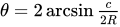
The central angle is

Chord length and height

[edit]

The chord length and height can be back-computed from radius and central angle by:

The chord length is

The sagitta is

The apothem is

Arc length and area

[edit]

The arc length, from the familiar geometry of a circle, is

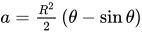
The area of the circular segment is equal to the area of the circular sector minus the area of the triangular portion (using the double angle formula to get an equation in terms of ):

In terms of c and R,

In terms of R and h,

In terms of c and h,

What can be stated is that as the central angle gets smaller (or alternately the radius gets larger), the area a rapidly and asymptotically approaches . If , is a substantially good approximation.

If is held constant, and the radius is allowed to vary, then we have

As the central angle approaches π, the area of the segment is converging to the area of a semicircle, , so a good approximation is a delta offset from the latter area:

for h>.75R

As an example, the area is one quarter the circle when θ ~ 2.31 radians (132.3°) corresponding to a height of ~59.6% and a chord length of ~183% of the radius.[clarification needed]

Other properties

[edit]

The perimeter p is the arclength plus the chord length:

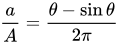
Proportion of the whole area of the circle:
Applications

[edit]

The area formula can be used in calculating the volume of a partially-filled cylindrical tank lying horizontally.

In the design of windows or doors with rounded tops, c and h may be the only known values and can be used to calculate R for the draftsman's compass setting.

One can reconstruct the full dimensions of a complete circular object from fragments by measuring the arc length and the chord length of the fragment.

To check hole positions on a circular pattern. Especially useful for quality checking on machined products.

For calculating the area or locating the centroid of a planar shape that contains circular segments.

See also

[edit]

References

[edit]
[edit]
Revisions and contributorsEdit on WikipediaRead on Wikipedia
from Grokipedia
A circular segment is a portion of a disk bounded by a chord and the corresponding arc of the circle, typically defined for a θ less than or equal to π radians (180 degrees), distinguishing it from the larger segment when θ exceeds π. This geometric figure, first described in ancient texts as "the figure contained by a straight line and a of a ," has been a fundamental concept in since Euclid's Elements around 300 BCE. Key properties of a circular segment include its area, chord length, sagitta (height), and arc length, all derived from the circle's radius R and the central angle θ. The area A is given by the formula A=12R2(θsinθ)A = \frac{1}{2} R^2 (\theta - \sin \theta), where θ is in radians, representing the difference between the sector area and the triangular portion. The chord length a measures a=2Rsin(θ/2)a = 2R \sin(\theta/2), while the sagitta h (the perpendicular distance from the chord midpoint to the arc) is h=R(1cos(θ/2))h = R (1 - \cos(\theta/2)). The arc length s simply equals s=Rθs = R \theta. Circular segments find practical applications across and fields, such as calculating the volume of in partially filled horizontal cylindrical tanks in , where the cross-sectional area is a segment. In , they inform the design of arched structures like windows, , and vaults for both aesthetic and structural integrity. Circular segments are also used in and . Historically, circular segments appeared in Japanese temple geometry (sangaku) problems of the (1603–1868), solving area-related puzzles.

Introduction

Definition

A circular segment is the region of a disk bounded by a chord and the corresponding arc subtended by that chord, specifically the portion where the central is less than π\pi radians to denote the smaller area. Visually, it appears as a cap-like area cut off from the rest of the disk by the straight chord line. The minor segment, corresponding to the arc less than a , is the standard reference unless the major segment is explicitly indicated. This region differs from a , which includes the triangular area formed by the two radii to the chord's endpoints and the arc, whereas the segment excludes that triangle. It also contrasts with the full disk, representing only a partial area enclosed by the circle's boundary. Common parameters include the circle's radius rr, the central angle θ\theta in radians, the chord length cc, and the sagitta hh (the perpendicular distance from the chord's midpoint to the arc). The and chord serve as fundamental components defining the segment's shape.

Historical Background

The concept of the circular segment traces its origins to ancient civilizations, where early approximations for its area appeared in around the late 5th century BCE and in 3rd-century BCE Egyptian papyri, often employing simple trapezoidal or triangular estimates assuming a value of π close to 3. These practical methods were geared toward architectural and measurement tasks, such as inscribing segments within polygons. Archimedes of Syracuse contributed foundational insights in his treatise On the Measurement of a Circle (c. 250 BCE), establishing the circle's area as equal to that of a with one leg equal to the and the other to the , which provided a rigorous basis for later segment derivations, though he focused more broadly on circular areas and parabolic segments. His mechanical influenced subsequent geometric treatments. The systematic development of circular segment theory is primarily attributed to (c. 10–70 CE) in Book I of his Metrica, where he outlined four distinct procedures for computing the segment's area using the chord length (base b) and (height h). These included the "ancient method," a basic trapezoidal approximation suitable for modest segments; a "revised method" adjusting for a more precise π ≈ 3 1/7; a "quasi-Archimedean method" drawing from ' parabolic quadrature for flatter segments (where b > 3h); and a "subtraction method" for deeper segments (h > r), subtracting the smaller complementary segment from the full circle's area. Hero's approaches blended geometric constructions, such as inscribing isosceles triangles via the , with empirical approximations, bridging practical needs—like aqueduct and vessel design—with theoretical rigor. During the medieval , scholars preserved and refined Greek geometric traditions through translations and commentaries, advancing quadrature techniques for circular figures, including segment-like divisions via inscribed polygons and trigonometric methods. Figures such as (c. 1380–1429) in his Treatise on the Chord (1424) enhanced approximations for circular arcs and areas by computing π to 16 decimal places using polygonal perimeters, which facilitated more accurate segment calculations in astronomical and architectural contexts. These trigonometric advancements allowed for exact formulas using sine functions, further developing segment theory. The saw European mathematicians adopt these Islamic-transmitted works, integrating segment methods into emerging fields like perspective and fortification design. By the 19th century, formalized the circular segment in standard textbooks, expressing it through trigonometric and coordinate-based relations for precise applications, evolving from ancient approximations to proofs grounded in and limits.

Geometry

Components and Terminology

A circular segment is composed of several key geometric elements that define its structure. The chord is the straight line segment connecting the two endpoints of the arc, serving as the base of the segment and denoted by its length cc. This chord divides the circle into the segment and the remaining portion. The arc forms the curved boundary of the segment, representing the portion of the circle's between the chord's endpoints and subtending a θ\theta at the circle's center. The sagitta, or height hh, is the perpendicular distance from the of the chord to the midpoint of the arc, measuring the "depth" or bulge of the segment. The rr is the fixed distance from the circle's to any point on the arc, determining the overall scale of the segment. Segments are classified as minor when θ<π\theta < \pi radians (less than 180 degrees), forming the smaller cap away from the , or major when θ>π\theta > \pi, encompassing the larger portion including the ; by convention, discussions focus on the minor segment. Additionally, the chord and the two radii to its endpoints form an , which provides a foundational geometric relation for understanding the segment's position relative to the circle's center. These components interconnect through basic , as explored in subsequent relations.

Basic Relations

A circular segment is defined by its chord, which subtends a θ\theta at the circle's center. The length of the chord cc is given by the formula c=2rsin(θ2)c = 2 r \sin\left(\frac{\theta}{2}\right), where rr is the radius of the circle; this relation arises from considering the formed by the two radii to the chord endpoints and the chord itself, where the right triangle half of this has opposite side c/2c/2 to the angle θ/2\theta/2. The hh, or height of the segment, measures the from the chord's to the arc's . It is expressed as h=r(1cos(θ2))h = r \left(1 - \cos\left(\frac{\theta}{2}\right)\right), derived by subtracting the projection of the radius along the perpendicular bisector from the full radius. The position of the circle's center relative to the chord is determined by the signed dd from the center to the chord, given by d=rcos(θ2)d = r \cos\left(\frac{\theta}{2}\right); here, dd is positive when the center lies on the side of the major arc (for θ<π\theta < \pi) and negative otherwise, indicating the side of the chord where the center resides. For the minor segment, the relates to this as h=rdh = r - d when d>0d > 0. These components satisfy a Pythagorean relation in the formed by the to a chord endpoint, half the chord , and the from the center to the chord: (c2)2+d2=r2\left(\frac{c}{2}\right)^2 + d^2 = r^2. Substituting d=rhd = r - h for the minor segment yields the alternative form (c2)2+h2=2rh\left(\frac{c}{2}\right)^2 + h^2 = 2 r h, which connects the chord, , and directly. In all these relations, the θ\theta is measured in radians, as the in the s are defined accordingly; to convert from degrees, multiply by π/180\pi / 180. These basic relations form the foundation for computing other segment properties, such as area.

Formulas

Area

The area AA of a circular segment is given by the A=12r2(θsinθ),A = \frac{1}{2} r^2 (\theta - \sin \theta), where rr is the of the circle and θ\theta is the subtended by the chord in radians. This formula is derived by subtracting the area of the isosceles triangle formed by the two radii and the chord from the area of the circular sector bounded by the two radii and the arc. The sector area is 12r2θ\frac{1}{2} r^2 \theta, and the triangle area is 12r2sinθ\frac{1}{2} r^2 \sin \theta, yielding the difference 12r2(θsinθ)\frac{1}{2} r^2 (\theta - \sin \theta). An alternative expression uses the sagitta (height) hh of the segment and the radius rr, where θ=2arccos(1hr)\theta = 2 \arccos\left(1 - \frac{h}{r}\right). Substituting these relations into the standard formula gives A=r2arccos(rhr)(rh)2rhh2.A = r^2 \arccos\left(\frac{r - h}{r}\right) - (r - h) \sqrt{2 r h - h^2}.
Add your contribution
Related Hubs
User Avatar
No comments yet.