



Community hub
Recent from talks
Knowledge base stats:
Talk channels stats:
Members stats:
Coal preparation plant
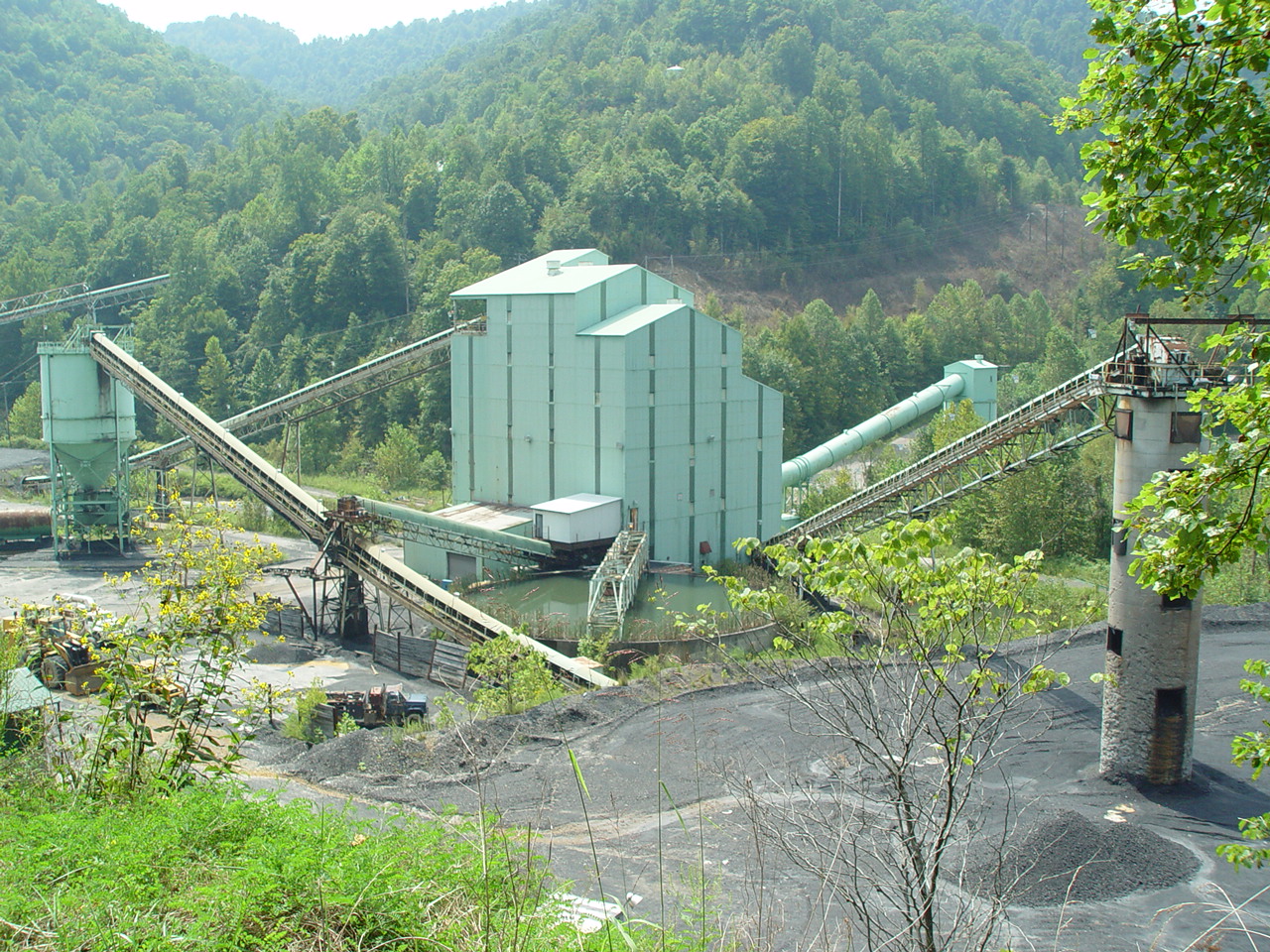
A coal preparation plant (CPP; known as a coal handling and preparation plant (CHPP), coal handling plant, prep plant, Coal Washery, tipple or wash plant) is a facility that washes coal of soil and rock, crushes it into graded sized chunks (sorting), stockpiles grades preparing it for transport to market, and more often than not, also loads coal into rail cars, barges, or ships.
The more of this waste material that can be removed from coal, the lower its total ash content, the greater its market value and the lower its transportation costs.
The coal delivered from the mine that reports to the coal preparation plant is called run-of-mine, or ROM, coal. This is the raw material for the CPP, and consists of coal, rocks, middlings, minerals and contamination. Contamination is usually introduced by the mining process and may include machine parts, used consumables and parts of ground engaging tools. ROM coal can have a large variability of moisture and maximum particle size.
Coal needs to be stored at various stages of the preparation process, and conveyed around the CPP facilities. Coal handling is part of the larger field of bulk material handling, and is a complex and vital part of the CPP.
Stockpiles provide surge capacity to various parts of the CPP. ROM coal is delivered with large variations in production rate of tonnes per hour (tph). A ROM stockpile is used to allow the washplant to be fed coal at lower, constant rate. A simple stockpile is formed by machinery dumping coal into a pile, either from dump trucks, pushed into heaps with bulldozers or from conveyor booms. More controlled stockpiles are formed using stackers to form piles along the length of a conveyor, and reclaimers to retrieve the coal when required for product loading, etc. Taller and wider stockpiles reduce the land area required to store a set tonnage of coal. Larger coal stockpiles have a reduced rate of heat loss, leading to a higher risk of spontaneous combustion.
Travelling, luffing boom stackers that straddle a feed conveyor are commonly used to create coal stockpiles.
Tunnel conveyors can be fed by a continuous slot hopper or bunker beneath the stockpile to reclaim material. Front-end loaders and bulldozers can be used to push the coal into feeders. Sometimes front-end loaders are the only means of reclaiming coal from the stockpile. This has a low up-front capital cost, but much higher operating costs, measured in dollars per tonne handled. High-capacity stockpiles are commonly reclaimed using bucket-wheel reclaimers. These can achieve very high rates.
Sampling of coal is an important part of process control in the production and marketing of coal. A grab sample is a one-off sample of the coal at a point in the process stream, and tends not to be very representative. A routine sample is taken at a set frequency, either over a period of time or per shipment. Coal sampling consists of several types of sampling devices. A "cross cut" sampler mimics the "stop belt" sampling method specified by a standard originally published by the American Society for Testing and Materials (ASTM). A cross cut sampler mounts directly on top of the conveyor belt, the falling stream sampler is placed at the head section of the belt. There are several points in the wash plant that many coal operations choose to sample. The raw coal, before it enters the plant. The refuse, to see what the plant missed. Then the clean coal, to see exactly what is being shipped. The sampler is set according to Tons per hour, Feet per minute and top size of the product on the actual belt. A sample is taken then crushed, then sub sampled and returned to the main belt. The sample is sent to an Independent lab for testing where the results will be shared with the buyer as well as the supplier. The buyer in many cases will also sample the coal again once it is received to "double check" the results. Continuous measurement of ash, moisture, kCal (BTU), sulfur Fe, Ca, Na, and other element constituents of the coal are reported by cross belt elemental analyzers. This information can be calibrated periodically to the lab data per methods.
Hub AI
Coal preparation plant AI simulator
(@Coal preparation plant_simulator)
Coal preparation plant
A coal preparation plant (CPP; known as a coal handling and preparation plant (CHPP), coal handling plant, prep plant, Coal Washery, tipple or wash plant) is a facility that washes coal of soil and rock, crushes it into graded sized chunks (sorting), stockpiles grades preparing it for transport to market, and more often than not, also loads coal into rail cars, barges, or ships.
The more of this waste material that can be removed from coal, the lower its total ash content, the greater its market value and the lower its transportation costs.
The coal delivered from the mine that reports to the coal preparation plant is called run-of-mine, or ROM, coal. This is the raw material for the CPP, and consists of coal, rocks, middlings, minerals and contamination. Contamination is usually introduced by the mining process and may include machine parts, used consumables and parts of ground engaging tools. ROM coal can have a large variability of moisture and maximum particle size.
Coal needs to be stored at various stages of the preparation process, and conveyed around the CPP facilities. Coal handling is part of the larger field of bulk material handling, and is a complex and vital part of the CPP.
Stockpiles provide surge capacity to various parts of the CPP. ROM coal is delivered with large variations in production rate of tonnes per hour (tph). A ROM stockpile is used to allow the washplant to be fed coal at lower, constant rate. A simple stockpile is formed by machinery dumping coal into a pile, either from dump trucks, pushed into heaps with bulldozers or from conveyor booms. More controlled stockpiles are formed using stackers to form piles along the length of a conveyor, and reclaimers to retrieve the coal when required for product loading, etc. Taller and wider stockpiles reduce the land area required to store a set tonnage of coal. Larger coal stockpiles have a reduced rate of heat loss, leading to a higher risk of spontaneous combustion.
Travelling, luffing boom stackers that straddle a feed conveyor are commonly used to create coal stockpiles.
Tunnel conveyors can be fed by a continuous slot hopper or bunker beneath the stockpile to reclaim material. Front-end loaders and bulldozers can be used to push the coal into feeders. Sometimes front-end loaders are the only means of reclaiming coal from the stockpile. This has a low up-front capital cost, but much higher operating costs, measured in dollars per tonne handled. High-capacity stockpiles are commonly reclaimed using bucket-wheel reclaimers. These can achieve very high rates.
Sampling of coal is an important part of process control in the production and marketing of coal. A grab sample is a one-off sample of the coal at a point in the process stream, and tends not to be very representative. A routine sample is taken at a set frequency, either over a period of time or per shipment. Coal sampling consists of several types of sampling devices. A "cross cut" sampler mimics the "stop belt" sampling method specified by a standard originally published by the American Society for Testing and Materials (ASTM). A cross cut sampler mounts directly on top of the conveyor belt, the falling stream sampler is placed at the head section of the belt. There are several points in the wash plant that many coal operations choose to sample. The raw coal, before it enters the plant. The refuse, to see what the plant missed. Then the clean coal, to see exactly what is being shipped. The sampler is set according to Tons per hour, Feet per minute and top size of the product on the actual belt. A sample is taken then crushed, then sub sampled and returned to the main belt. The sample is sent to an Independent lab for testing where the results will be shared with the buyer as well as the supplier. The buyer in many cases will also sample the coal again once it is received to "double check" the results. Continuous measurement of ash, moisture, kCal (BTU), sulfur Fe, Ca, Na, and other element constituents of the coal are reported by cross belt elemental analyzers. This information can be calibrated periodically to the lab data per methods.