


Community hub
Recent from talks
Contribute something
Nothing was collected or created yet.
Tipple
View on Wikipedia

A tipple is a structure used at a mine to load the extracted product (e.g., coal, ores) for transport, typically into railroad hopper cars. In the United States, tipples have been frequently associated with coal mines, but they have also been used for hard rock mining.
Operation
[edit]Basic coal tipples simply load coal into railroad cars.[1] Many tipples had simple screening equipment to sort coal pieces by size before loading.[2][3]: 20 A modern coal mine facility usually includes a coal preparation plant which washes coal of soil and rock, before loading it for transport to market. The term "tipple" may be used interchangeably with coal prep plant.
Tipples were initially used with minecarts, also called tubs or tram cars, or mine cars in the U.S. These were small hopper cars that carried the product on a mine railway out of the mine. When a mine car entered the upper level of the tipple, its contents were dumped through a chute leading to a railroad hopper car positioned on a track running beneath the tipple. At some facilities, each car was tipped over manually—thus the name, "tipple".[3]: 4 In higher volume facilities, each car was placed in a machine called a rotary dump, which rotated the car to dump the coal or ore.[4]
In the early 20th century, mine operators began using conveyor belts to load coal and ores into railroad cars, eliminating the use of mine cars.[5] At some mines the conveyor loading facility is still referred to as a "tipple".
-
 A coal tipple in Clarksburg, West Virginia, in 1908
 -
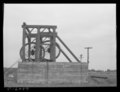 Tipple at a Michigan copper mine in 1941
 -
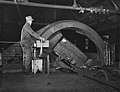 A rotary dump of the Pittsburgh Coal Co.
 -
 Coal tipple in Belmont County, Ohio, 1923
 -
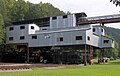 Coal tipple in Blue Heron, Kentucky


_(cropped2).jpg)

See also
[edit]References
[edit]
- ^ The Coal and Metal Miners' Pocketbook of Principles, Rules, Formulas and Tables (9th ed.). Scranton, PA: International Textbook Co. 1905. p. 617.
- ^ International Correspondence Schools (1900). A Treatise on Coal Mining; Part 24 (2nd ed.). Scranton, PA: The Colliery Engineer Co. pp. 63ff.
- ^ a b Dixon, Thomas W. (1994). Appalachian Coal Mines & Railroads. Lynchburg, VA: TLC Publishing. ISBN 1-883089-08-5.
- ^ Ketchum, Milo S. (1913). The Design of Mine Structures. New York: McGraw-Hill. p. 154.
- ^ Rakes, Paul H. (2012). "Coal Mine Mechanization." The West Virginia Encyclopedia. West Virginia Humanities Council, Charleston, WV.
Tipple
View on GrokipediaDefinition and Etymology
Definition
A tipple is a specialized surface structure at a mine site primarily used for loading extracted product, such as coal or ores, into transportation vehicles, such as railroad hopper cars or trucks.[6] This facility represents a key component of mining operations, enabling the efficient transfer of raw or partially processed material from mine cars to larger transport systems.[2] The core functions of a tipple include providing temporary storage for incoming material, performing initial sorting by particle size through screening and crushing, and preparing the material for shipment by ensuring it meets basic quality and size requirements. Tipples can range from basic loading facilities to those with integrated screening and crushing equipment for initial processing.[7] These activities occur after material has been brought to the surface, focusing on aggregation and basic handling rather than advanced beneficiation.[8] Tipples differ from broader mining facilities, such as those dedicated to underground extraction or full-scale preparation plants that involve extensive washing to remove impurities; instead, they emphasize product loading and rudimentary processing to facilitate immediate transport.[2] In the context of U.S. coal mining, tipples were particularly vital during periods when rail transport dominated distribution, serving as the critical interface between mines and rail networks.[9]Etymology
The term "tipple" in mining derives from the dialectal English verb "tipple," meaning to tip over or overturn, a frequentative form of the verb "tip." This etymology reflects the structure's primary function in emptying material from minecarts by tipping them.[10] The noun usage for a mining apparatus or facility first appeared in print in 1880, marking its entry into documented English mining terminology during the expansion of industrial coal production.[10] The word evolved from general overturning actions associated with "tip" into specialized mining jargon, with related terms like "tipping" directly describing the dumping mechanism for mine cars.[11] It gained prominence in English-speaking mining regions, especially Appalachia, where dense networks of bituminous coal mines adopted the term for local facilities handling material discharge and initial processing.[2] The term "tipple" is used in both American and British English mining contexts, though it is more commonly associated with American coal mining regions.[12]History
Origins in the 19th Century
The development of coal loading facilities, including early tipples, occurred during the late 19th century amid the industrial coal boom in the anthracite regions of Pennsylvania and bituminous coal fields of the United Kingdom and United States, propelled by the rapid expansion of rail networks that enabled efficient coal export to urban and industrial markets.[13] In the United States, this development aligned with the growth of railroads like the Philadelphia and Reading Railroad, which by the 1840s connected Pennsylvania mines to eastern ports and cities, transforming coal from a local resource into a national commodity.[13] Similarly, in the UK, rail infrastructure such as the Stockton and Darlington Railway (operational since 1825) and subsequent lines facilitated coal shipment from northern coalfields to southern ports, supporting the export trade that reached tens of millions of tons annually by the 1850s.[14] Early loading methods involved elevated wooden platforms where coal-filled minecarts were positioned for manual tipping or gravity-assisted dumping directly into waiting rail cars below, minimizing labor-intensive shoveling and speeding up the loading process.[5] These structures, often built adjacent to mine shafts and rail sidings, represented a practical adaptation to the increasing volume of coal output, with basic hoists or chutes handling the transfer without mechanical power.[15] In the UK, analogous loading facilities known as staithes—wooden or stone platforms with chutes for gravity discharge—evolved alongside rail development, as seen at Wearmouth Colliery in Sunderland, where deep shafts operational from 1846 integrated with port loading for export.[14] Prominent early tipple examples appeared at Pennsylvania anthracite mines in the late 19th century, including those facilitating coal loading for shipment via canal and rail to Philadelphia's burgeoning markets, thereby boosting regional production from approximately 1 million tons in 1840 to 3.7 million tons by 1850.[13] These facilities marked a shift from manual wagon loading at the pithead to organized rail integration, exemplified by the first coal shipments from the Old Barnett mine in 1855 via the Huntingdon and Broad Top Mountain Railroad.[15] The socioeconomic ramifications of these early loading facilities were profound, as they accelerated coal production growth—reaching 9.2 million tons in Pennsylvania by 1860—and underpinned the era's industrialization by supplying affordable fuel for ironworks, steam engines, and urban heating, while fostering urbanization through job creation in mining communities despite emerging labor challenges like the 1842 Minersville strike.[13] In both the US and UK, this infrastructure supported a surge in coal exports, with US rail lines like the Baltimore and Ohio shipping 3 million tons by 1878, fueling economic expansion and the transition to a coal-dependent society.[13]Technological Evolution in the 20th Century
The transition from manual to powered systems in coal tipples began in the late 19th and early 20th centuries, as steam engines replaced hand-operated dumping and hoisting mechanisms to handle growing industrial demand. By the 1890s, steam-powered shaking screens emerged for initial coal sizing, while steam hoists facilitated car dumping; for instance, at the Kenilworth Mine in Utah, 125-hp Kewanee steam boilers powered tipple operations starting around 1910.[16] Into the 1910s, early rotary car dumps—initially steam-driven in some installations—enabled automated unloading of coal cars by rotating them 180 degrees, reducing labor and spillage compared to manual tipping over rails. This mechanization marked a pivotal shift, with tipples evolving from wooden frames with bar screens to steel structures incorporating powered components for efficiency.[16][17] By the 1920s, conveyor belts supplanted minecarts for intra-tipple and mine-to-tipple transport in some operations, integrating with electric undercutting machines to streamline coal flow and boost processing rates. These rubberized belts, often electrically driven, allowed continuous movement of coal to screening and loading areas, elevating throughput in major operations to hundreds of tons per hour and supporting the era's rising output demands.[18][17] Mechanization accelerated as mines electrified—reaching 70% by 1920—replacing steam with electric motors for conveyors and auxiliary equipment, though full adoption varied by region.[17] Post-World War II automation transformed tipples into integrated facilities, with electric motors powering vibrating screens for precise size separation and crushers, aligning with peak U.S. coal production of approximately 530 million short tons annually in the mid-1950s.[19] By 1956, 89% of coal was machine-loaded via these systems, enhancing separation accuracy and reducing manual sorting.[17][18] Union advocacy, led by the United Mine Workers of America (UMWA), drove safety enhancements amid rising mechanization, pushing for enclosed tipple structures and ventilation to curb dust exposure from dumping and screening. These efforts influenced the 1969 Federal Coal Mine Health and Safety Act, which mandated dust sampling and limits, contributing to a sharp decline in fatal injuries from 686 in 1925 to 9 by 1989.[20][21][17]Design and Components
Core Structural Elements
Early coal tipples were primarily constructed using wood, such as timber for elevated platforms typically ranging from 15 to 60 feet in height to facilitate coal handling above ground level.[22] By the 1930s, designs transitioned to more durable steel and concrete materials, often reinforced for structural integrity and longevity in harsh mining environments, as exemplified by the 1936 Reliance Tipple.[23][24] Key structural features of tipples include elevated tracks positioned above rail beds to allow rail cars to be loaded directly beneath, large hoppers for accumulating and storing incoming coal, and chutes that enable controlled discharge into transport vehicles.[24][22] These elements form the static backbone, with hoppers often built from concrete and tracks supported by steel beams to handle the weight and flow of materials.[22] Tipples were typically integrated into mining sites adjacent to mine portals or rail sidings, spanning multiple levels to promote gravity-assisted flow of coal from upper receiving areas to lower loading points.[24] This positioning minimized the need for mechanical lifting and optimized efficiency in coal transfer.[25] Scale variations in tipple design reflected mine output, with smaller structures handling 200-500 tons daily for modest operations and larger ones accommodating up to 1,000 tons per day in high-production settings.[26] While core elements remained consistent, larger tipples incorporated expanded hoppers and extended track lengths to support greater throughput.[24] Some designs briefly integrated basic processing add-ons like screens atop the structural frame, though advanced equipment is addressed separately.[22]Processing Equipment
Processing equipment in coal tipples encompasses the machinery designed for initial handling, separation, and preparation of coal prior to loading, focusing on size classification, impurity removal, and controlled distribution. These components were essential for transforming raw coal from mines into marketable grades, with designs evolving to improve efficiency and product quality in both simple and integrated tipples.[27] Screening devices form a core part of tipple processing, utilizing vibrating screens or trommels to segregate coal by particle size into grades such as lump, nut, and pea. Vibrating screens, often mechanically shaken or powered by electric motors, employ perforated plates or wire mesh to allow finer material to pass through while retaining larger pieces, typically handling run-of-mine coal directly from the mine. Trommels, revolving cylindrical screens commonly installed in tipples, feature perforated drums that rotate to classify coal using mesh apertures ranging from 1 to 4 inches, effectively separating oversize rock or coal from smaller fractions in a continuous flow. These devices were standard in early 20th-century tipples to ensure uniform sizing without extensive manual labor.[27][28][29] In integrated tipples that combined loading with basic preparation, cleaning tools like jigs and cyclones addressed impurities such as rock and sulfur to enhance coal quality. Jigs operate on density separation principles, using pulsating water currents in a tank to stratify coal and heavier refuse, allowing the lighter clean coal to be drawn off as overflow while denser impurities settle and are discharged separately; these were particularly effective for coarse coal fractions in tipple settings. Cyclones, employing centrifugal force in a conical vessel, further refined the product by classifying fine particles and removing ash or sulfur-bearing materials, often as a secondary step after screening in more advanced installations. Such equipment enabled tipples to produce higher-grade coal suitable for industrial or export markets.[30][31] Loading mechanisms ensure efficient transfer of processed coal into railcars or storage, with rotary dumpers and belt feeders playing pivotal roles. Rotary dumpers secure railcars or mine cars on a rotating platform that inverts 180 degrees to discharge contents into underlying hoppers, minimizing spillage and handling high volumes typical of tipple operations. Belt feeders, consisting of short conveyor belts with adjustable speeds, regulate the flow of screened or cleaned coal from storage bins into loading chutes, promoting even distribution and preventing surges that could damage equipment or unevenly fill cars. These mechanisms were engineered for durability in dusty, abrasive environments common to coal handling.[32][33] Auxiliary systems support safe and accurate processing, including dust collectors and scales introduced to mitigate hazards and ensure compliance. Dust collectors, such as early cyclone separators or shaker-bag filters, captured airborne coal particles generated during screening and dumping, reducing explosion risks and improving air quality in tipple structures; these became more prevalent in the 1920s amid growing safety regulations. Scales, typically platform or track types integrated into the tipple framework, measured coal weight during loading for billing and quality verification, with quick-weighing dials calibrated in 1,000- or 2,000-pound increments to facilitate rapid throughput. These additions marked a shift toward mechanized quality control in mid-20th-century operations.[34][35]Operation
Coal Receiving and Dumping
Coal arrived at the tipple via underground rail systems, where it was transported from the mine workings in specialized minecars typically holding 1 to 4 tons of raw coal each, varying by era and region. These cars, often referred to as mine tubs or skips, were hauled to the surface by hoists or locomotives along inclined tracks, emerging at the tipple's receiving area to facilitate unloading. This method ensured a steady flow from deep mines, with the cars positioned on elevated tracks or dump stations for efficient transfer.[36] In the 19th century, dumping was predominantly manual, involving several laborers who physically tipped the cars using levers, winches, or sheer force to empty the contents over a chute or directly into receiving bins; this labor-intensive process aimed to manage the weight and prevent spillage. By the early 20th century, mechanical innovations such as rotary dumpers—where cars were rotated 180 degrees on a turntable—and bottom-dump mechanisms, which opened hinged floors, largely replaced manual methods, reducing the workforce needed through automation and safer handling. These advancements minimized injury risks and increased throughput, marking a key evolution in tipple efficiency.[36] Once dumped, the coal was directed into integrated storage hoppers, large bins such as those holding around 120 tons, designed to act as buffers against the irregular production rates common in underground mining operations. These hoppers, often constructed from wood, steel, or reinforced concrete, featured inclined sides and vibrating feeders to prevent coal from bridging and ensure a consistent feed to downstream processes. The buffering role was essential for maintaining operational continuity, allowing tipples to handle surges or delays without halting mine output.[4] Efficiency in the receiving and dumping phase improved dramatically over time; early manual setups processed around 20 to 30 cars per hour, while automated mechanical systems in the mid-20th century achieved rates exceeding 100 cars per hour, enabling larger-scale coal handling at central tipples. This progression supported the industrialization of coal mining, with rotary dumpers becoming standard by the 1920s in major U.S. coalfields.[36]Sorting, Cleaning, and Loading
In coal tipples, size sorting begins after the initial dumping of raw coal, where the material is passed over shaker or vibrating screens to separate it into marketable grades such as lump, egg, nut, and pea sizes, with finer particles often recycled back into processing or directed to waste piles. Methods varied by coal type and region, such as lignite processing in the Midwest using specific screen sizes. This screening process, common in 19th- and 20th-century operations, ensured that coal met specific customer requirements, such as pea-sized coal for industrial engines or larger lumps for smelting. Screen apertures varied, with examples including 1-inch and 3/8-inch meshes to grade lignite and bituminous coal effectively.[36][25] Cleaning processes in advanced tipples focused on removing impurities like ash, sulfur, and rock through water-based methods, particularly jigs and dense medium separation for coal sizes between 10 and 150 mm. These techniques, employing gravity concentration or froth flotation, could reduce ash content by up to 60% and pyritic sulfur by 30-50%, targeting clean coal with less than 10% ash to improve combustion efficiency and market value. In earlier setups, hand sorting on picking tables supplemented mechanical cleaning by manually removing shale and bone coal, a labor-intensive step phased out with mechanization in the early 20th century. Post-cleaning, dewatering via centrifuges, filters, or drainage removed excess moisture to prepare the coal for transport.[7][36] The loading sequence involved conveying the graded and cleaned coal via chutes or conveyor belts to rail car hoppers positioned beneath the tipple, filling them evenly to capacities of 50 to 100 tons per car by the mid-20th century for efficient shipment. This automated process, which evolved from manual methods, allowed high throughput; for instance, some tipples loaded up to 3,000 tons per hour, equivalent to 100 cars in 3.5 hours. Dust and fines not suitable for loading were routed to waste banks, minimizing losses.[36][25] Quality checks occurred throughout, with visual inspections and systematic sampling on picking tables or at loading points to verify consistency in size, ash content, and purity, rejecting substandard material to waste piles. These measures, documented in historical mining reports, ensured compliance with market standards and reduced contamination risks during dispatch.[36]Types and Variations
Simple Loading Tipples
Simple loading tipples were minimalist structures designed for small-scale coal mines, particularly those operating before the 1900s, featuring basic gravity dumps and chutes to facilitate the direct transfer of coal without any washing or processing facilities.[17] These wooden constructions relied on simple mechanical principles, where coal was elevated via ramps or small hoists and then released through inclined chutes into waiting railroad cars or wagons below.[36] Such tipples found widespread use in rural, low-output operations across regions like Appalachia, where they enabled the loading of unprocessed run-of-mine coal straight from the mine face into transport vehicles, supporting local fuel needs and early industrial distribution without the need for complex infrastructure.[17] This approach was ideal for isolated mines with limited access to advanced equipment, allowing operators to bypass extensive preparation and focus on basic extraction and shipment.[36] Notable examples include 19th-century tipples in the Appalachian coalfields, which typically handled daily capacities of 50 to 200 tons using rudimentary wooden frameworks.[17] These structures, often built near drift mine entrances, exemplified the era's reliance on manual labor and gravity-assisted loading to serve nearby railroads or canals.[36] The primary advantages of simple loading tipples lay in their low construction costs—around $2,000 in 1875 dollars—and rapid assembly, which permitted quick entry into production for small operators, though their design restricted them to markets for unrefined lump coal.[17] Over time, these basic models evolved into more sophisticated variants to accommodate growing industrial demands.[36] Variations for ore mining followed similar principles but adapted chutes and dumps for denser materials like iron or copper ores, often incorporating basic screening to separate waste rock before rail loading.[1]Integrated Preparation Plants
Integrated preparation plants emerged in the 1920s as multi-stage facilities that combined coal loading with comprehensive processing to produce high-purity output, incorporating crushers to reduce coal size, washers for impurity removal, dryers to lower moisture content, and centrifuges for dewatering after washing.[37] These plants evolved from earlier tipples by integrating gravity-based separation and chemical processes, enabling the handling of varied coal qualities while minimizing waste. These facilities typically operated at scales exceeding 1,000 tons per day, with many designed for continuous production through features like rail loops for efficient train positioning and storage silos that allowed stockpiling for 24/7 operations regardless of mining schedules.[39] For instance, the Hanna Coal Company's Willow Grove No. 10 preparation plant in Ohio processed up to 5,000 tons of cleaned coal daily in the mid-20th century, supporting large-scale distribution.[36] In the Illinois Basin, mid-20th-century plants like the Orient No. 3 Mine near Waltonville, Illinois, and the Freeman No. 4 Mine in southern Illinois exemplified this scale, with the latter achieving 500 tons per hour using heavy media vessels and screens to prepare bituminous coal.[40][41] Key innovations in these plants included the adoption of froth flotation cells starting in the 1920s, which enhanced recovery of fine coal particles by attaching air bubbles to hydrophobic surfaces, often achieving mass yields exceeding 90% from raw inputs.[37][42] By mid-century, Illinois Basin facilities incorporated advanced flotation designs with chemical agents and electronic control panels, reducing labor needs and improving efficiency in producing cleaner coal for industrial uses.[40] These developments marked a shift toward mechanized, high-yield processing distinct from basic loading operations.[37]Decline and Legacy
Post-WWII Decline
Following World War II, the traditional coal tipple faced rapid obsolescence due to profound economic shifts in transportation. The rise of truck and barge transport eroded the dominance of rail shipping, which had necessitated tipples for loading coal into rail cars. By the 1950s, escalating rail rates prompted many coal consumers to switch to barging, particularly along rivers like the Ohio and Mississippi, while improved highways facilitated truck hauls for short distances. Truck shipments grew from a small share of U.S. coal transport in the early 1950s and came to dominate short-haul segments by the 1970s, reducing the need for rail-oriented tipples by the 1960s.[19][43][44] Concurrent industry changes accelerated this decline. U.S. coal production, which peaked at around 680 million short tons in 1918 during the late 1910s and early 1920s boom, faced prolonged stagnation and then a post-war surge driven by electricity demand, but mechanized mining transformed operations. The introduction of continuous miners, longwall systems, and large-scale surface equipment like draglines reduced the volume of on-site processing required at tipples, as these methods produced larger, more uniform coal with less sorting and cleaning needed. Underground mines, which often relied on tipples, dropped by 90% in key states like Ohio between 1950 and 1970, shifting production to surface methods that bypassed traditional facilities.[45][36][46] Environmental regulations in the 1970s further hastened tipple closures by addressing coal dust emissions and slurry waste. The Clean Air Act of 1970 established national standards for particulate matter, including coal dust generated during loading and dumping at tipples, compelling operators to install costly dust suppression systems or shut down non-compliant sites. Complementary rules under the Federal Coal Mine Health and Safety Act of 1969 set respirable dust limits at 3 mg/m³, directly impacting tipple operations where airborne particles posed health risks to workers. These measures, combined with Clean Water Act provisions targeting slurry discharge, led to widespread decommissioning, especially in older facilities ill-equipped for compliance.[21][47] The statistical toll was stark: the U.S. hosted over 10,000 active coal mines in 1940, many with associated tipples, but this number fell to approximately 1,400 mines by 2000, with tipples concentrated in Appalachia (e.g., West Virginia, Kentucky) and the Midwest (e.g., Ohio, Illinois) as central and eastern operations consolidated. By 2000, active preparation plants numbered around 210 nationwide, a fraction of mid-century levels, reflecting the broader contraction.[36][48][49][50][51]Preservation and Modern Relevance
Efforts to preserve historic coal tipples have focused on recognizing their engineering and cultural significance through national listings and restoration projects. The Aladdin Coal Tipple in Crook County, Wyoming, constructed around 1898, is one of the last surviving wooden tipples from the late 19th century and was added to the National Register of Historic Places for its role in early coal operations.[52] Preservation work at the site, including stabilization in the 1990s and fencing for safety in 2018, has transformed it into an interpretive park, supported by local historical societies.[53] Similarly, the Reliance Tipple in Sweetwater County, Wyoming, built in 1910 and abandoned in 1955, was listed on the National Register of Historic Places in 1983 to highlight its sandstone foundation and multi-mine service.[54] In the Big South Fork National River and Recreation Area, the Blue Heron Mining Community—once Mine 18 operated from 1937 to 1962—features preserved "ghost structures" of its original tipple and buildings, reconstructed as open metal frames in the 1980s to evoke the site's layout without modern interference.[55] This National Park Service initiative reclaimed the abandoned area, incorporating models of the tipple and bridge to illustrate coal processing.[55] Since the 1980s, restored tipple sites have served as key venues for tourism and education, offering public access to mining heritage through guided tours and interactive exhibits. At Blue Heron, visitors explore audio recordings of former residents' stories, themed displays on community life, and historic photographs, fostering understanding of Appalachian coal culture.[55] The Aladdin Tipple supports school field trips and casual tourist stops along scenic routes, with pathways and signage providing context on 19th-century mining techniques.[56] These efforts emphasize the social and technological aspects of coal extraction, drawing annual visitors to sites that blend natural recreation with industrial history.[55] Contemporary coal operations at large surface mines have adapted tipple principles into hybrid facilities, where conveyor systems handle sorting, cleaning, and direct rail loading to streamline transport.[57] Modern steel structures equipped with screens and crushers process coal from pits via belts to hopper cars, maintaining efficiency in high-volume surface extraction while reducing manual handling. As of 2023, the U.S. had approximately 550 active coal mines and around 250 preparation plants, per EIA data, continuing the trend of consolidation. Ongoing federal efforts include nearly $725 million in fiscal year 2025 funding from the Department of the Interior for reclaiming abandoned coal mines, potentially benefiting historic tipple sites.[57][58][59] The legacy of tipples extends to industrial archaeology, where preserved examples inform studies of 19th- and 20th-century resource extraction and labor systems across the United States. Organizations like the Society for Industrial Archeology advocate for their protection as vital records of technological evolution, influencing broader efforts to document America's mining landscapes.[60]References
- https://dam.assets.ohio.gov/image/upload/ohiodnr.gov/documents/[geology](/page/Geology)/B72_Crowell_1995.pdf