Hubbry Logo
Common eiderCommon eiderMain
Open search
Common eider
Community hub
Common eider
logo
8 pages, 0 posts
0 subscribers
Be the first to start a discussion here.
Common eider
Common eider
from Wikipedia

Common eider
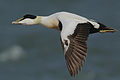
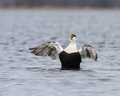
Adult male, breeding plumage
Female
Scientific classification Edit this classification
Kingdom: Animalia
Phylum: Chordata
Class: Aves
Order: Anseriformes
Family: Anatidae
Genus: Somateria
Species:
S. mollissima
Binomial name
Somateria mollissima
Subspecies
Range of S. mollissima
  Breeding range
  Wintering/Feeding range
Synonyms

Anas mollissima Linnaeus, 1758

Common eiders in the breeding season on Texel, the Netherlands

The common eider (pronounced /ˈ.dər/) (Somateria mollissima), also called St. Cuthbert's duck or Cuddy's duck, is a large (50–71 cm (20–28 in) in body length) sea-duck that is distributed over the northern coasts of Europe, North America and eastern Siberia. It breeds in Arctic and some northern temperate regions, but winters somewhat farther south in temperate zones, when it can form large flocks on coastal waters. It can fly at speeds up to 113 km/h (70 mph).[2]

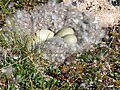
The eider's nest is built close to the sea and is lined with eiderdown, plucked from the female's breast. This soft and warm lining has long been harvested for filling pillows and quilts, but in more recent years has been largely replaced by down from domestic farm-geese and synthetic alternatives. Although eiderdown pillows or quilts are now a rarity—typically being marketed as luxury goods—eiderdown harvesting continues and is sustainable, as it can be done after the ducklings leave the nest with no harm to the birds.

Taxonomy

[edit]

The common eider was formally named by the Swedish naturalist Carl Linnaeus in 1758 in the tenth edition of his Systema Naturae. He placed it with all the other ducks in the genus Anas and coined the binomial name Anas mollissima.[3] It is now placed with two other species in the genus Somateria that was introduced in 1819 by the English zoologist William Leach.[4][5] The genus name is derived from Ancient Greek σῶμα sōma 'body' (stem somat-) and ἔριον erion 'wool'. The specific mollissimus is Latin, meaning 'very soft'. Both parts of the name refer to its down feathers.[6]

Subspecies

[edit]

Six subspecies are recognised:[5]

  • S. m. v-nigrum Bonaparte & Gray, GR, 1855 – breeds in northeast Asia and Alaska; winters in the Bering Sea and the Aleutian Islands
  • S. m. borealis (Brehm, CL, 1824) – breeds in northeast Canada, Greenland and Iceland; winters in the north Atlantic
  • S. m. sedentaria Snyder, 1941 – breeds in Hudson Bay and James Bay (Canada)
  • S. m. dresseri Sharpe, 1871 – breeds in southeast Canada and northeast US; winters around northwest Atlantic coasts
  • S. m. faeroeensis Brehm, CL, 1831 – Faroe Islands
  • S. m. mollissima (Linnaeus, 1758) – breeds in northwest Eurasia; winters in northwest and central Europe

Description

[edit]
A common eider skull
Egg, Collection Museum Wiesbaden

The common eider is both the largest of the four eider species and the largest duck found in Europe, and is exceeded in North America only by smatterings of the Muscovy duck, which only reaches North America in a wild state in southernmost Texas (and arguably south Florida where feral but non-native populations reside). It measures 50 to 71 cm (19+12 to 28 in) in length, weighs 0.81 to 3.04 kg (1 lb 12+12 oz to 6 lb 11 oz) and spans 80–110 cm (31–43 in) across the wings.[7][8] The average weight of 22 males in the North Atlantic was 2.21 kg (4 lb 14 oz) while 32 females weighed an average of 1.92 kg (4 lb 3+12 oz).[9] It is characterized by its bulky shape and large, wedge-shaped bill. The male is distinct, with its black and white plumage and green nape. The female is a brown bird, but can still be readily distinguished from all ducks, except other eider species, on the basis of size and head shape. The drake's display call is a strange almost human-like "ah-ooo", while the hen utters hoarse quacks. The species is often readily approachable.

Drakes of the European, eastern North American and Asia/western North American races can be distinguished by minor differences in plumage and bill colour. Some authorities place the subspecies v-nigra as a separate species.

This species dives for crustaceans and molluscs, with mussels being a favoured food. The eider will eat mussels by swallowing them whole; the shells are then crushed in their gizzard and excreted. When eating a crab, the eider will remove all of its claws and legs, and then eat the body in a similar fashion.

It is abundant, with populations of about 1.5–2 million birds in both North America and Europe, and also large but unknown numbers in eastern Siberia (HBW).

A particularly famous colony of eiders lives on the Farne Islands in Northumberland, England. About 1,000 pairs still nest there every year. It has been claimed that these birds were the subject of one of the first-ever bird protection laws, and that the first wildlife preserve was established for them by Saint Cuthbert in the year 676, though this is not likely to be true. No mention of the hermit having any affinity with birds is found in any documents until the publication of a story about 500 years after his death.[10] The stories told in these later works also do not involve any concerns about habitat loss or other concepts in modern nature conservation.[10] Because St. Cuthbert is the patron saint of Northumberland, it was natural that the eider should be chosen as the county's emblem bird; the birds are still often called St Cuthbert's ducks or Cuddy's ducks in the area (Cuddy is the familiar form of Cuthbert).

In Canada's Hudson Bay, important eider die-offs were observed in the 1990s by local populations due to quickly changing ice flow patterns. The Canadian Wildlife Service has spent several years gathering up-to-date information on their populations, and preliminary results seem to show a population recovery.[11][12][13] The common eider is the object of the 2011 documentary People of a Feather,[citation needed] which studies the historical relationship between the Sanikiluaq community and eiders, as well as various aspects of their ecology.[14]

The common eider is one of the species to which the Agreement on the Conservation of African-Eurasian Migratory Waterbirds (AEWA) applies.

Social behaviour

[edit]

Eiders are colonial breeders. They nest on coastal islands in colonies ranging in size of less than 100 to upwards of 15,000 individuals.[15] Female eiders frequently exhibit a high degree of natal philopatry, where they return to breed on the same island where they were hatched. This can lead to a high degree of relatedness between individuals nesting on the same island, as well as the development of kin-based female social structures.[16] This relatedness has likely played a role in the evolution of co-operative breeding behaviours amongst eiders. Examples of these behaviours include laying eggs in the nests of related individuals[17] and crèching, where female eiders team up and share the work of rearing ducklings.[18]

[edit]

References

[edit]
[edit]
Revisions and contributorsEdit on WikipediaRead on Wikipedia
from Grokipedia
The Common eider (Somateria mollissima) is a large sea duck and the largest species in the Northern Hemisphere, measuring 23–27 inches (58–69 cm) in length with a wingspan of about 41 inches, distinguished by its heavy, lethargic build, long sloping bill adapted for foraging on rocky substrates, and striking sexual dimorphism in plumage: breeding males are predominantly white with black cap, back, and tail, accented by a pistachio-green nape and variable bill color (orange in western populations, olive-gray in eastern), while females and immature males are barred in warm brown and black for camouflage. Native to the Holarctic , the Common eider breeds in colonies along mid- to high-latitude northern coasts, from and through , , , and eastern , with six recognized adapted to regional variations; it migrates southward to winter in shallower coastal waters, bays, and estuaries as far as in , western in , and the in , though some southern populations remain sedentary. Its preferred habitats are rocky shorelines, islands, and tundra free from heavy predation, where it rarely ventures into freshwater except during migration; the is highly marine-oriented, spending most of its life on or near saltwater. Behaviorally, Common eiders are sociable birds that form large flocks of several thousand individuals offshore, with males performing elaborate displays involving crooning calls and head-bobbing; in depressions lined with and insulating down plucked from the 's , often in dense colonies alongside terns for , laying 3–5 olive-gray eggs incubated solely by the for 23– days. Ducklings are precocial and leave the nest soon after , forming communal "crèches" of 150 young tended by multiple while biological mothers , a strategy that enhances survival in predator-rich environments; the diet consists primarily of marine invertebrates such as mussels, clams, crabs, and sea urchins, which are swallowed whole after being pried from rocks with the bill. The global population is estimated at 3.3–4 million individuals, with significant concentrations in Europe (791,000–955,000 breeding pairs), but it has experienced moderate declines exceeding 40% in some regions over the past three decades, leading to its classification as Near Threatened on the IUCN Red List due to threats including overharvesting of eiderdown, hunting, oil pollution, habitat disturbance, avian diseases like cholera, and climate change impacts on breeding grounds. Notably, the species' soft, dense down has been harvested sustainably for over 1,000 years for bedding and insulation, particularly in Iceland where artificial nest huts support commercial collection without harming populations.

Taxonomy

Etymology

The common name "eider" derives from the Old Norse word æþr, meaning "eider duck," which entered English via Dutch, German, or Swedish forms in the mid-18th century, with the first recorded use in 1743 referring to the bird or its down. The scientific name Somateria mollissima was originally described by Carl Linnaeus in 1758 as Anas mollissima in the tenth edition of Systema Naturae, placing it among the ducks in the genus Anas. In 1819, English zoologist William Elford Leach transferred it to the newly established genus Somateria, where it has remained without significant subsequent changes. The genus name Somateria is a New Latin formation from Ancient Greek sôma ("body," stem somat-) and erion ("wool"), alluding to the bird's soft, wool-like downy plumage. The specific epithet mollissima is the superlative form of Latin mollis ("soft"), meaning "very soft," further emphasizing the texture of its feathers.

Classification and subspecies

The common eider (Somateria mollissima) is classified within the , , , and swans, specifically in the and the , which encompasses the . This placement reflects its to marine environments, distinguishing it from freshwater ducks in other . Within the Somateria, which includes the three other eider , the common eider is recognized as a distinct based on morphological, ecological, and genetic criteria. It is most closely related to the king eider (Somateria spectabilis), sharing phylogenetic affinities within the as evidenced by molecular analyses. Six subspecies of the common eider are currently recognized, primarily differentiated by geographic isolation, subtle variations in bill morphology (such as the shape, size, and extent of frontal lobes and nasal saddle), plumage tones, and body size. These subspecies partition the species' circumpolar range across the Northern Hemisphere, with limited gene flow due to migratory patterns and breeding site fidelity. The following table summarizes the recognized subspecies, their primary geographic ranges, and key distinguishing morphological traits:
SubspeciesGeographic RangeDistinguishing Morphological Traits
S. m. mollissima (nominate)Northern Europe, including Scandinavia, Baltic Sea, and northwestern RussiaModerate-sized bill with small, triangular frontal lobes; males have a pale green nasal saddle and extensive white on the back; females show lighter barring.
S. m. faeroensisFaroe Islands and adjacent North Atlantic islandsSmaller overall size (3–15% smaller than nominate); bill with reduced frontal processes; females exhibit darker, more uniform brown plumage with finer barring; supported by mtDNA similarity to Shetland populations.
S. m. borealisIceland, Greenland, and eastern Canada (Labrador)Larger bill with more extensive green on the nasal saddle; males show a steeper forehead profile; body size intermediate between nominate and American forms.
S. m. sedentariaHudson Bay region, Arctic Canada (Manitoba to Nunavut)Long, broad bill with rounded frontal lobes extending toward the eye; sedentary populations with larger body mass; males have prominent white wing patches.
S. m. v-nigrumSiberia, Bering Sea, and western Alaska (Pacific coast)Distinct V-shaped black feathers on the white belly in males; bill with pronounced, wedge-shaped frontal lobes; overall darker plumage tones adapted to Pacific conditions.
S. m. dresseriNortheastern North America (Maine to Labrador, Gulf of St. Lawrence)Similar to sedentaria but smaller; bill with broad, rounded processes; males display a more extensive black cap and green nape patch.
Recent genetic studies have largely supported the validity of these subspecies, though they highlight nuances in differentiation. A 2024 genomic analysis of over 300 individuals across North American breeding sites revealed deeper genetic divergence between Pacific (v-nigrum) and eastern (borealis, sedentaria, dresseri) populations, aligning with their wintering grounds in the Pacific versus Atlantic/Hudson Bay and indicating limited gene flow that reinforces subspecies boundaries. Additionally, a chromosome-level genome assembly from a female common eider in 2024 provided a high-quality reference for future studies, confirming low heterozygosity consistent with structured populations but not challenging current taxonomy. Earlier molecular work, such as mtDNA sequencing, has occasionally suggested overlaps (e.g., Shetland birds aligning with faeroensis rather than mollissima), but post-2020 research emphasizes geographic and wintering-related drivers of genomic structure over wholesale revisions.

Physical characteristics

Size and measurements

The Common eider (Somateria mollissima) is a large sea duck, with adults measuring 50–71 cm in body length, exhibiting a wingspan of 80–108 cm, and weighing between 1.2 and 2.9 kg. These measurements are derived from extensive banding studies and museum specimens across its range, showing consistent averages for the species overall. Sexual dimorphism is pronounced in size, with males typically larger than females; males average 55–66 cm in length and 1.8–2.6 kg in weight, while females measure 53–61 cm and 1.2–2.0 kg. This difference is evident in morphometric data from captured birds during breeding seasons, where male body mass can exceed female mass by up to 30%. Subspecies exhibit notable size variations, with the northern race (S. m. borealis) being the largest; males of this can reach weights up to 3.0 kg, based on specimens from populations. In contrast, the American race (S. m. dresseri) tends toward the lower end of the range. Relative to other , the Common eider ranks among the largest, surpassing like the (Clangula hyemalis) in body and , though its robust build is adapted for . The bill measures 6–7 cm in , featuring a gently sloping profile that aids in foraging, with measurements from museum skins confirming this across . Its legs are positioned toward the rear of the body, facilitating efficient propulsion during underwater pursuits, as observed in anatomical studies of dissected specimens.

Plumage and sexual dimorphism

The adult male common eider displays pronounced sexual dimorphism through its striking black-and-white breeding plumage, featuring a black cap, white back and forewings, and a white chest. A distinctive light emerald green patch adorns the nape and sides of the head, contrasting sharply with the otherwise crisp pattern that develops fully by the third year. In summer, following breeding, males undergo an eclipse molt into a duller, brownish plumage resembling that of females, which includes mottled brown tones with retained white patches on the chest and wings; this temporary phase renders them flightless for approximately one month. Adult females exhibit a more subdued, camouflaged plumage suited to nesting, characterized by uniform brownish feathers ranging from reddish-brown to pale grayish-brown, with dark barring on the flanks and sides for blending into rocky or vegetated substrates. The overall pattern lacks the bold contrasts of males, emphasizing mottled tones that provide effective concealment during incubation. Juveniles of both sexes closely resemble adult females at hatching, with grayish-brown down that transitions to barred brownish plumage by the first winter; immature males progressively acquire whiter feathering and green nape tones over two to three years, while females reach adult coloration by their third year. Molt cycles in common eiders follow a biannual pattern typical of sea ducks, involving pre-basic (post-breeding) and pre-alternate (pre-breeding) molts. Males initiate the pre-basic molt in late June or early July after departing breeding areas, replacing colorful alternate feathers with eclipse basic plumage over summer to fall, often at sea molting sites; they then undergo pre-alternate molt in late fall to regain breeding attire by winter. Females typically molt later, in autumn after caring for flightless young, retaining camouflage plumage year-round without an eclipse phase. Full adult plumage, including definitive male patterns, is not attained until the third winter, with young birds molting up to eight times in their first three years to achieve maturity. Subspecies of the common eider show subtle plumage variations, particularly in tone and intensity. The nominate European subspecies (S. m. mollissima) features a more vividly emerald green nape in males, while North American forms like the American eider (S. m. dresseri) exhibit a slightly yellower or less pronounced nape patch. Female plumage varies geographically, with eastern North American birds (S. m. dresseri) tending toward warmer reddish-brown hues and Hudson Bay populations (S. m. sedentaria) displaying paler grayish-brown tones, adaptations possibly linked to local habitats. Pacific races such as S. m. v-nigrum show similar patterns but with regional bill and feathering differences around the loral area.

Distribution and habitat

Geographic range

The Common eider (Somateria mollissima) exhibits a circumpolar distribution across the Arctic and subarctic regions of the northern hemisphere, primarily along coastal marine habitats where ice-free conditions allow breeding in summer. Its breeding range spans the northern coasts of Europe, from Norway and the Baltic Sea eastward through Russia to Novaya Zemlya, as well as Iceland and Greenland. In North America, breeding occurs along the Arctic coasts from western Alaska through the Canadian Arctic Archipelago to Labrador and southward to the Gulf of St. Lawrence and Maine. This distribution is interrupted by persistent sea ice in central portions of the Russian and Canadian Arctic. During winter, the species' range compresses southward as northern populations migrate to ice-free coastal waters. Wintering grounds include the southern Baltic Sea and North Atlantic coasts of Europe extending to western France, as well as the northeastern United States from Newfoundland south to New Jersey. In the Pacific, wintering occurs along the Bering Sea coasts and Aleutian Islands down to southern Alaska in North America and the Kuril Islands in Asia. Sedentary populations remain in polynyas and leeward coastal areas where open water persists year-round. Vagrant individuals have been recorded farther south, such as in Florida on the Atlantic coast and Washington state on the Pacific coast, though these are rare. The species comprises several subspecies with distinct geographic distributions. S. m. mollissima breeds along the northwestern Eurasian coasts from Scandinavia to the Barents Sea and winters southward to France. S. m. faeroeensis is restricted to the Faroe Islands and adjacent areas. S. m. borealis breeds in Greenland, Iceland, and northeastern Canada, wintering in the northwest Atlantic. S. m. dresseri occupies eastern North America, breeding from Labrador to Massachusetts and wintering from Newfoundland to Rhode Island. S. m. sedentaria is confined to the Hudson and James Bays region. S. m. v-nigrum breeds in northeastern Siberia and Alaska, wintering in the Bering Sea and Aleutian Islands. In the 20th century, protective legislation and reduced human disturbance on breeding islands facilitated range expansions in southern portions of North America, such as increased breeding in Maine and Massachusetts. However, 21st-century records indicate contractions in southern breeding ranges, particularly in the Gulf of St. Lawrence and Nova Scotia, linked to environmental changes, while wintering distributions in some Atlantic areas have shown temporary expansions before recent declines.

Habitat preferences

The Common eider (Somateria mollissima) prefers breeding habitats consisting of rocky coastal islands and low-lying tundra shores in arctic and subarctic regions, where nests are typically placed among gravel, rocky, or mossy substrates with sparse vegetative cover such as grasses or lichens to provide concealment and protection from predators. These sites are often small offshore islands or narrow points of land that minimize exposure to mammalian predators while remaining close to marine foraging areas. For foraging, Common eiders favor shallow coastal waters, generally 5– in depth, characterized by hard substrates like rocky reefs and boulder-strewn seabeds that support dense beds of mussels (Mytilus edulis) and other benthic . These nearshore environments allow for efficient diving and head-dipping to access prey, with selection strongly influenced by high prey to optimize during feeding bouts. Such preferences directly their diet, which is dominated by mussels in these mussel-rich shallows. During winter, Common eiders roost in large aggregations within sheltered inshore coastal areas, including bays, estuaries, and leeward sides of islands that remain ice-free or near polynyas—open water areas in otherwise ice-covered seas. These protected zones provide respite from harsh winds and waves while allowing quick access to foraging sites, with birds often floating at the surface in flocks. The species exhibits notable adaptations to Arctic conditions, including a thick layer of insulating down feathers that traps air and maintains body heat in frigid marine environments, enabling year-round residence in cold waters where temperatures can approach freezing. This down, plucked from the breast for both personal insulation and nest lining, contributes to their hardiness as the largest and most marine-oriented duck in the Northern Hemisphere.

Behavior and ecology

Feeding and diet

The Common eider (Somateria mollissima) is primarily a benthic forager, relying on marine invertebrates as the core of its diet, with blue mussels (Mytilus edulis) comprising up to 90% of intake in many populations where these prey are abundant. Other key prey include crustaceans such as crabs and amphipods, polychaete worms, echinoderms like sea urchins, and occasionally small fish or fish eggs, reflecting opportunistic feeding based on local availability. During winter, the diet may incorporate more diverse items like green sea urchins brought to the surface for processing, while seasonal shifts occur toward plant matter—such as algae, berries, seeds, and leaves—particularly by incubating females on breeding grounds to supplement limited access to animal prey. Foraging occurs mainly during daylight hours through head-down dives from the water surface, propelled primarily by powerful webbed feet to reach depths of 10–20 , where the bird uses its specialized, chisel-shaped bill to dislodge and grasp epibenthic prey. Prey items are swallowed whole and crushed in the muscular , with eiders often processing larger mussels at the surface to remove shells before consumption. Daily food intake reaches up to 250 g of soft tissue (flesh), equivalent to 20–30% of body , enabling the bird to meet high metabolic demands in cold marine environments. Dietary preferences vary by age and sex; pre-breeding females often consume softer prey such as herring eggs and polychaetes like Nereis virens to support calcium needs for eggshell formation, differing from the harder-shelled mollusks favored year-round by males and non-breeding adults. Juveniles similarly prioritize smaller, softer invertebrates in shallow intertidal zones. These strategies optimize energy acquisition, with eiders often foraging in loose groups to enhance vigilance against predators while exploiting mussel beds.

Breeding and reproduction

The Common eider exhibits a seasonally monogamous , with pairs typically forming during winter flocks through displays such as head tossing and cooing by males. In some populations, pairs maintain long-term bonds across multiple seasons, while females show strong site fidelity, often returning to the same nesting areas. characteristics, including the male's bold black-and-white , play a in mate attraction during this period. Breeding occurs in large colonies on low-lying coastal islands or shorelines, where females construct simple ground nests in depressions lined with vegetation, rocks, and their own down after laying the third egg. Clutch sizes average 4–6 eggs, which are olive-green and unmarked, laid from late May to early June depending on latitude. Incubation lasts 25–28 days and is performed almost entirely by the female, who fasts during this period and loses 25–40% of her body mass to sustain both herself and the developing embryos. The male remains nearby to guard the female and nest against predators during the early incubation phase but departs for molting grounds shortly after, leaving no further parental involvement. Ducklings are precocial, hatching covered in down and leaving the nest within hours to follow the female to nearby waters. Broods frequently amalgamate into large crèches, often tended by multiple females including non-breeding "aunties" that provide protection and guidance without being the biological mother. These groups forage in sheltered coastal areas rich in invertebrates, with ducklings achieving fledging at 70–75 days post-hatching. Overall breeding success is relatively low, averaging 0.5–1.0 fledglings per nest in many populations, primarily due to high predation rates on eggs and ducklings by gulls, crows, and mammals. Factors such as nest concealment and colony size influence predation risk, with success varying from 15–79% across studies.

Social interactions

Common eiders exhibit highly gregarious behavior outside the breeding season, forming large winter rafts on coastal waters that typically consist of hundreds to thousands of individuals, though flocks can occasionally reach tens of thousands in size. These rafts facilitate social cohesion and predator vigilance, with birds maintaining close proximity while resting or preening. Within these groups, subtle hierarchical dynamics emerge through displays such as head-throwing, where males toss their heads upward while emitting cooing calls, establishing dominance or spacing among individuals. Vocalizations play a key role in non-reproductive social communication, with males producing distinctive advertising calls described as "ah-oo" or cooing notes that carry across water and help coordinate group movements or signal alertness. Females contribute with low, grunting or hoarse calls, often used in group contexts to maintain contact or respond to disturbances, though these are less frequent than male vocalizations. Such sounds also aid in territory defense during non-breeding aggregations, where individuals use harsh grating calls like "kor-korr-korr" to ward off intruders or potential threats within the flock. Interspecific interactions often involve competition with gulls, such as gulls, for suitable nest sites in coastal areas, leading to aggressive chases and displacement attempts by eiders to secure . Additionally, occasional hybridization occurs with closely related like the king eider, resulting in rare mixed observed in overlapping ranges, though such are infrequent and do not significantly impact . Post-hatching, non-reproductive alloparenting is evident in the formation of crèches, where multiple females, including non-breeders and failed nesters, collectively tend to mixed groups of ducklings, providing protection through shared vigilance and occasional adoption of unrelated young. This cooperative behavior enhances duckling survival by diluting predation risk, with genetic studies indicating kin-biased associations among attendant females that strengthen group stability without direct parental investment.

Migration and movements

Patterns and routes

The Common eider (Somateria mollissima) is a partial migrant, with northern populations undertaking southward movements from breeding grounds to temperate coastal wintering areas, while more southern populations, such as the (S. m. sedentaria), remain largely sedentary year-round within ice-free waters. This allows many individuals to exploit persistent open in polynyas or leeward coastal zones, minimizing long-distance where possible. Key migratory routes follow coastal corridors to avoid inland barriers and optimize access to . In , the Baltic/Wadden Sea flyway directs birds along the coasts from breeding sites in and the southward to wintering grounds in the Wadden Sea and Danish waters. In , the Atlantic flyway channels northern from areas like Baffin Bay and Hudson Strait southward along and Newfoundland coasts to wintering sites in and the mid-Atlantic seaboard. These pathways overlap briefly with static winter ranges but emphasize dynamic coastal transit. Subspecies exhibit distinct migration distances and directions, reflecting regional adaptations. The northern subspecies (S. m. borealis), breeding from northern Labrador to Ellesmere Island and Greenland, typically engages in shorter to medium-distance migrations to nearby wintering areas in southwest Greenland or Atlantic Canada, though some individuals travel over 2,000 km via routes like the Canada-West Greenland flyway. In contrast, the Pacific subspecies (S. m. v-nigrum), breeding from Alaska's Beaufort Sea eastward to Siberia's Chaun Bay, undertakes trans-Bering movements to winter in the Bering Sea and Aleutian Islands, spanning vast Pacific Arctic expanses. Navigation relies heavily on coastal following, with birds hugging shorelines and ice edges during transit, supplemented by sensitivity to Earth's magnetic fields for orientation, as demonstrated in broader sea duck studies. telemetry, including Argos platform transmitter terminals deployed on over 160 individuals across breeding ranges, has mapped these routes with high precision, revealing fidelity to specific flyways and variability in path lengths influenced by ice conditions.

Timing and triggers

The breeding migration of the Common eider (Somateria mollissima) typically occurs from to May, with southern populations arriving as early as late and northern extending into mid-June. This northward movement is primarily triggered by increasing daylight lengths, which serve as a photoperiod cue to initiate gonadal development and departure from wintering grounds, and by the seasonal of , which opens access to breeding islands and areas. Following breeding, males, immatures, and nonbreeders undertake a post-breeding molt migration southward in and to reach protected waters suitable for replacement and recovery. females, which remain on breeding grounds to care for young, delay their molt migration until late or , after fledge around 70 days post-hatching. These movements align with the energetic demands of molting, during which flightlessness necessitates secure habitats away from predators. The return to wintering areas, known as fall migration, peaks in October and November, with most populations reaching southern destinations by mid-December. This southward shift is cued by deteriorating weather conditions, including autumn storms that reduce foraging efficiency, and increasing food scarcity as advancing sea ice limits access to benthic prey like mussels in northern latitudes. Climate change has influenced these patterns, with warmer winters and earlier ice melt advancing spring migration and breeding arrival by up to 1–2 weeks in some European populations over recent decades, potentially desynchronizing eiders with peak food availability.

Conservation

Population status

The global population of the Common eider (Somateria mollissima) is estimated at 3.3–4 million individuals, with Europe (including Greenland) holding more than 60% and significant concentrations also occurring in Canada and Russia. Regional trends vary across the species' range. In Europe, populations have experienced moderate declines exceeding 40% over the past three generations (approximately 27 years). In the Baltic/Wadden Sea flyway, the population declined by ~36% from ~1.2 million individuals in 1991 to ~760,000 in 2000; in Denmark, wintering numbers dropped ~50% from ~800,000 in the early 1990s to ~370,000 in 2000. In North America, trends are mixed, with some subspecies such as S. m. v-nigra (Pacific) showing declines while others, like S. m. borealis (northern), exhibit stability or increases in certain colonies; recent estimates indicate up to 85% loss of breeding eiders in the southern part of their Canadian range as of 2024. The International Union for Conservation of Nature (IUCN) classifies the Common eider as Near Threatened globally (last assessed 2018), due to ongoing declines in key European subpopulations that are not fully offset by stability elsewhere. Some regional subpopulations, particularly in the Baltic, are considered more vulnerable and approach Near Threatened thresholds independently. Population monitoring relies on methods such as aerial surveys to count breeding pairs and wintering flocks, as well as ground-based nest counts on key colonies. These approaches, including the International Waterbird Census and flyway-scale counts, provide essential data for tracking trends across subspecies and regions.

Threats and management

The Common eider faces several anthropogenic threats that have historically and currently impacted its populations across its range. Historical overhunting in the 19th century drastically reduced numbers, particularly in North America, where exploitation brought American Common eider populations to very low levels by the century's end. In regions like the Maine coast, populations fluctuated greatly but were greatly diminished during this period due to unregulated harvest. Egg collection has also posed risks, though it is now prohibited in countries such as Canada, Finland, Greenland, and the United States, with limited personal use permitted only in Iceland. Oil spills represent a significant ongoing hazard, especially for Arctic and sub-Arctic populations that congregate in dense flocks. Major incidents have caused substantial mortality, including an estimated 15,000 deaths from spills in Norway during 1981–1982 and thousands affected near the Pribilof Islands in 1996; chronic pollution remains a concern in Icelandic waters. Additionally, outbreaks of highly pathogenic avian influenza (HPAI) in the 2020s have contributed to mass mortality events among wild birds, including seabirds like the Common eider, as part of a global epizootic affecting over 400 species since 2021. Climate change exacerbates these pressures by altering marine habitats critical to the species. Loss of sea ice in High Arctic areas like Svalbard fjords disrupts breeding site accessibility and foraging conditions, influencing population dynamics through changes in ice cover that affect nest site selection and prey availability. Shifting prey distributions due to warming oceans further challenge the eider's benthic feeding habits, compounding declines observed in some regions. Conservation management focuses on mitigating these threats through regulatory and protective measures. Hunting is regulated via quotas and seasonal limits in key areas, including bans or restrictions in Canada, Finland, Greenland, Norway, Russia, and the United States, with approximately 115,000 birds harvested annually in Denmark, Norway, Sweden, and Finland under controlled frameworks. Protected areas play a vital role, such as those in Svalbard, where 65% of the land area is conserved under Norway's network, including nature reserves that safeguard breeding colonies as part of the Circumpolar Protected Areas Network. Sustainable cultural practices also support conservation, notably the collection of eiderdown from abandoned nests in Iceland, a tradition over 1,000 years old that does not harm breeding birds and is regulated to ensure ethical harvesting. Similar regulated down harvesting occurs in Canada and Norway, promoting coexistence between human use and population stability. These efforts have helped stabilize or recover populations in managed areas, though ongoing monitoring is essential given persistent declines in some locales.

References

Add your contribution
Related Hubs
User Avatar
No comments yet.