Hubbry Logo
Centaurea nigraCentaurea nigraMain
Open search
Centaurea nigra
Community hub
Centaurea nigra
logo
8 pages, 0 posts
0 subscribers
Be the first to start a discussion here.
Centaurea nigra
Centaurea nigra
from Wikipedia

Centaurea nigra
Scientific classification Edit this classification
Kingdom: Plantae
Clade: Tracheophytes
Clade: Angiosperms
Clade: Eudicots
Clade: Asterids
Order: Asterales
Family: Asteraceae
Genus: Centaurea
Species:
C. nigra
Binomial name
Centaurea nigra
Dried flower heads of Centaurea nigraMHNT
Illustration

Centaurea nigra is a species of flowering plant in the family Asteraceae, and is also known as lesser knapweed, common knapweed, black knapweed and bell weed.

It is native to central Europe,[1] and has been introduced to temperate North America and Australasia, where it is usually regarded as a noxious weed due to its fast spread, hardiness and competitive potential.

Description

[edit]

Centaurea nigra is an upright herbaceous perennial growing up to c. 1 m (3.3 ft) in height.[2][3] It produces spreading rhizomes.[2]

C. nigra initially produces a basal rosette of leaves, which are usually entire and up to 30 cm long (11.8 in).[2] Once the rosette is fully formed, it produces upright stems before eventually dying away.[2] These upright stems turn purple when mature. The leaves on these stems are smaller, 1-8 mm x 2-10 mm, usually entire, grey-green and roughly hairy.[2]

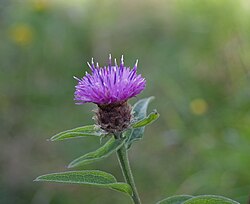
The inflorescence is globe-shaped, 10-20 mm x 30-40 mm, and contains small purple to reddish flowers that are fringed by black or dark brown bracts.[2]

The fruit (seeds) are a light brown flattened ovoid 3-4 mm long, topped with short bristles c. 1 mm.[2] In its native range, flowering occurs in summer to autumn from June-July until September.[4][5]

Ecology

[edit]
Deschambault-Grondines, Quebec, Canada

Centaurea nigra boasts high nectar and pollen production relative to other British perennial meadow flowers.[6] Nectar, pollen and seeds are highly important food resources to many species of invertebrates and birds. In its native range, C. nigra can therefore greatly improve biodiversity values and ecosystem services, such as pollination, when planted with a variety of other forbs, for example on field margins.[7][8]

In its introduced range, C. nigra is often considered a weed because it excludes native vegetation and can reduce agricultural potential. In the United States, it invades meadows where it excludes native vegetation, thereby impacting native biodiversity.[2] In Australia and New Zealand, C. nigra is known to invade grasslands, wastelands (e.g. railway lines, roadsides, waste areas) and agricultural lands.[2]

Similar species

[edit]

Black Knapweed is similar to Brown Knapweed (Centaurea jacea), Spotted Knapweed (C. stoebe) and Greater Knapweed (C. scabiosa).[2] It is also relatively similar to Creeping Knapweed (Rhaponticum repens) and Star Thistle (Centaurea calcitrapa).[2] Centaurea × moncktonii, is a fertile hybrid between black knapweed and brown knapweed.[9]

References

[edit]
[edit]
Revisions and contributorsEdit on WikipediaRead on Wikipedia
from Grokipedia
Centaurea nigra, commonly known as black knapweed or common knapweed, is a in the family characterized by erect stems growing 30–150 cm tall, with basal leaves that are petiolate, oblanceolate to elliptic, and 5–25 cm long, and distal leaves that are sessile and linear to lanceolate. It produces discoid flower heads in corymbiform arrays, featuring 40–100 purple florets (rarely white) that are 15–18 mm long, surrounded by ovoid to hemispheric involucres 15–18 mm in diameter with distinctive blackish bracts. The plant reproduces via tan cypselae 2.5–3 mm long with blackish pappi, and it has a chromosome number of 2n = 22 or 44. Native to western Europe, including the British Isles, western Norway, Sweden, and central Italy, C. nigra has been introduced to North America, where it was first collected in Washington state in 1895, likely via ships' ballast or as an ornamental. In its introduced range, it is widely distributed across the northeastern and northwestern United States, including states such as California, Connecticut, Idaho, Illinois, Maine, Michigan, New York, Oregon, Pennsylvania, and Washington, as well as Canadian provinces like New Brunswick, Newfoundland, Nova Scotia, Ontario, Prince Edward Island, and Quebec. It is classified as a noxious weed in Colorado and Washington due to its invasive potential. Centaurea nigra thrives in a variety of habitats, including roadsides, fields, clearings, waste areas, prairies, open forests, and disturbed sites from to 300 m , preferring soils with a of 6.1–7.8. It flowers from summer to fall (–October) and spreads both sexually through viable seeds lasting over a year and asexually via ground-level meristems. Ecologically, it can slightly reduce native diversity and increase herb layer in invaded areas without majorly altering structure, though it poses challenges in agricultural and natural settings.

Taxonomy

Etymology and nomenclature

The genus name Centaurea originates from Greek mythology, where it is associated with the centaur Chiron, who reportedly discovered the medicinal properties of plants in this genus and used them to create poultices for healing wounds, including his own inflicted by Hercules' arrow. This etymological link reflects ancient beliefs in the healing virtues of these plants, with the name derived from the Greek kentaureios, meaning "belonging to the centaurs," later Latinized as Centaurea. The specific epithet nigra, Latin for "black," refers to the dark brown to black tips on the involucral bracts that surround the flower heads. Centaurea nigra belongs to the family. Common names for the species include black knapweed, common knapweed, lesser knapweed, hardheads, and bell weed, reflecting its distinctive features and historical usage in English-speaking regions. The term "knapweed" derives from Old English cnæp or knappr, both meaning "knob" or "bud," alluding to the hard, knob-like flower heads. The prefix "black" highlights the dark coloration of the bracts, while "hardheads" emphasizes the rigid, solid nature of those heads. Centaurea nigra was first formally described by in his seminal work (volume 2, page 911) in 1753, establishing its under the Linnaean system. Historical naming variations include synonyms such as Centaurea jacea subsp. nigra and Centaurea nemoralis, reflecting taxonomic debates and regional interpretations prior to and following Linnaeus's classification.

Classification and subspecies

Centaurea nigra belongs to the kingdom Plantae, phylum , class Equisetopsida ss., subclass Magnoliidae, order , family , genus , and species C. nigra. Within the genus , it is placed in the Jacea group of the subgenus Centaurea, part of the Circum-Mediterranean , characterized by a basic chromosome number of x = 11, though molecular studies have highlighted incongruences in traditional sectional boundaries due to recent and hybridization events. The species forms part of a complex with closely related taxa such as C. jacea, where hybridization complicates taxonomic boundaries, leading to ongoing debates within the C. jacea aggregate. Recognized infraspecific variation includes two subspecies: C. nigra subsp. nigra (common knapweed), which is widespread, and C. nigra subsp. nemoralis (lesser knapweed), more restricted to woodland habitats, distinguished by traits such as leaf shape and margins; however, the status of subsp. nemoralis is debated, with some authorities elevating it to full species rank as debeauxii. Hybrids are common in this group, notably C. × moncktonii, a fertile hybrid between C. nigra and C. jacea, exhibiting intermediate characteristics and contributing to the taxonomic complexity of the aggregate through homoploid and polyploid forms. These hybridization events, supported by molecular evidence from ITS and chloroplast DNA analyses, underscore the challenges in delimiting species boundaries, with intermediate forms often blurring distinctions in the field.

Description

Morphology

Centaurea nigra is an upright herbaceous that grows 30–150 cm tall, forming a basal rosette from a woody before bolting to produce multiple erect, branched stems. The stems are round with longitudinal grooves, covered in fine cobwebby hairs, and may be hairless in some individuals; they often branch in the upper portion, terminating in solitary flower heads. Basal leaves are petiolate, oblanceolate to lanceolate, 5–25 cm long and up to 3 cm wide, with shallowly dentate or lobed margins and a bright green to grey-green coloration; they taper toward the base and may be undivided or have small teeth. Cauline leaves are smaller, 1–10 cm long, sessile, linear to lanceolate, entire or sparsely toothed, and increasingly bract-like toward the stem apex, with grey-green surfaces and arachnoid pubescence. The consists of terminal, solitary or clustered capitula that are ovoid to hemispheric, 15–18 mm in diameter, subtended by an involucre of imbricate in several rows; outer are green and rounded, while inner have fimbriate margins fringed in black or brown. Each capitulum contains 40–100 tubular, hermaphroditic florets that are pinkish-purple to purple (rarely white), lacking ray florets, and blooming from to . variations primarily occur in the coloration and extent of fringing on the involucral margins. The plant has a number of 2n = 22 or 44. The fruits are light brown achenes, 2.5–3 mm long, sparsely pubescent with short hairs, topped by a short pappus of bristles 0.5–1 mm long (occasionally absent); each achene is produced within the persistent calyx, with plants capable of yielding from a few dozen to several hundred seeds per individual.

Reproduction

Centaurea nigra exhibits a flowering typical of summer-blooming perennials, with blooms occurring from to in its native European range. Each capitulum, or flower head, contains 40 to 100 or more florets that open sequentially, extending the period of availability and supporting prolonged visits. The florets are hermaphroditic, with purple corollas measuring 15–18 mm in length. Pollination in C. nigra is primarily entomophilous, relying on insects such as bees, flies, and butterflies for transfer, though the species is self-compatible and capable of autogamy. While self-pollination can occur, cross-pollination is favored under natural conditions due to the species' promotion of outcrossing through floral morphology and pollinator behavior. Seed production is prolific, with a single plant capable of generating up to 1,000 seeds annually under favorable conditions. These seeds, known as cypselae, are tan, 2.5–3 mm long, and finely hairy, with viability persisting for 1–5 years in the soil seed bank. In addition to , C. nigra demonstrates limited vegetative propagation through root sprouts and crown regeneration, particularly in disturbed or established populations, which enhances its persistence in habitats. of C. nigra seeds typically occurs in autumn or spring under moist conditions, promoting emergence aligned with the plant's reproductive cycle.

Distribution and habitat

Native range

Centaurea nigra is native to central and , with a distribution spanning from in the north to the Mediterranean region in the south, and eastward to parts of the and . Specific countries within its native range include , , , , , , , , the , , northwestern Balkan Peninsula regions, , , , and . This occurs commonly in temperate zones, favoring open landscapes across a variety of elevations up to approximately 600 meters. In its native habitats, C. nigra thrives in dry to mesic grasslands, meadows, edges, roadsides, and areas with disturbed soils. It prefers full sun to partial shade and tolerates poor soils that are or neutral in pH, though it avoids cold, wet, peaty conditions due to its deep . In the , it is a characteristic and often dominant in the National Vegetation Classification (NVC) community MG5, known as Cynosurus cristatus–Centaurea nigra mesotrophic grassland, which represents species-rich, neutral to mildly meadows. The species is well-adapted to temperate climates, exhibiting and cold hardiness suitable for regions with annual precipitation ranging from 500 to 1,000 mm and winter temperatures down to -20°C. These adaptations allow it to persist in variable conditions, from coastal verges to inland fields, without requiring high .

Introduced ranges

Centaurea nigra, native to central and , was first recorded outside its native range in in 1895 near , USA, likely introduced via or as an . By the early , the species had spread to other parts of , including , as well as to and , with early collections in New Zealand dating to 1894 in . In , it was first documented in Victoria in 1910, probably as an escaped ornamental. Today, C. nigra is established across temperate regions of , with common occurrences in the (such as New York and ) and the states (including Washington and ). In , it is widespread in provinces like , , , , , and . The plant is also naturalized in , particularly in Victoria and , as well as throughout . It is classified as a noxious weed in several U.S. states, including Washington and , due to its invasive potential. Introduction pathways include both intentional planting as a garden ornamental and accidental transport via contaminated hay, crop seed, or machinery from . Once established, C. nigra spreads rapidly along linear disturbances such as roadsides and railways, facilitated by its prolific seed production and ability to tolerate disturbed soils. In introduced areas, C. nigra primarily invades open, disturbed habitats like pastures, rangelands, meadows, and waste places. It thrives in a variety of soils but prefers neutral to slightly alkaline conditions and full sun exposure, mirroring aspects of its European habitats while adapting to new climates.

Ecology

Pollination and seed dispersal

Centaurea nigra flowers produce substantial amounts of and , making them an important for pollinators in their native habitats. Each flower head yields approximately 1.5 mg of nectar sugar over 24 hours, with pollen production reaching 2.1 μl per head, values that are among the highest recorded for British native wildflowers. Nectar secretion occurs continuously in newly opened florets during the first day, typically ceasing by late afternoon, which aligns with peak insect activity earlier in the day. The primary pollinators of C. nigra are various insects, including bees and syrphid flies, which visit for nectar and pollen. C. nigra is largely self-incompatible, resulting in low selfing rates and a strong reliance on outcrossing facilitated by these pollinators to ensure reproductive success. Seed dispersal in C. nigra is primarily anemochorous, with lightweight achenes equipped with a pappus of fine bristles that enables wind transport, though most seeds travel only 1-2 m from the parent plant under typical conditions. Secondary mechanisms include epizoochory, where seeds adhere to animal fur via rough surfaces, and endozoochory, with viable seeds passing through the digestive systems of birds and mammals to enable occasional longer-distance movement. Human activities further promote dispersal, particularly through seeds attaching to vehicles or contaminating hay and seed mixes, allowing spread over distances of tens to hundreds of meters or more. Overall, per-generation dispersal averages 1-5 m locally, contributing to the formation of dense patches while rare long-distance events drive range expansion.

Interactions with other species

Centaurea nigra engages in various biotic interactions that influence its ecology in both native and introduced ranges. In its native European habitats, the plant serves as a significant nectar source for numerous pollinators, including over 20 insect species such as bees, butterflies, and hoverflies, providing high-quality nectar that supports their foraging needs during late summer when other floral resources may be scarce. For instance, studies quantify nectar production at approximately 1.5 mg sugar per floral unit, ranking it among the top perennial species for pollinator support. The species faces antagonism from herbivores and pathogens, particularly in its native range where natural enemies regulate its populations. Aphids like Uroleucon jaceae feed on stems and leaves, potentially reducing plant vigor, while parasitoids such as Aphidius funebris target these aphids in response to plant-emitted volatiles. Weevils including Larinus minutus and Larinus spp. consume foliage and developing seeds, with larvae damaging receptacles and thereby limiting reproduction. Fungal pathogens, such as rust species in the genus Puccinia (e.g., P. jaceae), infect leaves and stems, causing defoliation and weakening the plant under favorable conditions. These interactions collectively control C. nigra density in Europe, preventing dominance. In terms of competition, C. nigra exerts negative effects on neighboring through allelopathic root exudates that inhibit the growth of grasses and other . These chemical compounds, released into the , suppress competitors, enhancing the knapweed's ability to establish dense patches. In invaded areas, this leads to the formation of monocultures that reduce local by outcompeting native vegetation for resources. Centaurea nigra also plays a trophic role as a food source for higher-level consumers. Its seeds are consumed by granivorous birds, such as goldfinches (Carduelis carduelis), providing essential winter forage. Stems and foliage are grazed by herbivores like rabbits (Oryctolagus cuniculus), contributing to nutrient cycling through litter decomposition, though specific contributions remain context-dependent in ecosystems. Differences between native and introduced ranges highlight the enemy release hypothesis, where C. nigra experiences fewer specialist herbivores and pathogens outside , leading to reduced damage and higher fitness in non-native habitats like . In these areas, the absence of co-evolved enemies allows greater accumulation and spread, exacerbating invasive impacts.

Human interactions

Uses

In traditional European herbalism, Centaurea nigra was applied as a to treat wounds and sores, owing to its properties derived from . Infusions of the plant served as remedies for digestive disorders and as a . These uses are documented in medieval texts, including Nicholas Culpeper's Complete Herbal (1653), which describes the plant's efficacy in staunching bleeding from the or and healing internal or external wounds. As an , C. nigra is cultivated in gardens for its vibrant flowers and notable . It thrives in meadows, borders, and as , with achieved easily through seeds or division. In native regions, C. nigra occasionally provides for , despite its generally low . The flowers have been utilized in folk crafts to produce dyes yielding hues. For successful cultivation, C. nigra requires well-drained soil and full sun exposure, performing well in USDA hardiness zones 3 through 8. Established plants tolerate dry, low-fertility, and alkaline conditions, and the species self-seeds prolifically.

Invasiveness and management

Centaurea nigra is classified as a noxious weed in several regions outside its native range, including Class B status in Washington state and listings in Colorado within the United States, where it is prohibited from transport, sale, or distribution. In Canada, it is designated as a prohibited noxious weed under Alberta's Weed Control Act and is recognized as invasive in provinces such as Prince Edward Island and British Columbia. In Australia, it is an established invasive species in states such as Victoria, South Australia, and Tasmania, where strategic eradication plans target its limited infestations to prevent wider spread. This species forms dense monocultures in introduced areas, particularly in grasslands and rangelands, which can reduce available forage for livestock and wildlife by displacing desirable vegetation. The invasive success of C. nigra stems from its ability to outcompete native plants through rapid growth and the formation of persistent stands, leading to decreased plant diversity and degradation of habitats in meadows, pastures, and open areas. It contributes to in grasslands by crowding out , increasing , and elevating risks due to accumulated dead . Economic impacts include heightened production costs for ranchers through reduced quality and quantity, as well as broader losses in agricultural rangelands; while specific figures for C. nigra are limited, related knapweed invasions in the U.S. cause substantial annual damages estimated in the tens of millions for control and lost productivity. Although direct evidence of strong in C. nigra is less documented than in congeners like spotted knapweed, its competitive dominance suggests chemical interference may play a role in suppressing native flora. Effective management of C. nigra emphasizes integrated approaches starting with prevention, such as ensuring clean seeds and equipment to avoid inadvertent spread along roadsides and disturbed sites. Mechanical methods include hand-pulling small patches to remove the entire , mowing or clipping before seed set to limit reproduction, and deep in larger areas, though regrowth from fragments can occur. Chemical control involves targeted applications like or clopyralid, ideally in pre-bloom stages for optimal efficacy, often combined with follow-up monitoring to address survivors. Biological control agents have been explored for knapweeds in , though specific implementations for C. nigra are limited due to its lower invasiveness. In its native European range, C. nigra is not typically targeted for conservation but contributes to ecosystems; however, in protected habitats like semi-natural , it may benefit from broader restoration efforts to maintain . Post-eradication in invaded regions, conservation strategies focus on replanting to restore competitive vegetation and prevent reinvasion. Challenges to control include a persistent viable for over a year, complicating long-term eradication. Additionally, hybrid vigor with other knapweed , such as forming meadow knapweed (C. × moncktonii), enhances invasiveness and resilience to management efforts.

Identification

Distinguishing characteristics

Centaurea nigra is readily identifiable by its unique involucral bracts, which feature fimbriate (fringed) margins that are black or dark brown on the inner rows, imparting the characteristic "" appearance to the flower heads; the outer bracts are typically ovate and glabrous. These bracts lack any spines, distinguishing the plant from spiny relatives in the family. The capitula are solitary at the ends of branches, consisting solely of tubular disk florets without ray flowers, and measure approximately 15–25 mm in diameter with pink-purple (rarely white) corollas. The leaves of C. nigra exhibit arachnoid woolly hairs, conferring a grey-green hue to the foliage; basal leaves are pinnatifid or lobed, up to 150–250 mm long and 10–60 mm wide, while cauline leaves are entire or weakly lobed, lanceolate, and progressively smaller upward, with fuzzy undersides. Like the bracts, are spineless, further aiding identification. Stems are erect, branched near the apex, and non-spiny, often displaying a purplish tint at the base as they mature, supporting a growth habit of 30–150 cm in height from a . The is primarily taprooted, enabling regeneration from , though occasional rooting at prostrate stem nodes can occur, unlike the more extensively rhizomatous habits of some congeners. Post-flowering, the persistent dark bracts on dried capitula provide a reliable winter identification cue, remaining conspicuous on the plant through autumn and into the dormant season.

Similar species

Centaurea nigra is often confused with other members of the genus Centaurea due to overlapping floral and vegetative traits, but key differences in morphology, dissection, and flower head size facilitate identification. Centaurea jacea, known as brown knapweed, shares similar purple florets with C. nigra, but its involucral s feature pale brown, rounded, papery margins with minimal fringing, contrasting the dark brown to black, prominently fringed and comb-like appendages of C. nigra s; additionally, C. jacea tends to be more pubescent overall. These species frequently hybridize, producing intermediates. In comparison to Centaurea stoebe, or spotted knapweed, C. nigra lacks the distinctive white-margined bracts spotted with black on C. stoebe, instead exhibiting uniformly dark-fringed bracts; leaves of C. stoebe are more deeply lobed. Centaurea scabiosa, greater knapweed, can be distinguished from C. nigra by its larger capitula, reaching up to 50 mm in diameter compared to 10-20 mm in C. nigra, along with a swollen receptacle and more deeply dissected leaves. Among other potential look-alikes, Rhaponticum repens (Russian knapweed, formerly Acroptilon repens) differs from through its spineless, grey-cottony stems and smaller, white to pinkish flower heads lacking the prominent purple florets of . Centaurea calcitrapa, or star thistle, has yellow florets and spiny bracts, unlike the purple, fringed bracts of . , musk thistle, features spiny-winged stems, prickly leaves, and distinctly nodding inflorescences, setting it apart from the non-spiny, upright heads of . The hybrid Centaurea × moncktonii, arising from C. nigra and C. jacea, exhibits intermediate characteristics, such as light to dark brown coloration with a thin, fringed margin, aiding in its recognition as a distinct entity.

References

Add your contribution
Related Hubs
User Avatar
No comments yet.