Hubbry Logo
logo
Community development block
Community hub

Community development block

logo
0 subscribers
Read side by side
from Wikipedia

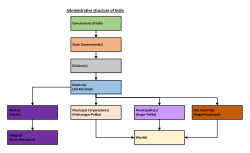
Administrative structure of India

In India, a community development block (CD block) or simply Block is a sub-division of District, administratively earmarked for planning and development.[1] In tribal areas, similar sub-divisions are called tribal development blocks (TD blocks).[2] The area is administered by a Block Development Officer (BDO), supported by several technical specialists and village-level workers.[3] A community development block covers several gram panchayats, the local administrative units at the village level. A block is a rural subdivision and typically smaller than a tehsil. A tehsil is purely for revenue administration, whereas a block is for rural development purposes. In most states, a block is coterminous with the panchayat samiti area.[4][5][6]

Nomenclature

[edit]

The nomenclature varies from state to state, such as common terms like "block" and others including community development block, panchayat union block, panchayat block, panchayat samiti block, development block, etc. All denote a CD Block, which is a subdivision of a district, exclusively for rural development.[7][6][4]

History

[edit]

The concept of the community development block was first suggested by Grow More Food (GMF) Enquiry Committee in 1952 to address the challenge of multiple rural development agencies working without a sense of common objectives.[8] Based on the committee's recommendations, the community development programme was launched on a pilot basis in 1952 to provide for a substantial increase in the country's agricultural programme, and for improvements in systems of communication, in rural health and hygiene, and in rural education and also to initiate and direct a process of integrated culture change aimed at transforming the social and economic life of villagers.[9] The community development programme was rapidly implemented. In 1956, by the end of the first five-year plan period, there were 248 blocks, covering around a fifth of the population in the country. By the end the second five-year plan period, there were 3,000 blocks covering 70 per cent of the rural population. By 1964, the entire country was covered.[10]

Block Development Officer

[edit]

A Block Development Officer (BDO) is an administrative officer in India responsible for the overall development of a Community Development Block (CD Block), a sub-division of a district. They are appointed by the state government and report to the Chief Development Officer (CDO) or District Development Commissioner or the similar position.

They typically fall under the purview of the Rural Development Department or Department of Panchayats of the respective state government. The BDO is responsible for overall supervision of all the antipoverty schemes and execution of the Developmental works.

The BDO functions as the Secretary of the Panchayat Samiti/Block Panchayat and exercises supervision and control over the extension officers and other employees of the Panchayat Samiti and the staff borne on transferred schemes.

Blocks statewise

[edit]

[11]

State CD Block Number of
CD Blocks
Andaman and Nicobar Islands CD Block 9
Andhra Pradesh Mandal 668
Arunachal Pradesh Block 129
Assam Block 239
Bihar Block 534
Chandigarh Block 3
Chhattisgarh CD Block 146
Dadra and Nagar Haveli and Daman and Diu CD Block 3
Delhi CD Block 342
Goa CD Block 12
Gujarat CD Block 250
Haryana Block 143
Himachal Pradesh CD Block 88
Jammu and Kashmir CD Block 287
Jharkhand Block 264
Karnataka CD Block 235
Kerala Block 152
Ladakh CD Block 31
Lakshadweep CD Block 10
Madhya Pradesh CD Block 313
Maharashtra CD Block 352
Manipur CD Block 70
Meghalaya CD Block 54
Mizoram CD Block 28
Nagaland CD Block 74
Odisha CD Block 314
Puducherry CD Block 6
Punjab CD Block 153
Rajasthan CD Block 353
Sikkim CD Block 33
Tamil Nadu Taluk 388
Telangana Mandal 594
Tripura CD Block 58
Uttar Pradesh CD Block 826
Uttarakhand CD Block 95
West Bengal CD Block 345

References

[edit]
Revisions and contributorsEdit on WikipediaRead on Wikipedia
from Grokipedia
In India, a community development block, often abbreviated as C.D. block, constitutes a rural sub-district administrative unit within a district, designated specifically for the coordinated planning and execution of rural development initiatives across multiple villages.[1] Headed by a Block Development Officer (BDO), who oversees a team of specialists in sectors such as agriculture, animal husbandry, and public health, the block functions as the pivotal intermediary tier in the Panchayati Raj framework, linking village-level gram panchayats with district authorities to implement central and state government schemes aimed at economic and social upliftment.[2][3] Originating from the national Community Development Programme initiated on October 2, 1952, these blocks were designed to foster self-reliant village economies through integrated efforts in infrastructure, education, and productivity enhancement, though evaluations have highlighted persistent challenges including uneven implementation and dependency on bureaucratic oversight rather than genuine grassroots participation.[4] As of recent administrative data, India encompasses thousands of such blocks, each typically serving populations ranging from 80,000 to 120,000, playing a critical role in programs like rural employment generation and sanitation drives, yet often critiqued for inefficiencies stemming from centralized funding and limited local fiscal autonomy.[5]

Definition and Scope

A community development block (CD block), also known simply as a block, constitutes a rural administrative subdivision in India positioned below the district and tehsil (or taluka) levels, serving as the foundational unit for coordinated planning and execution of rural development initiatives. Originating from the Grow More Food Enquiry Committee's recommendations in 1952 to tackle fragmented rural extension efforts, the structure was formalized through the national Community Development Programme launched on October 2, 1952, which initially established 55 pilot projects covering over 27,000 villages and a population of approximately 16 million.[6] [7] Administratively, each CD block encompasses a cluster of gram panchayats—typically numbering around 100 villages—with a combined population ranging from 80,000 to 120,000 and an area of 400 to 500 square kilometers, though exact demarcations are determined by state governments and adjusted for local geography, density, and administrative efficiency. The block is headed by a Block Development Officer (BDO), a state civil services officer responsible for overseeing development activities, implementing central and state schemes, monitoring progress, and liaising between district authorities and village-level bodies. While lacking a uniform central statutory definition under a single act, CD blocks are embedded in state Panchayati Raj legislations and recognized nationally in census operations and planning frameworks, such as those by the Ministry of Statistics and Programme Implementation, for disaggregated rural data presentation at the block level.[8] [9] [10] ![Administrative structure of India showing hierarchical position of community development blocks][float-right] This administrative delineation facilitates decentralized governance, aligning with post-independence efforts to integrate community participation in development, as reinforced by the Balwant Rai Mehta Committee's 1957 recommendations for Panchayat Samiti institutions at the block level, though the block's operational framework predates formal constitutional amendments like the 73rd in 1992. State variations exist; for instance, in some regions, blocks may align precisely with Panchayat Samiti jurisdictions, ensuring the BDO's role in both executive administration and elected local body coordination.[11]

Geographical and Demographic Coverage

Community development blocks in India delineate the rural portions of districts, excluding statutory towns, urban local bodies, and census towns, to facilitate targeted rural development initiatives. These blocks form contiguous territorial units comprising multiple gram panchayats and villages, enabling localized planning for agriculture, infrastructure, and social services. According to the Local Government Directory of the Government of India, there are 7,309 such development blocks nationwide, distributed across states and union territories to align with varying rural topographies and administrative requirements.[12] Demographically, CD blocks cover India's rural population, estimated at 65 percent of the national total as of 2021, primarily comprising agrarian communities with dependencies on agriculture and allied sectors. This includes diverse groups such as Scheduled Castes, Scheduled Tribes, and other rural households, with block-level data often used for census enumeration and program targeting. For example, in Uttar Pradesh, 822 development blocks serve the state's substantial rural demographic, acting as intermediaries between district administrations and village-level panchayats.[13][14] Geographical extents of CD blocks vary by regional density and terrain: in populous Gangetic plains, blocks may span 100–300 square kilometers encompassing 100–200 villages, while in arid Rajasthan or hilly Northeast states, they can extend over 1,000 square kilometers with fewer settlements. This delineation traces back to the 1950s Community Development Programme, where initial blocks were standardized to cover 450–500 square miles (about 1,165–1,295 square kilometers) and roughly 300 villages for efficient resource allocation. Adjustments since then reflect decadal censuses and state reorganizations, ensuring coverage of non-urban landmasses that constitute the bulk of India's 3.287 million square kilometers total area.[15]

Historical Background

Pre-Independence Influences

Pre-independence rural development initiatives in India, primarily driven by nationalist leaders and local reformers rather than colonial administration, emphasized integrated, community-led reconstruction efforts that foreshadowed the block-level approach to holistic rural upliftment. These programs focused on agriculture, education, sanitation, and cooperatives within defined rural clusters, addressing the limitations of British revenue-centric policies like the Permanent Settlement of 1793, which prioritized land extraction over sustainable growth.[16][17] Mahatma Gandhi's vision of Gram Swaraj, articulated during the independence struggle from the 1920s onward, profoundly shaped these efforts by promoting self-reliant villages as the core of national development, integrating economic self-sufficiency with moral and social regeneration through participatory khadi production, sanitation drives, and village councils. Gandhi's ashrams, such as Sevagram established in 1936 near Wardha, served as models for rural reconstruction, influencing subsequent programs by demonstrating community mobilization for multi-faceted improvement without top-down imposition.[16][18] Key experimental projects included Sir Daniel Hamilton's 1903 Gosaba initiative in the Sunderbans region of Bengal, which organized cooperative societies across 145 villages to promote rice cultivation, fisheries, and education, achieving self-financing through local contributions and establishing a precedent for area-specific rural planning. Rabindranath Tagore's Sriniketan project, launched in 1921 near Santiniketan, engaged eight surrounding villages in cooperative farming, irrigation, and adult education via the Institute of Rural Reconstruction, emphasizing scientific agriculture and social equity to counter rural indebtedness. The Servants of India Society, founded by Gopal Krishna Gokhale in 1905, undertook rural surveys and sanitation campaigns in regions like Bombay Presidency, fostering voluntary service for community welfare.[19][20][21] In the closing years of British rule, provincial governments initiated more structured schemes, such as the Madras Presidency's Firka Vikas Yojana in 1946, which targeted development at the firka (a sub-tahsil administrative unit comprising 50-60 villages) through integrated agricultural extension, health, and infrastructure interventions, directly inspiring the post-independence block as a viable unit for coordinated rural programs. Similarly, the Baroda State's rural development efforts under Maharaja Sayajirao Gaekwad III from the early 1900s involved village-level cooperatives and education, while Spencer Hatch's Marthandam project in Travancore (1920s) integrated Christian missionary work with farming demonstrations across village clusters. These initiatives, though limited in scale and often reliant on private or princely funding, highlighted the efficacy of localized, multi-sectoral blocks over fragmented village efforts, influencing the national adoption of community development frameworks after 1947.[22][23][24]

Launch of Community Development Programme

The Community Development Programme (CDP) was formally launched by the Government of India on 2 October 1952, coinciding with Mahatma Gandhi's birth anniversary, as a nationwide initiative to foster integrated rural development.[25][26] This programme marked India's first large-scale, structured effort at post-independence rural reconstruction, emphasizing self-help, community participation, and improvements in agriculture, irrigation, health, education, and infrastructure to address widespread rural poverty and underdevelopment.[27][25] The launch began on a pilot basis with 55 Community Development Projects scattered across the country, each designated as a foundational administrative unit known as a community development block.[25] These initial blocks covered approximately 27,388 villages and a population exceeding 16 million, targeting regions with acute needs for economic and social upliftment.[6] The programme's structure allocated resources for multi-sectoral interventions, including the promotion of cooperative farming, village sanitation, and basic amenities, with an initial outlay supported by central government funding and technical assistance from agencies like the Ford Foundation.[27][28] Prime Minister Jawaharlal Nehru inaugurated the programme, underscoring its role in nation-building by linking rural progress to national self-reliance, though implementation relied heavily on bureaucratic oversight through block-level development officers rather than purely grassroots mechanisms.[26] Early phases prioritized demonstration effects in pilot areas to build momentum, with evaluations planned to assess efficacy in generating local initiative amid challenges like limited farmer buy-in and resource constraints.[25] By the end of the first year, the programme expanded its scope, setting the stage for nationwide replication while revealing tensions between centralized planning and actual community engagement.[6]

Integration with Panchayati Raj Reforms

The Community Development Programme, initiated on October 2, 1952, established administrative blocks for rural development but faced limitations in fostering local participation and democratic oversight.[29] To address these shortcomings, the Government of India formed the Balwant Rai Mehta Committee in January 1957 to evaluate the programme's efficacy.[29] The committee's 1958 report criticized the top-down approach of the CDP for inadequate community involvement and recommended integrating it with a decentralized governance structure.[30] Central to this integration was the proposal for a three-tier Panchayati Raj system: Gram Panchayats at the village level, Panchayat Samitis at the block level, and Zila Parishads at the district level.[30] The Panchayat Samiti was designed to align territorially with existing community development blocks, enabling elected representatives to oversee planning and implementation of development schemes previously managed bureaucratically.[31] The Block Development Officer (BDO), already heading the block's administrative staff, was designated as the executive officer of the Panchayat Samiti, ensuring coordination between elected bodies and technical experts while subordinating bureaucratic functions to democratic control.[32] These recommendations gained approval from the National Development Council in January 1958, prompting states to enact legislation.[33] Rajasthan pioneered implementation in Nagaur district on October 2, 1959, followed by Andhra Pradesh and other states by 1961, marking the formal fusion of community development blocks with elected Panchayati Raj institutions.[34] This reform shifted blocks from mere administrative units to hubs of participatory governance, though challenges persisted in devolving real powers amid state-level political interference.[35]

Organizational Structure

Block Development Officer Role

The Block Development Officer (BDO) is the chief executive officer of a community development block, tasked with overseeing rural development initiatives and serving as the administrative head of the Panchayat Samiti, the block-level body in India's three-tier Panchayati Raj system.[36][37] Appointed by the state government, typically from the state civil services cadre, the BDO coordinates between district authorities and village-level Gram Panchayats to ensure effective implementation of central and state schemes.[38][39] Qualifications for the position generally include a bachelor's degree from a recognized university, with selection occurring through state public service commission examinations and adherence to age limits varying by state, often between 21 and 38 years.[40] Primary responsibilities of the BDO encompass formulating and executing block-level development plans, including poverty alleviation programs, infrastructure projects, and welfare schemes such as those under the Mahatma Gandhi National Rural Employment Guarantee Act (MGNREGA).[41][42] The officer supervises a team of extension officers, junior engineers, and support staff, monitoring scheme progress, allocating resources, and ensuring compliance with government guidelines while fostering community participation.[43][39] In addition, BDOs handle administrative functions like land management, election duties as returning officers for panchayat polls, and disaster response coordination at the block level.[41][44] Within the administrative hierarchy, the BDO reports to the district collector or chief development officer while exercising supervisory control over Gram Panchayat activities and serving as secretary to the Block Development Council or equivalent body.[45][36] This positioning enables the BDO to bridge policy directives from higher authorities with grassroots execution, though effectiveness can vary due to resource constraints and local political dynamics.[41] State-specific adaptations exist; for instance, in some regions like Tamil Nadu, specialized BDOs handle program implementation separately from general administration.[38]

Panchayat Samiti and Local Bodies

The Panchayat Samiti, also known as the Block Panchayat or Mandal Parishad in some states, constitutes the intermediate tier of the three-tier Panchayati Raj system at the community development block level.[46] Enshrined under the 73rd Constitutional Amendment Act of 1992, it aligns territorially with the community development block, serving as the primary elected body for coordinating rural development activities across constituent villages.[47] Membership typically comprises all sarpanches or pradhans from the gram panchayats within the block, supplemented by directly elected members from block constituencies (often 20-30% of total seats), and ex-officio members including local Members of Parliament, Members of Legislative Assembly, and co-opted experts in fields like agriculture or social welfare.[48] Panchayat Samitis exercise oversight and coordination over local bodies, primarily the gram panchayats, by consolidating village-level plans into block-wide development strategies.[49] Key functions include preparing and approving annual block development plans focused on economic development and social justice, such as infrastructure projects, agricultural extension services, and minor irrigation works; implementing central and state schemes like those for rural roads, sanitation, and health; and allocating resources to gram panchayats while monitoring their execution.[48] The body also prioritizes community needs through participatory processes, including gram sabha inputs, and maintains standing committees for specialized areas like finance, education, and public health to ensure targeted interventions.[48] The Block Development Officer (BDO), an administrative civil servant, functions as the ex-officio secretary to the Panchayat Samiti, bridging elected representatives with executive implementation.[46] This arrangement facilitates technical support, supervision of extension officers in sectors like agriculture and animal husbandry, and integration of block activities with district-level zila parishads. While gram panchayats handle localized functions such as basic sanitation and water supply, the Panchayat Samiti ensures alignment with broader objectives, preventing silos in resource use and program delivery. Variations exist across states; for instance, in Tripura, the Panchayat Samiti Advisory Committee emphasizes need-based prioritization and scheme convergence.[48] Empirical data from evaluations indicate that effective Panchayat Samitis enhance scheme absorption rates, with blocks showing higher fund utilization when elected bodies actively engage local bodies.[50]

Supporting Administrative Framework

The Block Development Office serves as the central hub of the supporting administrative framework for community development blocks, housing a multi-disciplinary team that executes rural development initiatives under the oversight of the Block Development Officer (BDO). This office integrates technical expertise, administrative logistics, and field-level outreach to bridge central and state policies with local implementation, ensuring compliance with schemes like the Mahatma Gandhi National Rural Employment Guarantee Act (MGNREGA) and Pradhan Mantri Gram Sadak Yojana.[2][51] Supporting staff typically includes sector-specific extension officers for agriculture, animal husbandry, horticulture, and fisheries, who provide specialized guidance to farmers and monitor program delivery across the block's gram panchayats. Engineering personnel, such as junior engineers and sub-overseers, manage construction and maintenance of rural infrastructure, including roads, water supply systems, and community buildings. Administrative roles are filled by assistant development officers, accountants, and clerical staff responsible for budgeting, record-keeping, and reporting to district and state authorities.[2][39] At the grassroots level, village-level workers or gram sevaks—often 8 to 12 per block—act as intermediaries, conducting surveys, facilitating beneficiary enrollment, and promoting community mobilization for participatory planning. These workers, drawn from local or state services, report directly to extension officers and ensure last-mile connectivity between block directives and village councils. The framework also incorporates auditing and evaluation units to track fund utilization and project outcomes, with periodic reviews mandated by state rural development departments.[52][53] This structure operates under the state government's rural development department, which appoints and trains personnel, while central guidelines from the Ministry of Rural Development standardize core functions across blocks. Variations exist by state—for instance, northeastern states emphasize tribal area coordinators—but the emphasis remains on decentralized execution with accountability mechanisms like social audits.[54][55]

Functions and Responsibilities

Planning and Resource Allocation

The Panchayat Samiti, functioning as the elected body at the community development block level, formulates the Block Panchayat Development Plan (BPDP) by aggregating and reviewing Gram Panchayat Development Plans (GPDPs) from its constituent villages.[56] This process, mandated under Article 243G of the Constitution following the 73rd Amendment Act of 1992, emphasizes bottom-up planning for economic development and social justice, integrating local priorities such as agriculture, sanitation, and rural infrastructure with higher-level schemes.[57] The Ministry of Panchayati Raj's People's Plan Campaign, initiated in 2017-18, facilitates BPDP preparation through participatory exercises involving gram sabhas and block-level consultations to identify gaps and converge resources across sectors.[58] Preparation of the BPDP follows a structured framework issued by the Ministry of Panchayati Raj in November 2021, which outlines steps including data collection on existing assets, assessment of unmet needs via tools like the Gram Panchayat Development Plan portal, prioritization based on Sustainable Development Goals localization, and formulation of sector-specific action plans for five-year horizons.[59] Block-level officials, including the Block Development Officer, coordinate with line departments to ensure alignment with state and central guidelines, though empirical assessments indicate persistent challenges in shifting from top-down implementation to genuine decentralized planning due to capacity constraints at the block level. Approved BPDPs are forwarded to the District Panchayat for integration into the District Panchayat Development Plan (DPDP), enabling vertical convergence.[60] Resource allocation to community development blocks derives primarily from central and state grants, with the 15th Finance Commission (covering 2021-2026) devolving untied grants totaling ₹2.36 lakh crore to rural local bodies for discretionary local planning and tied grants for national priorities like water conservation and sanitation. Centrally sponsored schemes, such as the Mahatma Gandhi National Rural Employment Guarantee Act (MGNREGA) and Pradhan Mantri Awaas Yojana, channel funds to blocks based on demand assessments and plan approvals, with Panchayat Samitis responsible for intra-block distribution to Gram Panchayats and project execution.[48] State governments supplement these through their own allocations, often tied to block performance metrics, while blocks generate marginal own revenues from local taxes and fees, though these constitute less than 1% of total funds in most cases per empirical studies. The Block Development Officer oversees fund utilization, ensuring compliance with guidelines from bodies like the Comptroller and Auditor General, with annual action plans detailing budgeted expenditures across 29 subjects devolved under the 11th Schedule.[48] Despite these mechanisms, audits reveal inefficiencies, including delays in fund releases averaging 3-6 months, attributed to procedural bottlenecks at state levels.

Scheme Implementation and Coordination

The Block Development Officer (BDO), as the administrative head of the community development block, coordinates the implementation of central and state government schemes by translating district-level plans into actionable programs at the sub-district level. This involves identifying local needs through field assessments, allocating funds from schemes such as the Mahatma Gandhi National Rural Employment Guarantee Act (MGNREGA) and Pradhan Mantri Awas Yojana (PMAY), and ensuring timely execution via departmental extension officers in agriculture, health, and infrastructure.[61][62] The BDO's role extends to verifying beneficiary lists and procuring materials, with blocks typically covering 60,000–70,000 people across 80–100 villages to facilitate scalable yet localized delivery.[25] The Panchayat Samiti, the elected intermediate body within the block, supports coordination by approving annual plans, prioritizing schemes in sectors like water supply and sanitation, and integrating inputs from Gram Panchayats to align village-specific demands with block resources. This body holds regular meetings to review progress, resolve bottlenecks, and ensure compliance with scheme guidelines, such as those under the National Rural Livelihood Mission (NRLM), thereby bridging bureaucratic directives with community oversight.[48][63] Inter-block coordination occurs through district-level forums led by the Chief Development Officer, where BDOs report on metrics like scheme coverage rates and fund utilization—often exceeding 90% in high-performing blocks as per state audits—and address cross-block issues like watershed management projects. Challenges in synchronization, such as delayed fund releases, are mitigated via digital platforms like the e-Gram Swaraj portal for real-time tracking since its nationwide rollout in 2018.[41][2] Community engagement is embedded through block-level committees that facilitate participatory planning, ensuring schemes like rural road construction under the Pradhan Mantri Gram Sadak Yojana incorporate local feedback to enhance sustainability.[25]

Monitoring, Evaluation, and Community Engagement

The Block Development Officer (BDO), as the chief executive of the community development block, oversees day-to-day monitoring of centrally sponsored and state-level schemes, including field inspections, progress reporting to district authorities, and coordination with extension officers for agriculture, health, and infrastructure projects.[44] This involves tracking metrics such as fund utilization rates, beneficiary coverage, and scheme completion timelines, often through monthly reviews and digital platforms like the e-Gram Swaraj portal for real-time data submission.[64] National Level Monitors, empaneled by the Department of Rural Development for three-year terms starting January 1, 2024, conduct independent field visits to blocks to assess implementation fidelity and report irregularities directly to central ministries.[65] Evaluation at the block level integrates with the Development Monitoring and Evaluation Office (DMEO) under NITI Aayog, which conducts sector-specific reviews of rural development programs, analyzing outcomes against targets in areas like poverty alleviation and sanitation.[66] For instance, in the Aspirational Blocks Programme launched in 2021, blocks monitor 50 key performance indicators across health, nutrition, education, and agriculture, with quarterly evaluations feeding into national dashboards for adaptive interventions.[67] These processes emphasize outcome-based assessments, such as reductions in malnutrition rates or increases in school enrollment, though challenges persist in data accuracy due to reliance on self-reported block-level inputs.[68] Community engagement occurs primarily through Panchayati Raj Institutions (PRIs), where Gram Sabhas—mandatory village assemblies held at least twice annually—facilitate participatory planning, beneficiary selection for schemes like MGNREGA, and feedback on block-level projects.[64] The Panchayat Samiti, comprising elected representatives from gram panchayats within the block, reviews monitoring reports and incorporates community inputs via social audits, which scrutinize expenditures and service delivery to prevent mismanagement.[69] In practice, engagement extends to self-help groups and village-level committees for programs like NRLM, promoting bottom-up accountability, though participation rates vary, with higher involvement in states like Kerala due to stronger PRI devolution.[70]

Variations Across States

Distribution and Number of Blocks

Community development blocks, also known as development blocks or intermediate panchayats, number 7,309 across India's states and union territories as per the Local Government Directory maintained by the Ministry of Panchayati Raj.[12] This figure encompasses rural administrative units responsible for development planning at the sub-district level, with creation and delineation handled by state governments, leading to variations in nomenclature and boundaries.[71] The distribution of blocks is disproportionate to state size and population, influenced by rural density and historical administrative divisions. Larger, more populous states in the north and east host the majority; for example, Bihar operates 534 blocks across its 38 districts, while Uttar Pradesh maintains 822 development blocks serving as intermediate administrative tiers between its districts and villages.[72][14] In contrast, smaller states like Goa have only 12 blocks, and union territories such as Delhi report 342, often adapting the block concept to urban-rural interfaces or sub-divisions. States in the south and west, such as Andhra Pradesh and Karnataka, use terms like mandals or taluks but function equivalently, with Andhra Pradesh featuring 670 mandals post-reorganization.[5] This uneven spread reflects state-specific adaptations to the Panchayati Raj framework established by the 73rd Constitutional Amendment in 1992, which mandates three-tier local governance but allows flexibility in block numbers based on local needs. Periodic revisions occur; for instance, Ministry records noted 7,256 blocks in early 2024, indicating minor adjustments through state notifications.[71] Blocks typically cover 50-100 villages, averaging populations of 80,000 to 120,000, though densities vary from densely populated Gangetic plains blocks to sparsely settled arid or hilly regions.[15]

State-Specific Modifications and Adaptations

States retain flexibility under the 73rd Constitutional Amendment Act of 1992 to adapt community development (CD) blocks through their respective Panchayati Raj Acts, including variations in nomenclature, boundary alignments, devolved functions, and integration with state-specific schemes.[73] For instance, the block-level elected body is termed Panchayat Samiti in most states, but Mandal Parishad in Andhra Pradesh and Telangana, Panchayat Union Council in Tamil Nadu, and Taluka Panchayat in Gujarat, reflecting local administrative preferences while maintaining the core developmental mandate.[73] These adaptations often aim to align CD blocks more closely with revenue sub-divisions like tehsils or talukas, though in states such as Maharashtra, CD blocks focus exclusively on rural development and are not always coterminous with taluka revenue units, allowing separate handling of land records and development planning.[74] In Kerala, CD blocks have been significantly adapted through the People's Planning Campaign initiated in 1996, empowering block panchayats (equivalent to CD blocks) with enhanced participatory planning roles, including preparation of sector-specific plans for watersheds, agriculture, and infrastructure, and allocation of up to 40% of plan funds directly to local bodies for decentralized execution.[75] This model contrasts with less devolved states, as evidenced by Kerala's high ranking in the Panchayat Devolution Index 2024, which assesses states on functional and financial transfers, where southern states like Kerala and Karnataka demonstrate greater assignment of 29 subjects listed in the Eleventh Schedule, such as minor irrigation and rural housing, to block levels compared to northern states.[76][77] Recent structural modifications include Punjab's 2025 cabinet approval to restructure rural development blocks by aligning them precisely with district boundaries, reducing overlaps and improving administrative efficiency in scheme implementation across 23 districts.[74] In contrast, hill states like Uttarakhand adapt CD blocks to terrain-specific needs, with fewer blocks per district (averaging 5-7 versus the national 10-15) and integration of tribal area committees under the Sixth Schedule in northeastern states like Meghalaya, where traditional bodies partially substitute formal blocks for customary governance.[78] These variations underscore states' tailoring of CD blocks to local demographics, geography, and fiscal capacities, though uneven devolution persists, with only 20-30% of functions effectively transferred in many states per empirical assessments.[76]

Impact and Effectiveness

Key Achievements and Empirical Outcomes

The implementation of national rural development schemes through community development blocks has yielded measurable improvements in employment, infrastructure, and household amenities. Under the Mahatma Gandhi National Rural Employment Guarantee Scheme (MGNREGS), block-level execution generated 187.44 crore person-days of wage employment in FY 2019-20, with 104.11 crore days contributed by women workers and assets like water conservation structures created across 3.58 crore geo-tagged projects out of 4.44 crore total.[64] By FY 2024-25, this expanded to 196.30 crore person-days nationally, with central funding of Rs. 7,491.29 crore disbursed via blocks for unskilled labor in rural areas.[79] In housing and sanitation, blocks have driven the Pradhan Mantri Awaas Yojana-Gramin (PMAY-G), sanctioning 1.73 crore houses by November 2020, including 37.79 lakh for Scheduled Castes and 40.24 lakh for Scheduled Tribes, with 89.78 lakh completed toward a 1 crore annual target through convergence with MGNREGS labor.[64] This contributed to 76.7% of rural households possessing pucca structures by 2018, per National Sample Survey data.[64] Infrastructure connectivity advanced via the Pradhan Mantri Gram Sadak Yojana (PMGSY), where blocks facilitated linking of habitations with populations over 250 persons, connecting approximately 30% of previously unconnected rural areas by 2000 and enabling better access to block and district offices, as evidenced by increased villager visits post-road completion.[64][80] Electricity access reached 93.9% of rural households by 2018, supported by block-coordinated electrification drives.[64] Livelihood enhancements through the Deen Dayal Antyodaya Yojana-National Rural Livelihoods Mission (DAY-NRLM) at the block level mobilized women into self-help groups, providing revolving funds of Rs. 10,000-15,000 per group and fostering income diversification, which evaluations link to reduced vulnerability among the poorest households.[64] Broader outcomes include progress in the SDG India Index, with rural-focused indicators showing gains in poverty reduction and basic services, though block-level variations persist due to local execution factors.[81] These efforts correlate with national rural multidimensional poverty declining from 29.17% in 2013-14 to 11.28% in 2022-23, attributable in part to block-implemented welfare convergence.[82]

Criticisms of Implementation and Efficiency

Criticisms of the implementation of community development blocks in India center on chronic staffing shortages and capacity constraints at the block level, which undermine efficient execution of rural development schemes. In states such as Uttar Pradesh, Jharkhand, Andhra Pradesh, and Rajasthan, only about 50% of required posts at district and block levels remain filled, leading to overburdened officials and significant delays in program rollout.[64] These shortages, coupled with inadequate training, result in limited administrative skills for planning, monitoring, and convergent implementation of schemes like MGNREGS and PMGSY, as block development officers (BDOs) juggle multiple responsibilities without sufficient support staff.[64] Efficiency is further hampered by poor infrastructure maintenance and uneven scheme outcomes. For instance, under the Pradhan Mantri Gram Sadak Yojana (PMGSY), only 28% of constructed rural roads fall within the prescribed five-year maintenance period, with 72% exceeding it due to erosion, inadequate state funding for upkeep, and a focus on upgrading existing roads rather than new connectivity, deviating from core objectives.[64] Similarly, Mahatma Gandhi National Rural Employment Guarantee Scheme (MGNREGS) implementation varies widely across blocks, with weak Gram Panchayat monitoring, awareness gaps excluding lower-literacy groups like women, and inconsistent social audits, despite direct funding to audit units improving some functionality pre-2021.[64] Coordination failures and lack of feedback mechanisms exacerbate these issues, as siloed planning between central, state, and block entities leads to overlaps and suboptimal resource allocation. Block-level officials report insufficient institutionalized channels for upward feedback on policy gaps, resulting in persistent misalignment with local needs and inefficient use of funds.[64] Recent state-level responses, such as Punjab's 2025 cabinet approval to restructure rural development blocks for improved administrative efficiency, highlight structural inefficiencies in block delineation and staffing distribution that hinder timely service delivery.[74] Overall, these critiques, drawn from government evaluations, underscore a reliance on top-down directives over adaptive, data-driven local governance, limiting the blocks' role in sustainable rural progress.[64]

Challenges and Controversies

Corruption and Elite Capture Issues

Corruption in community development blocks often manifests through misappropriation of funds allocated for rural schemes, with Block Development Officers (BDOs) and subordinate officials implicated in diverting resources meant for infrastructure, welfare, and employment programs. In January 2024, the Directorate of Vigilance and Anti-Corruption in Tamil Nadu registered a case against nine officials, including two former BDOs of Kottampatti panchayat union—a block-level entity—for swindling ₹19.46 lakh in public funds through irregular payments and fictitious works.[83] Similarly, in August 2025, five panchayat functionaries in Sivaganga district, operating under block oversight, faced charges for misappropriating ₹2.56 crore from development grants via unauthorized diversions and fake bills.[84] Comptroller and Auditor General (CAG) audits have flagged systemic irregularities, such as in Odisha's tribal development agencies (often aligned with block operations), where ₹148.75 crore in government funds were suspected of misappropriation by engineers through personal withdrawals from departmental accounts between 2017 and 2022.[85] Elite capture occurs when influential local actors, such as dominant caste landowners or politically connected families, skew block-level resource allocation to favor their interests over intended beneficiaries, undermining the decentralized intent of programs like MGNREGA and poverty alleviation schemes. A 2019 study on decentralized governance in rural India documented how elites in gram panchayats—sub-units under CD blocks—manipulate beneficiary lists and contract awards, capturing up to 30-40% of benefits in surveyed districts through informal networks and patronage.[86] Empirical analysis of a national poverty program revealed that villages with politically connected elites saw 15-20% higher capture rates, as measured by disproportionate fund flows to elite-held assets, based on data from over 1,000 Indian villages.[87] Resistance mechanisms, like community monitoring, have shown limited success without external enforcement, as pre-existing power asymmetries persist; for instance, in Andhra Pradesh case studies, elite influence distorted natural resource management initiatives despite participatory rules.[88] These issues are exacerbated by weak accountability in block administration, where audits reveal unrecovered misappropriations totaling ₹193.67 crore across states in 2024-25 for local body funds, with recovery rates below 6%.[89] In Punjab's Amloh block, a 2024 Vigilance Bureau probe led to arrests for embezzling development funds through forged documents, highlighting collusion between BDOs and panchayat officers.[90] Academic assessments attribute elite dominance to incomplete decentralization, where blocks serve as conduits for state funds but lack robust local oversight, enabling capture via vote-bank politics and kinship ties.[91] CAG performance audits of schemes like MGNREGA, implemented via blocks, have noted persistent delays in wage payments and ghost works, indirectly fueling elite intermediaries who control labor muster rolls.[92]

Political Interference and Bureaucratic Hurdles

Political interference in community development blocks often involves elected representatives exerting undue influence over Block Development Officers (BDOs), who oversee scheme implementation at the block level, to favor politically aligned beneficiaries or projects for electoral advantage. This pressure frequently results in arbitrary transfers of BDOs, disrupting continuity and prioritizing short-term political gains over long-term development objectives. For example, in August 2022, a BDO in Barabanki district, Uttar Pradesh, resigned citing mental harassment by the district magistrate and alleged political interference in his transfer to Puredalai development block, highlighting how such dynamics can demoralize administrative personnel.[93][94] Empirical studies on rural development officials reveal that while moderate political engagement can enhance alignment with local priorities, excessive interference—such as demands to overlook merit in contractor selection or resource allocation—correlates with reduced bureaucratic effectiveness and increased favoritism.[95][96] In blocks with high political turnover, BDOs experience heightened vulnerability to such influences, leading to deviations from planned development activities like infrastructure or livelihood programs.[97] Bureaucratic hurdles compound these issues through administrative overload, where blocks manage dozens of centrally sponsored schemes simultaneously, causing delays in fund disbursement, project approvals, and execution. A survey of rural development blocks representing about 6% of India's total found that the proliferation of schemes increases workload on BDOs, resulting in inefficiencies such as postponed village-level planning and incomplete evaluations.[97] Hierarchical approval processes and inadequate staffing further exacerbate lags, with officials navigating multi-layered compliances that hinder timely community engagement.[98] These structural rigidities, rooted in centralized oversight, often delay outcomes in areas like water conservation or sanitation, undermining the decentralized intent of block-level governance.[99]

Debates on Decentralization and Self-Reliance

The establishment of community development blocks under India's Panchayati Raj framework, formalized through the 73rd Constitutional Amendment Act of 1992, sought to decentralize administrative and developmental functions to foster local self-governance and reduce dependency on central authorities. Proponents argue that this structure enables block-level planning committees to leverage local knowledge for tailored interventions, enhancing efficiency in public goods delivery such as rural employment under schemes like MGNREGA, where elected block officials have demonstrated superior responsiveness to citizen priorities compared to appointed bureaucrats during crises like the COVID-19 pandemic.[100] Empirical evidence from states like Kerala underscores these benefits, with effective devolution leading to higher human development indices through participatory resource allocation and social equity measures.[101] However, critics contend that decentralization remains superficial due to inadequate fiscal autonomy, with blocks deriving 80-90% of funds from tied central and state grants, severely limiting self-reliance and local revenue generation capabilities.[102] In practice, many states have devolved fewer than the 29 subjects listed in the Eleventh Schedule, such as taxation and land management, resulting in persistent bureaucratic oversight and political interference that undermines block-level decision-making.[102] This has perpetuated a dependency culture, contradicting the Gandhian ideal of self-sufficient village republics, as blocks often lack the capacity for independent budgeting or infrastructure management, leading to delays and inefficient service delivery.[101] Debates on self-reliance highlight mixed outcomes from initiatives like integrating self-help groups (SHGs) into block-level programs, as seen in Chhattisgarh's Integrated Child Development Services (ICDS), where over 3,000 SHGs have been contracted since 2007 to supply nutrition, boosting local economic participation and accountability through community oversight mechanisms like quality campaigns.[103] Yet, such models face risks of elite capture and political misuse, where sarpanches influence resource distribution unevenly, and informal power dynamics erode equitable gains, questioning the scalability of self-reliance without broader reforms in training and untied funding.[103] Scholars emphasize that true self-sufficiency requires allocating at least 10% of public outlays to blocks for sustainable financing via local taxes, user charges, and projects like afforestation, alongside capacity-building through institutions such as State Institutes of Rural Development, though implementation lags in poorer states like Bihar due to weak state capacities.[100][104] Overall, while decentralization via community development blocks has increased representation—evidenced by over 250,000 panchayats and 3 million elected representatives, including mandated quotas for women and marginalized castes—it has not consistently translated into self-reliant governance, as centrally sponsored schemes often bypass local bodies, reinforcing top-down control and highlighting the need for genuine devolution to realize participatory development.[100][101]

References

User Avatar
No comments yet.