Hubbry Logo
Direct sum of modulesDirect sum of modulesMain
Open search
Direct sum of modules
Community hub
Direct sum of modules
logo
7 pages, 0 posts
0 subscribers
Be the first to start a discussion here.
Direct sum of modules
from Wikipedia

In abstract algebra, the direct sum is a construction which combines several modules into a new, larger module. The direct sum of modules is the smallest module which contains the given modules as submodules with no "unnecessary" constraints, making it an example of a coproduct. Contrast with the direct product, which is the dual notion.

The most familiar examples of this construction occur when considering vector spaces (modules over a field) and abelian groups (modules over the ring Z of integers). The construction may also be extended to cover Banach spaces and Hilbert spaces.

See the article decomposition of a module for a way to write a module as a direct sum of submodules.

Construction for vector spaces and abelian groups

[edit]

We give the construction first in these two cases, under the assumption that we have only two objects. Then we generalize to an arbitrary family of arbitrary modules. The key elements of the general construction are more clearly identified by considering these two cases in depth.

Construction for two vector spaces

[edit]

Suppose V and W are vector spaces over the field K. The Cartesian product V × W can be given the structure of a vector space over K (Halmos 1974, §18) by defining the operations componentwise:

  • (v1, w1) + (v2, w2) = (v1 + v2, w1 + w2)
  • α (v, w) = (α v, α w)

for v, v1, v2V, w, w1, w2W, and αK.

The resulting vector space is called the direct sum of V and W and is usually denoted by a plus symbol inside a circle:

It is customary to write the elements of an ordered sum not as ordered pairs (v, w), but as a sum v + w.

The subspace V × {0} of VW is isomorphic to V and is often identified with V; similarly for {0} × W and W. (See internal direct sum below.) With this identification, every element of VW can be written in one and only one way as the sum of an element of V and an element of W. The dimension of VW is equal to the sum of the dimensions of V and W. One elementary use is the reconstruction of a finite vector space from any subspace W and its orthogonal complement:

This construction readily generalizes to any finite number of vector spaces.

Construction for two abelian groups

[edit]

For abelian groups G and H which are written additively, the direct product of G and H is also called a direct sum (Mac Lane & Birkhoff 1999, §V.6). Thus the Cartesian product G × H is equipped with the structure of an abelian group by defining the operations componentwise:

(g1, h1) + (g2, h2) = (g1 + g2, h1 + h2)

for g1, g2 in G, and h1, h2 in H.

Integral multiples are similarly defined componentwise by

n(g, h) = (ng, nh)

for g in G, h in H, and n an integer. This parallels the extension of the scalar product of vector spaces to the direct sum above.

The resulting abelian group is called the direct sum of G and H and is usually denoted by a plus symbol inside a circle:

It is customary to write the elements of an ordered sum not as ordered pairs (g, h), but as a sum g + h.

The subgroup G × {0} of GH is isomorphic to G and is often identified with G; similarly for {0} × H and H. (See internal direct sum below.) With this identification, it is true that every element of GH can be written in one and only one way as the sum of an element of G and an element of H. The rank of GH is equal to the sum of the ranks of G and H.

This construction readily generalises to any finite number of abelian groups.

Construction for an arbitrary family of modules

[edit]

One should notice a clear similarity between the definitions of the direct sum of two vector spaces and of two abelian groups. In fact, each is a special case of the construction of the direct sum of two modules. Additionally, by modifying the definition one can accommodate the direct sum of an infinite family of modules. The precise definition is as follows (Bourbaki 1989, §II.1.6).

Let R be a ring, and {Mi : i ∈ I} a family of left R-modules indexed by the set I. The direct sum of {Mi} is then defined to be the set of all sequences where and for cofinitely many indices i. (The direct product is analogous but the indices do not need to cofinitely vanish.)

It can also be defined as functions α from I to the disjoint union of the modules Mi such that α(i) ∈ Mi for all iI and α(i) = 0 for cofinitely many indices i. These functions can equivalently be regarded as finitely supported sections of the fiber bundle over the index set I, with the fiber over being .

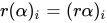
This set inherits the module structure via component-wise addition and scalar multiplication. Explicitly, two such sequences (or functions) α and β can be added by writing for all i (note that this is again zero for all but finitely many indices), and such a function can be multiplied with an element r from R by defining for all i. In this way, the direct sum becomes a left R-module, and it is denoted

It is customary to write the sequence as a sum . Sometimes a primed summation is used to indicate that cofinitely many of the terms are zero.

Properties

[edit]
  • The direct sum is a submodule of the direct product of the modules Mi (Bourbaki 1989, §II.1.7). The direct product is the set of all functions α from I to the disjoint union of the modules Mi with α(i)∈Mi, but not necessarily vanishing for all but finitely many i. If the index set I is finite, then the direct sum and the direct product are equal.
  • Each of the modules Mi may be identified with the submodule of the direct sum consisting of those functions which vanish on all indices different from i. With these identifications, every element x of the direct sum can be written in one and only one way as a sum of finitely many elements from the modules Mi.
  • If the Mi are actually vector spaces, then the dimension of the direct sum is equal to the sum of the dimensions of the Mi. The same is true for the rank of abelian groups and the length of modules.
  • Every vector space over the field K is isomorphic to a direct sum of sufficiently many copies of K, so in a sense only these direct sums have to be considered. This is not true for modules over arbitrary rings.
  • The tensor product distributes over direct sums in the following sense: if N is some right R-module, then the direct sum of the tensor products of N with Mi (which are abelian groups) is naturally isomorphic to the tensor product of N with the direct sum of the Mi.
  • Direct sums are commutative and associative (up to isomorphism), meaning that it doesn't matter in which order one forms the direct sum.
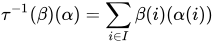
  • The abelian group of R-linear homomorphisms from the direct sum to some left R-module L is naturally isomorphic to the direct product of the abelian groups of R-linear homomorphisms from Mi to L: Indeed, there is clearly a homomorphism τ from the left hand side to the right hand side, where τ(θ)(i) is the R-linear homomorphism sending xMi to θ(x) (using the natural inclusion of Mi into the direct sum). The inverse of the homomorphism τ is defined by for any α in the direct sum of the modules Mi. The key point is that the definition of τ−1 makes sense because α(i) is zero for all but finitely many i, and so the sum is finite.
    In particular, the dual vector space of a direct sum of vector spaces is isomorphic to the direct product of the duals of those spaces.
  • The finite direct sum of modules is a biproduct: If are the canonical projection mappings and are the inclusion mappings, then equals the identity morphism of A1 ⊕ ⋯ ⊕ An, and is the identity morphism of Ak in the case l = k, and is the zero map otherwise.

Internal direct sum

[edit]

Suppose M is an R-module and Mi is a submodule of M for each i in I. If every x in M can be written in exactly one way as a sum of finitely many elements of the Mi, then we say that M is the internal direct sum of the submodules Mi (Halmos 1974, §18). In this case, M is naturally isomorphic to the (external) direct sum of the Mi as defined above (Adamson 1972, p.61).

A submodule N of M is a direct summand of M if there exists some other submodule N′ of M such that M is the internal direct sum of N and N′. In this case, N and N′ are called complementary submodules.

Universal property

[edit]

In the language of category theory, the direct sum is a coproduct and hence a colimit in the category of left R-modules, which means that it is characterized by the following universal property. For every i in I, consider the natural embedding
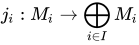
which sends the elements of Mi to those functions which are zero for all arguments but i. Now let M be an arbitrary R-module and fi : MiM be arbitrary R-linear maps for every i, then there exists precisely one R-linear map

such that f o ji = fi for all i.

Grothendieck group

[edit]

The direct sum gives a collection of objects the structure of a commutative monoid, in that the addition of objects is defined, but not subtraction. In fact, subtraction can be defined, and every commutative monoid can be extended to an abelian group. This extension is known as the Grothendieck group. The extension is done by defining equivalence classes of pairs of objects, which allows certain pairs to be treated as inverses. The construction, detailed in the article on the Grothendieck group, is "universal", in that it has the universal property of being unique, and homomorphic to any other embedding of a commutative monoid in an abelian group.

Direct sum of modules with additional structure

[edit]

If the modules we are considering carry some additional structure (for example, a norm or an inner product), then the direct sum of the modules can often be made to carry this additional structure, as well. In this case, we obtain the coproduct in the appropriate category of all objects carrying the additional structure. Two prominent examples occur for Banach spaces and Hilbert spaces.

In some classical texts, the phrase "direct sum of algebras over a field" is also introduced for denoting the algebraic structure that is presently more commonly called a direct product of algebras; that is, the Cartesian product of the underlying sets with the componentwise operations. This construction, however, does not provide a coproduct in the category of algebras, but a direct product (see note below and the remark on direct sums of rings).

Direct sum of algebras

[edit]

A direct sum of algebras and is the direct sum as vector spaces, with product

Consider these classical examples:

is ring isomorphic to split-complex numbers, also used in interval analysis.
is the algebra of tessarines introduced by James Cockle in 1848.
called the split-biquaternions, was introduced by William Kingdon Clifford in 1873.

Joseph Wedderburn exploited the concept of a direct sum of algebras in his classification of hypercomplex numbers. See his Lectures on Matrices (1934), page 151. Wedderburn makes clear the distinction between a direct sum and a direct product of algebras: For the direct sum the field of scalars acts jointly on both parts: while for the direct product a scalar factor may be collected alternately with the parts, but not both: Ian R. Porteous uses the three direct sums above, denoting them as rings of scalars in his analysis of Clifford Algebras and the Classical Groups (1995).

The construction described above, as well as Wedderburn's use of the terms direct sum and direct product follow a different convention than the one in category theory. In categorical terms, Wedderburn's direct sum is a categorical product, whilst Wedderburn's direct product is a coproduct (or categorical sum), which (for commutative algebras) actually corresponds to the tensor product of algebras.

Direct sum of Banach spaces

[edit]

The direct sum of two Banach spaces and is the direct sum of and considered as vector spaces, with the norm for all and

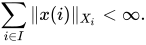
Generally, if is a collection of Banach spaces, where traverses the index set then the direct sum is a module consisting of all functions defined over such that for all and

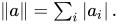
The norm is given by the sum above. The direct sum with this norm is again a Banach space.

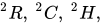
For example, if we take the index set and then the direct sum is the space which consists of all the sequences of reals with finite norm

A closed subspace of a Banach space is complemented if there is another closed subspace of such that is equal to the internal direct sum Note that not every closed subspace is complemented; e.g. is not complemented in

Direct sum of modules with bilinear forms

[edit]

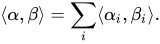
Let be a family indexed by of modules equipped with bilinear forms. The orthogonal direct sum is the module direct sum with bilinear form defined by[1] in which the summation makes sense even for infinite index sets because only finitely many of the terms are non-zero.

Direct sum of Hilbert spaces

[edit]

If finitely many Hilbert spaces are given, one can construct their orthogonal direct sum as above (since they are vector spaces), defining the inner product as:

The resulting direct sum is a Hilbert space which contains the given Hilbert spaces as mutually orthogonal subspaces.

If infinitely many Hilbert spaces for are given, we can carry out the same construction; notice that when defining the inner product, only finitely many summands will be non-zero. However, the result will only be an inner product space and it will not necessarily be complete. We then define the direct sum of the Hilbert spaces to be the completion of this inner product space.

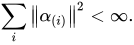
Alternatively and equivalently, one can define the direct sum of the Hilbert spaces as the space of all functions α with domain such that is an element of for every and:

The inner product of two such function α and β is then defined as:

This space is complete and we get a Hilbert space.

For example, if we take the index set and then the direct sum is the space which consists of all the sequences of reals with finite norm Comparing this with the example for Banach spaces, we see that the Banach space direct sum and the Hilbert space direct sum are not necessarily the same. But if there are only finitely many summands, then the Banach space direct sum is isomorphic to the Hilbert space direct sum, although the norm will be different.

Every Hilbert space is isomorphic to a direct sum of sufficiently many copies of the base field, which is either This is equivalent to the assertion that every Hilbert space has an orthonormal basis. More generally, every closed subspace of a Hilbert space is complemented because it admits an orthogonal complement. Conversely, the Lindenstrauss–Tzafriri theorem asserts that if every closed subspace of a Banach space is complemented, then the Banach space is isomorphic (topologically) to a Hilbert space.

See also

[edit]

References

[edit]
Revisions and contributorsEdit on WikipediaRead on Wikipedia
from Grokipedia
In module theory, the direct sum of a family of modules {Mi}iI\{M_i\}_{i \in I} over a ring RR is the RR-module consisting of all families (mi)iI(m_i)_{i \in I} with miMim_i \in M_i and all but finitely many mi=0m_i = 0, equipped with componentwise addition and . For finite families, such as two modules MM and NN, the MNM \oplus N comprises all pairs (m,n)(m, n) without the finiteness restriction, and it coincides with the in this case. This construction serves as the in the category of RR-modules, characterized by the universal property that for any module LL with homomorphisms ϕi:MiL\phi_i: M_i \to L, there exists a unique Φ:iMiL\Phi: \bigoplus_i M_i \to L such that Φιi=ϕi\Phi \circ \iota_i = \phi_i for inclusion maps ιi\iota_i. An internal direct sum arises within a single module MM: if M1,,MnM_1, \dots, M_n are submodules such that M=M1++MnM = M_1 + \dots + M_n and Mi(jiMj)={0}M_i \cap (\sum_{j \neq i} M_j) = \{0\} for each ii, then MM1MnM \cong M_1 \oplus \dots \oplus M_n, with every element of MM admitting a unique decomposition as a sum of elements from the submodules. A submodule SMS \subseteq M is a direct summand if it is complemented by another submodule TT such that MSTM \cong S \oplus T. For infinite families, the embeds as a submodule into the iMi\prod_i M_i, which allows arbitrary families without the finiteness condition, highlighting a key distinction in infinite cases. Direct sums play a central role in the structure theory of modules, particularly over principal ideal domains (PIDs), where every finitely generated module decomposes uniquely (up to ) as a of cyclic modules, enabling the of such modules via invariant factors or elementary divisors. They also facilitate the study of properties like projectivity and injectivity, as of projective (resp., injective) modules are projective (resp., injective), though not all properties preserve under infinite sums. This decomposition tool extends concepts from vector spaces and abelian groups, underscoring the 's foundational importance in .

Constructions in Basic Categories

Vector Spaces over a Field

In the category of vector spaces over a field KK, the direct sum of two vector spaces VV and WW is constructed as the set VWV \oplus W consisting of all ordered pairs (v,w)(v, w) with vVv \in V and wWw \in W, equipped with componentwise addition (v,w)+(v,w)=(v+v,w+w)(v, w) + (v', w') = (v + v', w + w') and λ(v,w)=(λv,λw)\lambda (v, w) = (\lambda v, \lambda w) for λK\lambda \in K. This structure makes VWV \oplus W a over KK, serving as the categorical , where morphisms from VV and WW combine uniquely into a morphism to another space. The basis of VWV \oplus W is formed by the of bases for VV and WW; if {vi}\{v_i\} is a basis for VV and {wj}\{w_j\} is a basis for WW, then {(vi,0)i}{(0,wj)j}\{(v_i, 0) \mid i\} \cup \{(0, w_j) \mid j\} spans VWV \oplus W and is linearly independent. Consequently, for finite-dimensional spaces, the satisfies dim(VW)=dimV+dimW\dim(V \oplus W) = \dim V + \dim W. For instance, the R2R3\mathbb{R}^2 \oplus \mathbb{R}^3 is isomorphic to R5\mathbb{R}^5, where elements are represented as 5-tuples (x1,x2,x3,x4,x5)(x_1, x_2, x_3, x_4, x_5) corresponding to ((x1,x2),(x3,x4,x5))((x_1, x_2), (x_3, x_4, x_5)), with the of R5\mathbb{R}^5 arising from the union of the standard bases of R2\mathbb{R}^2 and R3\mathbb{R}^3. The natural inclusion maps are defined by ιV:VVW\iota_V: V \to V \oplus W, ιV(v)=(v,0)\iota_V(v) = (v, 0), and ιW:WVW\iota_W: W \to V \oplus W, ιW(w)=(0,w)\iota_W(w) = (0, w); these are linear injections whose images intersect trivially and span VWV \oplus W. Historically, for finite collections of vector spaces, this direct sum coincides with the Cartesian product, as every element involves only finitely many components, eliminating the distinction that arises in infinite cases.

Abelian Groups

In the category of , the direct sum GHG \oplus H of two GG and HH is defined as the set of ordered pairs (g,h)(g, h) with gGg \in G and hHh \in H, equipped with componentwise addition (g1,h1)+(g2,h2)=(g1+g2,h1+h2)(g_1, h_1) + (g_2, h_2) = (g_1 + g_2, h_1 + h_2). This construction serves as the in the category of , meaning that for any KK and group s f:GKf: G \to K, g:HKg: H \to K, there exists a unique ϕ:GHK\phi: G \oplus H \to K such that ϕiG=f\phi \circ i_G = f and ϕiH=g\phi \circ i_H = g, where iG:GGHi_G: G \to G \oplus H and iH:HGHi_H: H \to G \oplus H are the inclusion maps given by iG(g)=(g,0)i_G(g) = (g, 0) and iH(h)=(0,h)i_H(h) = (0, h). A basic example is the direct sum ZZ\mathbb{Z} \oplus \mathbb{Z}, which is isomorphic to Z2\mathbb{Z}^2, the free abelian group of rank 2 generated by the standard basis elements (1,0)(1,0) and (0,1)(0,1). For finite cyclic groups with coprime orders, the direct sum simplifies further; for instance, Z/2ZZ/3ZZ/6Z\mathbb{Z}/2\mathbb{Z} \oplus \mathbb{Z}/3\mathbb{Z} \cong \mathbb{Z}/6\mathbb{Z} via the Chinese Remainder Theorem, where the isomorphism maps (1,1)(1,1) to the generator of Z/6Z\mathbb{Z}/6\mathbb{Z}. The fundamental theorem of finitely generated abelian groups illustrates the role of direct sums in decomposition: every finitely generated abelian group is isomorphic to a direct sum of a free abelian group (its torsion-free part) and its torsion subgroup, which decomposes as a direct sum of its pp-primary components for each prime pp. For example, the torsion subgroup of a finitely generated abelian group is a direct sum of cyclic groups of prime-power order, such as Z/pkZ\mathbb{Z}/p^k\mathbb{Z} for distinct primes pp. The projection maps from the direct sum are defined componentwise: the projection πG:GHG\pi_G: G \oplus H \to G sends (g,h)g(g, h) \mapsto g, and similarly πH:GHH\pi_H: G \oplus H \to H sends (g,h)h(g, h) \mapsto h. These projections are homomorphisms that are compatible with the coproduct structure, as any homomorphism out of GHG \oplus H factors uniquely through the projections when composed with the inclusions. For finite direct sums of abelian groups, the direct sum coincides with the , as every element has components in only finitely many factors. However, for infinite families, the restricts to elements with only finitely many nonzero components, distinguishing it from the full .

General Constructions for Modules

Direct Sum of Two Modules

In , the of two modules MM and NN over a ring RR with identity, denoted MNM \oplus N, is defined as the set {(m,n)mM,nN}\{(m, n) \mid m \in M, n \in N\} equipped with componentwise addition (m1,n1)+(m2,n2)=(m1+m2,n1+n2)(m_1, n_1) + (m_2, n_2) = (m_1 + m_2, n_1 + n_2) and scalar multiplication r(m,n)=(rm,rn)r \cdot (m, n) = (r \cdot m, r \cdot n) for rRr \in R. This structure makes MNM \oplus N an RR-module, where the ring RR acts diagonally on the pairs. The MNM \oplus N is characterized by the universal mapping property: for any RR-module PP and any RR-module homomorphisms f:MPf: M \to P, g:NPg: N \to P, there exists a unique RR- h:MNPh: M \oplus N \to P such that h(m,n)=f(m)+g(n)h(m, n) = f(m) + g(n). This homomorphism hh is determined by the inclusion maps ιM:MMN\iota_M: M \to M \oplus N given by ιM(m)=(m,0)\iota_M(m) = (m, 0) and ιN:NMN\iota_N: N \to M \oplus N given by ιN(n)=(0,n)\iota_N(n) = (0, n), satisfying hιM=fh \circ \iota_M = f and hιN=gh \circ \iota_N = g. When R=ZR = \mathbb{Z}, the direct sum of two abelian groups recovers the standard , as abelian groups are precisely the Z\mathbb{Z}-modules. For non-commutative rings, such as the ring of n×nn \times n matrices over a field, the direct sum construction applies similarly, with modules over matrix rings corresponding to direct sums of copies of column vector spaces. This construction for two modules addresses finite direct sums of exactly two terms and extends to finite sums of more modules through iterated application of the binary operation.

Direct Sum of an Arbitrary Family

In the context of an arbitrary II and a family of RR-modules {Mi}iI\{M_i\}_{i \in I}, the iIMi\bigoplus_{i \in I} M_i is defined as the set of all families (mi)iI(m_i)_{i \in I} where miMim_i \in M_i for each iIi \in I and mi=0m_i = 0 for all but finitely many ii, equipped with componentwise addition and : (mi)+(mi)=(mi+mi)(m_i) + (m_i') = (m_i + m_i') and r(mi)=(rmi)r \cdot (m_i) = (r m_i) for rRr \in R. This finite support condition ensures that the direct sum captures only "finitely generated" combinations from the family, distinguishing it from other constructions. The can be constructed explicitly as a submodule of the iIMi\prod_{i \in I} M_i, which consists of all families without the finite support restriction; specifically, iIMi\bigoplus_{i \in I} M_i is the submodule generated by the elements, where for each iIi \in I and mMim \in M_i, the element ei,me_{i,m} has mm in the ii-th component and 0 elsewhere. The inclusion maps ιi:MijIMj\iota_i: M_i \to \bigoplus_{j \in I} M_j are given by ιi(m)=(δijm)jI\iota_i(m) = (\delta_{ij} m)_{j \in I}, where δij\delta_{ij} is the , embedding each MiM_i as the submodule with support only at ii. A representative example is the n=1Z\bigoplus_{n=1}^\infty \mathbb{Z}, which is isomorphic to the on countably infinitely many generators, consisting of all linear combinations with only finitely many nonzero coefficients. In contrast, the n=1Z\prod_{n=1}^\infty \mathbb{Z} allows arbitrary sequences and has 202^{\aleph_0}, making it uncountable and non-free. By convention, the over an empty is the zero module, the unique module with a single element satisfying the . This aligns with the finite case, where the of no modules yields the trivial structure.

Properties

Algebraic Properties

The of two modules MM and NN over a ring RR is equipped with componentwise and , defined by (m1,n1)+(m2,n2)=(m1+m2,n1+n2)(m_1, n_1) + (m_2, n_2) = (m_1 + m_2, n_1 + n_2) and r(m,n)=(rm,rn)r(m, n) = (rm, rn) for rRr \in R, mMm \in M, and nNn \in N. This structure ensures additivity in each component, as (m1+m2,n)=(m1,n)+(m2,n)(m_1 + m_2, n) = (m_1, n) + (m_2, n), and bilinearity with respect to the ring action, preserving the module axioms. The operation of forming direct sums is commutative and associative up to canonical isomorphisms: there exists an MNNMM \oplus N \cong N \oplus M given by (m,n)(n,m)(m, n) \mapsto (n, m), and (MN)PM(NP)(M \oplus N) \oplus P \cong M \oplus (N \oplus P) via the map ((m,n),p)(m,(n,p))((m, n), p) \mapsto (m, (n, p)). Additionally, the direct sum with the zero module satisfies M0MM \oplus 0 \cong M through the explicit (m,0)m(m, 0) \leftrightarrow m. For finite families of modules {Mi}i=1k\{M_i\}_{i=1}^k, the i=1kMi\bigoplus_{i=1}^k M_i coincides with the iterated pairwise direct sum, inheriting these properties inductively. A key homological property is the HomR(iIMi,N)iIHomR(Mi,N)\operatorname{Hom}_R\left(\bigoplus_{i \in I} M_i, N\right) \cong \prod_{i \in I} \operatorname{Hom}_R(M_i, N), where a from the to NN is uniquely determined by its restrictions to each summand, which act independently. This reflects the nature of direct sums in the category of modules. Furthermore, direct sums preserve projectivity: if each MiM_i is a projective RR-module, then iIMi\bigoplus_{i \in I} M_i is projective, as it arises as a direct summand of a .

Universal Property

In the category of left RR-modules, denoted ModR\mathrm{Mod}_R, the of two modules MM and NN satisfies a characterizing it as the . Specifically, for any RR-module PP and any pair of RR-s f:MPf: M \to P and g:NPg: N \to P, there exists a unique RR- h:MNPh: M \oplus N \to P such that the following diagrams commute: hιM=fh \circ \iota_M = f and hιN=gh \circ \iota_N = g, where ιM:MMN\iota_M: M \to M \oplus N and ιN:NMN\iota_N: N \to M \oplus N are the inclusion maps sending m(m,0)m \mapsto (m, 0) and n(0,n)n \mapsto (0, n), respectively. This can be visualized as a commutative square where MM and NN map to PP directly via ff and gg, and also via the inclusions to MNM \oplus N followed by hh. The uniqueness of hh ensures that MNM \oplus N, together with the inclusions, is initial among all objects receiving such a pair of maps from MM and NN. This property extends to the direct sum of an arbitrary family of modules {Mi}iI\{M_i\}_{i \in I} over an index set II, which may be infinite. The object iIMi\bigoplus_{i \in I} M_i comes equipped with canonical inclusions ιi:MiiIMi\iota_i: M_i \to \bigoplus_{i \in I} M_i for each iIi \in I. For any RR-module PP and any family of RR-module homomorphisms {fi:MiP}iI\{f_i: M_i \to P\}_{i \in I}, there exists a unique RR-module homomorphism h:iIMiPh: \bigoplus_{i \in I} M_i \to P such that hιi=fih \circ \iota_i = f_i for all iIi \in I. In diagrammatic terms, this forms a commutative cone: each MiM_i maps to PP via fif_i, and equivalently via ιi\iota_i to the direct sum followed by hh, with the universal morphism hh factoring uniquely through any such family. The finite case is recovered when II has two elements. To see why this holds, consider the explicit construction of hh. An element of iIMi\bigoplus_{i \in I} M_i is a tuple (mi)iI(m_i)_{i \in I} with only finitely many nonzero mim_i, so define h((mi)iI)=iIfi(mi)h((m_i)_{i \in I}) = \sum_{i \in I} f_i(m_i); this is well-defined because the sum is finite and the fif_i are linear. Linearity of hh follows from linearity of the fif_i, and the relation hιi=fih \circ \iota_i = f_i holds by direct computation on generators. Uniqueness arises because any such hh is determined on the images of the ιi\iota_i, which generate the direct sum as an RR-module. In the category ModR\mathrm{Mod}_R, the is thus given by the , a feature shared with the category of abelian groups (Ab) and vector spaces over a field (Vectk_k). This contrasts with non-abelian categories, such as the category of groups, where coproducts take the form of free products rather than direct sums.

Comparison with Direct Product

In the case of a finite , the and of modules coincide up to canonical . For modules M1,,MnM_1, \dots, M_n over a ring RR, the i=1nMi\bigoplus_{i=1}^n M_i is isomorphic to the i=1nMi\prod_{i=1}^n M_i as RR-modules, where both are realized as the set of nn-tuples (m1,,mn)(m_1, \dots, m_n) with miMim_i \in M_i and componentwise addition and .$$] When the index set II is infinite, the direct sum and direct product diverge set-theoretically and algebraically. The direct product iIMi\prod_{i \in I} M_i comprises all families (mi)iI(m_i)_{i \in I} with miMim_i \in M_i for each ii, again with componentwise operations. The direct sum iIMi\bigoplus_{i \in I} M_i, however, consists precisely of those families where mi=0m_i = 0 for all but finitely many ii, forming a proper submodule of the direct product whenever the MiM_i are nonzero.[[](http://www.math.clemson.edu/ macaule/classes/s21math8530/slides/math8530lecture103h.pdf)[](https://ncatlab.org/nlab/show/direct [](http://www.math.clemson.edu/~macaule/classes/s21_math8530/slides/math8530_lecture-1-03_h.pdf)[](https://ncatlab.org/nlab/show/direct%2Bsum) The natural inclusion $\bigoplus_{i \in I} M_i \hookrightarrow \prod_{i \in I} M_i$ is injective but not surjective in this setting.] This distinction is evident in the category of abelian groups. The direct sum nNZ\bigoplus_{n \in \mathbb{N}} \mathbb{Z} is free on a countable basis {ennN}\{e_n \mid n \in \mathbb{N}\}, where ene_n has 1 in the nnth position and 0 elsewhere. In contrast, the direct product nNZ\prod_{n \in \mathbb{N}} \mathbb{Z} consists of all integer sequences and is uncountable, with cardinality 202^{\aleph_0}. Considering the product as a ring under componentwise multiplication, the quotient by the sum submodule admits zero divisors, such as the images of characteristic functions of disjoint infinite subsets of N\mathbb{N}, whose product is zero.[$$ The constructions also differ in their interactions with the Hom functor. For any RR-module NN, the universal property of the coproduct yields HomR(iIMi,N)iIHomR(Mi,N)\mathrm{Hom}_R\left( \bigoplus_{i \in I} M_i, N \right) \cong \prod_{i \in I} \mathrm{Hom}_R(M_i, N). Likewise, the universal property of the product gives HomR(N,iIMi)iIHomR(N,Mi)\mathrm{Hom}_R\left( N, \prod_{i \in I} M_i \right) \cong \prod_{i \in I} \mathrm{Hom}_R(N, M_i). There is a natural injection iIHomR(N,Mi)HomR(N,iIMi)\bigoplus_{i \in I} \mathrm{Hom}_R(N, M_i) \hookrightarrow \mathrm{Hom}_R\left( N, \bigoplus_{i \in I} M_i \right), corresponding to maps that factor through finite direct sums, but in general this is not surjective for infinite I. The isomorphism holds when I is finite. For maps out of the product, there is a natural injection iIHomR(Mi,N)HomR(iIMi,N)\bigoplus_{i \in I} \mathrm{Hom}_R(M_i, N) \hookrightarrow \mathrm{Hom}_R\left( \prod_{i \in I} M_i, N \right). In general, HomR(iIMi,N)\mathrm{Hom}_R\left( \prod_{i \in I} M_i, N \right) properly contains iIHomR(Mi,N)\bigoplus_{i \in I} \mathrm{Hom}_R(M_i, N), with equality holding under additional conditions on N, such as N being slender when the M_i are cyclic. Over a RR, both the and serve as biproducts in the category of RR-modules precisely when the is finite.$$]

Internal Direct Sum

Definition and Criteria

In module theory, given an RR-module MM and a of submodules {Ni}iI\{N_i\}_{i \in I} of MM, the submodules form an internal direct sum if every element mMm \in M can be uniquely written as a finite sum m=iFnim = \sum_{i \in F} n_i, where FIF \subset I is finite and each niNin_i \in N_i. This uniqueness ensures that the representation is independent of choices within the submodules. A necessary and sufficient criterion for the internal is that the sum of the submodules equals the entire module, iINi=M\sum_{i \in I} N_i = M, and that for each iIi \in I, the NijiNj={0}N_i \cap \sum_{j \neq i} N_j = \{0\}. For a finite family of two submodules N,PMN, P \subseteq M, this simplifies to M=N+PM = N + P and NP={0}N \cap P = \{0\}, in which case MM is denoted M=NPM = N \oplus P. In this finite case, the condition can equivalently be checked pairwise for the intersections with the sums excluding each submodule. For instance, the Z2\mathbb{Z}^2 (as a Z\mathbb{Z}-module) is the internal of the submodules N=(1,0)=Z×{0}N = \langle (1,0) \rangle = \mathbb{Z} \times \{0\} and P=(0,1)={0}×ZP = \langle (0,1) \rangle = \{0\} \times \mathbb{Z}, since every (a,b)Z2(a,b) \in \mathbb{Z}^2 uniquely as (a,0)+(0,b)(a,0) + (0,b) with (a,0)N(a,0) \in N, (0,b)P(0,b) \in P, N+P=Z2N + P = \mathbb{Z}^2, and NP={0}N \cap P = \{0\}. In contrast, the rational numbers Q\mathbb{Q} as a Z\mathbb{Z}-module provide a non-example: it admits no decomposition into an internal of two nonzero proper submodules, as any pair of nonzero submodules N,PQN, P \subseteq \mathbb{Q} with N+P=QN + P = \mathbb{Q} necessarily satisfies NP{0}N \cap P \neq \{0\}. If the family {Ni}\{N_i\} forms an internal direct sum of MM, then the canonical sum map iIιi:iINiM\sum_{i \in I} \iota_i : \bigoplus_{i \in I} N_i \to M, where each ιi:NiM\iota_i : N_i \to M is the inclusion, is an of RR-modules. This concept of internal direct sum generalizes the classical direct sum decompositions of vector spaces over a field into subspaces spanned by basis elements.

Relation to Submodule Decompositions

The internal direct sum decomposition of a module MM into submodules NiN_i implies that MM is isomorphic to the external direct sum Ni\bigoplus N_i, where the isomorphism arises from the inclusion maps and the fact that the summands intersect trivially and generate MM. This equivalence holds because the internal construction satisfies the universal property of the in the category of modules, ensuring a canonical between elements. Free modules admit explicit decompositions as internal direct sums of rank-one free modules. Specifically, a free module of finite rank nn over a ring RR is isomorphic to Rn=i=1nRR^n = \bigoplus_{i=1}^n R, where each RR is a rank-one free module generated by a basis element. Projective modules generalize this by being direct summands of free modules; thus, every projective module PP decomposes as an internal direct summand in some free module F=PQF = P \oplus Q. The Krull–Schmidt theorem provides conditions for unique decompositions. For a module MM of finite over any ring, MM decomposes as a of indecomposable modules, and any two such decompositions are unique up to and reordering of the summands. This uniqueness follows from the structure of endomorphisms on indecomposables, where non-isomorphism implies zero maps between distinct summands. Indecomposable modules illustrate basic obstructions to non-trivial decompositions, as they admit no internal M=NKM = N \oplus K with both NN and KK non-zero. In the category of abelian groups (i.e., Z\mathbb{Z}-modules), the fundamental theorem of finitely generated abelian groups guarantees a unique into a torsion submodule (direct sum of cyclic groups of order) and a torsion-free part (free abelian of finite rank). However, not all modules decompose non-trivially. For example, Q\mathbb{Q} as a Z\mathbb{Z}-module is indecomposable, possessing no non-trivial direct summands despite being torsion-free and divisible. In cases where decompositions exist, uniqueness often stems from orthogonal projections in the endomorphism ring End(M)\operatorname{End}(M): for summands NiN_i, there exist idempotents eie_i (satisfying ei2=eie_i^2 = e_i) such that eiej=0e_i e_j = 0 for iji \neq j and ei=idM\sum e_i = \operatorname{id}_M, with im(ei)=Ni\operatorname{im}(e_i) = N_i. These projections ensure the summands are canonically determined.

Grothendieck Construction

The Grothendieck Group

The Grothendieck group K0(R)K_0(R) of a ring RR is defined as the generated by the isomorphism classes of RR-modules, denoted [M][M] for an RR-module MM, subject to the relations [M]+[N]=[MN][M] + [N] = [M \oplus N] for all modules MM and NN. This construction can be formalized as K0(R)=Z(Iso(R-Mod))/K_0(R) = \mathbb{Z}^{( \mathrm{Iso}(R\text{-Mod}) )} / \sim, where Z(S)\mathbb{Z}^{(S)} denotes the on a set SS, and the \sim identifies classes via the operation, incorporating formal differences [M][N][M] - [N] to embed the commutative (Iso(R-Mod),,0)( \mathrm{Iso}(R\text{-Mod}), \oplus, 0 ) into an . More precisely, it arises as the universal making the map from the of isomorphism classes under to the group a homomorphism, ensuring additivity with respect to : [MN]=[M]+[N][M \oplus N] = [M] + [N]. This group completion captures relations induced by short exact sequences in the category of RR-modules. Specifically, for a short exact sequence 0ABC00 \to A \to B \to C \to 0, the classes satisfy [B]=[A]+[C][B] = [A] + [C] in K0(R)K_0(R), reflecting the in . In the standard presentation for algebraic , K0(R)K_0(R) is generated by classes [P][P] of finitely generated projective RR-modules, with relations arising from projective resolutions or split exact sequences involving such modules. For the ring R=ZR = \mathbb{Z}, the Grothendieck group K0(Z)K_0(\mathbb{Z}) is isomorphic to Z\mathbb{Z}, where the isomorphism is given by the rank function on free modules, as all finitely generated projective Z\mathbb{Z}-modules are free. Similarly, for RR a field, K0(R)ZK_0(R) \cong \mathbb{Z}, again via the dimension (rank) of vector spaces, since all modules over a field are free (or zero). The concept was introduced by in the late 1950s as a foundational tool in algebraic , initially to generalize the Riemann-Roch theorem in the context of coherent sheaves on algebraic varieties, later extended to modules over rings.

Direct Sums in the

In the K0(R)K_0(R) of a ring RR, the operation on modules induces the additive group structure through the []:Iso(R-Mod)K0(R)[\cdot] : \mathrm{Iso}(R\text{-Mod}) \to K_0(R), which sends isomorphism classes of modules to their classes in the group and acts as a homomorphism with respect to \oplus. Specifically, for any modules MM and NN, the relation [MN]=[M]+[N][M \oplus N] = [M] + [N] holds, preserving the abelian structure of isomorphism classes under . This additivity ensures that K0(R)K_0(R) captures the formal differences of module classes, with the providing the underlying operation that extends to the group completion. For a finite family of modules {Mi}i=1n\{M_i\}_{i=1}^n, the class of their satisfies [ \left[ \bigoplus_{i=1}^n M_i \right] = \sum_{i=1}^n [M_i] in $ K_0(R) $, reflecting the bilinearity of the construction.[](https://sites.math.rutgers.edu/~weibel/Kbook/Kbook.pdf) Moreover, $ K_0(R) $ is generated as an [abelian group](/page/Abelian_group) by the classes of finitely generated projective modules under these direct sums, since every element can be expressed as $ [P] - [Q] $ for projectives $ P $ and $ Q $, with free modules $ R^k $ forming a cofinal [subset](/page/Subset).[](https://sites.math.rutgers.edu/~weibel/Kbook/Kbook.pdf) This generation property highlights how direct sums of projectives underpin the entire structure of $ K_0(R) $. The additivity extends to exact sequences: for a short exact sequence $ 0 \to A \to B \to C \to 0 $, if the sequence splits, then $ B \cong A \oplus C $ and thus $ [B] = [A] + [C] $.[](https://sites.math.rutgers.edu/~weibel/Kbook/Kbook.pdf) In general, the [Grothendieck group](/page/Grothendieck_group) incorporates the relation $ [B] = [A] + [C] $ for any such sequence, defining the [Euler characteristic](/page/Euler_characteristic) $ \chi = [A] - [B] + [C] = 0 $, which generalizes additivity beyond split cases and links to homological invariants.[](https://sites.math.rutgers.edu/~weibel/Kbook/Kbook.pdf) A concrete example arises over a field $ k $, where $ K_0(k) \cong \mathbb{Z} $ and the [dimension](/page/Dimension) function $ \dim : K_0(k) \to \mathbb{Z} $ given by $ [V] \mapsto \dim_k(V) $ is a [group homomorphism](/page/Group_homomorphism) additive over direct sums, since $ \dim_k(V \oplus W) = \dim_k(V) + \dim_k(W) $.[](https://sites.math.rutgers.edu/~weibel/Kbook/Kbook.pdf) All finitely generated projective $ k $-modules are free, so classes are multiples of $ $, with $ [k^n] = n \cdot $. While formal direct sums of infinitely many modules appear in $ K_0(R) $ as infinite formal sums of classes, the construction focuses on finite direct sums to ensure well-definedness in the group; infinite cases require additional [topology](/page/Topology) for convergence but are not central to the standard [algebraic structure](/page/Algebraic_structure).[](https://sites.math.rutgers.edu/~weibel/Kbook/Kbook.pdf) ## Direct Sums with Extra Structure ### Direct Sum of Algebras The direct sum of a family of $R$-algebras $\{A_i\}_{i \in I}$, where $R$ is a [commutative ring](/page/Commutative_ring), is defined on the underlying $R$-module direct sum $\bigoplus_{i \in I} A_i$, consisting of tuples $(a_i)_{i \in I}$ with $a_i \in A_i$ and $a_i = 0$ for all but finitely many $i$. Addition and [scalar multiplication](/page/Scalar_multiplication) by elements of $R$ are performed componentwise: $(a_i) + (b_i) = (a_i + b_i)$ and $r \cdot (a_i) = (r a_i)$. The [multiplication](/page/Multiplication) is also componentwise: $(a_i)(b_i) = (a_i b_i)$, where $a_i b_i$ denotes the product in $A_i$. For finite index sets $I$, the unit element is the tuple $(1_i)_{i \in I}$, where $1_i$ is the multiplicative identity in $A_i$. For infinite $I$, the [direct product](/page/Direct_product) $\prod_{i \in I} A_i$ (allowing arbitrary support) is typically used instead to obtain a unital algebra, with the same componentwise operations. This structure makes $\bigoplus_{i \in I} A_i$ (or the product for infinite $I$) into an $R$-algebra, with the inclusions $\iota_i: A_i \to \bigoplus_{i \in I} A_i$ given by $\iota_i(a) = (0, \dots, a, \dots, 0)$ (with $a$ in the $i$-th position) being $R$-algebra homomorphisms that preserve multiplication: $\iota_i(a b) = \iota_i(a) \iota_i(b)$.[](https://www.cip.ifi.lmu.de/~grinberg/t/23wa/lec22.pdf)[](http://www2.math.ou.edu/~kmartin/quaint/ch2.pdf) The [direct sum](/page/Direct_sum) contains a [family](/page/Family) of orthogonal idempotents $\{e_i\}_{i \in I}$, where $e_i = \iota_i(1_i)$, satisfying $e_i^2 = e_i$, $e_i e_j = 0$ for $i \neq j$. For finite $I$, $\sum_{i \in I} e_i = (1_i)_{i \in I}$, [the unit](/page/The_Unit). These idempotents project onto the $i$-th component: $e_i ((a_j)) = ( \delta_{ij} a_i )$.[](https://www.math.uci.edu/~brusso/BremnerEtAl35pp.pdf) A concrete example is the [direct sum](/page/Direct_sum) $\mathbb{C} \oplus \mathbb{R}$ as $\mathbb{R}$-[algebra](/page/Algebra)s, where $\mathbb{C}$ is viewed as a 2-dimensional $\mathbb{R}$-[algebra](/page/Algebra) via its [standard basis](/page/Standard_basis) $\{1, i\}$ and $\mathbb{R}$ as the 1-dimensional $\mathbb{R}$-[algebra](/page/Algebra). The resulting structure is a 3-dimensional commutative $\mathbb{R}$-[algebra](/page/Algebra) with componentwise [multiplication](/page/Multiplication), such as $(c, r)(c', r') = (c c', r r')$ for $c, c' \in \mathbb{C}$ and $r, r' \in \mathbb{R}$, and unit $(1, 1)$. It admits zero divisors, for instance $(1, 0)(0, 1) = (0, 0)$, and the idempotents are $e_1 = (1, 0)$ and $e_2 = (0, 1)$. Topologically, $\mathbb{C} \oplus \mathbb{R}$ resembles $\mathbb{C} \times \mathbb{R}$, but algebraically it is the [direct sum](/page/Direct_sum) with the specified operations.[](http://www2.math.ou.edu/~kmartin/quaint/ch2.pdf) In contrast to the tensor product, which serves as the coproduct in the category of commutative $R$-algebras, the direct sum (for finite families) functions as the categorical product in the category of $R$-algebras (commutative or not).[](https://www.cip.ifi.lmu.de/~grinberg/t/23wa/lec22.pdf) ### Direct Sum of Banach Spaces The direct sum of a family of Banach spaces $\{X_i\}_{i \in I}$ over $\mathbb{R}$ or $\mathbb{C}$ is the set $\bigoplus_{i \in I} X_i$ consisting of all families $(x_i)_{i \in I}$ where $x_i \in X_i$ and only finitely many $x_i$ are nonzero, equipped with componentwise addition and [scalar multiplication](/page/Scalar_multiplication).[](https://www.math.purdue.edu/~iswanso/functionalanalysis.pdf) This construction extends the algebraic direct sum of modules to the category of normed spaces.[](https://www.math.purdue.edu/~iswanso/functionalanalysis.pdf) To endow $\bigoplus_{i \in I} X_i$ with a norm, common choices include the $\ell^1$ norm $\|(x_i)\| = \sum_{i \in I} \|x_i\|_{X_i}$ or the max norm $\|(x_i)\| = \sup_{i \in I} \|x_i\|_{X_i}$.[](https://www.math.purdue.edu/~iswanso/functionalanalysis.pdf)[](https://www.math.cuhk.edu.hk/course_builder/2324/math4010/Fumctional%20Analysis%202023-24Nov24.pdf) For finite index sets $I$, both norms yield a [Banach space](/page/Banach_space) whenever each $X_i$ is Banach, as Cauchy sequences converge componentwise in each coordinate.[](https://www.math.purdue.edu/~iswanso/functionalanalysis.pdf) For infinite $I$, the space $\bigoplus_{i \in I} X_i$ equipped with the $\ell^1$ norm is incomplete; its completion consists of all $(x_i)$ such that $\sum_{i \in I} \|x_i\|_{X_i} < \infty$, and this $\ell^1$-direct sum is a [Banach space](/page/Banach_space).[](https://www.math.purdue.edu/~iswanso/functionalanalysis.pdf) Similarly, the completion under the max norm comprises all $(x_i)$ with $\sup_{i \in I} \|x_i\|_{X_i} < \infty$, forming a [Banach space](/page/Banach_space).[](https://www.math.cuhk.edu.hk/course_builder/2324/math4010/Fumctional%20Analysis%202023-24Nov24.pdf) A representative example is the space $\ell^1(\mathbb{N})$, which arises as the $\ell^1$-direct sum (completion) of countably many copies of $\mathbb{C}$, where sequences have finite $\sum |z_n|$.[](https://physics.bme.hu/sites/physics.bme.hu/files/users/BMETE15AF53_kov/Kreyszig%20-%20Introductory%20Functional%20Analysis%20with%20Applications%20%281%29.pdf) In contrast, the space $c_0$ of sequences converging to zero under the sup norm is not obtained as such a direct sum completion for copies of $\mathbb{C}$, as the completion of finite-support sequences under the max norm yields $\ell^\infty$ instead.[](https://www.math.purdue.edu/~iswanso/functionalanalysis.pdf) Bounded linear operators on direct sums are defined componentwise: for families of bounded operators $T_i: X_i \to Y_i$, the direct sum $\bigoplus_{i \in I} T_i$ acts on $\bigoplus_{i \in I} X_i$ by $(\bigoplus T_i)(x_j) = (T_j x_j)_j$, preserving finite support.[](https://people.math.ethz.ch/~salamon/PREPRINTS/funcana.pdf) The operator norm of $\bigoplus T_i$ under the $\ell^1$ or max norm on the domain and [codomain](/page/Codomain) is $\sup_{i \in I} \|T_i\|$, ensuring boundedness if each $T_i$ is bounded.[](https://people.math.ethz.ch/~salamon/PREPRINTS/funcana.pdf) The natural inclusions $\iota_i: X_i \hookrightarrow \bigoplus_{j \in I} X_j$ are defined by $\iota_i(x) = (\delta_{ij} x)_j$, where $\delta_{ij}$ is the [Kronecker delta](/page/Kronecker_delta); these are bounded linear maps with $\|\iota_i(x)\| = \|x\|_{X_i}$ for the $\ell^1$ norm (or adjusted for finite support).[](https://www.math.purdue.edu/~iswanso/functionalanalysis.pdf) Convergence in the direct sum requires that sequences of finite-support elements have coordinates converging in each $X_i$, with the sum of norms controlled for $\ell^1$-type limits.[](https://www.math.purdue.edu/~iswanso/functionalanalysis.pdf) More generally, $\ell^p$-direct sums for $1 \leq p < \infty$ equip $\bigoplus_{i \in I} X_i$ with $\|(x_i)\|_p = \left( \sum_{i \in I} \|x_i\|_{X_i}^p \right)^{1/p}$, and the completion—comprising $(x_i)$ with $\sum \|x_i\|^p < \infty$—is a [Banach space](/page/Banach_space).[](https://www.math.purdue.edu/~iswanso/functionalanalysis.pdf) These variants generalize the scalar case, where $\ell^p(\mathbb{N})$ emerges as the completion.[](https://physics.bme.hu/sites/physics.bme.hu/files/users/BMETE15AF53_kov/Kreyszig%20-%20Introductory%20Functional%20Analysis%20with%20Applications%20%281%29.pdf) ### Direct Sum of Modules with Bilinear Forms In the context of module theory over a [commutative ring](/page/Commutative_ring) $R$, the direct sum of modules equipped with bilinear forms extends the standard construction by inducing a compatible bilinear structure on the sum. Suppose $\{M_i\}_{i \in I}$ is a [family](/page/Family) of $R$-modules, each endowed with a bilinear form $B_i: M_i \times M_i \to R$. The direct sum module $M = \bigoplus_{i \in I} M_i$ is equipped with the bilinear form $B: M \times M \to R$ defined by $B((m_i)_{i \in I}, (n_i)_{i \in I}) = \sum_{i \in I} B_i(m_i, n_i)$, where the sum is finite since only finitely many components are nonzero in each argument.[](https://kconrad.math.uconn.edu/blurbs/linmultialg/bilinearform.pdf) This form ensures orthogonality between distinct components: if $\iota_i: M_i \to M$ denotes the inclusion map, then cross terms vanish, meaning $B(\iota_i(m), \iota_j(n)) = 0$ for $i \neq j$.[](https://kconrad.math.uconn.edu/blurbs/linmultialg/bilinearform.pdf) More precisely, the induced form satisfies $B(\iota_i(m), \iota_j(n)) = \delta_{ij} B_i(m, n)$, where $\delta_{ij}$ is the [Kronecker delta](/page/Kronecker_delta). This orthogonality implies that the adjoint maps associated to the $B_i$ decompose accordingly on the [direct sum](/page/Direct_sum). A key preservation property holds for non-degeneracy: assuming each $M_i$ is finitely generated projective and each $B_i$ is nonsingular (i.e., the adjoint $M_i \to \mathrm{Hom}_R(M_i, R)$ is an [isomorphism](/page/Isomorphism)), then $B$ is nonsingular on $M$. Conversely, the orthogonal [direct sum](/page/Direct_sum) of nonsingular forms yields a nonsingular form.[](https://core.ac.uk/download/pdf/197757827.pdf) Examples illustrate this construction effectively. For quadratic forms, which arise from symmetric bilinear forms via polarization, the [direct sum](/page/Direct_sum) on free modules $R^n \oplus R^m$ inherits a quadratic form that decomposes as the sum of the [individual](/page/Individual) [ones](/page/The_Ones), facilitating [classification](/page/Classification) over rings like Dedekind domains. Symplectic [direct sums](/page/Direct_sum) involve alternating bilinear forms, where the total form remains alternating and non-degenerate if each component is, as seen in the [decomposition](/page/Decomposition) of symplectic modules into hyperbolic planes. Orthogonal direct sums, for symmetric forms, similarly preserve the [signature](/page/Signature) or [discriminant](/page/Discriminant) in appropriate settings.[](https://kconrad.math.uconn.edu/blurbs/linmultialg/bilinearform.pdf)[](https://core.ac.uk/download/pdf/197757827.pdf) In [representation theory](/page/Representation_theory), this structure is crucial for decomposing modules with invariant bilinear forms. For a group $G$-module $V$ admitting a $G$-invariant bilinear form $B$, if $V$ decomposes as a [direct sum](/page/Direct_sum) of invariant submodules $V = \bigoplus V_k$, the form restricts to each $V_k$ and induces orthogonal components, enabling the analysis of irreducible representations via [Schur's lemma](/page/Schur's_lemma), where invariant forms are unique up to scalar and non-degenerate. Such decompositions underpin the study of orthogonal and symplectic representations, classifying invariant forms by character values like $\sum \chi(s^2)/|G|$.[](https://math.berkeley.edu/~serganov/math252/notes5.pdf) ### Direct Sum of Hilbert Spaces The orthogonal direct sum of a family of Hilbert spaces $\{H_i\}_{i \in I}$, denoted $\bigoplus_{i \in I} H_i$, is defined as the set of all families $(h_i)_{i \in I}$ with $h_i \in H_i$ such that $\sum_{i \in I} \|h_i\|_{H_i}^2 < \infty$, equipped with the inner product $\langle (h_i), (k_i) \rangle = \sum_{i \in I} \langle h_i, k_i \rangle_{H_i}$. The associated norm is $\|(h_i)\| = \sqrt{\sum_{i \in I} \|h_i\|^2}$, and this space is complete, hence a [Hilbert space](/page/Hilbert_space), when the [index set](/page/Index_set) $I$ is countable (or finite). For finite sums, the condition reduces to all but finitely many $h_i = 0$, but the infinite case requires the square-summable norm condition to ensure convergence.[](https://spot.colorado.edu/~baggett/funcchap8.pdf)[](https://www.math.ucdavis.edu/~hunter/book/ch6.pdf) Each [Hilbert space](/page/Hilbert_space) $H_i$ embeds into the [direct sum](/page/Direct_sum) via the orthogonal inclusion $\iota_i: H_i \to \bigoplus_{j \in I} H_j$ defined by $\iota_i(h) = (0, \dots, h, \dots, 0)$ with $h$ in the $i$-th position, and these embeddings satisfy $\iota_i(H_i) \perp \iota_j(H_j)$ for $i \neq j$. This yields an orthogonal decomposition $\bigoplus_{i \in I} H_i = \overline{\sum_{i \in I} \iota_i(H_i)}$, where the closure is taken in the [direct sum](/page/Direct_sum) norm. An illustrative example is the finite [direct sum](/page/Direct_sum) $L^2(\mathbb{R}) \oplus L^2(\mathbb{R})$, which is isometrically isomorphic to $L^2(\mathbb{R} \times \{1,2\})$ under the [product measure](/page/Product_measure) (Lebesgue on $\mathbb{R}$ and [counting on](/page/Counting_On) $\{1,2\}$), via the map sending $(f,g)$ to the function that is $f$ on $\mathbb{R} \times \{1\}$ and $g$ on $\mathbb{R} \times \{2\}$. Moreover, the [direct sum](/page/Direct_sum) of countably many separable [Hilbert space](/page/Hilbert_space)s is separable.[](https://www.math.ucdavis.edu/~hunter/book/ch6.pdf) Bounded linear operators on the direct sum can be constructed componentwise: given bounded operators $T_i: H_i \to H_i$ with $\sup_{i \in I} \|T_i\| < \infty$, the direct sum operator $T = \bigoplus_{i \in I} T_i$ acts by $T((h_i)) = (T_i h_i)$ and is bounded on $\bigoplus H_i$ with $\|T\| = \sup_i \|T_i\|$. A key property extending [Parseval's identity](/page/Parseval's_identity) is that for any $(h_i) \in \bigoplus H_i$, \left| \sum_{i \in I} \iota_i(h_i) \right|^2 = \sum_{i \in I} |h_i|^2, which follows directly from the inner product definition and [orthogonality](/page/Orthogonality) of the $\iota_i(H_i)$. For infinite direct sums, the square-summable norm condition ensures that only families with $\sum \|h_i\|^2 < \infty$ are included, analogous to the $\ell^2$ direct sum over scalars.[](https://www.math.ucdavis.edu/~hunter/book/ch8.pdf)[](https://spot.colorado.edu/~baggett/funcchap8.pdf)

References

Add your contribution
Related Hubs
User Avatar
No comments yet.