

Recent from talks
Mandelbrot set
Knowledge base stats:
Talk channels stats:
Members stats:
Mandelbrot set
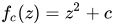
The Mandelbrot set (/ˈmændəlbroʊt, -brɒt/) is a two-dimensional set that is defined in the complex plane as the complex numbers for which the function does not diverge to infinity when iterated starting at , i.e., for which the sequence , , etc., remains bounded in absolute value.



This set was first defined and drawn by Robert W. Brooks and Peter Matelski in 1978, as part of a study of Kleinian groups. Afterwards, in 1980, Benoit Mandelbrot obtained high-quality visualizations of the set while working at IBM's Thomas J. Watson Research Center in Yorktown Heights, New York.
Images of the Mandelbrot set exhibit an infinitely complicated boundary that reveals progressively ever-finer recursive detail at increasing magnifications; mathematically, the boundary of the Mandelbrot set is a fractal curve. The "style" of this recursive detail depends on the region of the set boundary being examined. Mandelbrot set images may be created by sampling the complex numbers and testing, for each sample point , whether the sequence goes to infinity.[close paraphrasing] Treating the real and imaginary parts of as image coordinates on the complex plane, pixels may then be colored according to how soon the sequence crosses an arbitrarily chosen threshold (the threshold must be at least 2, as −2 is the complex number with the largest magnitude within the set, but otherwise the threshold is arbitrary).[close paraphrasing] If is held constant and the initial value of is varied instead, the corresponding Julia set for the point is obtained.



The Mandelbrot set is well-known, even outside mathematics, for how it exhibits complex fractal structures when visualized and magnified, despite having a relatively simple definition, and is commonly cited as an example of mathematical beauty.
The Mandelbrot set has its origin in complex dynamics, a field first investigated by the French mathematicians Pierre Fatou and Gaston Julia at the beginning of the 20th century. The fractal was first defined and drawn in 1978 by Robert W. Brooks and Peter Matelski as part of a study of Kleinian groups. On 1 March 1980, at IBM's Thomas J. Watson Research Center in Yorktown Heights, New York, Benoit Mandelbrot first visualized the set.
Mandelbrot studied the parameter space of quadratic polynomials in an article that appeared in 1980. The mathematical study of the Mandelbrot set really began with work by the mathematicians Adrien Douady and John H. Hubbard (1985), who established many of its fundamental properties and named the set in honor of Mandelbrot for his influential work in fractal geometry.
The mathematicians Heinz-Otto Peitgen and Peter Richter became well known for promoting the set with photographs, books (1986), and an internationally touring exhibit of the German Goethe-Institut (1985).
The cover article of the August 1985 Scientific American introduced the algorithm for computing the Mandelbrot set. The cover was created by Peitgen, Richter and Saupe at the University of Bremen. The Mandelbrot set became prominent in the mid-1980s as a computer-graphics demo, when personal computers became powerful enough to plot and display the set in high resolution.
Hub AI
Mandelbrot set AI simulator
(@Mandelbrot set_simulator)
Mandelbrot set
The Mandelbrot set (/ˈmændəlbroʊt, -brɒt/) is a two-dimensional set that is defined in the complex plane as the complex numbers for which the function does not diverge to infinity when iterated starting at , i.e., for which the sequence , , etc., remains bounded in absolute value.
This set was first defined and drawn by Robert W. Brooks and Peter Matelski in 1978, as part of a study of Kleinian groups. Afterwards, in 1980, Benoit Mandelbrot obtained high-quality visualizations of the set while working at IBM's Thomas J. Watson Research Center in Yorktown Heights, New York.
Images of the Mandelbrot set exhibit an infinitely complicated boundary that reveals progressively ever-finer recursive detail at increasing magnifications; mathematically, the boundary of the Mandelbrot set is a fractal curve. The "style" of this recursive detail depends on the region of the set boundary being examined. Mandelbrot set images may be created by sampling the complex numbers and testing, for each sample point , whether the sequence goes to infinity.[close paraphrasing] Treating the real and imaginary parts of as image coordinates on the complex plane, pixels may then be colored according to how soon the sequence crosses an arbitrarily chosen threshold (the threshold must be at least 2, as −2 is the complex number with the largest magnitude within the set, but otherwise the threshold is arbitrary).[close paraphrasing] If is held constant and the initial value of is varied instead, the corresponding Julia set for the point is obtained.
The Mandelbrot set is well-known, even outside mathematics, for how it exhibits complex fractal structures when visualized and magnified, despite having a relatively simple definition, and is commonly cited as an example of mathematical beauty.
The Mandelbrot set has its origin in complex dynamics, a field first investigated by the French mathematicians Pierre Fatou and Gaston Julia at the beginning of the 20th century. The fractal was first defined and drawn in 1978 by Robert W. Brooks and Peter Matelski as part of a study of Kleinian groups. On 1 March 1980, at IBM's Thomas J. Watson Research Center in Yorktown Heights, New York, Benoit Mandelbrot first visualized the set.
Mandelbrot studied the parameter space of quadratic polynomials in an article that appeared in 1980. The mathematical study of the Mandelbrot set really began with work by the mathematicians Adrien Douady and John H. Hubbard (1985), who established many of its fundamental properties and named the set in honor of Mandelbrot for his influential work in fractal geometry.
The mathematicians Heinz-Otto Peitgen and Peter Richter became well known for promoting the set with photographs, books (1986), and an internationally touring exhibit of the German Goethe-Institut (1985).
The cover article of the August 1985 Scientific American introduced the algorithm for computing the Mandelbrot set. The cover was created by Peitgen, Richter and Saupe at the University of Bremen. The Mandelbrot set became prominent in the mid-1980s as a computer-graphics demo, when personal computers became powerful enough to plot and display the set in high resolution.
Recent media