
Hubbry Logo
Linear complex structureLinear complex structureMain
Open search
Linear complex structure
Community hub
Linear complex structure
logo
7 pages, 0 posts
0 subscribers
Be the first to start a discussion here.
Linear complex structure
from Wikipedia

In mathematics, a complex structure on a real vector space is an automorphism of that squares to the minus identity, . Such a structure on allows one to define multiplication by complex scalars in a canonical fashion so as to regard as a complex vector space.

Every complex vector space can be equipped with a compatible complex structure in a canonical way; however, there is in general no canonical complex structure. Complex structures have applications in representation theory as well as in complex geometry where they play an essential role in the definition of almost complex manifolds, by contrast to complex manifolds. The term "complex structure" often refers to this structure on manifolds; when it refers instead to a structure on vector spaces, it may be called a linear complex structure.

Definition and properties

[edit]

A complex structure on a real vector space is a real linear transformation such that Here means composed with itself and is the identity map on . That is, the effect of applying twice is the same as multiplication by . This is reminiscent of multiplication by the imaginary unit, . A complex structure allows one to endow with the structure of a complex vector space. Complex scalar multiplication can be defined by for all real numbers and all vectors in V. One can check that this does, in fact, give the structure of a complex vector space which we denote .

Going in the other direction, if one starts with a complex vector space then one can define a complex structure on the underlying real space by defining .

More formally, a linear complex structure on a real vector space is an algebra representation of the complex numbers , thought of as an associative algebra over the real numbers. This algebra is realized concretely as which corresponds to . Then a representation of is a real vector space , together with an action of on (a map ). Concretely, this is just an action of , as this generates the algebra, and the operator representing (the image of in ) is exactly .

If has complex dimension , then must have real dimension . That is, a finite-dimensional space admits a complex structure only if it is even-dimensional. It is not hard to see that every even-dimensional vector space admits a complex structure. One can define on pairs of basis vectors by and and then extend by linearity to all of . If is a basis for the complex vector space then is a basis for the underlying real space .

A real linear transformation is a complex linear transformation of the corresponding complex space if and only if commutes with , i.e. if and only if Likewise, a real subspace of is a complex subspace of if and only if preserves , i.e. if and only if

Examples

[edit]

Elementary example

[edit]

The collection of real matrices over the real field is 4-dimensional. Any matrix

has square equal to the negative of the identity matrix. A complex structure may be formed in : with identity matrix , elements , with matrix multiplication form complex numbers.

Complex n-dimensional space Cn

[edit]

The fundamental example of a linear complex structure is the structure on R2n coming from the complex structure on Cn. That is, the complex n-dimensional space Cn is also a real 2n-dimensional space – using the same vector addition and real scalar multiplication – while multiplication by the complex number i is not only a complex linear transform of the space, thought of as a complex vector space, but also a real linear transform of the space, thought of as a real vector space. Concretely, this is because scalar multiplication by i commutes with scalar multiplication by real numbers – and distributes across vector addition. As a complex n×n matrix, this is simply the scalar matrix with i on the diagonal. The corresponding real 2n×2n matrix is denoted J.

Given a basis for the complex space, this set, together with these vectors multiplied by i, namely form a basis for the real space. There are two natural ways to order this basis, corresponding abstractly to whether one writes the tensor product as or instead as

If one orders the basis as then the matrix for J takes the block diagonal form (subscripts added to indicate dimension): This ordering has the advantage that it respects direct sums of complex vector spaces, meaning here that the basis for is the same as that for

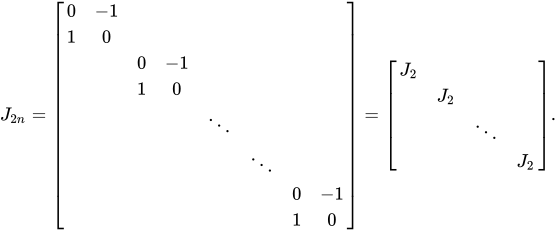
On the other hand, if one orders the basis as , then the matrix for J is block-antidiagonal: This ordering is more natural if one thinks of the complex space as a direct sum of real spaces, as discussed below.

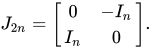
The data of the real vector space and the J matrix is exactly the same as the data of the complex vector space, as the J matrix allows one to define complex multiplication. At the level of Lie algebras and Lie groups, this corresponds to the inclusion of gl(n,C) in gl(2n,R) (Lie algebras – matrices, not necessarily invertible) and GL(n,C) in GL(2n,R):

gl(n,C) < gl(2n,R) and GL(n,C) < GL(2n,R).

The inclusion corresponds to forgetting the complex structure (and keeping only the real), while the subgroup GL(n,C) can be characterized (given in equations) as the matrices that commute with J: The corresponding statement about Lie algebras is that the subalgebra gl(n,C) of complex matrices are those whose Lie bracket with J vanishes, meaning in other words, as the kernel of the map of bracketing with J,

Note that the defining equations for these statements are the same, as is the same as which is the same as though the meaning of the Lie bracket vanishing is less immediate geometrically than the meaning of commuting.


Direct sum

[edit]

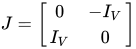
If V is any real vector space there is a canonical complex structure on the direct sum VV given by The block matrix form of J is where is the identity map on V. This corresponds to the complex structure on the tensor product

Compatibility with other structures

[edit]

If B is a bilinear form on V then we say that J preserves B if for all u, vV. An equivalent characterization is that J is skew-adjoint with respect to B:

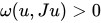
If g is an inner product on V then J preserves g if and only if J is an orthogonal transformation. Likewise, J preserves a nondegenerate, skew-symmetric form ω if and only if J is a symplectic transformation (that is, if ). For symplectic forms ω an interesting compatibility condition between J and ω is that holds for all non-zero u in V. If this condition is satisfied, then we say that J tames ω (synonymously: that ω is tame with respect to J; that J is tame with respect to ω; or that the pair is tame).

Given a symplectic form ω and a linear complex structure J on V, one may define an associated bilinear form gJ on V by Because a symplectic form is nondegenerate, so is the associated bilinear form. The associated form is preserved by J if and only if the symplectic form is. Moreover, if the symplectic form is preserved by J, then the associated form is symmetric. If in addition ω is tamed by J, then the associated form is positive definite. Thus in this case V is an inner product space with respect to gJ.

If the symplectic form ω is preserved (but not necessarily tamed) by J, then gJ is the real part of the Hermitian form (by convention antilinear in the first argument) defined by


Relation to complexifications

[edit]

Given any real vector space V we may define its complexification by extension of scalars:
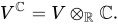
This is a complex vector space whose complex dimension is equal to the real dimension of V. It has a canonical complex conjugation defined by
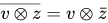
If J is a complex structure on V, we may extend J by linearity to VC:

Since C is algebraically closed, J is guaranteed to have eigenvalues which satisfy λ2 = −1, namely λ = ±i. Thus we may write

where V+ and V are the eigenspaces of +i and −i, respectively. Complex conjugation interchanges V+ and V. The projection maps onto the V± eigenspaces are given by
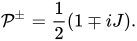
So that

There is a natural complex linear isomorphism between VJ and V+, so these vector spaces can be considered the same, while V may be regarded as the complex conjugate of VJ.

Note that if VJ has complex dimension n then both V+ and V have complex dimension n while VC has complex dimension 2n.

Abstractly, if one starts with a complex vector space W and takes the complexification of the underlying real space, one obtains a space isomorphic to the direct sum of W and its conjugate:
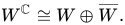
[edit]

Let V be a real vector space with a complex structure J. The dual space V* has a natural complex structure J* given by the dual (or transpose) of J. The complexification of the dual space (V*)C therefore has a natural decomposition

into the ±i eigenspaces of J*. Under the natural identification of (V*)C with (VC)* one can characterize (V*)+ as those complex linear functionals which vanish on V. Likewise (V*) consists of those complex linear functionals which vanish on V+.

The (complex) tensor, symmetric, and exterior algebras over VC also admit decompositions. The exterior algebra is perhaps the most important application of this decomposition. In general, if a vector space U admits a decomposition U = ST, then the exterior powers of U can be decomposed as follows:

A complex structure J on V therefore induces a decomposition
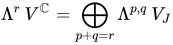
where

All exterior powers are taken over the complex numbers. So if VJ has complex dimension n (real dimension 2n) then

The dimensions add up correctly as a consequence of Vandermonde's identity.

The space of (p,q)-forms Λp,q VJ* is the space of (complex) multilinear forms on VC which vanish on homogeneous elements unless p are from V+ and q are from V. It is also possible to regard Λp,q VJ* as the space of real multilinear maps from VJ to C which are complex linear in p terms and conjugate-linear in q terms.

See complex differential form and almost complex manifold for applications of these ideas.

See also

[edit]

References

[edit]
Revisions and contributorsEdit on WikipediaRead on Wikipedia
from Grokipedia
In mathematics, a linear complex structure on a real vector space VV of even dimension 2n2n is a linear endomorphism J:VVJ: V \to V satisfying J2=IdVJ^2 = -\mathrm{Id}_V, which endows VV with the additional structure of a complex vector space of dimension nn by defining multiplication by ii via iv=J(v)i \cdot v = J(v) for vVv \in V. This construction is compatible with the underlying real vector space operations, as JJ is real-linear, and it decomposes VCV \otimes \mathbb{C} into eigenspaces V1,0={vVCJv=iv}V^{1,0} = \{v \in V \otimes \mathbb{C} \mid Jv = iv\} and V0,1={vVCJv=iv}V^{0,1} = \{v \in V \otimes \mathbb{C} \mid Jv = -iv\}, each of complex dimension nn. Such structures arise naturally in linear algebra and differential geometry, where they serve as the local model for almost complex structures on manifolds; specifically, an almost complex structure on a manifold MM is a smooth assignment of a linear complex structure to each tangent space TpMT_p M. The space of all linear complex structures on R2n\mathbb{R}^{2n} forms a manifold diffeomorphic to the homogeneous space GL(2n,R)/GL(n,C)GL(2n, \mathbb{R})/GL(n, \mathbb{C}), reflecting the action of the general linear group in stabilizing these endomorphisms. Key properties include orthogonality with respect to a compatible metric, leading to Hermitian structures when paired with a positive-definite inner product gg such that g(Ju,Jv)=g(u,v)g(Ju, Jv) = g(u, v), and the existence of a fundamental 2-form ω(u,v)=g(Ju,v)\omega(u, v) = g(Ju, v). In broader contexts, linear complex structures generalize to generalized complex structures in the framework of Courant algebroids, where a complex structure on VVV \oplus V^* unifies symplectic and complex geometries, but the pure linear case remains foundational for understanding integrability conditions like the Newlander–Nirenberg theorem, which ensures when such a structure on a manifold integrates to a holomorphic atlas. Examples include the standard complex structure on CnR2n\mathbb{C}^n \cong \mathbb{R}^{2n} given by J(x1,y1,,xn,yn)=(y1,x1,,yn,xn)J(x_1, y_1, \dots, x_n, y_n) = (-y_1, x_1, \dots, -y_n, x_n), and quaternionic adaptations where multiple compatible JJ's satisfy J1J2=J2J1=J3J_1 J_2 = -J_2 J_1 = J_3. These structures are crucial in areas such as mirror symmetry and , where they parameterize moduli spaces of Calabi–Yau manifolds.

Definition and Basic Properties

Formal Definition

A linear complex structure on a real vector space VV is a linear J:VVJ: V \to V satisfying J2=IdVJ^2 = -\mathrm{Id}_V, where IdV\mathrm{Id}_V denotes the identity map on VV. This endomorphism JJ provides a means to define multiplication by the ii on VV, where J(v)=ivJ(v) = i \cdot v for each vVv \in V; consequently, the pair (V,J)(V, J) becomes a complex vector space with complex dimension dimRV/2\dim_{\mathbb{R}} V / 2. Complex vector spaces motivate this construction, as they naturally carry such a structure via scalar multiplication by ii. A non-trivial linear complex structure exists on VV only if dimRV\dim_{\mathbb{R}} V is even. The object (V,J)(V, J) is commonly referred to as a complex structure on the real vector space VV.

Key Properties

A linear complex structure JJ on a real vector space VV endows it with the properties of complex linearity, where a real linear map f:(V,J)(W,K)f: (V, J) \to (W, K) between two such structured spaces is complex linear if it satisfies fJ=Kff \circ J = K \circ f. This condition ensures that ff respects the complex multiplication induced by JJ and KK, allowing operations to be performed as in a complex vector space. The endomorphism JJ, extended C\mathbb{C}-linearly to the complexification VRCV \otimes_{\mathbb{R}} \mathbb{C}, has eigenvalues ii and i-i. The corresponding eigenspaces decompose VRCV \otimes_{\mathbb{R}} \mathbb{C} into the direct sum V1,0V0,1V^{1,0} \oplus V^{0,1}, where V1,0={viJ(v)vV}V^{1,0} = \{ v - i J(v) \mid v \in V \} (up to scaling by 1/21/2) is the ii-eigenspace, often called the holomorphic part, and V0,1={v+iJ(v)vV}V^{0,1} = \{ v + i J(v) \mid v \in V \} (up to scaling) is the i-i-eigenspace, known as the anti-holomorphic part. These eigenspaces are complex subspaces of dimension nn over C\mathbb{C} when dimRV=2n\dim_{\mathbb{R}} V = 2n, providing a canonical way to view VV as underlying a complex vector space isomorphic to V1,0V^{1,0}. Over C\mathbb{C}, JJ is diagonalizable with spectrum {i,i}\{i, -i\}, since its minimal polynomial x2+1=0x^2 + 1 = 0 splits into distinct linear factors. In the linear setting, the integrability condition for JJ is always satisfied, as the Nijenhuis tensor vanishes trivially due to the absence of in the structure, ensuring that JJ defines a genuine complex structure without additional obstructions.

Examples and Constructions

Elementary Example

A fundamental illustration of a linear complex structure arises on the real R2\mathbb{R}^2. The standard J:R2R2J: \mathbb{R}^2 \to \mathbb{R}^2 is defined by the action J(x,y)=(y,x)J(x, y) = (-y, x) for (x,y)R2(x, y) \in \mathbb{R}^2, or equivalently, in matrix form with respect to the {e1=(1,0),e2=(0,1)}\{e_1 = (1,0), e_2 = (0,1)\}, J=(0110),J = \begin{pmatrix} 0 & -1 \\ 1 & 0 \end{pmatrix}, where Je1=e2J e_1 = e_2 and Je2=e1J e_2 = -e_1. This operator represents a counterclockwise by 90 degrees around the origin. To verify the defining property, compute J2J^2: J2=(0110)(0110)=(1001)=I2,J^2 = \begin{pmatrix} 0 & -1 \\ 1 & 0 \end{pmatrix} \begin{pmatrix} 0 & -1 \\ 1 & 0 \end{pmatrix} = \begin{pmatrix} -1 & 0 \\ 0 & -1 \end{pmatrix} = -I_2, where I2I_2 is the 2×22 \times 2 . Thus, JJ equips R2\mathbb{R}^2 with a linear complex structure, making it isomorphic as a complex vector space to C\mathbb{C}, which has real 2 and complex 1. This structure aligns naturally with the field of complex numbers via the identification ϕ:R2C\phi: \mathbb{R}^2 \to \mathbb{C} given by (x,y)x+iy(x, y) \mapsto x + i y. Under ϕ\phi, the action of JJ corresponds precisely to multiplication by ii on C\mathbb{C}, since i(x+iy)=ix+i(iy)=ixy=y+ix=ϕ(y,x)=ϕ(J(x,y)).i \cdot (x + i y) = i x + i (i y) = i x - y = -y + i x = \phi(-y, x) = \phi(J(x, y)).

Standard Complex Spaces

The standard complex space refers to the canonical linear complex structure on the complex vector space Cn\mathbb{C}^n, which equips it with the structure of a of dimension nn. When viewed as a real vector space R2n\mathbb{R}^{2n}, Cn\mathbb{C}^n admits a natural almost complex structure J0J_0 induced by multiplication by the ii, satisfying J02=IdJ_0^2 = -\mathrm{Id}. This structure is integrable, making Cn\mathbb{C}^n a model for holomorphic , and it generalizes the elementary case on R2C\mathbb{R}^2 \cong \mathbb{C} where JJ rotates vectors by 90 degrees counterclockwise. Consider the standard real basis {e1,,e2n}\{e_1, \dots, e_{2n}\} for R2n\mathbb{R}^{2n}, where the coordinates are ordered as (x1,,xn,y1,,yn)(x_1, \dots, x_n, y_1, \dots, y_n) with zk=xk+iykz_k = x_k + i y_k for k=1,,nk = 1, \dots, n. The operator J0J_0 acts on this basis by J0(e2k1)=e2kJ_0(e_{2k-1}) = e_{2k} and J0(e2k)=e2k1J_0(e_{2k}) = -e_{2k-1} for each k=1,,nk = 1, \dots, n, corresponding to J0(/xk)=/ykJ_0(\partial/\partial x_k) = \partial/\partial y_k and J0(/yk)=/xkJ_0(\partial/\partial y_k) = -\partial/\partial x_k. In this identification, J0J_0 precisely mimics multiplication by ii in the holomorphic coordinates zkz_k, as i(xk+iyk)=yk+ixki \cdot (x_k + i y_k) = -y_k + i x_k, which aligns with the real and imaginary parts after applying J0J_0. The matrix representation of J0J_0 with respect to the is the block-diagonal form consisting of nn copies of the 2×22 \times 2 (0110)\begin{pmatrix} 0 & -1 \\ 1 & 0 \end{pmatrix}, or equivalently, the 2n×2n2n \times 2n matrix J0=(0InIn0)J_0 = \begin{pmatrix} 0 & -I_n \\ I_n & 0 \end{pmatrix}, where InI_n is the n×nn \times n . This ensures that the real of the space is 2n2n while the complex is nn, providing a foundational example of how a linear complex structure endows a real with complex linearity. The holomorphic coordinates zk=xk+iykz_k = x_k + i y_k then serve as a global where functions and maps can be analyzed for holomorphicity with respect to J0J_0.

Direct Sums

Given two real vector spaces VV and WW equipped with linear complex structures JV:VVJ_V: V \to V and JW:WWJ_W: W \to W respectively, the direct sum vector space [VW](/page/Directsum)[V \oplus W](/page/Direct_sum) admits a natural induced linear complex structure J=JVJWJ = J_V \oplus J_W defined by J(v,w)=(JV(v),JW(w))J(v, w) = (J_V(v), J_W(w)) for all vVv \in V, wWw \in W. This operator satisfies J2=IdVWJ^2 = -\mathrm{Id}_{V \oplus W}, since J2(v,w)=(JV2(v),JW2(w))=(v,w)J^2(v, w) = (J_V^2(v), J_W^2(w)) = (-v, -w). The complex dimension is additive under this construction, with dimC(VW)=dimCV+dimCW\dim_{\mathbb{C}}(V \oplus W) = \dim_{\mathbb{C}} V + \dim_{\mathbb{C}} W, as the induced structure identifies VWV \oplus W with the underlying real space of the complex VCWCV_{\mathbb{C}} \oplus W_{\mathbb{C}}. A concrete example arises by taking the R2R2R4\mathbb{R}^2 \oplus \mathbb{R}^2 \cong \mathbb{R}^4, where each R2\mathbb{R}^2 carries the standard linear complex structure given by the matrix J0=(0110).J_0 = \begin{pmatrix} 0 & -1 \\ 1 & 0 \end{pmatrix}. The induced JJ on R4\mathbb{R}^4 is then the block-diagonal matrix diag(J0,J0)\mathrm{diag}(J_0, J_0), which satisfies J2=IdR4J^2 = -\mathrm{Id}_{\mathbb{R}^4} and endows R4\mathbb{R}^4 with the structure of C2\mathbb{C}^2. This construction preserves complex linear maps: if f:VVf: V \to V' and g:WWg: W \to W' are complex linear (i.e., R\mathbb{R}-linear maps commuting with JVJ_V and JWJ_W), then the induced map fg:VWVWf \oplus g: V \oplus W \to V' \oplus W' is complex linear with respect to JVJWJ_V \oplus J_W and JVJWJ_{V'} \oplus J_{W'}.

Compatibility and Relations

With Other Geometric Structures

A linear complex structure JJ on a real VV is compatible with a Riemannian metric gg on VV if g(Ju,Jv)=g(u,v)g(Ju, Jv) = g(u, v) for all u,vVu, v \in V and g(u,Ju)>0g(u, Ju) > 0 for all nonzero uVu \in V. This compatibility ensures that gg becomes a Hermitian metric when VV is viewed as a complex vector space via JJ. In this setting, the associated fundamental 2-form ω(u,v)=g(Ju,v)\omega(u, v) = g(Ju, v) defines a symplectic structure on VV, which is non-degenerate due to the positive-definiteness condition on gg. When JJ is compatible with both a metric gg and the induced symplectic form ω\omega, the pair (g,ω)(g, \omega) satisfies the Kähler condition in the linear case: ω(Ju,Jv)=ω(u,v)\omega(Ju, Jv) = \omega(u, v) and the metric is preserved under JJ. This structure equips VV with a flat Kähler metric, analogous to the standard one on Cn\mathbb{C}^n. The linear complex structure JJ induces a natural positive orientation on VV, determined by the ordering of a basis adapted to the eigenspaces of JJ with eigenvalues ii and i-i over C\mathbb{C}. In the finite-dimensional case, this orientation aligns with the volume form from the determinant of JJ restricted to real bases. For a finite-dimensional complex vector space Cn\mathbb{C}^n equipped with its standard flat Kähler metric, the structure is Calabi-Yau, as the vanishes and the is trivial. However, not every Riemannian metric on VV is compatible with a given JJ; for instance, a metric that distorts angles unevenly relative to the 90-degree induced by JJ on R2\mathbb{R}^2 fails the invariance condition g(Ju,Jv)=g(u,v)g(Ju, Jv) = g(u, v).

To Complexification

The of a real vector space VV equipped with a linear complex structure JJ is the complex vector space VC=VRCV_{\mathbb{C}} = V \otimes_{\mathbb{R}} \mathbb{C}. The operator JJ extends uniquely to a C\mathbb{C}-linear JCJ_{\mathbb{C}} on VCV_{\mathbb{C}} defined by JC(vz)=J(v)zJ_{\mathbb{C}}(v \otimes z) = J(v) \otimes z for vVv \in V and zCz \in \mathbb{C}. Since J2=IdVJ^2 = -\mathrm{Id}_V, it follows that JC2=IdVCJ_{\mathbb{C}}^2 = -\mathrm{Id}_{V_{\mathbb{C}}}. The Nijenhuis tensor of JCJ_{\mathbb{C}}, denoted [JC,JC][J_{\mathbb{C}}, J_{\mathbb{C}}], vanishes identically on VCV_{\mathbb{C}}, reflecting the integrability of the extended structure in the linear setting. This allows a decomposition of VCV_{\mathbb{C}} into eigenspaces of JCJ_{\mathbb{C}} corresponding to the eigenvalues ±i\pm i: VC=V1,0V0,1,V_{\mathbb{C}} = V^{1,0} \oplus V^{0,1}, where V1,0=ker(JCiIdVC)V^{1,0} = \ker(J_{\mathbb{C}} - i \mathrm{Id}_{V_{\mathbb{C}}}) and V0,1=ker(JC+iIdVC)V^{0,1} = \ker(J_{\mathbb{C}} + i \mathrm{Id}_{V_{\mathbb{C}}}). Each of these is a complex subspace of complex dimension dimRV/2\dim_{\mathbb{R}} V / 2. The space (V,J)(V, J) is isomorphic as a complex vector space to V1,0V^{1,0}, via the R\mathbb{R}-linear map Φ:VVC\Phi: V \to V_{\mathbb{C}} given by Φ(v)=v1i(J(v)1)\Phi(v) = v \otimes 1 - i (J(v) \otimes 1), which intertwines JJ with multiplication by ii on V1,0V^{1,0}. This isomorphism identifies the original complex structure induced by JJ with the standard one on the (1,0)(1,0)-part. Conversely, any complex structure on a real vector space VV arises in this manner from the complexification of its underlying real form.

Extensions

To Infinite-Dimensional Spaces

In infinite-dimensional settings, the notion of a linear complex structure extends to real Banach spaces, where it is defined by a bounded linear operator J:XXJ: X \to X satisfying J2=IdXJ^2 = -\mathrm{Id}_X. This operator equips the space with a compatible complex vector space structure via (a+ib)x=ax+bJx(a + ib) \cdot x = a x + b J x for a,bRa, b \in \mathbb{R} and xXx \in X, preserving the norm if JJ is an . Unlike finite-dimensional cases, the domain of JJ is the entire space due to boundedness requirements, though unbounded operators may arise in less regular contexts. A concrete example occurs on the L2(R)L^2(\mathbb{R}), where the HH provides such a structure, defined by the Fourier multiplier Hf^(ξ)=isgn(ξ)f^(ξ)\widehat{H f}(\xi) = -i \operatorname{sgn}(\xi) \hat{f}(\xi)
Add your contribution
Related Hubs
User Avatar
No comments yet.



