Hubbry Logo
Concession (contract)Concession (contract)Main
Open search
Concession (contract)
Community hub
Concession (contract)
logo
8 pages, 0 posts
0 subscribers
Be the first to start a discussion here.
Concession (contract)
from Wikipedia
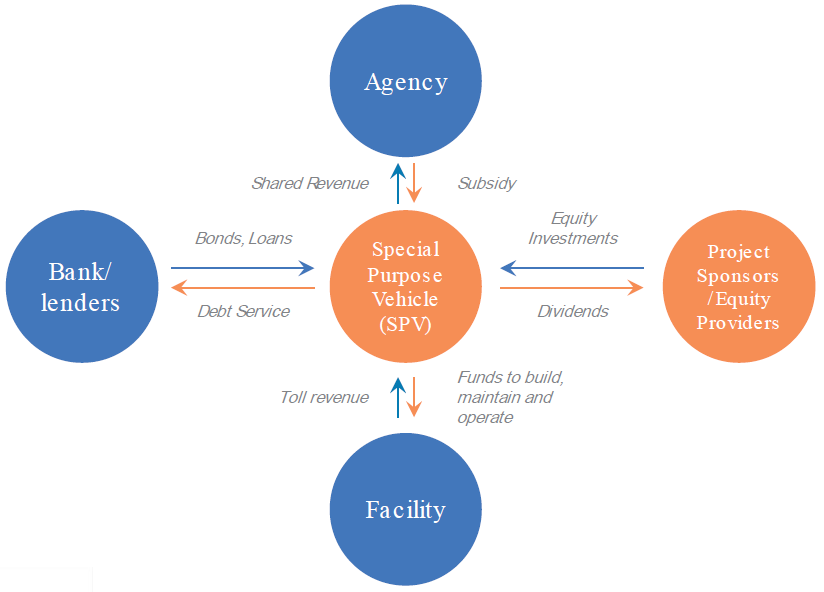
Typical Toll Concession P3 Structure

A concession or concession agreement is a grant of rights, land, property, or facility by a government, local authority, corporation, individual or other legal entity.[1]

Public services such as water supply may be operated as a concession. In the case of a public service concession, a private company enters into an agreement with the government to have the exclusive right to operate, maintain and carry out investment in a public utility (such as a water privatisation) for a given number of years. Other forms of contracts between public and private entities, namely lease contract and management contract (in the water sector often called by the French term affermage), are closely related but differ from a concession in the rights of the operator and its remuneration. A lease gives a company the right to operate and maintain a public utility, but investment remains the responsibility of the public. Under a management contract the operator will collect the revenue only on behalf of the government and will in turn be paid an agreed fee.

A grant of land or a property by the government may be in return for services or for a particular use, a right to undertake and profit by a specified activity, a lease for a particular purpose. A concession may include the right to use some existing infrastructure required to carry out a business (such as a water supply system in a city); in some cases, such as mining, it may involve merely the transfer of exclusive or non-exclusive easements.

In the private sector, the owner of a concession — the concessionaire — typically pays either a fixed sum or a percentage of revenue to the owner of the entity from which it operates.[2] Examples of concessions within another business are concession stands within sporting venues and movie theaters and concessions in department stores operated by other retailers. Short term concessions may be granted as promotional space for periods as short as one day.

Concession agreement may also state the role of an authority and concessionaire and conditions regarding control and ownership of the assets and facilities such as concession can either allow the authority to retain or keep actual ownership of the assets, turning over to the concessionaire and reverting the control and ownership back to an authority once the duration of their concession ended or both the authority and concessionaire control and own the facilities.

The assets and facilities that were built, designated, and acquired prior to the turnover of operations and maintenance from the authority to the concessionaire and are included on a plan of a project that was planned by an authority are predetermined as owned by the authority and to be operated and maintained by the concessionaire upon the turnover of operations and maintenance of the facilities and assets to the concessionaire. Those that were built, acquired and designated by the concessionaire may initially be owned and controlled by the concessionaire and these will be transferred to the authority once its concession duration is ended.

Early history

[edit]

Sultanate of Egypt

[edit]

Muhammad Ali of Egypt used contracts called concessions to build cheap infrastructure - dams and railroads - whereby foreign European companies would raise capital, build projects, and collect most of the operating revenue but would provide Ali's government with a portion of that revenue.[3]

D'Arcy Concession

[edit]

Regulation

[edit]

European Union

[edit]

Within the European Union, the granting of concessions by public bodies is subject to regulation. Works concessions have been subject to award rules for some time as Directive 2004/18/EC of the European Parliament and of the Council of the EU on public procurement applied to works concessions. The award of services concessions with a cross-border interest has been subject to the principles of the Treaty on the Functioning of the European Union. The European Commission had originally included public concession contracts in the Services Directive of 1992, but these were removed from its scope by the European Council.[4] However, the European Parliament and the Council issued a further Directive 2014/23/EU on the award of concession contracts on 26 February 2014,[5] which required EU member states to introduce national legislation covering the award of concession contracts in excess of EUR 5,186,000 awarded on or after 18 April 2016.

United Kingdom

[edit]

In the UK, the equivalent threshold for concession contracts is £4,104,394. Concession contracts granted by public bodies fall within the term "covered procurement" in the Procurement Act 2023.[6]

See also

[edit]

References

[edit]
Revisions and contributorsEdit on WikipediaRead on Wikipedia
from Grokipedia
A concession contract is a binding agreement whereby a public authority grants a private exclusive rights to , construct, operate, and maintain infrastructure or public services, such as toll roads, ports, or utilities, for a defined term, typically in exchange for concession fees, revenue shares, or performance-based payments, while the grantor retains asset ownership and regulatory oversight. These arrangements, often embedded within public-private partnerships (PPPs), aim to mobilize private capital and expertise to address fiscal constraints on governments, particularly for large-scale projects where public funding falls short. Concessions have evolved as mechanisms to transfer operational risks and rewards to private partners, with the concessionaire assuming demand, construction, and maintenance uncertainties in return for potential profits from user fees or efficiencies. Common examples include highway toll concessions, where private operators collect fees to recoup investments, and airport or water supply management, spanning decades to allow amortization of capital-intensive assets. Empirical data from infrastructure projects indicate that concessions can enhance service quality and innovation through competition in bidding, yet they frequently encounter renegotiations—often exceeding 50% in developing economies—due to optimistic traffic forecasts, cost overruns, or regulatory changes that erode expected returns. Despite theoretical advantages in aligning incentives via long-term horizons, concessions are prone to controversies including , political interference in tariff adjustments, and disputes over events, leading to arbitrations or contract terminations that undermine investor confidence and public . In resource extraction contexts, such as or , concessions have historically been unstable, with host governments seeking revisions amid commodity price volatility or nationalist pressures, highlighting causal risks from asymmetric information and hold-up problems inherent in these sovereign-private dealings.

Definition and Core Principles

Fundamental Characteristics

A concession contract is a legal agreement in which a public authority grants a private entity the exclusive right to operate a public service, manage public assets, or exploit natural resources for a specified duration, typically ranging from 15 to 50 years depending on the sector and jurisdiction. This arrangement transfers operational responsibilities and associated commercial risks to the concessionaire, who finances, constructs, maintains, or rehabilitates the infrastructure as required, while the public grantor retains ownership of the assets. Unlike traditional public procurement, concessions emphasize private initiative in service delivery, with the concessionaire recovering costs and earning returns primarily through user fees or tolls rather than direct government payments. Central to concessions is the allocation of risks, where the private party assumes demand risk (variability in user volumes) and much of the and operational risks, incentivizing and to meet standards outlined in the . The specifies output-based obligations, such as metrics, commitments, and tariffs regulated to balance affordability and viability, often with mechanisms for periodic reviews or renegotiation to address unforeseen changes like economic shifts or regulatory updates. At expiration, assets and operations revert to the grantor, ensuring public control persists, though extensions may occur if predefined conditions are met. Concessions differ from leases or management contracts by encompassing broader responsibilities, including potential capital investments funded by the private sector without sovereign guarantees in competitive awards, promoting fiscal discipline for the grantor. Award processes typically involve competitive bidding to select the bidder offering the best value, such as lowest tariffs or highest upfront payments, mitigating risks of favoritism or suboptimal terms. Empirical evidence from implementations, such as in transport sectors, shows concessions can accelerate infrastructure delivery where public budgets are constrained, though success hinges on robust contract design to prevent opportunism by either party.

Key Contractual Elements

Concession contracts delineate the rights and responsibilities between the granting authority—typically a public entity—and the concessionaire, a private party tasked with developing, operating, or exploiting public assets or services. These agreements emphasize clear allocation of risks, incentives for efficiency, and safeguards for public interest, often spanning infrastructure like highways or utilities, or resource extraction. Core elements ensure the concessionaire recovers investments through user fees or specified revenues while meeting performance standards, with provisions for adjustments to economic changes or unforeseen events. A fundamental provision is the grant of concession, which explicitly transfers operational rights to the concessionaire, including exclusive or semi-exclusive authority to collect user fees, manage the asset, and implement specified works. This clause outlines the scope, such as design-build-operate-maintain (DBOM) obligations for infrastructure projects, and links to annexes detailing site plans or technical specifications. The grant is conditioned on achieving key milestones, like financial close (appointed date) and operational readiness (commercial operations date), to mitigate delays. The duration or concession period is typically long-term, ranging from 20 to 30 years, to allow amortization of capital investments while aligning with asset life cycles. Extensions may be permitted for proven performance or force majeure events, but early termination triggers compensation formulas based on undepreciated investments. Obligations of the parties form the operational core: the concessionaire must finance, construct, operate, and maintain the asset to predefined standards, often including insurance requirements and hand-back conditions ensuring good repair at expiry. The granting authority provides land access, approvals, and sometimes subsidies, while retaining oversight through monitoring mechanisms. Representations and warranties affirm each party's capacity and compliance with laws. Financial arrangements specify payment mechanisms, such as user tariffs, revenue shares, or concession fees paid to the authority, with adjustments for inflation, demand changes, or regulatory shifts to maintain viability. Performance-based incentives include bonuses for exceeding targets and penalties or deductions for shortfalls in service quality or availability. Risk allocation provisions distribute uncertainties—construction, operational, or revenue risks—to the party best positioned to manage them, often with force majeure clauses excusing non-performance due to uncontrollable events like natural disasters. Change-in-law adjustments protect against regulatory alterations affecting costs. Termination and dispute resolution clauses outline triggers for ending the contract, such as material breach or insolvency, with buyout valuations for the concessionaire's investments. Disputes escalate through negotiation, expert determination, or arbitration under bodies like the International Chamber of Commerce, governed by the host country's law or international standards for cross-border projects.

Historical Evolution

Pre-Modern and Colonial Origins

In ancient Rome, the practice of concession-like contracts emerged through the publicani, private syndicates of equestrian businessmen who bid at public auctions for the right to collect provincial taxes, supply armies with provisions and equipment, and undertake public works such as infrastructure maintenance. These agreements, formalized by the 3rd century BCE, typically lasted five years and required the publicani to remit a fixed sum to the Roman treasury while retaining excess revenues as profit, effectively outsourcing state fiscal and logistical operations to private enterprise. This model persisted into the early Empire but declined as the state centralized control under Augustus around 27 BCE, shifting toward direct administration to curb abuses like over-collection that fueled provincial resentment and corruption. Publicani operations exemplified early risk allocation, where contractors bore collection uncertainties in exchange for potential gains, though frequent defaults highlighted the hazards of fixed-bid systems amid fluctuating provincial yields. During the colonial era, European sovereigns adapted such outsourcing via royal charters and capitulaciones, granting private parties exclusive rights to trade, settle, and extract resources in overseas domains to finance expansion without direct crown expenditure. In Spain, capitulaciones from the late 15th century onward awarded discoverers and miners specific concessions for American territories, including rights to exploit gold and silver deposits, with the crown claiming a quinto (fifth) share of output as royal prerogative. These instruments, embedded in explorer contracts like those of Columbus in 1492, tied private initiative to state revenue, spurring ventures such as the Potosí silver boom after 1545, which supplied up to 60% of global silver by the late 16th century. English and Dutch precedents included charters like Queen Elizabeth I's 1600 grant to the East India Company, conferring monopoly trading rights in Asia for an initial 15-year term, renewable upon performance, in exchange for duties on imports and exports. Such concessions extended to North American fur trade via the 1670 Hudson's Bay Company charter, which awarded vast territorial control for resource monopoly, blending commercial exploitation with quasi-sovereign administration. These arrangements prioritized investor incentives through exclusivity but often led to renegotiations or revocations amid disputes over profit-sharing and local governance, foreshadowing modern concession instabilities.

19th and Early 20th Century Developments

In the 19th century, concession contracts expanded significantly as industrializing governments sought private capital for infrastructure projects amid limited public funds, particularly in Europe and semi-colonial regions. These agreements typically granted private entities—often foreign-led companies—exclusive rights to build, operate, and collect tolls from railways, canals, and telegraphs for fixed terms, in exchange for royalties or shares of revenue. In France, the 1842 railway law formalized this model by awarding fixed-term concessions to private companies for line operations, while the state sometimes handled initial earthworks and tracks, enabling rapid network growth from 400 kilometers in 1842 to over 20,000 by 1880. Similar concessions proliferated in other European states and empires, such as the Ottoman Empire, where foreign firms secured rights for telegraph lines (e.g., British pursuits from 1855–1858) and railways in Rumelia to enhance connectivity and extractive efficiency. A landmark example was the Suez Canal concession, granted on November 30, 1854, by Egyptian Viceroy Said Pasha to the French-led Compagnie Universelle du Canal Maritime de Suez for 99 years, authorizing construction of the 163-kilometer waterway linking the Mediterranean and Red Seas. The firm raised initial capital through 400,000 shares at 500 francs each, with the Khedive later acquiring 44% ownership yielding 31% of net profits plus 15% of residual income; the canal opened in 1869, facilitating global trade but exemplifying foreign dominance over local sovereignty in underdeveloped territories. Canal and railway concessions in colonial contexts, such as British and French ventures in Africa and Asia, often bundled infrastructure rights with resource access, prioritizing European capital inflows over indigenous development. By the early 20th century, concessions increasingly targeted natural resources, reflecting rising global demand for commodities like petroleum, with sovereigns granting vast territorial monopolies to entice exploration investments. The D'Arcy Concession, signed May 28, 1901, by Persia's Shah Mozaffar ad-Din to British entrepreneur William Knox D'Arcy, provided a 60-year exclusive right to prospect and extract oil across nearly all Persian territory except five northern provinces, in return for a £20,000 signing bonus, shares, and 16% royalties—paving the way for the 1908 Masjed Soleyman discovery and formation of the Anglo-Persian Oil Company. This model spread to the Middle East, where early concessions covered entire nations or regions, often with minimal upfront payments but long durations to offset risks, shifting emphasis from infrastructure tolls to resource royalties amid technological advances in drilling. Such agreements underscored causal tensions between host-state fiscal needs and foreign firms' profit incentives, frequently leading to renegotiations or expropriations as resource values escalated.

Post-World War II Shifts

Following World War II, concession contracts underwent significant transformations driven by decolonization, the emergence of newly independent states, and a growing emphasis on national sovereignty over resources and infrastructure. In developing countries, initial post-war agreements often retained colonial-era structures favoring foreign investors with long-term exclusive rights and low revenue shares for host governments. However, as political independence advanced and local capacities developed, host states gained leverage, leading to widespread renegotiations that increased fiscal terms and government involvement. This shift reflected a broader causal dynamic: reduced investor monopoly on technology and capital, coupled with rising nationalist sentiments, prompted adjustments to prevent perceived exploitation, though many concessions faced instability or termination. In natural resources extraction, particularly oil and mining, post-1945 changes were pronounced. Iran's 1951 attempt to nationalize the Anglo-Iranian Oil Company's concession culminated in a 1954 consortium agreement that boosted Iran's revenue share from 16% to 50%, setting a precedent for profit-sharing models. Similarly, Venezuela's 1948 oil law revisions and subsequent 50-50 splits influenced global standards, while Chile renegotiated copper concessions with firms like Anaconda, raising effective tax rates from 18% to over 60% by the 1960s. These alterations often followed nationalizations or threats thereof, justified by the emerging principle of permanent sovereignty over natural resources, formalized in UN General Assembly Resolution 1803 (1962), which prioritized state control despite investor claims under international law. The Suez Canal Company's 99-year concession, granted in 1854, ended abruptly with Egypt's 1956 nationalization, highlighting how geopolitical tensions accelerated the erosion of pre-war investor protections. Infrastructure concessions evolved more variably, with Western Europe initially favoring public-led reconstruction under frameworks like the Marshall Plan (1948–1952), which allocated $13 billion primarily for state-managed projects rather than private grants. Yet, selective private concessions reemerged for efficiency; France awarded its first motorway concession to Société des Autoroutes du Sud de la France in 1955, spanning 35 years with toll rights to fund construction. In contrast, developing regions saw hybrid models amid fiscal constraints, but frequent renegotiations mirrored resource sectors, as governments sought to retain oversight amid uneven bargaining power. Overall, these post-war dynamics marked a transition from investor-dominant pacts to more balanced or state-centric arrangements, though empirical data indicate few unaltered long-term concessions succeeded without fiscal or operational revisions.

Types and Applications

Infrastructure and Public Services

Concession contracts in infrastructure typically grant private operators the exclusive right to finance, build, operate, and maintain public assets such as toll roads, bridges, airports, and ports, with revenue derived from user fees like tolls or landing charges. These arrangements often span 20 to 75 years, allowing recovery of capital investments through operational revenues while transferring assets back to the public sector at the end of the term. For instance, in 2006, the Indiana Toll Road was leased to a private consortium for 75 years in exchange for a $3.8 billion upfront payment to the state, enabling upgrades and maintenance funded by toll collections. In airport concessions, private entities manage terminals, runways, and ancillary services, often under build-operate-transfer models that include expanding capacity to meet demand. European examples include motorway and airport service concessions, where operators handle traffic management and safety compliance under regulatory oversight. Similarly, port concessions involve rehabilitating and commercializing docking facilities, with the concessionaire optimizing cargo handling for a fixed period. For public services, concessions apply to utilities like water distribution and wastewater systems, where private firms operate networks, invest in infrastructure upgrades, and bill users while adhering to service quality standards set by the granting authority. In such agreements, the concessionaire assumes operational risks, including demand fluctuations, in return for the right to generate revenues from tariffs approved by regulators. Examples include urban water concessions that encompass metering, treatment, and leakage reduction, often resulting in expanded access through private capital infusion. These models extend to other services like public transport and waste management, prioritizing efficiency in asset utilization over direct government procurement.

Natural Resources Extraction

Concession contracts in natural resources extraction authorize private companies to explore, develop, and produce commodities such as petroleum, natural gas, and minerals from state-controlled territories, with the concessionaire bearing upfront exploration risks and retaining ownership of extracted resources in exchange for fiscal payments to the government. These payments commonly include signature bonuses paid upon award, royalties calculated as a percentage of production value (typically 10-20% for oil), rental fees during exploration, and corporate income taxes on profits, often supplemented by profit-sharing mechanisms once costs are recouped. This structure incentivizes rapid investment in high-risk frontier areas, as the company captures full upside from discoveries, unlike production-sharing agreements where governments retain resource title and contractors recover costs from allocated output shares. In the oil and gas sector, concessions originated prominently in the early 20th century, exemplified by the 1901 D'Arcy Concession in Persia (modern Iran), which spanned 480,000 square miles for an initial £20,000 payment plus 16% royalties, enabling the Anglo-Persian Oil Company's discovery of the Masjed Soleyman field in 1908 and shaping subsequent Middle Eastern agreements. Modern variants, such as Egypt's 2021 model concession for gas and crude oil, grant 10-30 year terms with work obligations like seismic surveys and drilling commitments, alongside environmental safeguards and local content requirements to mitigate resource nationalism risks. For minerals, mining concessions typically confer perpetual or renewable titles to defined claims, with fiscal terms favoring output-based royalties (e.g., 2-5% ad valorem in many African jurisdictions) to align extraction efficiency with revenue generation, though they often include relinquishment clauses requiring unproven areas to revert to the state after initial phases. Empirical evidence on concession outcomes reveals efficiency gains from private risk-taking, as seen in accelerated production under investor-led models compared to state monopolies, but also vulnerabilities to renegotiation amid commodity price volatility or political shifts, with over 50% of Latin American mining contracts facing revisions between 2004 and 2012 due to perceived imbalances favoring initial terms. In Liberia's iron ore sector, post-1960 concessions with 30-50 year durations and infrastructure build-back obligations boosted exports from negligible levels to 4.5 million tons annually by the 1970s, yet generated disputes over fiscal stability amid civil unrest, underscoring the causal link between secure tenure and capital inflows versus opportunistic state interventions eroding investor confidence. While concessions have facilitated technology transfer and revenue mobilization—yielding up to 70% government take in optimized oil regimes—they correlate with elevated corruption risks in weakly governed contexts, where opaque awarding processes enable elite capture, as documented in cross-national analyses of extractive rents.

Risk Allocation and Incentives

In concession contracts, risk allocation follows the principle of assigning each risk to the party best positioned to manage it at the lowest cost, thereby promoting efficiency and value for money in public-private partnerships (PPPs). Construction risks, such as delays or cost overruns, are typically borne by the private concessionaire due to its expertise in project execution, while political risks like regulatory changes remain with the government. Demand or revenue risks, critical in user-fee based concessions like toll roads, are often allocated to the concessionaire to incentivize accurate forecasting and service quality improvements, though governments may share these in availability-payment models to mitigate volatility. This allocation creates high-powered incentives for the private sector to innovate and control costs, as the concessionaire's returns depend directly on performance outcomes rather than fixed payments. Mechanisms such as performance-based payments, tied to service standards and availability, further align interests by penalizing underperformance and rewarding efficiency gains. Revenue-sharing clauses in toll concessions, for instance, encourage overperformance by allowing the concessionaire to retain excess revenues up to a threshold, after which surpluses revert to the public sector, balancing profit motives with fiscal prudence. Empirical evidence indicates that effective risk allocation enhances project efficiency, with studies showing reduced lifecycle costs when risks are transferred appropriately, though misallocation often leads to renegotiations—occurring in over 50% of concessions in Latin America during the 1990s due to unforeseen demand shortfalls or opportunistic government actions. However, OECD analyses reveal that governments frequently overpay for risk transfers in PPPs, with premiums exceeding actual risk values, underscoring the need for robust valuation to avoid fiscal burdens. Incentives like reputation effects and ratchet mechanisms, which adjust tariffs based on past performance, help sustain long-term compliance but require credible enforcement to counter moral hazard.

Renegotiation and Stability Clauses

Renegotiation clauses in concession contracts permit the parties to revise terms in response to specified triggers, such as material adverse changes in economic conditions, regulatory shifts, or unforeseen events that disrupt the contract's economic balance. These provisions aim to adapt long-term agreements to evolving circumstances while allocating risks appropriately, but they can incentivize opportunistic behavior if poorly designed, as parties may anticipate revisions to bid aggressively or later seek favorable adjustments. Empirical evidence from Latin American infrastructure concessions indicates that over 50% of transport sector projects awarded between 1989 and 2000 were renegotiated within an average of three years, often resulting in extended durations, higher tariffs, or additional government payments to restore private investors' returns. To mitigate excessive renegotiations, contracts frequently include triggers limited to objective events like force majeure or significant demand shortfalls, coupled with predefined adjustment mechanisms such as price indexation or arbitration for disputes. However, studies attribute high renegotiation rates to factors including incomplete contracting, weak regulatory frameworks, and asymmetric information, where governments face hold-up problems from private operators or vice versa, leading to fiscal costs estimated at 10-20% of initial investment values in affected projects. In developed markets, renegotiations are less frequent due to stronger institutions, but global data from public-private partnerships (PPPs) show they occur in up to 30% of cases, underscoring the need for clauses that balance flexibility with commitment to original terms absent clear justification. Stability clauses, often termed stabilization or grandfathering provisions, counteract potential regulatory or fiscal changes by locking in the legal and economic framework at the contract's inception, thereby reducing political risk for investors in high-uncertainty environments like natural resource extraction or infrastructure. Common variants include freezing clauses, which exempt the concessionaire from new laws post-signing; economic equilibrium clauses, which mandate compensation or adjustments to preserve the project's financial viability if changes impair returns; and hybrid forms combining both. These mechanisms promote investment by signaling credible commitment from host governments, as evidenced in mining concessions where stabilization provisions correlate with higher foreign direct investment inflows in volatile jurisdictions. Critics argue that broad stability clauses constrain sovereign regulatory powers, potentially hindering responses to environmental imperatives or fiscal needs, though empirical analyses reveal they rarely absolve operators of core obligations and often include materiality thresholds to activate protections. In practice, renegotiation and stability clauses interact: the former provides post-award adaptability, while the latter preempts disputes by stabilizing upfront conditions, with optimal designs tying adjustments to verifiable metrics like internal rate of return to align incentives and minimize ex-post opportunism. World Bank reviews of over 1,000 concessions emphasize that robust enforcement of such clauses reduces overall renegotiation incidence by fostering trust, though outcomes vary by institutional quality, with developing economies experiencing higher litigation rates absent independent oversight.

Regulation Across Jurisdictions

European Union Framework

The European Union framework for concession contracts is established primarily through Directive 2014/23/EU, adopted by the European Parliament and Council on 26 February 2014 and published in the Official Journal on 28 March 2014. This directive harmonizes rules for awarding concessions by public authorities and utilities entities, addressing prior gaps where works concessions fell under Directive 2004/18/EC but service concessions lacked full EU-level regulation. It mandates transposition into national law by Member States by 18 April 2016, setting minimum standards to ensure transparency, non-discrimination, and equal treatment while allowing flexibility for national variations. The framework supports public-private partnerships by clarifying risk allocation, where concessionaires assume operational risks and derive primary remuneration from user fees rather than direct payments from the authority. A concession contract under the directive is defined as a written agreement for works or services where the concessionaire bears substantial economic risk, with consideration consisting either solely or predominantly of the right to exploit the works or services. It applies to contracts valued above EU thresholds—€5,382,000 for works concessions and €5,382,000 for services concessions as of 1 January 2024—awarded by central government authorities, sub-central authorities, or utilities in sectors like water, energy, transport, and postal services. Exclusions include concessions for lotteries, certain social services below thresholds, and contracts awarded to affiliated undertakings without competitive procedure, though secret network concessions in utilities may require justification. The directive integrates with broader procurement rules under Directives 2014/24/EU and 2014/25/EU, emphasizing value for money over lowest price and permitting life-cycle costing in evaluations. Award procedures must be transparent, with mandatory prior publication in the Official Journal of the EU for cross-border interest contracts, using notices detailing scope, selection criteria, and award rules. Available methods include open procedures (unrestricted participation), restricted procedures (pre-qualification), negotiated procedures with prior call for tenders, and competitive dialogue for complex projects, but direct awards are limited to unforeseen urgency or single-tender justification. Selection criteria assess economic and financial standing, technical capacity, and suitability, while award criteria prioritize the economically most advantageous tender based on quality, price, and environmental factors. Duration is capped at five years unless justified by amortization needs or service complexity, with renegotiation prohibited except for unforeseen circumstances, and subcontracting regulated to maintain control. The framework enforces governance through standstill periods post-decision (30 days for review applications), remedies directives for enforcement, and electronic means for submissions to reduce barriers. Empirical application has facilitated infrastructure projects like toll roads and ports, but implementation varies, with some Member States facing delays or adding stricter national rules, as seen in Ireland's 2017 regulations applying to contracts over €5.2 million. While promoting market access and efficiency, the directive's risk-bearing requirement distinguishes concessions from traditional procurement, aiming to incentivize private investment amid fiscal constraints post-2008 crisis.

United Kingdom and Common Law Approaches

In the United Kingdom, concession contracts are primarily regulated under the Procurement Act 2023, which establishes a unified framework for public procurement, including concessions, superseding earlier EU-derived legislation such as the Concession Contracts Regulations 2016 following Brexit. This Act mandates competitive procedures for concessions exceeding specified thresholds—typically £5 million for services or works concessions awarded by central government authorities—emphasizing transparency, value for money, and risk transfer to the private sector, where the concessionaire derives revenue at least partially from end-users rather than direct government payments. The framework applies to contracting authorities and utilities, requiring open tenders or competitive dialogues for complex projects, with provisions for direct awards in limited cases like urgency or intellectual property protection. Under common law principles, which underpin contract formation and enforcement in the UK and influencing jurisdictions such as Australia, Canada, and pre-independence common law countries, concession agreements are treated as standard commercial contracts subject to doctrines of offer, acceptance, consideration, and intention to create legal relations. Courts interpret terms objectively based on the parties' expressed intentions at the time of contracting, prioritizing the plain meaning of language while implying terms like cooperation or reasonableness only where necessary to give business efficacy. Unlike civil law systems, common law does not accord special status to state contracts, applying parity of arms and enforcing concessions through ordinary remedies such as damages, specific performance, or injunctions, without presumptions of sovereign immunity or automatic stabilization clauses. This approach fosters contractual stability via pacta sunt servanda but allows for frustration or force majeure in unforeseen events, as seen in disputes over infrastructure concessions affected by economic shocks. In practice, UK concessions often involve infrastructure and services like electric vehicle charging networks or leisure facilities, where private operators assume demand risk and operational costs in exchange for user fees, as in contracts under the Local Electric Vehicle Infrastructure (LEVI) Fund totaling £633 million across local authorities. Post-Brexit flexibility under the 2023 Act permits tailored risk allocation—such as revenue-sharing or performance-based incentives—without EU-mandated light-touch regimes, though challenges arise in renegotiations, where common law courts scrutinize changes for mutual consent rather than unilateral public interest overrides. Empirical outcomes show efficiency gains from private operation, but litigation risks persist if procurement breaches equality of treatment, as affirmed in cases reinforcing the exploitative right inherent to true concessions.

United States and Emerging Markets

In the United States, concession contracts are predominantly applied to transportation infrastructure via public-private partnerships (P3s), with a focus on highways and toll roads to supplement limited public funding. The Federal Highway Administration has documented 28 highway P3 concession projects implemented since 1992, emphasizing long-term leases where private operators finance, maintain, and collect tolls in exchange for upfront payments or revenue shares. Federal involvement is advisory, providing model contract guides for toll concessions, while states enact enabling legislation and negotiate deals. Key examples include the Indiana Toll Road concession, awarded in 2006 for a 75-year lease to a private consortium in return for a $3.8 billion upfront payment to the state, granting rights to operate and toll the facility. Toll revenues fell short of projections due to traffic shortfalls, culminating in the operator's bankruptcy filing in 2014 and subsequent restructuring. Similarly, the Chicago Skyway lease in 2005 involved a 99-year concession for $1.83 billion, enabling private improvements but exposing operators to demand risks without government revenue guarantees. These cases highlight stable legal enforcement in the U.S., where disputes are resolved through courts rather than unilateral state action, though financial viability hinges on accurate traffic forecasts. In emerging markets, concessions serve as a primary mechanism to attract foreign direct investment for infrastructure and natural resource projects, often in sectors like ports, power, and mining amid fiscal constraints. Latin America exemplifies widespread adoption, with hundreds of transport and water concessions awarded in the 1990s to privatize assets and fund expansions. However, institutional weaknesses lead to elevated political and regulatory risks, manifesting in frequent contract renegotiations that transfer value from private investors to governments. Empirical analysis of over 1,000 Latin American infrastructure concessions from the 1980s to 2000 reveals that roughly 75% underwent renegotiation, averaging 1.6 years after award for water projects and occurring in 3.5 years on average across public-private partnerships. A study of 307 concessions in the region from 1989 to 2000 confirms this pattern, attributing it to incomplete contracts, opportunistic hold-ups by governments or operators, and exogenous shocks like economic downturns, which erode initial efficiency incentives. In contrast to U.S. experiences, such renegotiations in emerging markets often favor public entities without judicial recourse, deterring long-term private capital and perpetuating underinvestment despite initial promises of stability. World Bank assessments underscore that robust upfront risk allocation and enforcement mechanisms are critical to mitigate these issues, yet implementation lags in weaker governance environments.

Benefits and Empirical Outcomes

Efficiency Gains and Private Sector Advantages

Private operators in concession contracts assume operational and financial risks, incentivizing cost minimization and service optimization to maximize returns within fixed terms, often leading to efficiencies unattainable under public management. Empirical analyses indicate substantial productivity improvements, with private concessionaires achieving up to 20-30% reductions in operating costs through streamlined processes and technology adoption in sectors like toll roads and ports. For instance, in Spanish toll motorway concessions, private firms demonstrated persistent efficiency gains, with productivity indices rising by 15% on average post-concession due to better resource allocation and maintenance practices. The bundling of design, construction, financing, and operations in concessions promotes life-cycle cost savings by aligning incentives for durable investments over short-term fixes common in public procurement. Studies of public-private partnerships, including concessions, report average life-cycle cost reductions of 10-25% via innovative maintenance and revenue management, as private entities optimize asset longevity to sustain toll or fee revenues. In the Indiana Toll Road concession leased in 2006, the private operator overhauled safety protocols, achieving zero lost-time injuries and enhancing operational efficiency, which lowered long-term repair expenditures compared to prior public oversight. Private sector involvement facilitates access to specialized expertise and capital markets, enabling faster project delivery and technological upgrades without straining public budgets. Concessions transfer demand and construction risks to firms with superior forecasting and hedging capabilities, yielding empirical efficiency uplifts such as 5-15% earlier completion times in highway projects. This contrasts with traditional public models, where bureaucratic delays often inflate costs by 20% or more; private bidders, competing on upfront payments or service quality, internalize these incentives to deliver value. Overall, these mechanisms underscore causal links between profit-driven operations and verifiable performance metrics, though outcomes depend on robust contract enforcement.

Case Studies of Successful Implementations

One prominent example of successful concession contracts is Chile's infrastructure program, launched in the early 1990s to address chronic underinvestment in highways and other transport assets through private sector involvement. The program awarded franchises via competitive auctions, emphasizing least-present-value-of-revenue bids to align incentives with efficiency and fiscal restraint. By 2023, it encompassed over 100 contracts, mobilizing more than US$27 billion in works nationwide, primarily in roads, which expanded the paved highway network and reduced the infrastructure deficit. Early projects demonstrated tangible efficiency gains and rapid deployment. The El Melón Tunnel concession, awarded in 1993 for a 23-year term, involved a US$42 million private investment to upgrade a critical link in the Santiago-Valparaíso corridor, entering operation shortly thereafter and boosting traffic flow without public funding overruns. Similarly, the Acceso Norte Concepción concession (1995, 28-year term, US$230 million investment) and Santiago-San Antonio Route 78 (1995, 23-year term, US$140 million investment) enhanced urban and intercity connectivity, with observed increases in toll-paying vehicle volumes—such as 8.8% to 9.4% annual growth on comparable segments from 1986 to 1994—reflecting improved utilization and economic activity. Overall, the initiative drove US$3.3 billion in investments across 15 interurban highways by 1998, including expansions like Route 68 (Santiago-Valparaíso-Viña del Mar), a 130 km project with three new tunnels completed by late 1998 for US$374 million, yielding higher travel speeds and a 25.8% rise in paved roads between 1986 and 1993. In aviation, Puerto Rico's Luis Muñoz Marín International Airport (LMM) concession, privatized in 2013 via a 40-year lease, provided an upfront payment of US$615 million to the public authority plus US$400 million for facility modernization, enabling upgrades without straining government budgets amid fiscal challenges. The operator, a consortium led by Airports Alliance, invested in terminal expansions and operational enhancements, increasing passenger throughput from 13.8 million in 2013 to over 15 million by 2019 pre-pandemic, while maintaining financial viability through diversified non-aeronautical revenues. This model transferred demand and operational risks to the private partner, resulting in sustained improvements in service quality and capacity without reported renegotiations. These cases highlight how well-structured concessions, with clear risk allocation and competitive bidding, can accelerate infrastructure delivery and leverage private capital for public benefit, as evidenced by Chile's program achieving projected investments exceeding US$4.25 billion in intercity roads alone during 1995–2000.

Criticisms and Controversies

Government Overreach and Renegotiations

Government overreach in concession contracts typically involves unilateral regulatory interventions, such as tariff controls or scope expansions without compensation, which disrupt the predefined risk-sharing mechanisms and prompt forced renegotiations. These actions often arise from fiscal pressures or political demands, exploiting the public sector's sovereign authority to alter terms after private investments are sunk, thereby undermining contractual predictability. Empirical evidence from developing regions indicates that such overreach correlates with institutional weaknesses, where governments initiate changes to mitigate short-term public discontent at the expense of long-term investment incentives. In Latin America, renegotiations driven by government actions affected over 50% of infrastructure concessions awarded between 1989 and 2000, with transport and water sectors hit hardest; J. Luis Guasch's dataset of 307 contracts revealed that 26% of renegotiations were government-initiated, often involving tariff reductions or investment mandates that shifted costs exceeding $7 billion in fiscal adjustments across the region. For example, in Argentina post-2001 crisis, the administration under President Néstor Kirchner (2003–2007) imposed peso devaluation without tariff pass-through and froze utility rates unilaterally, compelling renegotiations in multiple sectors; this included the 2006 termination of the Buenos Aires water concession operated by Aguas Argentinas (a Suez subsidiary), where the government cited non-compliance but withheld agreed adjustments amid $1.4 billion in claimed private investments. Similar interventions occurred in rail concessions, with Kirchner-era policies suspending contracts and politicizing terms, culminating in partial renationalizations by 2015 under Cristina Fernández de Kirchner, which transferred assets back to state control without full compensation. These patterns reflect causal dynamics where aggressive initial bidding—often encouraged by governments—leads to post-award imbalances, but overreach materializes through opportunistic enforcement failures rather than mutual adaptation. In Mexico, the 1990s toll road program saw 52 concessions granted, only for the government to unilaterally assume debts and restructure terms during the 1994–1995 Tequila Crisis, bailing out projects at a cost of $6.5 billion in public funds while private operators faced defaults and asset seizures. A Global Infrastructure Hub analysis confirms Latin America's 58% renegotiation rate for 2005–2015 projects, far above global averages, attributing much to regulatory unilateralism that erodes private incentives and elevates dispute resolution via arbitration. Critics, including World Bank analyses, argue that such government-led shifts—public sector proposals dominating 87–91% of total renegotiation value—exacerbate hold-up problems, where sovereign leverage post-investment deters future private participation despite initial efficiency gains. In contrast, stable jurisdictions like Chile exhibit renegotiation rates seven times lower than neighbors like Colombia, underscoring institutional enforcement as a buffer against overreach. These episodes highlight the tension between short-term public fiscal relief and the causal erosion of concession viability, with arbitration outcomes often favoring governments due to jurisdictional advantages.

National Security and Sovereignty Concerns

Concession contracts that award operational control of critical infrastructure, such as ports and airports, to foreign entities have raised significant national security concerns, particularly when operators maintain ties to adversarial governments, enabling potential espionage, supply chain disruptions, or strategic leverage during conflicts. In the United States, the Committee on Foreign Investment in the United States (CFIUS) scrutinizes such concessions, evaluating risks like access to sensitive logistics data or vulnerabilities in transportation networks vital for military logistics. These reviews stem from the recognition that foreign control over infrastructure handling 90% of global trade via sea could facilitate intelligence gathering or sabotage, as ports process billions in cargo annually with limited oversight of operator-embedded technologies. A prominent example occurred in 2006 when Dubai Ports World (DPW), a state-owned United Arab Emirates firm, acquired management rights for terminals at six major U.S. ports, including New York and New Jersey, sparking bipartisan congressional opposition over fears of inadequate vetting for terrorism-related risks and foreign influence on security protocols. The deal, valued at involving operations for 30 U.S. terminals, was ultimately abandoned on March 9, 2006, after lawmakers argued it undermined port defenses, which rely on private operators for scanning only 5-10% of containers at the time, heightening exposure to illicit shipments or data exfiltration. Critics, including security experts, highlighted that foreign operators could prioritize home-state interests, potentially delaying responses to threats amid post-9/11 vulnerabilities. Sovereignty risks intensify with concessions to entities from non-allied nations, as seen in China's COSCO Shipping's 51% stake in Greece's Piraeus Port acquired in 2016, which transformed it into Europe's fastest-growing container hub but elicited U.S. and EU alarms over cyber espionage and military dual-use potential. By 2025, the U.S. blacklisted COSCO for alleged military links, citing its control over Piraeus—handling 5.6 million TEUs in 2023—as a vector for Beijing's Belt and Road Initiative to embed surveillance in European logistics, potentially compromising NATO supply lines. Similar patterns in African ports, where Chinese firms operate 10% of facilities, have prompted sovereignty critiques for ceding control over chokepoints that could be withheld or manipulated in geopolitical tensions, eroding host nations' autonomy over economic lifelines. These cases underscore causal vulnerabilities: foreign operators' profit motives may conflict with host security needs, fostering dependencies that adversaries exploit without reciprocal transparency. To counter these threats, concession agreements increasingly incorporate clauses permitting termination for national security breaches, though enforcement varies; for instance, model contracts allow revocation if operations risk public safety or stability, yet political and economic pressures often delay action until incidents arise. Empirical outcomes reveal uneven mitigation, with U.S. ports maintaining higher scrutiny post-DPW, while European concessions have faced criticism for lax reviews, amplifying risks in an era of hybrid warfare where infrastructure serves dual civilian-military roles.

Environmental and Social Impacts

Concession contracts for infrastructure projects, such as roads, ports, and utilities, frequently generate environmental impacts during both construction and operational phases, including habitat fragmentation, pollution, and resource depletion, particularly in ecologically sensitive areas. In sectors like electricity and hydropower, concessions can exacerbate risks of biodiversity loss and water contamination if environmental impact assessments and permits are inadequately enforced, as evidenced by delays in Malaysia's Bakun dam project due to breaches of environmental quality laws. Road concessions in Colombia under the 4G program have led to incidents like the 2018 Chirajara bridge collapse, which triggered landslides and environmental damage estimated at 72 billion pesos, underscoring failures in risk assignment and superficial permitting processes that violated national guidelines. While private operators may introduce technologies for emission reductions, such as in sewage treatment concessions where public-private partnerships have lowered discharge intensity, weak regulatory oversight in developing contexts often results in net degradation without robust safeguards. Port concessions highlight ongoing challenges with dredging-induced sediment disruption and ship-related emissions, prompting calls for embedded sustainability frameworks to mitigate cumulative effects on marine ecosystems, though implementation varies by jurisdiction. Empirical data from World Bank analyses indicate that concessions in high-impact sectors require pre-award environmental studies to allocate liabilities, yet changes in environmental laws can impose unforeseen costs on operators, potentially deterring investment or leading to corner-cutting. Positive outcomes are possible where incentives align, as in low-carbon infrastructure concessions that leverage private innovation for climate resilience, but these depend on contractual ESG clauses, which have evolved but remain inconsistently applied globally. Social impacts of concessions include enhanced service coverage and job creation from operational efficiencies, as seen in Buenos Aires water concessions where connections rose from 70% to 100% over three decades through private management. Utility concessions can reduce service interruptions, indirectly benefiting public health by lowering risks like food spoilage from power outages, based on Latin American electricity privatization studies. However, tariff hikes post-concession often strain low-income households, with examples from Ecuador's slums showing water mark-ups reaching 8,500% of family income, exacerbating inequities absent targeted subsidies. Resettlement for projects like Chile's Bio Bio River dam has provoked opposition due to inadequate compensation and indigenous rights violations, leading to project halts and International Finance Corporation withdrawal. In water and sanitation concessions, non-payment risks trigger disconnections, disproportionately affecting vulnerable populations, while broader privatization trends correlate with affordability threats in aging urban systems. Overall, social outcomes hinge on subsidy mechanisms and regulatory independence; for instance, Chile's tiered water subsidies (25-85% for low-income users) have mitigated access gaps, but failures like Côte d'Ivoire's water lease accrued $330 million in debt from mismanaged investments, underscoring how profit motives can prioritize financial returns over equitable service. Community displacement and labor risks during construction, as in road megaprojects, further amplify tensions, with uneven burden distribution evident in U.S. port expansions where lower-income areas bear disproportionate heat island effects from infrastructure. Empirical reviews emphasize that while concessions can catalyze development, their social viability requires explicit performance targets and appeal processes to prevent backlash, particularly in institutionally fragile settings.

Integration with Public-Private Partnerships

Concession contracts integrate seamlessly with public-private partnerships (PPPs) as a specialized modality for delivering infrastructure projects, particularly those financed through user revenues such as tolls or fees. In this framework, the concessionaire—a private entity—assumes responsibilities for financing, constructing, operating, and maintaining public assets over a long-term period, typically 20 to 50 years, while the public sector retains ownership and regulatory oversight. This structure transfers significant risks, including construction, demand, and operational risks, to the private partner, incentivizing efficiency and innovation. The integration leverages PPP principles by aligning incentives through contractual mechanisms like performance-based payments or revenue-sharing clauses, which mitigate fiscal burdens on governments strained by limited public budgets. For instance, in highway projects, concessions enable private equity and debt financing without immediate taxpayer outlays, with the concessionaire recovering investments via tolls collected during the agreement term. Empirical evidence from U.S. implementations indicates that such PPP concessions accelerate project timelines, with private involvement often reducing delivery delays compared to traditional public procurement. Modern developments emphasize hybrid models combining concessions with availability payments, where governments provide periodic payments contingent on meeting service standards, reducing the private sector's exposure to traffic demand volatility. This evolution addresses past renegotiation risks by incorporating robust risk allocation and dispute resolution provisions, as seen in updated frameworks from institutions like the European Bank for Reconstruction and Development (EBRD). In emerging markets, World Bank-supported laws have standardized concession terms within PPPs to enhance transparency and attract international investors, with over 1,000 such projects globally by 2020 demonstrating improved lifecycle cost management. Future trends point toward digital integration, such as using data analytics for real-time performance monitoring in concession agreements, further embedding concessions within broader PPP ecosystems for sustainable infrastructure. These advancements, informed by three decades of global experience, prioritize empirical outcomes like enhanced maintenance over initial cost savings, countering earlier criticisms of fiscal illusion in public budgeting.

Recent Global Examples and Innovations

In Nigeria, the federal government advanced highway concessions under the Highway Development Management Initiative in 2024–2025, aiming to mobilize N1.5 trillion for road rehabilitation and tolling by private operators. Specific awards included the Benin-Asaba Road to the Africa Plus Consortium and the Abuja-Lokoja Road to Avia Construction, with toll implementation set for 2025 to fund maintenance and expansions, charging saloon cars N500 and SUVs N800 per crossing. In Europe, Bulgaria's Sofia Airport received a 35-year concession in July 2020 to a consortium of Meridiam and Munich Airport International, following a 2019 tender award, with operations starting April 19, 2021, after an upfront payment of BGN 660 million (approximately €337 million) to the state budget for infrastructure upgrades. In Latin America, Chile announced plans in September 2025 to tender a US$600 million concession for a 50-km, four-lane highway linking Freire and Temuco, emphasizing private financing for construction and operation to address regional connectivity gaps. Similarly, Actis acquired a 416-km portfolio of Colombian toll roads from Sacyr in June 2025, with concessions extending to the mid-2040s, to expand operations and integrate sustainable upgrades. For ports, Tanzania's Ports Authority signed concession agreements in August 2025 for inland facilities including Kigoma, aiming to boost cargo handling and regional trade efficiency through private investment in modernization. In Asia, India's major ports updated their model concession agreement in September 2024 to allow market-driven tariffs for cargo handling, replacing fixed rates to attract investment under the 2021 Ports Act, with private operators gaining flexibility in operations while sharing revenues with the government. Innovations in recent concessions include embedded sustainability clauses, such as performance-based environmental metrics in port agreements to mitigate ecological impacts from operations and expansions. Blended finance models combine public guarantees with private equity to de-risk projects in emerging markets, as seen in tourism-linked infrastructure PPPs incorporating green bonds and community equity stakes for long-term viability. Additionally, contracts increasingly feature tariff-adjustment mechanisms to incentivize technological upgrades, like digital traffic management in toll roads or automated systems in airports, allowing operators to recover costs from efficiency gains without rigid renegotiation. These adaptations address empirical challenges like demand volatility and regulatory shifts, prioritizing risk allocation based on verifiable outcomes over initial bids.

References

Add your contribution
Related Hubs
User Avatar
No comments yet.