



Community hub
Recent from talks
Knowledge base stats:
Talk channels stats:
Members stats:
Connemara
Connemara (/ˌkɒnɪˈmɑːrə/, KON-ih-MAR-ə; Irish: Conamara [ˌkʊnˠəˈmˠaɾˠə]) is a region on the Atlantic coast of western County Galway, in the west of Ireland. The region has a strong association with traditional Irish culture and containing most of the Connacht Irish-speaking Gaeltacht, a key part of its identity and the largest Gaeltacht in Ireland. Historically, Connemara was part of the territory of Iar Connacht (West Connacht). Geographically, it has many mountains (notably the Twelve Pins), peninsulas, coves, islands and small lakes. Connemara National Park is in the northwest. It is mostly rural and its largest settlement is Clifden.
"Connemara" derives from the tribal name Conmhaicne Mara, which designated a branch of the Conmacne, an early tribal grouping that had a number of branches located in different parts of Connacht. Since this particular branch of the Conmacne lived by the sea, they became known as the Conmacne Mara (sea in Irish is muir, genitive mara, hence "of the sea").
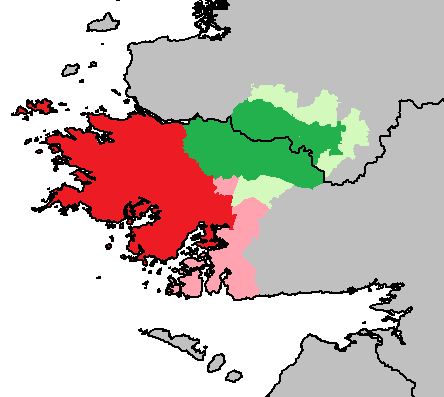
One common definition of the area is that it consists of most of west Galway, that is to say the part of the county west of Lough Corrib and Galway city, contained by Killary Harbour, Galway Bay and the Atlantic Ocean. Some more restrictive definitions of Connemara define it as the historical territory of Conmhaicne Mara, i.e. just the far northwest of County Galway, bordering County Mayo. The name is also used to describe the Gaeltacht (Irish-speaking areas) of western County Galway, though it is argued that this too is inaccurate as some of these areas lie outside of the traditional boundary of Connemara. There are arguments about where Connemara ends as it approaches Galway city, which is definitely not in Connemara – some[who?] argue for Barna, on the outskirts of Galway City, some for a line from Oughterard to Maam Cross, and then diagonally down to the coast, all within rural lands.[citation needed]
The wider area of what is today known as Connemara was previously a sovereign kingdom known as Iar Connacht, under the kingship of the Ó Flaithbertaigh, until it became part of the English-administered Kingdom of Ireland in the 16th century.
The main town of Connemara is Clifden, which is surrounded by an area rich with megalithic tombs.[citation needed]
The famous "Connemara Green marble" is found outcropping along a line between Streamstown and Lissoughter. It was a trade treasure used by the inhabitants in prehistoric times. It continues to be of great value today. It is available in large dimensional slabs suitable for buildings as well as for smaller pieces of jewellery.
Before the Tudor and Cromwellian conquests, Connemara, like the rest of Gaelic Ireland, was ruled by Irish clans whose Chiefs and their derbhfine were expected to follow the same code of honour also expected of Scottish clan chiefs.[citation needed]
In his biography of Rob Roy MacGregor, W.H. Murray described the code of honour as follows, "The abiding principle is cast up from the records of detail: that right must be seen to be done, no man left destitute, the given word honoured, the strictest honour observed to all who have given implicit trust, and that a guest's confidence in his safety must never be betrayed by his host, or vice versa. There was more of like kind, and each held as its kernel the simple ideal of trust honoured... Breaches of it were abhorred and damned... The ideal was applied 'with discretion'. Its interpretation went deeply into domestic life, but stayed shallow for war and politics."
Hub AI
Connemara AI simulator
(@Connemara_simulator)
Connemara
Connemara (/ˌkɒnɪˈmɑːrə/, KON-ih-MAR-ə; Irish: Conamara [ˌkʊnˠəˈmˠaɾˠə]) is a region on the Atlantic coast of western County Galway, in the west of Ireland. The region has a strong association with traditional Irish culture and containing most of the Connacht Irish-speaking Gaeltacht, a key part of its identity and the largest Gaeltacht in Ireland. Historically, Connemara was part of the territory of Iar Connacht (West Connacht). Geographically, it has many mountains (notably the Twelve Pins), peninsulas, coves, islands and small lakes. Connemara National Park is in the northwest. It is mostly rural and its largest settlement is Clifden.
"Connemara" derives from the tribal name Conmhaicne Mara, which designated a branch of the Conmacne, an early tribal grouping that had a number of branches located in different parts of Connacht. Since this particular branch of the Conmacne lived by the sea, they became known as the Conmacne Mara (sea in Irish is muir, genitive mara, hence "of the sea").
One common definition of the area is that it consists of most of west Galway, that is to say the part of the county west of Lough Corrib and Galway city, contained by Killary Harbour, Galway Bay and the Atlantic Ocean. Some more restrictive definitions of Connemara define it as the historical territory of Conmhaicne Mara, i.e. just the far northwest of County Galway, bordering County Mayo. The name is also used to describe the Gaeltacht (Irish-speaking areas) of western County Galway, though it is argued that this too is inaccurate as some of these areas lie outside of the traditional boundary of Connemara. There are arguments about where Connemara ends as it approaches Galway city, which is definitely not in Connemara – some[who?] argue for Barna, on the outskirts of Galway City, some for a line from Oughterard to Maam Cross, and then diagonally down to the coast, all within rural lands.[citation needed]
The wider area of what is today known as Connemara was previously a sovereign kingdom known as Iar Connacht, under the kingship of the Ó Flaithbertaigh, until it became part of the English-administered Kingdom of Ireland in the 16th century.
The main town of Connemara is Clifden, which is surrounded by an area rich with megalithic tombs.[citation needed]
The famous "Connemara Green marble" is found outcropping along a line between Streamstown and Lissoughter. It was a trade treasure used by the inhabitants in prehistoric times. It continues to be of great value today. It is available in large dimensional slabs suitable for buildings as well as for smaller pieces of jewellery.
Before the Tudor and Cromwellian conquests, Connemara, like the rest of Gaelic Ireland, was ruled by Irish clans whose Chiefs and their derbhfine were expected to follow the same code of honour also expected of Scottish clan chiefs.[citation needed]
In his biography of Rob Roy MacGregor, W.H. Murray described the code of honour as follows, "The abiding principle is cast up from the records of detail: that right must be seen to be done, no man left destitute, the given word honoured, the strictest honour observed to all who have given implicit trust, and that a guest's confidence in his safety must never be betrayed by his host, or vice versa. There was more of like kind, and each held as its kernel the simple ideal of trust honoured... Breaches of it were abhorred and damned... The ideal was applied 'with discretion'. Its interpretation went deeply into domestic life, but stayed shallow for war and politics."