Hubbry Logo
Coolray FieldCoolray FieldMain
Open search
Coolray Field
Community hub
Coolray Field
logo
8 pages, 0 posts
0 subscribers
Be the first to start a discussion here.
Coolray Field
Coolray Field
from Wikipedia

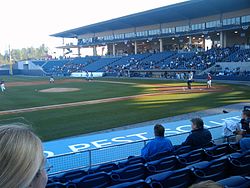
Gwinnett Stadium (formerly known as Coolray Field) is a 10,427-seat minor league baseball park in unincorporated Gwinnett County, Georgia (with a mailing address in Lawrenceville). It is the home field of the Gwinnett Stripers, the Triple-A affiliate of the Atlanta Braves.

Key Information

History

[edit]

Gwinnett Stadium hosted its first regular season baseball game on April 17, 2009, a 7–4 Gwinnett Braves loss to the Norfolk Tides.[4] The stadium site is located approximately two miles (3 km) east of the Mall of Georgia along Georgia State Route 20, between Interstate 85 and Georgia State Route 316.

The 44-acre (18 ha) site was previously farmland and forest. An additional 73 acres (0.30 km2) of mostly forest around it became a mixed-use project, after a February 2009 rezoning by the Gwinnett County Commission.[5] When the naming rights held by Coolray, an air conditioning and plumbing company based in nearby Marietta, expired after the 2025 season, the ballpark name returned to Gwinnett Stadium.[6]

The stadium construction and maintenance is being paid by the taxpayer-funded Gwinnett County government, but the Stripers will keep most of the revenue from ticket and concession stand sales. The municipal bonds used to pay for the stadium run for 30 years (until 2038), but the Stripers have an option to back out of the contract after only half of that time (in 2023), if the county does not maintain the facility at an acceptable level. This would leave county taxpayers responsible for the remainder.[7]

After the first season, it was revealed that parking revenue was a fraction (about 15%) of what was expected.[8]

The Gwinnett Braves (renamed to the Stripers in 2017) moved to the stadium in 2009 when the Atlanta Braves moved their affiliate, the Richmond Braves, after 43 seasons (1966–2008) in Richmond, Virginia. They are located 35 miles northeast of their parent club's stadium, Truist Park in unincorporated Cobb County—the second-shortest distance between a Triple-A team and its major league parent (behind only the Pacific Coast League's Tacoma Rainiers, based 26 miles south of Seattle). They have held this distinction since moving to Gwinnett County; the Braves played at Turner Field in Atlanta at the time.

Features

[edit]

Gwinnett Stadium features 19 luxury suites, a 30-foot-by-40-foot video board in right-center field, a 6-foot-by-42-foot LED board along the left-field wall and chairback seating complete with cupholders.[9]

References

[edit]
[edit]
Revisions and contributorsEdit on WikipediaRead on Wikipedia
from Grokipedia

Coolray Field is a minor league baseball stadium in unincorporated Gwinnett County, Georgia, United States, that serves as the home venue for the Gwinnett Stripers of the International League, the Triple-A affiliate of the Atlanta Braves.
The stadium opened on April 17, 2009, initially under the name Gwinnett Stadium, following groundbreaking in June 2008 and approximately 800,000 man-hours of construction. In 2010, it was renamed Coolray Field after a 16-year naming rights agreement with Coolray, a local HVAC company.
With a seating capacity of 10,115 following updates in 2024, the facility offers modern amenities including 360-degree views, multiple restaurants, party decks, and is designed as part of a mixed-use development district. It operates as a cashless venue with mobile-only ticketing and hosts the Stripers' home games, drawing fans for its proximity to the action and family-friendly atmosphere.

Location and Construction

Site Selection and Development

The site for Coolray Field was selected in unincorporated , adjacent to Lawrenceville, approximately 30 miles northeast of , to capitalize on the region's and accessibility within the Atlanta . This location along Buford Drive (Georgia State Route 20), roughly one mile south of Interstate 85, facilitated logistical advantages including direct highway interchanges for regional traffic flow and proximity to emerging commercial hubs like the , situated about two miles west. The site's relatively undeveloped status at the time provided ample land availability for a stadium-scale project without immediate constraints, while tying into existing transportation infrastructure to support anticipated attendance from the broader metro population. Gwinnett County's Board of Commissioners played a central role in approving the site through land acquisition processes, committing resources to purchase property on Buford Drive as part of the initiative. The county allocated approximately $5 million specifically for land acquisition, enabling the assembly of the necessary parcel in an area zoned for potential redevelopment. This involved streamlined approvals amid a compressed timeline, with minimal public debate preceding the decision, reflecting the county's prioritization of rapid execution to secure the ' Triple-A affiliate relocation from . Zoning adjustments facilitated the transition from prior low-density uses to accommodate the 10,000-plus seat venue designed for operations. Development proceeded with groundbreaking on June 3, 2008, following site preparation and acquisition finalization, leading to completion in under 14 months for the April 17, 2009, opening. The process emphasized empirical site suitability, including flat terrain for construction efficiency and integration with adjacent roadways, to establish the stadium as an anchor for future mixed-use expansion without initial reliance on surrounding developments.

Funding and Public Investment

The construction of Coolray Field, completed in 2009 at a total cost of $64 million, was financed primarily through municipal bonds issued by Gwinnett County in , with debt service obligations extending until 2038. These bonds represented general obligation debt backed by county taxpayers, with annual repayments supported by revenues from hotel-motel taxes and lease payments from the stadium's tenant, the Gwinnett Braves (now Stripers). The organization, which owns the minor league affiliate, provided no significant upfront capital for construction, instead entering a agreement structured to mirror the county's bond repayment schedule without absorbing principal risk. This arrangement shifted the full capital burden to public funds, a common pattern in minor league projects where local governments issue debt to attract teams, often yielding limited direct fiscal returns beyond incremental generation. Post-construction revenue streams included a 16-year naming rights agreement signed in February 2010 with Coolray Heating & Cooling, an Atlanta-area HVAC firm, valued at a multi-million-dollar total. Under the deal, the Braves received the first $350,000 annually, with excess proceeds—totaling approximately $4.5 million over the contract term—directed to Gwinnett County for debt service or general stadium operations. This sponsorship mitigated some ongoing costs but did not offset the initial public investment, highlighting the reliance on corporate branding for supplementary, rather than foundational, funding.

Historical Development

Planning and Opening Phase

The relocation of the ' Triple-A affiliate from , to , was announced on January 14, 2008, marking the initial planning phase for what would become Coolray Field. This decision aimed to establish a presence in the suburban area, fostering local and community identity through a new development funded primarily by Gwinnett County taxpayers at a cost of $64 million. The move displaced the Richmond Braves franchise, which had operated since 1966, and positioned the team as the Gwinnett Braves starting in 2009. Groundbreaking took place on June 3, 2008, with HKS Architects leading the design and Barton Malow serving as the construction manager in a that enabled completion in under 14 months despite the Great Recession's onset, which began in December 2008. The project prioritized a rapid timeline to align with the 2009 season, resulting in the stadium—initially called Gwinnett Stadium—opening in April 2009. The Gwinnett Braves' inaugural season drew 423,556 total attendees across 71 home games, averaging 5,965 fans per game and reflecting heightened interest from the venue's novelty in a market without prior Triple-A baseball. The first home game on April 17, 2009, against the Norfolk Tides attracted a sellout crowd matching the initial capacity, though attendance trended downward in subsequent seasons, indicating the opening year's figures were inflated by debut excitement rather than enduring demand.

Operational Milestones and Rebranding

Coolray Field was originally known as Gwinnett Stadium upon its 2009 opening but was renamed following a 16-year deal announced on February 17, 2010, with local HVAC firm Coolray Heating and Cooling, which committed to sponsorship emphasizing community ties in Gwinnett County. The venue has operated continuously as the home of the Atlanta Braves' Triple-A affiliate since 2009, initially hosting the Gwinnett Braves as a core development platform for prospects transitioning to the major leagues, with the partnership secured through at least 2030 via a 2021 extension. Among post-opening achievements, the Gwinnett Braves advanced to the 2016 International League Governors' Cup finals after clinching a playoff spot with late-season momentum and defeating the Columbus Clippers 3-1 in the semifinals, though they lost the title series 3-1 to the Scranton/Wilkes-Barre RailRiders. Attendance patterns showed early promise but a sustained post-2009 decline, with per-game averages falling to 5,084 by 2011 amid broader minor league challenges like regional competition from major league baseball; recovery efforts yielded 231,044 total fans in 2023 across 71 home dates, the strongest figure since 2015, while the stadium's single-game record stands at 10,568 from a 2012 exhibition matchup involving Braves personnel. The most prominent rebranding occurred on December 8, 2017, when the unveiled its shift to the for the 2018 season, drawing the name from fishing traditions at to highlight local outdoor heritage and create separation from the ' major league identity—this marked the first non-"Braves" moniker for a team under direct Braves ownership.

Design and Facilities

Architectural Features and Capacity

Coolray Field features a by HKS Architects, emphasizing a 360-degree that encircles the seating and provides continuous access and views of the field from all vantage points. The structure supports approximately 7,243 fixed seats, supplemented by 2,757 seats on the outfield known as "The Bank," contributing to a total capacity of 10,115 as updated in 2024. Earlier assessments reported a capacity of 10,427, with around 7,777 fixed seats, reflecting possible adjustments in configuration over time. The playing field employs natural grass and adheres to standard dimensions: 335 feet along the left and right field lines, 375 feet to the left-center and right-center alleys, and 400 feet to center field. These measurements promote balanced play comparable to former ' , while the open-air layout exposes the venue to Gwinnett County's , with prevailing southeast winds and an east-southeast field orientation influencing visibility and natural ventilation during events. The elevated seating design prioritizes clear sightlines to the diamond, minimizing obstructions for spectators across fixed, suite, and areas.

Amenities and Spectator Experience

Coolray Field provides 21 standard luxury suites, supplemented by a super suite, offering climate-controlled indoor and outdoor seating, flat-screen televisions, wet bars, and access to exclusive lounges for groups prioritizing comfort and privacy during games. These accommodations, available in sizes from 20 to 100 persons, include options like the and Game Suite, enabling customized experiences with premium service. Dining amenities emphasize variety and convenience, with premium options such as the Pontoon Brewing Boathouse for craft beers and cocktails behind home plate, and The Club for upscale food during specified pre-game hours. All concessions operate cashless, supporting efficient service across multiple stands to minimize wait times for spectators. Family-oriented features include a dedicated Kids Zone with amusements and the Little Anglers Kids Club for children under 13, which provides perks like free Sunday tickets and post-game base-running events to encourage attendance with young children. The extensive berm, dubbed "The Bank," offers general-admission grass seating for blanket picnics and casual group viewing, priced at $9 in advance or $11 on game day, first-come, first-served. Parking accommodates thousands across lots C, D, and E at $12 per (credit/debit only), with early arrival recommended to navigate Buford Drive traffic; shuttle services from lots to the drop-off are available, including priority for disabled patrons with valid placards in Lot B. Rideshare pickups occur at VIP Lot A near the main entrance, facilitating access without on-site storage. Technological integrations feature free in targeted areas for connectivity and a video enabling fan message displays during the fifth , enhancing real-time engagement without relying on personal devices alone. via the MiLB app streamlines entry, reducing lines and supporting seamless navigation for attendees.

Tenants and Events

Primary Baseball Tenants

The , the Triple-A affiliate of the , have served as the primary tenant of Coolray Field since the stadium's opening in 2009. Originally known as the Gwinnett Braves upon relocation, the team rebranded to the Stripers in to reflect local wildlife and distinguish from the parent club. As members of the , the Stripers play a 150-game regular season schedule, hosting roughly 75 home games annually at the venue. The franchise traces its move to Gwinnett from , where it had operated as the Richmond Braves since 1966, announced in January 2008 via a 30-year agreement with Gwinnett County. This relocation addressed facility and attendance limitations in Richmond while targeting Gwinnett's burgeoning population—exceeding 800,000 by the late —as a viable expansion market within the suburbs, enabling upgraded infrastructure for Triple-A operations over smaller Double-A venues elsewhere in the Braves system. In the hierarchy, the Stripers function as the final pre-major league evaluation site, focusing on refining skills for MLB competition through extended at-bats, pitching workloads, and tactical adjustments. Players demonstrating proficiency here routinely advance to the roster; for example, in 2025 alone, the team hosted eight major league rehab assignments and contributed to mid-season call-ups amid roster needs. This setup establishes a direct developmental conduit, with historical data showing consistent talent flow from Gwinnett's roster to Atlanta's active 26-man squad based on performance metrics like , , and defensive efficiency.

Non-Baseball Events and Usage

Coolray Field serves as a venue for various non-baseball events, including carnivals, corporate rentals, and community gatherings, to extend its utility beyond the baseball season. The facility promotes year-round event hosting with eight distinct rental spaces tailored for private functions, such as corporate outings and holiday parties. Annually, the venue hosts the Coolray Field Carnival in late March, organized by Dreamland Amusements, featuring midway rides, games, fair food, circus shows, and a act, with free admission and pay-per-ride pricing; for example, the 2025 edition ran from March 26 to 30, operating evenings and extending to full days on weekends. Other community-oriented events include the Gwinnett Chamber Foundation's Celebrity Showdown, a drawing local participants and spectators. In 2024, non-game events at the attracted over 80,000 attendees, indicating significant supplementary usage. Off-season rentals include luxury suites repurposed as " for a Day" workspaces, available for $75 per day or $300 per week, equipped with and televisions to support productivity. The stadium's capacity of over 10,000 seats limits it to smaller-scale non-sporting gatherings rather than major concerts or large festivals typically held in multifunctional arenas with higher infrastructure for amplified performances. While promoted for concerts and shows, specific instances of such events remain infrequent, prioritizing versatile but modest programming over high-profile entertainment.

Renovations and Upgrades

Initial Modifications

In , shortly after its April 2009 opening as Gwinnett Stadium, the facility underwent its first notable post-opening change with the acquisition of by Coolray Heating & Cooling, resulting in a to Coolray Field under a 16-year agreement valued to generate significant revenue for the Gwinnett Braves . This adjustment included updates to signage and promotional materials but did not involve structural alterations, reflecting an operational tweak to enhance commercial viability amid early attendance stabilization efforts. By 2015, incremental enhancements addressed concessions operations, as the Gwinnett Braves partnered with Professional Sports Catering (PSC) to introduce new specialty food carts, revitalized branded stands, and expanded menu options, aimed at improving fan experience without broader facility redesign. These changes, funded primarily through the team's partnership revenues rather than public subsidies, underscored an ad-hoc approach to operational refinements in response to routine usage demands, lacking evidence of coordinated long-term infrastructure planning during the early . No major or seating modifications were documented in this period, with the stadium's core layout remaining intact from its initial .

Recent Developments and Future Plans

In January 2024, the Gwinnett Stripers, in conjunction with owner Diamond Baseball Holdings and sponsor Coca-Cola, unveiled plans for the Coca-Cola Front Porch, marking the first major renovation at Coolray Field in its 15-year history. This 1,700-square-foot covered open-air deck, situated behind home plate in the former location of Section 100, accommodates up to 150 guests in a semi-private hospitality setting with unobstructed field views, while incorporating two rows of premium 4Topps seating and 72 individual seats to expand revenue-generating options. The space opened in spring 2024, directly accessible from the main concourse to enhance premium fan engagement. Complementing the Front Porch, 2024 updates for the ballpark's 15th anniversary season included installation of a new sound system for improved audio quality across the venue and enhancements to the suite level, such as refreshed amenities to modernize outdated infrastructure. These targeted modifications prioritize spectator comfort and technological integration without altering core capacity, reflecting adaptive investments amid stable operational demands. Ongoing lease terms with Gwinnett County, unchanged following the 2021 acquisition by , provide a framework for potential successive upgrades, with decisions informed by empirical metrics like per-game attendance averages that have consistently approached or exceeded 4,000 patrons in recent seasons. Such data underscores the venue's sustained viability, supporting phased enhancements over wholesale overhauls.

Economic Impact

Construction Costs and Revenue Models

The construction of Coolray Field relied on public financing mechanisms, including municipal bonds issued by Gwinnett County and revenues from the Special Purpose Local Option Sales Tax (SPLOST), which allocated funds for projects like the . The project was structured as a -at-cost arrangement, where bond debt service is covered by lease payments from the tenant team, though shortfalls have historically required county general fund support. In , the county refinanced $29.8 million in outstanding stadium debt to reduce long-term interest costs by up to $6.1 million. Revenue streams blend public and private elements, with naming rights providing a key private contribution. In 2010, Coolray Heating & Cooling secured a 16-year naming rights deal valued in the multi-millions, generating annual payments where the first $350,000 goes to the team and excess amounts—estimated at around $281,000 annually for the county—support debt obligations. The lease agreement stipulates team payments to the county including base rent calibrated to bond costs, plus $1 per ticket sold or a $400,000 minimum annually, whichever is greater, ensuring some alignment between usage and public recovery. Operational revenues primarily accrue to the tenant team through ticket sales, concessions, luxury suites, and additional sponsorships beyond , with the county retaining a 50% share of proceeds. This model shifts day-to-day income generation to private management while tying county returns to fixed lease terms and ancillary shares, exposing public finances to risks if team-generated payments underperform relative to debt service.

Attendance Patterns and Financial Performance

Attendance at Coolray Field reached a peak of 423,556 during the inaugural 2009 season for the Gwinnett Braves, reflecting initial enthusiasm for the new venue. Thereafter, total attendance declined in nearly every subsequent season, with per-game averages falling to between 2,500 and 3,000 fans in the mid-to-late 2010s, often below 200,000 annually by the mid-2010s. Specific figures include 212,342 in 2019 across 67 home games, 216,177 in 2022 over 73 dates, and a modest increase to 231,044 in 2023—the highest since 2015 but still far below opening-year levels. This downward trend has been attributed primarily to geographic proximity to the Atlanta Braves' , approximately 35 miles away, which offers major-league quality and diverts potential minor-league spectators preferring MLB experiences over Triple-A affiliates. Additional contributors include post-2008 economic pressures coinciding with the stadium's opening and limited on-site attractions beyond , reducing repeat visits despite marketing efforts. Only one post-opening uptick occurred, amid broader minor-league attendance patterns influenced by these structural factors rather than isolated promotions. The sustained low has generated operating deficits for operations, as ticket and revenues fail to cover service and costs projected at opening. Gwinnett has subsidized these shortfalls using general funds, effectively placing taxpayers on the hook for annual gaps stemming from unmet projections that assumed sustained high turnout. Recent gains in 2022–2023 have not reversed the overall fiscal strain, with county support continuing to bridge inadequacies tied to persistent draw limitations.

Broader Community and Local Economy Effects

The construction of Coolray Field, completed in , generated temporary opportunities through its design-build involving firms like Barton Malow, though specific figures for -phase jobs remain undocumented in . Ongoing operations support more than 200 seasonal positions, primarily gameday staff such as ushers, vendors, and parking attendants, with hiring focused on part-time roles rather than permanent, high-wage . Coolray Field draws visitors primarily from the area, serving as an accessible alternative to urban venues and contributing modestly to local business activity on game days, including nearby restaurants and retail. However, attendance shortfalls and revenue underperformance have led Gwinnett to redirect allocations originally intended for broader promotion, suggesting limited net gains beyond seasonal spikes. Plans for surrounding developments, such as the Village at Coolray Field envisioning residential units, retail space, and offices, were promoted as catalysts for property value growth and economic spillover, but disputes and delays have hindered realization, with commercial additions remaining years away as of 2015. Empirical on property values near the shows general market appreciation in Lawrenceville aligning with countywide trends, without isolated uplift attributable to the facility; apartment complexes like The Views at Coolray Field have emerged, yet broader studies on stadium vicinities indicate negligible or mixed effects on residential valuations.

Criticisms and Challenges

Financial Subsidies and Taxpayer Burden

Gwinnett County has shouldered significant financial responsibility for Coolray Field since its 2009 opening, covering construction overruns and ongoing operational shortfalls through dedicated taxes and general fund support. The stadium's total cost reached $64 million, with the county borrowing $33 million after initial estimates of $25–30 million escalated due to delays and added features. Revenues from rent, parking, and naming rights fell short of projections—such as $31,000 in parking income against an expected $200,000 in 2009 and $225,000 annually from naming rights versus $500,000 anticipated—leaving the facility unable to service its debt independently. To address these deficits, exacerbated by attendance averaging 4,762 per game in early years (below the projected 6,000–6,500 and ranking near the bottom of its league), the implemented a 3 percent and diverted hotel-motel revenues starting in 2012. By 2014, approximately $440,000–$600,000 annually from hotel-motel taxes—originally earmarked for tourism promotion—was redirected to payments, alongside proceeds as the primary funding mechanism. A 2016 refinancing of $29.8 million in bonds reduced annual service to about $2.1 million, yet payments persist through at least 2040, imposing a multi-decade liability amid continued low attendance relative to league peers. These subsidies highlight opportunity costs, as diverted and rental taxes reduce funds available for or tax relief without verifiable of commensurate economic returns from the . Similar venues, including those in comparable markets, have exhibited persistent operating deficits post-honeymoon periods, challenging claims of self-sustaining "civic investment" and underscoring reliance on public backstopping despite initial revenue optimism. The county's maintenance funding, separate from team-retained game-day revenues, further amplifies the imbalance, with no adjustment for post-2010s attendance stagnation that has kept utilization below projections.

Traffic Congestion and Accessibility Issues

Coolray Field's location in suburban , fosters heavy dependence on automobile access primarily via Interstate 85 (I-85) and feeder roads including State Route 20 and Georgia Highway 316, frequently causing ingress and egress delays during events. issued warnings of substantial congestion on these routes for the sold-out exhibition series on March 17–19, 2024, attributing delays to an influx of thousands of fans from the metro area. Weekday evening games amplify these issues, with northbound I-85 traffic described as "brutal" and local approach roads overwhelmed by single-route bottlenecks. Public transit integration remains inadequate, with Gwinnett County Transit (GCT) offering limited service via Route 50, which connects the stadium to points like Suwanee Town Center and but operates on sparse schedules (e.g., hourly or less during peak times) without seamless links to MARTA or other . This scarcity, characteristic of Gwinnett's broader underdevelopment in mass transit infrastructure, forces most attendees to drive, intensifying absent viable carpooling or shuttle alternatives. Stadium operators provide mitigation through multiple on-site lots (A, C, D) and adjacent bus parking, charging $5 per vehicle and $10 per bus, with recommendations to arrive 60–90 minutes early for smoother access. However, attendee reports highlight ongoing frictions, including navigational from nearby condo developments and inconsistent guidance at entry points, revealing persistent strains from the venue's scale—up to capacity—against limited suburban roadway capacity.

Development Disputes and Surrounding Area Impacts

In 2012, developers sought Gwinnett County approval to amend the plan adjacent to Coolray Field by converting 165,000 square feet of planned commercial space and 150 hotel rooms into additional apartment units, shifting away from the original "live-work-play" concept approved to support the stadium's 2009 opening. County commissioners unanimously rejected the proposal on September 4, 2012, citing risks of lower yields from residential-heavy development compared to commercial and hospitality uses, which could undermine the area's projected revenue generation and long-term property values. The dispute underscored broader conflicts between rapid housing expansion and maintaining commercial density to bolster economic synergy with the , as apartments were seen to generate less per acre than retail or while potentially increasing infrastructure demands on surrounding properties. Local planning officials and commissioners emphasized adherence to the 2006 rezoning conditions for the 74-acre tract, intended to create a vibrant node integrating traffic with nearby retail and dining, rather than risking " city" saturation that might deter investment. Further complications arose in subsequent years, including a 2015 by a family owning parcels within the development zone, who alleged improper rezoning without their consent for mixed-use expansion encompassing retail and restaurants to draw from stadium visitors. These legal challenges delayed complementary projects, fostering criticism that the area's vitality remained overly dependent on game-day events rather than sustained private-sector activation of adjacent land. Limited environmental objections focused on routine land disturbance protocols, such as tree removal for grading, but county records show no substantive regulatory blocks tied to broader ecological claims.

References

Add your contribution
Related Hubs
User Avatar
No comments yet.