


Community hub
Recent from talks
Contribute something
Nothing was collected or created yet.
Curule seat
View on Wikipedia
A curule seat is a design of a (usually) foldable and transportable chair noted for its uses in Ancient Rome and Europe through to the 20th century. Its status in early Rome as a symbol of political or military power carried over to other civilizations, as it was also used in this capacity by kings in Europe, Napoleon, and others.
History
[edit]Ancient Rome
[edit]

In the Roman Republic and the Roman Empire, the curule chair (sella curulis, supposedly from currus, "chariot") was the seat upon which magistrates holding imperium were entitled to sit. This includes dictators, magistri equitum, consuls, praetors, curule aediles, and the promagistrates, temporary or de facto holders of such offices. Additionally, the censors and the flamen of Jupiter (Flamen Dialis) were also allowed to sit on a curule seat,[1] though these positions did not hold imperium. Livy writes that the three flamines maiores or high priests of the Archaic Triad of major gods were each granted the honor of the curule chair.[2] Additionally, when an interregnum occurred in the Roman republic, the interrex was also granted a sella curulis along with the other symbols of power given to a regular magistrate.[3] The precise name of the curule seat also varied based on the specific type and holder of the seat, such as: "sella regia (royal chair), sella ducis (general's chair), sella consularis (consular chair), sella consulis (chair of a consul), sella eburnea (an ivory seat often used a gift for foreign dignitaries), sella castrensis (the campstool, a military version of the sella curulis), and sella aurea (a gold chair)."[4][5]
The curule seat was carried by public slaves when being transported from place to place. This custom further symbolized the authority of the magistrate/owner of the sella curulis. Imagery of a slave carrying a curule seat can be seen in archaic Etruscan art (see in Gallery "Tomb of the Augurs" 530 BCE).[6] As seen on the Tomb of Augurs, a small slave is seen to be bearing a sella curulis on his shoulders in the lower left corner. In the Tomb of the Jugglers from 520 BCE (see in Gallery "Tomb of the Jugglers"), the magistrate for whom the tomb is dedicated to is also seen to be seated on his sella curulis on the far right which indicates that he is the owner and magistrate.
The curule chairs themselves indicated the authority of the magistrate as he conducted business while sitting in the chair. Therefore, the seats themselves have been symbolically viewed as political pawns for power over Rome itself.[7] However, this powerful symbolism appears to be limited due to incidents where the sella curulis was purposely destroyed. The destruction of the chair as a means to disrupt or attack a magistrate’s rule did not actually prevent the owner of the curule seat from exercising his power. In Cassius Dio’s Roman History, Dio recounts the event where Glabrio destroyed Lucius Lucullus’ curule seat out of anger towards Lucullus. However, Lucullus and his attending officials still proceeded with business although the sella curulis was destroyed.[8]

According to Livy, the curule seat, like the Roman toga, originated in Etruria,[9] and it has been used on surviving Etruscan monuments to identify magistrates.[10] However, much earlier stools supported on a cross-frame are known from the New Kingdom of Egypt. One of the earliest recorded examples of the curule chair proper was in 494 BC when the honour of a curule chair in the circus maximus was awarded to the Roman dictator Manius Valerius Maximus as a result of his victory over the Sabines.[11] According to Cassius Dio, early in 44 BC a senate decree granted Julius Caesar the curule seat everywhere except in the theatre, where his gilded chair and jeweled crown were carried in, putting him on a par with the gods.[12] The curule chair is also used on Roman medals as well as funerary monuments to express a curule magistracy; when traversed by a hasta, it is the symbol of Juno.

The curule seat was also used in funeral processions. Several pieces of Etruscan art, urns, and tomb reliefs from the 4th century BCE portray a magistrate's funerary procession. The curule seat was one of the many symbols displayed during the procession which indicated his status and prestige, along with the fasces, lituus-bearers, and other emblems of his office.[15] The custom of bearing the curule chair of the magistrate at his funeral was present in Rome as well. The funerary monument from via Labicana itself is shaped like a sella curulis (see in Gallery below). Additionally, on the top beam of the monument, the frieze prominently features a sella curulis beside the presumed magistrate and his attendants. For example, Dio recounts that Caesar’s golden curule seat was displayed in his funeral procession along with his golden crown and a golden image of him.[8] Polybus detailed that the representatives of the family would sit in the curule seats of the deceased during public ceremonies.[7] Additionally, the curule seat of a magistrate was also ceremonially paraded while he was living. An example of this appears when the golden sella curules of Tiberius and Sejanus were displayed at the ludi scaenici in 30 CE.[16]
In Rome, the curule chair was traditionally made of or veneered with ivory, with curved legs forming a wide X; it had no back, and low arms. Although often of luxurious construction, this chair was meant to be uncomfortable to sit on for long periods of time, the double symbolism being that the official was expected to carry out his public function in an efficient and timely manner, and that his office, being an office of the republic, was temporary, not perennial. The chair could be folded, and thus was easily transportable; this accords with its original function for magisterial and promagisterial commanders in the field. It developed a hieratic significance, expressed in fictive curule seats on funerary monuments, a symbol of power which was never entirely lost in post-Roman European tradition.[17] 6th-century consular ivory diptychs of Orestes and of Constantinus each depict the consul seated on an elaborate curule seat with crossed animal legs.[18]
As a form of throne, the sella might be given as an honor to foreign kings recognized formally as allies by the Roman people or Senate.[19] The ivory curule seat specifically was used as an honorary gift which was sent to foreign kings by the senate of Rome. The presentation of the insignia of royalty which included an ivory curule seat, (along with other insignia such as a scepter, golden crown, horse, armor, and embroidered robe), signified that the foreign king was worthy of this delegated power.[16]
Other uses
[edit]
Folding chairs of foreign origin were mentioned in China by the 2nd century AD, possibly related to the curule seat. These chairs were called hu chuang ("barbarian bed"), and Frances Wood argues that they came from the Eastern Roman Empire, since the cultures of Persia and Arabia preferred cushions and divans instead.[20] A poem by Yu Jianwu, written about 552 AD, reads:
By the name handed down you are from a foreign region
coming into [China] and being used in the capital
With legs leaning your frame adjusts by itself
With limbs slanting your body levels by itself...[21]
In Gaul the Merovingian successors to Roman power employed the curule seat as an emblem of their right to dispense justice, and their Capetian successors retained the iconic seat: the "Throne of Dagobert", of cast bronze retaining traces of its former gilding, is conserved in the Bibliothèque nationale de France. The "throne of Dagobert" is first mentioned in the 12th century, already as a treasured relic, by Abbot Suger, who claims in his Administratione, "We also restored the noble throne of the glorious King Dagobert, on which, as tradition relates, the Frankish kings sat to receive the homage of their nobles after they had assumed power. We did so in recognition of its exalted function and because of the value of the work itself." Abbot Suger added bronze upper members with foliated scrolls and a back-piece. The "Throne of Dagobert" was coarsely repaired and used for the coronation of Napoleon.[22]

In the 15th century, a characteristic folding-chair of both Italy and Spain was made of numerous shaped cross-framed elements, joined to wooden members that rested on the floor and further made rigid with a wooden back. 19th-century dealers and collectors termed these "Dante Chairs" or "Savonarola Chairs", with disregard to the centuries intervening between the two figures. Examples of curule seats were redrawn from a 15th-century manuscript of the Roman de Renaude de Montauban and published in Henry Shaw's Specimens of Ancient Furniture (1836).[23]
The 15th or early 16th-century curule seat that survives at York Minster, originally entirely covered with textiles, has rear members extended upwards to form a back, between which a rich textile was stretched.

The cross-framed armchair, no longer actually a folding chair, continued to have regal connotations. James I of England was portrayed with such a chair, its framing entirely covered with a richly patterned silk damask textile, with decorative nailing, in Paul van Somer's portrait, and in his portrait by John de Critz. Similar early 17th-century cross-framed seats survive at Knole, perquisites from a royal event.[24]
The photo of actor Edwin Booth as Hamlet poses him in a regal cross-framed chair, considered suitably medieval in 1870.
The form found its way into stylish but non-royal decoration in the archaeological second phase of neoclassicism in the early 19th century. An unusually early example of this revived form is provided by the large sets of richly carved and gilded pliants (folding stools) forming part of long sets with matching tabourets delivered in 1786 to the royal châteaux of Compiègne and Fontainebleau.[25] With their Imperial Roman connotations, the backless curule seats found their way into furnishings for Napoleon, who moved some of the former royal pliants into his state bedchamber at Fontainebleau. Further examples were ordered, in the newest Empire taste: Jacob-Desmalter's seats with members in the form of carved and gilded sheathed sabres were delivered to Saint-Cloud about 1805.[26] Cross-framed drawing-room chairs are illustrated in Thomas Sheraton's last production, The Cabinet-Maker, Upholsterer and General Artist's Encyclopaedia (1806), and in Thomas Hope's Household Furniture (1807).
With the decline of archaeological neoclassicism, the curule chair disappeared; it is not found among Biedermeier and other Late Classical furnishing schemes.
Gallery
[edit]-
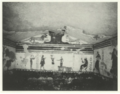 Magistrate on his sella curulis (lower right corner), Etruscan wall painting, Tomb of the Jugglers (520 BCE)
 -
 Sella curulis on a funerary monument from the Via Labicana, Rome
 -
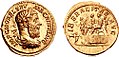
-
![Drawing of a seal of Peter II of Aragon, ca. 1196—1213[27]](//upload.wikimedia.org/wikipedia/commons/thumb/1/13/Peter_II_of_Aragon.jpg/120px-Peter_II_of_Aragon.jpg) Drawing of a seal of Peter II of Aragon, ca. 1196—1213[27]
Drawing of a seal of Peter II of Aragon, ca. 1196—1213[27] -
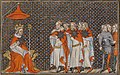 John II of France on the Throne of Dagobert adorned unusually with dogs' heads, founding the Order of the Star in 1351 (manuscript illumination, Bibliothèque nationale)
 -
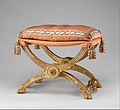 French folding stool in the curule style, by Jean-Baptiste-Claude Sené, 1786 (Metropolitan Museum of Art )
 -
 Napoleon on a curule seat with the goddess Tutela, 1804 medal by André Galle and Romain-Vincent Jeuffroy (Musée Carnavalet)
 -
 The American actor Edwin Booth as Hamlet, seated in a curule chair, c. 1870
 -

.png)


![Drawing of a seal of Peter II of Aragon, ca. 1196—1213[27]](https://en.wikipedia.org/wiki/File:Peter_II_of_Aragon.jpg)

_(one_of_a_pair)_MET_DP113122.jpg)
,_ND2808.jpg)


See also
[edit]References
[edit]
- ^ Livius (Livy), Titus (1974). Robert Maxwell Ogilvy (ed.). Ab Urbe Condita: Volume I: Book I (in Latin) (2nd ed.). USA: Oxford University Press. p. 416. ISBN 978-0-19-814661-2.
- ^ Ab urbe condita 1:20
- ^ Koptev, Aleksandr (2016). "The Five-Day Interregnum in the Roman Republic". The Classical Quarterly. 66 (1). The Classical Association: 205–221. doi:10.1017/S000983881600032X.
- ^ Gontar, Cybèle Trione (2003). "The Campeche Chair in the Metropolitan Museum of Art". Metropolitan Museum Journal. 38. The University of Chicago Press on behalf of The Metropolitan Museum of Art: 183–212. doi:10.2307/1513107. JSTOR 1513107.
- ^ Wanscher, Ole (1980). Sella Curulis: The Folding Stool : an Ancient Symbol of Dignity. Denmark: Rosenkilde and Bagger. pp. 121–190.
- ^ Torelli, Mario (1999). "Funera Tusca: Reality and Representation in Archaic Tarquinian Painting". Studies in the History of Art. 56: 146–161. JSTOR 42622237.
- ^ a b Tuori, Kaius (2020). "Breaking Chairs : Sella Curulis in Roman Law, Identity and Memory". Arctos: Acts Philologica Fennica. 54: 254–284. hdl:10138/344429.
- ^ a b Dio Cassius (1914). Roman History, Volume III: Books 36-40. Translated by Cary, Earnest; Foster, Herbert B. Cambridge, MA: Harvard University Press.
- ^ Livy, Ab urbe condita, I.8: Me haud paenitet illis auctoribus assentiri, quibus et apparitores hoc genus ab Etruscis finitimis, unde sella curulis, unde toga praetexta sumpta est...
- ^ Thomas Schäfer, Imperii insignia: Sella Curulis und Fasces. Zur Repräsentation römischer Magistrate, (Mainz) 1989, fully discusses the representations of curule seats and their evolving significance.
- ^ Livy, Ab urbe condita, 2:31
- ^ Peter Michael Swan, The Augustan Succession: An historical Commentary on Cassius Dio's Roman History Books 55-56 (9 B.C.-A.D. 14), "Commentary on Book 56", (Oxford 2004) p. 298, noting T. Schäfer 1989, pp 114-22.
- ^ Museo Borbonico, vol. vi. tav. 28)
- ^
 Smith, William, ed. (1870). "Sella". Dictionary of Greek and Roman Antiquities. London: John Murray.
- ^ Holliday, Peter J. (1990). "Processional Imagery in Late Etruscan Funerary Art". American Journal of Archaeology. 94 (1): 73–93. doi:10.2307/505526. JSTOR 505526.
- ^ a b Sutherland, C. H. V. (1950). "The Symbolism of a Unique Aes Coin of Tiberius". The Numismatic Chronicle and Journal of the Royal Numismatic Society. 10 (39/40): 290–297. JSTOR 42661468.
- ^ Schäfer 1989.
- ^ Discussed and illustrated in Nancy Netzer, "Redating the Consular Ivory of Orestes" The Burlington Magazine 125 No. 962 (May 1983): 265-271 p. 267, figs. 11-13.
- ^ Stefan Weinstock, "The Image and the Chair of Germanicus," Journal of Roman Studies 47 (1957), p. 148 and note 38.
- ^ Further east, the cultures of Persia employed the cushioned divan instead (Frances Wood, The Silk Road: two thousand years in the heart of Asia, 2002:85-87).
- ^ Quoted in Wood 2002:86.
- ^ Sir W. Martin Conway, The Treasures of Saint Denis, 1915
- ^ Some are illustrated in John Gloag, A Short Dictionary of Furniture, rev. ed. 1969: s.v. "X-chairs".
- ^ The contemporary term "cross-framed" came to be employed in the later 17th century to describe chairs with rigid horizontal cross-framed x-stretchers, possibly causing confusion for a modern reader; see Adam Bowett, "The English 'Cross-Frame' Chair, 1694-1715" The Burlington Magazine 142 No. 1167 (June 2000:344-352).
- ^ Pierre Verlet, French Royal Furniture p. 75f; F.J.B. Watson, The Wrightsman Collection (Metropolitan Museum of Art) 1966:vol. I, cat. no. 51ab, pp76-78.
- ^ One at the Victoria and Albert Museum is illustrated in Serge Grandjean, Empire Furniture, (London: Faber and Faber) 1966:fig. 7. Grandjean also illustrates a gilded curule seat from the former Grand Galerie, Malmaison, ca 1804 (fig. 5b); a painted one from Fontainebleau (fig. 31), and a walnut curule seat in Empire style, from Romagna (fig. 6).
- ^ From Louis Blancard, Iconographie des sceaux et bulles, 1860.

Curule seat
View on GrokipediaThe curule seat, or sella curulis in Latin, was a lightweight folding chair, often crafted from ivory with curved legs resembling those of an animal or chariot, reserved exclusively for high-ranking Roman magistrates endowed with imperium, such as consuls, praetors, censors, and dictators.[1][2] This seat symbolized magisterial authority and was used during public judgments, assemblies, and processions, distinguishing its bearers as curules—a class of officials entitled to privileges like exemption from certain taxes and the right to a state funeral.[1] Introduced during the monarchy under the Etruscan king Tarquinius Priscus around the 6th century BCE, the sella curulis likely derived from Etruscan traditions of elite seating, reflecting influences on early Roman governance and regalia.[3][2] Its design facilitated portability, allowing magistrates to carry it in chariots (currus), from which the term "curule" may etymologically stem, underscoring the mobile exercise of power in the expanding Roman state.[1] Though primarily functional in the Republic and Empire, the seat's form persisted symbolically in funerary art and later European thrones, embodying enduring notions of sovereignty.[4]
Design and Physical Characteristics
Structure and Form
The sella curulis featured a simple, portable folding structure resembling a campstool, with curved or S-shaped legs forming a wide X-frame that pivoted for collapse.[1] [4] This design consisted of two articulated frames connected by crossbars, enabling easy transport by magistrates during processions or judgments.[1] The seat lacked a backrest and arms, maintaining a low profile for rapid setup, with the sitting surface supported by leather or fabric straps stretched between the uprights rather than a rigid base.[5] [4] Surviving bronze examples and ancient coin depictions illustrate flat feet perpendicular to the legs and semicircular tabs securing the pivot mechanism with washers.[1] [4] Early forms were plain, though later variants incorporated carvings such as horses or medallions on the legs.[1]Materials and Variations
The sella curulis was primarily constructed from ivory, often veneered or carved into curved legs forming an X-shape, which allowed for folding portability akin to a camp stool, with no backrest and optionally low arms.[6][7] This material choice emphasized luxury and status, as ivory was imported and labor-intensive to work, distinguishing it from everyday wooden seats.[2] Archaeological evidence confirms ivory's prevalence, as seen in an Etruscan folding stool from northern Etruria (ca. 500 BCE), fully covered in slabs of worked ivory fixed to a frame of crossed legs joined by metal pins and crosspieces.[6] Roman examples likely followed similar techniques, with ivory legs symbolizing magisterial authority, though textual descriptions note occasional gilding or metallic accents for enhanced prestige.[8] Variations included utilitarian wooden frames for less ceremonial use, contrasting the elite ivory models, while rare metal constructions appear in 1st-century CE contexts, such as charred iron remains from a Gallic funeral pyre containing elite grave goods.[2][4] These metal variants, possibly iron with decorative overlays, suggest adaptations for durability in provincial or military settings, diverging from the traditional ivory form without altering the essential X-legged, armless design.[8]Origins and Etymology
Pre-Roman Roots
The curule seat, known as sella curulis in Latin, originated in Etruria during the early first millennium BCE, predating its adoption in Rome. Etruscan civilization, flourishing in central Italy from approximately the 8th century BCE, utilized folding stools as symbols of magisterial authority, a practice evidenced by archaeological finds such as a restored 6th-century BCE ivory folding stool recovered from an Etruscan context.[6] This design featured curved, X-shaped legs typical of portable camp stools, facilitating transport and deployment in judicial or ceremonial settings.[2] Ancient Roman historian Livy attributed the introduction of the curule seat to Rome from Etruria, paralleling the adoption of the toga, with its use on Etruscan monuments serving to identify high-ranking officials.[9] Depictions in Etruscan art, including a wall painting from the Tomb of the Jugglers near Tarquinia dated to 520 BCE, portray magistrates seated on such chairs, underscoring their role in denoting political and judicial power within Etruscan society.[8] These artifacts confirm the seat's pre-Roman precedence, as Etruscan influence shaped early Roman institutions during the period of the Tarquin kings (circa 616–509 BCE).[10] No definitive evidence links the curule seat to cultures antecedent to the Etruscans, such as Villanovan or broader Italic traditions, though the folding stool motif appears in broader Mediterranean contexts as a practical form for mobile leadership. Etruscan innovation likely refined it into a distinct emblem of authority, later formalized in Roman curule magistracies.[2]Linguistic Evolution
The Latin term sella curulis, denoting the official folding chair reserved for certain high magistrates, derives its distinguishing adjective curulis from currus, meaning "chariot," reflecting the tradition that the seat originated as a portable perch used during judicial proceedings conducted from a magistrate's chariot.[1] This etymology, attested by ancient Roman authors such as Aulus Gellius (Noctes Atticae 3.18), Festus (s.v. Curules), and Servius, underscores the chair's association with mobility and authoritative transport to sites of judgment.[1] Over time, curulis extended metonymically to describe not only the sella itself but also the magistratus curules—the class of patrician officials entitled to its use, such as consuls, praetors, and curule aediles—thus evolving from a literal designator of furniture to a marker of equestrian-derived imperium.[5] In post-classical Latin and medieval scholarship, the term retained its classical form without significant phonetic or semantic alteration, appearing in texts by Renaissance humanists who revived Roman antiquarianism to describe symbols of sovereignty.[11] The adjective entered vernacular European languages during the early modern period, with English adopting "curule" around 1600 in translations of classical works, as in Philemon Holland's renditions, where it denoted chairs of state or superior rank, often linked back to the chariot etymon via currere ("to run").[12] This borrowing preserved the term's specificity to authority-bearing seats, influencing architectural and furniture terminology in neoclassical contexts, though without substantive morphological evolution beyond anglicization.[13] Modern lexicographical sources continue to trace "curule" directly to Latin curūlis, affirming the chariot-derived root while noting its adaptation from a functional descriptor to a symbol of hierarchical privilege.[14]Usage in Ancient Rome
Eligible Magistrates and Officials
In the Roman Republic, the sella curulis was a privilege accorded to magistratus curules, a class of higher magistrates distinguished by their ius sellae curulis—the right to sit upon the curule seat as a symbol of authority derived from royal and Etruscan precedents. These officials typically held imperium (the power to command armies and execute legally), wore the toga praetexta, and were attended by lictores bearing fasces. The core curule magistrates were the consuls, praetors, censors, and curule aediles, elected annually or at intervals by the comitia centuriata.[15][16] Consuls, two in number, were the paramount executives with supreme imperium maius, overseeing the Senate, assemblies, and military campaigns; they sat on the sella curulis during formal proceedings, such as Senate meetings or trials.[17] Praetors, initially one but expanding to eight by 81 BCE, exercised imperium in judicial administration and provincial governance, using the seat in courts and public audiences.[18] Censors, elected every five years for an 18-month term, conducted the census, moral oversight, and public contracts without imperium but retained curule status, including the seat, as a mark of their supervisory role over citizen rolls and infrastructure.[15] Curule aediles, two patricians (later opened to plebeians after 366 BCE), managed urban markets, temples, and public games without imperium, yet their curule dignity entitled them to the sella curulis during oversight of festivals and infrastructure, distinguishing them from non-curule plebeian aediles.[19] Extraordinary curule appointments included the dictator, nominated in crises for a six-month term with absolute imperium, and the magister equitum (master of the horse), his deputy, both using the seat to signify delegated command; these were invoked 204 times between 501 and 44 BCE.[20] Promagistrates, such as proconsuls or propraetors after 242 BCE, extended curule privileges to former magistrates governing provinces, retaining lictores and the sella curulis abroad. The flamen Dialis (priest of Jupiter) held honorary curule rank, sitting on the chair in religious contexts despite lacking civil imperium. Early Republican tribuni militum consulari potestate (military tribunes with consular power, ca. 445–367 BCE) also qualified.[1] Under the Empire, from Augustus onward (27 BCE–476 CE), the sella curulis extended to the emperor as princeps, consuls, praetors, and select equestrian prefects (e.g., urban or praetorian prefects by the 2nd century CE), who adopted it for administrative authority, though senatorial norms persisted for traditional magistrates.[21] This evolution reflected the centralization of power, with the seat symbolizing continuity amid shifting hierarchies.Ceremonial Functions and Protocols
The sella curulis served as the official seat for curule magistrates during the execution of their imperium-bearing duties in ancient Rome, particularly in judicial proceedings and public assemblies. Praetors, for example, occupied it while presiding over trials and rendering judgments, as evidenced in Cicero's prosecution of Verres, where the chair underscored the magistrate's authority in legal contexts.[1] Consuls and other eligible officials, including dictators and the magister equitum, similarly used it in tribunals set up in the Forum or other venues for official business.[1] In ceremonial protocols, the chair's portability was key; its folding design with curved legs allowed lictors or attendants to transport it to the site of functions, such as public spectacles in the Circus or theatre, where it was displayed to affirm magisterial presence.[1] Livy records its placement at such events under early consuls, linking it to the exercise of state power from the Republic's inception (Livy II.31).[1] Ornamentation evolved from ivory inlays to gold plating by the late Republic, enhancing its prestige during formal sittings (Hor. Ep. I.6.53).[1] Only curule magistrates—consuls, praetors, curule aediles, censors, and select priests like the Flamen Dialis—held the privilege to sit upon it, with protocols strictly reserving its use to denote imperium and excluding non-curule officials like tribunes of the plebs.[1] Emperors later monopolized it, as seen in imperial coinage depicting rulers enthroned upon sellae curules to symbolize continuity of authority.[1] Violations, such as unauthorized assumption, incurred severe penalties, reinforcing its role in maintaining hierarchical order (Livy II.8).[1]Symbolism and Significance
Representation of Authority
The sella curulis functioned as a tangible emblem of imperium, the sovereign power to command armies and administer justice, exclusively granted to curule magistrates including consuls, praetors, dictators, censors, and curule aediles. This privilege underscored their superior jurisdiction, setting them apart from non-curule officials who employed ordinary stools (sella). The chair's use originated as a marker of regal authority in early Rome, later adapted for republican magistrates to signify the state's conferral of executive power without monarchical connotations.[1][3] Its form—typically an armless, folding seat with curved, X-shaped legs crafted from ivory, bronze, or wood—symbolized mobility and readiness for command, etymologically linked to currus (chariot), evoking the swift deployment of authority akin to a warlord's transport. Magistrates did not carry the chair themselves; public slaves bore it in processions, emphasizing the office's prestige and the magistrate's detachment from manual labor, thereby reinforcing hierarchical order and the impersonal nature of state power. In judicial and deliberative settings, seating upon the sella visually asserted dominance, compelling deference from litigants and subordinates.[22][1][23] Artistic representations amplified this symbolism, with the sella curulis frequently depicted on coins, reliefs, and funerary monuments to commemorate the holder's authority posthumously, as seen in Republican denarii and imperial aurei where it signified dynastic legitimacy. During the Principate, emperors like Augustus integrated it into their iconography, transforming the republican symbol into one of autocratic rule, with the chair placed in triumphal contexts or alongside other regalia like the toga praetexta. This enduring visual code conveyed not mere status but the causal link between the office and enforceable sovereignty, where the chair's presence invoked obedience rooted in tradition and precedent rather than personal charisma.[3][8][1]Social and Political Implications
The sella curulis embodied the exclusivity of curule magistrates—dictators, consuls, praetors, and censors—who wielded imperium, the sovereign power to command obedience in military, judicial, and administrative spheres, distinguishing them from non-curule officials like quaestors or tribunes lacking such authority. This privilege reinforced a rigid political hierarchy, where the chair's deployment in tribunals, senate meetings, and public assemblies visually asserted dominance, facilitating deference and order amid Rome's competitive elite politics.[24] Socially, the curule seat amplified the prestige of its occupants, marking them as members of the nobilitas—those who had ascended the cursus honorum through curule offices—and perpetuating an aristocratic ethos that prioritized lineage, oratorical prowess, and martial success over egalitarian ideals.[24] Its elevated, armless form symbolized detachment from the populace, akin to a general's sella castrensis, underscoring the magistrates' role as quasi-monarchical figures within the republic's balanced constitution, where such displays deterred challenges to elite consensus.[25] Politically, the sella curulis transitioned from republican emblem of shared yet stratified power to imperial icon, with empty chairs on coins and monuments evoking the emperor's omnipresent authority, as seen in depictions under rulers like Macrinus, blending tradition with absolutism to legitimize dynastic claims.[26] Rituals involving its symbolic breaking or funerary inclusion, as analyzed in legal and memorial contexts, highlighted power's impermanence, channeling collective memory to affirm institutional continuity over individual tyranny.[25]Archaeological and Historical Evidence
Key Discoveries and Artifacts
One of the earliest known depictions of a curule seat appears in the Etruscan Tomb of the Jugglers at Tarquinia, dating to approximately 520 BCE, where a wall fresco shows a magistrate seated on a sella curulis in the lower right corner, illustrating its use in pre-Roman Italic contexts.[27] A physical ivory Etruscan sella curulis from the 6th century BCE, featuring the characteristic folding X-frame, was restored and returned to display in 2025, providing direct evidence of early construction techniques possibly involving ivory inlays for elite status symbols.[6] In Roman contexts, a relief on a funerary monument from the Via Labicana in Rome portrays a sella curulis alongside magisterial attributes like a capsa for documents, emphasizing its role in commemorating authority during the Imperial period.[28] A marble block relief from the Antonine period (circa 138–192 CE), housed in the Roman National Museum, depicts a folding curule seat in detail, highlighting its portable design with curved legs crossing in an X-shape.[29] Physical survivals remain exceedingly rare; charred bronze and iron fragments of a sella curulis were recovered from a 1st-century CE funeral pyre at Épagny-Metz-Tessy in southeastern France, representing one of only eight such metal chairs found in the region and underscoring their use in elite Gallic-Roman burials.[4] This discovery, analyzed in 2021, confirms the chair's construction from durable metals for portability and prestige, though most evidence derives from iconography on coins, reliefs, and tomb art rather than intact examples due to perishable materials and ritual destruction.[8]Interpretations and Debates
Scholars interpret depictions of the sella curulis in Etruscan tomb paintings, such as the Tomb of the Jugglers (c. 520 BCE), as evidence of its pre-Roman use by magistrates, supporting ancient claims by Livy and Pliny the Elder of Etruscan origins for the chair as a symbol of authority, though some debate persists over whether this reflects indigenous Etruscan innovation or adaptation from broader Mediterranean folding stool traditions.[30] The curved, S-shaped legs in these artifacts are seen by archaeologists as denoting high status, potentially evoking predatory birds like falcons to symbolize swift justice or imperium, but interpretations vary on the precise iconographic intent, with some attributing it to practical portability for itinerant officials rather than purely emblematic design.[31] In Roman funerary art, the sella curulis frequently appears on stelae and monuments, such as those from the Via Labicana, as a marker of curule office-holding, signifying the deceased's exercise of imperium in life; however, debates arise in municipal contexts where it adorns tombs of local duoviri or Augustales, with scholars questioning whether such representations denote actual magisterial tenure or aspirational claims to prestige, given the chair's restriction to higher officials in canonical sources.[32] The rare physical discovery of a bronze sella curulis in a 3rd-century CE funerary pyre at Naintré, France, has fueled discussion on material symbolism, interpreted by excavators as confirming the chair's role in elite cremation rites for provincial magistrates or honorati, yet prompting debate over why metal supplanted traditional ivory (reserved for consular rank per literary accounts), possibly indicating regional adaptations or status gradations not fully captured in central Roman texts.[4] Legal historians like Kaius Tuori analyze associated motifs, such as chair-breaking in senatorial decrees (e.g., senatus consultum ultimum contexts), as ritualistic destruction symbolizing authority's termination upon a magistrate's death or deposition, though evidence remains anecdotal and contested as metaphorical rather than literal practice.[25] These interpretations underscore the chair's dual role as functional seat and enduring emblem, with ongoing scholarly contention over its evolution from republican tool of collegial power to imperial monopoly.[26]Post-Roman Developments
Medieval and Early Modern Adaptations
In the early Middle Ages, the curule seat form persisted as a symbol of royal and ecclesiastical authority, adapting Roman imperial traditions to Germanic kingdoms. The Throne of Dagobert, crafted around 629–639 CE for the Merovingian king Dagobert I, exemplifies this continuity; its bronze structure features an X-shaped folding base reminiscent of the sella curulis, with lion's head armrests and beast-form supports, signaling legitimacy derived from antiquity.[31] This throne, housed in the Louvre, was used by subsequent Frankish rulers and French monarchs into the Renaissance, reinforcing dynastic claims through visual evocation of Roman magistracy.[33] Archaeological evidence underscores the seat's role among early medieval elites. A 7th–8th century iron folding chair, discovered in 2022 in a high-status female grave at Planig in Germany, mirrors the curule design with curved, X-legged supports, suggesting its deployment by nobility or clergy as a portable emblem of power, akin to Roman precedents.[34] Such artifacts indicate that post-Roman rulers repurposed the form to assert authority amid the transition from imperial to feudal structures, often adorning it with animal motifs for added ferocity and prestige. During the Renaissance and early modern periods, Italian craftsmen revived the curule style in wooden folding chairs known as selle a savonarola, named after the 15th-century Dominican friar Girolamo Savonarola, though predating him in form. These chairs, featuring interlaced slats and X-frames without backs in early variants, served magistrates, scholars, and clergy, embodying neoclassical ideals of governance and portable dignity.[35] By the 16th century, the design proliferated across Europe, influencing French fauteuils Dagobert with carved oak and upholstered seats, as seen in 17th–18th-century examples that blended medieval throne aesthetics with Renaissance humanism.[31] This adaptation symbolized enduring ties to classical antiquity, employed in ceremonial contexts to project sovereignty without the full throne's immobility.19th-20th Century Revivals and Modern References
In the early 19th century, the curule seat experienced a revival during the Napoleonic Empire, where its ancient Roman form and symbolism of authority were consciously restored to legitimize imperial power. Napoleon's regime referenced the sella curulis not only in design but also in function, adapting it for ceremonial contexts akin to its original magisterial use.[31] This included furniture such as curule seats commissioned for official receptions, like those prepared by the workshop of Georges Jacob for Napoleon's post-coronation events in 1804.[36] The form persisted in neoclassical furniture production, particularly in France under the Empire and Restoration styles, and extended to American Federal pieces. A notable example is a mahogany taboret with a curule base, attributed to the workshop of Duncan Phyfe and dated around 1837, which drew directly from the Roman sella curulis for its ogee-crossed stretcher base.[37] Such adaptations appealed to an antiquarian interest in classical antiquity, blending functionality with symbolic prestige in elite interiors.[31] By the mid-to-late 19th century, curule chairs reemerged in Renaissance Revival styles across Europe, often crafted in walnut with carved details and upholstery to evoke medieval and Roman precedents. Italian and Spanish examples from this period, such as solid walnut curule chairs with shimmering velvet seats, continued production into the era, sometimes featuring folding mechanisms reminiscent of originals.[38][39] These pieces served decorative and seating purposes in grand homes, maintaining the form's association with power despite the decline of strict neoclassicism.[40] In theatrical contexts, the curule chair appeared as a prop symbolizing authority, as in a circa 1870 photograph of American actor Edwin Booth portraying Hamlet seated upon one, underscoring its enduring visual cue for regal or contemplative dignity. Into the 20th century, the design influenced modern furniture, with mid-century neoclassical interpretations featuring metal frames and leather seats, and later works like Pierre Paulin's 1980s curule evoking the foldable ancient stool in contemporary aesthetics.[40][41] These references highlight the curule seat's persistence as a motif bridging historical symbolism and stylistic revival.References
- https://commons.wikimedia.org/wiki/File:Tomb_of_the_Jugglers_%28520_BCE%29.png