Hubbry Logo
CyprianusCyprianusMain
Open search
Cyprianus
Community hub
Cyprianus
logo
8 pages, 0 posts
0 subscribers
Be the first to start a discussion here.
Cyprianus
Cyprianus
from Wikipedia
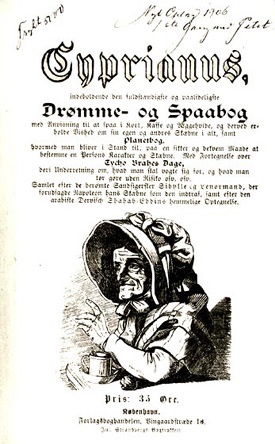
This published Cyprianus from 1916 calls itself a "dream and fortunetelling book", and it also promises an astrological almanac from Tycho Brahe.

Cyprianus is a name given in Scandinavian traditions of folk magic to the "black book" ("Svarteboken"): a grimoire or manuscript collection of spells; and by extension to the magical tradition that these spells form a part of. There is no standard text called "Cyprianus"; it was a general label given to a collection of spells.[1]

Manuscripts called or referring to Cyprianus had a dark reputation; in some versions, one obtained the text by renouncing one's baptism and devoting oneself to Satan. The common people's opinion of the book was that it was a standard grimoire concerned with the summoning of demons and spirits. Ministers were often thought to have obtained it through their studies at university; it is not coincidence that ministers' wives often functioned as folk healers in rural communities.[2] Like many such texts, it was said to be bound to its owner and hard to get rid of; it was claimed that these texts will not burn nor be destroyed by water, and attempting to discard them will only result in their supernatural return.[3] These compilations nevertheless were widely circulated among the cunning folk of Scandinavia, who in a rural land with few physicians were the folk healers sought out by ordinary people beset by injury or illness.

Cyprianus

[edit]

"Cyprianus" is the name frequently given to the compiler or author of the spells contained in the tradition. A variety of stories are told concerning the identity of this Cyprianus.

Saint Cyprian of Antioch was a bishop and martyr in early Christianity. In the Middle Ages, a variety of legends attached to his name, including a tradition that he practiced magic before his conversion, and as such was the author of a magical textbook. In another medieval tradition, Cyprianus was a sorcerer who sought to seduce St. Justina, but was foiled and converted when she made the sign of the cross and he followed suit, freeing himself from the power of the devil. The sorcerer and the historical bishop were likely conflated in later legend.[4][5] The Black Books of Elverum claim to be a summary of a Cyprianus by a "Bishop Johannes Sell" from Oxford, England in 1682. The British bishop John Fell may be the person who is meant here; Fell did publish an edition of the works of St. Cyprian.[6]

The actual stories told of Cyprianus in Scandinavia often made no reference to St. Cyprian. Some made Cyprianus into a typical Faust figure; some said that Cyprianus was a wicked Norwegian or Dane who learned magic through his dealings with the Devil; one version makes Cyprianus so evil that the Devil threw him out of Hell; Cyprianus wrote the text to have his revenge. A different and strongly contradictory version explains that Cyprianus was a student who discovered he was attending a diabolical "black school", and wrote the text to explain how to undo all the witchcraft he learned there.[7]

En Signekjerring, an 1848 painting by Adolph Tidemand. The elderly woman is performing the støyping divination ritual to seek the cause of the child's illness.

An anachronistic tale told in the printed Danish spell collection Oldtidens Sortebog ("Old Time Magic Book") makes Cyprianus to have been a pious and beautiful Mexican nun from the fourteenth century. In a gothic tale, Oldtidens Sortebog has Cyprianus cast into a dungeon in 1351. While imprisoned in the dungeon, Cyprianus rends her clothing and commits her magical knowledge to the rags, written in her own blood. Her text was then found in an old castle.[8]

The spells

[edit]

The spells in the Cyprianus tradition are typical Germanic folk magic: a mixed bag of folk remedies, prayers, and actual magic. They resemble the spells of the German language Braucherei, "pow-wow", and The Long Lost Friend traditions. One typical spell to heal a sprained ankle went:

Jesus rei over ei hei
Fållån snåva og foten vrei
Jesus steig av og la foten an
som den tilforn var
i namnet Gud, Fader, Sønn, og Helligånd
"Jesus rode over a stony plain.
His horse stumbled, its leg it did sprain.
Jesus dismounted to cure the pain
And made the injury good again.
In the name of God the Father, Son, and Holy Ghost."[9]

The methods of contagion and transference are in use here; a sacred personage in an apocryphal story is confronted with a problem similar to that faced by the actual sufferer, who avails himself of their supernatural aid.[10]

An important aspect of the magical tradition was the performance of divination, often by pouring molten lead through a hole in a piece of flatbread into cold water, a practice called støyping ("molybdomancy"). Lead scraped from the windows of churches was often used for this purpose. This was done to divine the cause of rickets, which was often thought to be the result of a changeling, a huldrabarn or bytting, left in the place of a healthy child by the malicious huldra-folk. The diviner in this ritual was called a signekjerring, a "blessing crone".[11]

Inexperienced use of the Black Book

[edit]

The Inexperienced Use of the Black Book is a motif in Scandinavian folklore. In such legends, a servant, maid or someone else unexpectedly happens to find and read the Black Book, thus summoning the devil, while the owner, often a clergyman, is away. The only way to save oneself is to give the devil a task that he cannot solve: to empty a fjord, to untie all knots in a fishing net, to twist a rope of sand, to row against the wind with a boat filled with empty buckets, etc.. The devil is then kept busy until the expert or the owner of the book returns and exorcises the devil away. It is given an ML (Migratory Legend) number of 3020 and is related to Aarne-Thompson type 325, "Apprentice and Ghost" and type 565, "The Magic Mill".[12]

See also

[edit]

References

[edit]
Revisions and contributorsEdit on WikipediaRead on Wikipedia
from Grokipedia
Cyprianus is a term denoting a legendary or "black book" (Svarteboken) in Scandinavian folk magic traditions, comprising collections of spells, charms, and rituals used for purposes. These texts, primarily documented in Norwegian and Danish archives from the 18th and 19th centuries, are pseudepigraphically attributed to Saint Cyprian of Antioch (d. ca. 304 CE), a historical figure legendarily known as a powerful sorcerer who converted to and became a alongside Saint Justina. The contents of Cyprianus books vary across manuscripts but typically include for healing ailments, attracting love, protecting against malevolent forces, and summoning spirits or demons, often blending with pagan and Solomonic elements. In , Cyprianus gained a reputation as a byword for sorcery, with legends claiming the books originated from a "Black School" at or were discovered in hidden locations, and their possession was shrouded in secrecy to avoid persecution. The tradition extends beyond to Iberian and other European contexts, where similar grimoires like Clavis Inferni (The Key of Hell), an 18th-century manual in Latin, Hebrew, and cipher scripts, detail invocations of archangels and demon kings for white and . Recent scholarly discoveries of dozens of such manuscripts have highlighted their role in rural and countermagic, preserving a unique intersection of religious devotion and .

Origins and Historical Background

Connection to Cyprian

Saint of Antioch, a figure central to early Christian , was reportedly born in the third century in Antioch to pagan parents who dedicated him from childhood to the service of idols and sorcery. He received extensive training in the magical arts, studying and in prominent centers such as , , and Argos, where he mastered summoning spirits, inducing possessions, and manipulating natural forces like storms. Renowned as a powerful pagan sorcerer, was hired by a young man named Aglaides to use his arts to seduce the Christian virgin , but his demonic agents failed upon encountering the protective power of the and her prayers, leading to investigate and ultimately convert to Christianity. Following his , he renounced magic, burned his occult books, and rose to become a bishop; during the , he was arrested, tortured, and martyred by beheading in around 304 AD alongside and her servant Theoctistus. The narrative of Cyprian's life and conversion, preserved in the Greek Acts of —a composite text comprising the Conversion, , and Martyrdom sections composed between the fourth and sixth centuries—details his pre-conversion magical expertise and post-conversion renunciation, forming the basis for later attributions. In these acts, particularly the , Cyprian recounts his sorcerous practices, which inspired medieval and early modern grimoires falsely claiming his authorship as a means to lend authority to their contents; such Cyprianus often frame the texts as his "confessions" of revealed after his conversion to warn against demonic arts. Early precursors include Latin adaptations of the acts circulating in monastic libraries, with specific grimoires like the Clavis Inferni sive magia alba et nigra (an eighteenth-century Solomonic-style manual) explicitly attributing evocations and rituals to Cyprian's supposed authorship, blending white and under his name. Cyprian's legend, emphasizing his dual role as sorcerer and saint, spread across through medieval hagiographical compilations, notably Jacobus de Voragine's thirteenth-century , which popularized the story in Latin manuscripts read in clerical and lay circles. This transmission associated him with potent magic despite his canonization, as the and related vitae highlighted his demonic pacts, leading to his invocation in folk traditions as a paradoxical patron of practices. By the late medieval period, Latin versions of the acts reached via ecclesiastical networks, influencing Scandinavian grimoires like the Cyprianus , where his name evoked both holy protection and forbidden sorcery.

Development in Scandinavian Folk Magic

The concept of Cyprianus entered Scandinavian folk magic traditions during the , primarily through printed grimoires disseminated via German and Dutch printing presses in the . These texts, often modeled on continental European magical works attributed to , began circulating in and around the late 1600s, with the first documented Norwegian references appearing in rural manuscript copies by the early 1700s. This arrival coincided with broader European exchanges of literature, adapting the legendary figure of Cyprian—a reputed sorcerer turned —into a symbol of esoteric power within Nordic contexts. Cultural adaptation transformed these imported Latin-based ecclesiastical texts into Norwegian and Danish manuscripts, reflecting local linguistic and practical needs while evading clerical . Handwritten in everyday dialects, the Cyprianus books shifted from formal ritual grimoires to accessible compilations of charms and invocations, incorporating elements like protective alongside . The Lutheran Church's strict prohibitions on magic, enforced through ordinances like the 1683 Danish-Norwegian witchcraft laws, further shaped this evolution, positioning Cyprianus as emblematic of that challenged official and persisted underground despite . In social contexts, Cyprianus materials were employed by fishermen, farmers, and healers in isolated rural regions such as in southern , where access to formal was limited and supernatural beliefs intertwined with daily survival. These practitioners used the texts to address practical concerns like safeguarding , ensuring bountiful catches, or warding off illness, often in defiance of church bans that criminalized such activities as or devil's work. By the , this grassroots integration had embedded Cyprianus deeply into folk practices, serving as a to institutionalized and preserving pre-Lutheran magical heritage amid modernization pressures.

The Black Book Tradition

Manuscripts and Variations

The Black Books attributed to Cyprianus, known as Svartebøker in Norwegian traditions, exist primarily as handwritten s from the late 18th and 19th centuries, with over 100 known exemplars preserved in alone. These include notable Norwegian examples such as the Trondenes manuscript, dating to circa 1760 and comprising 18 pages focused on hunting, healing, and protective formulas, owned originally by Gudmund Pedersen (1801–1862) and now held as Ms. fol. 580 in the National Library of in . Another key artifact is the Vesterålen manuscript from around 1800, a fragmentary 33-sheet document emphasizing demonic invocations and personal gain spells, discovered hidden under a church and archived as Gunnerus XA Oct. 120 at the University Library in . The Elverum Black Books, two distinct volumes dated 1790–1820 with 32 and 78 incantations respectively, were found in a farm attic in 1977 and represent localized peasant adaptations blending Catholic and pre-Christian elements. Danish variants of Cyprianus materials appear in both manuscript and early printed forms, with the 1802 manuscript by Jens Clemmensen preserved in the Danish Royal Library exemplifying monastic influences on spell collections. A significant printed edition emerged in the mid-19th century as Oldtidens Sortebog (Old Time's Black Book), first published in around 1857, compiling charms and a reverse-readable "key" signed by Cyprianus for ailments, theft recovery, and . Estimates suggest dozens of additional handwritten copies circulated across , many personalized by owners with unique additions, though exact totals remain uncertain due to losses. Regional variations highlight practical differences: Norwegian manuscripts often prioritize everyday applications like healing recipes and hunting charms, reflecting rural folk needs, while Danish and Swedish counterparts incorporate more theoretical elements such as elaborate invocations and runic cryptography influenced by continental grimoires. For instance, the Trondenes text leans toward integrated with protective spells, contrasting the Vesterålen's focus on demonic pacts for personal advantage. Preservation of these works was challenged by 17th- and 18th-century persecutions, during which authorities confiscated and destroyed many volumes amid trials, leading owners to hide them in attics, under altars, or within church structures to evade detection. Surviving copies were often recovered in the through collections, with major archival sites including the National Library of Norway in and the University Library in for Norwegian items, and the Danish Royal Library in for Danish examples. Modern efforts, such as those by Norwegian folklorists, continue to catalog and protect these artifacts from further degradation.

Structure and Compilation

The Cyprianus texts, known as svartebøker or in Scandinavian folk magic, typically exhibit a structured organizational framework divided into distinct sections that blend practical and esoteric elements. These manuscripts often begin with a attributing the content to Saint Cyprian and invoking his protection, frequently citing legendary origins such as discovery in in 1529 within a marble stone chest written on . The core generally comprises two main parts: an initial section focused on remedies and rituals for everyday concerns, such as ailments or attracting , followed by a second part containing prayers, charms, invocations to saints and demons, biblical excerpts like quotations from the , and magical seals or sigils. This arrangement categorizes spells and charms into thematic groups, emphasizing protective and curative applications before escalating to more supernatural elements. Compilation of Cyprianus manuscripts involved hand-copying and from diverse sources, reflecting a fluid process of transmission among practitioners. Owners, often educated individuals such as or , transcribed content from earlier grimoires, incorporating biblical passages for legitimacy, folk remedies derived from local traditions, and elements from imported European esoteric texts like Latin formulas or medieval manuals. Personalization was common, with users adding family-specific spells, regional variations, or modifications to suit personal needs, resulting in unique composites that evolved over generations. This method ensured the books' adaptability while maintaining core motifs, such as invocations blending Christian prayers like the with profane charms reminiscent of abracadabra-style incantations. Printed editions of Cyprianus from the marked a shift toward , contrasting with the variable nature of compilations. For instance, Danish versions such as Compendium og Magie eller de forborgene Konster af Siprianus reproduced recurring formulas and symbols from oral and traditions, making the content more uniform and accessible for wider dissemination. These publications, influenced by earlier Danish Cyprianus texts dating back to the , often simplified the structure for audiences while preserving the and sectional divisions, unlike the highly individualized handwritten versions that predominated until the mid-1800s. Later printings, such as the 1892 edition of Oldtidens Sortebog, further commercialized the material, fixing variations into a .

Contents and Magical Elements

Types of Spells and Charms

The practical magical contents of the Cyprianus, a key text in Norwegian black book tradition, encompass a range of spells and charms designed for everyday concerns, blending folk practices with elements of and . These workings are typically concise, relying on spoken incantations, inscribed sigils, herbal preparations, and objects to achieve their effects, reflecting the pragmatic needs of rural Scandinavian communities.

Protective Charms

Protective charms in the Cyprianus focus on safeguarding against threats and human malice, often employing sigils drawn on paper or wood, herbal amulets, and recited incantations to create barriers. Common examples include formulas to ward off trolls and elves, using sigils and protective herbs. Other charms target illness or misfortune, such as those using sigils for immunity to bullets or , recited during or to ensure personal safety in hazardous labors. Practical applications extend to livelihood protections, like fishing charms involving blessed and incantations over nets to attract abundant catches, or thief-binding formulas that curse intruders with immobility through sympathetic effigies.

Healing and Divination

Healing spells and charms in the Cyprianus emphasize remedies for physical and lost property ailments, incorporating where objects or words mimic the desired outcome to restore balance. For instance, fever treatments incorporate herbs and personal items like the patient's , with incantations to draw out the sickness. Blood-staunching charms apply pressure to wounds while chanting verses that "bind" the flow, often drawing on herbal poultices like yarrow for reinforcement. Some practices include methods for locating lost items or basic foretelling, underscoring their role in self-reliant folk medicine. These practices prioritize accessible materials and oral transmission.

Love and Curse Spells

Love spells in the Cyprianus aim to foster attraction or bind affections, frequently adapting biblical psalms with altered phrasing to infuse romantic intent, recited over tokens like hair or photographs of the desired person. Curse spells, conversely, channel revenge against wrongdoers, using twisted psalms or effigies to inflict harm, such as against thieves. These workings often reference broader invocations of spirits for potency but remain grounded in personal agency rather than elaborate ceremonies.

Rituals and Supernatural Invocations

The rituals and supernatural invocations in Cyprianus manuscripts blend Christian devotional practices with elements of demonology and goetia, forming a core of advanced ceremonial magic within the Scandinavian black book tradition. These procedures often begin with preparatory prayers, including recitations of the Our Father and Hail Mary, to invoke divine protection before calling upon supernatural entities such as archangels (Gabriel, Michael, Raphael) or demons for aid in healing, fortune, or revelation. Latin formulas and psalm excerpts are central to these invocations, serving to command or bind the entities summoned, often incorporating Solomonic influences such as magical seals and circles. In manuscripts like the Vesteraalen Black Book, invocations target demons for practical gains such as success or uncovering hidden knowledge, typically structured as sequential charms that escalate from protective blessings to direct conjurations. Practitioners would inscribe magical seals or sigils on to channel the invocation's power, with the process emphasizing verbal commands derived from biblical and apocryphal sources. While specific tools like knives are not prominently detailed, blood from animals or the practitioner is occasionally incorporated into spells as a binding agent, echoing broader folk magic practices. Timing for these ceremonies is not rigidly prescribed in surviving texts, though legendary narratives associate intense rituals with nocturnal hours to align with spiritual potency. Necromantic elements appear infrequently but are explicitly referenced in some Cyprianus-derived works under titles like "Nec Cromantien," linking to Saint Cyprian's mythic reputation as a master sorcerer skilled in communing with the dead. These rare spells aim to elicit responses from spirits of the deceased for or guidance, often requiring symbolic offerings such as animal blood to establish contact, though detailed procedures remain sparse in documented manuscripts. The practice ties directly to Cyprian's legendary conversion from sorcery, where his pre-Christian expertise included raising the dead through infernal arts. Protective measures are embedded throughout these rituals to mitigate risks from summoned forces, including the recitation of binding phrases that compel obedience from entities and the deployment of magical seals as barriers against backlash. Manuscripts warn that mishandling invocations could lead to spiritual peril, with traditions holding that perusing all nine volumes of the full Cyprianus corpus invites eternal damnation, underscoring the texts' dual role as both instructional and cautionary.

Cultural Significance and Warnings

Role in Folklore and Society

In Scandinavian folklore, the Black Book of Cyprianus features prominently in legends depicting it as a hidden that bestows extraordinary powers upon its owners, often at great personal cost, such as eternal or retribution. Tales collected in the portray the book as originating from the Academy of , where it was allegedly discovered or penned by a figure named Cyprianus, a sorcerer who bargained with the for arcane knowledge. These narratives integrate into oral traditions about and healers, who use the book to summon demonic aid for feats like constructing bridges or revealing thieves, but the stories frequently emphasize the book's perilous allure, with owners facing curses like madness or infernal pursuit if they fail to return it to its source. Socially, the Cyprianus served as a practical tool for itinerant magicians, household shamans, and educated lay practitioners in rural communities, enabling them to perform healing rituals, protective charms, and divinations that addressed everyday concerns like illness or lost property. In 18th-century , such books were transcribed and circulated among those with skills, blending folk remedies with to legitimize their use within a predominantly Lutheran . However, this integration created tensions with authorities, who viewed the grimoires as superstitious deviations; bishops and documented and critiqued them, leading to confiscations and public condemnations in the late 18th and 19th centuries, though outright excommunications were rare and typically tied to broader accusations. Regional variations highlight the book's embeddedness in local customs, with a stronger presence in rural , where manuscript copies like the Trondenes and grimoires emphasized protective and applications amid isolated northern communities. In contrast, Danish leaned toward urban-collected legends emphasizing narrative motifs of trickery and demonic pacts, as documented by folklorists in the late . These differences underscore the Cyprianus as a symbol of cultural resistance to modernization and centralized religious control, preserving pre-Christian elements in amid encroaching Enlightenment .

Dangers of Use in Tradition

In Scandinavian folklore, particularly Danish traditions, the Black Book of is surrounded by legends emphasizing severe perils for those who mishandle it, often portraying it as a cursed artifact that defies easy disposal and invites retribution. Tales warn that the book cannot be permanently gotten rid of through ordinary means; if sold, burned, or buried, it invariably returns to its owner, compelling them to keep it unless it is donated to a church accompanied by a monetary offering to a . This motif underscores the book's malevolent persistence, symbolizing the inescapable grip of , with the "black" designation itself evoking peril and association with demonic forces in folk narratives. Unauthorized or inexperienced reading frequently leads to dire consequences in these legends, such as , possession, or encounters with malevolent entities. For instance, a who secretly read the lost her , babbling incoherently until a ritually removed the tome from her possession, restoring her mind. Similarly, a young girl who perused it without preparation attracted trolls that haunted her, requiring clerical intervention to banish them. These stories highlight the requirement for —often involving renouncing —to safely access its contents, without which readers risk summoning uncontrollable devils that demand impossible tasks, like sieving water, before they can be dismissed. Church-influenced amplifies these warnings with fears of eternal , portraying possession of the book as a pathway to if not relinquished before death. Anecdotes describe individuals overwhelmed by terror upon partial reading; a nobleman, after perusing eight of its nine sections, buried it in fright, unable to continue due to the overwhelming dread it induced. Such taboos against casual or unprepared use reinforce the book's status as a perilous tool, where even glancing at its spells without proper safeguards could provoke backlash from unintended forces, blending folk caution with condemnation of sorcery.

Modern Interpretations

Publications and Revivals

In the late , efforts to preserve and disseminate the Norwegian gained momentum through translations and facsimiles produced by specialized publishers. A notable example is The Black Books of Elverum (1999), translated and edited by Mary S. Rustad, which reproduces two 17th- and 18th-century handwritten grimoires discovered in a Norwegian , presenting the original pages alongside English translations of spells for everyday magic such as and . This edition, published by Bantu Publishing, marked an early modern revival by making accessible practical folk magic that had previously circulated only in form. The 21st century has seen further reprints and adaptations, particularly through occult-oriented presses aiming to introduce these texts to international audiences. In 2024, Cyprianus: The Norwegian Black Books by Nikolas Currier Brusletto, published by Mercurius Publishing, provided the first English compilation of 63 unique spells, recipes, and instructions drawn from various , spanning healing charms, , and invocations, while contextualizing their historical development. Similarly, Simone Kotva's Cyprianic Conjurations from Norway (2024, Hadean Press) translated selections from 19th-century Norwegian sources, focusing on conjurations and emphasizing their roots in folk traditions. These editions reflect a deliberate effort to bridge historical manuscripts with contemporary practitioners, often including annotations on sigils and rituals. Revival movements surrounding Cyprianus materials have flourished within pagan reconstructionist groups and subcultures, where enthusiasts reconstruct Norse-influenced folk magic for spiritual and ceremonial use. Post-2000, self-published versions and adaptations have proliferated in online communities, adapting spells for modern contexts like personal empowerment and environmental harmony, often shared through forums and print-on-demand services. Accessibility has transformed dramatically with the digitization of , shifting them from rare physical artifacts to widely available resources that have expanded their influence in global networks. Digital scans, such as the full of The Black Books of Elverum on the , enable free access to original texts and translations, fostering discussions and adaptations in international pagan and esoteric circles since the early . This online proliferation has democratized Cyprianus traditions, allowing practitioners beyond to incorporate them into eclectic rituals and study groups.

Academic and Contemporary Study

Scholarly interest in Cyprianus, the infamous grimoire of Scandinavian folk magic, has intensified in recent years through anthropological and historical lenses, focusing on its cultural embeddedness and transmission dynamics. Key contributions include Simone Kotva's 2025 work, Cyprianus: St. Cyprian and the Black Book in Scandinavian Folklore, which translates and analyzes 19th-century Danish legends collected by Evald Tang Kristensen, highlighting the book's legendary powers and its association with sorcery and Devil pacts. Kotva's analysis explores gender roles in magic transmission, noting how the figure of Cyprianus assumes varied guises and genders in folklore, reflecting fluid identities in the oral and manuscript traditions of spellcasting and spirit invocation. Methodological approaches in contemporary research emphasize archival analysis of surviving manuscripts, facilitated by digital preservation efforts that have digitized numerous svartebøker (black books) from Norwegian and Danish collections. These methods allow for detailed examination of textual variations and historical contexts, as seen in studies reconstructing the evolution of Cyprianus from early Christian hagiography to vernacular grimoires. Comparative studies position Cyprianus within broader European grimoire traditions. This includes linking the grimoire's motifs to modern witchcraft movements, where practitioners draw on its charms for empowerment and cultural revival, as evidenced in recent translations and esoteric publications.

References

Add your contribution
Related Hubs
User Avatar
No comments yet.