



Community hub
Recent from talks
Knowledge base stats:
Talk channels stats:
Members stats:
Galactose
Galactose (/ɡəˈlæktoʊs/, galacto- + -ose, sometimes abbreviated Gal. It is a common monosaccharide, i.e. a simple sugar. It is classified as a reducing hexose, more specifically an aldohexose. In terms of structure, it is a C-4 epimer of glucose. A white, water-soluble solid, it is about as sweet as glucose, and about 65% as sweet as sucrose.
Galactan is a polymeric form of galactose found in hemicellulose, and forming the core of the galactans, a class of natural polymeric carbohydrates.
D-Galactose is also known as brain sugar since it is a component of glycoproteins (oligosaccharide-protein compounds) found in nerve tissue. Galactofuranose occurs in bacteria, fungi and protozoa, and is recognized by a putative chordate immune lectin intelectin through its exocyclic 1,2-diol.
Galactose, when combined with glucose (another monosaccharide) through a condensation reaction, gives the disaccharide called lactose. The hydrolysis of lactose to glucose and galactose is catalyzed by the enzymes lactase and β-galactosidase. The latter is produced by the lac operon in Escherichia coli.
In nature, lactose is found primarily in milk and milk products. Consequently, various food products made with dairy-derived ingredients can contain lactose. Galactose is metabolised to glucose by the three principal enzymes in a mechanism known as the Leloir pathway. The enzymes are listed in the order of the metabolic pathway: galactokinase (GALK), galactose-1-phosphate uridyltransferase (GALT), and UDP-galactose 4′-epimerase (GALE).[citation needed]
In human lactation, galactose is required in a 1 to 1 ratio with glucose to enable the mammary glands to synthesize and secrete lactose. In a study where women were fed a diet containing galactose, 69 ± 6% of glucose and 54 ± 4% of galactose in the lactose they produced were derived directly from plasma glucose, while 7 ± 2% of the glucose and 12 ± 2% of the galactose in the lactose, were derived directly from plasma galactose. 25 ± 8% of the glucose and 35 ± 6% of the galactose was synthesized from smaller molecules in a process referred to in the paper as hexoneogenesis. This suggests that the synthesis of galactose is supplemented by direct uptake and of use of plasma galactose when present.
Galactose exists in both open-chain and cyclic form. The open-chain form is an aldehyde (RCHO).
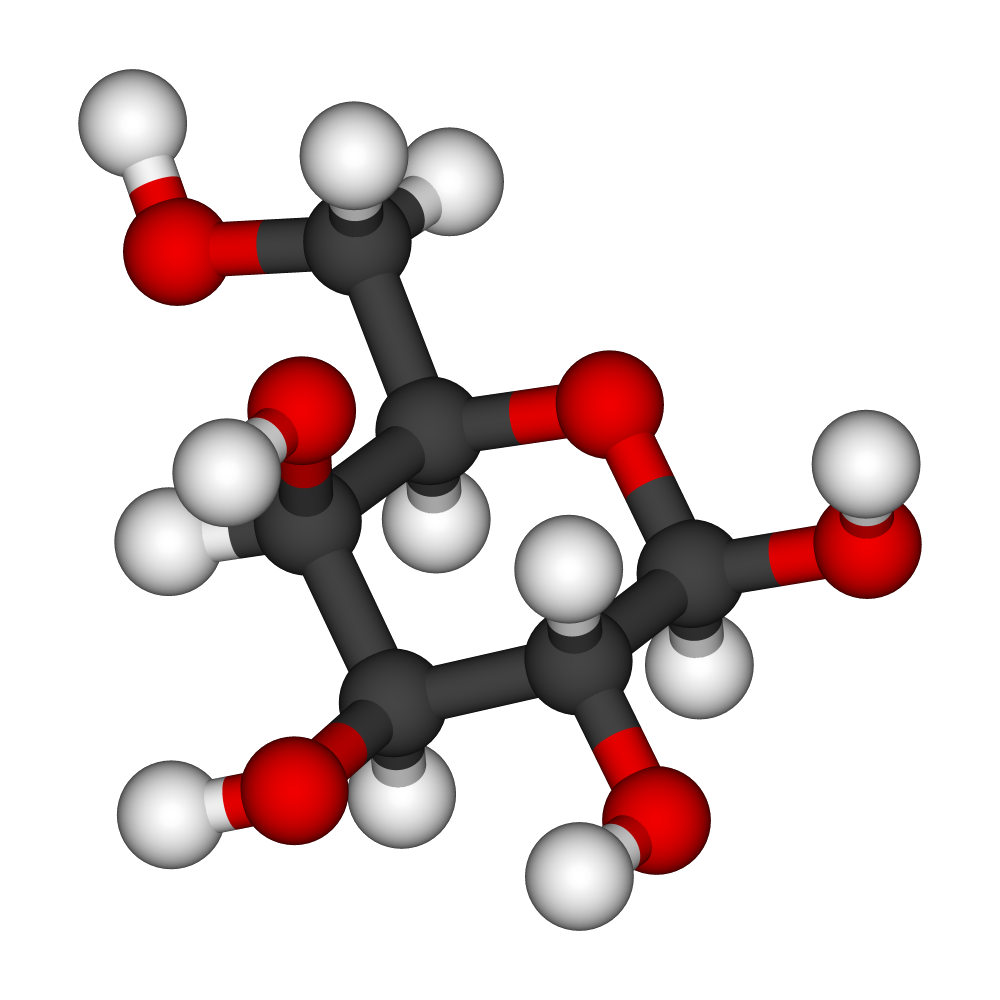
Four isomers are cyclic, two of them with a pyranose (six-membered) ring and two with a furanose (five-membered) ring. Each cyclic form can exist as two anomers, named alpha and beta, since a new stereocenter is generated upon cyclization at the site of the carbonyl. In the pyranose form, the OH group on C-3 is axial.
Hub AI
Galactose AI simulator
(@Galactose_simulator)
Galactose
Galactose (/ɡəˈlæktoʊs/, galacto- + -ose, sometimes abbreviated Gal. It is a common monosaccharide, i.e. a simple sugar. It is classified as a reducing hexose, more specifically an aldohexose. In terms of structure, it is a C-4 epimer of glucose. A white, water-soluble solid, it is about as sweet as glucose, and about 65% as sweet as sucrose.
Galactan is a polymeric form of galactose found in hemicellulose, and forming the core of the galactans, a class of natural polymeric carbohydrates.
D-Galactose is also known as brain sugar since it is a component of glycoproteins (oligosaccharide-protein compounds) found in nerve tissue. Galactofuranose occurs in bacteria, fungi and protozoa, and is recognized by a putative chordate immune lectin intelectin through its exocyclic 1,2-diol.
Galactose, when combined with glucose (another monosaccharide) through a condensation reaction, gives the disaccharide called lactose. The hydrolysis of lactose to glucose and galactose is catalyzed by the enzymes lactase and β-galactosidase. The latter is produced by the lac operon in Escherichia coli.
In nature, lactose is found primarily in milk and milk products. Consequently, various food products made with dairy-derived ingredients can contain lactose. Galactose is metabolised to glucose by the three principal enzymes in a mechanism known as the Leloir pathway. The enzymes are listed in the order of the metabolic pathway: galactokinase (GALK), galactose-1-phosphate uridyltransferase (GALT), and UDP-galactose 4′-epimerase (GALE).[citation needed]
In human lactation, galactose is required in a 1 to 1 ratio with glucose to enable the mammary glands to synthesize and secrete lactose. In a study where women were fed a diet containing galactose, 69 ± 6% of glucose and 54 ± 4% of galactose in the lactose they produced were derived directly from plasma glucose, while 7 ± 2% of the glucose and 12 ± 2% of the galactose in the lactose, were derived directly from plasma galactose. 25 ± 8% of the glucose and 35 ± 6% of the galactose was synthesized from smaller molecules in a process referred to in the paper as hexoneogenesis. This suggests that the synthesis of galactose is supplemented by direct uptake and of use of plasma galactose when present.
Galactose exists in both open-chain and cyclic form. The open-chain form is an aldehyde (RCHO).
Four isomers are cyclic, two of them with a pyranose (six-membered) ring and two with a furanose (five-membered) ring. Each cyclic form can exist as two anomers, named alpha and beta, since a new stereocenter is generated upon cyclization at the site of the carbonyl. In the pyranose form, the OH group on C-3 is axial.