Hubbry Logo
CatalysisCatalysisMain
Open search
Catalysis
Community hub
Catalysis
logo
8 pages, 0 posts
0 subscribers
Be the first to start a discussion here.
Catalysis
Catalysis
from Wikipedia

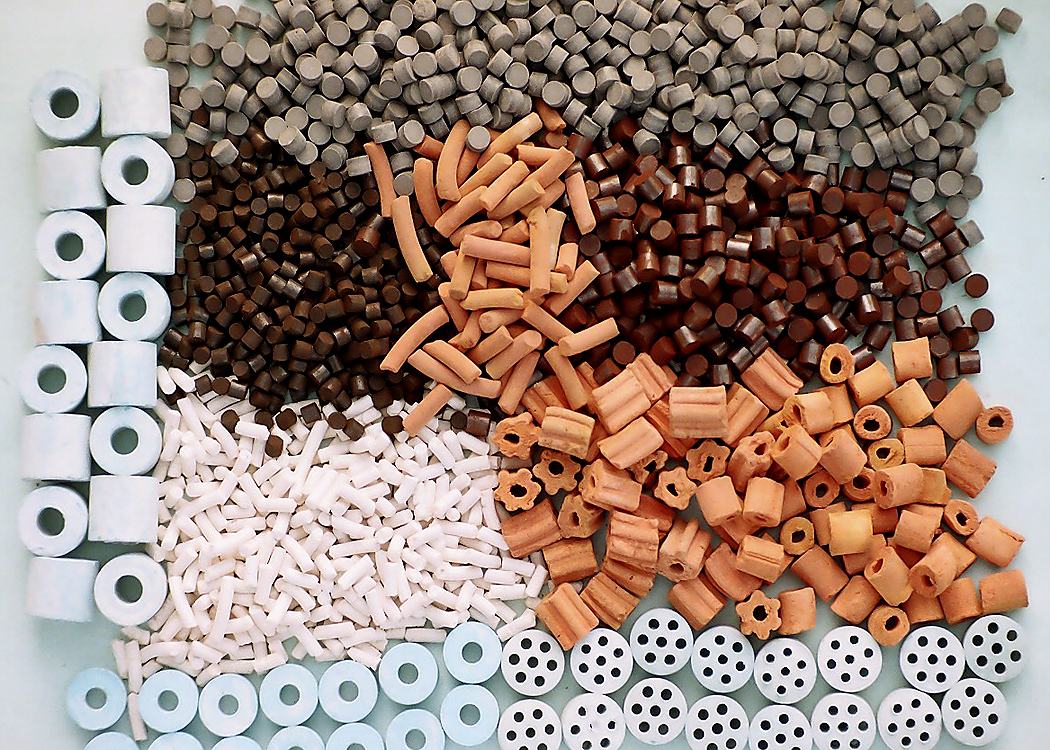
A range of industrial catalysts in pellet form
An air filter that uses a low-temperature oxidation catalyst to convert carbon monoxide to less toxic carbon dioxide at room temperature. It can also remove formaldehyde from the air.

Catalysis (/kəˈtælɪsɪs/ kə-TAL-iss-iss) is the increase in rate of a chemical reaction due to an added substance known as a catalyst[1][2] (/ˈkætəlɪst/ KAT-əl-ist). Catalysts are not consumed by the reaction and remain unchanged after the reaction.[3] If the reaction is rapid and the catalyst is recycled quickly, a very small amount of catalyst often suffices;[4] mixing, surface area, and temperature are important factors in reaction rate. Catalysts generally react with one or more reactants to form intermediates that subsequently give the final reaction product, in the process of regenerating the catalyst.

The rate increase occurs because the catalyst allows the reaction to occur by an alternative mechanism which may be much faster than the noncatalyzed mechanism. However the noncatalyzed mechanism does remain possible, so that the total rate (catalyzed plus noncatalyzed) can only increase in the presence of the catalyst and never decrease.[5]

Catalysis may be classified as either homogeneous, whose components are dispersed in the same phase (usually gaseous or liquid) as the reactant, or heterogeneous, whose components are not in the same phase. Enzymes and other biocatalysts are often considered as a third category.

Catalysis is ubiquitous in chemical industry of all kinds.[6] Estimates are that 90% of all commercially produced chemical products involve catalysts at some stage in the process of their manufacture.[7]

The term "catalyst" is derived from Greek καταλύειν, kataluein, meaning "loosen" or "untie". The concept of catalysis was invented by chemist Elizabeth Fulhame, based on her novel work in oxidation-reduction experiments.[8][9]

General principles

[edit]

Example

[edit]

An illustrative example is the effect of catalysts to speed the decomposition of hydrogen peroxide into water and oxygen:

2 H2O2 → 2 H2O + O2

This reaction proceeds because the reaction products are more stable than the starting compound, but this decomposition is so slow that hydrogen peroxide solutions are commercially available. In the presence of a catalyst such as manganese dioxide, this reaction proceeds much more rapidly. This effect is readily seen by the effervescence of oxygen.[10] The catalyst is not consumed in the reaction, and may be recovered unchanged and re-used indefinitely. Accordingly, manganese dioxide is said to catalyze this reaction. In living organisms, this reaction is catalyzed by enzymes (proteins that serve as catalysts) such as catalase.

Another example is the effect of catalysts on air pollution and reducing the amount of carbon monoxide. Development of active and selective catalysts for the conversion of carbon monoxide into desirable products is one of the most important roles of catalysts. Using catalysts for the hydrogenation of carbon monoxide helps remove this toxic gas and produce useful materials.[11]

Units

[edit]

The SI derived unit for measuring the catalytic activity of a catalyst is the katal, which is quantified in moles per second. The productivity of a catalyst can be described by the turnover number (TON) and the catalytic activity by the turn over frequency (TOF), which is the TON per time unit. The biochemical equivalent is the enzyme unit. For more information on the efficiency of enzymatic catalysis, see the article on enzymes.

Catalytic reaction mechanisms

[edit]

In general, chemical reactions occur faster in the presence of a catalyst because the catalyst provides an alternative reaction mechanism (reaction pathway) having a lower activation energy than the noncatalyzed mechanism. In catalyzed mechanisms, the catalyst is regenerated.[12][13][14][15]

As a simple example occurring in the gas phase, the reaction 2 SO2 + O2 → 2 SO3 can be catalyzed by adding nitric oxide. The reaction occurs in two steps:

2 NO + O2 → 2 NO2 (rate-determining)
NO2 + SO2 → NO + SO3 (fast)

The NO catalyst is regenerated. The overall rate is the rate of the slow step[15]

v=2k1[NO]2[O2].

An example of heterogeneous catalysis is the reaction of oxygen and hydrogen on the surface of titanium dioxide (TiO2, or titania) to produce water. Scanning tunneling microscopy showed that the molecules undergo adsorption and dissociation. The dissociated, surface-bound O and H atoms diffuse together. The intermediate reaction states are: HO2, H2O2, then H3O2 and the reaction product (water molecule dimers), after which the water molecule desorbs from the catalyst surface.[16][17]

Reaction energetics

[edit]
Generic potential energy diagram showing the effect of a catalyst in a hypothetical exothermic chemical reaction X + Y to give Z. The presence of the catalyst opens a different reaction pathway (shown in red) with lower activation energy. The final result and the overall thermodynamics are the same.

Catalysts enable pathways that differ from those of uncatalyzed reactions. These pathways have lower activation energy. Consequently, more molecular collisions have the energy needed to reach the transition state. Hence, catalysts can enable reactions that would otherwise be blocked or slowed by a kinetic barrier. The catalyst may increase the reaction rate or selectivity, or enable the reaction at lower temperatures. This effect can be illustrated with an energy profile diagram.

In the catalyzed elementary reaction, catalysts do not change the extent of a reaction: they have no effect on the chemical equilibrium of a reaction. The ratio of the forward and the reverse reaction rates is unaffected (see also thermodynamics). The second law of thermodynamics describes why a catalyst does not change the chemical equilibrium of a reaction. Suppose there was such a catalyst that shifted an equilibrium. Introducing the catalyst to the system would result in a reaction to move to the new equilibrium, producing energy. Production of energy is a necessary result since reactions are spontaneous only if Gibbs free energy is produced, and if there is no energy barrier, there is no need for a catalyst. Then, removing the catalyst would also result in a reaction, producing energy; i.e. the addition and its reverse process, removal, would both produce energy. Thus, a catalyst that could change the equilibrium would be a perpetual motion machine, a contradiction to the laws of thermodynamics.[18] Thus, catalysts do not alter the equilibrium constant. (A catalyst can however change the equilibrium concentrations by reacting in a subsequent step. It is then consumed as the reaction proceeds, and thus it is also a reactant. Illustrative is the base-catalyzed hydrolysis of esters, where the produced carboxylic acid immediately reacts with the base catalyst and thus the reaction equilibrium is shifted towards hydrolysis.)

The catalyst stabilizes the transition state more than it stabilizes the starting material. It decreases the kinetic barrier by decreasing the difference in energy between starting material and the transition state. It does not change the energy difference between starting materials and products (thermodynamic barrier), or the available energy (this is provided by the environment as heat or light).

[edit]

Some so-called catalysts are really precatalysts, which convert to catalysts in the reaction. For example, Wilkinson's catalyst RhCl(PPh3)3 loses one triphenylphosphine ligand before entering the true catalytic cycle. Precatalysts are easier to store but are easily activated in situ. Because of this preactivation step, many catalytic reactions involve an induction period.

In cooperative catalysis, chemical species that improve catalytic activity are called cocatalysts or promoters.

In tandem catalysis two or more different catalysts are coupled in a one-pot reaction.

In autocatalysis, the catalyst is a product of the overall reaction, in contrast to all other types of catalysis considered in this article. The simplest example of autocatalysis is a reaction of type A + B → 2 B, in one or in several steps. The overall reaction is just A → B, so that B is a product. But since B is also a reactant, it may be present in the rate equation and affect the reaction rate. As the reaction proceeds, the concentration of B increases and can accelerate the reaction as a catalyst. In effect, the reaction accelerates itself or is autocatalyzed. An example is the hydrolysis of an ester such as aspirin to a carboxylic acid and an alcohol. In the absence of added acid catalysts, the carboxylic acid product catalyzes the hydrolysis.

Switchable catalysis refers to a type of catalysis where the catalyst can be toggled between different ground states possessing distinct reactivity, typically by applying an external stimulus.[19] This ability to reversibly switch the catalyst allows for spatiotemporal control over catalytic activity and selectivity. The external stimuli used to switch the catalyst can include changes in temperature, pH, light,[20] electric fields, or the addition of chemical agents.

A true catalyst can work in tandem with a sacrificial catalyst. The true catalyst is consumed in the elementary reaction and turned into a deactivated form. The sacrificial catalyst regenerates the true catalyst for another cycle. The sacrificial catalyst is consumed in the reaction, and as such, it is not really a catalyst, but a reagent. For example, osmium tetroxide (OsO4) is a good reagent for dihydroxylation, but it is highly toxic and expensive. In Upjohn dihydroxylation, the sacrificial catalyst N-methylmorpholine N-oxide (NMMO) regenerates OsO4, and only catalytic quantities of OsO4 are needed.

Classification

[edit]

Catalysis may be classified as either homogeneous or heterogeneous. A homogeneous catalysis is one whose components are dispersed in the same phase (usually gaseous or liquid) as the reactant's molecules. A heterogeneous catalysis is one where the reaction components are not in the same phase. Enzymes and other biocatalysts are often considered as a third category. Similar mechanistic principles apply to heterogeneous, homogeneous, and biocatalysis.

Heterogeneous catalysis

[edit]
The microporous molecular structure of the zeolite ZSM-5 is exploited in catalysts used in refineries
Zeolites are extruded as pellets for easy handling in catalytic reactors.

Heterogeneous catalysts act in a different phase than the reactants. Most heterogeneous catalysts are solids that act on substrates in a liquid or gaseous reaction mixture. Important heterogeneous catalysts include zeolites, alumina,[21] higher-order oxides, graphitic carbon, transition metal oxides, metals such as Raney nickel for hydrogenation, and vanadium(V) oxide for oxidation of sulfur dioxide into sulfur trioxide by the contact process.[22]

Diverse mechanisms for reactions on surfaces are known, depending on how the adsorption takes place (Langmuir-Hinshelwood, Eley-Rideal, and Mars-van Krevelen).[23] The total surface area of a solid has an important effect on the reaction rate. The smaller the catalyst particle size, the larger the surface area for a given mass of particles.

A heterogeneous catalyst has active sites, which are the atoms or crystal faces where the substrate actually binds. Active sites are atoms but are often described as a facet (edge, surface, step, etc.) of a solid. Most of the volume but also most of the surface of a heterogeneous catalyst may be catalytically inactive. Finding out the nature of the active site is technically challenging.

For example, the catalyst for the Haber process for the synthesis of ammonia from nitrogen and hydrogen is often described as iron. But detailed studies and many optimizations have led to catalysts that are mixtures of iron-potassium-calcium-aluminum-oxide.[24] The reacting gases adsorb onto active sites on the iron particles. Once physically adsorbed, the reagents partially or wholly dissociate and form new bonds. In this way the particularly strong triple bond in nitrogen is broken, which would be extremely uncommon in the gas phase due to its high activation energy. Thus, the activation energy of the overall reaction is lowered, and the rate of reaction increases.[25] Another place where a heterogeneous catalyst is applied is in the oxidation of sulfur dioxide on vanadium(V) oxide for the production of sulfuric acid.[22] Many heterogeneous catalysts are in fact nanomaterials.

Heterogeneous catalysts are typically "supported", which means that the catalyst is dispersed on a second material that enhances the effectiveness or minimizes its cost. Supports prevent or minimize agglomeration and sintering of small catalyst particles, exposing more surface area, thus catalysts have a higher specific activity (per gram) on support. Sometimes the support is merely a surface on which the catalyst is spread to increase the surface area. More often, the support and the catalyst interact, affecting the catalytic reaction. Supports can also be used in nanoparticle synthesis by providing sites for individual molecules of catalyst to chemically bind. Supports are porous materials with a high surface area, most commonly alumina, zeolites, or various kinds of activated carbon. Specialized supports include silicon dioxide, titanium dioxide, calcium carbonate, and barium sulfate.[26]

Electrocatalysts

[edit]

In the context of electrochemistry, specifically in fuel cell engineering, various metal-containing catalysts are used to enhance the rates of the half reactions that comprise the fuel cell. One common type of fuel cell electrocatalyst is based upon nanoparticles of platinum that are supported on slightly larger carbon particles. When in contact with one of the electrodes in a fuel cell, this platinum increases the rate of oxygen reduction either to water or to hydroxide or hydrogen peroxide.

Homogeneous catalysis

[edit]

Homogeneous catalysts function in the same phase as the reactants. Typically homogeneous catalysts are dissolved in a solvent with the substrates. One example of homogeneous catalysis involves the influence of H+ on the esterification of carboxylic acids, such as the formation of methyl acetate from acetic acid and methanol.[27] High-volume processes requiring a homogeneous catalyst include hydroformylation, hydrosilylation, hydrocyanation. For inorganic chemists, homogeneous catalysis is often synonymous with organometallic catalysts.[28] Many homogeneous catalysts are however not organometallic, illustrated by the use of cobalt salts that catalyze the oxidation of p-xylene to terephthalic acid.

Organocatalysis

[edit]

Whereas transition metals sometimes attract most of the attention in the study of catalysis, small organic molecules without metals can also exhibit catalytic properties, as is apparent from the fact that many enzymes lack transition metals. Typically, organic catalysts require a higher loading (amount of catalyst per unit amount of reactant, expressed in mol% amount of substance) than transition metal(-ion)-based catalysts, but these catalysts are usually commercially available in bulk, helping to lower costs. In the early 2000s, these organocatalysts were considered "new generation" and are competitive to traditional metal(-ion)-containing catalysts.

Organocatalysts are supposed to operate akin to metal-free enzymes utilizing, e.g., noncovalent interactions such as hydrogen bonding. The discipline organocatalysis is divided into the application of covalent (e.g., proline, DMAP) and noncovalent (e.g., thiourea organocatalysis) organocatalysts referring to the preferred catalyst-substrate binding and interaction, respectively. The Nobel Prize in Chemistry 2021 was awarded jointly to Benjamin List and David W.C. MacMillan "for the development of asymmetric organocatalysis."[29]

Photocatalysts

[edit]

Photocatalysis is the phenomenon where the catalyst can receive light to generate an excited state that effect redox reactions.[30] Singlet oxygen is usually produced by photocatalysis. Photocatalysts are components of dye-sensitized solar cells.

Enzymes and biocatalysts

[edit]

In biology, enzymes are protein-based catalysts in metabolism and catabolism. Most biocatalysts are enzymes, but other nonprotein-based classes of biomolecules also exhibit catalytic properties including ribozymes, and synthetic deoxyribozymes.[31]

Biocatalysts can be thought of as an intermediate between homogeneous and heterogeneous catalysts, although strictly speaking soluble enzymes are homogeneous catalysts and membrane-bound enzymes are heterogeneous. Several factors affect the activity of enzymes (and other catalysts) including temperature, pH, the concentration of enzymes, substrate, and products. A particularly important reagent in enzymatic reactions is water, which is the product of many bond-forming reactions and a reactant in many bond-breaking processes.

In biocatalysis, enzymes are employed to prepare many commodity chemicals including high-fructose corn syrup and acrylamide.

Some monoclonal antibodies whose binding target is a stable molecule that resembles the transition state of a chemical reaction can function as weak catalysts for that chemical reaction by lowering its activation energy.[32] Such catalytic antibodies are sometimes called "abzymes".

Significance

[edit]
Left: Partially caramelized cube sugar, Right: burning cube sugar with ash as catalyst
A Ti-Cr-Pt tube (~40 μm long) releases oxygen bubbles when immersed in hydrogen peroxide (via catalytic decomposition), forming a micropump.[33]

Estimates are that 90% of all commercially produced chemical products involve catalysts at some stage in the process of their manufacture. In 2005, catalytic processes generated about $900 billion in products worldwide.[34] Catalysis is so pervasive that subareas are not readily classified. Some areas of particular concentration are surveyed below.

Energy processing

[edit]

Petroleum refining makes intensive use of catalysis for alkylation, catalytic cracking (breaking long-chain hydrocarbons into smaller pieces), naphtha reforming and steam reforming (conversion of hydrocarbons into synthesis gas). Even the exhaust from the burning of fossil fuels is treated via catalysis: Catalytic converters, typically composed of platinum and rhodium, break down some of the more harmful byproducts of automobile exhaust.

2 CO + 2 NO → 2 CO2 + N2

With regard to synthetic fuels, an old but still important process is the Fischer–Tropsch synthesis of hydrocarbons from synthesis gas, which itself is processed via water-gas shift reactions, catalyzed by iron. The Sabatier reaction produces methane from carbon dioxide and hydrogen. Biodiesel and related biofuels require processing via both inorganic and biocatalysts.

Fuel cells rely on catalysts for both the anodic and cathodic reactions.

Catalytic heaters generate flameless heat from a supply of combustible fuel.

Bulk chemicals

[edit]
Typical vanadium pentoxide catalyst used in sulfuric acid production for an intermediate reaction to convert sulfur dioxide to sulfur trioxide.

Some of the largest-scale chemicals are produced via catalytic oxidation, often using oxygen. Examples include nitric acid (from ammonia), sulfuric acid (from sulfur dioxide to sulfur trioxide by the contact process), terephthalic acid from p-xylene, acrylic acid from propylene or propane and acrylonitrile from propane and ammonia.[23]

The production of ammonia is one of the largest-scale and most energy-intensive processes. In the Haber process nitrogen is combined with hydrogen over an iron oxide catalyst.[35] Methanol is prepared from carbon monoxide or carbon dioxide but using copper-zinc catalysts.

Bulk polymers derived from ethylene and propylene are often prepared using Ziegler–Natta catalyst. Polyesters, polyamides, and isocyanates are derived via acid–base catalysis.

Most carbonylation processes require metal catalysts, examples include the Monsanto acetic acid process and hydroformylation.

Fine chemicals

[edit]

Many fine chemicals are prepared via catalysis; methods include those of heavy industry as well as more specialized processes that would be prohibitively expensive on a large scale. Examples include the Heck reaction, and Friedel–Crafts reactions. Because most bioactive compounds are chiral, many pharmaceuticals are produced by enantioselective catalysis (catalytic asymmetric synthesis). (R)-1,2-Propandiol, the precursor to the antibacterial levofloxacin, can be synthesized efficiently from hydroxyacetone by using catalysts based on BINAP-ruthenium complexes, in Noyori asymmetric hydrogenation:[36]

levofloxaxin synthesis

Food processing

[edit]

One of the most obvious applications of catalysis is the hydrogenation (reaction with hydrogen gas) of fats using nickel catalyst to produce margarine.[37] Many other foodstuffs are prepared via biocatalysis (see below).

Environment

[edit]

Catalysis affects the environment by increasing the efficiency of industrial processes, but catalysis also plays a direct role in the environment. A notable example is the catalytic role of chlorine free radicals in the breakdown of ozone. These radicals are formed by the action of ultraviolet radiation on chlorofluorocarbons (CFCs).

Cl· + O3 → ClO· + O2
ClO· + O· → Cl· + O2

History

[edit]

The term "catalyst", broadly defined as anything that increases the rate of a process, is derived from Greek καταλύειν, meaning "to annul", or "to untie", or "to pick up". The concept of catalysis was invented by chemist Elizabeth Fulhame and described in a 1794 book, based on her novel work in oxidation–reduction reactions.[8][9][38] The first chemical reaction in organic chemistry that knowingly used a catalyst was studied in 1811 by Gottlieb Kirchhoff, who discovered the acid-catalyzed conversion of starch to glucose. The term catalysis was later used by Jöns Jakob Berzelius in 1835[39] to describe reactions that are accelerated by substances that remain unchanged after the reaction. Fulhame, who predated Berzelius, did work with water as opposed to metals in her reduction experiments. Other 18th century chemists who worked in catalysis were Eilhard Mitscherlich[40] who referred to it as contact processes, and Johann Wolfgang Döbereiner[41][42] who spoke of contact action. He developed Döbereiner's lamp, a lighter based on hydrogen and a platinum sponge, which became a commercial success in the 1820s that lives on today. Humphry Davy discovered the use of platinum in catalysis.[43] In the 1880s, Wilhelm Ostwald at Leipzig University started a systematic investigation into reactions that were catalyzed by the presence of acids and bases, and found that chemical reactions occur at finite rates and that these rates can be used to determine the strengths of acids and bases. For this work, Ostwald was awarded the 1909 Nobel Prize in Chemistry.[44] Vladimir Ipatieff performed some of the earliest industrial scale reactions, including the discovery and commercialization of oligomerization and the development of catalysts for hydrogenation.[45]

Inhibitors, poisons, and promoters

[edit]

An added substance that lowers the rate is called a reaction inhibitor if reversible and catalyst poisons if irreversible.[1] Promoters are substances that increase the catalytic activity, even though they are not catalysts by themselves.[46]

Inhibitors are sometimes referred to as "negative catalysts" since they decrease the reaction rate.[47] However the term inhibitor is preferred since they do not work by introducing a reaction path with higher activation energy; this would not lower the rate since the reaction would continue to occur by the noncatalyzed path. Instead, they act either by deactivating catalysts or by removing reaction intermediates such as free radicals.[47][12] In heterogeneous catalysis, coking inhibits the catalyst, which becomes covered by polymeric side products.

The inhibitor may modify selectivity in addition to rate. For instance, in the hydrogenation of alkynes to alkenes, a palladium (Pd) catalyst partly "poisoned" with lead(II) acetate (Pb(CH3CO2)2) can be used (Lindlar catalyst).[48] Without the deactivation of the catalyst, the alkene produced would be further hydrogenated to alkane.[49][50]

The inhibitor can produce this effect by, e.g., selectively poisoning only certain types of active sites. Another mechanism is the modification of surface geometry. For instance, in hydrogenation operations, large planes of metal surface function as sites of hydrogenolysis catalysis while sites catalyzing hydrogenation of unsaturates are smaller. Thus, a poison that covers the surface randomly will tend to lower the number of uncontaminated large planes but leave proportionally smaller sites free, thus changing the hydrogenation vs. hydrogenolysis selectivity. Many other mechanisms are also possible.

Promoters can cover up the surface to prevent the production of a mat of coke, or even actively remove such material (e.g., rhenium on platinum in platforming). They can aid the dispersion of the catalytic material or bind to reagents.

Prebiotic catalysis in the origin of life

[edit]

Life is based on an interplay between information processing and catalytic activity carried out by biological polymers.[51] A possible evolutionary pathway for the emergence of catalytic functions in prebiotic information coding polymers was proposed.[51] It has also been proposed that life emerged as an RNA-protein system in which the two components cross catalyzed the formation of each other.[52]

See also

[edit]

References

[edit]
[edit]
Revisions and contributorsEdit on WikipediaRead on Wikipedia
from Grokipedia
Catalysis is the acceleration of a by a substance known as a catalyst, which provides an alternative reaction pathway with a lower while remaining unchanged at the end of the reaction. The catalyst does not alter the overall of the reaction, such as the standard Gibbs change, but significantly enhances the by facilitating bond breaking and formation. The concept of catalysis was first systematically described in 1835 by Swedish chemist , who coined the term to explain phenomena where substances influenced reactions without being consumed, attributing it to a "catalytic force." Early observations of catalytic effects date back further, including the decomposition of by noted by French chemist Louis Jacques Thénard in 1818, but Berzelius's work unified these into a coherent framework. Subsequent developments, such as Wilhelm Ostwald's thermodynamic interpretations in the late , elevated catalysis to a cornerstone of , earning him the 1909 . Catalysis is broadly classified into several types based on the nature of the catalyst and reaction conditions. occurs when the catalyst is in the same phase (typically or gas) as the reactants, allowing for intimate molecular interactions but complicating catalyst recovery; examples include acid- or base-catalyzed esterification reactions. In contrast, involves a catalyst in a different phase, often a solid surface interacting with gaseous or reactants, which is prevalent in due to ease of separation; in catalytic converters exemplifies this by facilitating purification. Biocatalysis, or , employs biological catalysts like proteins to achieve high specificity and efficiency under mild conditions, as seen in metabolic pathways where enzymes such as accelerate . Additionally, autocatalysis arises when a reaction product itself acts as the catalyst, leading to sigmoidal rate profiles, such as in the oxidation of by . Catalysis plays a pivotal role in modern industry, underpinning over 90% of chemical processes and enabling the production of essential commodities like fertilizers, fuels, and pharmaceuticals with reduced energy input and waste. For instance, the Haber-Bosch process for synthesis relies on iron-based heterogeneous catalysts to fix atmospheric , supporting global by producing fertilizers that sustain approximately half of the world's population. In petroleum refining, catalytic cracking using zeolites converts heavy hydrocarbons into , optimizing fuel yields. Beyond industry, catalysis is crucial in environmental applications, such as three-way catalysts in vehicles that convert harmful pollutants like CO, , and hydrocarbons into less toxic substances, mitigating . Emerging areas, including electrocatalysis for and for , highlight catalysis's potential in transitions. Overall, advancements in catalyst design continue to drive efficiency, selectivity, and sustainability across chemical, biological, and environmental domains.

Fundamentals

Definition and Principles

Catalysis is the process by which a substance, known as a , increases the rate of a without undergoing any permanent change itself or altering the overall standard Gibbs energy change of the reaction. The participates in the reaction by forming temporary intermediates but is regenerated at the end, allowing it to facilitate multiple reaction cycles. This acceleration occurs because the provides an alternative reaction pathway that circumvents the highest energy barrier of the uncatalyzed process, thereby enabling the reaction to proceed more rapidly under the same conditions. A key principle of catalysis is the reduction of the (EaE_a), which is the minimum energy required for reactants to reach the . In the uncatalyzed reaction, molecules must overcome a high EaE_a to form products, resulting in a slower rate; the catalyzed pathway lowers this EaE_a through intermediate steps, as illustrated in an energy diagram where the catalyzed curve shows a shallower peak compared to the uncatalyzed one. This lower EaE_a increases the proportion of reactant molecules with sufficient energy to react, without shifting the equilibrium position. Catalysts are also highly selective, favoring specific reactions or substrates while remaining inert to others, which enhances their utility in targeted chemical transformations. The efficiency of a catalyst is quantified by metrics such as the turnover number (TON), defined as the maximum number of moles of product formed per mole of catalyst under specified conditions before deactivation. The turnover frequency (TOF) extends this by measuring the TON per unit time, providing a rate of catalytic activity in moles of product per mole of catalyst per second. These parameters highlight the catalyst's productivity and are crucial for evaluating performance. The rate enhancement can be expressed generally as ratecatalyzed=k[reactants]\text{rate}_{\text{catalyzed}} = k \cdot [\text{reactants}], where the rate constant kk is amplified due to the reduced EaE_a. According to the , k=AeEa/RTk = A e^{-E_a / RT}, a decrease in EaE_a exponentially increases kk, with AA as the , RR the , and TT the temperature in .

Basic Examples

One of the simplest demonstrations of catalysis is the decomposition of hydrogen peroxide (H₂O₂) into water and oxygen gas, represented by the reaction 2H2O22H2O+O22 \mathrm{H_2O_2} \rightarrow 2 \mathrm{H_2O} + \mathrm{O_2}. Without a catalyst, this reaction proceeds slowly at room temperature, producing oxygen bubbles at a minimal rate over hours or days. Adding manganese dioxide (MnO₂) as a heterogeneous catalyst dramatically accelerates the process, causing vigorous bubbling and rapid evolution of oxygen gas within seconds, as the solid catalyst provides a surface for peroxide molecules to adsorb and react without being consumed. Similarly, in a homogeneous catalysis example, potassium iodide (KI) dissolved in solution introduces iodide ions (I⁻) that speed up the decomposition, producing a visible foam of oxygen bubbles almost immediately upon mixing, with the iodide acting as an intermediate in the reaction pathway. Quantitative comparisons show that the catalyzed rate can be over 2,000 times faster than the uncatalyzed reaction under similar conditions, highlighting how catalysts lower the activation energy barrier to enhance reaction speed. In the atmosphere, catalysis plays a critical role in through a cycle involving radicals from chlorofluorocarbons (CFCs). The process begins with a atom (Cl•) reacting with () to form (ClO•) and oxygen (O₂): Cl+O3ClO+O2\mathrm{Cl \cdot + O_3 \rightarrow ClO \cdot + O_2}. The ClO• then reacts with an oxygen atom (O) to regenerate Cl• and produce another O₂ molecule: ClO+OCl+O2\mathrm{ClO \cdot + O \rightarrow Cl \cdot + O_2}. This net reaction destroys two molecules per cycle while recycling the , allowing a single Cl• to deplete thousands of O₃ molecules before being removed. Proposed in seminal work by Molina and Rowland, this catalytic mechanism explains the enhanced loss in the due to anthropogenic CFCs. A practical application of catalysis appears in automotive catalytic converters, which reduce harmful emissions from internal combustion engines. These devices use platinum (Pt) and rhodium (Rh) supported on a ceramic honeycomb to facilitate oxidation of carbon monoxide (CO) to carbon dioxide (CO₂): CO+12O2CO2\mathrm{CO + \frac{1}{2} O_2 \rightarrow CO_2}, and reduction of nitrogen oxides (NOₓ) to nitrogen gas (N₂) and oxygen: 2NON2+O22 \mathrm{NO} \rightarrow \mathrm{N_2 + O_2} (or similar for NO₂)./Kinetics/07:_Case_Studies-_Kinetics/7.01:_Catalytic_Converters) The metals provide active sites for these redox reactions at exhaust temperatures around 300–800°C, converting up to 98% of CO and NOₓ into less toxic products in modern three-way converters. This everyday example underscores catalysis's role in environmental protection by enabling efficient pollutant transformation without altering the overall engine chemistry./Kinetics/07:_Case_Studies-_Kinetics/7.01:_Catalytic_Converters)

Measurement and Units

The assessment of catalytic performance relies on standardized quantitative metrics that capture activity, productivity, and efficiency, enabling comparisons across catalysts and reaction conditions. Key among these are the turnover frequency (TOF) and (TON), which focus on the intrinsic activity per catalytic site. TOF quantifies the rate at which a catalyst converts substrate molecules, defined as the number of moles of reactant converted per mole of active sites per unit time, with common units of s⁻¹ or h⁻¹. According to IUPAC, this corresponds to molecules reacting per active site in unit time, a definition borrowed from but widely applied in chemical catalysis. TON, a dimensionless measure, represents the total number of moles of substrate converted per mole of catalyst before deactivation, serving as an indicator of catalyst stability and lifetime under specified conditions. Another important metric is space-time yield, which evaluates overall process productivity as the mass of product generated per unit reactor volume per unit time, typically in units of g/(L·h); this is particularly relevant for scaling up catalytic processes in industrial settings. Efficiency metrics complement activity measures by addressing product distribution. Selectivity is defined as the ratio of moles of desired product to the total moles of all products formed, often expressed as a , reflecting the catalyst's ability to favor specific reaction pathways over side reactions. Yield, on the other hand, is the ratio of moles of desired product produced to moles of reactant converted, also typically reported as a , providing a direct gauge of conversion effectiveness toward the target product. These metrics are interrelated; for instance, yield can be expressed as the product of conversion and selectivity, emphasizing the need for balanced optimization in catalyst design. The International Union of Pure and Applied Chemistry (IUPAC) provides foundational standardization for catalytic activity, defining it as the catalyzed rate of reaction in moles of reactant converted per unit time, with the coherent SI unit being the katal (kat ≡ 1 mol/s). In heterogeneous catalysis, where catalyst mass varies, specific catalytic activity is normalized to mol/(s·kg catalyst) to account for loading and enable comparability across systems. This unit facilitates precise reporting of performance independent of scale, as outlined in IUPAC guidelines for catalyst characterization. Experimental techniques for measuring these metrics are tailored to the reaction setup and catalyst type. Batch reactors are commonly used for and TOF determination, where a fixed amount of catalyst is added to reactants, and product evolution is tracked over time—often via sampling and analysis—to compute initial rates and total turnovers. Continuous flow reactors, by contrast, assess space velocity metrics, such as weight hourly space velocity (WHSV in g feed/(g catalyst·h)), by maintaining steady-state feed rates through a catalyst bed, allowing evaluation of long-term productivity and space-time yield under operational conditions. To probe catalyst state and mechanisms, spectroscopic techniques like (IR) spectroscopy and (NMR) are employed; IR detects surface species and adsorption modes , while NMR reveals molecular-level changes in homogeneous or supported catalysts during operation. A representative calculation illustrates TOF application: for a reaction yielding 100 mol of product from 1 mol of catalyst over 1 h, assuming all catalyst sites are active, \TOF=100\mol1\mol1\h=100\h1.\TOF = \frac{100 \, \mol}{1 \, \mol \cdot 1 \, \h} = 100 \, \h^{-1}. This value highlights the catalyst's per-site efficiency, with higher TOF indicating greater activity, though actual computation requires verification of active site concentration via techniques like or .

Mechanisms and Energetics

Reaction Mechanisms

Catalytic reaction mechanisms typically proceed through a series of discrete steps that enable the catalyst to lower the for the transformation of reactants into products while remaining unchanged at the end of the cycle. The fundamental sequence includes: (1) adsorption of one or more reactants onto active sites of the catalyst or coordination to the catalyst's reactive center; (2) a surface reaction or intramolecular transformation within the coordinated ; (3) desorption of the products from the catalyst sites; and (4) regeneration of the original catalyst form, allowing the cycle to repeat. These steps ensure efficient turnover, with the catalyst interacting reversibly with substrates to facilitate bond breaking and formation. In many catalytic processes, the Langmuir-Hinshelwood mechanism governs bimolecular reactions where both reactants must adsorb onto adjacent sites of the catalyst before undergoing transformation. This pathway assumes independent adsorption of each reactant following the Langmuir isotherm, leading to a surface-bound intermediate that reacts in the rate-determining step. The is proportional to the product of the fractional coverages of the two species, expressed as rate=kθAθB\text{rate} = k \theta_A \theta_B, where kk is the rate constant and θA\theta_A, θB\theta_B are the coverages of reactants A and B, respectively. This mechanism highlights the importance of surface saturation and competitive adsorption in controlling overall kinetics. An alternative pathway, the Eley-Rideal mechanism, occurs when one reactant is adsorbed on the catalyst while the second approaches directly from the surrounding phase without prior adsorption. Here, the adsorbed species reacts with the incoming molecule at the interface, bypassing dual-site occupancy. The rate law simplifies to rate=kPAθB\text{rate} = k P_A \theta_B, where PAP_A is the (or concentration) of the non-adsorbed reactant A and θB\theta_B is the coverage of adsorbed B. This mechanism is favored in systems where co-adsorption leads to inhibition or when limitations prevent full surface coverage. Homogeneous catalytic mechanisms often operate via closed catalytic cycles comprising iterative coordination events, such as ligand exchange, which allow substrates to bind and products to depart while preserving the catalyst's integrity. In transition metal complexes, a typical cycle might involve oxidative addition of a reactant to the metal center, followed by migratory insertion or ligand coupling, and concluding with reductive elimination to release the product; ligand exchange steps, like substitution of a labile ancillary ligand for the substrate, ensure continuous regeneration. These cycles enable high selectivity and turnover in solution-phase reactions, with the metal's electronic and steric properties dictating the pathway. Stereoselectivity emerges in catalytic mechanisms through the catalyst's ability to impose facial discrimination on prochiral substrates, directing approach to one enantiotopic face during key bond-forming steps. In asymmetric transformations, chiral ligands or frameworks create a non-symmetric environment that stabilizes one over its , often via differential non-covalent interactions like hydrogen bonding or steric shielding. For example, in rhodium-catalyzed hydrogenations, diphosphine ligands enforce facial selectivity by positioning the substrate such that delivery occurs preferentially from the less hindered face, yielding enantiomerically enriched products with . This principle underpins the efficiency of chiral catalysts in generating molecular .

Energy Considerations

In catalysis, the energy profile of a reaction pathway reveals key distinctions between catalyzed and uncatalyzed processes. The uncatalyzed reaction typically exhibits a single, high barrier separating reactants from products. In contrast, the catalyzed pathway involves a series of steps with reaction intermediates, where each step has a lower , particularly for the rate-determining step, thus enabling the reaction to proceed at a faster rate under milder conditions. Despite these kinetic advantages, the overall change (ΔG) from reactants to products remains identical in both cases, as the catalyst does not alter the thermodynamic favorability or equilibrium position of the reaction. Catalysts achieve this acceleration by reducing the (Ea) through preferential stabilization of the relative to reactants and intermediates. This reduction, expressed as ΔEa = Ea_uncat - Ea_cat, lowers the barrier that molecules must overcome to reach the reactive , often by several kcal/mol. Seminal work by emphasized that effective catalysts, such as enzymes, possess structures complementary to the , binding it more tightly than the ground-state substrates and thereby decreasing the required for its formation. Thermodynamically, catalysis impacts only the reaction kinetics and not the equilibrium, preserving the overall ΔG and ensuring that the catalyst emerges unchanged. In reversible reactions, the catalyst enhances both forward and reverse rates proportionally, allowing the system to approach equilibrium more rapidly without shifting the position dictated by . Catalysts facilitate this by modulating bond energies, such as weakening reactant bonds through adsorption or coordination to promote cleavage, or stabilizing high-energy intermediates via electrostatic or hydrogen-bonding interactions that lower their free energy relative to uncatalyzed paths. The fundamental barrier in these processes is captured by the of activation from , developed by Henry Eyring: ΔG=ΔHTΔS\Delta G^\ddagger = \Delta H^\ddagger - T \Delta S^\ddagger Here, catalysts primarily reduce ΔG‡ by lowering the enthalpic term ΔH‡ through binding, though favorable entropic changes (ΔS‡) can contribute in cases involving desolvation or conformational flexibility. This equation underscores how even modest reductions in ΔG‡ can yield exponential increases in reaction rates, as per the Eyring formulation of the rate constant.

Kinetics

In catalytic reactions, the rate law expresses the reaction velocity as a function of reactant concentrations, catalyst amount, and other factors, often derived from the underlying mechanism where the rate-determining step governs the overall kinetics. For homogeneous catalysis, where reactants and catalysts are in the same phase, rate laws typically involve the concentrations of substrates and catalyst; when the catalyst concentration is much lower than that of the substrates, pseudo-first-order approximations simplify the kinetics, treating the reaction as first-order in substrate with an effective rate constant proportional to catalyst concentration. In heterogeneous catalysis, involving distinct phases such as gas-solid systems, empirical power-law rate expressions are frequently applied, such as rate=kPn\text{rate} = k P^n, where PP is the partial pressure of the reactant, kk is the rate constant, and nn is the reaction order reflecting pressure dependence, useful for initial modeling before detailed mechanistic insights. A key example of saturation kinetics in catalysis, originally developed for enzymes but generalizable to binding-limited processes in homogeneous and heterogeneous systems, is the Michaelis-Menten equation: v=Vmax[S]Km+[S]v = \frac{V_{\max} [S]}{K_m + [S]} Here, vv is the , VmaxV_{\max} is the maximum achievable rate when the catalyst is fully saturated, [S][S] is the substrate concentration, and KmK_m is the Michaelis constant representing the substrate concentration at half VmaxV_{\max}, analogous to a for the catalyst-substrate complex. This form emerges from mechanisms where substrate binding precedes the rate-determining catalytic step and applies broadly when active sites become saturated at high substrate levels, as observed in surface adsorption for . Inhibition modifies these rate laws by reducing effective catalyst activity; competitive inhibition occurs when an inhibitor binds reversibly to the , competing with the substrate and increasing the apparent KmK_m while leaving VmaxV_{\max} unchanged, as higher substrate concentrations can overcome the inhibition. involves binding at a site distinct from the , decreasing VmaxV_{\max} by lowering the concentration of active catalyst without altering KmK_m, since substrate binding affinity remains unaffected. These effects are derived from steady-state analysis of modified mechanisms and are prominent in biocatalysis but extend to poison adsorption in heterogeneous systems. Catalytic mechanisms are modeled using the steady-state approximation, which assumes intermediates like catalyst-substrate complexes maintain constant concentrations, allowing derivation of simplified rate laws from coupled differential equations for multi-step cycles. For complex catalytic cycles with multiple intermediates, numerical simulations solve the full system of ordinary differential equations to predict time-dependent concentrations and rates, enabling validation against experimental data without analytical simplifications. The temperature dependence of the catalytic rate constant kcatk_{\text{cat}}, defined as the turnover frequency, follows the adapted : kcat=AeEa,cat/RTk_{\text{cat}} = A e^{-E_{a,\text{cat}}/RT} where AA is the pre-exponential factor, Ea,catE_{a,\text{cat}} is the lowered activation energy due to catalysis, RR is the gas constant, and TT is temperature; this results in kcatk_{\text{cat}} being orders of magnitude larger than the uncatalyzed rate constant at typical operating temperatures, highlighting catalysis's kinetic enhancement./Kinetics/06%3A_Modeling_Reaction_Kinetics/6.02%3A_Temperature_Dependence_of_Reaction_Rates/6.2.03%3A_The_Arrhenius_Law/6.2.3.01%3A_Arrhenius_Equation)

Classification of Catalysis

Heterogeneous Catalysis

Heterogeneous catalysis occurs when the catalyst and reactants exist in different phases, most often involving a solid catalyst interacting with gaseous or liquid reactants at the interface of the phases. This setup leverages surface phenomena where reactions primarily take place on the catalyst's surface, enabling the of reaction rates without the catalyst being consumed. The inherent to heterogeneous systems allows for straightforward recovery and reuse of the catalyst through simple or , reducing operational costs and minimizing waste in large-scale processes. This characteristic makes heterogeneous catalysis dominant in industrial applications, accounting for over 80% of catalytic processes in chemical . A key feature of heterogeneous catalysts is the presence of active sites on the solid surface, which are specific locations where reactants adsorb and react. These sites can be coordinatively unsaturated atoms on metal surfaces, such as or , or defect sites on metal oxides like titania or zirconia, facilitating bond breaking and formation. To maximize the number of active sites and prevent aggregation, catalysts are often supported on high-surface-area materials, such as alumina (Al₂O₃), which disperses the active phase into fine particles, increasing accessibility and stability. For instance, in Ziegler-Natta , titanium-based active sites supported on enable the stereospecific of olefins like into , a process central to plastics production since its development in the . Observed reaction rates in heterogeneous catalysis can be influenced by diffusion limitations, where mass transfer of reactants to and products from the active sites becomes rate-controlling. External diffusion involves the transport of species from the bulk fluid phase to the external surface of the catalyst particle, often mitigated by increasing flow rates or reducing particle size. Internal diffusion, or pore diffusion, occurs within the porous structure of the catalyst, leading to concentration gradients that lower the effective rate, particularly in larger particles or highly exothermic reactions; this is quantified using effectiveness factors that compare observed and intrinsic kinetics. These limitations highlight the importance of catalyst design, such as optimizing pore size and particle morphology, to ensure surface reactions dominate. Catalyst deactivation is a common challenge in heterogeneous systems, arising from mechanisms like , where high temperatures cause active metal particles to , reducing surface area, or , the deposition of carbonaceous residues that block sites and pores. is thermally driven and often irreversible without specialized treatments, while results from side reactions in hydrocarbon processing. Regeneration methods, such as controlled burning off of coke deposits in an oxygen-containing atmosphere, can restore activity, though repeated cycles may lead to permanent loss; for example, catalysts are routinely regenerated this way to maintain performance. A seminal example of is the Haber-Bosch process for synthesis, where and gases react over an iron-based catalyst promoted with and alumina: N2+3H22NH3\mathrm{N_2 + 3 H_2 \rightleftharpoons 2 NH_3} The iron catalyst provides active sites for dissociation, the rate-limiting step, operating at high pressures (150-300 atm) and temperatures (400-500°C) to achieve industrial yields exceeding 10-20% per pass. This process, developed in the early , produces over 150 million tons of annually, underscoring the scale of in production.

Homogeneous Catalysis

Homogeneous catalysis involves chemical reactions where the catalyst is in the same phase as the reactants, typically a liquid solution, allowing for intimate molecular interactions that facilitate reaction pathways. This uniformity enables precise control over reaction dynamics, often leading to high reactivity and selectivity compared to heterogeneous systems. A key advantage of homogeneous catalysis is the ability to tune selectivity through modifications to the catalyst's ligands, which can alter electronic and steric properties to favor specific products or pathways. For instance, in complexes, ligand variations can direct or in bond-forming reactions. However, a major challenge is the separation of the catalyst from products and byproducts due to the shared phase, often requiring energy-intensive methods like or the design of biphasic systems where the catalyst partitions into a distinct layer post-reaction. Biphasic approaches, such as aqueous-organic or fluorous systems, mitigate this by enabling catalyst while maintaining homogeneous conditions during catalysis. In metal complex catalysis, , chlorotris(triphenylphosphine)rhodium(I) (RhCl(PPh₃)₃), exemplifies homogeneous of alkenes under mild conditions. This (I) complex activates dihydrogen and adds it across the C=C bond, converting substrates like RCH=CHR' to RCH₂CH₂R' with high efficiency and selectivity for terminal alkenes. The reaction proceeds at and , showcasing the precision of soluble organometallic catalysts. Acid and base catalysis in homogeneous media often relies on proton transfer mechanisms, where Brønsted or bases accelerate reactions by stabilizing charged intermediates. A classic example is the acid-catalyzed of esters, such as to acetic acid and , involving of the carbonyl oxygen to enhance electrophilicity, followed by addition and elimination steps. This process highlights how homogeneous acids, like in , lower activation barriers for nucleophilic acyl substitution without phase boundaries impeding diffusion. Organometallic cycles in frequently involve coordination steps like , migratory insertion, and , which enable multi-step transformations at a single metal center. occurs when a low-valent metal complex binds and cleaves a substrate like H₂, increasing the metal's and to form a dihydride species. Migratory insertion then follows, where an alkyl or alkenyl shifts to the , forming an alkyl complex, often with π-acceptor ligands stabilizing the . completes the cycle by coupling the ligands to release the product, regenerating the low-valent catalyst and restoring its . These steps, common in cross-coupling and , allow for turnover numbers exceeding 10⁴ in optimized systems. Solvent polarity plays a crucial role in homogeneous catalysis by influencing reaction rates and selectivity through stabilization of transition states or charged species. Polar protic solvents, such as or alcohols, can enhance rates of ionic mechanisms like by solvating ions, while nonpolar solvents favor apolar substrates and may improve selectivity in organometallic insertions by reducing competing coordination. For example, in rhodium-catalyzed , switching from to more polar can shift regioselectivity by altering solvation and metal-substrate interactions.

Biocatalysis

Biocatalysis refers to the acceleration of chemical reactions using biological catalysts, primarily enzymes and whole microbial cells, which integrate the specificity of biological systems with fundamental chemical principles. Enzymes, typically proteins but occasionally molecules known as ribozymes, possess dedicated active sites where substrates bind and undergo transformation. These active sites are regions of precise three-dimensional structure that facilitate catalysis through proximity, orientation, and stabilization of transition states. The interaction between enzyme and substrate is classically described by the lock-and-key model, proposed by Emil Fischer in 1894, wherein the substrate's shape precisely matches the rigid active site, akin to a key fitting a lock, ensuring high specificity. This model was later refined by the induced fit hypothesis introduced by Daniel Koshland in 1958, which posits that the enzyme undergoes a conformational change upon substrate binding to achieve optimal alignment, enhancing catalytic efficiency and accommodating minor substrate variations. Many enzymes require coenzymes, non-protein organic molecules that act as transient carriers of chemical groups; for instance, nicotinamide adenine dinucleotide (NAD+) and flavin adenine dinucleotide (FAD) serve as electron acceptors and donors in redox reactions. A prominent example is alcohol dehydrogenase, which utilizes NAD+ to catalyze the oxidation of alcohols to aldehydes or ketones, playing a key role in ethanol metabolism. In industrial applications, biocatalysts are often engineered for enhanced performance, with immobilization techniques—such as in gels or attachment to solid supports—improving stability against denaturation, enabling reuse, and simplifying product separation. , a laboratory mimicry of involving iterative and screening of variants, optimizes properties like activity, , and substrate specificity for commercial processes. Whole-cell biocatalysts, employing intact microorganisms, offer advantages in multi-enzyme cascades, as cellular compartments protect enzymes and provide endogenous cofactors. Key benefits of biocatalysis include exceptional enantioselectivity, allowing production of single stereoisomers vital for pharmaceuticals, and operation under mild aqueous conditions at ambient temperatures and neutral , which minimizes energy use and avoids harsh reagents.01283-9) A representative industrial example is the use of lipases, serine hydrolases, to catalyze the esterification or of fatty acids with alcohols, such as in from vegetable oils or waste fats. Immobilized lipases, like those from Candida antarctica, achieve yields exceeding 90% under mild conditions (40–60°C, ), outperforming chemical catalysts by reducing byproducts and enabling feedstock flexibility. This approach exemplifies how biocatalysis enhances in renewable fuel synthesis.

Specialized Forms

Electrocatalysis

Electrocatalysis involves the acceleration of electrochemical reactions at surfaces by applying an electrical potential, where the acts as the catalyst to lower the barriers. In this process, the surface facilitates the transfer of electrons between the and reactants, enabling efficient energy conversion in systems like . A key challenge is the required to drive reactions such as the reaction (OER), where the catalyst reduces the extra voltage needed beyond the to achieve practical current densities, thereby improving overall efficiency. Common electrocatalytic materials are selected based on their ability to optimize reaction kinetics for specific half-reactions. For the (HER), represented as 2H++2eH22H^+ + 2e^- \rightarrow H_2, (Pt) serves as a benchmark catalyst due to its near-zero and high intrinsic activity in acidic media. Non-precious alternatives, such as nickel-iron (Ni-Fe) oxides, have emerged for the OER (2H2OO2+4H++4e2H_2O \rightarrow O_2 + 4H^+ + 4e^-), exhibiting low overpotentials (around 300 mV at 10 mA/cm²) and enhanced stability through iron doping that modifies the electronic structure and active sites on the surface. These materials leverage heterogeneous surface catalysis principles, where adsorption energies of intermediates dictate performance. The , η=a+blog(j)\eta = a + b \log(j), quantifies the relationship between (η\eta) and (jj), with the Tafel slope (bb) providing insights into the and rate-determining step; for instance, slopes near 120 mV/dec indicate a Volmer-Heyrovsky pathway limited by recombination. Intrinsic activity is often assessed via the (i0i_0), which measures the rate at equilibrium and highlights efficiency independent of mass loading—for Pt in HER, i0i_0 values reach approximately 1 mA/cm², underscoring its superior performance. Electrocatalysts find critical applications in fuel cells, where they enable oxygen reduction at the , and electrolyzers, facilitating through , with operational stability under potential cycling being essential to withstand voltage fluctuations over thousands of hours. For example, Pt-based catalysts in fuel cells maintain activity with minimal degradation (<10% loss) during accelerated stress tests simulating load changes. Ni-Fe oxides in alkaline electrolyzers demonstrate durability, retaining over 90% efficiency after 1000 cycles, addressing scalability for storage.

Photocatalysis

Photocatalysis involves the acceleration of chemical reactions through the absorption of by a catalyst, typically leading to the generation of reactive species that drive processes. In semiconductor-based , illumination with photons of energy greater than or equal to the material's (EgE_g) excites electrons from the valence band to the conduction band, creating electron-hole pairs (e⁻/h⁺). These charge carriers can migrate to the catalyst surface, where electrons reduce acceptors and holes oxidize donors, enabling reactions such as or pollutant degradation; the energy determines the required wavelength, with wider gaps like 3.0–3.2 eV for TiO₂ limiting activity to () . Semiconductor photocatalysts, particularly (TiO₂), have been pivotal in demonstrating photocatalytic potential. In the seminal Honda-Fujishima effect, UV irradiation of a TiO₂ in an splits into and oxygen via the reaction 2H2O2H2+O22 \mathrm{H_2O} \rightarrow 2 \mathrm{H_2} + \mathrm{O_2}, with anodic oxidation producing O₂ and cathodic reduction yielding H₂, achieving stoichiometric gas evolution without external bias after initial setup. TiO₂'s phase, with its suitable band edge positions (conduction band ≈ -0.5 V vs. NHE, valence band ≈ +2.7 V), aligns well for potentials, though its wide restricts solar efficiency. Molecular photocatalysts, such as tris(2,2'-bipyridine) ([Ru(bpy)₃]²⁺), operate via metal-to-ligand charge transfer (MLCT) excitation under , forming a long-lived triplet ([Ru(bpy)₃]²⁺*). This excited complex acts as a strong reductant (E ≈ -1.33 V vs. SCE) or oxidant depending on , often in sacrificial systems where it donates electrons to acceptors like methyl viologen, regenerating via a donor such as EDTA. Such complexes enable homogeneous , bridging to applications in and . The core mechanisms in photocatalysis revolve around efficient charge separation to minimize recombination losses, where e⁻/h⁺ pairs annihilate rapidly (on timescales) if not separated, reducing quantum efficiency to below 10% in many systems. Effective separation occurs via surface trapping, heterojunctions, or , leading to radical formation: holes generate hydroxyl radicals (•OH) for oxidation, while electrons produce (O₂⁻•) for reduction. Recombination, either bulk or surface-mediated, remains a primary bottleneck, often addressed by doping or co-catalysts like Pt to facilitate charge transfer. Applications of photocatalysis include environmental remediation through pollutant degradation, where TiO₂ under UV light mineralizes organic dyes and pesticides to CO₂ and H₂O, achieving up to 95% removal of compounds like in aqueous suspensions via •OH attack on chromophores. For CO₂ reduction, photocatalysts convert CO₂ to value-added fuels like CO or CH₄ using H₂O as the , with quantum yields reaching 0.1–1% under visible light in optimized systems. Z-scheme configurations, inspired by , couple two semiconductors (e.g., TiO₂ with BiVO₄) where conduction band electrons from one recombine with valence band holes of the other, preserving high potentials for simultaneous CO₂ reduction and water oxidation.

Organocatalysis

Organocatalysis refers to the acceleration of chemical reactions by small organic molecules that operate without metal centers, often mimicking the activation strategies of enzymes but using synthetically accessible, metal-free catalysts. These catalysts typically function through non-covalent interactions such as hydrogen bonding or covalent mechanisms like nucleophilic or electrophilic , enabling precise control over reaction pathways. In asymmetric organocatalysis, chiral organic molecules induce , producing enantioenriched products essential for pharmaceuticals and fine chemicals. Key principles of organocatalysis involve hydrogen bonding to activate electrophiles by stabilizing transition states or coordinating substrates, as well as nucleophilic activation where the catalyst forms transient covalent bonds with reactants to enhance reactivity. For instance, electrophilic activation via hydrogen bonding lowers the energy barrier for nucleophilic attack, while nucleophilic catalysts like amines add to carbonyls to generate activated intermediates. Chiral organocatalysts, often derived from or simple heterocycles, enforce asymmetry by creating diastereomeric transition states, leading to high enantioselectivities in reactions such as C-C bond formations. Prominent types of organocatalysts include derivatives for s and (DMAP) for acyl transfers. acts as a bifunctional catalyst, forming an with ketones to activate them as nucleophiles in the aldol addition to aldehydes, achieving enantioselectivities up to 99% in the direct asymmetric between acetone and various aldehydes. This mechanism was demonstrated in seminal work showing 's efficiency in promoting intermolecular aldolizations under mild conditions. Similarly, DMAP functions as a nucleophilic catalyst in acylation reactions, forming an acylpyridinium intermediate that facilitates rapid or formation from alcohols or amines and anhydrides, with turnover numbers exceeding 10^4 in some cases. Introduced as a superior alternative to , DMAP enables efficient group transfers in both achiral and chiral contexts when modified with stereogenic centers. Organocatalysis offers significant advantages in , including low toxicity due to the absence of , straightforward synthesis from abundant feedstocks, and elimination of metal residues in products, which simplifies purification and reduces environmental impact. These catalysts are often air- and moisture-stable, operable in aqueous or benign solvents, and recyclable in many protocols, aligning with principles of by minimizing waste and energy use. For example, in industrial scouting, organocatalytic processes have demonstrated E-factors below 10 for asymmetric syntheses, far superior to metal-catalyzed analogs. A landmark example is the use of MacMillan's imidazolidinone catalyst in the Diels-Alder reaction, where the chiral condenses with an α,β-unsaturated to form an intermediate that accelerates the with dienes, yielding cycloadducts with up to 99% and endo selectivity. This im/ activation strategy expanded organocatalysis to pericyclic reactions, enabling asymmetric synthesis of complex polycycles. The field experienced a surge in asymmetric organocatalysis after 2000, spurred by independent reports from List on proline-mediated aldol reactions and MacMillan on iminium-catalyzed Diels-Alder processes, which demonstrated broad applicability and high stereocontrol without metals. This renaissance led to over 20,000 publications by 2020, integrating organocatalysis into total syntheses and industrial processes, and culminated in the 2021 for List and MacMillan. The post-2000 developments emphasized multifunctional catalysts and hybrid activations, transforming organocatalysis into a cornerstone of sustainable synthetic chemistry.

Applications and Significance

Industrial Production

Industrial production of chemicals heavily relies on catalytic processes to synthesize bulk and fine chemicals efficiently on a large scale. The Haber-Bosch process exemplifies this for , utilizing an iron-based catalyst at pressures of 150-200 atm and temperatures around 400°C to convert and hydrogen into , yielding approximately 180 million metric tons annually as of 2023 to support global needs. Similarly, the produces by oxidizing to over a vanadium pentoxide catalyst, enabling the manufacture of this essential industrial chemical used in fertilizers, batteries, and detergents. In fine chemicals, particularly pharmaceuticals, employs complexes with DuPHOS ligands to achieve high enantioselectivity, facilitating the synthesis of chiral intermediates with minimal byproducts and supporting scalable production of single-enantiomer drugs. in industrial catalysis varies by type: often uses fixed-bed reactors where catalyst pellets remain stationary, allowing continuous flow of reactants through the bed for gas-phase reactions like ammonia synthesis. In contrast, typically employs continuous stirred-tank reactors, ensuring uniform mixing of soluble catalysts and reactants for liquid-phase processes such as . Catalysts underpin over 90% of chemical processes, driving economic value through higher yields, reduced , and lower , which collectively lower production costs and enhance competitiveness in the global . Sustainability efforts in industrial catalysis increasingly incorporate enzymes for processing bio-based feedstocks, such as , to produce platform chemicals like , reducing reliance on and minimizing environmental footprints through milder conditions and renewable resources.

Environmental Impact

Catalysis plays a pivotal role in mitigating environmental pollution and promoting sustainable processes by enabling efficient chemical transformations that reduce emissions and waste. In control, (SCR) using vanadium pentoxide (V₂O₅)-based catalysts has become a standard technology in power plants to remove (), which contribute to and formation. The process involves the reaction of with over V₂O₅ supported on titania (TiO₂), typically promoted with tungsten oxide (WO₃), operating at temperatures around 300–400°C to achieve over 90% conversion. The key reaction is: 4NH3+4NO+O24N2+6H2O4 \mathrm{NH_3} + 4 \mathrm{NO} + \mathrm{O_2} \rightarrow 4 \mathrm{N_2} + 6 \mathrm{H_2O} This method has been widely adopted since the 1970s, significantly lowering emissions from stationary sources like coal-fired boilers. In , with (TiO₂) offers an effective approach for degrading organic pollutants, such as dyes from textile effluents, which can harm aquatic ecosystems by reducing oxygen levels and causing toxicity. Under light, TiO₂ generates that mineralize dyes like into harmless CO₂ and H₂O, with degradation efficiencies exceeding 95% in many lab-scale studies. Modifications, such as doping with or metals, extend TiO₂'s activity to visible light, enhancing its practicality for large-scale remediation without secondary . For management, catalysis facilitates CO₂ capture and conversion into valuable products, addressing by utilizing this abundant waste gas. Copper-zinc oxide (Cu/ZnO) catalysts, often supported on alumina, enable the of CO₂ to at moderate pressures (50–100 bar) and temperatures (200–300°C), with selectivities up to 80% for . This process not only sequesters CO₂ from industrial flue gases but also produces a clean fuel or chemical feedstock, reducing reliance on fossil-derived . Catalysis also advances green chemistry principles by enabling atom-efficient reactions that minimize waste. Olefin metathesis, for instance, exemplifies high atom economy—often approaching 100%—as it rearranges carbon-carbon double bonds in alkenes with minimal byproducts, primarily ethylene, using ruthenium or molybdenum catalysts. This reaction supports sustainable synthesis of pharmaceuticals and polymers, aligning with the goal of waste prevention in chemical manufacturing. However, environmental challenges persist, including catalyst leaching, where active metal species dissolve into reaction media and potentially enter ecosystems, causing bioaccumulation and toxicity in soil and water. Strategies like immobilization on stable supports are essential to mitigate these risks and ensure long-term ecological safety.

Biological and Food Processing

In biological systems, catalysis plays a pivotal role in , enabling efficient energy production and processes essential for . Cytochrome P450 enzymes, a superfamily of heme-containing monooxygenases, catalyze the oxidation of xenobiotics and endogenous compounds, facilitating in the liver and other tissues. These enzymes introduce oxygen atoms to substrates, converting lipophilic toxins into water-soluble metabolites for excretion, thus preventing cellular damage from drugs, pollutants, and dietary components. In parallel, —a foundational —relies on a series of enzymes to convert glucose into pyruvate, generating ATP and NADH under anaerobic conditions. Key catalysts include , which phosphorylates glucose in the initial step, and phosphofructokinase-1, which regulates flux through irreversible of fructose-6-phosphate, ensuring rapid energy mobilization in cells like erythrocytes and muscle fibers. In food processing, enzymatic catalysis enhances flavor, texture, and preservation while minimizing energy use compared to thermal methods. During yeast fermentation, invertase (β-fructofuranosidase) secreted by Saccharomyces cerevisiae hydrolyzes sucrose into glucose and fructose in the periplasmic space, fueling alcoholic fermentation for products like bread, beer, and wine. This glycoside hydrolase operates optimally at acidic pH and moderate temperatures, yielding equimolar monosaccharides that yeast rapidly metabolizes to ethanol and carbon dioxide. Similarly, in cheese production, chymosin (also known as rennin), an aspartic protease from calf stomachs or recombinant sources, catalyzes the specific hydrolysis of κ-casein at the Phe105-Met106 bond, destabilizing milk micelles to form curds. This coagulation step is crucial for separating whey from solids, with recombinant chymosin enabling consistent yields and vegetarian-compatible variants without altering cheese quality. Biocatalysis extends to pharmaceutical manufacturing, where enzymes streamline synthesis of complex molecules like statins, cholesterol-lowering drugs. hydrolase, a serine from , selectively cleaves the 2-methylbutyryl ester from lovastatin to produce monacolin J, a key intermediate for simvastatin. This enzymatic deacylation achieves high and efficiency under mild aqueous conditions, reducing waste and enabling scalable production for global supply. Such processes exemplify how biocatalysts, building on fundamentals from the broader field of biocatalysis, replace multi-step chemical routes with greener alternatives. Catalysis also underpins by aiding and absorption in the . Salivary and pancreatic hydrolyzes starches into and dextrins, initiating breakdown in the mouth and for . Proteases, including in the stomach and in the , cleave bonds in proteins to release , supporting muscle repair and synthesis. Deficiencies in these enzymes can impair , highlighting their role in maintaining dietary health. Emerging applications leverage engineered microbes for sustainable , bridging biological catalysis with production akin to processes. Metabolic of yeasts and bacteria, such as and , introduces synthetic pathways to convert lignocellulosic sugars into advanced biofuels like and with yields exceeding 90% of theoretical maxima. These genetically modified strains enhance tolerance to inhibitors and optimize cascades, potentially reducing dependence while drawing on fermentation principles used in food industries.

Historical Development

Early Observations

The earliest known observations of catalytic phenomena trace back to ancient civilizations, particularly in the production of fermented foods and beverages. Around 5000 BCE, ancient Egyptians utilized natural processes for and leavened , where acted as an unrecognized biocatalyst to convert sugars into alcohol and . These empirical practices demonstrated acceleration of biochemical reactions without awareness of the underlying mechanisms, marking the inadvertent harnessing of biocatalysis in human society. In the , scientific inquiry began to uncover more deliberate examples of catalytic effects. During the 1770s, English chemist conducted experiments showing that a sprig of mint placed in a sealed container with "dephlogisticated air" (oxygen) depleted by could restore the air's ability to support respiration or burning after several days. This observation, later linked to , highlighted how living organisms could catalyze the renewal of atmospheric gases essential for and life. The formal conceptualization of catalysis emerged in the early . In 1811, Russian chemist Gottlieb Sigismund Kirchhoff demonstrated that heating in dilute produced a sweet containing glucose, illustrating acid-catalyzed as a non-biological acceleration of chemical change. This experiment provided a key inorganic example, showing how small amounts of acid facilitated the breakdown of complex carbohydrates into simpler sugars without being consumed. In 1835, Swedish chemist coined the term "catalysis" from the Greek "katalysis" (meaning dissolution or loosening), defining it as a process where a foreign substance invigorates a slumbering while remaining unchanged. Berzelius applied this to both inorganic and organic reactions, including those involving ferments. Nineteenth-century developments further solidified catalysis as a chemical principle amid philosophical debates. German chemist Justus von Liebig promoted the idea of "organic catalysis," arguing that processes like fermentation in living systems resulted from contact actions between organic substances, akin to inorganic catalysts, rather than requiring a mystical vital force. Liebig's views positioned catalysis as a unifying chemical phenomenon applicable to both lifeless and vital processes, influencing agricultural and physiological chemistry. However, these ideas fueled controversies with vitalism, a doctrine asserting that organic reactions demanded a unique life force inaccessible to purely chemical explanations; debates intensified over fermentation, pitting mechanistic interpretations against vitalistic ones, as seen in Liebig's exchanges with Louis Pasteur. These early disputes underscored the tension between empirical observations and theoretical frameworks in establishing catalysis as a rigorous scientific concept.

Modern Advances

The formalization of catalysis as a scientific discipline advanced significantly in the early with Wilhelm Ostwald's contributions to its principles and industrial applications, earning him the 1909 . Ostwald's work established key laws governing catalytic action, emphasizing how catalysts accelerate reaction rates without being consumed, and extended these concepts to practical processes like the for production. Mid-20th century breakthroughs in catalysis came with the independent discoveries of and in the 1950s, who developed titanium-based Ziegler-Natta catalysts enabling stereospecific of olefins into and isotactic . Their innovations transformed plastics manufacturing by allowing precise control over polymer microstructure, for which they shared the 1963 . The 1960s and 1970s marked the rise of , exemplified by Geoffrey Wilkinson's development of chlorotris(triphenylphosphine)rhodium(I), known as , first reported in 1966 for efficient under mild conditions. This square-planar complex revolutionized selective reductions in , paving the way for soluble metal catalysts that offered mechanistic insights unattainable with heterogeneous systems. Building on this, the late saw asymmetric catalysis flourish, with William S. Knowles, Ryoji Noyori, and K. Barry Sharpless awarded the 2001 for chiral catalysts enabling enantioselective hydrogenations and oxidations, crucial for producing pure enantiomers in pharmaceuticals. A major milestone in biocatalysis came with the 2018 Nobel Prize in Chemistry awarded to Frances H. Arnold, George P. Smith, and Sir Gregory P. Winter for the of enzymes and development of techniques, which enabled the creation of customized biocatalysts with improved efficiency and specificity for industrial applications. In the 2010s and 2020s, biocatalysis advanced further through CRISPR-Cas9-mediated , allowing precise to engineer enzymes with enhanced stability and activity for industrial processes like production. This gene-editing tool facilitated high-throughput variant screening, yielding optimized biocatalysts that outperform traditional chemical methods in specificity. Concurrently, single-atom catalysts (SACs) emerged as a paradigm in , featuring isolated metal atoms on supports to maximize atom efficiency and tunability, with applications in oxygen reduction reactions showing turnover frequencies exceeding 10 times those of counterparts. Computational methods transformed catalyst design from the onward, with (DFT) enabling detailed modeling of active sites on surfaces and in complexes. Early applications of DFT to catalysis, such as adsorbate interactions on metal surfaces, provided quantitative predictions of reaction barriers and selectivity, accelerating the rational design of heterogeneous catalysts.

Advanced Concepts

Inhibitors and Promoters

In catalysis, inhibitors, often referred to as , are substances that reduce the activity of a catalyst by strongly adsorbing onto active sites, thereby blocking access for reactants. This adsorption can occur through , where the inhibitor forms a bond with the catalyst surface, leading to deactivation. A classic example is of catalysts in reforming processes, where species like irreversibly chemisorb onto sites, preventing activation and necessitating feed pretreatment to remove below 1 ppm. Such irreversible contrasts with temporary inhibitors that adsorb weakly and can desorb under reaction conditions, allowing partial recovery of activity. Promoters, on the other hand, are additives that enhance catalytic performance by modifying the electronic or geometric properties of the active sites. Electronic promoters alter the electronic structure of the catalyst, such as by donating electrons to increase metal and weaken reactant adsorption bonds. For instance, (K₂O) acts as an electronic promoter in iron-based catalysts for synthesis, facilitating dissociation by enhancing to the iron surface. Geometric promoters, by contrast, influence the arrangement of surface atoms, creating ensembles that favor specific reaction pathways or dispersing active sites to prevent . These effects can be synergistic, as seen in multi-promoted systems where both types optimize turnover frequencies without blocking sites. Inhibitors and promoters can be distinguished by their adsorption nature: temporary inhibitors involve reversible , akin to competitive adsorption in kinetics, while permanent poisons rely on irreversible that deactivates sites indefinitely. Electronic effects from poisons, such as charge transfer that modifies d-band centers, can exacerbate deactivation, whereas geometric effects involve site blocking that reduces ensemble sizes for multi-atom reactions. In , these additives often lead to deactivation patterns observed in long-term operation, influencing overall . Mitigation strategies for poisoning include alloying the catalyst with metals that resist strong adsorption or provide alternative sites for poison sequestration. For example, in proton exchange membrane fuel cells, carbon monoxide poisoning of platinum anodes—where CO binds strongly to undercoordinated Pt sites, reducing hydrogen oxidation efficiency—is alleviated by alloying with ruthenium, which promotes CO oxidation via bifunctional mechanisms at lower potentials. Promoter optimization through controlled doping, such as varying K₂O loading in iron catalysts, fine-tunes electronic density to maximize activity while minimizing over-promotion that could lead to instability. These approaches, including surface engineering via alloying, enhance poison resistance and extend catalyst lifetimes in industrial applications.

Prebiotic Role

In the context of , catalysis played a pivotal role in facilitating the synthesis and of prebiotic biomolecules on , bridging simple geochemical precursors to complex self-replicating systems. surfaces and emerging organic molecules likely accelerated reactions that were otherwise kinetically unfavorable under aqueous, energy-limited conditions, enabling the accumulation of life's building blocks such as and . This prebiotic catalysis is hypothesized to have occurred in environments like hydrothermal vents and mineral-rich pools, where heterogeneous and homogeneous mechanisms promoted the formation of oligomers without enzymatic intervention. The RNA world hypothesis proposes that RNA molecules functioned dually as genetic carriers and catalysts, with enabling and the emergence of functional polymers. , such as variants, can synthesize copies of themselves and complementary strands from template-directed monomers, mimicking the autocatalytic processes essential for in prebiotic settings. selections have demonstrated ribozyme ligases capable of using prebiotically plausible substrates like 2-aminoimidazole-activated , supporting a transition from non-enzymatic to RNA-catalyzed replication. However, achieving sustained replication required overcoming hydrolysis-prone linkages, with experiments showing that short ribozymes (as few as 50 ) could catalyze ligation under mild aqueous conditions. Mineral surfaces provided heterogeneous catalytic sites for and assembly, concentrating reactants and lowering activation energies. clay, a abundant in prebiotic sediments, catalyzes the regioselective of activated ribonucleotides into oligomers up to 50 units long in aqueous solutions at ambient temperatures, with yields enhanced by interlayer adsorption that protects monomers from degradation. Similarly, (FeS) minerals in alkaline hydrothermal vents facilitate carbon fixation and reactions, such as the reduction of CO₂ to and the conversion of pyruvate to metabolic precursors, simulating protometabolic cycles under conditions with gradients of and . These sulfides, including mackinawite, promote and at rates comparable to modern enzymes, potentially compartmentalizing reactions within porous structures. Peptide formation via condensation was similarly aided by mineral catalysis, particularly on (FeS₂) surfaces, which activate carboxyl groups through adsorption and proton transfer, enabling s in aqueous media despite thermodynamic hurdles. Experiments indicate that surfaces accelerate formation from such as under simulated prebiotic conditions, including temperatures up to 150°C and geochemical gradients, yielding short like dipeptides. Extensions of the Miller-Urey experiment incorporating catalytic minerals, such as iron-rich meteorites, have demonstrated enhanced yields of organics like and nucleobases from CO₂ and N₂ under spark discharge or volcanic conditions, yielding significantly higher amounts (over 200 times more) of organic compounds, including key prebiotic molecules such as and nucleobases, than uncatalyzed runs. Despite these advances, prebiotic catalysis faced significant challenges, including the chemical instability of RNA oligomers under hydrolytic and UV-exposed conditions, which limited chain lengths and fidelity in replication. Non-enzymatic RNA synthesis suffers from high error rates (up to 10⁻¹ per ), hindering the of complex functions, while the transition to protein enzymes required hybrid RNA-peptide systems to stabilize catalysis and expand substrate specificity. Modified , such as those with 2-thio or 8-aza substitutions, may have mitigated degradation, allowing longer, more stable ribozymes to emerge before the dominance of DNA-protein paradigms. Ongoing experiments highlight that while mineral catalysts enable initial oligomerization, achieving enzymatic demanded selective pressures favoring robust, cooperative networks. Recent studies (as of 2025) have further illuminated prebiotic catalysis. For instance, have been shown to catalyze RNA formation from under ambient dry alkaline conditions, suggesting organic molecules could drive early without minerals. Additionally, the facilitates reproducible oligomerization of Ala-Gly dipeptides in prebiotic simulations, highlighting diverse mineral roles in assembly.

References

Add your contribution
Related Hubs
User Avatar
No comments yet.