Hubbry Logo
Dan ReevesDan ReevesMain
Open search
Dan Reeves
Community hub
Dan Reeves
logo
8 pages, 0 posts
0 subscribers
Be the first to start a discussion here.
Dan Reeves
Dan Reeves
from Wikipedia

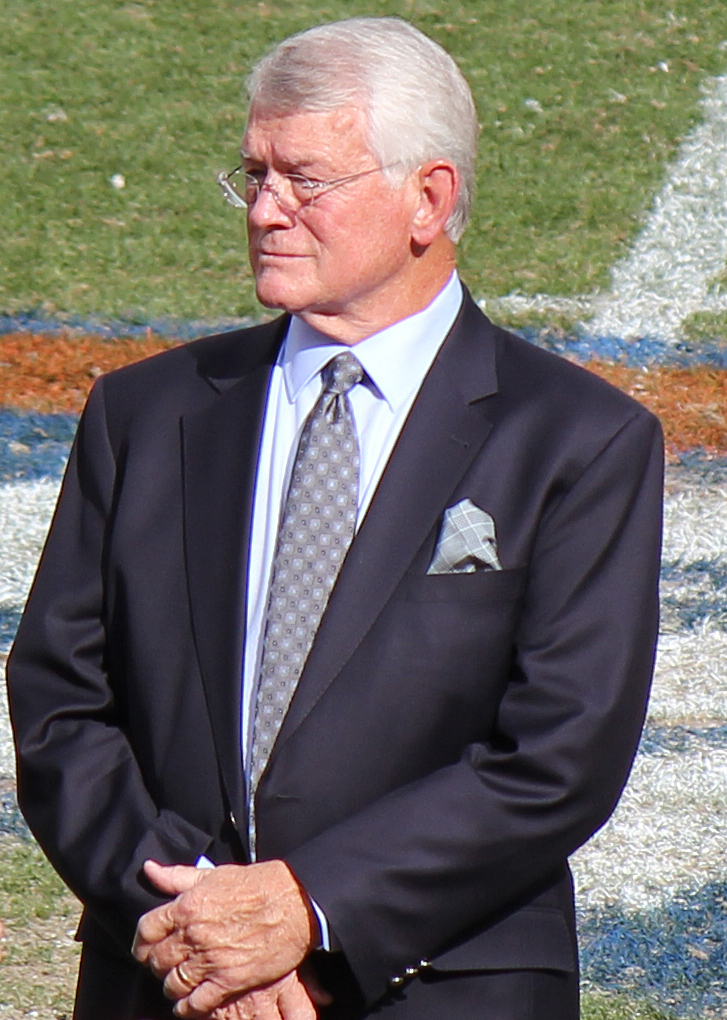
Daniel Edward Reeves (January 19, 1944 – January 1, 2022) was an American professional football running back and coach in the National Football League (NFL). During his 38 years in the NFL, Reeves participated in nine Super Bowls, the third most for an individual. He was a head coach for 23 seasons, a position he held with the Denver Broncos from 1981 to 1992, the New York Giants from 1993 to 1996, and the Atlanta Falcons from 1997 to 2003. As a player, he spent his eight-season career with the Dallas Cowboys, who signed him as an undrafted free agent in 1965.

Key Information

Reeves made his first two Super Bowl appearances during his playing career, winning one in Super Bowl VI. He began his coaching career in 1972 as an assistant for Cowboys, where he made three championship appearances and was part of the staff that won Super Bowl XII. As the head coach of the Broncos for 12 seasons, Reeves led the team to three championship appearances in Super Bowl XXI, Super Bowl XXII, and Super Bowl XXIV, each of which ended in defeat. He spent his next four seasons as the head coach of the Giants, winning NFL Coach of the Year in 1993 after bringing the team to the playoffs that season, although they would not qualify again under him. In his final seven seasons, Reeves was the head coach of the Falcons. His most successful season with the Falcons was in 1998 when he led them to their championship debut in Super Bowl XXXIII, in which he was defeated by his former team, the Broncos. He also won NFL Coach of the Year a second time, making him the ninth coach to win the award multiple times and the first Falcons coach to receive it.[1] For his accomplishments in Denver, Reeves was inducted to the Broncos Ring of Fame in 2014.

One of only 13 NFL head coaches to win 200 career games, Reeves has the most playoff wins (11, tied with Marv Levy) and Super Bowl appearances (four, tied with Levy and Bud Grant) among NFL head coaches to not win a championship. He is also tied with Jeff Fisher and Bill Belichick for the most regular season losses in NFL history at 165. Reeves and Marty Schottenheimer are the only eligible NFL head coaches with 200 career wins who have not been inducted to the Pro Football Hall of Fame.

Early life

[edit]

Born in Rome, Georgia, Reeves grew up in Americus, Georgia. He attended Americus High School, where he participated in football, baseball, and basketball.[2]

After Reeves missed four games with a broken collarbone during his senior season, only the University of South Carolina was interested enough to offer him a football scholarship. The interest from other schools came later, when he won the MVP trophy at the Georgia High School football All-star game, but he decided to stay with his first choice. Reeves also was selected to the All-state basketball team in 1961.[3]

College career

[edit]

Reeves played college football for the South Carolina Gamecocks, where he was a three-year starter at quarterback from 1962 to 1964. Reeves became the starting quarterback during his sophomore year in 1962 and was named second-team All-conference after his junior and senior years.[4][5]

Even though he only compiled an 8–21–4 (.303) record, Reeves ended his college career as the leading passer in Gamecock history, accumulating 2,561 yards passing, to go along with sixteen touchdowns and three games with 100 rushing yards.[6] Reeves also played for the South Carolina Gamecocks baseball team.[7]

In 1977, Reeves was inducted into the school's Athletic Hall of Fame.[8] In 2006, he was inducted into the State of South Carolina Athletic Hall of Fame.[9]

Professional playing career

[edit]

Although he went undrafted after graduation, Reeves received professional sports offers from the Dallas Cowboys in the National Football League (NFL), the San Diego Chargers in the American Football League (AFL) and the Pittsburgh Pirates in Major League Baseball. Reeves signed with the Cowboys as an undrafted free agent in 1965 to play safety, but was later moved to halfback when a series of injuries depleted the team's depth during training camp.[10]

In 1966, Tom Landry, looking for more speed at running back, shifted All-Pro safety Mel Renfro to offense. Renfro was hurt in the opening game, against the New York Giants, and Reeves took advantage of his opportunity by having a breakout season, leading the team in rushing with 757 yards and scoring with 96 points, while finishing second in receiving with 557 yards.[11] His performance helped the Cowboys take some of the running load from fullback Don Perkins and reach their first championship game. Reeves set a franchise record with sixteen touchdowns (eight rushing and eight receiving), had over 1,300 all-purpose yards, was sixth in the NFL in rushing, first in touchdowns, and sixth in scoring.[12] He was also voted to The Sporting News All-Pro team at the end of the year.[13]

In 1967, Reeves posted back-to-back seasons with more than 600 rushing yards, ranking second on the team in rushing with 603 yards and third in receiving with 490 yards. In the week 8 game against the Atlanta Falcons, he set a franchise record after scoring four touchdowns.[14] In the week 13 game against the Philadelphia Eagles, Reeves scored touchdowns rushing, receiving, and passing in the same game.[15] He remained a starter until Week 4 of the 1968 season, when he tore ligaments in his left knee and was lost for the season.[16]

The injury ended up hampering Reeves for the remainder of his career and limiting his abilities. Head coach Tom Landry started playing him in spots and asked him to become a player-coach, while being passed on the depth chart by Calvin Hill and Duane Thomas. Reeves remained in that role for three years, until he retired as an active player to become a full-time assistant coach on February 22, 1972.[17][18]

Reeves played eight seasons with the Dallas Cowboys, collected 1,990 rushing yards, 1,693 receiving yards, and 42 touchdowns.[19] The Cowboys made the playoffs every year, reaching the Super Bowl twice and culminating in a 24–3 victory over the Miami Dolphins in Super Bowl VI following the 1971 season.

He threw a touchdown pass in the Cowboys' losing effort in the legendary subzero Ice Bowl against the Green Bay Packers for the 1967 NFL title.[20] In Super Bowl V with the Cowboys and Colts tied at 13 in the last two minutes, he let a pass go through his hands that was intercepted, setting up the Colts in Dallas territory. The Colts won the game on a 32-yard field goal from Jim O'Brien with five seconds left. In Super Bowl VI he collected 7 rushing yards as his team, Dallas Cowboys, won their first Super Bowl title, defeating Miami Dolphins.

In 2010, Reeves was inducted into the Texas Sports Hall of Fame.[21]

Coaching career

[edit]

Reeves, a protégé of Tom Landry, became the youngest head coach in the NFL when he joined the Denver Broncos in 1981 as vice president and head coach. After acquiring quarterback John Elway in a trade, Reeves guided the Broncos to six post-season appearances, five divisional titles, three AFC championships, and three Super Bowl appearances (Super Bowl XXI, Super Bowl XXII, and Super Bowl XXIV) during his twelve-year tenure. He was the only AFC coach in the decade of the 1980s to lead his team to consecutive Super Bowl berths, and his Broncos appeared in the Super Bowl three times during a span of four years.[22] Reeves and Elway did not always see eye-to-eye, to the point where quarterback Tommy Maddox was drafted by the Broncos in the first round of the 1992 draft. This came off the heels of the 1991 season in which Reeves had fired offensive coordinator and quarterbacks coach Mike Shanahan for "insubordination", as Reeves felt that Shanahan was driving a wedge between him and Elway, who said in 1990 that his relationship with Reeves was "the worst."[23][24] Reeves was fired after the 1992 season[25] and replaced by his protégé and friend Wade Phillips, who was previously the Broncos' defensive coordinator.[26] Upon the death of Reeves in 2022, Elway stated that Reeves was a "winner" and said he owed a good deal of his career to Reeves.[27]

Reeves was hired as head coach by the New York Giants for the 1993 season. In his first season, he led the Giants to an 11–5 record and a berth in the playoffs. Reeves's 1993 season record is the best ever for a first-year Giants coach, and he was named the 1993 Associated Press Coach of the Year after helping them improve from a 6–10 record in 1992.[28] Reeves was fired after the Giants went 5–11 in 1995 and 6–10 in 1996.[29]

In 1997, Reeves was named the head coach of the Atlanta Falcons. Under his command the team, which had finished the 1996 campaign with a 3–13 record, steadily improved. After going 7–9 in his first season in 1997, the Falcons went 14–2 in 1998, going on to capture their first NFC Championship. He became the third coach (after Bill Parcells and Chuck Knox) to lead three different franchises to the playoffs.[23] Reeves coached the Falcons to a 12–2 record before being hospitalized for the final two regular season games to undergo quadruple-bypass heart surgery in December. Reeves managed to return to the sidelines just three weeks later to lead the Falcons to victory against the Minnesota Vikings in the NFC Championship Game. During Super Bowl XXXIII, Reeves's Falcons were pitched against his former team, the defending champion Denver Broncos whose quarterback Elway was in his final season that had Shanahan as head coach. The Falcons lost, 34–19.[30] In the process, Reeves earned the NFL's top coaching awards as he was named the 1998 NFL Coach of the Year.[31] In 2003, after winning just three of the first thirteen games, Reeves was fired and the Falcons replaced him with Wade Phillips as interim coach for three games.[32]

In 2007, Reeves had an active role in the startup of Georgia State University's football program.[33] In January 2009, Reeves interviewed with the San Francisco 49ers for their offensive coordinator job.[34] After negotiations with the Dallas Cowboys, Reeves became a consultant for the team in February 2009. This role was short-lived, lasting two days before Reeves turned in the keys to his office and left. Reeves and the Cowboys could apparently not reach conclusions as to Reeves's role with the team. In the days following, it was revealed that the dispute came down to a contract clause specifying a number of hours per week to be worked, which Reeves deemed insulting.[34]

Head coaching record

[edit]
Team Year Regular season Postseason
Won Lost Ties Win % Finish Won Lost Win % Result
DEN 1981 10 6 0 .625 2nd in AFC West
DEN 1982 2 7 0 .222 5th in AFC West
DEN 1983 9 7 0 .563 2nd in AFC West 0 1 .000 Lost to Seattle Seahawks in AFC wild card game
DEN 1984 13 3 0 .813 1st in AFC West 0 1 .000 Lost to Pittsburgh Steelers in AFC Divisional Game
DEN 1985 11 5 0 .688 2nd in AFC West
DEN 1986 11 5 0 .688 1st in AFC West 2 1 .667 Lost to New York Giants in Super Bowl XXI
DEN 1987 10 4 1 .700 1st in AFC West 2 1 .667 Lost to Washington Redskins in Super Bowl XXII
DEN 1988 8 8 0 .500 2nd in AFC West
DEN 1989 11 5 0 .688 1st in AFC West 2 1 .667 Lost to San Francisco 49ers in Super Bowl XXIV
DEN 1990 5 11 0 .313 5th in AFC West
DEN 1991 12 4 0 .750 1st in AFC West 1 1 .500 Lost to Buffalo Bills in AFC Championship Game
DEN 1992 8 8 0 .500 3rd in AFC West
DEN total 110 73 1 .601 7 6 .538
NYG 1993 11 5 0 .688 2nd in NFC East 1 1 .500 Lost to San Francisco 49ers in NFC Divisional Game
NYG 1994 9 7 0 .563 2nd in NFC East
NYG 1995 5 11 0 .313 4th in NFC East
NYG 1996 6 10 0 .375 5th in NFC East
NYG total 31 33 0 .484 1 1 .500
ATL 1997 7 9 0 .438 2nd in NFC West
ATL 1998 14 2 0 .875 1st in NFC West 2 1 .667 Lost to Denver Broncos in Super Bowl XXXIII
ATL 1999 5 11 0 .313 3rd in NFC West
ATL 2000 4 12 0 .250 5th in NFC West
ATL 2001 7 9 0 .438 3rd in NFC West
ATL 2002 9 6 1 .594 2nd in NFC South 1 1 .500 Lost to Philadelphia Eagles in NFC Divisional Game
ATL 2003 3 10 0 .231 Fired mid-season
ATL total 49 59 1 .454 3 2 .600
Total[35] 190 165 2 .535 11 9 .550

Broadcast career

[edit]

Reeves covered NFL games as a color analyst (teamed with play-by-play man Bill Rosinski) for the second Sunday afternoon game on the Westwood One radio network.[36][37]

Personal life and death

[edit]

Reeves was married to Pam Reeves, and had three children and six grandchildren.[38] Reeves and his future wife dated in high school, where she was a cheerleader.[2] While coaching for the Giants, Reeves and his wife were residents of Ho-Ho-Kus, New Jersey.[39] He was a Christian.[40]

Reeves' nephew is David Andrews, who played for the New England Patriots.[41][42] His son-in-law, Joe DeCamillis, is a longtime NFL assistant.[43]

Reeves died from complications of dementia at his home in Atlanta on the morning of January 1, 2022, aged 77, about three weeks before his 78th birthday.[7]

See also

[edit]

Books

[edit]
  • Reeves, Dan; Dick Connor (1988). Reeves: An Autobiography. Chicago: Bonus Books. ISBN 978-0-933893-64-1. OCLC 19519630.

Notes

[edit]

References

[edit]
[edit]
Revisions and contributorsEdit on WikipediaRead on Wikipedia
from Grokipedia
Dan Reeves (January 19, 1944 – January 1, 2022) was an American football player and coach whose 38-year career in the National Football League (NFL) made him one of the most accomplished figures in the sport's history. Born in Rome, Georgia, and raised in Americus, he played college football at the University of South Carolina before signing as an undrafted free agent with the Dallas Cowboys in 1965. As a running back, Reeves appeared in 100 games over eight seasons, rushing for 1,990 yards and 25 touchdowns while adding 1,693 receiving yards and 17 more scores, helping the Cowboys reach their first two Super Bowls. He transitioned to coaching in 1970 as a player-coach and became a full-time assistant under Tom Landry from 1973 to 1980, contributing to Super Bowl appearances in X, XII, and XIII, including victories in the latter two. Reeves' head coaching tenure began in 1981 when, at age 37, he became the youngest in NFL history with the , a position he held for 12 seasons. Under his leadership, the Broncos achieved a 110–73–1 regular-season record, made the playoffs six times, and advanced to three Super Bowls (XXI, XXII, and XXIV), though they lost each. He earned NFL Coach of the Year honors from the in 1984 after guiding Denver to a 13–3 record and an AFC Championship appearance. Reeves later coached the from 1993 to 1996, posting a 31–33 record and reaching the playoffs in his first two seasons, and then the from 1997 to 2003, where he compiled a 49–59–1 record, secured two playoff berths, and led the team to in 1998. Across his 23 seasons as a with three franchises, Reeves amassed 190 regular-season wins, 11 postseason victories, and a total of 201 career wins, placing him among only 13 coaches in history to reach that threshold. His involvement in nine Super Bowls—as a player in two, assistant in three, and in four—remains the highest total for any individual in league history. Reeves, who battled health issues including in his later years, was posthumously inducted into the Ring of Fame in 2014 and named a semifinalist for the in 2024 and 2026.

Early Life and Education

Childhood and High School

Daniel Edward Reeves was born on January 19, 1944, in , to parents Ann and Ed Reeves. As an infant, the family relocated to , where Reeves spent his formative years in a small-town environment that emphasized and athletics. Growing up in Americus, he developed an early passion for sports, participating in local activities that laid the foundation for his future career. Reeves attended Americus High School, where he emerged as a standout multi-sport excelling in football, , and . In football, he played and demonstrated exceptional leadership, helping guide the team to a state championship during his senior year under coach Jimmy Hightower. His performance earned him recognition as the of the Georgia High School , highlighting his skill and potential despite initial scouting doubts about his versatility. That same year, Reeves contributed to state titles in and , solidifying his reputation as a versatile talent in Georgia high school sports. These high school accomplishments paved the way for Reeves' transition to at the , where he continued as a .

College Career

Dan Reeves enrolled at the in 1961 and began his collegiate football career with the Gamecocks the following year. As a three-year starter at from 1962 to 1964 under head coach Marvin Bass, Reeves showcased his dual-threat capabilities, leading the team in both passing and rushing. Over his college tenure, he completed 211 of 441 passes for 2,561 yards and 16 touchdowns, while rushing for 815 yards on 359 carries. Notable performances included a 124-yard rushing effort against North Carolina State in 1962, which ranked among the top single-game totals in Gamecock history at the time, and his senior year in 1964 when he threw for 974 passing yards. During Reeves' starting years, the Gamecocks competed in the Atlantic Coast Conference (ACC), posting records of 4–5–1 in 1962 (3–4 in conference), 1–8–1 in 1963 (1–5–1 in conference), and 3–5–2 in 1964 (2–3–1 in conference), for an overall mark of 8–18–4. Despite the team's struggles, Reeves earned second-team All-ACC honors in both 1962 and 1964 for his leadership and productivity as a signal-caller. Reeves' versatility as a mobile drew attention from scouts, who noted his speed and toughness despite questions about his arm strength and the Gamecocks' poor win-loss record. Entering the 1965 and AFL drafts, he was projected as a mid-round prospect at best but ultimately went undrafted, leading him to sign with the as a and transition to in the professional ranks.

Professional Playing Career

Dallas Cowboys

Dan Reeves joined the Dallas Cowboys as an undrafted in 1965, initially signed to play safety before transitioning to halfback and return specialist amid injuries to the team's corps. As a , he contributed on special teams, including a 97-yard kickoff return on a reverse handoff, the fourth longest in franchise history at the time. Under , Reeves quickly became a versatile offensive contributor, helping the Cowboys establish themselves as contenders in the East Division. Over his eight seasons with from 1965 to 1972, Reeves amassed 1,990 rushing yards on 535 carries with 25 rushing touchdowns, 1,693 receiving yards on 129 catches with 17 receiving touchdowns, and a total of 42 touchdowns in 100 games. His most notable season came in , when he rushed for 757 yards, caught 34 passes for 329 yards, and scored 16 touchdowns—tying for the lead and marking two seasons in his career with over 1,000 combined rushing and receiving yards. These efforts supported ' consistent playoff appearances, including Eastern Conference championships in 1966 and 1967. Reeves played a key role in the Cowboys' first Super Bowl victory in Super Bowl VI following the 1971 season, a 24-3 win over the Miami Dolphins, where he recorded one carry for 7 yards as part of the playoff run. His regular-season and postseason contributions under Landry's innovative offense, which emphasized ball control and versatility, were instrumental in the team's 11-3 record that year. Later in his tenure, a severe injury in Week 4 of the 1968 season sidelined Reeves for the year and limited his role thereafter, leading to a transition into backup and special teams duties while he began assisting as a starting in 1970. Despite the 's impact on his speed and starting status, Reeves remained a valuable amid the Cowboys' dynasty-building dynamics, appearing in 13 games in 1972 before retiring as a player.

Coaching Career

Assistant Coaching Roles

Reeves began his coaching career in 1970 as a with the , initially serving as the special teams coach while continuing to play . His prior experience as a key contributor on the Cowboys' offense during the late provided a natural foundation for this transition into coaching. By 1972, following his retirement from playing, he became a full-time assistant coach under head coach Tom Landry. After a brief hiatus in 1973 to pursue private business interests, Reeves returned to the Cowboys in 1974 as the backfield coach. From 1975 to 1976, Reeves served as the offensive backfield coach, contributing to the development of the team's running game during a period of consistent playoff contention. He advanced to from 1977 to 1980, where he played a pivotal role in designing balanced offensive schemes that emphasized a strong rushing attack integrated with play-action passing. Under his coordination, the Cowboys' offense ranked among the league's elite, averaging 24.6 points per game in 1977 and supporting a run-heavy approach that maximized the talents of running backs like , whom Reeves directly coached after his 1977 draft selection. Dorsett credited Reeves' guidance for helping him adapt to the , leading to a rookie season with over 1,000 rushing yards and multiple appearances. Reeves' work as an assistant was instrumental in two Super Bowl appearances during the 1970s. As offensive backfield coach for the 1975 season, he helped orchestrate the Cowboys' run to , though they fell short against the . In his first year as , following the 1977 season, Reeves' strategies powered the team's victory in over the , with the offense executing efficiently in a 27-10 win that highlighted Landry's innovative multiple offense. Throughout his tenure, Reeves benefited from mentorship under Landry, absorbing lessons in offensive creativity, such as the use of the and flexible personnel groupings, which influenced his later head coaching philosophies. Reeves' decade-long apprenticeship under Landry solidified his reputation as a rising offensive mind, fostering his understanding of player development and game planning that emphasized discipline and versatility. His impact extended to nurturing young talent, including Dorsett, whose explosive running style became a cornerstone of the Cowboys' success, culminating in a 1977 NFL rushing title. These assistant roles laid the groundwork for Reeves' eventual move to head coaching, having contributed to two victories overall with Dallas—as a player in and as an assistant in —while learning the intricacies of building a championship-caliber unit.

Head Coach: Denver Broncos

Dan Reeves was hired by the Denver Broncos in 1981 as both head coach and vice president, becoming the youngest head coach in the at age 37. Drawing from his experience as an assistant under with the , Reeves brought a disciplined, run-oriented philosophy to a franchise seeking stability after a 2-9 finish the previous year. Over his 12-season tenure from 1981 to 1992, he compiled a regular-season record of 110-73-1, achieving a of .601 and leading the Broncos to eight playoff appearances. Reeves' offensive strategies emphasized a balanced attack, highlighted by innovations such as the —a trio of speedy wide receivers consisting of , , and Ricky Nattiel—who combined for over 1,000 receptions during the late 1980s, stretching defenses and complementing quarterback John Elway's arm strength. Acquired by Reeves in a landmark 1983 trade with the , Elway developed into a franchise cornerstone under his guidance, passing for more than 47,000 yards and earning multiple selections while the Broncos won five titles. Reeves also fostered a strong running game, integrating veterans like Sammy Winder and later to control the clock and support Elway's deep throws. The pinnacle of Reeves' success came in the mid-to-late , with back-to-back AFC Championships in 1986 and 1987, followed by another in 1989, propelling the Broncos to three appearances (XXI, XXII, and XXIV), though they lost each by significant margins to the , Washington Redskins, and , respectively. These deep playoff runs, including seven postseason victories overall, transformed from a middling team into perennial AFC contenders, with the franchise posting a .601 during his era. However, tensions escalated toward the end, culminating in Reeves' firing after an 8-8 finish in 1992 amid philosophical differences with owner over personnel and strategy.

Head Coach: Atlanta Falcons

Dan Reeves was hired by the Atlanta Falcons on January 20, 1997, as head coach and executive vice president of football operations, shortly after his dismissal as head coach with the . His prior success leading the to multiple appearances positioned him as a proven leader to revitalize a Falcons team that had posted a 3-13 record in 1996. Over seven seasons from 1997 to 2003, Reeves compiled a regular-season record of 49-59-1, yielding a .454 winning percentage. Reeves' tenure peaked in 1998, when the Falcons achieved a franchise-best 14-2 regular-season record, secured the NFC West title, and advanced through the playoffs with upset victories over the San Francisco 49ers and Minnesota Vikings to claim the NFC Championship. This run culminated in the Falcons' first Super Bowl appearance in Super Bowl XXXIII, a 34-19 loss to the Denver Broncos, marking Reeves' ninth and final Super Bowl as a head coach. Central to this "Dirty Birds" success was the development of running back Jamal Anderson, who rushed for 1,846 yards and 14 touchdowns that season, earning Pro Bowl honors and embodying the team's gritty offensive identity under Reeves' run-heavy scheme. Reeves also nurtured emerging talents like running back Warrick Dunn, acquired via trade in 2002, who quickly became a versatile contributor with over 1,000 all-purpose yards in his debut season, helping stabilize the backfield amid transitions. The Falcons experienced steady improvement in Reeves' first three years, reaching the playoffs in 1998 and 2002 with a 9-6-1 mark, but subsequent seasons were hampered by key injuries, including Anderson's devastating knee injury in 2001 that sidelined him for two years and disrupted the rushing attack. Ownership transitioned in February 2002 when Arthur M. Blank purchased the franchise from Taylor Smith, prompting shifts in personnel strategy while Reeves retained significant influence. From 2002 to 2004, Reeves assumed a dual role as de facto general manager alongside head coach, overseeing drafts and free agency, including the selection of quarterback in 2001, though the team struggled to integrate high-profile talents consistently. Late in his tenure, Reeves emphasized defensive enhancements, hiring coordinator in 2003 to bolster a unit that ranked among the league's top performers in sacks and turnovers during the 2002 playoff push. However, the 2003 season unraveled with a 3-10 start marred by offensive inconsistencies and further injuries, leading to Reeves' abrupt departure on December 10, 2003—effectively a mutual release after he declined to coach the final three games—with Phillips serving as interim and the team finishing 5-11 overall.

Post-Coaching Career

Broadcast Work

Following his dismissal from the after the 2003 season, Dan Reeves entered broadcasting as a color analyst for games on the radio network, a role he held starting in 2004. Partnered with play-by-play announcer Bill Rosinski, Reeves provided commentary for select Sunday afternoon doubleheader matchups, drawing on his extensive coaching background to offer detailed insights into game strategy and player decisions. Reeves' analysis style emphasized practical perspectives, breaking down offensive schemes and defensive adjustments in a manner informed by his experience leading teams to four Super Bowls. His broadcasts included notable national coverage of regular-season games and playoff contests, contributing to Westwood One's partnership with Sports for broader radio distribution through at least 2012. In later years, Reeves transitioned to occasional guest appearances on networks including , where he shared expertise on pre-game shows and strategy discussions. He eventually stepped away from regular broadcasting in his later years amid health challenges, leaving a legacy of enhancing NFL radio coverage with authoritative, insider breakdowns of the game's tactical elements.

Executive Positions

Reeves' formal executive role with the Falcons concluded in late 2003 when he was relieved of his duties as head coach and personnel overseer after a 3-10 start to the season, amid broader team transitions under Blank's new ownership. Post-departure, Reeves transitioned to advisory positions with other NFL teams, serving as a special consultant for the Houston Texans in 2005 to evaluate talent and provide strategic input during their rebuilding phase. In February 2009, Reeves briefly served as a consultant for the Dallas Cowboys, starting the role but departing after two days due to disagreements over contract terms. Beginning in 2007, Reeves served as a consultant for Georgia State University, assisting in the development and launch of their football program, which began competing in 2010. These roles underscored Reeves' enduring influence in NFL front offices beyond his coaching career.

Personal Life and Legacy

Family and Personal Interests

Dan Reeves married his high school sweetheart, Pam White, in 1964 after they were set up on a date during his time at Americus High School in Georgia. The couple remained together for 57 years until Reeves' death, raising three children: daughters Dana and Laura, and son Lee. They also had six grandchildren. Reeves' family life often intersected with his football career, as frequent team relocations—from Dallas to Denver to New York and back to Atlanta—required the family to adapt to multiple moves across the country. The Reeves family maintained strong ties to professional football beyond Dan's own involvement; Dana's husband, Joe DeCamillis, served as an special teams coordinator for several teams, including the and . After retiring from coaching, the family settled in the area, where Reeves and Pam enjoyed a quieter life surrounded by their children and grandchildren. Son Lee pursued a career as a lawyer in , while daughters Dana and Laura built their own families amid the transient world of life. Outside of football, Reeves pursued personal interests that provided balance to his demanding career, including , , and , activities he often shared with family and friends. He was also actively involved in , supporting youth sports initiatives, such as contributing to the early development of Georgia State University's football program to provide opportunities for young athletes. Reeves' Christian played a central role in his , guiding his values of perseverance and , which he often shared in public talks. He and Pam were regular participants in church activities in , including studies and community events, reflecting their commitment to faith-based service.

Health Issues and Death

In his later years, Dan Reeves battled , which ultimately led to his death. He passed away peacefully on January 1, 2022, at the age of 77, at his home in , Georgia, surrounded by his loving family. The cause was listed as complications from . A statement from Reeves' family, released through former media relations director Aaron Salkin, read: "Legendary player and coach Dan Reeves passed away early this morning, peacefully and surrounded by his loving family at his home in from complications of . Dan will be remembered first and foremost for his character and integrity. He was a person of great faith, a devoted husband, father, and grandfather, and a beloved member of the community." Reeves was survived by his wife of over 50 years, Pam, and their three children: Dana, , and Laura, along with several grandchildren and great-grandchildren. A celebration of life ceremony was held in Reeves' honor on January 14, 2022, at Peachtree Road United Methodist Church in , attended by family, friends, former players, and colleagues who paid tribute to his enduring legacy.

Awards, Honors, and Impact

Dan Reeves received numerous accolades throughout his career, reflecting his success as both a player and coach. He earned two championships with the as a in 1972 and as offensive coordinator in 1978—contributing to the team's early dominance under . As a , Reeves led the to in 1999, marking the franchise's first appearance in the championship game, though they fell to the . His coaching excellence was recognized with multiple Coach of the Year honors, including the award in 1984 for guiding the Broncos to a 13-3 record and an AFC Championship, as well as in 1993 with the and 1998 with the Falcons after a franchise-best 14-2 season. Reeves' contributions extended to team-specific honors that cemented his legacy with key franchises. In 2014, he became the first head coach inducted into the Denver Broncos Ring of Fame, acknowledging his 12-year tenure that produced five AFC West titles and three Super Bowl appearances from 1981 to 1992. Although not formally inducted into the Atlanta Falcons Ring of Honor, Reeves' impact on the team was honored through tributes following his 1998 success, including recognition in franchise retrospectives for transforming the Falcons into contenders. His overall coaching record of 201-174-2 ranks among the most successful in NFL history, with nine Super Bowl appearances across roles—the third-most ever at the time of his retirement. Reeves' influence on the game is particularly evident in his development of elite quarterbacks and innovative offensive approaches. He played a pivotal role in John Elway's rise from struggling rookie to Hall of Fame quarterback, implementing a balanced offense during their decade together in that emphasized Elway's arm strength while protecting him with a strong running game—resulting in five division titles and Elway's first selections. Reeves' philosophy, rooted in his background, prioritized physical, run-heavy schemes to control the clock and wear down defenses, influencing subsequent coaches who blended power running with play-action passing. Elway later credited Reeves as "instrumental in my career," highlighting their partnership's role in establishing the Broncos' dynasty. Posthumously, following his death in 2022, Reeves continued to receive recognition for his enduring impact on coaching pipelines. He was named a finalist for the in 2020 and 2023, and advanced as a semifinalist for the Class of 2025 and 2026. Stadium tributes, such as moments of silence at Broncos and games in 2022, honored his role in elevating underdog franchises, while his strategies informed modern offensive coordinators focused on quarterback longevity and balanced attacks. Reeves' work also inspired youth football initiatives.

References

Add your contribution
Related Hubs
User Avatar
No comments yet.