Hubbry Logo
Ciliary muscleCiliary muscleMain
Open search
Ciliary muscle
Community hub
Ciliary muscle
logo
8 pages, 0 posts
0 subscribers
Be the first to start a discussion here.
Ciliary muscle
Ciliary muscle
from Wikipedia
Ciliary muscle
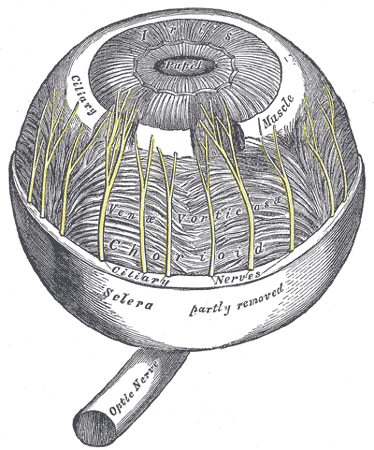
The choroid and iris. (Ciliary muscle is labeled near top.)
Details
PronunciationUK: /ˈsɪliəri/, US: /ˈsɪliɛri/[2]
Origin1) longitudinal fibers → scleral spur; 2) circular fibers → encircle root of iris[1]
Insertion1) longitudinal fibers → ciliary process, 2) circular fibers → encircle root of iris[1]
ArteryLong posterior ciliary arteries
VeinVorticose veins
NerveShort ciliary
Parasympathetic fibers in the oculomotor nerve (CN-III) synapse in the ciliary ganglion. Parasympathetic postganglionic fibers from the ciliary ganglion travel through short ciliary nerves into the ocular globe.
Actions1) Accommodation, 2) regulation of trabecular meshwork pore sizes
Identifiers
Latinmusculus ciliaris
TA98A15.2.03.014
TA26770
FMA49151
Anatomical terms of muscle

The ciliary muscle is an intrinsic muscle of the eye formed as a ring of smooth muscle[3][4] in the eye's middle layer, the uvea (vascular layer). It controls accommodation for viewing objects at varying distances and regulates the flow of aqueous humor into Schlemm's canal. It also changes the shape of the lens within the eye but not the size of the pupil[5] which is carried out by the sphincter pupillae muscle and dilator pupillae.

The ciliary muscle, pupillary sphincter muscle and pupillary dilator muscle sometimes are called intrinsic ocular muscles[6] or intraocular muscles.[7]

Structure

[edit]

Development

[edit]

The ciliary muscle develops from mesenchyme within the choroid and is considered a cranial neural crest derivative.[8]

Nerve supply

[edit]
Ciliary ganglion with parasympathetic fibers of ciliary nerves.

The ciliary muscle receives parasympathetic fibers from the short ciliary nerves that arise from the ciliary ganglion. The parasympathetic postganglionic fibers are part of cranial nerve V1 (Nasociliary nerve of the trigeminal), while presynaptic parasympathetic fibers to the ciliary ganglia travel with the oculomotor nerve.[9] The postganglionic parasympathetic innervation arises from the ciliary ganglion.[10]

Presynaptic parasympathetic signals that originate in the Edinger-Westphal nucleus are carried by cranial nerve III (the oculomotor nerve) and travel through the ciliary ganglion via the postganglionic parasympathetic fibers which travel in the short ciliary nerves and supply the ciliary body and iris. Parasympathetic activation of the M3 muscarinic receptors causes ciliary muscle contraction. The effect of contraction is to decrease the diameter of the ring of ciliary muscle causing relaxation of the zonule fibers, the lens becomes more spherical, increasing its power to refract light for near vision.[citation needed]

The parasympathetic tone is dominant when a higher degree of accommodation of the lens is required, such as reading a book.[11]

Function

[edit]

Accommodation

[edit]

The ciliary fibers have circular (Ivanoff),[12] longitudinal (meridional) and radial orientations.[13]

According to Hermann von Helmholtz's theory, the circular ciliary muscle fibers affect zonular fibers in the eye (fibers that suspend the lens in position during accommodation), enabling changes in lens shape for light focusing. When the ciliary muscle contracts, it pulls itself forward and moves the frontal region toward the axis of the eye. This releases the tension on the lens caused by the zonular fibers (fibers that hold or flatten the lens). This release of tension of the zonular fibers causes the lens to become more spherical, adapting to short range focus. Conversely, relaxation of the ciliary muscle causes the zonular fibers to become taut, flattening the lens, increasing the focal distance,[14] increasing long range focus. Although Helmholtz's theory has been widely accepted since 1855, its mechanism still remains controversial. Alternative theories of accommodation have been proposed by others, including L. Johnson, M. Tscherning, and especially Ronald A. Schachar.[3]

Trabecular meshwork pore size

[edit]

Contraction and relaxation of the longitudinal fibers, which insert into the trabecular meshwork in the anterior chamber of the eye, cause an increase and decrease in the meshwork pore size, respectively, facilitating and impeding aqueous humour flow into the canal of Schlemm.[15]

Clinical significance

[edit]

Glaucoma

[edit]

Open-angle glaucoma (OAG) and closed-angle glaucoma (CAG) may be treated by muscarinic receptor agonists (e.g., pilocarpine), which cause rapid miosis and contraction of the ciliary muscles, opening the trabecular meshwork, facilitating drainage of the aqueous humour into the canal of Schlemm and ultimately decreasing intraocular pressure.[16]

History

[edit]

Etymology

[edit]

The word ciliary had its origins around 1685–1695.[17] The term cilia originated a few years later in 1705–1715, and is the Neo-Latin plural of cilium meaning eyelash. In Latin, cilia means upper eyelid and is perhaps a back formation from supercilium, meaning eyebrow. The suffix -ary originally occurred in loanwords from Middle English (-arie), Old French (-er, -eer, -ier, -aire, -er), and Latin (-ārius); it can generally mean "pertaining to, connected with", "contributing to", and "for the purpose of".[18] Taken together, cili(a)-ary pertains to various anatomical structures in and around the eye, namely the ciliary body and annular suspension of the lens of the eye.[19]

Additional images

[edit]

See also

[edit]

References

[edit]
[edit]
Revisions and contributorsEdit on WikipediaRead on Wikipedia
from Grokipedia
The ciliary muscle is a ring-shaped structure composed of fibers located within the of the eye, posterior to the iris and anterior to the , playing a crucial role in visual accommodation by altering the shape of the crystalline lens to focus on objects at varying distances. It forms part of the anterior and extends from the ora serrata posteriorly to the corneoscleral junction anteriorly, enabling the eye to adjust its refractive power for near and far vision. This muscle is essential for the process of accommodation, where its contraction relaxes the zonular fibers attached to the lens, allowing the lens to become more spherical and increase its curvature for near focus, while relaxation during distant vision tenses the zonules to flatten the lens. Structurally, the ciliary muscle consists of three distinct fiber types: longitudinal (meridional) fibers, which are the largest portion and insert into the scleral spur to facilitate aqueous humor outflow; radial (oblique) fibers, forming a transitional layer; and circular (equatorial) fibers, arranged in a sphincter-like manner around the lens equator to primarily drive lens accommodation. These fibers originate embryonically from neural crest cells and mesodermal mesenchyme. The muscle receives its blood supply from the anterior and long posterior ciliary arteries, branches of the ophthalmic artery, ensuring nutrient delivery to this vascularized region. In addition to accommodation, the ciliary muscle regulates intraocular pressure by influencing the outflow of aqueous humor through the trabecular meshwork, as contraction of its longitudinal fibers opens the pores in the meshwork to enhance drainage. Innervation is predominantly parasympathetic via the oculomotor nerve (cranial nerve III) through short ciliary nerves from the ciliary ganglion, acting on muscarinic M3 receptors to stimulate contraction, with minor sympathetic input from the superior cervical ganglion that may modulate tone. Clinically, dysfunction of the ciliary muscle contributes to presbyopia, the age-related loss of near vision due to reduced accommodative ability, and it serves as a target for glaucoma therapies, such as miotic agents like pilocarpine, which induce contraction to improve humor outflow.

Anatomy

Location and gross morphology

The ciliary muscle is located in the anterior segment of the eye, forming part of the , which lies posterior to the iris and extends from the ora serrata posteriorly to just behind the corneoscleral junction anteriorly. It occupies the space between the externally and the ciliary processes internally, encircling the of the crystalline lens. In gross morphology, the ciliary muscle appears as a circumferential ring of fibers arranged in a triangular configuration when viewed in meridional section, with its base oriented toward the and apex pointing inward toward the lens. This triangle comprises three distinct fiber orientations: meridional (longitudinal) fibers running parallel to the scleral surface, radial (oblique) fibers extending between the meridional and circular layers, and circular (Müller) fibers forming a sphincter-like band closest to the lens. These fibers collectively form a continuous muscular structure that surrounds the lens equator, facilitating its suspension and movement. The muscle attaches anteriorly via its meridional fibers to the scleral spur and , while posteriorly it blends seamlessly into the and supracoroidal lamina. In adults, the ciliary muscle measures approximately 4.5 to 6.3 mm in length along its meridional extent, with nasal portions slightly shorter (4.5-5.2 mm) than temporal ones (5.6-6.3 mm), and exhibits a thickness of about 1-2 mm in the relaxed state, which can increase by up to 30% during accommodation. It maintains close proximity to adjacent structures, including the ciliary processes that project inward for aqueous humor production and the zonular fibers that extend from the processes to suspend the lens capsule, allowing the muscle's contraction to modulate zonular tension.

and cellular composition

The ciliary muscle is composed of tissue characterized by the absence of striations, distinguishing it from skeletal and types. Its contractile apparatus relies on and filaments, which interact to generate force through a sliding filament mechanism typical of contraction. Histologically, the muscle consists of three distinct bundles of fibers arranged in meridional (longitudinal), radial (oblique), and circular orientations, embedded within a stroma. Meridional fibers, the outermost and most numerous, run longitudinally parallel to the and insert into the scleral spur and ; their contraction contributes to zonular relaxation by pulling the forward. Radial fibers occupy an intermediate position, extending obliquely between the meridional and circular layers to provide transitional support during contraction. Circular fibers form the innermost sphincter-like ring around the lens equator, contracting to draw the forward and inward. The surrounding these fibers is rich in and , which confer elasticity and structural integrity to accommodate the muscle's dynamic contractions. networks help maintain recoil properties, while types I, III, IV, and VI, along with and , form basement membranes and supportive lattices around individual muscle cells and bundles. In terms of thickness, the ciliary muscle exhibits regional variations, with the apical region generally thinner compared to the thicker posterior portion, reflecting adaptations to its functional gradients. In individuals with high myopia, studies have shown a specific thickening of the posterior ciliary muscle, potentially linked to altered biomechanical demands.

Embryological development

The ciliary muscle originates from neural crest-derived mesenchymal cells that migrate into the region surrounding the optic cup during weeks 5-6 of , contributing to the anterior segment structures alongside the developing and . These mesenchymal precursors condense between the distal portion of the optic cup and the emerging , forming the initial stromal framework for the . By the end of week 7, the ciliary muscle anlage emerges as a distinct condensation in this , coinciding with the formation of the ciliary fold from the anterior optic cup rim. Differentiation into fibers begins around week 12, with the first muscle-like cells appearing from mesenchymal fibroblasts located between the anterior scleral condensation and the ciliary ; by weeks 15-16, these cells exhibit adult-like morphology, including organized myofibrils. Full innervation, primarily parasympathetic via the , is established by birth, enabling early accommodative function. Postnatally, the ciliary muscle undergoes growth and remodeling, reaching substantial length shortly after birth (approximately 3 mm nasally and temporally), with continued elongation and fiber maturation through . The circular (annular) portion, known as Müller's muscle, remains incomplete at birth and develops further in the early years, supporting progressive improvements in through enhanced lens accommodation. Congenital anomalies affecting the ciliary muscle are rare but can occur in conditions like , a caused by mutations, where of the leads to underdeveloped or absent muscle tissue, impairing aqueous humor regulation and accommodation from birth.

Physiology

Role in accommodation

The ciliary muscle plays a central role in ocular accommodation, the process by which the eye adjusts its focus for near vision. According to the Helmholtz theory, contraction of the ciliary muscle, primarily driven by parasympathetic innervation, causes the muscle to move anteriorly and inward, thereby relaxing the tension on the zonular fibers attached to the lens equator. This relaxation allows the elastic lens capsule to mold the lens into a more spherical shape, increasing its anterior and posterior curvature and thus its refractive power for focusing on near objects. During contraction, the ciliary muscle undergoes measurable morphologic changes, including a shortening of its anterior-posterior length, which can be quantified using imaging techniques such as anterior segment (AS-OCT) or biomicroscopy (UBM). Studies have reported reductions in overall ciliary muscle length of approximately 0.2 to 0.3 mm temporally and 0.1 to 0.2 mm nasally during maximal accommodation in young adults, reflecting the muscle's contractile dynamics that facilitate zonular release. The is triggered by visual stimuli indicating a near target, with afferent signals from the traveling via the to the Edinger-Westphal nucleus in the , which then sends parasympathetic efferents through the to the and subsequently to the ciliary muscle. In young adults, this pathway enables an accommodative amplitude of 10-15 diopters, allowing clear focus from infinity to about 6-10 cm. Recent investigations, including 2024 reviews of imaging data, indicate that the ciliary muscle retains partial contractile function into later decades, with evidence from MRI and UBM showing persistent movement despite the typical onset of around age 40, suggesting that age-related lens stiffening rather than complete muscle failure is the primary limiter. As of 2025, advancements include non-invasive measurement of ciliary muscle biopotentials during accommodation, confirming active electrical responses, and improved quantification of anterior-centripetal movement using trans-scleral OCT, enhancing understanding of dynamic contractile patterns.

Regulation of aqueous humor outflow

The ciliary muscle plays a crucial role in regulating the outflow of aqueous humor through the conventional pathway, primarily via contraction that modulates the (TM) and to maintain (IOP). Contraction of the muscle pulls on the scleral spur, a key attachment point, which spreads the TM sheets and dilates , thereby opening intertrabecular spaces and reducing resistance to aqueous flow. This mechanism enhances drainage through the TM, which accounts for approximately 75% of total aqueous humor outflow under normal conditions. The meridional (longitudinal) fibers of the ciliary muscle are primarily responsible for this effect, as their contraction tugs on ligamentous insertions within the corneoscleral and juxtacanalicular regions of the TM, widening intercellular spaces and increasing permeability. This anatomical arrangement allows the muscle to directly influence the conventional outflow pathway, distinct from its effects on the uveoscleral route. In response to parasympathetic stimulation, such as with , contraction can significantly boost outflow facility, with studies in showing increases of up to 100% in TM permeability. Physiologically, this regulation ensures a balance between aqueous humor production by the epithelium, at a rate of 2-3 μL/min (varying diurnally from ~3.0 μL/min in the morning to ~1.5 μL/min at night), and outflow, maintaining IOP within the normal range of 10-21 mmHg. Outflow matches production to prevent pressure fluctuations, with TM-mediated drainage providing the primary adjustable component. Recent research using ultrasound biomicroscopy has demonstrated dynamic changes in ciliary body structures during contraction, correlating with IOP regulation in veterinary models such as dogs, where anterior-posterior ciliary muscle dimensions influence outflow pathways and suggest similar mechanisms applicable to eyes despite anatomical differences. These studies highlight real-time alterations in outflow-related spaces, supporting the muscle's role in fine-tuning drainage.

Innervation and vascular supply

Neural control

The ciliary muscle receives dominant parasympathetic innervation, which regulates its contraction essential for ocular accommodation. Preganglionic parasympathetic fibers originate from the Edinger-Westphal nucleus in the and course along the (cranial nerve III) to synapse in the located within the . Postganglionic fibers then travel via the to the ciliary muscle, where they release that binds to muscarinic M3 receptors, triggering smooth muscle contraction. This pathway ensures precise control over lens shape adjustment during focusing on near objects. Sympathetic innervation plays a minor modulatory role in ciliary muscle function, primarily promoting relaxation. These fibers arise from the , travel through the and , and reach the muscle via long and without synapsing in the . The norepinephrine acts on β2-adrenergic receptors to inhibit contraction, providing fine-tuning to parasympathetic dominance rather than direct opposition. Neural control of the ciliary muscle is integrated through reflex arcs originating in the , coordinating responses to visual stimuli. The near , or accommodation-convergence , involves afferent signals from the to the and efferent output from the Edinger-Westphal nucleus via the , leading to ciliary muscle contraction, pupillary , and eye convergence for near vision. The , mediated by the more dorsal pretectal nucleus in the , indirectly influences the ciliary muscle through shared parasympathetic pathways, causing in response to increased light intensity. These arcs ensure synchronized autonomic responses without voluntary cortical input. Pharmacological agents target these neural pathways to modulate ciliary muscle activity. Miotics such as act as muscarinic agonists, enhancing parasympathetic stimulation to contract the muscle and facilitate aqueous humor outflow in treatment. Conversely, cycloplegics like atropine are muscarinic antagonists that block binding, paralyzing the muscle to induce relaxation and , commonly used in assessments or to manage .

Blood supply

The ciliary muscle receives its arterial blood supply primarily from the , which arise as branches from the muscular arteries of the four rectus and travel along these muscles before piercing the near the limbus to anastomose with the , forming the major arterial circle of the iris. The , typically two in number, originate directly from the and penetrate the posteriorly near the , extending anteriorly to supply the ciliary muscle and body as well as the . These vessels ensure a rich arterial network that supports the muscle's role in dynamic processes like accommodation. Venous drainage of the ciliary muscle occurs through the ciliary veins, which collect blood from the muscle and ciliary processes and connect with the choroidal veins or the veins of the , ultimately emptying into the vortex (vorticose) veins that drain posteriorly into the superior and inferior ophthalmic veins. This posterior-directed venous system facilitates efficient removal of metabolic byproducts from the highly active muscle tissue. The within the ciliary muscle features a dense bed embedded in the muscle substance, characterized by endothelial cells with blood-tissue barrier properties, including few pinocytotic vesicles and tight junctions that regulate permeability and support the high metabolic demands during contraction and relaxation. This intricate network arborizes from the arterial supply to provide localized oxygenation and nutrient delivery, essential for the muscle's contractile function. Ischemia of the ciliary muscle is rare but can arise indirectly in conditions like anterior segment ischemia, often following surgery where multiple are compromised, leading to reduced blood flow and potential impairment of muscle function such as accommodation. Neural fibers associated with the muscle's innervation course through perivascular spaces alongside these blood vessels, highlighting the integrated vascular and neural architecture.

Clinical significance

Presbyopia and accommodative disorders

, the age-related loss of accommodative ability, typically begins around age 40 and results primarily from hardening of the crystalline lens, along with changes in zonular fibers such as increased stiffness, which impair the muscle's capacity to alter lens shape effectively despite retained contractility. By age 60, this leads to a substantial reduction in accommodative amplitude to less than 2 diopters, necessitating corrective lenses for near vision. Unlike normal accommodation, where the ciliary muscle contracts to relax zonular tension and thicken the lens, these age-related changes diminish the overall focusing range. Other accommodative disorders involving the ciliary muscle include , characterized by excessive and sustained contraction leading to pseudomyopia and blurred distance vision, often triggered by prolonged near work, emotional stress, head trauma, or . In contrast, accommodative insufficiency involves undercontraction of the ciliary muscle, resulting in difficulty with near tasks and symptoms like asthenopia, which is more common in younger individuals and can be associated with progression or ocular trauma. These conditions affect approximately 10% of the for insufficiency alone and highlight the ciliary muscle's to both hyper- and hypo-active states beyond age-related decline. Diagnosis of presbyopia and these accommodative disorders relies on clinical assessments such as the near point of convergence test to evaluate focusing limits and cycloplegic to eliminate ciliary muscle tone and reveal underlying refractive errors. These methods confirm dysfunction by measuring accommodative and lag, distinguishing pathological issues from normal physiological limits. Recent 2024 , including studies, indicates that the ciliary muscle often retains significant contractility even after onset, but its effectiveness is compromised primarily by lens hardening and reduced choroidal compliance rather than muscle failure alone. These studies highlight that while the ciliary muscle maintains contractility, arises mainly from lens hardening and decreased choroidal compliance, which limits the transmission of accommodative forces. This shift in understanding emphasizes extramuscular factors in age-related accommodative loss, as detailed in comprehensive literature reviews.

Glaucoma and outflow pathway dysfunction

In primary open-angle (POAG), dysfunction of the ciliary muscle contributes to impaired aqueous humor drainage by failing to adequately open the (TM) through weakened longitudinal fiber contraction, thereby increasing outflow resistance and elevating (IOP). This reduced contractility limits the widening of TM intercellular spaces, which normally facilitates conventional outflow, with clinical interventions like demonstrating that enhanced contraction can lower IOP by approximately 20-25% in glaucomatous eyes by improving TM permeability. In angle-closure glaucoma, acute spasms or excessive contraction of the ciliary muscle can exacerbate the condition by relaxing the zonules, causing anterior lens displacement and narrowing of the iridocorneal angle, which obstructs outflow and rapidly raises IOP. Emerging evidence from clinical investigations, such as the 2022 trial NCT05352854, indicates that stimulating ciliary muscle contraction with agonists enhances TM-Schlemm's canal complex morphology and aqueous outflow in early-stage glaucoma, suggesting therapeutic potential before advanced TM damage occurs. Aging-related changes in the ciliary muscle, including progressive thickening due to accumulation and posterior restriction of mobility, further exacerbate trabecular sclerosis and outflow pathway dysfunction, compounding progression in older individuals. These morphological shifts reduce the muscle's ability to modulate TM tension effectively, as documented in 2024 reviews of age-induced ocular alterations.

Surgical and therapeutic considerations

Pharmacotherapy targeting the ciliary muscle primarily involves miotic agents for management. These agents, such as , induce contraction of the ciliary muscle, which tensions the and facilitates aqueous humor outflow through the conventional pathway, thereby lowering . This mechanism is particularly effective in open-angle , where miotics enhance trabecular patency by pulling on the scleral spur. However, in , strong miotics are generally avoided due to risks of accommodative spasm and brow ache from excessive ciliary muscle stimulation, though low-dose formulations like 1.25% exploit a pinhole effect for near vision improvement with minimal contraction. Surgical interventions often interact with ciliary muscle function to optimize outcomes. In , the procedure creates a new filtration pathway, and postoperative administration of miotics promotes ciliary muscle contraction to support outflow through the adjacent , reducing the risk of filtration failure. During , implantation of monofocal intraocular lenses (IOLs) bypasses the ciliary muscle's role in accommodation by providing a fixed , eliminating the need for dynamic lens shape changes. A notable complication involving the ciliary muscle is cyclodialysis, where traumatic or iatrogenic detachment of the muscle from the scleral spur creates an abnormal aqueous outflow pathway, leading to hypotony and potential vision-threatening sequelae like . Repair typically requires surgical reattachment, using techniques such as direct cyclopexy, gas endotamponade, or scleral buckling to restore normal anatomy and .

History

Discovery and early descriptions

The concept of visual accommodation has been recognized since ancient times, with Greek philosophers around 400 BC attributing it to a "soul effort" rather than anatomical structures. In the 16th century, described the as a tunic resembling eyelashes attached to the lens equator. The earliest descriptions of muscular structures in the ciliary region date back to the , when anatomists began to speculate on the presence of fibers capable of contraction within the . In 1708, Herman Boerhaave noted muscular fibers in the ciliary muscle, likely inferred from observations of pupillary responses rather than direct dissection, marking one of the first attributions of muscularity to this area. By 1746, Pieter Camper provided a more detailed account, describing the contraction of these muscular fibers in the as essential for lens accommodation, based on his anatomical studies. In the early 19th century, several investigators independently identified and described the ciliary muscle's anatomy, though its precise function remained elusive. Between 1810 and 1840, Philip Crampton, Robert Knox, and each documented the muscle's structure through dissections, with Crampton's initial observations in 1813 emphasizing its ring-like arrangement around the lens in bird eyes, influencing subsequent human studies; and Wallace naming it explicitly in 1835. Credit for more comprehensive observations is often given to Brücke and William Bowman, who published independent accounts in the 1840s; Brücke detailed the muscle's meridional and circular fibers in 1845, while Bowman provided histological descriptions in 1847, highlighting its layered organization. These works built on Thomas Young's 1801 proof that accommodation involves lens rounding, yet early anatomists largely overlooked this, proposing incorrect roles such as iris movement. Hermann von Helmholtz advanced the understanding in 1855 by integrating the ciliary muscle's anatomy into his seminal theory of accommodation, positing that its contraction relaxes the zonular fibers, allowing the lens to thicken for near vision—a framework that resolved prior inconsistencies. Throughout the , improvements in light microscopy revealed the ciliary muscle's nature, distinguishing its unstriated fibers from and laying foundational insights for , as confirmed in studies by Brücke and others. Refinements continued into the , with electron microscopy in the providing ultrastructural confirmation of the muscle's fiber types. In 1962, Toyoko Ishikawa's electron microscopic analysis demonstrated that human ciliary muscle fibers resembled visceral , featuring dense bodies, caveolae, and distinct longitudinal, radial, and circular orientations, enhancing comprehension of its contractile mechanics.

Etymology and nomenclature

The term "ciliary" in "ciliary muscle" originates from the Latin cilium, meaning "" or "," reflecting the hair-like appearance of the ciliary processes that extend from the in the eye. This usage was applied to ocular in the 17th and 18th centuries, with "ciliary" entering English around 1685–1695 as an adjective denoting structures resembling eyelashes. The component "muscle" derives from the Latin musculus, a diminutive form of mus ("mouse"), so named because the bulging and rippling motion of contracted muscles evoked the image of a small animal scurrying beneath the skin; this etymology has been standard in anatomical terminology since ancient Greek and Roman texts. The complete designation "ciliary muscle" emerged and was standardized in the early 19th century amid anatomical studies of the eye's uvea, following its initial descriptions by figures such as Philip Crampton in 1813 and subsequent refinements by Robert Knox and William Wallace in the 1820s and 1830s. By the 1840s, microscopists including Ernst Brücke provided detailed histological confirmation of its structure, distinguishing it clearly from adjacent smooth muscles like the iris sphincter and solidifying its nomenclature in texts such as those by later Hermann von Helmholtz. In Latin anatomical nomenclature, it is termed musculus ciliaris, and it is equivalently described as the pars muscularis corporis ciliaris, denoting the muscular portion of the ciliary body.

References

Add your contribution
Related Hubs
User Avatar
No comments yet.