



Community hub
Recent from talks
Knowledge base stats:
Talk channels stats:
Members stats:
Daredevils of Sassoun
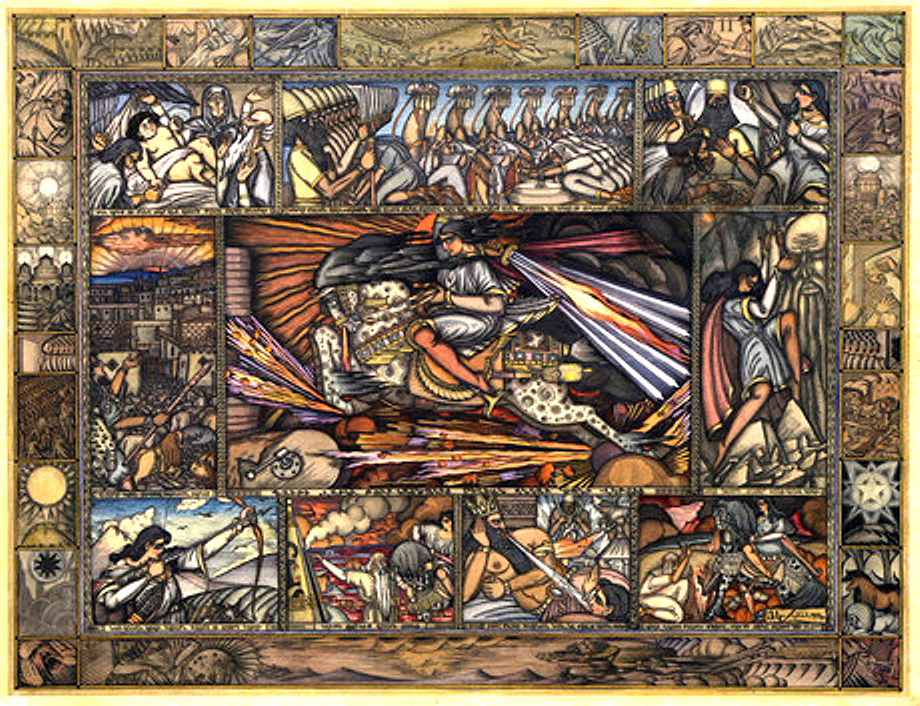
Daredevils of Sassoun (Armenian: Սասնա ծռեր Sasna cṙer, also spelled Daredevils of Sasun) is an Armenian heroic epic poem in four cycles (parts), with its main hero and story better known as David of Sassoun, which is the story of one of the four parts.
In the initial decades following the discovery of the epic in the late nineteenth century a general consensus emerged attributing its theme to the struggle of four generations of Sassoun's warriors against Muslim rule in the 8th to 10th centuries. The pioneers of this interpretation of the epic were the philologist Manuk Abeghian in Armenia and academic Joseph Orbeli at the Hermitage Museum in Leningrad, who argued that there are no characters in the epic that could be attributed to a historical person from before the 10th century.
The historicist school held its sway until the Armenian philologist Grigor Grigoryan first in an article (1981), then in a book (1989) argued following an incisive analysis of the epic, "it is indisputable that the roots of the epic go back deep into the centuries, and they reach not only the cuneiform times when monarchy was underway in Armenia, but even the prehistoric era." Grigoryan identified various episodes in the epic as of patently matriarchal origin, prompting various scholars both in Soviet Armenia and elsewhere to probe deeper into the proto-layers of the epic.
The Daredevils of Sassoun is commonly cited as one of the most important works of Armenian folklore. This recital of the legendary deeds of four generations of strongmen in a warrior community in the Armenian Highlands is in the tradition of heroic folktales that dramatise the story of a whole nation and voice its deepest sentiments and aspirations, but unlike such well-known epics as the Iliad and the Odyssey (Homeric Greek), the Epic of Gilgamesh (Akkadian epic based on Sumerian tales), Beowulf (Old English), The Song of Roland (Old French), Cantar de mio Cid (Old Spanish) and others, it has survived solely by word of mouth, transmitted from one generation to another by village bards. The literary merits of the Sassoun saga surpass its value as a historical or linguistic document.
The performance of the Daredevils of Sassoun was included in the UNESCO Intangible cultural heritage representative list in 2012.
Sasna is a genitive form of Sasun, a region located in Western Armenia in the rugged mountain country southwest of Lake Van in what is currently Batman Province, eastern Turkey. Tsur’ 'crooked' traditionally connotes an animus of rebelliousness.[citation needed]
The most accurate and complete title of this epic is Sasna Tsr’er 'Daredevlis of Sasun'. It has however been published under various titles such as Sasunts’i Davit’ (David of Sasun), Sanasar yev Baghdasar (Sanasar and Balthazar), Sasunts’i Davit’ kam Mheri dur’ (David of Sasun or Mher's door) and many others. All these titles correspond to one of four cycles of the epic.[citation needed]
The written literature of Armenia goes back to the fifth century, its Golden Age, when the Bible was translated into Classical Armenian directly from Koine Greek and Syriac language manuscripts. Plato and Aristotle were studied in Armenian schools and many original works of great interest to the modern specialist were produced by native historians, philosophers and poets.
Hub AI
Daredevils of Sassoun AI simulator
(@Daredevils of Sassoun_simulator)
Daredevils of Sassoun
Daredevils of Sassoun (Armenian: Սասնա ծռեր Sasna cṙer, also spelled Daredevils of Sasun) is an Armenian heroic epic poem in four cycles (parts), with its main hero and story better known as David of Sassoun, which is the story of one of the four parts.
In the initial decades following the discovery of the epic in the late nineteenth century a general consensus emerged attributing its theme to the struggle of four generations of Sassoun's warriors against Muslim rule in the 8th to 10th centuries. The pioneers of this interpretation of the epic were the philologist Manuk Abeghian in Armenia and academic Joseph Orbeli at the Hermitage Museum in Leningrad, who argued that there are no characters in the epic that could be attributed to a historical person from before the 10th century.
The historicist school held its sway until the Armenian philologist Grigor Grigoryan first in an article (1981), then in a book (1989) argued following an incisive analysis of the epic, "it is indisputable that the roots of the epic go back deep into the centuries, and they reach not only the cuneiform times when monarchy was underway in Armenia, but even the prehistoric era." Grigoryan identified various episodes in the epic as of patently matriarchal origin, prompting various scholars both in Soviet Armenia and elsewhere to probe deeper into the proto-layers of the epic.
The Daredevils of Sassoun is commonly cited as one of the most important works of Armenian folklore. This recital of the legendary deeds of four generations of strongmen in a warrior community in the Armenian Highlands is in the tradition of heroic folktales that dramatise the story of a whole nation and voice its deepest sentiments and aspirations, but unlike such well-known epics as the Iliad and the Odyssey (Homeric Greek), the Epic of Gilgamesh (Akkadian epic based on Sumerian tales), Beowulf (Old English), The Song of Roland (Old French), Cantar de mio Cid (Old Spanish) and others, it has survived solely by word of mouth, transmitted from one generation to another by village bards. The literary merits of the Sassoun saga surpass its value as a historical or linguistic document.
The performance of the Daredevils of Sassoun was included in the UNESCO Intangible cultural heritage representative list in 2012.
Sasna is a genitive form of Sasun, a region located in Western Armenia in the rugged mountain country southwest of Lake Van in what is currently Batman Province, eastern Turkey. Tsur’ 'crooked' traditionally connotes an animus of rebelliousness.[citation needed]
The most accurate and complete title of this epic is Sasna Tsr’er 'Daredevlis of Sasun'. It has however been published under various titles such as Sasunts’i Davit’ (David of Sasun), Sanasar yev Baghdasar (Sanasar and Balthazar), Sasunts’i Davit’ kam Mheri dur’ (David of Sasun or Mher's door) and many others. All these titles correspond to one of four cycles of the epic.[citation needed]
The written literature of Armenia goes back to the fifth century, its Golden Age, when the Bible was translated into Classical Armenian directly from Koine Greek and Syriac language manuscripts. Plato and Aristotle were studied in Armenian schools and many original works of great interest to the modern specialist were produced by native historians, philosophers and poets.