


Community hub
Recent from talks
Contribute something
Nothing was collected or created yet.
Daryl Harper
View on Wikipedia
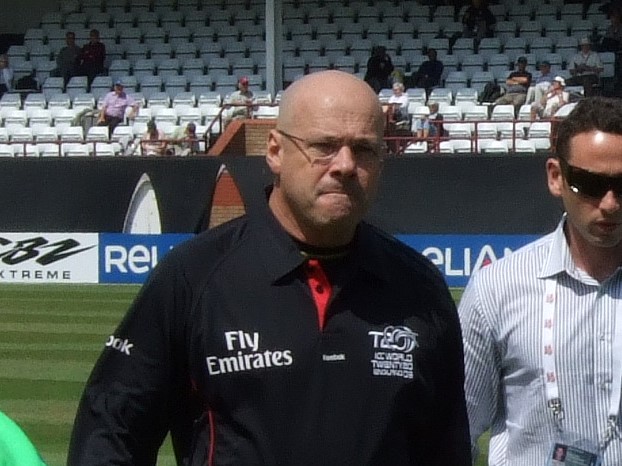
Daryl John Harper (born 23 October 1951) is an Australian cricket umpire, who was a Test umpire between 1998 and 2011. He was a member of the ICC Elite Panel of Umpires from 2002 until 2011 when the ICC announced that Harper was being stood down at the termination of his contract in July 2011. In June 2011, following criticism from India during the India - West Indies Test series Harper retired from umpiring.[1]
Key Information


Biography
[edit]Harper was born on 23 October 1951, in Mile End, South Australia, and attended Norwood High School before taking up primary school teaching. He had a brief career as an Australian rules football umpire before injury forced him to quit.[2]
Playing career
[edit]Harper played as a right-handed batsman in Adelaide grade cricket competition for the Teachers' College and East Torrens clubs.
Umpiring
[edit]In 1983, he switched to umpiring, making his first-class cricket debut in 1987.
Harper made his first appearance in an international fixture in January 1994 when he umpired a One Day International (ODI) in Perth between New Zealand and South Africa. In November 1998, Harper made his test match umpiring debut when appointed to stand in the 2nd Ashes test at the WACA ground alongside umpire Venkat; Harper also stood at the MCG in the 4th test of that series. After promotion to the National Grid Panel of International Umpires, Harper also began to appear in Test matches away from Australia as the designated independent umpire.
In 2002, the International Cricket Council (ICC) introduced a policy of two independent umpires standing in each Test match, and one independent & one home umpire in ODIs. The independent umpires would be chosen from a newly conceived ICC Elite umpire panel comprising the ICC's determination of the top 8 - 10 umpires from around the world. Harper was included in the original line up for this panel, at the time chosen over fellow Australians Simon Taufel and Darrell Hair (both of whom subsequently joined the panel in 2003). Harper umpired the opening match of the 2003 Cricket World Cup in South Africa, and went on to stand in one of the semi-finals. On 31 August 2005, he adjudicated in his 100th ODI, a match between Zimbabwe and New Zealand at Harare.
He was the third umpire for a trial of the 'player referral' system in 2009.[3] In 2010, England lodged a formal complaint against Harper after a referred caught behind decision was turned down because the volume supplied by the home broadcaster was not good enough to detect the edge.[4][5][6]
The ICC dropped Harper from the 2010 ICC World Twenty20 due to "general performance reasons"[7] and demoted him from the Elite Panel in May 2011.[8] The ICC subsequently revealed that Harper would stand in two last Test matches; between West Indies and India at Sabina Park and Windsor Park.
Harper retired from umpiring following some heavy criticism from India during the first test against the West Indies.[9] Dave Richardson, the ICC Cricket manager, said Harper received "unfair criticism" from the Indian players and that his correct decision making percentage against India was at 96 percent, which was "considerably above average".[6] Harper said he got 94% of his decisions in the match right, but conceded he made two errors in the game.[10]
International Umpiring statistics
[edit]As of 4 June 2010:
| First | Latest | Total | |
|---|---|---|---|
| Tests | Australia v England at Perth, Nov 1998 | New Zealand v Pakistan at Wellington, Jan 2011 | 94 |
| ODIs | New Zealand v South Africa at Perth, Jan 1994 | Bangladesh v South Africa at Dhaka, March 2011 | 174 |
| T20Is | South Africa v West Indies at Johannesburg, Sep 2007 | Pakistan v Sri Lanka at Lord's, Jun 2009 | 10 |
- Awards
- ICC Bronze Bails Award for 100 ODIs.
- Ambassadorship
- In March 2009, Daryl Harper, was announced as an ambassador for Orana, an Adelaide company providing employment for people with disabilities.[11]
- He is an ambassador for The Adelaide Crows.[12]
See also
[edit]References
[edit]- ^ "Umpire Daryl Harper pulls out of India-West Indies Test". WorldSnap News. 29 June 2011. Archived from the original on 9 February 2013.
- ^ Homfray, Reece (5 January 2010). "Test umpire Daryl Harper's spin on Redlegs". East Torrens Messenger. Retrieved 8 June 2011.
- ^ Cricinfo. "Sarwan endures amid umpiring chaos". Retrieved 6 February 2010.
- ^ Cricinfo. "Harper howlers undermine UDRS". Retrieved 6 February 2010.
- ^ Cricinfo. "ECB ask for reinstatement of lost review". Retrieved 6 February 2010.
- ^ a b Hopps, David (29 June 2011). "Daryl Harper pulls out of final Test after criticism from India". The Guardian. London.
- ^ Cricinfo. "Daryl Harper won't stand at World Twenty20". Retrieved 11 March 2010.
- ^ "Harper, de Silva removed from Elite Panel".
- ^ "Motorsport Video |Motorsport Highlights, Replays, News, Clips".
- ^ "Harper defends performance, concedes two errors". ESPN.com. 1 July 2011. Retrieved 29 August 2023.
- ^ "International Cricket Council". Archived from the original on 5 November 2009. Retrieved 17 June 2010.
- ^ "New Crows Ambassador". 19 May 2010. Archived from the original on 10 October 2012. Retrieved 17 June 2010.
- ^ "Disgraced, Daryl Harper cribs: 'Indians above laws of cricket'". The Indian Express. 1 July 2017. Retrieved 9 January 2017.
External links
[edit]Daryl Harper
View on GrokipediaEarly Life and Education
Childhood and Family Background
Daryl John Harper was born on 23 October 1951 in Adelaide, South Australia.[1] He spent his early years growing up in Adelaide.[1] In his primary school days, Harper developed an interest in football, becoming a supporter of the Adelaide Crows, alongside his passion for cricket.[3]Education and Teaching Career
Daryl Harper trained at Wattle Park Teachers College in Adelaide, where he played grade cricket for the Teachers' College team as a right-handed batsman.[6] He began a career as a primary school teacher in South Australia and maintained this position for 23 years, balancing it with playing in Adelaide's grade cricket competitions for clubs such as East Torrens.[7][3] His teaching experience influenced his approach to umpiring by helping him build relationships with players and emphasize communication.[3]Entry into Cricket
Playing in Grade Cricket
Daryl Harper participated in Adelaide grade cricket leagues during the 1970s and early 1980s, competing as a right-handed batsman.[7][8] He represented the Teachers College and East Torrens clubs in these competitions.[7] Harper self-described as a "very ordinary batsman," noting that he rarely achieved a half-century and harbored no professional aspirations or notable accomplishments in the game.[3][7] This amateur playing stint offered Harper essential grounding in cricket's rules and on-field dynamics, particularly through his slips fielding, which honed his quick reactions and overall game awareness.[9][3]Transition to Umpiring
After playing grade cricket in Adelaide, Daryl Harper transitioned to umpiring in the mid-1980s, motivated by his deep involvement in the sport and a desire to remain connected following the end of his playing days.[2][3] As a primary school teacher in South Australia, Harper began officiating at grassroots and club levels, where he gained initial practical experience in local matches while pursuing formal umpiring accreditation through state-level training programs.[2][3] During these early years, he balanced his full-time teaching responsibilities with weekend and evening umpiring commitments, leveraging his 23 years of classroom experience to develop strong interpersonal skills essential for managing players on the field.[3] This dual role allowed him to steadily build his umpiring proficiency without immediately disrupting his professional career.[10]Umpiring Career
Domestic Umpiring Debut and Progression
Daryl Harper made his first-class umpiring debut on 27 November 1987, officiating the match between South Australia and New Zealand at Adelaide Oval during New Zealand's tour of Australia.[10][11] This debut marked the beginning of his professional progression within Australian domestic cricket, where he honed his skills under the guidance of experienced umpires like Tony Crafter and Max O'Connell.[7] Following his early training with the South Australian Cricket Umpires Association, Harper steadily advanced through the ranks, umpiring regular Sheffield Shield fixtures and gaining exposure in one-day domestic tournaments such as the Mercantile Mutual Cup starting from the 1988/89 season.[12] His consistent performances led to greater responsibilities, including national panel selection by Cricket Australia in the 1993/94 season, which solidified his status as one of the country's top domestic officials.[13] By the time of his retirement in 2011, Harper had umpired 165 first-class matches and 214 List A matches, the majority of which were in Australian domestic competitions like the Sheffield Shield and various limited-overs series.[11][12] His dedication to domestic umpiring was formally acknowledged with the Cricket Australia Umpire Award in 2006/07, recognizing his exemplary service and accuracy in high-stakes matches.[14]International Debut and Elite Panel Tenure
Daryl Harper made his One Day International (ODI) umpiring debut on 14 January 1994 at the WACA Ground in Perth, officiating the match between New Zealand and South Africa during the Benson and Hedges World Series Cup.[1][10] This appearance marked his entry into international cricket umpiring, following a solid foundation in domestic matches in Australia. Building on that experience, Harper progressed to Test cricket, debuting as an on-field umpire on 28 November 1998 at the same WACA Ground, standing in the second Test of the Ashes series between Australia and England.[15][1] In April 2002, Harper was appointed to the newly established ICC Elite Panel of Umpires, becoming one of the inaugural members alongside figures like Steve Bucknor and Rudi Koertzen.[2] This prestigious panel, designed to handle the highest level of international cricket, saw Harper serve continuously until 2011, during which he officiated in 95 Tests, 174 ODIs, and 10 T20Is.[10] His tenure on the panel solidified his reputation as a key figure in global umpiring, contributing to standardized decision-making across major series and bilateral fixtures. Harper's Elite Panel role extended to significant ICC events, including the 2003 Cricket World Cup in South Africa, where he umpired the opening match between South Africa and West Indies at Newlands, Cape Town, on 8 February 2003, alongside Srinivas Venkataraghavan.[16] He also stood in the second semi-final between India and Kenya at Kingsmead, Durban, on 20 March 2003, paired with Steve Bucknor. These assignments highlighted his involvement in high-stakes tournament play, emphasizing his reliability in neutral, pressure-filled environments.Notable Matches and Decisions
Key International Matches
Daryl Harper's international umpiring career featured several high-profile assignments, beginning with his role in the 2003 ICC Cricket World Cup. He stood as one of the on-field umpires for the tournament's opening match between New Zealand and Sri Lanka at Newlands, Cape Town, on February 13, 2003, marking a significant early milestone in his global exposure.[16] Later in the same event, Harper officiated the second semi-final between India and Kenya at Kingsmead, Durban, on March 20, 2003, alongside Steve Bucknor, contributing to the high-stakes knockout stage of the competition.[17] A notable personal landmark came in 2005 when Harper umpired his 100th One Day International, the fourth match of the Videocon Triangular Series between Zimbabwe and New Zealand at Harare Sports Club on August 31, 2005. This fixture highlighted his growing stature on the international circuit, as he partnered with local umpire Russell Tiffin to oversee the limited-overs encounter.[18] In 2009, Harper took on a pivotal technological role as the third umpire during the trial of the player referral system—later known as the Decision Review System (DRS)—in the fourth Test between West Indies and England at Kensington Oval, Bridgetown, Barbados, from February 26 to March 2. This assignment tested the nascent protocol allowing teams limited challenges to on-field decisions, with Harper reviewing multiple appeals in a series that underscored the evolving use of technology in Test cricket.[19] Harper's Elite Panel status also led to frequent assignments in challenging environments, including numerous fixtures in India such as the first Test against England in Chennai in 2008. He umpired eight Tests and twelve ODIs on Indian soil, along with matches at neutral venues like those during major ICC events, reflecting his reliability in high-pressure, diverse conditions.[3]Famous Umpiring Decisions
One of Daryl Harper's most debated decisions came during the first Test between Australia and India at Adelaide Oval in 1999, where he ruled Sachin Tendulkar out leg before wicket (LBW) after a delivery from Glenn McGrath struck the Indian batsman on the shoulder while he was ducking under what he believed was a bouncer.[4] This "shoulder before wicket" call, Harper's sixth Test as an umpire, sparked widespread discussion due to the unusual point of impact, but Harper has maintained it was correct under the laws of cricket, as the ball would have hit the stumps had it continued its path.[4] Tendulkar himself later acknowledged the decision's validity in private conversations, and Harper expressed pride in it as an example of precise application of the rules without the aid of modern technology like DRS.[4] In early 2010, Harper faced scrutiny as the third umpire during the fourth Test between England and South Africa at Johannesburg, where he upheld a not-out decision against South African captain Graeme Smith on a caught-behind appeal reviewed by England, reportedly due to insufficient audio from the stump microphone because the volume had not been adjusted.[20] England lodged a formal complaint with the ICC, highlighting issues with the Decision Review System (DRS) technology, though an ICC investigation cleared Harper of deliberate error and attributed the problem to technical inadequacies.[21] This incident contributed to broader performance concerns, leading to Harper's exclusion from the ICC Elite Panel for the 2010 World Twenty20 in the West Indies, a decision the ICC described as based on "general performance reasons" unrelated to any single event.[22] Harper was known for his engaging on-field banter, which he used to build rapport and manage player interactions effectively, drawing from his 23 years as a schoolteacher to foster open communication.[3] For instance, he would converse casually with players like Irfan Pathan about personal topics such as family life during matches, creating a relaxed atmosphere that allowed him to address concerns or correct behaviors without escalating tensions.[3] This style extended to light-hearted exchanges, such as advising Bangladesh bowler Shahadat Hossain on more constructive ways to sledge opponents during a game against New Zealand, helping to diffuse potential conflicts and maintain game flow.[3] Harper advocated for umpires to display personality on the field, arguing it made players more receptive to decisions and reduced confrontations.[3] Beyond the pitch, Harper made a brief foray into acting with a cameo appearance as himself in the 2009 Bollywood film Victory, a cricket-themed drama starring Harman Baweja and Amrita Rao, where he portrayed an umpire in a key scene.[3] This role highlighted his international recognition in cricket circles and added a unique footnote to his umpiring legacy.[3]Controversies and Retirement
Major Controversial Incidents
One of the most notable controversies in Daryl Harper's umpiring career occurred during the fourth Test between England and South Africa in Johannesburg in January 2010. As the television umpire, Harper failed to detect an audible edge off Graeme Smith's bat when England reviewed an on-field not-out decision, reportedly because he had not adjusted the volume on his stump microphone feed. This error allowed Smith to continue his innings, contributing to South Africa's strong position, and prompted an official complaint from the England and Wales Cricket Board (ECB) to the International Cricket Council (ICC), demanding a review of the Umpire Decision Review System (UDRS) and the reinstatement of England's lost referral.[23][24] The incident drew widespread criticism of Harper's handling of technology in referrals, with England's coach Andy Flower describing it as a "gross error" that undermined the system's integrity. In response, the ICC launched an investigation, ultimately attributing the issue partly to technological limitations rather than solely Harper's fault, but the fallout led to his omission from the officiating panel for the 2010 ICC World Twenty20 tournament in the West Indies, despite his elite status. The ICC stated that the decision was based on his "general performances" and not tied to the specific incident, though media and team officials linked it directly to the Johannesburg controversy.[25][22] Harper's umpiring in the first Test between India and West Indies at Sabina Park, Jamaica, in June 2011, sparked intense backlash from the Indian team. Several decisions were questioned, including an erroneous no-ball call overlooking Devendra Bishoo's back foot touching the return crease on the delivery that dismissed MS Dhoni caught at point; a disputed caught decision against Suresh Raina off Devendra Bishoo where replays showed no bat or glove involvement, only pad contact; a disputed lbw decision against Harbhajan Singh that replays suggested may have bounced over the stumps; and other calls such as Virat Kohli's caught dismissal. Indian captain MS Dhoni publicly criticized Harper for "poor decisions," stating they impacted the match's outcome, while the team highlighted at least three errors against India compared to similar mistakes favoring West Indies. Harper later conceded two specific errors in a statement but defended his overall performance, noting that match referee Jeff Crowe assessed his accuracy at 94% correct.[26][27][28][29] The Jamaican Test controversy escalated when Harper responded to the criticism in a letter to an Indian media outlet, making remarks perceived as racially insensitive toward Indian players. He compared umpiring errors to "Indians eating beef burgers," a culturally tone-deaf analogy given Hinduism's widespread prohibition on beef consumption in India, and sarcastically suggested he "should never have applied the laws of cricket to Indian players." These comments were widely condemned as a racial slur, intensifying calls for his removal and contributing to public and team outrage over perceived bias. The ICC later clarified that Harper's decision accuracy in Tests involving India stood at 96%, higher than the elite panel average, yet this statistical defense did little to quell the backlash, which highlighted broader frustrations with his high-profile mistakes despite strong overall metrics.[30][31]2011 Retirement and Aftermath
On June 29, 2011, Daryl Harper abruptly announced his retirement from international umpiring, withdrawing from his scheduled role in the third Test of the India-West Indies series at Windsor Park, Roseau. This decision came just five Tests short of the milestone 100 international Tests he would have officiated, following intense criticism from the Indian team during the ongoing series.[32][33] The International Cricket Council (ICC) swiftly defended Harper's performance, with cricket operations manager Dave Richardson describing the criticism from Indian players as "unfair" and emphasizing Harper's strong record, including a correct-decision percentage of over 90% in recent matches. The ICC also highlighted concerns over the undue influence exerted by the Indian team on umpiring appointments, underscoring the pressures faced by officials in high-stakes series.[33][34] Harper's emotional response revealed a sense of being "pushed out" after 17 years of dedicated service on the international stage, where he accused the Indian team of bullying tactics and criticized the ICC for insufficient support in addressing player complaints. In interviews following the announcement, he expressed frustration over unpunished comments from Indian captain MS Dhoni, who had publicly questioned his decisions, feeling that the governing body had failed to uphold standards of respect toward umpires. This retirement marked Harper's full transition away from elite international umpiring, concluding a career in which he had officiated a total of 830 cricket matches overall, with the vast majority occurring at grassroots and domestic levels in Australia. The ICC acknowledged his contributions, noting his role in developing umpiring standards, while Harper shifted focus to lower-level officiating and mentorship within Cricket Australia.[10][10]Later Life and Legacy
Health Challenges
In 2017, at the age of 65, Daryl Harper was diagnosed with bowel cancer, leading to a three-hour surgical procedure to address the condition while he was recovering in a hospital bed in Australia.[37] Following the surgery, he endured six months of chemotherapy, during which a power port was inserted near his chest to facilitate treatment; the port was later removed upon successful completion.[3] The treatment took a significant toll on Harper's physical health, resulting in a 20-kilogram weight loss, including a rapid six-kilogram drop over just four days, which altered his appearance noticeably during the ordeal.[3] Despite the challenges, his recovery was marked by a resilient mindset; he promised his wife that he would aim to "leave someone with a smile or a laugh" after each chemotherapy clinic visit, drawing strength from his affable personality and the support of the cricketing community, including Cricket Australia.[3] Reflecting on the severity of his battle, Harper later shared, "I didn’t think I was going to be here," highlighting the emotional weight of confronting mortality amid the treatment's hardships.[3] Following his treatment, Harper regained the lost weight along with additional weight and resumed aspects of his daily life, including returning to work the following summer, though the experience left a lasting impact on his perspective, emphasizing perseverance in the face of overwhelming odds observed in fellow patients. As of 2025, he remains active in cricket-related commentary.[3][38]Post-Retirement Roles and Contributions
Daryl Harper has remained actively involved in Australian cricket administration, leveraging his extensive experience to support emerging umpires. He serves as an umpiring mentor and match referee for domestic competitions, including the Sheffield Shield and other Cricket Australia-sanctioned events, where he provides on-site guidance and oversight to ensure high standards of officiating.[3][10] Harper's role extends to Cricket Australia's umpire education and training programs, a position he assumed shortly after his 2011 retirement from international umpiring. In this capacity, he contributes to workshops and coaching sessions, emphasizing the development of umpires' personal styles and decision-making under pressure, drawing from his background as a 23-year school teacher. His involvement has been praised by Cricket Australia officials as a vital resource for nurturing the next generation of officials.[10] Beyond umpiring development, Harper has pursued interests in the entertainment industry, building on a cameo appearance in the 2009 Bollywood film Victory. He has expressed aspirations for a Hollywood role, humorously suggesting he could serve as a body double for actor Bruce Willis, reflecting his affable personality noted during his umpiring career.[3] Harper has also shared his insights through public interviews, discussing topics such as the evolution of the Decision Review System (DRS), the importance of fair play, and lessons from high-stakes matches. In a 2020 interview with Asianet Newsable, he advocated for refining DRS protocols to enhance accuracy and reduce controversies, while stressing umpires' role in upholding the spirit of the game. In February 2025, he commented positively on a commercial advertisement featuring Sachin Tendulkar and Glenn McGrath, recalling his controversial 1999 lbw decision involving the pair. These contributions highlight his ongoing influence on cricket's officiating standards and broader discourse.[39][38]Umpiring Statistics
International Match Records
Daryl Harper's international umpiring career featured extensive involvement across Test, One Day International (ODI), and Twenty20 International (T20I) formats, reflecting his status as a prominent figure on the global stage. His selection to the ICC Elite Panel of Umpires in 2002 facilitated a substantial volume of assignments in major tournaments and bilateral series.[40] In Test matches, Harper officiated 95 games from his debut in November 1998 to his final appearance in 2011.[31] These fixtures included high-stakes encounters between top teams, underscoring his reliability in the longest format. Harper stood in 174 men's ODIs between January 1994 and March 2011, complemented by 2 Women's ODIs in 2002.[1] His ODI assignments often involved ICC events such as World Cups, where his decision-making was pivotal to match outcomes. For the emerging T20I format, he umpired 10 men's matches from 2007 to 2009, including 3 Women's T20Is during the 2009 ICC Women's World Twenty20.[31][41] ICC assessments up to 2011 rated Harper's accuracy at 96% in Tests involving India.[31]| Format | Men's Matches | Women's Matches | Period |
|---|---|---|---|
| Tests | 95 | - | 1998–2011 |
| ODIs | 174 | 2 | 1994–2011 |
| T20Is | 10 | 3 | 2007–2009 |
Domestic and Overall Totals
Daryl Harper officiated in 164 domestic first-class matches throughout his career, spanning from his debut in 1987 to his retirement in 2011.[11] These matches were primarily within Australian domestic competitions, including the Sheffield Shield, where he contributed to umpiring high-level interstate fixtures.[10] In domestic limited-overs cricket, Harper stood in 214 List A matches, reflecting his extensive involvement in one-day tournaments such as the Mercantile Mutual Cup and Benson and Hedges World Series Cup.[12] This substantial tally underscores his reliability and progression from provincial to national umpiring panels in Australia. Across his entire career, Harper umpired a total of 830 matches, with the majority occurring at grassroots and club levels in South Australia, where he began his umpiring journey after playing minor grades cricket.[10] This comprehensive figure highlights his lifelong dedication to the sport at all levels, including a notable international component that placed him among the top six umpires globally by volume of elite matches officiated.[3]| Category | Matches Officiated |
|---|---|
| Domestic First-Class | 164 |
| Domestic List A | 214 |
| Overall Career Total | 830 |
References
- https://www.bbc.com/sport/[cricket](/page/Cricket)/14189554
- https://www.foxsports.com.au/[cricket](/page/Cricket)/retiring-australian-cricket-umpire-darryl-harper-says-the-game-has-lost-sight-of-its-standards/news-story/ba4d3d81c36091804134af135e696435