


Community hub
Recent from talks
Contribute something
Nothing was collected or created yet.
Caught
View on Wikipedia

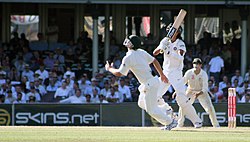
Caught is a method of dismissing a batsman in cricket. A batsman is out caught if the batsman hits the ball, from a legitimate delivery, with the bat, and the ball is caught by the bowler or a fielder before it hits the ground.
If the catch is taken by the wicket-keeper, then informally it is known as caught behind[1] or caught at the wicket.[2] A catch by the bowler is known as caught and bowled.[1] This has nothing to do with the dismissal bowled but is rather a shorthand for saying the catcher and bowler are the same player. (The scorecard annotation is usually c. and b. or c&b followed by the bowler's name.)
Caught is the most common method of dismissal at higher levels of competition, accounting for 36,190 Test match dismissals between 1877 and 2012, which is 56.9% of all Test match dismissals in this period.[3]
South African wicket-keeper Mark Boucher holds the record for the most Test match catches, with 532,[4] while Joe Root holds the record for the most Test match catches by non-wicket-keepers, with 211.[5]
Laws
[edit]This method of dismissal is covered by Law 33 of the Laws of Cricket, which reads:[6]
The striker is out Caught if a ball delivered by the bowler, not being a No ball, touches his/her bat without having previously been in contact with any fielder, and is subsequently held by a fielder as a fair catch,..., before it touches the ground.
This means that the batsman cannot be out caught if:
- The ball is called a no-ball or dead ball.
- The batsman does not hit the ball with his bat or a gloved hand holding the bat.
- The ball, having been hit, makes contact with the field before a fielder catches the ball.
- The ball does not remain under the control of the fielder.
- The ball is hit and lands beyond or on the boundary; (six runs).
- A fielder taking the catch makes contact with the boundary rope or the area outside the boundary, with any part of his body, equipment, when touching the ball.
- An airborne fielder taking the catch, having not previously legally touched the ball, had his last contact with the ground not entirely within the boundary.[7]
A catch is not completed until the fielder catching the ball obtains complete control over both the ball and his/her own movement (Law 33.3).
Note that if a batsman could be given out both caught and by another method, 'caught' takes precedence, unless the other method is bowled.[8]
If a batsman is out caught, any runs scored off that delivery are voided.
If a batsman is caught, the bowler is credited with the batsman's wicket and the catching fielder is credited for the dismissal; there are no catch assists for saving boundaries before a catch, or deflecting the ball to a different fielder in the slips cordon. If the two batsmen cross each other, in attempting to take a run, before the catch was taken, the non-striking batsman at the time remains at the opposite end of the pitch as the new incoming batsman comes to the crease at his former end. This means, unless it is now a new over, he is now on strike and the incoming batsman is not.
Adjudication
[edit]If the catch taken is pronounced or obvious, the players need not appeal to the umpire; the batsman normally chooses to acknowledge the dismissal himself. However, if the ball brushes the edge of the bat, or the catch is taken very close to the ground, or the ball appears to have bounced off the batsman's foot (so it has not touched the ground), or the ball appearing to come off the bat very close to the pitch surface (bump ball), or if the batsman is reluctant to accept that he has been dismissed, then the fielding team has to appeal to the umpire for this decision. In international competition, if neither field umpire can clearly decide if a catch has been made or not, they may refer to the third (television) umpire for a review. The third umpire may also be used if the Umpire Decision Review System is available and a team wishes to dispute a call concerning a possible catch.
Celebration
[edit]Before 2000, the Laws of Cricket defined a catch as being completed when the player had "complete control over the further disposal of the ball". In the very strictest sense, this meant that the player did not finish catching the ball until he threw it away, though the player doesn't have to throw the ball to anyone in particular in so doing.
For this reason, even today many cricketers celebrate a catch by lobbing the ball into the air. In a Super Sixes match in the 1999 Cricket World Cup, South African Herschelle Gibbs caught Australian captain Steve Waugh on 56, but Waugh was given not out when Gibbs was ruled to not have control of the ball when attempting to throw the ball in celebration.[9] Waugh went on to score a match-winning 120 not out[10] to qualify his team for the semi-finals; Australia went on to win the tournament.
Records
[edit]Test matches
[edit]The wicket-keepers with the highest number of catches taken in Test matches are as follows. Note: this list excludes catches made while not fielding as a wicket-keeper.
| Rank | Wicket-keeper | Catches | Test Career dates |
|---|---|---|---|
| 1 |  Mark Boucher Mark Boucher
|
532 | 1997–2012 |
| 2 |  Adam Gilchrist Adam Gilchrist
|
379 | 1999–2008 |
| 3 | Ian Healy
|
366 | 1988–99 |
| 4 | Rod Marsh
|
343 | 1970–84 |
| 5 |  Jeff Dujon Jeff Dujon
|
265 | 1981–91 |
| 6 | Brad Haddin
|
262 | 2008–15 |
| 7 |  BJ Watling BJ Watling
|
257 | 2009–21 |
| 8 |  MS Dhoni MS Dhoni
|
256 | 2005–14 |
| 9 |  Alan Knott Alan Knott
|
250 | 1967–81 |
| 10 | Matt Prior
|
243 | 2007–14 |
Source: Cricinfo Statsguru. Last updated: 20 June 2024.
The non-wicket-keepers with the highest number of catches taken in Test matches are as follows. Note: this excludes any catches made while fielding as a wicket-keeper.
| Rank | Fielder | Catches | Test Career dates |
|---|---|---|---|
| 1 | Joe Root
|
211 | 2012- |
| 2 | Rahul Dravid
|
210 | 1996–2012 |
| 3 |  Mahela Jayawardene Mahela Jayawardene
|
205 | 1997–2014 |
| 4= | Jacques Kallis
|
200 | 1995–2013 |
| 4= | Steve Smith
|
200 | 2010- |
| 6 | Ricky Ponting
|
196 | 1995–2012 |
| 7 | Mark Waugh
|
181 | 1991–2002 |
| 8 | Alastair Cook
|
175 | 2006–18 |
| 9 | Stephen Fleming
|
171 | 1994–2008 |
| 10 | Graeme Smith
|
169 | 2002–14 |
Source: Cricinfo Statsguru. Last updated: 11 July 2025.
One Day Internationals
[edit]T20 Internationals
[edit]First Class cricket
[edit]See also
[edit]References
[edit]- ^ a b "Ways of getting out: Caught". bbc.co.uk. 26 August 2005. Retrieved 2019-04-17.
- ^ "Runs for Vaughan but England caught short". theguardian.com. 13 December 2004. Retrieved 2019-04-17.
- ^ "Analysing Test dismissals across the ages". espncricinfo.com.
- ^ "Most catches in career". espncricinfo.com/. Retrieved 2019-04-17.
- ^ "Joe Root: England batter breaks world record for most Test catches".
- ^ "Law 33 - Caught". www.lords.org. Retrieved 2019-04-17.
- ^ "{% DocumentName %} Law | MCC". www.lords.org. Retrieved 2020-12-04.
- ^ "Law 32 (Caught)". ndca.nsw.cricket.com.au. Archived from the original on 2019-12-11. Retrieved 2019-04-17.
- ^ "Australia v South Africa". cricinfo.com. Archived from the original on 2010-11-05.
- ^ "9th Super, ICC World Cup at Leeds, Jun 13 1999 - Match Summary - ESPNCricinfo". ESPNcricinfo. Archived from the original on 2010-04-10.
Caught
View on GrokipediaDefinition and Fundamentals
Core Concept
In cricket, a caught dismissal occurs when a batsman strikes the ball with their bat or a hand or glove holding the bat, and a fielder catches it before it touches the ground or any other surface. This method requires the ball to have been hit from a legal delivery—not a no-ball—and without prior contact with any fielder. The catch must be deemed fair, meaning the fielder secures complete control of both the ball and their own movement while in contact with the playing area.[8] Caught serves as one of ten primary ways to dismiss a batsman, alongside methods like bowled, leg before wicket, and run out, and it plays a pivotal role in gameplay by often breaking partnerships and shifting momentum. Fielder-caught dismissals account for approximately 42% of all batsman dismissals in Test matches across history (as of 2025), with total caught (including wicketkeeper) around 59%, making it particularly decisive in tight contests where fielding skill can determine outcomes.[9] The basic mechanics emphasize a clean catch: the ball must be held securely in the fielder's hand or lodged in their clothing or equipment, and juggling is permitted provided the ball does not touch the ground at any point. Additionally, the fielder must complete the catch without stepping or being grounded beyond the boundary rope, even if the ball is airborne over it; otherwise, it is scored as a boundary rather than a dismissal. Umpire adjudication confirms these elements, though detailed processes are handled separately.[8] The caught rule traces its roots to early formalized cricket codes, appearing in the 1744 Laws of Cricket as a dismissal if the ball is caught—clothed or not—before touching the ground. It evolved from even earlier agreements, such as the 1727 Articles, and was refined and standardized in the 19th century by the Marylebone Cricket Club (MCC), which has governed the sport's laws since 1788.[10]Legal Requirements
For a catch to be valid in cricket, the ball must first touch the striker's bat without having previously contacted any fielder, and it must then be held by a fielder as a fair catch before touching the ground or any other object.[11] This clean catch rule ensures the dismissal arises directly from the striker's shot, excluding deflections off fielders prior to bat contact. Partial juggles are permitted provided the fielder maintains control of the ball—defined as firm possession in the hand or hands, with the ability to throw it—without the ball touching the ground during the process.[11] Boundary conditions play a critical role in catch validity. A catch remains fair if the ball crosses the boundary rope in the air but is secured by the fielder before it lands outside the playing area, as long as the fielder completes control while any part of their body in contact with the ball remains within the field of play. As of June 2025, ICC playing conditions (incorporated into MCC Laws in October 2026) limit fielders to one touch of the ball while airborne outside the boundary, requiring them to land inside the field for a fair catch and prohibiting "bunny hop" multiple touches.[12] Under the momentum rule, a fielder may step or be carried over the boundary line due to inertia after jumping to catch the ball, provided the catch is fully completed in the air—before any ground contact outside the field—and the fielder returns to the field if needed to avoid grounding the ball prematurely. However, if the fielder's final ground contact occurs outside the field before achieving complete control, the catch is deemed unfair, resulting in a boundary score of four or six runs instead of a dismissal.[11] Handling specifics further define a fair catch. The ball must be controlled and settled in the fielder's hand or hands; mere contact with gloves, pads, or other protective equipment after bat contact does not constitute a catch unless followed by hand control, but such incidental touches post-bat are permissible en route to a valid hold by another fielder.[11] Conversely, if the ball lodges in a fielder's clothing or equipment without being secured in the hands, it is not considered held, rendering the catch invalid.[11] Several scenarios invalidate a catch. A dropped catch occurs when the fielder fails to achieve complete control, allowing the ball to touch the ground before being secured. If the ball deflects off a fielder's helmet and is not subsequently held fairly in the hands without grounding, the dismissal cannot be upheld. Additionally, accidentally grounding the ball—such as by the fielder's foot or body contact—before control is gained nullifies the catch entirely. Umpires signal a dismissal, including caught, by raising the index finger above the head.[13]Rules and Variations
Governing Laws
The dismissal of caught is governed by Law 33 of the Marylebone Cricket Club (MCC) Laws of Cricket (2017 Code, 3rd Edition 2022), which states that the striker is out Caught if a ball delivered by the bowler, not being a no-ball, touches the striker's bat or a glove held on the hand without having previously contacted any fielder, and is subsequently held by a fielder before touching the ground.[8] A fair catch requires the ball to be held long enough for the fielder to throw it up in the air, and it is not fair if the wicket-keeper would have taken the catch but for interference by another fielder unless that fielder immediately returns the ball to allow the wicket-keeper to complete it.[8] The catch is incomplete if the fielder carries the ball beyond the boundary or grounds any part of their body beyond it before completing control of the ball and their movement.[8] No runs are scored off the delivery if the striker is caught, though penalty runs remain awarded, and the non-striker must return to their original crease if runs were attempted.[8] The bowler's end umpire is responsible for adjudicating caught dismissals, and caught takes precedence over bowled if both conditions are met.[8] Law 33 integrates with other MCC laws to ensure consistent application. A catch off a no-ball, as defined in Law 21 (previously Law 24 in the 2000 Code), is invalid and does not result in dismissal, though the no-ball penalty applies. Boundary interactions are governed by Law 19, which specifies that a catch remains fair only if completed without the fielder or ball grounding beyond the boundary, aligning with scoring rules for boundaries crossed in the air.[14] Under Law 41 (Unfair Play), if a fielder deliberately obstructs the striker's right to play the ball or interferes unfairly during a catch attempt, the umpire may intervene, potentially awarding runs or other penalties instead of allowing the dismissal.[15] Key amendments to Law 33 have refined its application over time. The 2000 Code (5th Edition, effective 2013) updated boundary catch rules to mirror Law 19 conditions, requiring consistency in handling balls crossing the boundary in the air and prohibiting momentum carrying the fielder beyond the boundary before completion.[16] The 2017 Code clarified juggled catches by emphasizing that control is achieved when the fielder has the ball firmly under control without further movement, allowing multi-touch juggles as long as the ball is not dropped and the fair catch criteria are met.[17] It also expanded caught possibilities by permitting dismissals even if the ball contacts a fielder's or wicket-keeper's helmet after touching the bat, treating the helmet as an extension of the body for catching purposes.[18] In June 2025, the ICC introduced playing conditions prohibiting 'bunny hop' catches at the boundary in international cricket, where a fielder who touches the ball while airborne beyond the boundary must complete the catch without multiple contacts or grounding outside before returning inside; these conditions are effective from June 17, 2025, and will be incorporated into the MCC Laws in October 2026.[19] These laws apply universally to all forms of cricket, from international to amateur levels, with enforcement relying on umpire interpretation during play; no inherent variations exist between amateur and professional contexts unless specified by playing conditions from governing bodies like the International Cricket Council.[20]Format-Specific Differences
In Test cricket, the lack of fielding restrictions permits captains to deploy fielders in deep positions throughout the five-day match, facilitating catches from defensive strokes or lofted shots as batsmen build long innings. This format's unlimited overs often see caught dismissals culminating extended partnerships, with fielders positioned to exploit fatigue or pressure, contributing to caught accounting for nearly 59% of all dismissals historically.[21] One-Day Internationals (ODIs) introduce fielding restrictions that significantly influence caught opportunities, particularly during powerplays. In the first 10 overs (Powerplay 1), only two fielders are allowed outside the 30-yard circle, restricting deep placements and encouraging close-in catches like those at slip or gully from edged shots; from overs 11 to 40 (Powerplay 2), up to four fielders can be outside, while the final 10 overs have no limits, allowing aggressive deep fielding for lofted hits. These rules elevate the proportion of slip catches early on and increase overall caught dismissals in the middle overs, where batting consolidates before acceleration.[22][23] In Twenty20 Internationals (T20Is), the format's emphasis on rapid scoring amplifies caught dismissals through aggressive, aerial batting, with lofted drives and pulls creating frequent catching chances; fielding restrictions limit only two fielders outside the 30-yard circle for the first six overs, promoting close catches, while the remaining overs allow up to five outside to target boundary attempts. Boundary rules require fielders to remain grounded after catching near the rope, enforcing precise execution and heightening the dismissal's frequency, which reaches around 56% in major tournaments like the T20 World Cup.[24][25][26] First-class and domestic cricket mirrors Test match dynamics in lacking fielding restrictions, enabling deep setups to capitalize on prolonged batting, though captains' declarations can truncate innings and reduce late-stage catching prospects compared to the full Test duration.Decision-Making Process
Umpire Responsibilities
In cricket, the primary responsibility for adjudging a caught dismissal lies with the umpire at the bowler's end, who must visually determine whether the ball has been struck by the bat or a hand or arm holding the bat, subsequently held cleanly by a fielder before touching the ground, and without the fielder crossing the boundary rope.[27] This assessment requires the umpire to evaluate the trajectory of the ball from the moment of potential contact, ensuring no deflection off the batsman's clothing or body prior to the catch, while maintaining focus on the fielder's stability and position relative to the boundary to avoid any grounding that would invalidate the dismissal.[27] For catches near the boundary, the umpire must confirm that the fielder has not stepped over the rope while holding the ball, prioritizing a complete and continuous hold over juggling attempts.[27] Upon an appeal from the fielding side—typically phrased as "How's that?"—the bowler's end umpire must promptly decide and signal the dismissal if valid, raising the index finger vertically above the head as the standard "out" gesture, while simultaneously calling "out" and declaring the ball dead to halt play.[13][28] In close or uncertain cases, such as potential deflections or boundary involvement, the umpire consults the square-leg umpire for additional perspective before finalizing the decision, ensuring collaborative judgment without undue delay.[13][27] If the delivery is a no-ball, the umpire must call and signal it immediately—by extending one arm horizontally—rendering any subsequent catch invalid, with the batsman not out regardless of the catch's cleanliness, and play continuing as a free hit in limited-overs formats or with runs awarded as applicable. As of June 2025, in cases of a no-ball, the third umpire will review the catch's fairness via the Decision Review System (DRS) to confirm its validity for scoring purposes, though the batsman remains not out.[13][23] This overlap demands vigilant monitoring by both umpires, as the bowler's end umpire calls no-balls for foot faults while assessing potential dismissals.[13] Umpires undergo rigorous training through the International Cricket Council (ICC) accreditation program, including Level 1 modules that emphasize decision-making skills for caught dismissals, such as analyzing ball trajectories via video simulations and on-field drills to refine visual acuity and consistency in judgment.[29] These sessions cover handling appeals, boundary catch scenarios, and no-ball interactions to ensure umpires apply the Laws of Cricket accurately during live play.[29]Technological Aids
The Decision Review System (DRS), introduced by the International Cricket Council (ICC) in 2008 on a trial basis during the Test series between India and Sri Lanka, enables teams to challenge on-field umpires' decisions, including those related to caught dismissals.[30] In international matches where DRS is available, each team is permitted two unsuccessful player reviews per innings in Test cricket as of 2025, with successful reviews (those that overturn the original decision) not counting toward this limit.[28][31] For caught decisions, DRS primarily assists in verifying whether the ball made contact with the bat and carried cleanly to the fielder, using specialized technologies to analyze edges and trajectories. The review process begins when a team signals for a player review by crossing their arms overhead, typically within 15 seconds of the umpire's decision. The on-field umpires then consult the third umpire, who examines broadcast footage and technological data without the requirement for a soft signal since its abolition by the ICC in June 2023. For caught appeals, the third umpire assesses visual evidence from multiple camera angles and slow-motion replays to confirm if the ball touched the bat and was caught before touching the ground, often integrating audio from stump microphones. As of June 2025, for combined reviews (umpire and player), the third umpire checks in chronological order: first the umpire's referral, then the player's if applicable. If conclusive evidence supports an overturn, the third umpire communicates the final decision back to the on-field umpires via wireless technology; otherwise, the original call stands, and the reviewing team loses one of its allocated reviews.[32][33] Key technologies employed in DRS for caught verifications include UltraEdge, a sound-based snick detection system that combines stump microphone audio with visual waveform analysis to identify bat-ball contact, and Hot Spot, an infrared imaging tool that detects heat signatures from friction on the bat's edges. Hawk-Eye ball-tracking, while more commonly used for lbw decisions, supplements caught reviews by illustrating the ball's trajectory to assess carry or deflection. These tools, approved by the ICC, provide the third umpire with objective data, though human judgment remains essential for interpreting inconclusive evidence.[28][34] DRS availability is limited to ICC-sanctioned international matches and select domestic tournaments equipped with the necessary technology, excluding many non-ICC events where financial or infrastructural constraints prevent implementation. Additionally, reviews are forfeited only on unsuccessful challenges, but teams risk strategic disadvantage if all allocations are exhausted early in an innings.[31] Since its widespread adoption in the 2010s, DRS has significantly reduced umpiring errors in caught decisions, with overturn rates for reviewed wicketkeeper catches reaching approximately 40%, compared to lower rates for other dismissals like lbw. This has enhanced decision accuracy, though it occasionally prolongs play by 1-2 minutes per review.[35][30]Cultural and Historical Aspects
Evolution in Cricket
The caught dismissal in cricket traces its origins to the earliest codified rules of the game, with the first known version of the Laws of Cricket drafted in 1744 by noblemen and gentlemen at London's Artillery Ground. In these foundational laws, a batsman was considered out caught if the ball, after being struck or nipped off the bat or hands (but not arms), was held before touching the ground, even if hugged to the body. Early matches featured looser interpretations of catches, as players lacked protective gloves, relying on bare hands for fielding, which made successful dismissals rarer and more dependent on skill rather than equipment. By the 19th century, the caught rule became more formalized as bowling techniques evolved, particularly with the legalization of overarm bowling in 1864 by the Marylebone Cricket Club (MCC), marking the onset of modern cricket. This change increased ball speed and bounce, leading to more frequent edges from the bat and elevating the importance of catching in the game's strategy. Concurrently, the slip position emerged around the mid-19th century, positioned behind the batsman on the off side to capitalize on these glancing shots, transforming fielding placements and emphasizing reactive catches near the wicket. In the 20th century, protective innovations influenced catching dynamics, notably the introduction of helmets in the 1970s, first popularized by England's Dennis Amiss during World Series Cricket, which allowed fielders to position closer to the batsman without fear of head injuries from fast deliveries. This shift indirectly affected glove usage in catches, as improved protective gear for hands—building on earlier batting gloves from the 1850s—enabled safer handling of harder-hit balls. Additionally, boundary rules were standardized in 1947 by the MCC, clarifying that a caught ball crossing the boundary without grounding would not count as a six, thereby refining the distinction between catches and boundaries in scoring. The modern era has seen further refinements through technology and format-specific adjustments, with the Decision Review System (DRS) trialed in 2008 during the Sri Lanka-India Test series, incorporating tools like Hot Spot and Snickometer to verify close catches and reduce umpiring errors. The advent of Twenty20 (T20) cricket in 2003 introduced rule tweaks, such as powerplays and fielding restrictions, which encouraged aggressive batting but also prompted strategies favoring safer catching techniques, like relay throws and diving attempts, to counter high-risk shots while minimizing drops under pressure.Iconic Examples
One of the most celebrated caught dismissals in cricket history is Kapil Dev's running catch to dismiss Viv Richards during the 1983 World Cup final between India and West Indies at Lord's. Richards, who had been dominating with 33 runs off 28 balls, top-edged a delivery from Madan Lal, prompting the Indian captain to run back from mid-on to secure the catch with both hands, shifting the momentum decisively in India's favor and contributing to their historic victory.[36] In the 1992 Cricket World Cup, Jonty Rhodes exemplified athletic brilliance with a series of diving catches that revolutionized fielding standards, including catches contributing to his tournament total of five, blending the flair of his famous run-out style with precise catching technique. Rhodes' efforts highlighted the growing emphasis on agile, proactive fielding in limited-overs cricket. Ben Stokes produced a jaw-dropping one-handed catch in the 2019 World Cup group stage match against South Africa at The Oval, leaping to intercept a fierce cut shot from Andile Phehlukwayo at point, preventing a boundary and helping England secure a 104-run victory. This moment, often hailed as one of the greatest catches in World Cup history, underscored the all-rounder's athleticism in a high-stakes tournament. In T20 formats, boundary catches have become emblematic of spectacular fielding, with efforts like Suryakumar Yadav's diving catch over the boundary rope to dismiss David Miller in the 2024 T20 World Cup final against South Africa at Barbados, helping India secure victory and exemplifying the high-risk, high-reward aerial efforts that turn matches.[37] Celebrations following caught dismissals have evolved from traditional individual appeals, such as the outstretched finger point toward the batsman to signal the umpire—a gesture rooted in cricket's early 20th-century customs—to modern collective expressions like team huddles, where players converge in unified excitement to amplify the moment's energy. Fielder-specific styles add personality; Australian opener Matthew Hayden was renowned for his thunderous roar after securing key catches, channeling raw aggression to intimidate opponents and energize the team, particularly during Australia's dominant era in the early 2000s.[38] These moments carry profound cultural significance, often defining match-turning junctures in World Cup history, such as Stokes' grab that boosted England's campaign en route to their 2019 title win, fostering narratives of heroism and national pride. Iconic catches like these not only validate the dismissal under Law 33 but also ignite fan passion, with replays and highlights perpetuating their legacy in cricket lore.[39]Statistical Overview
Test Cricket Records
In Test cricket, caught dismissals by non-wicketkeepers represent a significant aspect of fielding excellence, with England's Joe Root holding the record for the most career catches at 213 as of November 2025.[40] This surpasses India's Rahul Dravid's previous mark of 210, achieved over 164 matches, highlighting Root's consistency in the slip cordon during his 158 Tests.[40] The highest number of catches by a single fielder in one match stands at 7, a feat accomplished by multiple players including Yajurvindra Singh for India against England in Bengaluru in 1981-82 and HP Tillakaratne for Sri Lanka against New Zealand in Colombo in 1983-84.[41] Australia leads all teams in total caught dismissals taken by fielders (excluding wicketkeeper catches), with over 5,000 such dismissals since the inaugural Test in 1877, reflecting their participation in the highest number of matches (874 as of June 2025). Across all Test cricket history, caught dismissals by fielders account for approximately 41.81% of all batting dismissals, underscoring the method's prevalence in the longer format where seam and swing bowling often induce edges.[9] Era-specific trends show consistency in this dominance: pre-1950 (1877-1939), fielder-caught dismissals averaged 39-40% of total outs, with bowled and leg-before-wicket lower at 28-36% and 6-12% respectively; post-DRS introduction (from 2008 onward, analyzed up to 2012), the figure rose slightly to 42.22%, while bowled fell to 16.81% and LBW increased to 17.46%, reflecting technological aids in confirming faint edges (data up to 2012).[42]| Era | Fielder Caught (%) | Bowled (%) | LBW (%) | Wicketkeeper Caught (%) |
|---|---|---|---|---|
| 1877-1914 | 40.24 | 36.45 | 6.36 | 8.30 |
| 1920-1939 | 39.22 | 28.83 | 12.18 | 10.34 |
| 2007-2012 (post-DRS) | 42.22 | 16.81 | 17.46 | 17.45 |
| All Tests (to 2012) | 40.65 | 21.43 | 14.30 | 16.27 |