
_in_the_complex_plane_from_-2-2i_to_2+2i_with_colors_created_with_Mathematica_13.1_function_ComplexPlot3D.svg/250px-Plot_of_the_Dawson_integral_function_F(z)_in_the_complex_plane_from_-2-2i_to_2+2i_with_colors_created_with_Mathematica_13.1_function_ComplexPlot3D.svg.png)


_in_the_complex_plane_from_-2-2i_to_2+2i_with_colors_created_with_Mathematica_13.1_function_ComplexPlot3D.svg/2000px-Plot_of_the_Dawson_integral_function_F(z)_in_the_complex_plane_from_-2-2i_to_2+2i_with_colors_created_with_Mathematica_13.1_function_ComplexPlot3D.svg.png)
Community hub
Recent from talks
Contribute something
Nothing was collected or created yet.
Dawson function
View on Wikipedia_in_the_complex_plane_from_-2-2i_to_2%2B2i_with_colors_created_with_Mathematica_13.1_function_ComplexPlot3D.svg)
In mathematics, the Dawson function or Dawson integral[1] (named after H. G. Dawson[2]) is the one-sided Fourier–Laplace sine transform of the Gaussian function.
Definition
[edit]



The Dawson function is defined as either: also denoted as or or alternatively
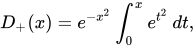


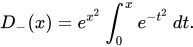
The Dawson function is the one-sided Fourier–Laplace sine transform of the Gaussian function,

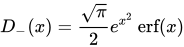
It is closely related to the error function erf, as

where erfi is the imaginary error function, erfi(x) = −i erf(ix).
Similarly,
in terms of the real error function, erf.
In terms of either erfi or the Faddeeva function the Dawson function can be extended to the entire complex plane:[3] which simplifies to for real

![{\displaystyle F(z)={{\sqrt {\pi }} \over 2}e^{-z^{2}}\operatorname {erfi} (z)={\frac {i{\sqrt {\pi }}}{2}}\left[e^{-z^{2}}-w(z)\right],}](https://wikimedia.org/api/rest_v1/media/math/render/svg/5e4707739a168d777d1f57cd944ce6872c9fd4c1)
![{\displaystyle D_{+}(x)=F(x)={\frac {\sqrt {\pi }}{2}}\operatorname {Im} [w(x)]}](https://wikimedia.org/api/rest_v1/media/math/render/svg/5263fe3be9abf87a3afe139c5b8c41e809fce58f)
![{\displaystyle D_{-}(x)=iF(-ix)=-{\frac {\sqrt {\pi }}{2}}\left[e^{x^{2}}-w(-ix)\right]}](https://wikimedia.org/api/rest_v1/media/math/render/svg/bc7a357d8241fa43ece147f1a877841d56529118)

For near zero, F(x) ≈ x. For large, F(x) ≈ 1/(2x). More specifically, near the origin it has the series expansion while for large it has the asymptotic expansion




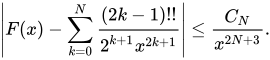
More precisely where is the double factorial.

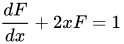
satisfies the differential equation with the initial condition Consequently, it has extrema for resulting in x = ±0.92413887... (OEIS: A133841), F(x) = ±0.54104422... (OEIS: A133842).


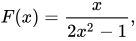
Inflection points follow for resulting in x = ±1.50197526... (OEIS: A133843), F(x) = ±0.42768661... (OEIS: A245262). (Apart from the trivial inflection point at )


Relation to Hilbert transform of Gaussian
[edit]The Hilbert transform of the Gaussian is defined as
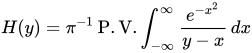
P.V. denotes the Cauchy principal value, and we restrict ourselves to real can be related to the Dawson function as follows. Inside a principal value integral, we can treat as a generalized function or distribution, and use the Fourier representation



With we use the exponential representation of and complete the square with respect to to find


![{\displaystyle \pi H(y)=\operatorname {Im} \int _{0}^{\infty }dk\,\exp[-k^{2}/4+iky]\int _{-\infty }^{\infty }dx\,\exp[-(x+ik/2)^{2}].}](https://wikimedia.org/api/rest_v1/media/math/render/svg/12890dc8ea10fe76bb211d705dbc25275718737d)
We can shift the integral over to the real axis, and it gives Thus

![{\displaystyle \pi ^{1/2}H(y)=\operatorname {Im} \int _{0}^{\infty }dk\,\exp[-k^{2}/4+iky].}](https://wikimedia.org/api/rest_v1/media/math/render/svg/1616202e4a1cd74e86616183e3e4a845aec1cc02)
We complete the square with respect to and obtain

![{\displaystyle \pi ^{1/2}H(y)=e^{-y^{2}}\operatorname {Im} \int _{0}^{\infty }dk\,\exp[-(k/2-iy)^{2}].}](https://wikimedia.org/api/rest_v1/media/math/render/svg/28fb5c23b8ffaa8bf82e0b03e78cc572c0b94305)
We change variables to
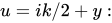

The integral can be performed as a contour integral around a rectangle in the complex plane. Taking the imaginary part of the result gives where is the Dawson function as defined above.


The Hilbert transform of is also related to the Dawson function. We see this with the technique of differentiating inside the integral sign. Let

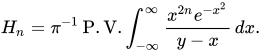
Introduce
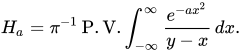
The th derivative is


We thus find
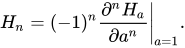
The derivatives are performed first, then the result evaluated at A change of variable also gives Since we can write where and are polynomials. For example, Alternatively, can be calculated using the recurrence relation (for )










See also
[edit]References
[edit]- ^ Temme, N. M. (2010), "Error Functions, Dawson's and Fresnel Integrals", in Olver, Frank W. J.; Lozier, Daniel M.; Boisvert, Ronald F.; Clark, Charles W. (eds.), NIST Handbook of Mathematical Functions, Cambridge University Press, ISBN 978-0-521-19225-5, MR 2723248.
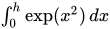
- ^ Dawson, H. G. (1897). "On the Numerical Value of ". Proceedings of the London Mathematical Society. s1-29 (1): 519–522. doi:10.1112/plms/s1-29.1.519.
- ^ Mofreh R. Zaghloul and Ahmed N. Ali, "Algorithm 916: Computing the Faddeyeva and Voigt Functions," ACM Trans. Math. Soft. 38 (2), 15 (2011). Preprint available at arXiv:1106.0151.
External links
[edit]- gsl_sf_dawson in the GNU Scientific Library
- libcerf, numeric C library for complex error functions, provides a function voigt(x, sigma, gamma) with approximately 13–14 digits precision. It is based on the Faddeeva function as implemented in the MIT Faddeeva Package
- Dawson's Integral (at Mathworld)
- Error functions Archived 2019-11-01 at the Wayback Machine
Dawson function
View on GrokipediaDawsonF[z], facilitate its evaluation and further study.[2]
Definitions and representations
Integral definition
The Dawson function, also known as Dawson's integral and denoted or , is fundamentally defined for real by the integral expression This form arises in contexts such as solutions to certain differential equations in physics and engineering, where the exponential weighting captures Gaussian-like behaviors modified by the quadratic phase. For , the function is extended oddly as , ensuring it remains an odd function across the real line. Closely related variants emphasize different exponential scalings: the positive form , which coincides with the primary definition of , and the negative form . These variants facilitate connections to other integrals, such as those involving the error function, though their primary utility lies in tailored applications like plasma dispersion or optical propagation.[2] An alternative integral representation expresses via the one-sided Fourier-Laplace sine transform of a Gaussian: [3] This form highlights the function's role in transform theory, particularly for analyzing damped oscillatory systems or spectral decompositions involving Gaussians. The definition extends analytically to the complex plane through , which defines an entire function holomorphic everywhere in the complex domain.[1]Relation to the imaginary error function
The Dawson function admits a closed-form expression in terms of the imaginary error function , given by where the imaginary error function is defined as and denotes the error function. For real arguments , this yields , an entire function that grows rapidly for large positive due to the exponential integrand, distinguishing it from the decaying behavior of . This relation positions the Dawson function within the broader family of error functions, facilitating its computation and analysis through established properties of , such as its series expansion and asymptotic behavior. A related variant, sometimes denoted , is defined as which connects directly to the standard error function and exhibits growth dominated by the prefactor for large .[2] This form arises in contexts requiring integrals of Gaussian decay weighted by exponential growth, complementing the primary Dawson function. The relation extends analytically to the complex plane, where the Dawson function is expressed as , an entire function preserving the core structure while enabling evaluations for complex arguments through the properties of .Mathematical properties
Differential equation
The Dawson function satisfies the first-order linear ordinary differential equation with the initial condition . This equation arises directly from the integral definition . Differentiating using the product rule and the fundamental theorem of calculus yields , which rearranges to the stated form. Given that the coefficients in the differential equation are continuous everywhere, the existence and uniqueness theorem for first-order linear initial value problems guarantees a unique solution on the entire real line, and this solution coincides with the Dawson function defined by the integral. Differentiating the first-order equation produces the related second-order form , which follows as a direct consequence and highlights the function's local behavior near the origin.[4]Power series expansion
The Maclaurin series expansion of the Dawson function about is The first few terms are This series can be derived from the integral definition by expanding within the integral, yielding , and then multiplying by the series . The resulting coefficients are obtained via the Cauchy product of the two series. Alternatively, the coefficients satisfy a recurrence derived from the differential equation with initial condition , allowing computation of higher-order terms recursively from lower ones. As the Dawson function is an entire function, the radius of convergence of this power series is infinite.[5] The series provides an efficient approximation for in the regime of small , where truncation after a few terms yields high accuracy.Asymptotic expansion
The asymptotic expansion of the Dawson function provides a useful approximation for large positive arguments, where the function decays like . Specifically, as , This series arises from repeated integration by parts applied to the defining integral representation of , yielding successively higher-order corrections to the leading behavior.[2] The general form of the expansion is where the coefficients in the sum are when expanded in powers of . This form can be derived from the known asymptotic expansion of the imaginary error function , given the relation .[2][6] The series is divergent for any finite , characteristic of asymptotic expansions, but truncation at the term just before the smallest absolute value yields high accuracy for sufficiently large , with the error bounded by the first omitted term. For , the odd symmetry implies .[2]Connections to other special functions
Hilbert transform relation
The Dawson function arises prominently as the Hilbert transform of the Gaussian function. Specifically, the Hilbert transform of the Gaussian , defined as where is the Dawson function and PV denotes the Cauchy principal value, establishes this direct link. Equivalently, in convolution notation, the relation can be expressed as with the convolution again understood in the principal value sense. This representation underscores the Dawson function's role in transform theory, particularly for functions supported on the real line. The connection gains further insight through the Fourier domain, where the Hilbert transform corresponds to multiplication of the Fourier transform by . The Fourier transform of the Gaussian is , another Gaussian; applying the Hilbert operator yields , whose inverse Fourier transform is . This frequency-domain perspective highlights how the Dawson function emerges as the imaginary part of the associated analytic signal formed by the Gaussian and its Hilbert transform pair. From this relation, the Dawson function inherits key properties of the Hilbert transform, including being an odd function—since the Gaussian is even—and supporting analytic continuation to the complex plane via the plasma dispersion function or related extensions. This tie to the Hilbert transform has positioned the Dawson function centrally in signal processing, where it facilitates the construction of analytic signals from real Gaussian-modulated waveforms.Faddeeva function relation
The Faddeeva function, defined as for complex , provides a key connection to the Dawson function . For , this relation is given by with the extension to following from the odd symmetry .[7] This expression leverages the analytic properties of , which is entire, to extend the Dawson function analytically to the complex plane beyond its original real-variable definition. An equivalent form arises through the imaginary error function , where , serving as an intermediary in derivations.[1] In plasma physics, the Dawson function relates directly to the plasma dispersion function , originally defined by Fried and Conte as the analytic continuation of the integral for . This function satisfies , and equivalently, For real arguments , the real part of involves the Dawson function as , which appears in the dispersion relations for longitudinal waves in hot plasmas. The imaginary part, meanwhile, captures Landau damping effects through the Gaussian term. The complex asymptotic expansion of the Faddeeva function for large with is where denotes the double factorial. Substituting into the relation for yields a corresponding expansion unique to this linkage: for large in the right half-plane, which aligns with the Dawson function's known behavior but highlights the complementary error function's role in terminating the exponential prefactor. Computationally, this relation is particularly useful for evaluating Voigt profiles in spectroscopy and plasma modeling, where the line shape is expressed as Efficient algorithms for , such as those using continued fractions or Laplace transforms, enable high-precision computation of via the linking formula, reducing numerical instability in complex domains compared to direct integration of the Dawson definition. This is especially beneficial for real-time simulations in plasma diagnostics, where Voigt convolutions model broadened spectral lines.[8]Numerical aspects
Computation methods
The Dawson function, denoted , is typically evaluated numerically using domain-specific algorithms to balance accuracy and efficiency across its range. For small arguments where , a truncated power series expansion provides high accuracy with minimal computational cost; the series is summed up to 10–15 terms, achieving relative errors below in double precision.[2][9] For large arguments where , asymptotic expansions are employed, often accelerated via continued fractions to mitigate divergence; the leading terms approximate , with optimal truncation at around terms yielding relative accuracies of or better before switching to the continued fraction form .[9][7] Uniform approximations over the real line rely on minimax rational functions, which minimize the maximum error; for instance, a Fourier-based rational form with 23 terms achieves relative accuracy exceeding for , expressed as with parameters , . Similar minimax polynomials on Chebyshev subintervals extend this to multiple-precision contexts, supporting up to 32 decimal digits.[10][9] Standard numerical libraries implement these methods for real arguments with double-precision accuracy (relative error ); SciPy'sdawsn function leverages the Faddeeva package for efficient evaluation via series and continued fractions.[11] The GNU Scientific Library (GSL) provides gsl_sf_dawson using analogous techniques, targeting full double precision.[12] MATLAB's dawson supports both numeric floating-point computation (via underlying approximations) and symbolic exact representation, with variable-precision arithmetic available through vpa.[13]
For complex arguments , the Dawson function is computed via its relation to the Faddeeva function , as ; algorithms combine continued fractions for large and Chebyshev or Taylor expansions near the real axis, achieving at least 13 significant digits in implementations like the Faddeeva package.[7][11]