Hubbry Logo
Rebound (basketball)Rebound (basketball)Main
Open search
Rebound (basketball)
Community hub
Rebound (basketball)
logo
8 pages, 0 posts
0 subscribers
Be the first to start a discussion here.
Rebound (basketball)
from Wikipedia

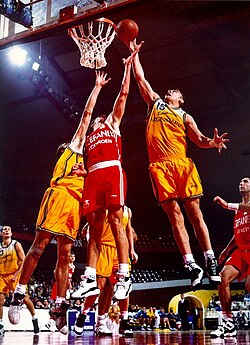
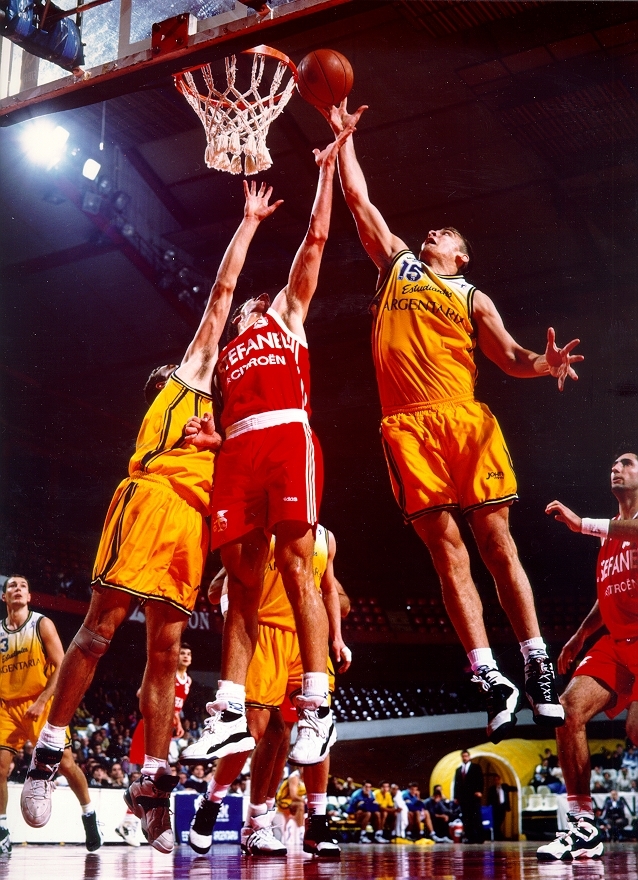
Iñaki de Miguel, Spanish basketball player, capturing a rebound in an international game.

In basketball, a rebound, sometimes colloquially referred to as a board,[1] is a statistic awarded to a player who retrieves the ball after a missed field goal or free throw.[2]

Rebounds in basketball are a routine part in the game; if a shot is successfully made possession of the ball will change, otherwise the rebound allows the defensive team to take possession. Rebounds are also given to a player who tips in a missed shot on their team's offensive end. A rebound can be grabbed by either an offensive player or a defensive player.

Rebounds are divided into two main categories: "offensive rebounds", in which the ball is recovered by the offensive side and does not change possession, and "defensive rebounds", in which the defending team gains possession. Most rebounds are defensive because the team on defense tends to be in better position (i.e., closer to the basket) to recover missed shots. Offensive rebounds give the offensive team another opportunity to score whether right away or by resetting the offense. A block is not considered a rebound.

After player with the #3 attempts a layup, player with the #1 gets an offensive rebound.

A ball does not need to actually "rebound" off the rim or backboard for a rebound to be credited. Rebounds are credited after any missed shot, including air balls which completely miss the basket and board. If a player takes a shot and misses and the ball bounces on the ground before someone picks it up, then the person who picks up the ball is credited for a rebound. Rebounds are credited to the first player that gains clear possession of the ball or to the player that successfully deflects the ball into the basket for a score. A rebound is credited to a team when it gains possession of the ball after any missed shot that is not cleared by a single player (e.g., deflected out of bounds after the shot, blocked out of bounds, bounced directly off the rim out of bounds). A team rebound is never credited to any player, and is generally considered to be a formality as according to the rules of basketball, every missed shot must be rebounded whether a single player controls the ball or not.

Josh Jackson and Jarrett Allen (#31) crash the offensive boards at the 2016 McDonald's All-American Boys Game.

Great rebounders tend to be tall and strong. Because height is so important, most rebounds are made by centers and power forwards, who are often positioned closer to the basket. The lack of height can sometimes be compensated by the strength to box out taller players away from the ball to capture the rebound. For example, Charles Barkley once led the league in rebounding despite usually being much shorter than his counterparts.

Some shorter guards can be excellent rebounders as well such as point guard Jason Kidd who led the New Jersey Nets in rebounding for several years. But height can also be an advantage for rebounding. Great rebounders must also have a keen sense of timing and positioning. Great leaping ability is an important asset, but not necessary. Players such as Larry Bird and Moses Malone were excellent rebounders, but were never known for their leaping ability. Bird has stated, "Most rebounds are taken below the rim. That's where I get mine".[3]

Boxing out

[edit]
Paul White (#13) and L. J. Peak (#10) box out D. J. Williams (#4) While Jahlil Okafor boxes out Jabari Parker on a Kendrick Nunn free throw during a Chicago Public High School League game between Simeon Career Academy and Whitney M. Young Magnet High School at the Jones Convocation Center

Players position themselves in the best spot to get the rebound by "boxing out"—i.e., by positioning themselves between an opponent and the basket, and maintaining body contact with the player he is guarding. The action can also be called "blocking out". A team can be boxed out by several players using this technique to stop the other team from rebounding. Because fighting for a rebound can be very physical, rebounding is often regarded as "grunt work" or a "hustle" play. Overly aggressive boxing out or preventing being boxed out can lead to personal fouls.

Statistics

[edit]

Statistics of a player's "rebounds per game" or "rebounding average" measure a player's rebounding effectiveness by dividing the number of rebounds by the number of games played. Rebound rates go beyond raw rebound totals by taking into account external factors, such as the number of shots taken in games and the percentage of those shots that are made (the total number of rebounds available).

Rebounds were first officially recorded in the NBA during the 1950–51 season. Both offensive and defensive rebounds were first officially recorded in the NBA during the 1973–74 season and ABA during the 1967–68 season.

New camera technology has been able to shed much more light on where missed shots will likely land.[4]

Notable rebounders in the NBA

[edit]
Wilt Chamberlain in 1960, when he averaged 27 rebounds per game.
  • Wilt Chamberlain – led the NBA in rebounds in 11 different seasons, has the most career rebounds in the regular season (23,924), the highest career average (22.9 rpg), the single season rebounding records in total (2,149) and average (27.2 rpg), most rebounds in a regular season game (55) and playoff game (41) in the NBA, and has the most career All-Star Game rebounds (197).[2]
  • Bill Russell – led the league in rebounding 4 times. He was the first player to average over 20 rebounds per game in the regular season, ranks second to Chamberlain in regular season total (21,620) and average (22.5) rebounds, averaged more than 20 rebounds per game in 10 of 13 seasons played, grabbed 51 rebounds in a single game (second best ever), grabbed a record 32 rebounds in one half, grabbed 40 rebounds in the NBA Finals twice, and is the all-time playoff leader in total (4,104) and average (24.9 rpg) rebounds.
  • Bob Pettit – averaged 20.3 rebounds per game in the 1960–61 season, his career average of 16.2 rebounds per game is third all-time, and holds the top two performances for rebounds in an NBA All-Star Game with 26 (in 1958) and 27 (in 1962).
  • Nate Thurmond – averaged more than 20 rebounds per game in two seasons (including 22.0 rpg in the 1967–68 season), career average of 15.0 rpg, and holds the regular season NBA record for rebounds in a single quarter with 18. He is also the only player besides Bill Russell, Wilt Chamberlain and Jerry Lucas to record more than 40 rebounds in a single game.
  • Jerry Lucas – averaged more than 20 rebounds per game in two seasons (including 21.1 rpg in the 1965–66 season), and had a career average of 15.6 rpg. Along with Russell, Chamberlain and Thurmond is one of only four players to grab at least 40 rebounds in a single game.
  • Moses Malone – led the NBA in rebounds per game in six different seasons including a high of 17.6 rpg in the 1978–79 season, ranks first in career offensive rebounds in the regular season (offensive and defensive rebounds were not recorded separately until the 1973–74 season), and ranks fifth all-time in total regular season rebounds in the NBA (third if ABA rebounds are also included).
  • Dennis Rodman – led the league in rebounds per game an NBA record 7 consecutive seasons, including a high of 18.7 rpg in the 1991–92 season. Rodman holds the top seven rebound rate seasons since the 1970–71 season. Rodman has the highest career rebounding average of any player since the NBA began recording offensive and defensive rebounds in 1973–74. The shortest on the list at 6'7".
  • Dwight Howard – only player to lead the NBA in rebounding three times before turning 25 years old. Howard has led the league in rebounding five times.
  • Andre Drummond — has led the NBA in rebounds per game in four different seasons. Drummond has the highest career rebounds per game average of any player to play in the 21st century.

See also

[edit]

References

[edit]
[edit]
Revisions and contributorsEdit on WikipediaRead on Wikipedia
from Grokipedia
In , a is the act of a player gaining possession of the live immediately after a missed or attempt, either by securing it directly or by tapping it to a teammate. This action is a core element of the game, as it directly controls which team retains or regains , often deciding the flow between offense and defense. Rebounds are classified into two primary types: offensive rebounds, where a member of the shooting team recovers the to create a second-chance scoring opportunity, and defensive rebounds, where a player from the opposing team secures the to end the current possession and initiate a or set play. Only one rebound—offensive or defensive—is credited per missed shot, regardless of multiple touches or taps, emphasizing the importance of the initial recovery in . Effective rebounding requires physical positioning, such as boxing out opponents to block their path to the , and is influenced by factors like player , jumping ability, and team strategy. The significance of rebounding cannot be overstated, as teams that dominate the boards typically control the game's tempo, generate more scoring chances through extra possessions, and limit opponents' opportunities, making it a key determinant of victory. In professional leagues like the NBA, elite rebounders often anchor team success by converting missed shots into points or preventing fast-break transitions, with data showing that superior rebounding margins correlate strongly with winning percentages. Rebounding also highlights the physical and hustle aspects of , rewarding aggression and teamwork in pursuing every loose ball.

Fundamentals

Definition

In basketball, a rebound occurs when a player gains control of the after a missed or free-throw attempt, by securing possession of the live . According to official NBA rules, an individual is credited each time a player retrieves a live or purposely taps a live to a teammate immediately following such a missed attempt, resulting in either an offensive (by the shooting team) or a defensive (by the opposing team); a team is awarded if the goes out of bounds without individual control. No is credited if possession is not gained due to a foul, violation, or the lodging on the . FIBA rules align closely, defining a rebound as the controlled recovery of a live by a player or team—or entitlement to a —after a missed attempt or the last free-throw attempt, including controlled tips to teammates or even opponents leading to out-of-bounds possession; exceptions apply if the period ends, a violation occurs before control, or the ball is not live after a non-last free throw. The basic mechanics of securing a rebound require jumping ability, precise timing to track the ball's trajectory, and hand-eye coordination to grasp it in mid-air or on the initial bounce off the rim, backboard, or floor. The term "rebound" in basketball derives from the ball's physical action of bouncing back after contacting the rim or backboard on a missed shot.

Types of Rebounds

In , rebounds are primarily categorized into two types: offensive and defensive, each with distinct characteristics and immediate effects on . An offensive rebound occurs when a member of the shooting team recovers the ball after their own missed shot, thereby extending the team's possession and creating a second-chance scoring opportunity. These opportunities often lead to higher-efficiency shots, such as put-backs near the rim, which historically convert at rates exceeding 60% in NBA play due to their proximity to the basket. In contrast, a defensive rebound is secured by a player from the non-shooting team following an opponent's , immediately ending the offensive possession and allowing the rebounding team to transition into their own attack, often via a . This type of rebound is crucial for regaining control and preventing extended opponent scoring runs, as it shifts momentum by initiating counterplay. Defensive rebounds typically occur after the initial shot attempt, whereas offensive ones follow a but prolong the original possession without resetting the shot clock fully. The key differences lie in their possession implications: offensive rebounds effectively grant an additional scoring chance without yielding control to the opponent, adding roughly one extra possession per successful recovery and boosting overall offensive efficiency by about 0.62 points per 100 possessions for each increase in rebounding rate. Defensive rebounds, however, terminate the opponent's chance and enable quick outlets for transition scoring, with long rebounds particularly favoring fast breaks due to the ball's distance from the . For instance, an offensive put-back exemplifies how these rebounds directly amplify scoring without a full reset. Boxing out, as detailed later, aids in securing either type by establishing position. Rebounds can also vary by distance as short or long variants, influencing . Short rebounds, typically from close-range shots, land near the rim and can often be controlled by a single player, favoring quick put-backs in offensive scenarios. Long rebounds, resulting from longer attempts like three-pointers, bounce farther out and require multiple players to cover dispersed areas, strategically benefiting defenses in transition but challenging offensive recoveries.

Techniques

Boxing Out

Boxing out, also known as blocking out, is a fundamental rebounding technique in basketball where a player positions their body between an opponent and the basket to seal off access to potential rebounds. This maneuver creates a physical barrier, often described as forming a "box" with the defender's wide stance, bent knees for a low center of gravity, and extended arms to maintain space without fouling. The technique is primarily defensive but can also be used offensively to block trailing defenders. By establishing this position immediately after a shot, the player gains a territorial advantage near the rim, allowing teammates to pursue the ball more effectively. The execution follows a structured to ensure legal and effective contact. First, upon the shot , the player locates their assigned opponent and pivots to face the while keeping their back to the opponent for contact. Next, they establish an athletic base by spreading their feet shoulder-width apart, bending at the knees, and extending arms outward or upward to create separation, avoiding illegal actions like reaching over the opponent's back. Contact is maintained through the hips and shoulders to "bump" the opponent away from the , but NBA rules prohibit displacing a legally positioned player, using an arm bar to impede progress, or excessive force such as pushing or holding, which result in a personal foul. Finally, as the ball rebounds, the player explodes upward with both hands extended, securing it while protecting it with elbows out to prevent swipes. This sequence emphasizes anticipation and body control to transition quickly to an outlet pass. The concept of boxing out emerged in the mid-20th century as professional basketball emphasized structured rebounding amid growing physicality in the post-World War II era. It gained prominence through influential coaches like , who integrated it into the ' defensive schemes during the 1950s and 1960s, often demonstrating it with players like to stress low stances, hand control, and arm extension for optimal rebounding. Auerbach's instructional series "Red on Roundball" further disseminated the technique in the 1970s, highlighting its role in championship defenses. Variations adapted for player matchups include "fronting," where smaller defenders position themselves in front of taller opponents to deny interior access and force rebounds outward, reducing the need for direct physical sealing. Teams that prioritize boxing out see measurable gains in rebounding efficiency, with NBA analytics indicating successful implementation can improve defensive rebound percentage by several points, elevating team figures from around 72% to elite levels above 75% for top performers. This improvement stems from better territorial control, leading to more possessions and limiting second-chance opportunities for opponents. For instance, players like have been shown to raise their team's defensive rebounding rate by several percentage points through consistent boxing out, underscoring its tactical value in high-stakes games.

Positioning and Pursuit

Effective rebounding begins with pre-rebound positioning, where players anticipate the shot's arc to predict the ball's and establish legal inside position near the . By observing the shooter's release angle and distance, rebounders can forecast common rebound patterns, such as long bounces from three-point attempts that often carom to the opposite side of the rim. This allows defenders to align along the NBA's charge/block arc in the , positioning themselves to without committing fouls. In the NBA, maintaining verticality—jumping straight up without leaning into or over an opponent—is crucial to legally secure inside position and avoid over-the-back fouls, which occur when a player reaches across the vertical plane of an established rebounder, resulting in illegal contact. Following a proper box out, this setup enables seamless transition to pursuit. Pursuit techniques emphasize aggressive movement once the shot is released, with "crashing the boards" involving explosive drives toward the rim to outmaneuver opponents and attack the ball's path. Rebounders read caroms off the rim or backboard by analyzing the shot's origin; for instance, baseline shots typically rebound to the opposite baseline, while straight-on attempts bounce back toward the shooter, with about 75% of misses deflecting away from the shooter. Using , players simultaneously track the ball's flight and nearby opponents, allowing early adjustments in direction without losing sight of potential threats. Advanced skills enhance contested rebound opportunities, such as executing tip-ins—where a player taps a missed shot directly into the basket for two points—or performing loose-ball dives to secure errant bounces in traffic. A tip-in credits the initial tapper with a if it leads to possession, emphasizing quick hand-eye coordination under pressure. Loose-ball dives require players to extend fully across the floor, prioritizing body control to avoid injury while gaining possession. Training drills, including rebounding machines that simulate variable shot angles and speeds, help develop timing and reaction for these scenarios by providing repetitive, high-volume practice. Player archetypes for rebounders typically feature significant , with NBA power forwards averaging 6 feet 8 inches and centers around 6 feet 11 inches, enabling reach advantages in crowded spaces. A longer , often exceeding by several inches, correlates with superior rebounding by allowing players to contest balls farther from the body without . Athleticism, particularly vertical leap and lateral quickness, further amplifies these physical traits, as seen in players who combine explosiveness with positioning to dominate the glass.

Strategic Importance

Role in Offense and Defense

In basketball, offensive rebounds play a pivotal role in enhancing a team's scoring opportunities by generating second-chance points, which typically account for approximately 12-15% of a team's total in modern NBA games. These additional possessions often lead to high-efficiency putback attempts, with an average points per possession (PPP) of around 1.14 for such shots, compared to 0.96 for standard half-court plays. By securing offensive rebounds—such as those from missed shots near the —teams can extend possessions and create momentum swings, turning potential turnovers into quick scoring sequences that disrupt defensive rhythm and boost offensive flow. On the , securing rebounds is essential for regaining possession and initiating transition offense, often through outlet passes that exploit fast-break opportunities. Defensive rebounds enable teams to limit opponents' second-chance scoring, effectively reducing the opponent's efficiency by denying extra possessions worth about 1.08-1.09 PPP on average. For instance, a strong defensive rebounding effort allows for immediate outlet passes to guards sprinting up the floor, leading to transition plays where teams can score at higher rates—often 1.2 PPP or more—while preventing the offense from resetting. This not only stabilizes the defense by ending the opponent's possession but also shifts the game tempo in favor of the rebounding team, curbing opponent efficiency and fostering counterattacks. Rebound margin serves as a critical strategic balance in team play, strongly correlating with overall win probability as one of Dean Oliver's Four Factors of success. Teams that maintain a positive rebound margin, particularly outperforming opponents by several boards per game, see improved point differentials and higher win rates, with rebounding efficiency contributing significantly to outcomes alongside shooting and turnovers. In the NBA, a superior rebounding edge—such as outrebounding opponents consistently—predicts greater control over possessions, directly influencing game dominance. The strategic emphasis on rebounding has evolved from the physical, interior-focused play of the , characterized by aggressive crashing of the offensive glass amid slower paces and dominance, to the modern era's spacing-driven game influenced by the three-point revolution. Since the , offensive rebounds have declined while defensive rebounds have risen, as teams prioritize floor spacing for three-point attempts, which often result in longer rebounds that favor quick transitions over physical battles under the basket. As of the 2024-25 season, teams continue to adapt, with some showing increased focus on offensive rebounding amid ongoing three-point emphasis. This shift has elevated the value of pursuing long rebounds, adapting rebounding strategies to complement perimeter-oriented offenses and enhance transition efficiency in today's faster-paced NBA.

Impact on Game Outcomes

Rebounding performance significantly influences game outcomes in , with a positive rebound differential—where a team secures more s than its opponent—strongly correlated to higher win percentages. According to Dean Oliver's Four Factors of Basketball Success, rebounding accounts for 20% of a team's in winning games, alongside , turnovers, and free throws, making it a key predictor of overall success. of NBA regular season data shows that defensive rebound differences exhibit a strong positive linear with win percentages, while offensive rebound differences show little to no correlation, underscoring how controlling the boards limits second-chance opportunities for opponents and extends possessions for the winning team. Teams maintaining a positive rebound margin throughout the season are more likely to achieve playoff success, as this metric reflects sustained control over possessions and defensive solidity. Advanced metrics like rebound percentage (REB%), which measures a team's share of available rebounds independent of game tempo or pace, provide deeper insight into this impact. Offensive REB% is particularly valuable, as it directly translates to additional scoring chances; for instance, each percentage point increase in offensive rebounding rate improves offensive efficiency by approximately 0.62 points per 100 possessions. Teams exceeding the league average offensive REB% of around 25-27% gain a substantial edge, often boosting their scoring output by 3-5 points per game through second-chance points and extended possessions. This tempo-independent stat highlights why elite rebounding units can overcome shooting inefficiencies or turnovers, directly contributing to higher win rates and deeper playoff runs. Case studies from NBA history illustrate rebounding's role in championship outcomes. In the 2010s, the employed small-ball lineups lacking traditional size but excelled in rebounding through aggressive positioning and pursuit, allowing them to outrebound larger opponents and secure multiple titles despite physical disadvantages. Similarly, the ' dominance in the was amplified by their superior rebounding control, which provided extra possessions and defensive stops en route to six championships in eight years. These examples demonstrate how strategic rebounding can tip the scales in high-stakes series, turning marginal advantages into decisive victories. In international play under FIBA rules, rebounding's importance is amplified due to the faster pace and emphasis on efficient possessions, where a 24-second demands quick transitions and limits recovery time after misses. This global context reinforces rebounding's universal role in dictating game flow and outcomes across variants.

Statistics and Records

Measurement and Tracking

In professional leagues such as the NBA and FIBA-governed competitions, rebounds are officially recorded by on-court statisticians who credit an individual rebound to the player who first secures clear possession of the live ball—typically with two hands—or who purposely taps the ball to a teammate immediately following a missed or free throw attempt. This criterion ensures that only definitive control or intentional deflection leading to possession is recognized, distinguishing rebounds from incidental touches. Total rebounds for a player or are calculated as the sum of offensive rebounds, awarded to the shooting upon regaining possession, and defensive rebounds, credited to the opposing . FIBA follows a comparable protocol, where rebounds are categorized as offensive or defensive based on the securing control after a missed shot, though rebounds may also be recorded when the ball goes out of bounds without individual possession. Key performance metrics for rebounds include rebounds per game (RPG), which simply averages the total rebounds accumulated by a player or across , providing a basic measure of volume. A more advanced indicator is rebound percentage (REB%), which estimates a player's or 's efficiency by calculating the proportion of available rebounds they secure while on the ; the is REB% = (player rebounds / total available rebounds during playing time) × 100, where available rebounds represent all missed shots not resulting in fouls or out-of-bounds plays. These statistics help contextualize rebounding impact relative to opportunities, rather than absolute counts influenced by pace or minutes played. The tracking of rebounds has evolved significantly from manual methods to sophisticated digital systems. The tracking of rebound statistics in the (NBA) has been part of official records since the league's early years, with comprehensive data available from the 1946-47 season. Prior to the , NBA statisticians relied on handwritten box scores and visual observation during games to log basic rebound data, a process prone to human error and limited in depth. By the early , video analysis tools like Synergy Sports emerged, enabling detailed breakdowns of rebound plays through tagged footage that links statistics to specific on-court actions, revolutionizing scouting and coaching reviews. Modern advancements include optical tracking technologies, such as the NBA's implementation of player and ball tracking data starting in the 2013-14 season via SportVU cameras in every arena, which capture positional data at 25 frames per second to quantify rebound pursuits, box-out effectiveness, and recovery paths. This system transitioned to Second Spectrum as the league's official provider beginning in the 2017-18 season, enhancing analytics with for predictive rebound modeling. Despite these improvements, traditional rebound statistics have limitations, particularly in accounting for collaborative efforts like sequential tips or deflections—analogous to "hockey assists"—where intermediate players contribute to the final possession without receiving credit, as only the player achieving control or the purposeful final tap is awarded the . Advanced tracking mitigates some gaps by analyzing trajectories and multiple interactions, but official box scores remain focused on singular possession events.

Historical Records and Milestones

The tracking of rebound statistics in the (NBA) has been part of official records since the league's early years, with comprehensive data available from the 1946-47 season, enabling the formal recording of individual and team rebounding achievements. This has defined rebounding excellence, with early eras featuring high totals due to slower pace, higher shot volumes, and different officiating standards. Wilt Chamberlain holds the NBA record for the most rebounds in a single game, grabbing 55 against the on November 24, 1960. In a more recent example, Jusuf Nurkic recorded 29 rebounds in a game against the on March 19, 2019, tying for the highest total in the league since 2000. For seasonal averages, Chamberlain also set the benchmark with 27.2 rebounds per game during the 1960-61 season for the Warriors. The Warriors established the team record for rebounds per game in a single season with 65.0 during 1961-62. Career leaders underscore the dominance of early big men, with Chamberlain amassing 23,924 total rebounds across his tenure, the all-time high. ranks second with 21,620 career rebounds, achieved over 13 seasons primarily with the Celtics. Over time, league-wide rebounding has trended downward, with team averages around 50-65 rebounds per game in the early but falling to around 43-44 in the 2020s, influenced by improved shooting efficiency, the rise of three-point shooting, and faster pace of play. As of the 2024-25 season, the league average stands at approximately 43.5 rebounds per team per game.

Notable Rebounders

NBA Pioneers

In the formative years of the (NBA), rebounding emerged as a cornerstone of team success, with pioneering centers leveraging physical prowess and strategic foresight to dominate the boards. , playing for the from 1956 to 1969, epitomized this era's defensive revolution through his exceptional rebounding anticipation, averaging 22.5 rebounds per game over his career while securing 11 NBA championships. His ability to read plays and position himself for rebounds not only bolstered the Celtics' dynasty but also transformed defensive schemes, emphasizing mobility and anticipation over static positioning. Russell's impact extended beyond statistics, as his rebounding efficiency—peaking at 24.7 rebounds per game in the —helped establish rebounding as a key metric for championship contention. Wilt Chamberlain further elevated rebounding's prominence during the 1960s, showcasing unparalleled physical dominance that redefined the center position. Over his 14-season career, Chamberlain averaged 22.9 rebounds per game, leading the league in multiple seasons and amassing a record 23,924 total rebounds. In the 1961-62 season, he averaged 25.7 rebounds per game alongside his record 50.4 points per game, highlighting his control over the paint in an era of slower, more physical contests. Chamberlain's rebounding feats included a single-game record of 55 rebounds against the Boston Celtics on November 24, 1960, and numerous 40-plus rebound performances, which underscored his athletic superiority and forced opponents to adapt tactically. His dominance prompted NBA rule adjustments, such as widening the lane in 1964 to reduce his scoring and rebounding efficiency near the basket. Nate Thurmond, though slightly undersized at 6 feet 11 inches for a , exemplified tenacity and versatility in rebounding during the late 1960s and early 1970s. Known for his relentless pursuit and defensive intensity, Thurmond averaged 15.0 rebounds per game across his 13-year career, with a peak of 19.7 in the 1968-69 season while playing for the Warriors. His rebounding prowess was on full display in his debut with the on October 18, 1974, when he recorded the NBA's first official quadruple-double: 22 points, 14 rebounds, 13 assists, and 12 blocks against the . Despite competing against taller giants like Chamberlain and Russell, Thurmond's quickness and work ethic made him a perennial and rebounding leader, grabbing 42 rebounds in a single game—the third-highest total in NBA history. The pre-1970s NBA era was characterized by rugged, physical play that heavily favored towering big men, as slower paces and fewer three-point attempts allowed centers to control the interior. Rebounders like Russell, Chamberlain, and Thurmond thrived in this environment, where battles under the basket often determined possession and scoring opportunities, with teams averaging over 130 but relying on second-chance points from offensive rebounds. Their collective dominance contributed to key rule evolutions, including the 1951 ban on offensive goaltending to prevent big men from swatting shots off the rim after release, and subsequent lane expansions to curb their paint control. These changes, initially prompted by earlier pioneers like , were refined in response to the 1960s stars, balancing physicality with competitive flow and paving the way for modern rebounding strategies.

Contemporary Standouts

In the late 20th century, emerged as a quintessential rebounding specialist, renowned for his career average of 13.1 rebounds per game across 14 NBA seasons, primarily with the and . His mastery of boxing out opponents to establish position and relentless pursuit of the ball, often studying opponents' shooting tendencies to anticipate rebound locations, helped him secure five NBA championships—two with the Pistons in and , and three with the Bulls from to 1998. Rodman's approach exemplified the physical, anticipatory style that defined rebounding during the 1980s and 1990s transition toward faster-paced play. Entering the 2000s, built on this foundation as a dominant interior force, peaking at 14.2 rebounds per game during the 2007-08 season with the , where he led the league in rebounding. Howard's rebounding prowess was integral to his three consecutive NBA Defensive Player of the Year awards from 2009 to 2011, as his ability to secure defensive boards and limit second-chance opportunities anchored elite defenses during his prime from 2004 to 2016. His athleticism and timing allowed him to control the paint in an era increasingly emphasizing perimeter defense. In the 2020s, players like and represent the evolution of rebounding amid heightened pace and spacing. Gobert, a four-time Defensive Player of the Year, has led the NBA in total rebound percentage multiple times, including a league-high 23.3% in the 2020-21 season and topping total rebounds per game at 14.7 in 2021-22, leveraging his length for contested boards. Jokić, meanwhile, has showcased versatile offensive rebounding, averaging 13.8 rebounds per game in the 2021-22 season—his highest to date—while using positioning and vision to convert misses into transition opportunities, contributing to the ' 2023 championship. Contemporary rebounders have adapted to the three-point era's emphasis on pace-and-space offenses, where increased long-range attempts produce more extended rebounds that favor quick pursuit over static positioning. This shift prioritizes switchable bigs capable of guarding multiple positions while crashing the glass, reducing risks of transition breakdowns. International influences are evident in Jokić's style, honed in Serbia's Adriatic League—a EuroLeague feeder system—where big men develop advanced passing and rebounding instincts beyond traditional post play.

References

Add your contribution
Related Hubs
User Avatar
No comments yet.