Hubbry Logo
Demand draftDemand draftMain
Open search
Demand draft
Community hub
Demand draft
logo
8 pages, 0 posts
0 subscribers
Be the first to start a discussion here.
Demand draft
Demand draft
from Wikipedia
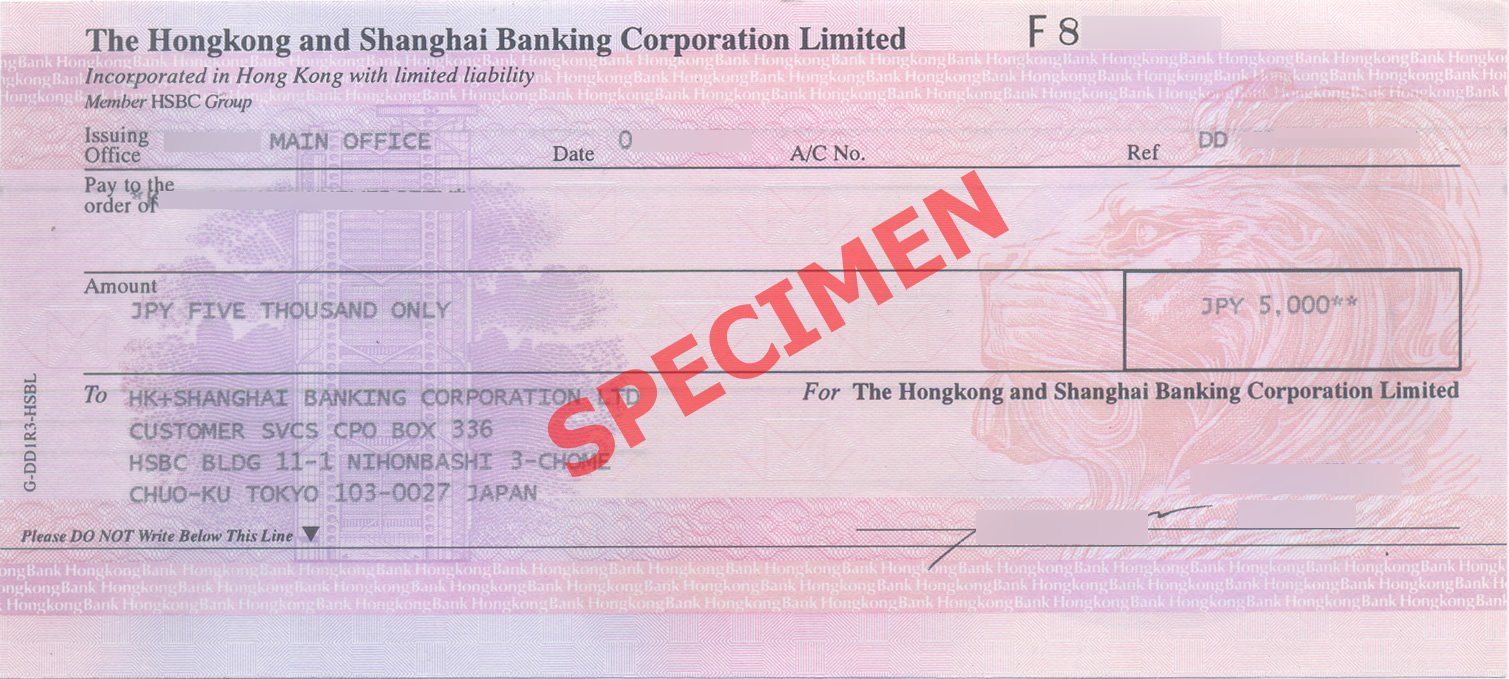
A specimen demand draft

A demand draft (DD) is a negotiable instrument similar to a bill of exchange. A bank issues a demand draft to a client (drawer), directing another bank (drawee) or one of its own branches to pay a certain sum to the specified party (payee).[1][2]

A demand draft can also be compared to a cheque. However, demand drafts are difficult to countermand or revoke. Cheques can also be made payable to the bearer. However, demand drafts can only be made payable to a specified party, also known as pay-to-order. Demand drafts are usually orders of payment by a bank to another bank, whereas cheques are orders of payment from an account holder to the bank. A Drawer has to visit the branch of the Bank and fill the demand draft form and pay the amount either by cash or any other mode, and Bank will issue a demand draft. A demand draft has a validity of three months from the date of issuance of the demand draft. For instance, when enrolling in a college, an admission fee is required which can be paid through either cash or a demand draft. However, cheques are generally not accepted by most colleges. The primary reason behind this is that demand drafts are considered as a safer payment method than cheques, as the drawee is required to pay the amount indicated before the demand draft is released from the bank. On the other hand, a cheque may not be genuine, since the drawee is uncertain whether the drawer's bank account contains the required funds specified on the cheque. It is not compulsory for the drawer to be a bank customer and a demand draft comes with an official stamp for added authenticity. [1]

Definitions and regulations by region

[edit]

Demand drafts are also known as sight drafts, as they are payable when presented by sight to the bank.[2] Under UCC 3-104, a draft has been defined as a negotiable instrument in the form of an order.[2][3] The person making the order is known as the drawer and the person specified in the order is called the drawee, as defined in the UCC 3–103. The party who creates the draft is called the maker, and the party who is ordered to pay is called the drawee.[2][4]

In the United States, remotely created cheques are also referred to as demand drafts. Remotely created cheques are orders of payment created by the payee and authorized by the customer remotely, using a telephone or the internet by providing the required information including the MICR code from a valid cheque. They do not bear the signatures of the customers like ordinary cheques. Instead, they bear a legend statement "Authorized by Drawer". This type of instrument is usually used by credit card companies, utility companies, or telemarketers. Remotely created cheques are susceptible to fraud, however.[5][6]

See also

[edit]

References

[edit]
Revisions and contributorsEdit on WikipediaRead on Wikipedia
from Grokipedia
A demand draft (DD), also known as a bank draft in some countries, is a prepaid negotiable issued by a on behalf of a (the drawer), instructing another or (the drawee) to pay a specified amount to the named payee on demand. Unlike personal checks, it guarantees because the funds are prepaid and held by the issuing , reducing the risk of dishonor. Demand drafts, also known as bank drafts in some countries, are widely used for secure transactions globally, with particular prevalence in regions like , where they serve as a reliable alternative to cash or checks for high-value payments. In , demand drafts are governed by the , as a type of bill of exchange payable on demand. Demand drafts are typically valid for three months from the date of issue. There are two main types: sight demand drafts, payable immediately upon presentation with necessary documents, and time demand drafts, payable after a specified period. Cancellation is possible before presentation by submitting a written request to the issuing bank along with the original DD and paying any applicable fees (typically ₹100–₹300). For lost or stolen DDs, a police FIR, bond, and bank verification are required, with refund or duplicate issuance possible after a 6–8 week waiting period or if needed. Demand drafts are particularly valued for their security and convenience in scenarios such as real estate purchases, educational fee payments, or remittances to unfamiliar parties, as they cannot be easily forged or dishonored due to the bank's guarantee. Compared to checks, they are issued solely by banks, incur issuance charges (typically 0.1–0.5% of the amount or flat fees), and generally offer no stop-payment option, making them ideal for transactions requiring assured payment without the drawer's direct involvement. While slower than electronic transfers, they provide a physical, verifiable method for cross-bank or inter-city payments, enhancing trust in financial dealings.

Definition and Characteristics

Definition

A demand draft (DD) is a prepaid, issued by a on behalf of a , directing another or branch to pay a specified sum of to the payee upon presentation. Unlike other methods that rely on post-dated or conditional fulfillment, the funds are debited from the 's account in advance, ensuring the 's of . The key parties in a demand draft transaction include the drawer, who is the initiating the request and providing the necessary funds to the ; the drawee, typically the paying or its responsible for honoring the draft; and the payee, the designated recipient entitled to the specified amount. This structure facilitates secure transfers without the drawer's direct involvement in the payment execution. A demand draft functions as a type of bill of exchange, payable either on sight (immediately upon presentation to the drawee) or after a specified period, depending on the type. Under relevant legal frameworks, such as the in , it qualifies as a bill of exchange by containing an unconditional order for payment signed by the issuing authority. As a , a demand draft can be endorsed by the payee to transfer ownership to another party, allowing it to circulate similarly to other bills of exchange or promissory notes. , demand drafts are akin to cashier's checks, both providing assured through issuance.

Key Features

A demand draft is characterized by its prepayment requirement, wherein the purchaser must deposit the full amount with the either by debiting their account or paying in upfront, thereby eliminating the risk of insufficient funds and ensuring the instrument's reliability. This feature distinguishes it from other methods like personal checks, as the guarantees solely based on the prepaid funds. Once issued, a demand draft is generally irrevocable, meaning it cannot be canceled unilaterally by the purchaser without the payee's or a , providing assurance to the recipient against arbitrary . Sight demand drafts are payable on demand, with no fixed maturity date; upon presentation to the drawee , must be made immediately, facilitating prompt transactions. As a under relevant banking laws, it can be transferred to another party via endorsement. Security is enhanced through various elements, including the issuing bank's unconditional , unique serial numbers for tracking, and physical designs such as watermarks, security threads, and tamper-evident to deter and counterfeiting. drafts typically have a validity period of three months from the date of issuance, after which they expire and require revalidation or replacement to be honored. This timeframe, established by guidelines, balances usability with the need to prevent stale instruments.

History

Origins in Banking

Demand drafts emerged in the 19th century as an evolution of the medieval bill of exchange, a commercial instrument originating in 13th-century among Florentine s to facilitate trade without transporting coinage. These early bills allowed one party to order payment from another in a distant , often through merchant networks, and by the , they had developed into more standardized forms that could circulate as transferable debt obligations. With the rise of commercial banking in during the early 1800s—particularly in Britain and , where institutions like the and joint-stock banks expanded—bills payable on sight (immediately upon presentation) were increasingly drawn on banks, formalizing the demand draft as a secure, bank-guaranteed payment tool distinct from time-based bills. British banking practices significantly influenced the global adoption of demand drafts, exporting the instrument through colonial systems. In , under British rule, the Negotiable Instruments Act of codified demand drafts as a type of sight bill of exchange, defining them as orders to pay a specified sum on demand and integrating them into the legal framework for transferable instruments. This legislation, modeled on English mercantile law, standardized the use of bank-drawn drafts for domestic and cross-border transactions in the , ensuring their negotiability by endorsement and protecting against forgery through prescribed stamping requirements. In the United States, parallels to demand drafts appeared during the national banking era following the National Banking Acts of 1863 and 1864, which established a uniform currency and correspondent banking networks. Bank drafts—essentially sight orders drawn by one bank on its reserves at another—served as a primary mechanism for settlements, circumventing the delays and risks of check clearing in a fragmented system without a . By the , these drafts were widely used by national banks in regional centers to transfer funds to hubs like New York, supporting wholesale trade while minimizing the need for physical specie transport. Demand drafts played a crucial role in 19th-century by enabling secure remittances across borders in an era predating electronic transfers. Merchants and banks relied on them to settle transactions, particularly in Europe-dominated global , where sight drafts on reputable institutions reduced risk and facilitated payments for commodities like and without the vulnerabilities of carrying or unbacked promises. Standardized forms of these instruments proliferated in the late 1800s, with clearinghouses in and New York handling billions in draft volumes annually by the , underscoring their efficiency in linking distant markets.

Modern Development

Following , demand drafts saw widespread adoption in developing economies such as during the mid-20th century, becoming a standard secure instrument for domestic and cross-border payments as banking networks expanded under nationalized systems in the 1950s and 1960s. In more broadly, similar growth occurred amid post-war economic reconstruction, with demand drafts facilitating reliable fund transfers in regions like South and Southeast Asia where formal banking infrastructure was developing rapidly. Technological advancements significantly shaped the evolution of demand drafts, particularly through the introduction of (MICR) encoding. Globally, MICR was adopted in the by institutions like the to accelerate check and draft processing by enabling machine-readable data. In , the implemented MICR technology in the to modernize clearing for paper-based instruments, including demand drafts, reducing manual errors and settlement times from days to hours at dedicated clearing houses. This innovation persisted into the 2000s, even as electronic systems like the (NEFT, launched 2005) and (RTGS, launched 2004) led to a partial decline in demand draft usage, shifting many transactions to digital channels while retaining drafts for high-value, secure needs. In the United States, demand drafts evolved into what is commonly termed a , formalized under the (UCC) Article 3 in its 1962 official revision, defining it as a draft where the drawer and drawee are the same bank, ensuring immediate fund availability. Across Europe, demand drafts and similar paper instruments were increasingly integrated into or supplanted by the (SEPA) framework starting in the late 2000s, with SEPA credit transfers launched in 2008 and direct debits in 2009, promoting standardized electronic payments by the and phasing out many cross-border paper-based methods. As of 2025, demand drafts continue to experience a usage decline in favor of solutions like UPI and instant transfers, though physical and hybrid digital variants—requested via banking apps for delivery—remain essential for legal, , and high-value applications where verifiable paper trails are required. Regulatory oversight has intensified for anti-money laundering purposes, with the mandating purchaser names on all demand drafts since 2018 to curb misuse in illicit fund flows.

Issuance and Usage

Process of Obtaining a Demand Draft

To obtain a demand draft (DD), the customer must first apply at the issuing bank, either in person at a branch or through online banking services. In the offline process, the applicant visits the bank branch, requests a DD application form, and completes it with essential details including the payee's name, the amount in both figures and words, the date, and the payable branch or location. Non-account holders typically pay the principal amount in cash (up to a limit such as Rs. 49,999 in India to comply with cash transaction rules), while account holders can opt for debit from their savings or current account; additional issuance fees, ranging from Rs. 1.50 to Rs. 4 per thousand of the amount plus service tax, must also be paid upfront. For online applications, the customer logs into the bank's internet banking portal, navigates to the "Requests" or "Enquiries" section, selects "Issue Demand Draft," chooses the linked account for debit, enters the payee details, amount, branch code for payment, and delivery preference (self-pickup or courier), then authorizes the transaction. This prepayment ensures the funds are secured before issuance. Upon submission, the verifies the application details, confirms the availability of funds through or account debit, and conducts any necessary know-your-customer (KYC) , such as reviewing identification documents like or PAN for Indian applicants. If approved, the issues the DD on secure featuring a unique , the , and official signatures or stamps from authorized personnel; the applicant receives the physical DD along with a containing the DD number, date, and amount for record-keeping. Issuance is typically immediate for the same-branch payable DDs, but for those payable at a different (cross-branch), processing may take 1-2 days to prepare and dispatch. The DD is non-transferable unless specified as payable to bearer and must be handed directly to the intended payee. The payee then presents the DD for payment at the drawee bank, which is usually a branch of the issuing bank specified on the instrument. The payee endorses the DD on the reverse side and deposits it into their own account or requests immediate encashment, providing identification if required for sight DDs. Domestically, clearance and crediting occur within 1-3 business days through the clearing house system, though this can extend to several days for inter-bank or remote locations; internationally, the process may take longer, often 7-10 days, due to correspondent banking arrangements. The DD remains valid for 3 months from the date of issue, after which it expires unless revalidated. If the DD is lost, stolen, or needs cancellation before presentation, the purchaser must notify the immediately in writing, providing the DD number, amount, date, payee details, and reason, along with the original . For undelivered or unused DDs, the original instrument must be surrendered; if lost, an bond on stamp paper () is required, affirming non-encashment and agreeing to compensate the for any claims, plus a non-liability undertaking from the payee if applicable. Cancellation fees typically range from Rs. 100 to Rs. 300, and the refunded amount is credited back to the purchaser's account after verification, which may take 1-2 weeks. Revalidation for an expired DD involves a similar written request to the issuing branch within the , allowing a one-time extension of another 3 months upon approval and fee payment, but only if not previously presented. Duplicate issuance for lost DDs follows the same process and incurs additional charges.

Common Applications

Demand drafts are frequently employed for high-value secure payments where the risk of insufficient funds associated with cheques is a concern, such as in transactions, purchases, and tuition fee payments. In deals, buyers often use demand drafts to provide sellers with guaranteed payment for transfers, ensuring the transaction proceeds without delays due to bounced payments. Similarly, for acquisitions, particularly in markets like , demand drafts serve as a reliable instrument to settle purchase amounts securely, minimizing risks in cash-heavy dealings. Educational institutions commonly require demand drafts for tuition fees, as they confirm the availability of funds upfront, which is essential for processing enrollments in both domestic and international programs. In government and institutional contexts, demand drafts are mandated for payments requiring assured funds, including visa applications, court fees, and utility deposits. For visa processing, embassies such as those of the and in accept demand drafts payable in to cover application fees, providing a verifiable . fees in , particularly for consumer disputes and civil filings, are often paid via demand drafts to facilitate official processing without reliance on personal cheques. Utility companies in regions like also utilize demand drafts for security deposits, ensuring immediate fund availability for new connections in or services. Demand drafts play a key role in international remittances, especially for foreign currency transfers related to overseas education and immigration, with prominent usage in countries like India and China. In India, students and immigrants frequently obtain foreign currency demand drafts from banks to pay tuition or visa-related fees abroad, offering a cost-effective alternative to wire transfers for mid-sized amounts. Similarly, in China, major banks such as the Agricultural Bank of China and Bank of China issue foreign exchange demand drafts for outward remittances, enabling secure payments for educational expenses or immigration processes overseas. For business transactions, are ideal for supplier payments in scenarios involving low trust between parties, particularly for mid-sized amounts where fees may be prohibitive. Companies use them for remote customer payments and inter-bank transfers, guaranteeing settlement without the need for direct account access, which is common in financing. This application is especially prevalent in , where demand drafts facilitate timely payments to overseas suppliers while avoiding higher costs associated with electronic methods.

Advantages and Disadvantages

Benefits

Demand drafts offer guaranteed payment because they are prepaid instruments issued by a on behalf of the payer, with funds deducted immediately from the payer's account, ensuring the assumes full liability and eliminating the risk of dishonor due to insufficient funds. This design inherently reduces fraud risks associated with unauthorized alterations or attempts, as the draft cannot be easily tampered with once issued. The convenience for recipients stems from the demand draft's role as proof of committed funds, enabling quicker acceptance in scenarios requiring verifiable payment assurance, such as secure transactions. Recipients do not need an account with the issuer's to encash the draft, broadening accessibility and simplifying the process without additional banking relationships. This prepayment mechanism further enhances reliability by confirming availability upfront. Demand drafts can be cost-effective for domestic high-value payments, often involving lower issuance fees compared to some international alternatives, while avoiding the need for the payee to maintain a specific account linkage. Additionally, the bank's involvement provides through maintained records, which assist in resolving disputes and contribute to anti-money laundering compliance by enabling trails under regulatory record-retention requirements.

Limitations

Demand drafts are characterized by significant inflexibility once issued, as they cannot be easily stopped or canceled by the payer, unlike personal checks which allow for stop-payment instructions under certain conditions. This irrevocability stems from the fact that the debits the payer's account immediately and guarantees payment to the beneficiary's upon presentation. If a demand draft is lost or stolen, recovering the funds requires a protracted process, typically involving the submission of an , , and sometimes police reports, which can take weeks or months to resolve before a duplicate is issued. Issuance of a demand draft incurs fees that range from 0.1% to 1% of the draft amount, often with minimum and maximum caps—such as a minimum of ₹100 and a maximum of ₹ in some Indian banks—making it less economical for small transactions. Additionally, since the funds are prepaid and debited upfront, there is an as the payer forfeits interest or use of those funds during the processing period. This combination of upfront costs and prepaid nature renders demand drafts unsuitable for urgent or low-value payments, where simpler digital options avoid such expenses. The physical nature of demand drafts contributes to processing delays, with clearance typically requiring 1 to 7 working days depending on whether the draft is local or outstation, as it involves manual verification and interbank handling. In 2025, this timeline lags behind instant electronic transfers, which can settle in seconds or minutes via systems like . Demand drafts are less prevalent in regions with advanced digital infrastructures, such as the , where electronic payment mandates like SEPA direct debits and card-based transactions dominate, handling over 140 billion non-cash payments annually as of 2024 and rendering paper-based instruments like demand drafts largely obsolete for everyday use. In , usage has declined with the rise of digital payment systems such as UPI, NEFT, and RTGS.

General Principles

A demand draft is recognized as a negotiable instrument and treated as a bill of exchange under established legal frameworks, such as the United Kingdom's , which defines a bill of exchange as an unconditional order in writing, addressed by one person to another, signed by the person giving it, and requiring the addressee to pay a specified sum of on demand or at a fixed future time. Similarly, in , the classifies a demand draft as a bill of exchange under Section 5, requiring an unconditional order in writing, signed by the maker, directing payment of a certain sum to a specified person or bearer, with Section 85A specifically addressing banker drafts and imposing liability equivalent to that of an accepted bill. These essentials—written form, unconditional directive for payment, and the issuer's signature—ensure the instrument's transferability and enforceability as a negotiable document. The bears primary liability for upon proper of the demand draft, as it functions as both drawer and drawee, guaranteeing the funds through the prepaid nature of the instrument. In cases of non-payment, the payee or holder may enforce the instrument by suing the or the original drawer for recovery, subject to limitation periods that vary by but typically allow three years from the date of dishonor in frameworks like India's Limitation Act 1963 (Article 35 for bills of exchange). Such enforcement actions uphold the instrument's role in facilitating secure transactions, with courts interpreting the bank's obligation as absolute once issued, barring defenses like lack of funds since payment is prepaid. Demand drafts are rendered invalid if subjected to or material alteration, as a forged or unauthorized renders the instrument wholly inoperative under Section 24 of the UK's , preventing any party from enforcing payment based on the tampered document. Banks are required to verify the authenticity of signatures and endorsements before honoring the draft, and failure to detect alterations may expose the paying bank to liability, while perpetrators face criminal penalties under statutes, such as up to seven years' for in applicable jurisdictions. These rules protect the integrity of the instrument, ensuring that only genuine drafts are paid and deterring fraudulent practices through strict verification protocols. For cross-border transactions, drafts align with international standards under the Convention on International Bills of Exchange and International Promissory Notes (1988), which provides a uniform framework for such instruments when labeled as "international" and involving parties in at least two contracting states, enhancing enforceability by standardizing rules on form, transfer, and payment obligations. This UNCITRAL instrument addresses disparities in national laws, promoting reliability in by ensuring that international bills, including variants, are recognized and executed consistently across borders without needing revalidation under local rules.

Regulations by Region

In , demand drafts are regulated under the , which defines and governs bills of exchange, including demand drafts as payable on . The Act was amended in 2002 to align with the , primarily enabling recognition of electronic records and signatures for cheques as a type of , while demand drafts as bills of exchange are governed by the general electronic record provisions of the IT Act. The (RBI) mandates enhanced for high-value demand drafts, treating purchases exceeding ₹10 in cash as reportable transactions under anti-money laundering guidelines to monitor potential suspicious activities. As of 2025, RBI continues to promote digital payment systems, reducing reliance on physical demand drafts for many transactions. In the United States, demand drafts function equivalently to cashier's checks and are governed by Uniform Commercial Code (UCC) Article 3, which outlines negotiability, issuance, and enforcement rules for such instruments where the drawer and drawee are the same bank. Federal Reserve Board operating circulars support collection and settlement, with UCC § 3-312 limiting bank liability for lost, destroyed, or stolen cashier's checks to zero after proper notice and indemnity, allowing the bank to pay the rightful presenter without further obligation to the claimant. Unclaimed funds from uncashed cashier's checks typically escheat to the state after a dormancy period of 1 to 3 years, varying by jurisdiction, after which they become unclaimed property subject to state reporting requirements. In the , the revised (PSD2), Directive (EU) 2015/2366 effective from 2018, regulates electronic payment services, excluding purely paper-based instruments like demand drafts from certain provisions, while applying to both euro and non-euro transactions. Under the (SEPA) scheme, credit transfers are prioritized for euro-denominated payments; demand drafts may be used for non-SEPA payments such as non-euro cross-border or specific commercial uses, subject to anti-money laundering (AML) verification aligned with (FATF) recommendations. In , the (PBOC) oversees demand drafts as negotiable instruments under foreign exchange controls, requiring prior approval from the (SAFE) for cross-border issuances to ensure compliance with capital account restrictions and prevent unauthorized outflows. In , the Australian Prudential Regulation Authority (APRA) regulates demand drafts under banking prudential standards, while the October 2025 exposure draft legislation establishes a licensing for payment service providers to modernize regulation, including for digital s.

Comparison to Other Payment Instruments

Versus Cheques

Demand drafts and cheques differ fundamentally in their issuance process. A demand draft is issued by a on behalf of the purchaser, who pays the amount upfront along with any applicable fees, ensuring the funds are prepaid and guaranteed by the . In contrast, a is issued directly by the account holder and drawn against their own , relying on the availability of sufficient funds in that account at the time of presentation. Regarding the risk of dishonor, cheques carry a significant potential for bouncing if the drawer's account lacks sufficient funds or if payment is stopped, which can lead to legal penalties under provisions such as Section 138 of the , in , imposing imprisonment up to two years or a fine up to twice the cheque amount. Demand drafts, however, cannot be dishonored in this manner because the funds are already debited from the purchaser's account and held by the issuing bank, providing a prepaid of . Clearance times and associated costs also vary. As of November 2025, following the Reserve Bank of India's implementation of continuous from October 4, 2025, cheques are typically cleared within hours on the same day for local transactions, though outstation cheques may still take up to one , with potential fees for returns if . Demand drafts generally clear in 1-2 working days for local issuance but can take 3-7 days for outstation ones, incurring upfront issuance fees from the bank (often 0.1-0.5% of the amount, subject to bank policies) without additional dishonor charges. In terms of usage flexibility, cheques are suited for routine, low-risk daily payments due to their ease of issuance and minimal upfront costs, while demand drafts are preferred for secure, high-value transactions such as rental deposits or property purchases, where the guarantee against non-payment is critical. Both instruments are negotiable under the , allowing transfer to third parties.

Versus Electronic Transfers

Electronic transfers, such as wire transfers via networks like or SWIFT and ACH payments, offer significantly faster processing times compared to demand drafts. Wire transfers can clear within minutes and settle on the same day, enabling near-instantaneous fund availability for high-value or urgent transactions. In contrast, demand drafts, being physical instruments, require issuance by the payer's bank, manual delivery to the payee, and subsequent presentation for clearance, which typically takes 1-4 business days or longer depending on interbank processing and verification. This physical handling makes demand drafts less accessible for time-sensitive payments, particularly in remote or international scenarios where mailing or courier services add delays. Cost structures also differ markedly, with electronic transfers often incurring higher flat fees for expedited services while demand drafts provide a more economical option for domestic, one-off payments. Domestic wire transfers in the commonly cost $15-30 for outgoing transactions, with international wires reaching $40-50 including intermediary fees, making them less suitable for low-value or frequent transfers. Demand drafts, akin to cashier's checks in the , typically carry issuance fees of $7-10, offering a cheaper alternative for guaranteed payments without the premium for speed. However, electronic methods like ACH can be even lower cost at under $5 per transaction or free for standard processing, though they lack the prepaid guarantee inherent in demand drafts. In terms of security and reversibility, both methods employ robust safeguards, but demand drafts emphasize finality through the issuing bank's prepaid , rendering them irrevocable once handed over. This irrevocability protects payees from payer defaults but exposes the instrument to risks like loss or theft during physical transit, necessitating stop-payment procedures that may incur additional fees. Electronic transfers provide real-time tracking and , with wire transfers also being largely irrevocable post-clearance to ensure settlement finality; however, ACH transfers allow reversals or disputes within 60 days for unauthorized debits, offering greater flexibility for error correction but potential exposure to claims. The bank's upfront in demand drafts thus suits scenarios demanding unconditional assurance, while electronic methods excel in auditable, digital environments. Adoption trends in 2025 highlight electronic transfers' dominance in digital commerce, where over 90% of transactions in the and utilize methods like cards, digital wallets, or ACH/wire, driven by convenience and integration with online platforms. Traditional instruments like demand drafts persist in offline or legal contexts, such as filings, closings, or regions with limited digital , where physical verification ensures compliance and trust. This niche relevance underscores demand drafts' role in high-stakes, non-digital applications despite the broader shift toward electronic efficiency.

References

Add your contribution
Related Hubs
User Avatar
No comments yet.