Hubbry Logo
Derwent EdgeDerwent EdgeMain
Open search
Derwent Edge
Community hub
Derwent Edge
logo
8 pages, 0 posts
0 subscribers
Be the first to start a discussion here.
Derwent Edge
Derwent Edge
from Wikipedia

Derwent Edge is a Millstone Grit escarpment that lies above the Upper Derwent Valley in the Peak District National Park in the English county of Derbyshire. An Ordnance Survey column marks the highest point of the Edge at Back Tor (538 metres, 1765 feet).[1] North of Back Tor the edge extends into Howden Edge and enters the county of South Yorkshire.

Key Information

Geography and geology

[edit]

The Millstone Grit forms the edge of the high peat moorland plateau on the eastern side of the valley above Ladybower Reservoir, the edges being the last remains of the gritstone which originally covered all of the Peak District, most of which was scraped off by glaciers in the last ice age.

The Edge itself is notable for its unusual gritstone tors and its views of the Derwent Valley and the Dark Peak landscape; these features along with its proximity to Sheffield have made it a popular venue for walkers. Its popularity has led to substantial path erosion and the most affected parts of the edge between The Salt Cellar and Lost Lad Hillend have been paved with natural stone slabs to reduce further damage as part of the Lottery Paths Project.

Tors

[edit]

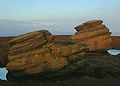
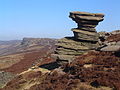
Derwent Edge has several examples of unusually shaped gritstone tors that have been formed by erosion from wind, rain, and frost over many centuries.[2] These tors have been named over the years by local residents and have now been officially titled on Ordnance Survey maps. These include the Cakes of Bread, the Coach and Horses, and the Salt Cellar. The Coach and Horses (also known as the Wheel Stones on Ordnance Survey maps) resemble a person on a carriage with horses when viewed from the A57 road to the south. Lost Lad Hillend has a stone-built topographic indicator to aid in identifying land marks in the extensive view.

Walking

[edit]

Derwent Edge is popular with walkers and is described in many walking guides. Mark Richards describes a 10.5-mile walk in his book “High Peak Walks” (ISBN 0-902363-43-3), starting at the Fairholmes car park in the Upper Derwent Valley (Grid Reference SK172893) at the northern end of Ladybower Reservoir; it is also possible to access the edge from Cutthroat Bridge (lay by parking) on the A57 (SK216873) or from Strines Reservoir car park (SK220909) near the Strines public house. The outcrops along Derwent Edge are popular with rock climbers, particularly the largest, Dovestone Tor, which has about 50 different routes ranging from difficult to Extremely Severe; however, it is not as well used as the nearby Stanage Edge.

Conservation

[edit]

Much of the moorland around Derwent Edge has been declared a Site of Special Scientific Interest (SSSI) because of its special vegetation and rare birds and animals, such as the Eurasian golden plover, red grouse, ring ouzel and mountain hare.[3] Species of plants such as common cottongrass, bilberry,[4] mountain strawberry, and crowberry grow in the area.

It has been proposed as a Special Protection Area for birds under the European Directive on the conservation of wild birds. The edge is part of the National Trust's High Peak Estate and visitors are free to roam at will but are urged to keep to established routes to avoid disturbing breeding birds. There are occasional times when the moors are closed for management purposes and grouse shooting – signs are posted at these times.

[edit]

References

[edit]

Bibliography

[edit]
[edit]
Revisions and contributorsEdit on WikipediaRead on Wikipedia
from Grokipedia
Derwent Edge is a prominent forming a rugged in the region of the , , , stretching approximately 6 miles (10 km) along the western boundary of the Eastern Moors and overlooking the Upper Derwent Valley reservoirs of Derwent, , and Ladybower. Composed primarily of Carboniferous-age sandstone, the edge exemplifies classic geology shaped by millions of years of , , and periglacial processes, resulting in its characteristic steep cliffs, tors, and formations that rise to over 300 meters (980 ft) above the valley floor. The landscape features distinctive outcrops such as the , a cube-shaped resembling a salt shaker; the Wheel Stones (also known as the Coach and Horses), a pair of dramatically weathered pillars; and the Cakes of Bread, stacked rock formations evoking loaves of bread, all of which are iconic landmarks attracting geologists, photographers, and hikers. The area holds natural and as part of a protected supporting heather , , and diverse birdlife, while the underlying was a key training site for the RAF's No. 617 Squadron—the "Dambusters"—during , where they practiced low-level bombing runs with bouncing bombs over the reservoirs in preparation for in 1943. Today, Derwent Edge is renowned for its extensive network of public footpaths, including sections of the Derwent Valley Heritage Way, offering moderate to challenging walks with panoramic views across the and into , drawing thousands of visitors annually for recreation and appreciation of its wild, unspoiled character.

Geography and Topography

Location and Extent

Derwent Edge is a prominent located within the in , , forming part of the area's upland landscape. The ridge primarily lies in but extends northward into , where it transitions into Howden Edge beyond Back Tor. This positioning places it along the western boundary of the Eastern Moors, overlooking the Upper Derwent Valley to the west while connecting to broader Pennine features to the north and east. The stretches approximately 10 km in a north-south orientation, parallel to the Upper Derwent Valley, rising steeply above the valley and providing a dramatic feature. Its boundaries are defined by the plateau to the east, dropping sharply to the valley floor below, with the southern end near the A57 road and the northern section transitioning into Howden Edge. This linear extent makes it a key topographical divider in the region, separating the enclosed farmlands of the Hope Valley from the expansive heather . The highest point on Derwent Edge is Back Tor, situated at coordinates 53.4152°N 1.7041°W with an elevation of 538 m (1,765 ft), marked by an trig pillar at OS grid reference SK197909. This summit offers panoramic views across the surrounding terrain, including the expansive moors and distant urban horizons. Derwent Edge is closely proximate to and the Upper Derwent Valley, with the ridge rising about 300 m above the water level, creating a striking visual contrast between the rugged heights and the engineered valley below. Popular access points include the Fairholmes car park at SK172893 near the visitor centre, Cutthroat Bridge lay-by at SK216873 along the A57, and paths from Strines Reservoir at SK220909 to the north, facilitating entry from both valley and moorland sides.

Physical Features

Derwent Edge is a prominent that rises steeply above the Upper Derwent Valley, forming the western boundary of the Eastern Moors and the eastern edge of the high peat plateau in the . This rugged features an undulating plateau with flat-topped summits and rocky outcrops, transitioning from exposed heights to lower valleys below. The 's dramatic profile includes boulder-strewn slopes and shallow peaty soils, contributing to its distinctive skyline appearance. The terrain of Derwent Edge is characterized by a steep western face with scree slopes that drop sharply toward the valley, contrasting with gentler eastern slopes covered in rough and heather moor. dominates the plateau tops, reaching depths of 2-4 meters and dissected by erosion channels known as groughs, while small streams carve deep, steep-sided cloughs that drain into the River Derwent. These features create a varied of wet flushes and heather-dominated moorland, grazed by sheep and supporting resilient upland vegetation. From its elevated positions, Derwent Edge offers panoramic vistas over Ladybower Reservoir and the Derwent Valley to the west, extending eastward and northward across the Eastern Moors to distant peaks such as Kinder Scout. These viewpoints highlight the escarpment's scenic attributes, with sweeping views across the Eastern Moors and into the broader High Peak landscape. It connects to the broader Dark Peak moorland system to the east and north, with Howden Edge continuing northward.

Geology

Formation Processes

The geological foundation of Derwent Edge consists primarily of , a coarse-grained group from the Namurian stage of the period, deposited approximately 320 million years ago in fluvio-deltaic environments as sediments were transported from ancient highlands into subsiding basins. These sandstones, rich in grains and feldspars, formed thick sequences up to several hundred deep, reflecting episodic flooding and marine influences that created a dynamic depositional setting across the proto-Pennine region. Tectonic processes significantly influenced the region's uplift, with the —a major collisional event at the end of the —compressing and folding the underlying strata, leading to the initial elevation of the Pennine dome and exposure of the layers. This orogeny transitioned the area from basin sedimentation to regional inversion and uplift, setting the stage for later landscape development. Subsequent post-glacial isostatic rebound during the , following the removal of ice loads, further contributed to the vertical adjustment and stabilization of the Pennine structures, enhancing the escarpment's prominence. During the Pleistocene, the experienced multiple glaciations, with earlier events such as the Anglian glaciation (Marine Isotope Stage 12, around 450,000 years ago) covering the area with ice sheets that carved U-shaped valleys and deposited tills and glacial erratics—boulders transported from distant sources. The more recent Devensian glaciation (approximately 115,000 to 11,700 years ago) did not cover Derwent Edge with ice sheets or valley glaciers, but intense periglacial conditions shaped the landscape through processes like frost shattering and solifluction as cold climates advanced from northern and western highlands. Over the epoch, spanning the last 11,700 years, has accumulated on the plateau above Derwent Edge, forming in waterlogged, acidic conditions where plant material from mosses like and ericaceous shrubs decomposes incompletely due to low oxygen and cool temperatures. This layer, developed over millennia in the post-glacial wetter climate, reaches depths of up to 5 meters in depressions, acting as a carbon store and influencing the area's .

Erosion and Rock Structures

The exposed formations of Derwent Edge have been shaped by a combination of physical and chemical processes over millennia, including wind abrasion, rainfall, frost shattering during Pleistocene periglacial conditions, and limited chemical due to the rock's quartz-rich composition. Frost action, in particular, has contributed to the fragmentation of the , while wind and water have accelerated the removal of weathered material from exposed surfaces. Tor formation on Derwent Edge results primarily from differential erosion, where more resistant massive sandstones of the Millstone Grit Group outcrop above softer underlying shales, leading to the preferential weathering and exposure of jointed blocks. This process creates precarious stacked boulders and hoodoo-like structures as joints widen through repeated freeze-thaw cycles and subaerial weathering, with collapse along bedding planes further enhancing the dramatic profiles. The resulting tors are characteristic of the Dark Peak's gritstone escarpments, standing as isolated remnants amid the surrounding moorland. Prominent examples include the Cakes of Bread, a cluster of distinctive rectangular gritstone blocks resembling loaves; the Coach and Horses (also known as the Wheel Stones), featuring a formed by differential ; the Salt Cellar, a flat-topped table-like ; and the summit tor at Lost Lad Hillend, a rugged pinnacle marking the edge's northern extent. These structures, sculpted over thousands of years, highlight the interplay of jointing and in creating the edge's iconic skyline. To combat ongoing erosion from intensive foot traffic on the sensitive , paving (flagstones) has been installed along key sections of the path between the and Lost Lad Hillend. This intervention, part of broader path repair initiatives by the Moors for the Future Partnership funded through the Heritage Lottery Fund, helps concentrate walker traffic and prevent further degradation of the underlying vegetation and soil.

Recreation and Access

Walking Routes

Derwent Edge offers several well-defined walking routes suitable for experienced hikers, with the most prominent being a circular path starting from Fairholmes car park in the Upper Derwent Valley. This strenuous 8.5-mile (13.7 km) loop features 639 m of ascent and typically takes 4-5 hours to complete, beginning along the reservoir's edge past Derwent Dam before ascending steeply through Walkers Clough to reach the high points of Lost Lad and Back Tor. The route then traverses the gritstone edge with panoramic views over the Derwent and Ladybower Reservoirs, descending via moorland paths back to the starting point near Ladybower Reservoir. A longer variation of this circuit extends to 10.5 miles by incorporating a descent through the rugged Abbey Brook valley, adding challenging navigation amid steep-sided gorges and headwaters. For those seeking a shorter alternative, a 10-mile (16.3 km) circular route begins at the Cutthroat Bridge lay-by on the A57, climbing steadily onto the edge via moorland tracks to explore from Whinstone Lee Tor to Back Tor, then descending via Lost Lad to and returning via Grindle Clough and Highshaw Clough, offering a 7-8 hour journey with 597 m of ascent. Another option starts near Strines Reservoir via Mortimer Road, following a 9-mile (14.5 km) loop across Moscar Moor with steady ascents to the edge, passing features like Back Tor and Boot’s Tower en route, and taking about 4.5 hours with some road sections and gates. These paths generally combine surfaced tracks near reservoirs, unsurfaced trails, and occasional steep rocky scrambles, with no stiles but potential for boggy ground or slippery conditions during wet seasons due to exposed and terrain. Navigation relies on Explorer OL1 ( ) maps, as visibility can drop in poor weather, and all major tors such as the Wheel Stones are encountered along the ridge sections.

Climbing Opportunities

Derwent Edge offers diverse climbing opportunities, primarily on its outcrops, with Dovestone Tor serving as the main crag. This prominent features over 170 routes, ranging from Very Difficult (VD) to around E1, across faces up to 20 meters high, providing a mix of crack systems, slabs, and walls suitable for . The rock's rough texture offers excellent friction, though routes like Great (HVS 5a) stand out for their quality and technical demands. Bouldering is concentrated around distinctive tor formations such as the Cakes of Bread and Salt Cellar, where climbers tackle short problems on boulders and low-angle slabs, often involving dynamic moves and on the weathered . These areas provide accessible, low-commitment sessions, though specific grades vary by line. The tors' eroded shapes, including balanced blocks and overhanging features, create natural venues for creative without extensive development. Compared to nearby , Derwent Edge sees fewer crowds, making it appealing for those seeking solitude amid quality lines, though it requires a moderate approach walk of 45-60 minutes from parking areas like Cutthroat Bridge. is best in summer when the west-facing aspects dry quickly and provide optimal conditions, with relying on traditional gear such as nuts and cams placed in cracks and pockets—no fixed bolts are present, emphasizing a classic ethic. Safety considerations include exposed positions on the edge, particularly at higher tors, and the potential for loose rock on less-trafficked lines, requiring careful route selection and use. Climbers should check for seasonal bird restrictions, such as those from June to July around nesting sites.

Conservation and Ecology

Protected Status

Derwent Edge lies within the National Park, the first national park designated in on 17 April 1951 under the National Parks and Access to the Countryside Act 1949, providing a framework for landscape protection and public enjoyment. The moorland encompassing Derwent Edge forms part of the (SSSI), notified on 8 July 1993 for its mixed biological and geological interest, including extensive habitats, upland heath, and formations that support diverse , , and geomorphological features. Additionally, the area contributes to the Moors (South Pennine Moors Phase 1) (SPA), classified in March 1996 under the EU Birds Directive (2009/147/EC) to safeguard internationally important populations of moorland breeding birds such as golden plover, , and . Administrative oversight is provided by the through its High Peak Estate, which includes Derwent Edge and spans approximately 18,000 hectares across the , including upland in the Upper Derwent Valley, ensuring coordinated conservation under and SSSI guidelines.

Flora and Fauna

Derwent Edge's upland environment supports a diverse array of and adapted to its and gritstone habitats. The area features breeding populations of several bird species characteristic of the , including the Eurasian golden plover (Pluvialis apricaria), which has shown population increases in rewetted areas, (Lagopus lagopus scotica), a widespread resident, and (Turdus torquatus), which nests on rocky edges. Migratory twite (Acanthis flavirostris) also frequent the region, though their numbers have declined significantly in the South Pennine Moors Special Protection Area due to habitat loss in upland hay meadows. Occasional sightings of (Asio flammeus), a winter visitor to open moorlands, occur along . Among mammals, the (Lepus timidus), introduced to the in the late for sporting purposes, has experienced a steep decline in recent years, with the population estimated at approximately 1,000 as of 2025 between Derwent Edge and nearby Outer Edge. The flora is dominated by upland heath and bog communities, with common cottongrass (Eriophorum angustifolium) prominent in wetter zones, alongside (Vaccinium myrtillus), a low-growing abundant on acidic soils. In boggy areas, mountain strawberry (Rubus chamaemorus), (Empetrum nigrum), and cowberry (Vaccinium vitis-idaea) contribute to the understory, supporting specialized pollinators like the bilberry . Key habitat types include extensive on the plateau, which harbors peat-forming mosses and cotton grasses, and acid on slopes, providing foraging grounds for waders. outcrops along the edge host specialized lichens and mosses, such as those in the Parmelia and Hypnum genera, thriving on the exposed rock surfaces.

Management Efforts

The , in collaboration with and the National Park Authority, has implemented path restoration projects on Derwent Edge to address erosion caused by heavy foot traffic. A key initiative involved resurfacing the 2.5 km Whinston Lee Tor permissive path on Moscar Moor using stone pitching, aggregate, and water channeling systems, which protects the underlying habitat designated as a (SSSI) and (SAC). This work, funded through Natural England's Higher Level Stewardship scheme, was completed in 2015 to enhance durability for walkers while minimizing environmental impact. In March 2025, the National Trust acquired an additional 76 hectares (189 acres) of land in the Peak District to create more space for wildlife. In January 2025, plans were announced for a rewilding fence enclosing over 1,600 hectares of moorland in the Upper Derwent Valley to aid ecosystem restoration. Grouse moor management on Derwent Edge, overseen by the , incorporates controlled practices to balance maintenance with recreational . Rotational heather burning has been largely replaced by mechanical cutting on deep areas to prevent carbon emissions and support upland bird populations, aligning with the High Peak Moors Vision. Predator control measures are applied selectively to sustain numbers, though the Trust emphasizes low-intensity to minimize ecological disruption. During the grouse shooting season from 12 August to 10 December, access land on moors may be temporarily closed for safety, though public footpaths remain open; signage advises visitors of these occasional restrictions. Biodiversity initiatives focus on heather regeneration and invasive species control to restore moorland ecosystems. The National Trust has revegetated eroded sections of Derwent Edge, such as the footpath from Back Tor to the Salt Cellar, using heather brash and seed mixes to promote natural regrowth and varied vegetation structure. Monitoring and removal of non-native invasive species, including rhododendron and Himalayan balsam, are conducted annually through vegetation condition assessments, often in partnership with organizations like Moors for the Future to enhance species diversity. These efforts support key moorland species, such as twites and golden plover, by creating mosaic habitats. Ongoing challenges include the impacts of climate change on peatlands and heightened tourism pressure following the COVID-19 pandemic. Rising temperatures and altered rainfall patterns threaten peat accumulation and increase wildfire risk on Derwent Edge's blanket bogs, potentially releasing stored carbon and exacerbating erosion. Visitor numbers in the Peak District surged by up to 40% post-2020, intensifying path wear on popular edges like Derwent; the area now sees an estimated 100,000+ annual users on key routes. These pressures are monitored through Natural England's SSSI condition assessments, with Derwent and Howden Moor units classified as "unfavourable recovering" since the mid-2010s, guiding targeted interventions like rewetting and erosion barriers.

References

Add your contribution
Related Hubs
User Avatar
No comments yet.