


Community hub
Recent from talks
Contribute something
Nothing was collected or created yet.
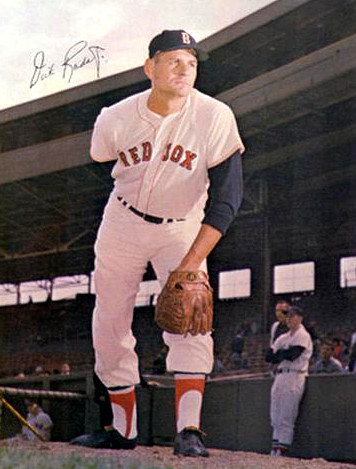
Dick Radatz
View on Wikipedia
Richard Raymond Radatz (April 2, 1937 – March 16, 2005) was an American relief pitcher in Major League Baseball. Nicknamed "The Monster", the 6 ft 6 in (1.98 m), 230 lb (100 kg) right-hander had a scorching but short-lived period of dominance for the Boston Red Sox in the early 1960s. Radatz is reported to have gotten his nickname during a game against the New York Yankees in Boston in 1963 in which he came in to pitch with the bases loaded and no one out. He consecutively struck out Mickey Mantle, Roger Maris, and Elston Howard (the 1963 American League most valuable player[1]), after which Mantle grumbled about Radatz being "that monster".[2] Over his career, Radatz struck out Hall of Famer Mantle 44 times in 63 at-bats.[3][4]
Key Information


As of 2025, Radatz owns the record for the most strikeouts in a single season by a reliever in MLB history, striking out 181 batters in 1964.[5] This broke his own record when he struck out 162 the year prior in 1963.[6] Only Mark Eichhorn has been able to best Radatz's 1963 single season strikeout total, when Eichhorn fanned 166 batters in 1986.[7]
Early life
[edit]Born in Detroit, Radatz was the first child of Virginia (Osterman) and Norman Radatz, an automotive engineer and body design draftsman. Radatz grew up in Berkley, Michigan, in the same neighborhood that produced Hall of Fame Detroit Tigers pitcher Hal Newhouser.[8] Norman Radatz had known Newhouser when Newhouser was young, and Dick Radatz grew up admiring Newhouser. Radatz attended Berkley High School, where he played football, baseball, and basketball.[9] He threw a no-hitter in April 1954, only allowing one base on balls;[10] one of three no-hitters he pitched in high school.[11]
He also played Class D baseball for Walway, in the Detroit Baseball Federation. He had a 7–1 won–loss record, the team winning the American Baseball Congress junior title in August of 1954.[11]
He was a star basketball and baseball player at Michigan State University before signing with the Red Sox as an amateur free agent in 1959.[12] Another future MLB relief pitcher, Ron Perranoski, was Radatz's roommate at Michigan State. In 1957, Radatz and Perranoski played for the Watertown Lake Sox of the Basin League in South Dakota, where he had a 10-1 record. Radatz returned in 1958 and led the Basin League with 107 strikeouts. As a Michigan State senior, he was 10–1 with a 1.12 earned run average (ERA).[9]
Minor leagues
[edit]Originally a starting pitcher when he began his professional career, Radatz compiled a 16–10 record and 3.48 earned run average in his first two seasons in the Red Sox farm system.[13] A sore arm led the Triple-A Seattle Rainiers manager Johnny Pesky to convert him into a reliever in 1961 against Radatz's will.[14] The experiment worked, as he pitched in 54 games in relief, with a 2.28 ERA, 24 saves and 74 strikeouts in 71 innings.[13] Radatz earned a job with the Red Sox out of spring training the following season as a non-roster invitee.[15]
Sporting News "Fireman of the Year" (Boston 1962-64)
[edit]Radatz was immediately dominant at the major league level, as he pitched 18.1 innings and recorded six saves before surrendering his first earned run on May 15, 1962, against the Yankees (a game which the Red Sox won, and Radatz earned his seventh save).[16] He went on to lead the American League in saves (24), games (62) and relief wins (9), while posting a 2.24 ERA in 124.2 innings his rookie season, earning the AL's Fireman of the Year from The Sporting News.[9][17][18][6] He was tied for ninth among all AL players with a 5.2 WAR (wins above replacement).[18] Radatz was tied for third in AL Rookie of the Year voting.[19] Boston's baseball writers named him the Red Sox Rookie of the Year.[20]
Yankee manager Ralph Houk, who said "[f]or two seasons, I've never seen a better pitcher,"[21] added Radatz to his 1963 AL All-Star squad after a 33 scoreless inning streak[9] saw his ERA dip to 0.88 on June 14. He gave up one earned run in two innings pitched, but impressed with strikeouts of Willie Mays, Dick Groat, Duke Snider, Willie McCovey and Julián Javier.[22] For the season, he saved 23 games and went 15–6 with a 1.97 ERA, along with the stretch of 33 scoreless innings pitched;[23] becoming the first pitcher in history to have consecutive 20-save seasons[24] and finishing fifth in AL MVP voting (his old roommate Perranoski finishing fourth as a reliever in the National League MVP voting)[25] despite Boston's seventh-place finish.[26] He was fifth among all AL players with a 5.5 WAR.[27]
The Red Sox toyed with the idea of converting Radatz back into a starter for the 1964 season.[28] Instead, he remained in the bullpen, and earned his second Fireman of the Year award in 1964[17] for his major league-leading 29 saves with 16 wins and a 2.29 ERA in 79 games (breaking Jim Konstanty’s record of 74).[23][6] He was again in the top 10 AL players with a 6.0 WAR.[29] Most notably, he fanned 181 batters in 157 innings, setting a record that still stands for most strikeouts by a relief pitcher in a single season.[30] During his three peak seasons in Boston (1962-64), Radatz averaged 10.59 strikeouts per nine innings.[31]
He was named to the AL's All-Star Game pitching staff again in 1964, and struck out the first two batters he faced when he entered the game in the eighth inning. He was, however, unable to hold onto the AL's 4–3 lead, as he surrendered four runs in the ninth, including a game ending three-run home run by Johnny Callison.[32]
Boston Red Sox (1965-66)
[edit]
Radatz got off to a poor start to the 1965 season, blowing three save opportunities and posting a 7.54 ERA through May 14.[33] He settled down, bringing his ERA down to a far more respectable 3.91 and earning 22 saves by season's end, but his 9–11 mark was the first losing record he had posted in his major league career.[6]
Radatz believed his decline as a pitcher was the result of trying to develop a new pitch during spring training in 1965. He worked on adding a sinker to go along with his overpowering fast ball. In the process, he changed his pitching motion and lost velocity on his fastball, taking away what had been the pitch that made him extraordinary.[23]
Radatz's only career home run came off the Kansas City Athletics' Jesse Hickman on June 5, 1965.[34] He was selected to the Boston Red Sox Hall of Fame in 1997.[35]
Radatz was mentioned in trade rumors with the Los Angeles Dodgers, Milwaukee Braves and Minnesota Twins during the off-season, but eventually returned to the Red Sox. He was 0–2 with a 4.74 ERA before being dealt to the Cleveland Indians on June 2 for Don McMahon and Lee Stange.[36]
Overall with Boston, Radatz saved 104 games (a team record later broken by Bob Stanley[37]) with a 49–34 record and 646 strikeouts in 576.1 innings pitched. With the other four teams, he went only 6–20 with 26 saves in 117.2 innings.[6]
Cleveland Indians
[edit]Radatz went 0–3 with a 4.61 ERA in Cleveland. He earned a combined 14 saves between his two teams in 1966, marking the first time in his career he failed to reach 20. He also failed to win a game as he ended the season with an 0–5 record.[6]
Chicago Cubs
[edit]Nine games into the 1967 season, Radatz was dealt to the Chicago Cubs for a player to be named later.[38] On June 9, Radatz pitched a scoreless ninth inning against the New York Mets at Wrigley Field to earn his first career win since September 14, 1965.[39] But in 21.2 innings pitched with the Cubs through July 7, Radatz surrendered 12 hits, 23 walks and hit five batters. He was sent down to the minors to work on his control, but was unable to regain it. In 34 innings pitched in the minors, Radatz surrendered 25 hits and 40 walks and hit eight batters.[6][13]
Detroit Tigers
[edit]The Cubs released Radatz during spring training of 1968. He signed with his hometown Detroit Tigers shortly afterwards,[38] and spent the 1968 season with their Triple A affiliate Toledo Mud Hens.[40][13] With Toledo, Dick was 6–7, 2.78 ERA, 24 GP, started 13 games, 5 CG, 3 SHO, 110.O IP, 103 K, 23 BB, and a WHIP of 0.973.[13] He earned a spot on the major league roster out of spring training 1969, and was 2–2 with a 3.32 ERA in 11 appearances when his contract was sold to the Montreal Expos at the June 15 trade deadline.[41][6] He went 0–4 with a 5.71 ERA for the Expos before he was released in August.[42][6][38]
Legacy
[edit]Radatz pitched at a time when starting pitchers were more likely to finish games and it was common for a closer to pitch more than one inning. These factors reduced the likelihood of getting a save. Out of his 104 saves, Radatz pitched two or more innings 53 times, including three or more innings for 20 of those saves. As a Red Sox reliever, he had a 10–0 record in games where he pitched five or more innings, and was 16–2 in games where he pitched four or more innings.[31]
On July 12, 1962, he pitched five innings in relief to gain a win over the Kansas City Athletics, and the next day pitched seven innings in relief for another win against the A’s. In a September 1962 game against the Yankees, he pitched nine innings in relief, winning the game. In a 1963 game, he pitched six relief innings to defeat the Baltimore Orioles, allowing only two hits.[31]
Through 2024, he remains fourth in saves among all Red Sox pitchers, only behind Stanley, Jonathan Papelbon, and Craig Kimbrel.[43]
Personal life and death
[edit]After leaving the game, Radatz worked at a number of jobs, had his own weekly radio show, and was a frequent guest on other sports talk radio shows. Radatz frequently suggested that contemporary relievers weren't durable enough and that his own experience was that when he didn't get used as much, he lost his edge.
In the 1970s, Radatz suffered from severely painful cluster headaches, after the deaths of his mother and a close friend.[23] A resident of Farmington Hills, Michigan, Radatz moved back to the Greater Boston area in 1984, living in Easton, Massachusetts, where former teammate Jerry Moses had found him a job at a corrugated packaging company, Triple P Packaging. "I felt I had formed a love affair with this town, that I was appreciated by the fans here." Before his death in 2005, Radatz worked as pitching coach for the North Shore Spirit, an independent league team based in Lynn, Massachusetts. The team was managed by former Red Sox infielder John Kennedy, who was expecting Radatz to return for the 2005 season.[9]
Radatz died on March 16, 2005, after falling down a flight of stairs at his home in Easton, Massachusetts.[44] He left behind a wife and three children. The Red Sox held a moment of silence during their 2005 home opener in his honor.[45]
His son Richard Jr. was an executive in the Red Sox minor league system.[46] He was later an assistant director of the Michigan Special Olympics and a creator of the Northwoods League.[47]
See also
[edit]

References
[edit]- ^ "1963 Awards Voting". Baseball-Reference.com. Retrieved April 19, 2025.
- ^ Mendonca, David. "A Monster of the Mound". imaginesports.com. Retrieved October 21, 2024.
- ^ "Dick Radatz, 67; Red Sox Relief Pitcher Was Called 'The Monster'". Los Angeles Times. March 18, 2005.
- ^ "Mantle, Mickey | Baseball Hall of Fame". baseballhall.org. Retrieved April 19, 2025.
- ^ "MLB Relief Pitching Records | Baseball Almanac". www.baseball-almanac.com. Retrieved April 17, 2025.
- ^ a b c d e f g h i "Dick Radatz Stats".
- ^ "Mark Eichhorn Stats, Height, Weight, Position, Rookie Status & More". Baseball-Reference.com. Retrieved April 17, 2025.
- ^ "Newhouser, Hal | Baseball Hall of Fame". baseballhall.org. Retrieved April 19, 2025.
- ^ a b c d e Nowlin, Bill. "Dick Radatz – Society for American Baseball Research". Retrieved October 21, 2024.
- ^ "No-Hit Scale Is Balanced By Berkley". Detroit Free Press. April 24, 1954. p. 15.
- ^ a b "Tigers Among 6 Clubs Making Pitch to Prep". Detroit Free Press. January 25, 1955. p. 23.
- ^ "Spartan Baseball To Honor 1971 Team, Dick Radatz". MSUSpartans.com. May 11, 2006.
- ^ a b c d e "Dick Radatz Minor & Winter Leagues Statistics". Baseball-Reference.com. Retrieved April 17, 2025.
- ^ Gordon Edes (March 17, 2005). "Former Red Sox closer Radatz dies after fall". Boston Globe.
- ^ "Cubs Nip BoSox". The Morning Call (Allentown, Pennsylvania). April 18, 1962. p. 51.
- ^ "Boston Red Sox 14, New York Yankees 4". Baseball-Reference.com. May 15, 1962.
- ^ a b "Fireman of the Year Award / Reliever of the Year Award by The Sporting News | Baseball Almanac". www.baseball-almanac.com. Retrieved October 20, 2024.
- ^ a b "1962 American League Pitching Leaders". Baseball-Reference.com. Retrieved April 18, 2025.
- ^ "1962 Awards Voting". Baseball-Reference.com. Retrieved April 18, 2025.
- ^ "Radatz Named Top Hub Rookie". The Morning Union (Springfield, Massachusetts). December 26, 1962. p. 30.
- ^ Ian Browne (March 17, 2005). "Red Sox mourn loss of Radatz". MLB.com.[dead link]
- ^ "1963 Major League Baseball All-Star Game". Baseball-Reference.com. July 9, 1963.
- ^ a b c d Sullivan, George (August 28, 1977). "Remember… …Dick Radatz". Boston Sunday Globe.
- ^ "Dick Radatz Stats, Height, Weight, Research & History | Baseball Almanac". www.baseball-almanac.com. Retrieved April 18, 2025.
- ^ "1963 Awards Voting". Baseball-Reference.com. Retrieved April 17, 2025.
- ^ "1963 MLB Standings and Records: Regular Season". MLB.com. Retrieved April 17, 2025.
- ^ "1963 American League Pitching Leaders". Baseball-Reference.com. Retrieved April 18, 2025.
- ^ "'Monster' a Starter Next Year?". The Evening Independent. December 17, 1963.
- ^ "1964 American League Pitching Leaders". Baseball-Reference.com. Retrieved April 18, 2025.
- ^ "Relief Pitching Records". Baseball Almanac.
- ^ a b c Scoggins, Chaz (May 31, 2009). "Radatz still top dog in the pen". Lowell Sun. Retrieved April 17, 2025.
- ^ "1964 Major League Baseball All-Star Game". Baseball-Reference.com. July 7, 1964.
- ^ "Red Hot Horton Hits Two Homers". Toledo Blade. May 15, 1965.
- ^ "Boston Red Sox 5, Kansas City Athletics 3". Baseball-Reference.com. June 5, 1965.
- ^ "Carlton Fisk to be Honored". Warsaw, Indiana Times-Union. September 9, 1997.
- ^ "Boston Trades Dick Radatz to Tribe for Two Pitchers". Spartanburg Herald. June 3, 1966.
- ^ Stern, Bob (July 14, 2008). "Papelbon records 100th career save". Enterprise News. Retrieved April 18, 2025.
- ^ a b c "Dick Radatz Trades and Transactions by Baseball Almanac". www.baseball-almanac.com. Retrieved April 18, 2025.
- ^ "Chicago Cubs 6, New York Mets 5". Baseball-Reference.com. June 9, 1967.
- ^ "Whatever Happened to Dick Radatz?". Rochester Sentinel. May 17, 1968.
- ^ "Expos Buy Radatz, Juggle Roster". Saskatoon Star-Phoenix. June 17, 1969.
- ^ "Expos Obtain First Canadian". Edmonton Journal. August 20, 1969.
- ^ "Boston Red Sox All-time Saves Leaders". www.baseball-almanac.com. Retrieved April 18, 2025.
- ^ Ian Browne (March 17, 2005). "Radatz passes away at 67". MLB.com.[dead link]
- ^ Ian Browne (April 9, 2005). "Red Sox set schedule for home opener". MLB.com.[dead link]
- ^ Brown, Garry (April 6, 1986). "Dick Radatz, Jr.: Son of 'the Monster,' bright executive". The Morning Union. p. 31.
- ^ "Board of Directors". Northwoods League. Retrieved April 19, 2025.
External links
[edit]- Career statistics from MLB · ESPN · Baseball Reference · Fangraphs · Baseball Reference (Minors) · Retrosheet · Baseball Almanac
- Dick Radatz at SABR (Baseball BioProject)
- Dick Radatz Archived February 5, 2020, at the Wayback Machine at The Deadball Era
- Dick Radatz at Find a Grave
Dick Radatz
View on GrokipediaEarly life
Family and upbringing
Richard Raymond Radatz was born on April 2, 1937, in Detroit, Michigan, to parents Norman Radatz, an automotive engineer, and Virginia (Osterman) Radatz.[2] As the first-born child in a family of German and Irish ancestry, he grew up in the Detroit suburb of Berkley, where his father's profession reflected the industrial backbone of the region.[2] Radatz's upbringing emphasized Midwestern values of hard work and community, shaped by his working-class family environment amid the automotive industry's influence in Michigan. From a young age, he developed a passion for baseball, inspired by Detroit Tigers pitcher Hal Newhouser, whom his father Norman had known from the same neighborhood and even helped raise during Newhouser's early years. This personal connection fueled Radatz's early interest in the sport, as he idolized Newhouser's mound presence and achievements.[2] During his childhood, Radatz actively participated in sports, playing football, baseball, and basketball, which honed his athleticism and competitive spirit. Anecdotes from his time at Berkley High School highlight his involvement in these activities, where he balanced multiple sports while navigating the typical rigors of suburban teenage life.[2] These early experiences laid the groundwork for his later pursuits in organized baseball.Education and amateur career
He attended Berkley High School in Berkley, Michigan, graduating in 1955 after excelling as a multisport athlete in football, basketball, and baseball; as the school's standout pitcher, he dominated local competition and earned recognition as the top hurler in the region.[2][4] Radatz then enrolled at Michigan State University, where he studied physical education and initially participated in both basketball and baseball as a freshman in the late 1950s. Radatz received no athletic scholarship to Michigan State and, due to his marginal high school grades, had to pass a special entrance exam to gain admission.[2][5][6] Under baseball coach John Kobs, who dissuaded him from football pursuits, Radatz focused on pitching and developed into a team leader, serving as captain in 1959 while posting an impressive 17-4 overall record during his college career, highlighted by a 1.12 ERA that season.[2][7][5] His commanding fastball and strikeout ability in collegiate games drew attention from professional scouts, establishing him as one of the Big Ten's premier arms before his senior year.[2][7] During his time at Michigan State, Radatz married his high school sweetheart, Sharon Lee Cooper, on September 6, 1958, as he began his senior year; the couple, who had dated since age 15, welcomed their first child, daughter Leigh, in 1959.[2][8]Minor leagues
Signing with the Red Sox
Richard Raymond Radatz signed with the Boston Red Sox as an amateur free agent in June 1959, following his collegiate career at Michigan State University where he excelled in both baseball and basketball.[2][9] The Red Sox scouts Maurice DeLoof and Chuck Koney identified his potential, securing him with a modest $5,000 signing bonus and promises of an additional $5,000 at each minor league level advancement—Class A, Triple-A, and the majors.[2] Immediately upon signing, Radatz was assigned to the Red Sox' Class B affiliate, the Raleigh Capitals of the Carolina League, marking his entry into professional baseball.[2][10] In his debut season of 1959, he made 13 appearances for Raleigh, primarily as a starter with 12 starts, compiling a 4-6 record and a 3.04 ERA over 77 innings pitched.[2][10] This performance, including five complete games and one shutout, demonstrated his raw power and control despite the adjustment to professional play.[10] Radatz's transition to minor league life was supported by his family, particularly his wife Sharon Lee Cooper, whom he had married in September 1958; the couple would later have three children together.[2] Sharon provided essential emotional backing as Radatz relocated from Michigan to North Carolina, helping him navigate the early uncertainties of a pro career.[2] Adapting to the rigors of professional baseball presented challenges for Radatz, including the demanding travel schedules across the Carolina League and the heightened competition from more seasoned players.[2] These factors tested his endurance, as he balanced the physical toll of starting assignments with the lifestyle shifts away from college athletics.[2]Progression through the system
In 1960, Radatz began the season with the Class B Raleigh Capitals of the Carolina League, where he posted a 9-4 record with a 3.79 ERA over 17 appearances, including 13 starts and 107 innings pitched, striking out 133 batters while beginning to experiment with relief outings.[10] His performance marked a clear improvement from his rookie year, showcasing better command of his fastball and increased durability as a starter. Midseason, the Red Sox promoted him to the Triple-A Minneapolis Millers, where he went 3-0 with a 3.50 ERA in 13 games (eight starts), allowing just 46 hits in 54 innings and fanning 46.[10] This dual-level success, totaling a 12-4 mark across 30 outings, highlighted his rapid development and versatility, though he remained primarily a starter.[2] The following year, Radatz advanced to the Red Sox's relocated Triple-A affiliate, the Seattle Rainiers of the Pacific Coast League, under manager Johnny Pesky. Pesky, recognizing the organization's need for a power reliever and Radatz's overpowering fastball, convinced him to transition fully to the bullpen as the quickest route to the major leagues, a move that honed his control and short-burst intensity.[2] In 54 relief appearances, all without a start, Radatz excelled with a 5-6 record, 2.28 ERA, and 74 strikeouts in 71 innings and emerging as one of the league's top firemen.[10] Standout performances included a nine-inning relief stint on July 4 against the Vancouver Mounties, where he allowed no runs and struck out 12, accelerating discussions of his major-league readiness.[2] During this period of professional growth, Radatz's personal life also expanded; his son Dick Jr. was born in 1959, followed by daughter Leigh in 1960, providing family stability amid the demands of minor-league travel.[2] These years solidified Radatz's reputation as a hard-throwing right-hander with pinpoint control, setting the stage for his breakthrough by emphasizing relief specialization over starting endurance.Boston Red Sox career
Rise to stardom (1962–1964)
Dick Radatz made his Major League Baseball debut with the Boston Red Sox on April 10, 1962, against the Los Angeles Angels at Fenway Park, where he pitched a scoreless inning in relief.[3] His transition to a relief role, honed during his minor league years with the Red Sox organization, proved immediately effective, as he appeared in 62 games that rookie season, posting a 9-6 record with a 2.24 ERA over 124.2 innings and leading the American League with 24 saves.[2] This performance earned him the Sporting News American League Fireman of the Year award, recognizing him as the top reliever in the league.[11] In 1963, Radatz solidified his status as a dominant force, earning his first All-Star selection and achieving a 15-6 record with a 1.97 ERA in 66 appearances and 132.1 innings pitched.[3] He recorded 23 saves and struck out 162 batters, setting an American League record for strikeouts by a reliever at the time.[2] Along with his 1962 total, this made Radatz the first pitcher in Major League history to post consecutive seasons with at least 20 saves.[12] A memorable highlight occurred that season against the Yankees at Fenway Park, where Radatz entered with the bases loaded and no outs, striking out Mantle, Roger Maris, and Elston Howard in succession on just nine pitches to escape the jam unscathed.[13] His imposing 6-foot-5, 235-pound frame contributed to his nickname "The Monster," reportedly coined by New York Yankees star Mickey Mantle after Radatz struck him out repeatedly.[14] Radatz's pinnacle came in 1964, when he earned his second All-Star nod and second Sporting News Fireman of the Year honor, leading the AL with 29 saves while going 16-9 with a 2.29 ERA in a league-high 79 games and 157 innings.[3][11] He set a modern-era record for reliever strikeouts with 181, surpassing his own 1963 mark and underscoring his overpowering fastball.[2]Decline and trade (1965–1966)
Following his dominant performances from 1962 to 1964, when he established himself as one of baseball's premier relief pitchers with a sub-2.50 ERA each season, Dick Radatz experienced a noticeable decline in 1965. Pitching exclusively for the Boston Red Sox, he appeared in 63 games, all in relief, but posted a 9-11 record with a 3.91 ERA over 124.1 innings. His control faltered markedly, as he issued 53 walks and allowed 104 hits, contributing to 11 home runs surrendered and a career-high 54 earned runs. These struggles led to the loss of his closer role, which shifted to Jerry Stephenson and Ron Herron, though Radatz still managed 22 saves.[2][3] The decline was attributed in part to arm fatigue accumulated from his previous multi-inning outings, during which he often pitched two or more innings per appearance, totaling over 130 innings annually in his peak years. New Red Sox manager Billy Herman, seeking to preserve Radatz's arm, restricted him to shorter stints in 1965, but the adjustment did not stem the erosion of his effectiveness. Amid these professional challenges, Radatz and his wife Sharon welcomed their third child, daughter Kristine, adding a personal milestone to a difficult season.[2] Radatz's form worsened in 1966, as he made just 16 relief appearances for Boston over 19 innings, going 0-2 with a 4.74 ERA. He allowed 24 hits and 11 walks while striking out 19, reflecting diminished velocity and command that relegated him to lower-leverage bullpen situations. On June 2, 1966, the Red Sox traded Radatz to the Cleveland Indians in exchange for pitchers Don McMahon and Lee Stange, effectively ending his tenure in Boston after four seasons.[2][3][9]Later career
Cleveland Indians (1966)
On June 2, 1966, the Boston Red Sox traded Dick Radatz to the Cleveland Indians in exchange for pitchers Don McMahon and Lee Stange, a move that sent the struggling reliever from a last-place team to one leading the American League at the time.[2][3] Radatz, who had posted a 0-2 record with a 4.74 ERA in 16 appearances for Boston that season, expressed enthusiasm about the change, comparing the trade to "Christmas Eve" and hoping for a fresh start under manager Birdie Tebbetts.[2] In 39 relief appearances for the Indians, Radatz served primarily as a middle reliever, logging 56.2 innings without securing a win and finishing 0-3 with a 4.61 ERA.[3] His performance was hampered by ongoing control issues, as evidenced by 34 walks against 49 strikeouts, contributing to a WHIP of 1.46 and allowing 29 earned runs.[3] Despite the acquisition as part of "Operation Reclamation" to bolster the bullpen, Radatz failed to regain his earlier dominance, with opponents batting .224 against him but exploiting his wildness.[2] The Indians' season, which began promisingly with a first-place standing, ultimately ended at 81-81, placing fifth in the American League, amid a midseason slump that saw Tebbetts resign on August 19.[15][2] Radatz's stint in Cleveland marked a challenging transition, as the team leaned on him for high-leverage situations but received inconsistent results from the once-feared "Monster."[2] That summer, the Radatz family resided in Farmington, Michigan, a suburb about 170 miles from Cleveland, allowing for relatively manageable travel without a full relocation.[2]Chicago Cubs (1967)
Following a challenging stint with the Cleveland Indians earlier in the year, Dick Radatz was traded to the Chicago Cubs on April 25, 1967, for a player to be named later (later identified as outfielder Bob Raudman).[2] As a reliever, he began the season with some promise, earning five saves in his first 20 appearances while primarily working out of the bullpen.[3] However, his effectiveness waned due to severe control problems, as he issued 24 walks, hit five batters, and threw nine wild pitches over 23⅓ innings, resulting in a 1–0 record and a 6.56 ERA.[2][3] These ongoing issues prompted the Cubs to demote Radatz to their Triple-A affiliate, the Tacoma Cubs of the Pacific Coast League, on July 14.[2] In 15 minor-league outings, he struggled further, posting a 0–2 record with a 9.00 ERA across 22 innings, plagued by 33 walks, seven hit batters, and 12 wild pitches.[10] Radatz expressed significant frustration with the demotion, initially threatening retirement before reporting to Tacoma; he attributed some of his woes to inconsistent bullpen usage and a nagging pinched nerve in his right shoulder.[2][5] Radatz returned to the Cubs in September after receiving treatment for his injury and participating in fall instructional league play, but he proved ineffective in limited action.[2] Overall, in 1967, he tallied 36 strikeouts across roughly 45 innings between the majors and minors.[3][10] The Cubs, meanwhile, endured a solid but ultimately disappointing 87–74 campaign, finishing third in the National League and six games out of the playoff spot.[16]Detroit Tigers and Montreal Expos (1968–1969)
After being released by the Chicago Cubs during spring training in 1968, Radatz signed as a free agent with his hometown Detroit Tigers on April 22.[17][18] He spent the entire 1968 season in the minors with the Tigers' Triple-A affiliate, the Toledo Mud Hens of the International League, where he posted a 6-7 record with a 2.78 ERA over 110 innings in 24 appearances, including 13 starts.[10] This performance earned him a spot on the Tigers' major league roster entering the 1969 season, following the release of veteran relievers Roy Face and John Wyatt.[17] Radatz appeared in 11 games for the Tigers in 1969, all in relief, compiling a 2-2 record with a 3.38 ERA and 18 strikeouts in 18.2 innings pitched.[3] On June 15, 1969, the Tigers sold his contract to the expansion Montreal Expos in a separate transaction from a larger deal involving outfielder Donn Clendenon.[17][19] With the Expos, Radatz made 22 relief appearances, going 0-4 with a 5.71 ERA and 32 strikeouts in 34.2 innings, struggling with control as he issued 18 walks.[3] His final major league game came on August 15, 1969, against the Los Angeles Dodgers, where he pitched 2 innings and allowed 1 earned run.[3] The Expos released him on August 26, 1969.[19] Over his seven-season major league career, Radatz finished with a 52-43 record, a 3.13 ERA, 120 saves, and 745 strikeouts in 693.2 innings across 381 relief appearances.[3] At age 32, he chose retirement following the release, citing ongoing arm troubles stemming from a pinched nerve in his shoulder and fingers that had first impacted him in 1967, as well as a desire to prioritize his family life in the Detroit area, where he began working in insurance sales.[17]Legacy
Statistical achievements
Dick Radatz compiled a career record of 52 wins, 43 losses, and 120 saves over seven Major League Baseball seasons from 1962 to 1967 and in 1969, with a 3.13 earned run average and 745 strikeouts in 693⅔ innings pitched, all in relief appearances.[3] His 102 saves with the Boston Red Sox rank fourth in franchise history through the 2024 season.[20] In 1964, Radatz set a long-standing American League and major league record for strikeouts by a reliever with 181 in 157 innings, a mark that remained unbroken for over five decades as of the 2025 season.[21] He achieved this during a dominant campaign for the Red Sox, where he appeared in 79 games, recorded 29 saves, and posted a 2.29 ERA. Earlier, in 1962, Radatz led the American League with 62 appearances and 53 games finished while notching 24 saves and a 2.24 ERA in 124⅔ innings.[3] He was the first reliever to post back-to-back seasons of 20 or more saves, with 24 in 1962 and 23 in 1963.[22] Radatz's dominance extended to notable matchups, including striking out New York Yankees legend Mickey Mantle 12 times in 16 at-bats across their careers.[2] His pitching style centered on a high-velocity fastball estimated at 95 miles per hour or faster, which he threw over 90 percent of the time, complemented by occasional sliders.[6] As a multi-inning reliever, he averaged nearly two innings per appearance during his peak years from 1962 to 1964, logging 414 innings across 207 outings.[22] One memorable anecdote from Radatz's career illustrates his rapid deployment: during a 1963 game against the Yankees, he was at home watching on television when summoned to Fenway Park, arriving in time to enter in relief and secure the win.[2]| Year | Team | G | IP | W-L | SV | ERA | SO |
|---|---|---|---|---|---|---|---|
| 1962 | BOS | 62 | 124⅔ | 9-6 | 24 | 2.24 | 144 |
| 1963 | BOS | 66 | 131⅓ | 15-6 | 23 | 2.63 | 162 |
| 1964 | BOS | 79 | 157 | 16-9 | 29 | 2.29 | 181 |
| Career | - | 381 | 693⅔ | 52-43 | 120 | 3.13 | 745 |