Hubbry Logo
Billy GoodmanBilly GoodmanMain
Open search
Billy Goodman
Community hub
Billy Goodman
logo
8 pages, 0 posts
0 subscribers
Be the first to start a discussion here.
Billy Goodman
Billy Goodman
from Wikipedia

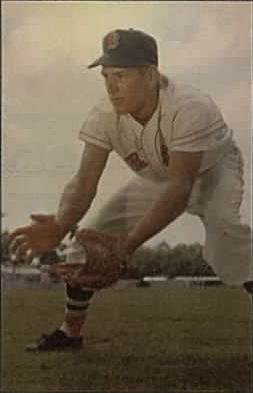
William Dale Goodman (March 22, 1926 – October 1, 1984) was an American Major League Baseball (MLB) infielder who played 16 seasons for the Boston Red Sox, Baltimore Orioles, Chicago White Sox, and Houston Colt .45s, from 1947 through 1962. Goodman was inducted posthumously into the Boston Red Sox Hall of Fame in November 2004.[1]

Key Information

Goodman was an outstanding hitter and fielder, and one of the most versatile players of his era. He played every position in the major leagues except catcher and pitcher and was an All-Star for two seasons. In 1950, he won the American League (AL) batting title hitting .354 with 68 runs batted in (RBI) and was the AL Most Valuable Player runner-up to New York Yankees shortstop Phil Rizzuto (hit .324 with 66 RBI). Goodman batted over .290 in eleven seasons including over .300 in five seasons. In 1959, he hit .304, helping the White Sox win the American League pennant. His career .376 on-base percentage made him an ideal lead-off hitter. He was inducted into the North Carolina Sports Hall of Fame in 1969.[2]

Early years

[edit]

Goodman was born in Concord, North Carolina, and played Textile League baseball in Concord before signing with the Atlanta Crackers of the Southern Association in 1944 at just eighteen years old.[3]

Minor league

[edit]

Goodman hit .336 his first season in Atlanta. He left baseball temporarily, serving in the United States Navy during World War II in 1945. While assigned to the Pacific Theater on Ulithi with Major Leaguer Mickey Vernon and future Baseball Hall of Famer, Larry Doby, both Goodman and Vernon encouraged Doby to become a Major League baseball player.

Goodman returned to the Atlanta Crackers in 1946 to bat .389 and lead his team to the Southern Association's playoff series championship. On February 8, 1947, he was sold to the Boston Red Sox.[4] Goodman entered his first Spring training battling Sam Mele for the open right field job.[5] With Mele winning the job, Goodman batted .182 in limited play through May of the 1947 season before being reassigned to the American Association's Louisville Colonels, where he batted .340 over the remainder of the season.

MLB career

[edit]

Boston Red Sox

[edit]

1947–1948

[edit]

Goodman spent the spring with the Red Sox in 1947 playing in 12 games, 2 in the outfield, and 10 filling in at second base for an injured Bobby Doerr,[6] He made his first start as a Major League third baseman on May 20, 1948.[7][8] From there, Goodman moved across the diamond to first base for the remainder of the season in the Majors. He batted .310 with 66 runs batted in as a rookie. His first Major League home run, and only home run of the season, was a grand slam off the Detroit Tigers' Virgil Trucks.[9]

1949–1950

[edit]

He was named to the first of two American League All-Star rosters in 1949, and appeared during the bottom of the 8th inning of the All-Star Game as a defensive replacement for Washington Senators first baseman Eddie Robinson.[10] Early in the 1950 season, Goodman suffered a chip fracture in his left ankle that cost him a month of play.[11] Power hitting rookie first baseman Walt Dropo earned himself a place in the everyday starting line-up in Goodman's absence, batting .348 with ten home runs and 33 RBIs. Goodman found himself without a starting position upon his return. However, injuries to Bobby Doerr and third baseman Johnny Pesky kept Goodman in the line-up semi-regularly. After Ted Williams injured himself in the All-Star game,[12] Goodman took over in left field for the Bosox, and batted .338 with 23 RBIs filling in for the Boston legend. Playing five different positions over the course of the season, Goodman logged enough at-bats to win the American League batting title with a .354 batting average (Stan Musial, National League, .346) with 68 RBI, and was the runner-up in AL Most Valuable Player Award balloting to New York Yankees shortstop Phil Rizzuto, who hit .324 with 66 RBI; Yankee catcher Yogi Berra finished 3rd in the voting, hitting .322 with 124 RBI.

1951–1953

[edit]

Goodman resumed his utility player role in 1951. He began the season playing first base when Dropo fractured his right wrist.[13] He shifted over to right field upon Dropo's return, but was back at first when Dropo was optioned to the Pacific Coast League's San Diego Padres at the end of June for "more work."[14] He spent most of the month of August at second base when Bobby Doerr's bad back kept him out of the lineup. In all, Goodman played five different positions, and batted .297 with 50 RBIs and 92 runs scored. His 638 plate appearances were third highest on the team behind Dom DiMaggio and Ted Williams.

Doerr retired at the end of the season,[15] opening a regular position for Goodman at second base in 1952. He batted over .300 each of the next three seasons, and was moved into the lead-off spot in manager Lou Boudreau's batting order in 1953, where he would remain for the rest of his Red Sox career. He was elected to start the All-Star Game as a second baseman that season despite being sidelined for a month by one of the more bizarre baseball injuries. While arguing with first base umpire Jim Duffy, Goodman was restrained by teammate Jim Piersall. Piersall pulled Goodman toward the dugout, and in doing so, strained Goodman's rib cartilage.[16]

1954–1957

[edit]

In 1954, Goodman returned to his "jack of all trades" role with the Bosox. After starting the season at second, he moved over to third when the Sox traded George Kell to the Chicago White Sox.[17] He moved to left field when Ted Williams was sidelined by a virus infection in his right lung.[18] Upon Williams' return, Goodman began platooning at first with Harry Agganis (despite the fact that both were left-handed batters) until he was shifted back to second base in the beginning of August.

He had a starting job at second base again in 1955, and led the team with 100 runs scored while logging a team-high 719 plate appearances. Both were career highs, as were his 176 hits and 99 walks. He began losing playing time to Ted Lepcio at second base toward the end of the 1956 season. He was relegated to pinch hitting duties early in 1957, before a mid-season trade sent him to the Baltimore Orioles for pitcher Mike Fornieles.[19]

The Rookie

[edit]

During his time with the Red Sox, Goodman was one of the players featured in the 1957 Norman Rockwell painting The Rookie.

Baltimore Orioles

[edit]

Goodman was immediately inserted into the starting line-up in Baltimore, and hit a home run in his first game as an Oriole.[20] He mostly played third base, filling in for an injured George Kell,[21] but also played first, second, short, left field and right field. He batted .308 with three home runs and 33 RBIs in 73 games for the Orioles. At the end of the season, he, Tito Francona and Ray Moore were dealt to the Chicago White Sox for Larry Doby, Jack Harshman and Jim Marshall.[22] Chicago later sent pitcher Russ Heman to Baltimore as part of this deal when the Orioles discovered that Harshman was suffering from a slipped disc.[23]

Chicago White Sox

[edit]
Goodman in 1958

In 1958, with Nellie Fox at second base, Goodman shifted to third with the White Sox. He was sidelined by a knee injury for most of the month of May. Upon his return, he quickly shot up among the American League leaders in batting, with his average peaking at .336 in late July.[24]

At 33 years old at the start of the 1959 season, Goodman was used in a lefty-righty platoon with Bubba Phillips at third base. The 1959 White Sox reached the World Series for the first time since the infamous 1919 World Series. It was also the first and only World Series of Goodman's career. Goodman appeared in five of the six games of the 1959 World Series, driving in and scoring one run in the White Sox's 11–0 game 1 victory.[25] He also went two-for-three in game 3, and was hit by a pitch in the eighth inning to load the bases with the White Sox down by two runs (they ended up scoring one).[26] Overall, he batted .231 (3-for-13) in Chicago's six-game loss to the Los Angeles Dodgers.

Goodman was used sparingly by manager Al López in 1960. After the season, the White Sox made him available for the 1960 Major League Baseball expansion draft,[27] but he went unselected. Instead, he remained with the franchise for two more seasons, in which he batted a combined .242 with one home run and sixteen RBIs in 71 games. After holding out over a salary dispute at the start of Spring training 1962,[28] he was released by the White Sox just as the season was set to start.[29]

Houston Colt .45s

[edit]

Goodman joined the Houston Colt .45s in 1962, playing in 49 games during their inaugural season, and went two-for-five with two runs scored in his first game with the team.[30] Overall, he batted .255 in 82 games for the Colt .45s, while playing first, second, and third base.

Player-manager

[edit]

In 1963, he became a player-manager for the Colts' Carolina League affiliate, the Durham Bulls, and batted .354 with six home runs, the most home runs he hit in a season at any level.[31] The following season, he appeared on the mound for two games (7 innings) with Durham, leaving catcher as the only position he never played professionally. He managed the Cocoa Astros of the Florida State League in 1965. In three seasons, he had a combined 184–228 record for a .447 winning percentage.

Scout and instructor

[edit]

He became a scout for the Red Sox in 1966, then an instructor in the Kansas City Athletics organization in 1967 before moving over to the Atlanta Braves' organization in 1968, serving as first-base coach for the Braves Major League squad through 1970.

Later years

[edit]

Goodman retired from the game in 1976, and became an antiques dealer in Sarasota, Florida, the spring training home of the Red Sox during his decade with them, and of the White Sox from 1960 through 1997. He died on October 1, 1984, after a year-long battle with cancer.[32]

Major League stats

[edit]
Years Games PA AB Runs Hits 2B 3B HR RBI SB BB SO OBP SGA BA Fld%
16 1623 6443 5644 807 1691 299 44 19 591 37 669 329 .376 .378 .300 .978

Goodman had five 5-hit games in his career. His best playing position according to fielding percentage was .991 at first base; in 1949, he led the AL with a .992 fielding average at first base.

See also

[edit]

References

[edit]
[edit]
Revisions and contributorsEdit on WikipediaRead on Wikipedia
from Grokipedia
Billy Goodman was an American professional baseball player known for his remarkable versatility as an infielder and outfielder, as well as his consistent contact hitting during a sixteen-year Major League career from 1947 to 1962. He is particularly remembered for winning the American League batting title in 1950 while playing without a regular defensive position, a feat unmatched in major-league history. Born William Dale Goodman on March 22, 1926, in Concord, North Carolina, he grew up on a family dairy farm and excelled in multiple sports at Winecoff High School before beginning his professional career in the minor leagues. He joined the Boston Red Sox in 1947 and spent over a decade with the team, frequently shifting between first base, second base, third base, and outfield positions to address lineup needs. His adaptability earned him recognition as one of the era's premier utility players, complemented by reliable offensive production that made him a valuable regular and occasional All-Star selection. Goodman later played for the Baltimore Orioles, Chicago White Sox—where he contributed to their 1959 American League pennant and appeared in the World Series—and the Houston Colt .45s before retiring in 1962. After his playing days, he remained involved in baseball through coaching, scouting, and instructional roles with several organizations. He was inducted into the North Carolina Sports Hall of Fame in 1969 and the Boston Red Sox Hall of Fame in 2004. Goodman died on October 1, 1984, in Sarasota, Florida, where he had settled with his family after marrying his childhood sweetheart in 1947.

Early life

Birth and family background

William Dale Goodman was born on March 22, 1926, in Concord, North Carolina. He was the second of three sons born to Fred Goodman and Margie Goodman (née DeLette Barringer). His father was a prosperous dairy farmer who owned more than 300 acres of pastureland in the Concord area, and Goodman frequently worked on the family farm during his youth. The Goodman family had deep roots in the region, with his grandfather C.J. Goodman owning the original family farmstead farther up the street and an uncle owning comparable farmland nearby. Goodman grew up in Concord, North Carolina, in this agricultural family setting.

Youth baseball and early professional start

Billy Goodman began his baseball career playing in the Textile League in Concord, North Carolina, during his youth. He signed his first professional contract with the Atlanta Crackers of the Southern Association in 1944 at age 18. In his initial season with the Crackers, Goodman batted .336. After serving in the military in 1945, he returned to the Atlanta Crackers in 1946 and posted a .389 batting average while helping the team capture the Southern Association playoff championship. On February 8, 1947, the Crackers sold Goodman to the Boston Red Sox.

Military service during World War II

Goodman entered the United States Navy at the end of the 1944 baseball season and served during the final year of World War II in 1945. His assignment took him to the South Pacific theater, where he was stationed at the Ulithi Atoll in the Western Caroline Islands. While serving, Goodman played baseball in games organized on the base, teaming up with established major leaguer Mickey Vernon and Larry Doby, who was also in the Navy at the time. Goodman and Vernon encouraged Doby to pursue a major league career after the war, helping to bolster his confidence in the face of the era's racial barriers. Upon his discharge from the Navy, Goodman returned to civilian life and resumed his professional baseball career in 1946.

Major League Baseball playing career

Entry into MLB and Boston Red Sox tenure (1947–1957)

Billy Goodman made his Major League debut with the Boston Red Sox on April 19, 1947, at age 21, appearing in 12 games primarily as a pinch hitter and defensive replacement. He collected two hits in 11 at-bats before being optioned to the minors in June. Goodman established himself as a regular in 1948, batting .310 with 66 RBI over 127 games while playing primarily first base. His first major league home run came as a grand slam on July 29, 1948. The following year, he earned selection to the All-Star Game as a defensive replacement in the eighth inning, though he did not bat. His standout season arrived in 1950, when he won the American League batting title with a .354 average—the only major leaguer ever to claim a batting championship without a regular defensive position—while driving in 68 runs and finishing second in AL Most Valuable Player voting behind Phil Rizzuto. That year, Goodman shifted across multiple positions due to injuries to regulars, including extended time in left field after Ted Williams broke his elbow in the All-Star Game. Throughout his tenure with the Red Sox, Goodman proved one of the era's most versatile players, taking the field at every position except catcher and pitcher as needed to fill gaps caused by injuries or slumps. He also earned an All-Star selection in 1953 as a starter at second base. He remained with Boston through 1957, contributing as a reliable utility performer and consistent .300 hitter during much of that span.

Trades and final playing years (1957–1962)

In mid-1957, after starting the season 1-for-16 with the Boston Red Sox, Billy Goodman was traded to the Baltimore Orioles. He recovered to bat .308 for the remainder of the year with Baltimore. On December 3, 1957, Goodman was traded to the Chicago White Sox in a multi-player deal that sent Larry Doby to Baltimore, along with Tito Francona and Ray Moore going to Chicago. Goodman played four seasons with the White Sox from 1958 through 1961. His most notable contribution came in 1959, when he hit .250 in 104 games and helped Chicago capture the American League pennant. That fall, he appeared in the 1959 World Series against the Los Angeles Dodgers, batting .231 in five games (3-for-13). Goodman concluded his major league playing career in 1962 with the Houston Colt .45s, appearing in 82 games and batting .255. In his overall MLB career spanning 1947 to 1962, he played in 1,623 games with a .300 batting average, collecting 1,691 hits, 19 home runs, and 591 RBI.

Playing style, versatility, and career statistics

Billy Goodman was renowned for his exceptional versatility as a utility infielder, regularly shifting between second base, third base, first base, and the outfield to meet team needs arising from injuries or lineup adjustments. He played the majority of his games at second base, followed by substantial time at first base and third base, along with outfield appearances, establishing him as one of the era's most flexible position players. Goodman compiled a career batting average of .300 with a .376 on-base percentage across 1,623 games, showcasing his skills as a consistent contact hitter who rarely struck out and excelled at reaching base. His strong on-base abilities led to frequent deployment as a leadoff hitter or near the top of the order, particularly during his peak years with the Boston Red Sox. He recorded batting averages over .300 in five seasons and over .290 in eleven seasons, demonstrating sustained offensive reliability. Defensively, Goodman posted a career fielding percentage of .978 across his various positions. He led the American League in fielding percentage at first base in 1949 with a .992 mark.

Awards, honors, and notable achievements

Post-playing career

Minor league managing

After his major league playing career ended following the 1962 season, Billy Goodman transitioned into minor league managing. In 1963, he served as player-manager for the Durham Bulls of the Class A Carolina League, where he also appeared in games and batted .354 with 6 home runs. In 1964, he managed the Winston-Salem Red Sox, also in the Carolina League. Goodman later managed the Cocoa Astros of the Florida State League in 1965. Across his three seasons managing in the minors, he compiled an overall record of 184–228 for a .447 winning percentage.

Coaching and scouting roles

After his period as a minor league manager, Billy Goodman remained involved in professional baseball through scouting and coaching positions. He returned to the Boston Red Sox organization as a scout in 1966. In 1967, he served as an instructor with the Kansas City Athletics. Goodman then joined the Atlanta Braves as their first-base coach, holding that role from 1968 to 1970. During this time, he contributed to the team's major league staff under manager Lum Harris.

Later occupations

After retiring from organized baseball in 1976, Billy Goodman became an antiques dealer in Sarasota, Florida. He owned an antique store in the city, which had served as the Boston Red Sox's spring training home during much of his playing career. Some sources indicate that the antiques business was primarily operated by his wife Margaret, with Goodman assisting her in the venture. During this period of retirement, he also pursued personal interests including real estate and farming in the Sarasota area.

Television and media appearances

Personal life and death

Family and retirement years

Billy Goodman married his childhood sweetheart, Margaret Little, in October 1947. The couple made Sarasota, Florida, their permanent home, where they raised their family and became involved in local business ventures. They had two children: a daughter, Kathy Goodman Simpkins, and a son, Robert Goodman. After concluding his baseball-related roles in the mid-1970s, Goodman retired to Sarasota and assisted his wife in her antiques business, known as the Babe Ruth Auxiliary, while also helping with their other commercial properties. Between 1977 and 1982, he was fully retired from baseball, enjoying leisure activities such as golf, fishing, hunting, and gardening. The Goodmans owned a 30-acre orange grove in the region, which they sold prior to his final illness.

Illness and death

Billy Goodman battled cancer during the final year of his life. He died from the disease on October 1, 1984, at Sarasota Memorial Hospital in Sarasota, Florida, at the age of 58. Goodman had been a longtime resident of Sarasota.

Legacy

Billy Goodman is remembered as one of the most consistent .300 hitters of his era, compiling a career batting average of exactly .300 across 1,623 games and 1,691 hits while demonstrating exceptional plate discipline and contact skills. His hallmark versatility set him apart as one of the most adaptable players in baseball history; he competently played every position except pitcher and catcher and remains the only major leaguer ever to win a batting title without a regular defensive role, achieving the American League crown in 1950 with a .354 average as a utility man. Teammates and scouts praised his understated yet highly effective style, with Hall of Famer Bobby Doerr describing him as “a very, very fine person and a darn good ballplayer… the perfect guy to be on a ballclub because he could play so many different positions.” Goodman received posthumous recognition for his contributions when he was inducted into the Boston Red Sox Hall of Fame in 2004. During his World War II service in the United States Navy, Goodman was stationed on Ulithi Atoll alongside Mickey Vernon and Larry Doby, where the three took batting practice together; Goodman and Vernon encouraged Doby in his pursuit of a major league career, providing early support to the future Hall of Famer before he broke the American League's color barrier in 1947.
Add your contribution
Related Hubs
User Avatar
No comments yet.