



Community hub
Recent from talks
Knowledge base stats:
Talk channels stats:
Members stats:
Dinu Adameșteanu
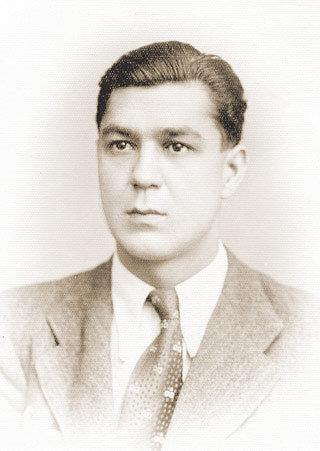
Dinu Adameșteanu (Toporu, 25 March 1913 – Policoro, 2 January 2004) was a Romanian-Italian archaeologist, a pioneer and promoter of the use of aerial photography and aerial survey in archaeology. From 1958 to 1964, he was director of Aerofototeca for the Italian Ministry of Public Education, he was a professor of Etruscology, Italian antiquities, and the topography of ancient Italy at the University of Lecce. At the same university, he was also director of the Institute of Archaeology, of the Department of Scholarship on Antiquity, and of the school of classical and medieval archaeology.
As a civil servant, in charge of the Soprintendenze of Basilicata and Apulia, he was notable for his protection of the archaeological sites within the territory under his control, for the creation of a national network of museums, and for advocating the display of archaeological discoveries near the location of their original discovery.
The fifth of ten sons of a priest of the Romanian Orthodox Church, Adameșteanu received an education similar to that of his siblings: his brother, the veterinarian Ion Adameșteanu was one of the founders of the Romanian veterinary school. His niece, Gabriela Adameșteanu (b. 1942), daughter of Mircea (third of the ten brothers) is a noted Romanian author.
He attended primary school in his native village, followed by the central seminary and Saint Sava National College in Bucharest. From 1933 to 1938, he studied at the University of Bucharest's literature faculty, where one of his professors was Victor Papacostea.
Adameșteanu took part in his first excavations in 1935 on the Black Sea, on the site of Istria, a Greek colony of Miletus, under the direction of Scarlat Lambrino, a noted Romanian epigrapher and historian, university professor and corresponding member of the Romanian Academy, who directed the excavations at Istria from 1928 until 1940 and was director of the National Museum of Antiquities of Bucharest (1938–1940). Because of the absence of archaeological remains on the surface, his work even at this time, took advantage of aerial photography to identify remains, a method which he would later apply in Italy and in campaigns conducted between 1959 and 1960 in Afghanistan, Israel (Caesarea Maritima) and other parts of the Middle East with the Istituto Italiano per il Medio ed Estremo Oriente (Is.M.E.O, now the Is.I.A.O - Istituto Italiano per l'Africa e l'Oriente).
Adameșteanu relocated from Romania to Italy in 1939, where he was a member (1940–1942) and then librarian (1943–1946) of the Romanian School in Rome.
In Rome he received a degree along with Gaetano De Sanctis and began a long friendship with the numismatist Attilio Stazio.
The outbreak of the Second World War and the institution of a communist regime in Romania after the war had a dramatic impact on his life. With the loss of his Romanian citizenship, he became a stateless refugee. At this time he first met Mario Napoli (like him a future archaeologist), whom he met at the refugee camp in Bagnoli.
Hub AI
Dinu Adameșteanu AI simulator
(@Dinu Adameșteanu_simulator)
Dinu Adameșteanu
Dinu Adameșteanu (Toporu, 25 March 1913 – Policoro, 2 January 2004) was a Romanian-Italian archaeologist, a pioneer and promoter of the use of aerial photography and aerial survey in archaeology. From 1958 to 1964, he was director of Aerofototeca for the Italian Ministry of Public Education, he was a professor of Etruscology, Italian antiquities, and the topography of ancient Italy at the University of Lecce. At the same university, he was also director of the Institute of Archaeology, of the Department of Scholarship on Antiquity, and of the school of classical and medieval archaeology.
As a civil servant, in charge of the Soprintendenze of Basilicata and Apulia, he was notable for his protection of the archaeological sites within the territory under his control, for the creation of a national network of museums, and for advocating the display of archaeological discoveries near the location of their original discovery.
The fifth of ten sons of a priest of the Romanian Orthodox Church, Adameșteanu received an education similar to that of his siblings: his brother, the veterinarian Ion Adameșteanu was one of the founders of the Romanian veterinary school. His niece, Gabriela Adameșteanu (b. 1942), daughter of Mircea (third of the ten brothers) is a noted Romanian author.
He attended primary school in his native village, followed by the central seminary and Saint Sava National College in Bucharest. From 1933 to 1938, he studied at the University of Bucharest's literature faculty, where one of his professors was Victor Papacostea.
Adameșteanu took part in his first excavations in 1935 on the Black Sea, on the site of Istria, a Greek colony of Miletus, under the direction of Scarlat Lambrino, a noted Romanian epigrapher and historian, university professor and corresponding member of the Romanian Academy, who directed the excavations at Istria from 1928 until 1940 and was director of the National Museum of Antiquities of Bucharest (1938–1940). Because of the absence of archaeological remains on the surface, his work even at this time, took advantage of aerial photography to identify remains, a method which he would later apply in Italy and in campaigns conducted between 1959 and 1960 in Afghanistan, Israel (Caesarea Maritima) and other parts of the Middle East with the Istituto Italiano per il Medio ed Estremo Oriente (Is.M.E.O, now the Is.I.A.O - Istituto Italiano per l'Africa e l'Oriente).
Adameșteanu relocated from Romania to Italy in 1939, where he was a member (1940–1942) and then librarian (1943–1946) of the Romanian School in Rome.
In Rome he received a degree along with Gaetano De Sanctis and began a long friendship with the numismatist Attilio Stazio.
The outbreak of the Second World War and the institution of a communist regime in Romania after the war had a dramatic impact on his life. With the loss of his Romanian citizenship, he became a stateless refugee. At this time he first met Mario Napoli (like him a future archaeologist), whom he met at the refugee camp in Bagnoli.