Hubbry Logo
Orientation (vector space)Orientation (vector space)Main
Open search
Orientation (vector space)
Community hub
Orientation (vector space)
logo
8 pages, 0 posts
0 subscribers
Be the first to start a discussion here.
Orientation (vector space)
from Wikipedia
The left-handed orientation is shown on the left, and the right-handed on the right.

The orientation of a real vector space or simply orientation of a vector space is the arbitrary choice of which ordered bases are "positively" oriented and which are "negatively" oriented. In the three-dimensional Euclidean space, right-handed bases are typically declared to be positively oriented, but the choice is arbitrary, as they may also be assigned a negative orientation. A vector space with an orientation selected is called an oriented vector space, while one not having an orientation selected is called unoriented.

In mathematics, orientability is a broader notion that, in two dimensions, allows one to say when a cycle goes around clockwise or counterclockwise, and in three dimensions when a figure is left-handed or right-handed. In linear algebra over the real numbers, the notion of orientation makes sense in arbitrary finite dimension, and is a kind of asymmetry that makes a reflection impossible to replicate by means of a simple displacement. Thus, in three dimensions, it is impossible to make the left hand of a human figure into the right hand of the figure by applying a displacement alone, but it is possible to do so by reflecting the figure in a mirror. As a result, in the three-dimensional Euclidean space, the two possible basis orientations are called right-handed and left-handed (or right-chiral and left-chiral).

Definition

[edit]

Let V be a finite-dimensional real vector space and let b1 and b2 be two ordered bases for V. It is a standard result in linear algebra that there exists a unique linear transformation A : VV that takes b1 to b2. The bases b1 and b2 are said to have the same orientation (or be consistently oriented) if A has positive determinant; otherwise they have opposite orientations. The property of having the same orientation defines an equivalence relation on the set of all ordered bases for V. If V is non-zero, there are precisely two equivalence classes determined by this relation. An orientation on V is an assignment of +1 to one equivalence class and −1 to the other.[1]

Every ordered basis lives in one equivalence class or another. Thus any choice of a privileged ordered basis for V determines an orientation: the orientation class of the privileged basis is declared to be positive.

For example, the standard basis on Rn provides a standard orientation on Rn (in turn, the orientation of the standard basis depends on the orientation of the Cartesian coordinate system on which it is built). Any choice of a linear isomorphism between V and Rn will then provide an orientation on V.

The ordering of elements in a basis is crucial. Two bases with a different ordering will differ by some permutation. They will have the same/opposite orientations according to whether the signature of this permutation is ±1. This is because the determinant of a permutation matrix is equal to the signature of the associated permutation.

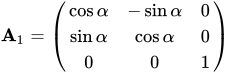
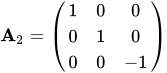
Similarly, let A be a nonsingular linear mapping of vector space Rn to Rn. This mapping is orientation-preserving if its determinant is positive.[2] For instance, in R3 a rotation around the Z Cartesian axis by an angle α is orientation-preserving: while a reflection by the XY Cartesian plane is not orientation-preserving:
Zero-dimensional case

[edit]

The concept of orientation degenerates in the zero-dimensional case. A zero-dimensional vector space has only a single point, the zero vector. Consequently, the only basis of a zero-dimensional vector space is the empty set . Therefore, there is a single equivalence class of ordered bases, namely, the class whose sole member is the empty set. This means that an orientation of a zero-dimensional space is a function It is therefore possible to orient a point in two different ways, positive and negative.

Because there is only a single ordered basis , a zero-dimensional vector space is the same as a zero-dimensional vector space with ordered basis. Choosing or therefore chooses an orientation of every basis of every zero-dimensional vector space. If all zero-dimensional vector spaces are assigned this orientation, then, because all isomorphisms among zero-dimensional vector spaces preserve the ordered basis, they also preserve the orientation. This is unlike the case of higher-dimensional vector spaces where there is no way to choose an orientation so that it is preserved under all isomorphisms.

However, there are situations where it is desirable to give different orientations to different points. For example, consider the fundamental theorem of calculus as an instance of Stokes' theorem. A closed interval [a, b] is a one-dimensional manifold with boundary, and its boundary is the set {a, b}. In order to get the correct statement of the fundamental theorem of calculus, the point b should be oriented positively, while the point a should be oriented negatively.

On a line

[edit]

The one-dimensional case deals with an oriented line or directed line, which may be traversed in one of two directions. In real coordinate space, an oriented line is also known as an axis.[3] There are two orientations to a line just as there are two orientations to an oriented circle (clockwise and anti-clockwise). A semi-infinite oriented line is called a ray. In the case of a line segment (a connected subset of a line), the two possible orientations result in directed line segments.

On a surface

[edit]

An orientable surface sometimes has the selected orientation indicated by the orientation of a surface normal. An oriented plane can be defined by a pseudovector.

Alternate viewpoints

[edit]

Multilinear algebra

[edit]

For any n-dimensional real vector space V we can form the kth-exterior power of V, denoted ΛkV. This is a real vector space of dimension . The vector space ΛnV (called the top exterior power) therefore has dimension 1. That is, ΛnV is just a real line. There is no a priori choice of which direction on this line is positive. An orientation is just such a choice. Any nonzero linear form ω on ΛnV determines an orientation of V by declaring that x is in the positive direction when ω(x) > 0. To connect with the basis point of view we say that the positively-oriented bases are those on which ω evaluates to a positive number (since ω is an n-form we can evaluate it on an ordered set of n vectors, giving an element of R). The form ω is called an orientation form. If {ei} is a privileged basis for V and {ei} is the dual basis, then the orientation form giving the standard orientation is e1e2 ∧ … ∧ en.

The connection of this with the determinant point of view is: the determinant of an endomorphism can be interpreted as the induced action on the top exterior power.

Lie group theory

[edit]

Let B be the set of all ordered bases for V. Then the general linear group GL(V) acts freely and transitively on B. (In fancy language, B is a GL(V)-torsor). This means that as a manifold, B is (noncanonically) homeomorphic to GL(V). Note that the group GL(V) is not connected, but rather has two connected components according to whether the determinant of the transformation is positive or negative (except for GL0, which is the trivial group and thus has a single connected component; this corresponds to the canonical orientation on a zero-dimensional vector space). The identity component of GL(V) is denoted GL+(V) and consists of those transformations with positive determinant. The action of GL+(V) on B is not transitive: there are two orbits which correspond to the connected components of B. These orbits are precisely the equivalence classes referred to above. Since B does not have a distinguished element (i.e. a privileged basis) there is no natural choice of which component is positive. Contrast this with GL(V) which does have a privileged component: the component of the identity. A specific choice of homeomorphism between B and GL(V) is equivalent to a choice of a privileged basis and therefore determines an orientation.

More formally: , and the Stiefel manifold of n-frames in is a -torsor, so is a torsor over , i.e., its 2 points, and a choice of one of them is an orientation.

Geometric algebra

[edit]
Parallel plane segments with the same attitude, magnitude and orientation, all corresponding to the same bivector ab.[4]

The various objects of geometric algebra are charged with three attributes or features: attitude, orientation, and magnitude.[5] For example, a vector has an attitude given by a straight line parallel to it, an orientation given by its sense (often indicated by an arrowhead) and a magnitude given by its length. Similarly, a bivector in three dimensions has an attitude given by the family of planes associated with it (possibly specified by the normal line common to these planes [6]), an orientation (sometimes denoted by a curved arrow in the plane) indicating a choice of sense of traversal of its boundary (its circulation), and a magnitude given by the area of the parallelogram defined by its two vectors.[7]

Orientation on manifolds

[edit]
The orientation of a volume may be determined by the orientation on its boundary, indicated by the circulating arrows.

Each point p on an n-dimensional differentiable manifold has a tangent space TpM which is an n-dimensional real vector space. Each of these vector spaces can be assigned an orientation. Some orientations "vary smoothly" from point to point. Due to certain topological restrictions, this is not always possible. A manifold that admits a smooth choice of orientations for its tangent spaces is said to be orientable.

See also

[edit]

References

[edit]
[edit]
Revisions and contributorsEdit on WikipediaRead on Wikipedia
from Grokipedia
In linear algebra, the orientation of a finite-dimensional real VV of n1n \geq 1 is a choice of one of the two equivalence classes of ordered bases, where two ordered bases {v1,,vn}\{v_1, \dots, v_n\} and {w1,,wn}\{w_1, \dots, w_n\} belong to the same class if and only if the of the change-of-basis matrix from the first to the second is positive. This binary distinction captures an intrinsic "" or "" of the space, analogous to the right-handed versus left-handed coordinate systems in R3\mathbb{R}^3. Formally, an orientation can also be defined using the top exterior power Λn(V)\Lambda^n(V^*), the of alternating nn-forms on VV, where an orientation selects one of the two connected components of Λn(V){0}\Lambda^n(V^*) \setminus \{0\} (the positive ray). For an ordered basis {v1,,vn}\{v_1, \dots, v_n\}, the wedge product v1vnv^1 \wedge \dots \wedge v^n (where {vi}\{v^i\} is the dual basis) lies in one component or the other, determining the basis's orientation; bases with wedge products in the same component share the orientation. A linear between oriented spaces preserves orientation if it induces a positive on bases or maps the positive component to itself. Orientations play a crucial role in and , extending to tangent spaces of manifolds to define orientable structures, such as those allowing consistent "positive" forms or enabling the into orientable and non-orientable types (e.g., the lacks a global orientation). In Rn\mathbb{R}^n, the standard orientation is given by the basis, corresponding to a counterclockwise "twirl" in low dimensions: rightward in R1\mathbb{R}^1, counterclockwise in the plane for R2\mathbb{R}^2, and a right-handed screw rule in R3\mathbb{R}^3. This concept ensures well-defined signed and is foundational for integration theory and on oriented manifolds.

Foundational Definitions

General Definition for Vector Spaces

In a finite-dimensional real vector space VV of dimension nn, an orientation is a choice of equivalence class of ordered bases, where two ordered bases (v1,,vn)(v_1, \dots, v_n) and (w1,,wn)(w_1, \dots, w_n) are equivalent if the change-of-basis matrix PP expressing the wiw_i as linear combinations of the viv_i has positive determinant, i.e., detP>0\det P > 0. Equivalently, the bases are related by an even permutation if considering direct reordering relative to a fixed reference basis, as even permutations preserve the sign of the determinant while odd ones reverse it. This equivalence relation arises from the decomposition of the general linear group GL(n,R)\mathrm{GL}(n, \mathbb{R}) into two connected components: those with positive determinant (GL+(n,R)\mathrm{GL}^+(n, \mathbb{R})) and those with negative determinant. The set of all ordered bases of VV, denoted Orb(V)\mathrm{Orb}(V), is thus partitioned into two disjoint equivalence classes under this relation: the positively oriented bases and the negatively oriented bases, with each orientation corresponding to selecting one class as positive. A basis belongs to the positive class relative to a fixed if the change-of-basis matrix to it has det>0\det > 0; otherwise, it is negative. This structure reflects the topological distinction in real vector spaces, where the R×\mathbb{R}^\times has two connected components (positive and negative reals), enabling such a binary choice. The emphasis on real vector spaces stems from the fact that complex vector spaces of dimension nn (viewed as real spaces of dimension 2n2n) admit a canonical orientation induced by the compatible complex and Hermitian inner product, which distinguishes a preferred class of bases without explicit selection. In contrast, real spaces lack this inherent , necessitating the explicit definition via bases. For the specific case of V=RnV = \mathbb{R}^n, the (e1,,en)(e_1, \dots, e_n) is conventionally chosen as positively oriented, serving as the reference for determining the sign of other bases. An orientation ΩOrb(V)\Omega \subset \mathrm{Orb}(V) is then the subset consisting of all bases equivalent to the standard one, so that for any B,BΩB, B' \in \Omega, the change-of-basis matrix between them satisfies detP>0\det P > 0.

Low-Dimensional Illustrations

In the zero-dimensional vector space {0}\{0\}, there is a unique orientation given by the empty basis, as no nonzero vectors exist to form alternative bases. In one dimension, such as the real line R\mathbb{R}, an orientation corresponds to a choice of positive direction, distinguishing rightward from leftward. For a nonzero vector vv, the ordered basis {v}\{v\} defines one orientation, while {v}\{-v\} defines the opposite, as the change-of-basis matrix has determinant 1-1. Visually, this can be illustrated by arrows pointing along the line: one orientation aligns with arrows to the right, the other to the left. In two dimensions, such as the plane R2\mathbb{R}^2, orientations distinguish counterclockwise from rotations, capturing notions of . Consider the (e1,e2)(\mathbf{e}_1, \mathbf{e}_2), where e1=(1,0)\mathbf{e}_1 = (1,0) and e2=(0,1)\mathbf{e}_2 = (0,1); this defines the positive orientation via the , with the thumb pointing out of the plane for a counterclockwise twirl from e1\mathbf{e}_1 to e2\mathbf{e}_2. The basis (e2,e1)(\mathbf{e}_2, -\mathbf{e}_1) represents the same orientation, as the change-of-basis matrix has positive +1+1. In contrast, (e1,e2)(\mathbf{e}_1, -\mathbf{e}_2) defines the opposite orientation, corresponding to an odd transformation (reflection) with 1-1. Visually, this is depicted by rotating vectors on the plane: a counterclockwise sweep preserves the standard orientation, while reverses it, akin to mirror images or chiral pairs. These low-dimensional cases highlight how orientations encode directional consistency or in a visually intuitive way, a feature that becomes less accessible in higher dimensions lacking simple geometric interpretations.

Equivalent Mathematical Perspectives

Multilinear Algebra Formulation

In , the orientation of an n-dimensional real VV can be formulated using the top exterior power Λn(V)\Lambda^n(V), which is the n-th exterior power of VV. This space Λn(V)\Lambda^n(V) is one-dimensional, as it is generated by the wedge product of any basis of VV. An orientation on VV is then defined as a choice of basis for Λn(V)\Lambda^n(V), or equivalently, a selection of one of the two connected components of Λn(V){0}\Lambda^n(V) \setminus \{0\} as the "positive" component, determining a positive ray in this space. To elaborate, let {e1,,en}\{e_1, \dots, e_n\} be a basis for VV. The element e1ene_1 \wedge \cdots \wedge e_n forms a basis for Λn(V)\Lambda^n(V). For another basis {f1,,fn}\{f_1, \dots, f_n\} related by fj=iaijeif_j = \sum_i a_{ij} e_i with change-of-basis matrix A=(aij)A = (a_{ij}), the induced element is f1fn=det(A)(e1en)f_1 \wedge \cdots \wedge f_n = \det(A) \, (e_1 \wedge \cdots \wedge e_n). Thus, the two bases induce the same orientation if det(A)>0\det(A) > 0, meaning they generate the same positive ray in Λn(V)\Lambda^n(V); otherwise, they induce opposite orientations. This formulation ties orientation directly to the sign of the determinant, which arises naturally from the multilinearity and alternating properties of the exterior product. Equivalently, an orientation can be specified by a nowhere-vanishing n-form ωΛn(V){0}\omega \in \Lambda^n(V^*) \setminus \{0\}, up to positive scalar multiple, where VV^* is the and Λn(V)\Lambda^n(V^*) is the top exterior power of VV^*, also one-dimensional. Such an ω\omega assigns an oriented volume to parallelepipeds in VV: for vectors v1,,vnv_1, \dots, v_n, ω(v1,,vn)\omega(v_1, \dots, v_n) yields the signed n-dimensional volume, positive if {v1,,vn}\{v_1, \dots, v_n\} aligns with the chosen orientation. Integrals over oriented regions in VV employ this signed measure, enabling consistent definitions of signed areas or volumes. Without an orientation, only absolute (unsigned) volumes are available via the norm on Λn(V)\Lambda^n(V), but the multilinear formulation introduces signed quantities essential for distinguishing directions. A key advantage is its natural extension to differential forms on manifolds, where orientations are defined pointwise via top exterior powers of spaces. This perspective traces its roots to Hermann Grassmann's development of in the , particularly in his 1844 work Die Lineale Ausdehnungslehre, which introduced the wedge product for handling extensions and volumes, though the explicit link to orientations emerged later in the context of and .

Determinant and Linear Algebra View

In the linear algebra perspective, the orientation of an nn-dimensional real VV is defined using the general linear group GL(n,R)\mathrm{GL}(n,\mathbb{R}), the set of all invertible n×nn \times n real matrices. This group decomposes into two connected components: GL+(n,R)\mathrm{GL}^+(n,\mathbb{R}), consisting of matrices with positive , and GL(n,R)\mathrm{GL}^-(n,\mathbb{R}), consisting of matrices with negative . An orientation of VV is a choice of one of these components, conventionally the positive one containing the , which has 1>01 > 0. Two ordered bases B\mathcal{B} and B\mathcal{B}' of VV determine the same orientation if and only if the change-of-basis matrix AGL(n,R)A \in \mathrm{GL}(n,\mathbb{R}) satisfying B=AB\mathcal{B}' = A \mathcal{B} has det(A)>0\det(A) > 0. This condition partitions the set of all ordered bases of VV into exactly two equivalence classes: those related by transformations in GL+(n,R)\mathrm{GL}^+(n,\mathbb{R}) and those related by elements of GL(n,R)\mathrm{GL}^-(n,\mathbb{R}). Formally, fixing a reference basis (such as the standard basis of Rn\mathbb{R}^n), an orientation Ω\Omega can be specified as the set of bases B\mathcal{B} such that the transition matrix TBT_\mathcal{B} from B\mathcal{B} to the standard basis satisfies det(TB)>0\det(T_\mathcal{B}) > 0: Ω={Bdet(TB)>0}.\Omega = \{ \mathcal{B} \mid \det(T_\mathcal{B}) > 0 \}. The sign of the arises from basic operations on matrices, particularly s and elementary row operations. The Leibniz formula expresses the as det(A)=σSnsgn(σ)i=1nai,σ(i),\det(A) = \sum_{\sigma \in S_n} \operatorname{sgn}(\sigma) \prod_{i=1}^n a_{i,\sigma(i)}, where SnS_n is the on nn elements and sgn(σ)=(1)k\operatorname{sgn}(\sigma) = (-1)^k with kk the number of inversions in the σ\sigma. Even permutations (even kk) contribute positively, while odd permutations contribute negatively, thus encoding the parity that distinguishes orientations. Elementary row operations preserve or flip this : adding a multiple of one row to another or scaling a row by a positive scalar leaves the sign unchanged, while swapping two rows or scaling by a negative scalar reverses it. For illustration in R2\mathbb{R}^2, consider the B={(1,0),(0,1)}\mathcal{B} = \{(1,0), (0,1)\} and the basis B={(0,1),(1,0)}\mathcal{B}' = \{(0,1), (1,0)\}. The change-of-basis matrix is A=(0110),A = \begin{pmatrix} 0 & 1 \\ 1 & 0 \end{pmatrix}, with det(A)=0011=1<0\det(A) = 0 \cdot 0 - 1 \cdot 1 = -1 < 0, indicating that B\mathcal{B}' has the opposite orientation to B\mathcal{B}. This view emphasizes the computational accessibility of orientation checks using matrix coordinates and determinants, without requiring advanced structures. It is equivalent to perspectives based on multilinear forms but relies solely on elementary linear tools.

Advanced Frameworks and Extensions

Lie Group and Topological Approach

The orthogonal group O(n)O(n) over the real numbers consists of all linear transformations of Rn\mathbb{R}^n that preserve the standard inner product, and it has two connected components distinguished by the sign of the determinant. The special orthogonal group SO(n)SO(n), defined as the subgroup of O(n)O(n) where det=1\det = 1, corresponds to the identity component and represents orientation-preserving isometries, such as rotations, while elements with det=1\det = -1 reverse orientation, like reflections. This decomposition captures the two possible orientations of the vector space: choosing one amounts to selecting the component of O(n)O(n) that aligns with a fixed oriented basis. More broadly, an orientation on an nn-dimensional real vector space VV can be viewed as a choice of the connected component of the general linear group GL(n,R)GL(n, \mathbb{R}) that contains SO(n)SO(n). The group GL(n,R)GL(n, \mathbb{R}) itself has two connected components, separated by the sign of the determinant, with GL+(n,R)GL^+(n, \mathbb{R})—the matrices of positive determinant—forming the orientation-preserving transformations. Oriented bases, or frames, of VV transform under the action of SO(n)SO(n) to preserve this orientation, ensuring consistency across equivalent bases related by even permutations and positive scaling. Topologically, for n2n \geq 2, the quotient O(n)/SO(n)O(n)/SO(n) is isomorphic to Z/2Z\mathbb{Z}/2\mathbb{Z}, reflecting the binary choice between the two orientations. In the context of Lie groups, the determinant condition defines the subgroup structure, with SO(n)SO(n) as the kernel of the determinant map from O(n)O(n) to {±1}\{\pm 1\}. The polar decomposition provides a unique decomposition of every matrix in the special linear group SL(n,R)SL(n, \mathbb{R}) as A=RPA = RP, where RSO(n,R)R \in SO(n, \mathbb{R}) and PP is a positive definite symmetric matrix with detP=1\det P = 1, highlighting the structure of orientation-preserving transformations. Extending to topology, orientations on vector spaces relate to principal SO(n)SO(n)-bundles: the frame bundle of an oriented Euclidean vector bundle reduces its structure group from O(n)O(n) to SO(n)SO(n), encoding the choice of orientation globally over a base space. For the one-dimensional case (n=1n=1), SO(1)SO(1) is trivial, consisting only of the identity, yet orientations distinguish the two rays (positive and negative directions) in the line, aligning with the components of GL(1,R)=R×GL(1, \mathbb{R}) = \mathbb{R}^\times. This topological distinction persists via frame bundles, where the oriented frame bundle over a one-dimensional space selects a consistent "positive" direction, even as the rotation group simplifies.

Geometric Algebra Representation

In geometric algebra, the Clifford algebra Cl(n)\mathrm{Cl}(n) over the real vector space Rn\mathbb{R}^n provides a unified framework for representing geometric objects, including orientations through the pseudoscalar II. The pseudoscalar is constructed as the outer product I=e1e2enI = e_1 \wedge e_2 \wedge \cdots \wedge e_n of an orthonormal basis {ei}\{e_i\}, forming a unit nn-blade that squares to I2=(1)n(n1)/2I^2 = (-1)^{n(n-1)/2} in Euclidean space. The elements II and I-I distinguish the two possible orientations of the space, encoding a chiral distinction that permeates all higher-grade multivectors. The orientation of a basis {f1,,fn}\{f_1, \dots, f_n\} is determined by the sign of its outer product relative to II: if f1fn=VIf_1 \wedge \cdots \wedge f_n = |V| I for some positive scalar V|V| (the volume), the basis shares the orientation of II; otherwise, it aligns with I-I. Linear transformations act on this via the pseudoscalar: rotations, implemented as even-grade rotors RR with detR=1\det R = 1, preserve II such that RIR1=IR I R^{-1} = I, maintaining orientation, while reflections, odd-grade versors with detR=1\det R = -1, reverse it to RIR1=IR I R^{-1} = -I. This sign convention directly ties to the determinant in classical linear algebra but leverages the geometric product's structure for intuitive computation. A concrete illustration occurs in two dimensions, where the pseudoscalar II is a unit bivector with I2=1I^2 = -1. For vectors aa and bb, the oriented area bivector is ab=12(abba)a \wedge b = \frac{1}{2}(ab - ba), which expands to a scalar multiple of II; the orientation is given by the sign of the scalar coefficient abI10\langle a \wedge b \, I^{-1} \rangle_0, positive for counterclockwise ordering relative to II. In three dimensions, I=e1e2e3I = e_1 e_2 e_3 (using the geometric product) behaves as the imaginary unit in quaternion representations, with the right-hand rule assigning positive orientation to II, unifying vectors, bivectors, and trivectors under a single algebra where orientation acts as an inherent chiral element. This representation's advantage lies in visualizing orientations through rotors, such as R=eBθ/2R = e^{B \theta / 2} for a bivector BB, which rotate objects while preserving II, enabling applications in computational geometry and physics. David Hestenes' foundational work in the 1970s and 1980s, including developments in spacetime algebra, established geometric algebra as a tool for such modern implementations, surpassing earlier Clifford formulations by emphasizing physical interpretability.

Applications to Geometric Structures

Orientation on Manifolds

In the context of smooth manifolds, the concept of orientation extends the notion from finite-dimensional vector spaces to the tangent spaces at each point, providing a consistent way to distinguish between "positive" and "negative" bases across the manifold. This allows for a global structure that aligns local orientations coherently, essential for defining integrals and other geometric operations on the manifold. An orientation on an nn-dimensional smooth manifold MM is defined via a choice of orientation on each tangent space TpMT_p M such that the orientations vary continuously with pMp \in M and are consistent under the manifold's smooth structure. Specifically, MM is orientable if it admits an oriented atlas, meaning a maximal atlas {(Uα,ϕα)}\{(U_\alpha, \phi_\alpha)\} where for any two charts (Uα,ϕα)(U_\alpha, \phi_\alpha) and (Uβ,ϕβ)(U_\beta, \phi_\beta) with UαUβU_\alpha \cap U_\beta \neq \emptyset, the transition map ϕβϕα1:ϕα(UαUβ)ϕβ(UαUβ)\phi_\beta \circ \phi_\alpha^{-1}: \phi_\alpha(U_\alpha \cap U_\beta) \to \phi_\beta(U_\alpha \cap U_\beta) is orientation-preserving. This consistency ensures that nearby tangent spaces align through diffeomorphisms with positive determinant, preserving the local vector space orientations globally. The orientation-preserving condition on transition maps is formalized by requiring the Jacobian determinant to be positive: det(d(ϕβϕα1))>0\det \left( d(\phi_\beta \circ \phi_\alpha^{-1}) \right) > 0 at every point in the domain of the transition map. Such an oriented atlas uniquely determines the orientation up to equivalence, where two atlases are equivalent if their union is also an oriented atlas. An oriented manifold is then the pair (M,A)(M, \mathcal{A}), where A\mathcal{A} is an equivalence class of oriented atlases. Equivalently, an nn-dimensional smooth manifold MM admits an orientation if and only if there exists a nowhere-vanishing nn-form μ\mu on MM, known as a volume form. The orientation is given by the equivalence class [μ][\mu], where μμ\mu' \sim \mu if μ=fμ\mu' = f \mu for a positive smooth function f:MR+f: M \to \mathbb{R}^+. To construct such a μ\mu from an oriented atlas, use a partition of unity {ρα}\{\rho_\alpha\} subordinate to the atlas and set μ=αρα(dxα1dxαn)\mu = \sum_\alpha \rho_\alpha \, (dx^1_\alpha \wedge \cdots \wedge dx^n_\alpha); this μ\mu is nowhere zero and compatible with the orientation. Conversely, a volume form induces an oriented atlas by locally expressing it as fdx1dxnf \, dx^1 \wedge \cdots \wedge dx^n with f>0f > 0 and adjusting charts accordingly. The 2-sphere S2S^2 provides a classic example of an orientable manifold, as its standard atlas from stereographic projections yields transition maps with positive Jacobian determinants. In contrast, the Möbius strip is non-orientable, as any atlas will include transition maps with negative Jacobian determinants, preventing a consistent global orientation. For non-orientable manifolds, while a global orientation on MM does not exist, the orientation double cover M~M\tilde{M} \to M—a two-sheeted covering space—is always orientable, allowing orientations to be defined locally on M~\tilde{M} that descend appropriately. This distinction highlights the local-global consistency required for orientations, where local choices on tangent spaces can be made but fail to cohere globally in non-orientable cases.

Orientability Conditions

A smooth manifold MM of dimension nn is orientable if and only if its first Stiefel-Whitney class w1(TM)H1(M;Z/2Z)w_1(TM) \in H^1(M; \mathbb{Z}/2\mathbb{Z}) vanishes, where TMTM denotes the of MM. This class captures the primary topological obstruction to , as it detects whether the structure group of the of TMTM can be reduced from the O(n)O(n) to its special orthogonal subgroup SO(n)SO(n). In obstruction theory terms, the existence of such a reduction corresponds to the vanishing of the primary obstruction class in H1(M;π0(SO(n)))H^1(M; \pi_0(SO(n))), which is isomorphic to H1(M;Z/2Z)H^1(M; \mathbb{Z}/2\mathbb{Z}) for n2n \geq 2, and w1(TM)w_1(TM) precisely represents this obstruction. The condition w1(TM)=0w_1(TM) = 0 ensures the existence of a consistent choice of orientation across MM, meaning that local orientations induced by bases of tangent spaces can be glued globally without sign inconsistencies along loops. For instance, if w1(TM)0w_1(TM) \neq 0, transitions between charts involve orientation-reversing maps, preventing a global orientation. This is related but distinct from the existence of a on TMTM, which requires both w1(TM)=0w_1(TM) = 0 and w2(TM)=0w_2(TM) = 0 for dimensions n3n \geq 3, as spin structures lift the structure group further to Spin(n)\mathrm{Spin}(n). Examples illustrate these obstructions clearly. The real projective space RPn\mathbb{RP}^n is orientable if and only if nn is odd, since w1(TRPn)w_1(T\mathbb{RP}^n) vanishes precisely in odd dimensions due to the double cover SnRPnS^n \to \mathbb{RP}^n preserving orientation when nn is odd. In contrast, the , a compact 2-dimensional manifold, is non-orientable, as its contains an orientation-reversing loop, leading to w10w_1 \neq 0. For low-dimensional cases, all compact 1-manifolds are orientable (as they are disjoint unions of circles), and all compact orientable 2-manifolds are orientable by definition, though non-orientable surfaces like the exist in dimension 2. Lie groups provide a class of manifolds that are always orientable. Every Lie group GG is parallelizable, meaning its tangent bundle TGTG is trivial, which implies w1(TG)=0w_1(TG) = 0 since trivial bundles have vanishing Stiefel-Whitney classes. This parallelizability arises from left-invariant vector fields spanning the tangent spaces globally. An alternative check for orientability uses : for a compact connected smooth nn-manifold MM, the top-degree cohomology group HdRn(M)RH^n_{\mathrm{dR}}(M) \cong \mathbb{R} if MM is orientable, and HdRn(M)=0H^n_{\mathrm{dR}}(M) = 0 otherwise. This follows from the integration of the volume form induced by an orientation generating the cohomology when it exists.

References

Add your contribution
Related Hubs
User Avatar
No comments yet.

