Hubbry Logo
Don MossiDon MossiMain
Open search
Don Mossi
Community hub
Don Mossi
logo
8 pages, 0 posts
0 subscribers
Be the first to start a discussion here.
Don Mossi
Don Mossi
from Wikipedia

Donald Louis Mossi[1] (January 11, 1929 – July 19, 2019) was an American Major League Baseball (MLB) pitcher from 1954 to 1965. He was a left-handed control pitcher whose strikeout-to-walk ratio was regularly among the league leaders (he led the league in 1961). He retired with 101 wins, 50 saves, and a career earned run average of 3.43.

Key Information

Early life

[edit]

Mossi was born in St. Helena, California, the son of Patience (Woodworth) and Louis Mossi.[2] He grew up in Daly City[3] and went to Jefferson High School.[4] At Jefferson High he was a star football player, twice earning all-Peninsula Athletic League honors as a quarterback.[5]

Professional career

[edit]

Mossi was spotted at an early age and signed by the Cleveland Indians after leaving high school in 1949. He was assigned to Class-A Bakersfield. At Bakersfield, Mossi exhibited control issues; he walked 115 batters in 195 innings in his first year. He nonetheless progressed with his career, posting a 2.92 ERA in 122 innings for the Wichita Indians in 1951.[4][6]

Mossi was given a spot in the Indians' bullpen for the 1954 season; as a fifth year professional, major league rules at the time would have forced the Indians to put him through waivers had he not been given a spot on the team. The quality of the Indians' rotation at that time—which included Early Wynn, Bob Lemon, Bob Feller, Hal Newhouser and Mike Garcia—meant that Mossi, who had always been a starter, had to be used as a reliever.[7] His major league debut came on April 17 of that year in an 8–1 loss to the Chicago White Sox as Mossi pitched three innings and allowed one run.[8] The first batter Mossi faced as a major leaguer was future Hall-of-Famer Nellie Fox, who reached base on an error. His first strikeout was against Sherm Lollar to end the inning.[8] In his first season in the majors, Mossi recorded an ERA of 1.94 in 93 innings pitched as the Indians advanced to the 1954 World Series, the only World Series of Mossi's career.[9] The Indians were swept in the series, and Mossi pitched four innings in three games, allowing no runs.[9]

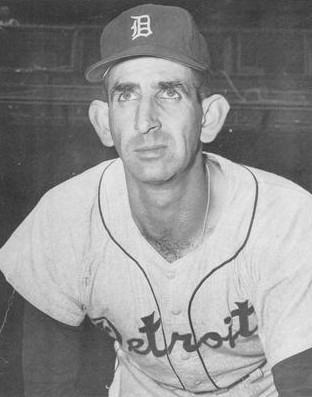
Mossi, circa 1959

In 1957, he and fellow reliever Ray Narleski, who was also Mossi's roommate, were moved to the starting rotation. Mossi finished the season with a record of 11–10 and an ERA of 4.13 on a team that finished below .500. He was named an American League All-Star that season. In the all-star game, a 6–5 American League win, Mossi entered the game to pitch the bottom of the ninth in relief of Billy Pierce, who had already allowed two runs in the inning to cut the American League's lead to 6–4. Mossi entered with two runners on base and the potential winning run at the plate. Mossi struck out future Hall-of-Famer Eddie Mathews, then gave up a single to future Hall-of-Famer Ernie Banks, which cut the lead to 6–5, but Gus Bell was thrown out at third base for the second out. Bob Grim then relieved Mossi and recorded the final out.[10]

The following season, he returned to anchoring the bullpen for the Indians. Mossi, along with Narleski and Ossie Alvarez, was traded to the Detroit Tigers on November 20, 1958 for Billy Martin and Al Cicotte. The trade meant that Mossi was guaranteed a spot in a major league starting rotation, something he had missed with the Indians. He went 17–9 with a 3.36 ERA in 1959. In 1960 he went 9–8, albeit on a club that was well below .500, with an ERA of 3.47. Mossi pitched the greatest season of his career in 1961, going 15–7 with a 2.96 ERA on a Tigers club that recorded over 100 wins. It was not long after this that he began to experience problems with his throwing arm, and in his final two years with the Tigers he went 18–20 with a combined ERA of 4.01.[9] He spent the final two years of his career as a short-reliever, his arm no longer capable of starting. Prior to the 1964 season he was dealt to the White Sox,[7][11] before finishing his career in 1965 with the Kansas City Athletics.

During his 12-year major league career, Mossi won 101 games, lost 80 (.558), and posted an ERA of 3.43. In 460 games pitched, including 165 games started, he registered 55 complete games, eight shutouts, and 50 saves. He allowed 1,493 hits and 385 bases on balls in 1,548 innings pitched, striking out 932. Mossi's career fielding percentage of .990 was the highest ever recorded by a pitcher when he retired. Though never recognized for his defense, he handled 311 chances while committing just three errors.

After baseball

[edit]

After retiring as a player, he moved to Ukiah, California,[7] where he lived with his wife, son and two daughters. He worked as a supervisor in a Masonite factory before retiring. In retirement, he enjoyed hunting and fishing.[12] In 2014, he was named by the Cleveland Indians as one of the Top 100 Greatest Indians.[13]

After the death of Ray Narleski (2012) and third baseman Al Rosen (2015), Mossi became the last surviving member of the 1954 Indians' pitching staff.[14] Mossi died on July 19, 2019, at age 90[15] in Nampa, Idaho.[16][17]

References

[edit]
[edit]
Revisions and contributorsEdit on WikipediaRead on Wikipedia
from Grokipedia
Donald Louis Mossi (January 11, 1929 – July 19, 2019), born in , and died in , was an American professional baseball pitcher who played twelve seasons in (MLB) as a left-handed reliever and starter from 1954 to 1965. Renowned for his pinpoint control and one of the best strikeout-to-walk ratios among pitchers of his era, Mossi finished his career with a 101–80 win–loss record, a 3.43 (), 932 strikeouts, and 50 saves over 1,548 innings pitched. He appeared in the as a key member of the Indians' pennant-winning team, which set a then-record 111 victories, and earned an selection in 1957. Mossi's professional journey began when he signed with the Cleveland Indians organization in 1949 and was assigned to the , debuting in the majors on April 17, 1954, at age 25. With the Indians from 1954 to 1958, he transitioned from a starter to a reliable bullpen arm, notably forming a pioneering lefty-righty relief duo with Ray Narleski that helped anchor the 1954 staff; in the against the , he pitched four scoreless innings across two appearances. Traded to the Tigers in June 1959, Mossi enjoyed his most productive years there, including a standout 1961 season where he went 15–7 with a 2.96 ERA and led the with a .682 , while also posting career highs in starts (34) and complete games (12). His Tigers tenure ended after the 1963 season, followed by brief stints with the in 1964—where he saved 7 games—and the Kansas City Athletics in 1965, his final year, before retiring at age 36. Beyond his on-field contributions, Mossi was noted for his defensive prowess, retiring with a .990 that ranked among the highest for pitchers at the time, and he maintained a low-profile life post-baseball, working in during off-seasons and later settling in and with his wife Eunice, whom he married in 1950; the couple raised a while he largely avoided the spotlight of former players. Mossi's legacy endures as a testament to the value of precision pitching in an era dominated by power arms, influencing subsequent generations of control-oriented hurlers.

Early life

Family and childhood

Donald Louis Mossi was born on January 11, 1929, in , a small town in Sonoma County north of , to parents Louis A. Mossi and Patience Ethel (Woodworth) Mossi. His family relocated to Daly City, just south of , where Mossi spent much of his childhood in a suburban environment that offered access to local youth activities during the summers.

High school and early baseball

Don Mossi attended Jefferson High School in Daly City, California, an institution known for producing notable athletes such as major leaguers Ken Reitz and Tony Solaita, as well as NFL coach John Madden. In addition to excelling in baseball, Mossi was an all-state quarterback on the football team and received college scholarship offers, which he turned down to pursue a professional baseball career. During his high school years, Mossi participated in youth-league teams, typically composed of his schoolmates and neighborhood kids, which provided his initial competitive exposure to the sport. In these summer leagues, he honed his skills as a left-handed , showcasing potential through local games and informal training sessions. Mossi was recognized early for his hard throwing, ability to hide the ball effectively, and composure under pressure, traits that marked him as a promising young hurler. He graduated from Jefferson High School in 1948, ending his amateur baseball phase and paving the way for professional scouting interest.

Professional baseball career

Cleveland Indians (1954–1958)

Don Mossi made his Major League Baseball debut on April 17, 1954, with the Cleveland Indians, joining a powerhouse team that achieved a franchise-record 111 wins and captured the American League pennant. In his rookie season, Mossi appeared in 40 games, primarily as a reliever with five starts, compiling a 6-1 record, a 1.94 ERA, and seven saves over 93 innings pitched. His control pitching, evidenced by just 39 walks against 55 strikeouts, helped solidify the Indians' dominant bullpen during their historic campaign. Mossi's strong debut carried into the postseason, where he contributed to the Indians' effort against the with three relief appearances, pitching 4 scoreless while allowing three hits and one . Despite the team's 0-4 sweep loss, Mossi's scoreless outings provided crucial stability in the series. The following year, in , Mossi emerged as a reliable reliever, making 57 appearances (second in the AL) with a 4-3 record, nine saves, and a 2.42 in 81⅔ , walking only 18 batters while 69. This performance, often paired with right-hander Ray Narleski in late-inning situations, underscored his value to Cleveland's pitching staff. By 1957, Mossi transitioned successfully to a starting role, earning his lone All-Star selection that season; he pitched in the ninth inning of the American League's 6-5 victory at Busch Stadium, allowing one run on one hit. In 36 games with 22 starts, he posted an 11-10 record and a 4.13 ERA over 159 innings, including six complete games and one shutout. After a 1958 season where he returned to a hybrid relief-starting role with a 7-8 record and 3.90 ERA in 43 games, Mossi was traded to the Detroit Tigers on November 20, along with Ray Narleski and Ossie Álvarez, in exchange for Billy Martin and Al Cicotte.

Detroit Tigers (1959–1963)

Following the 1958 season, Don Mossi was traded from the Indians to the Detroit Tigers on November 20, 1958, along with Ray Narleski and Ossie Alvarez, in exchange for and Al Cicotte. This move allowed Mossi to transition into a full-time starting role, where he quickly established himself as a reliable member of the Tigers' rotation. Building on his prior appearances with Cleveland, Mossi demonstrated immediate success, contributing to the team's pitching staff during a period of competitive rebuilding in the early 1960s. In 1959, Mossi enjoyed a breakout season as a starter, posting a 17-9 record with a 3.36 over 228 in 34 games (30 starts). He recorded three shutouts, tying for second in the , and led the Tigers with 15 complete games, solidifying his reputation as a durable workhorse capable of handling heavy workloads. His control was evident in issuing just 49 walks while striking out 125 batters, helping anchor the rotation alongside pitchers like Frank Lary and . Mossi's performance peaked in , when he went 15-7 with a career-best 2.96 across 240.1 innings in 34 starts, leading the Tigers' starters in effectiveness. That year, he topped the with a 2.915 strikeout-to-walk ratio (137 strikeouts to 47 walks), highlighting his exceptional command on the . This season exemplified his consistency and endurance, as he contributed to a Tigers team that won 101 games. Over his five seasons with Detroit from 1959 to 1963, Mossi compiled a 59-44 record with a 3.54 ERA in 929.2 innings across 151 appearances (129 starts), including seven shutouts and 46 complete games. He played a pivotal role in the team's rotation during the mid-1950s transition era, improving his ERA from early relief days and providing steady innings that supported Detroit's push for contention. After the 1963 season, in which he went 7-7 with a 3.74 ERA in 122.2 innings, Mossi was sold to the Chicago White Sox on March 18, 1964, for the $20,000 waiver price to address the Tigers' roster needs.

Chicago White Sox and Kansas City Athletics (1964–1965)

In March 1964, the purchased Don Mossi from the Detroit Tigers, marking his transition to a new team as he entered the final stages of his career. Assigned primarily to relief duties due to ongoing arm issues that limited his starting capabilities, Mossi appeared in 34 games for the White Sox, all in relief, where he recorded 3 wins, 1 loss, a 2.93 , and 7 saves while finishing 17 games. His performance provided valuable late-inning stability for a White Sox squad that contended closely in the pennant race, finishing second in the AL with a 98-64 record, just one game behind the New York Yankees. However, recurring arm trouble curtailed Mossi's 1964 season prematurely, ending his participation before the critical September stretch run and preventing further contributions to Chicago's near-miss at the title. The White Sox released him after the season, concluding his brief tenure with the club. Mossi drew on his established control skills from prior years to adapt effectively to these roles, maintaining effectiveness despite the physical limitations. Following his release, Mossi signed as a with the Kansas City Athletics on May 28, 1965, providing him one final opportunity in the majors at age 36. In 51 relief appearances for the last-place Athletics, he posted a 5-8 record, 3.74 , and 7 saves over 55.1 innings, finishing 19 games and offering occasional stability to a struggling team that ended 59-103. After the 1965 season, Mossi retired from , bringing an end to his 12-year MLB career that had spanned four teams and highlighted his versatility as a left-handed .

Playing style and attributes

Pitching mechanics and control

Don Mossi was renowned as a left-handed control pitcher, emphasizing precision and location in his deliveries rather than overpowering , which allowed him to maintain effectiveness throughout his career. His approach relied on a repertoire consisting of a sinking , , and , with the latter added later to complement his primary pitches by disrupting batters' timing through varied speeds and spots within the . Mossi's mechanics featured a three-finger grip that enhanced his pinpoint accuracy without sacrificing movement or speed on his fastball and , enabling him to hide the ball effectively from hitters and deliver strikes consistently. This technique contributed to his career-low walk rates, as evidenced by issuing just 385 walks over 1,548 , resulting in a 2.24 BB/9 and a 2.42 K/BB ratio. His preference for changing speeds and locations further minimized free passes, leading the in K/BB ratio (2.91, with 137 strikeouts and 47 walks) and fewest walks per nine innings (1.76) during the 1961 season. These attributes underpinned Mossi's low earned run averages, such as his rookie-year 1.94 in 1954 (39 walks in 93 innings) and 2.96 mark in 1961 (47 walks in 240 innings), while fostering his versatility in transitioning seamlessly between and starting roles without compromising command. In high-stakes situations, like appearances, his control proved instrumental in limiting baserunners and preserving leads.

Physical characteristics and nicknames

Don Mossi stood at 6 feet 1 inch tall and weighed approximately 195 pounds during his playing career, possessing an athletic build well-suited to the demands of pitching. His most distinctive physical features included a long, slightly crooked nose, close-set eyes, and prominent ears that protruded noticeably from the sides of his head. These traits contributed to an unconventional appearance that set him apart from many of his contemporaries in , often drawing attention in photographs and media portrayals. Mossi's unique look earned him the nickname "Ears," a moniker bestowed by teammates in reference to his protruding ears, which became a defining element of his public image. He was also known as "The Sphinx," a nod to his stoic and expressionless demeanor on the field, which contrasted sharply with his memorable facial features. This nickname highlighted how his unassuming presence complemented his precise control pitching style. In addition to his pitching and appearance, Mossi was noted for his defensive skills, retiring with a .990 fielding percentage on 324 chances, which ranked among the highest for of his era. Media coverage and baseball literature frequently highlighted Mossi's appearance through humorous anecdotes, such as in Jim Bouton's 1970 book , where he included Mossi on an "All-Ugly Nine" team and quipped that the "looked like a cab going down the street with both doors open" due to his ears. Baseball writer famously described Mossi as the "complete ugly player," capable of excelling in all facets of the game despite—or perhaps because of—his distinctive looks. Even his image on bubble-gum cards captured fans' attention, with one admirer likening him to " on a rainy day." These portrayals endeared Mossi to fans, fostering a that emphasized his approachable eccentricity without overshadowing his professional reputation.

Later life and legacy

Retirement activities

Following his retirement from in 1965, Don Mossi initially relocated with his family to , where they owned and operated the Four Seasons Lodge, seeking a quieter life away from the demands of professional sports. Later, the family moved to , approximately three hours north of , where Mossi owned the Lantern Inn and worked for several years as a supervisor at the local factory, contributing to the community's industrial workforce. In Ukiah, Mossi remained connected to baseball through informal community involvement, coaching youth teams and sharing his expertise with young players, often emphasizing the control and precision that defined his own pitching career. He occasionally participated in baseball events, such as an appearance at a San Francisco Giants Old Timers' Day at the invitation of former teammate , and responded to and requests sent to his home, fostering ongoing ties with admirers without pursuing formal roles in . Mossi's post-career life centered on and local pursuits, with minimal engagement in MLB circles as he prioritized time with his wife Eunice, until her death in 1995, and their three children. His daily routines included hobbies such as , , , and , reflecting a preference for hands-on, outdoor activities in the rural setting.

Death and remembrance

Don Mossi died on July 19, 2019, at the age of 90 in , where he had relocated in 2000 to be closer to family. Cremation followed, with his ashes spread in Idaho's mountains at his request. Immediate tributes from outlets highlighted Mossi's exceptional control as a , noting that he walked just 385 batters over his career. The () bio, updated upon his passing, emphasized his contributions to the 1954 Cleveland Indians' pennant-winning bullpen. Mossi is remembered as an underrated All-Star selection in 1957, with a career 3.43 ERA over 12 seasons, praised for his longevity and effectiveness despite his distinctive physical appearance, often caricatured in baseball lore. His story has been preserved through interviews, such as a discussion with This Great Game, where he reflected on his transition from starter to reliever and the 1954 World Series. His lasting community legacy included coaching youth teams in retirement. Death announcements respected family privacy, with no public planned and only a private family gathering held in .
Add your contribution
Related Hubs
User Avatar
No comments yet.