


Community hub
Recent from talks
Contribute something
Nothing was collected or created yet.
Dorodango
View on Wikipedia


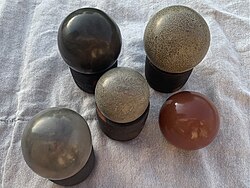
Dorodango (Japanese: 泥だんご; lit. "mud dumpling") is a Japanese art form in which soil and water are combined and moulded, then carefully polished to create a delicate shiny sphere.
Etymology
[edit]The phrase dorodango (泥だんご) is derived from the Japanese words doro (泥; lit. "mud") and dango (だんご; a type of round dumpling created from pressed rice flour).[1]
Technique
[edit]
Making the basic dorodango is a traditional pastime for school children.
More recently, the process has been refined into the art of the hikaru ("shining") dorodango (光る泥だんご), which has a glossy surface. Several different techniques can be used.[2][3] Across all methods, a core of the ball is made of basic mud, which has been carefully shaped by hand to be as round as possible. This core is left to dry, and then methodically and carefully dusted with finely sifted soil to create a crust several millimeters thick around the core. This step may be repeated several times, with finer and finer grains of dirt in order to create a smooth and shiny surface. A cloth then may be used to gently polish the surface. The dorodango, once completed, may look like a polished stone sphere, but it is still very fragile. The process requires several hours and careful focus so as not to break the ball.
In popular culture
[edit]In Christopher Paolini's novel series The Inheritance Cycle, protagonist Eragon witnesses Orik, the King of the Dwarves, carrying out a Dwarvish tradition of making an erôthknurl. The process of making an erôthknurl is highly similar to the process of making dorodango.
In the Discovery Channel series MythBusters episode "End with a Bang" (Episode 113), which first aired on November 12, 2008, hosts Adam Savage and Jamie Hyneman investigated the truth behind everyday sayings. They used the dorodango technique to create dung spheres in order to bust the myth that one "can't polish a turd". Using a glossmeter, they measured gloss levels substantially higher than the value of 70 gloss units, which is considered "high gloss". Savage's 106-gloss unit dorodango used an ostrich's feces, while Hyneman's 183-gloss unit specimen used a lion's feces. They therefore deemed the myth "busted".[4]
In episode 14, "Footsteps", of the anime series Your Lie in April, the character Tsubaki Sawabe polishes a dorodango to show to the protagonist, Kousei, in a flashback sequence. However, it shows it being broken in the next episode (Liar) when she shows it to Kousei, representing her feelings for Kousei in the present day.[5]
See also
[edit]- Mud pie – Children's activity
References
[edit]- ^ "The Art of Hikaru Dorodango – Japanese Mudball Pastime Made into Art | RESOBOX". 2016-07-17. Retrieved 2026-01-03.
- ^ "create". dorodango. Archived from the original on 2016-12-26. Retrieved 2017-01-14.
- ^ "泥だんご". kyokyo-u.ac.jp. Archived from the original on 2006-06-03. Retrieved 2006-05-30.
- ^ "MythBusters Idioms Special". MythBusters. Season 6. Episode 113. 2008-11-12.
- ^ "Your lie in April". Crunchyroll. Retrieved 2018-06-05.
External links
[edit]
Dorodango
View on GrokipediaHistory
Traditional Origins
Dorodango has long been recognized as a traditional, yet largely undocumented, pastime among children in Japan, where it emerged as a simple form of play involving the manipulation of natural soil.[2] The exact origins of this activity remain unknown, with no formal records tracing its beginnings to specific historical periods or regions, though it is associated with pre-modern rural life where children engaged in unstructured outdoor games using readily available earth materials.[1] In its earliest and most basic form, dorodango involved children hand-molding wet soil mixed with water into compact balls, often for use in games, toys, or casual competitions to determine which could be made the most durable or perfectly round.[2] These rudimentary spheres were formed by packing the moist mud tightly in the hands to squeeze out excess water, followed by rolling and drying in the open air to achieve a firm structure, reflecting an intuitive engagement with the environment rather than any artistic intent.[1] This practice played a significant role in rural Japanese childhood before widespread urbanization in the 20th century, fostering creativity and physical activity through direct interaction with nature's elements like soil from fields, riverbanks, or village paths.[2] It served as an accessible, cost-free diversion that connected young people to their surroundings, emphasizing tactile exploration over structured play. By the mid-20th century, such traditions began to wane with societal shifts, setting the stage for later interest in its preservation.[1]Modern Revival
The modern revival of dorodango began in the late 1990s through the work of Professor Fumio Kayo, a psychologist at Kyoto University of Education specializing in children's play. In 1999, Kayo observed children creating polished mud balls during recess at a Kyoto nursery school, noting behaviors that challenged conventional developmental psychology, such as sustained focus and iterative refinement in unstructured play.[1] He formalized a step-by-step technique to make the process accessible, even to young children, integrating it into educational activities to promote concentration and creativity.[3] As part of his studies, Kayo developed a five-point luster measurement scale to objectively assess the shine of dorodango, with level 5 representing the highest polish, achieved after extensive experimentation.[1] Kayo's research gained national attention in Japan starting in 2001, sparking a widespread boom among schoolchildren and appearing in media coverage that highlighted dorodango as a therapeutic play activity.[4] This promotion transformed the informal pastime into a structured educational tool, with kindergartens across Kyoto and beyond incorporating it into curricula to foster patience and fine motor skills.[5] The practice reached the West in 2002, when American artist Bruce Gardner encountered it through an article by science fiction writer William Gibson in Tate magazine, which described the hypnotic allure of shiny mud balls.[6] Inspired, Gardner began experimenting with local soils, particularly the fine red dirt of New Mexico, and adapted the technique for adult workshops emphasizing mindfulness and artistry.[6] He authored Dorodango: The Japanese Art of Making Mud Balls in 2019, providing detailed guidance and photographs that further popularized the craft internationally.[7] By the 2010s, dorodango's global spread accelerated via online tutorials and enthusiast communities, with video demonstrations on platforms like YouTube enabling practitioners worldwide to replicate the process using regional soils.[8] This digital dissemination built on Kayo's and Gardner's foundational efforts, evolving the art from a niche Japanese revival into a cross-cultural pursuit.[9]Terminology
Etymology
The term dorodango (泥だんご, dorodango) originates from the combination of two Japanese words: doro (泥), meaning "mud" or "dirt," and dango (団子), referring to a type of round dumpling or ball typically made from rice flour.[10][11] This literal translation, "mud dumpling," aptly captures the object's simple, spherical shape resembling a small, edible confection.[12] In the Japanese language, dorodango has historically been used in the context of children's games and regional dialects to describe informal mud balls formed during play, often without any structured artistic intent.[1] The standard romaji transcription is dorodango. This variant, hikaru dorodango, incorporates hikaru (meaning "shiny") to denote the polished form.[10]Types and Variations
Dorodango can be categorized primarily by the level of finish and complexity, distinguishing between basic traditional forms and more refined modern variants. Traditional dorodango consists of simple, smooth mud balls with a matte surface, lacking significant shine, and historically served as a playful activity for Japanese children using readily available soil.[1] In contrast, hikaru dorodango represents the advanced "shining" variant, characterized by glossy, reflective surfaces that mimic the luster of lacquered or gemstone-like objects, emerging from a late 1990s revival popularized by educator Fumio Kayo.[1] The term "hikaru" derives from the Japanese word for "shining," denoting this enhanced polish over the base dorodango form.[1] Classification among practitioners often relies on luster as the key criterion, with Kayo establishing a five-point scale ranging from 1 (dull) to 5 (mirror-like shine), where higher ratings reflect superior polishing and material density.[1] Beyond these core types, experimental variations incorporate mineral pigments or diverse soil compositions to produce colored dorodango, yielding hues from earthy tones to vibrant shades while maintaining spherical integrity.[13] Larger sculptural pieces extend the form into non-spherical shapes for artistic display, and novelty adaptations include dung-based dorodango, where animal manure substitutes for soil to test the technique's versatility.[10]Materials and Tools
Soil Selection
The selection of soil is crucial for creating successful dorodango, as it determines the malleability, cohesion, and final polish of the sphere. Ideal soils are those rich in fine silt and clay, which provide the necessary plasticity for shaping and layering while achieving a smooth, glossy finish. These soils typically have low sand content to prevent cracking during drying and to ensure even polishing, and they should be free from high levels of rocks, organic matter, or coarse particles that could disrupt the surface integrity.[14][15] Soil can be sourced from natural environments such as riverbanks, parks, or gardens, where fine, clayey deposits are common. To test quality, practitioners form small handfuls into balls by hand; suitable soil should hold together cohesively when moistened, feeling tacky yet firm, and maintain its shape without cracking upon slight drying. Unsuitable soils, like those overly sandy or organic-laden, fail this test by crumbling or becoming sticky.[14] Regional adaptations often leverage local soils to enhance aesthetic effects, such as color variations. For instance, artist Bruce Gardner in Albuquerque, New Mexico, collects clay-rich dirts from nearby sites like Golden, Placitas, and his backyard, selecting vibrant hues that impart unique tones to the finished dorodango, such as reds and earth tones reflective of the area's geology. These local materials not only support the traditional process but also add distinctive visual narratives to the artwork.[6][14] Basic preparation begins with sieving the collected soil through a fine mesh, such as 1 mm or smaller, to remove debris and larger particles, ensuring a uniform texture. The soil is then initially moistened with water—approximately 1:1 by volume, adjusted gradually—to achieve a pliable, dough-like consistency that allows easy molding without excess wetness. This step sets the foundation for the core formation, with tools for sieving referenced in broader equipment discussions.[15][14]Equipment and Additives
The creation of dorodango requires minimal equipment, emphasizing the hands-on, meditative nature of the process. Basic tools include the practitioner's hands for initial molding and shaping the mud into a sphere, soft cloths or chamois leather for the polishing stages to achieve a smooth surface, and simple buckets or containers for mixing soil with water to form the initial mud consistency. These everyday items suffice for traditional methods, allowing the art form to be accessible without specialized gear.[8][14][16] Optional equipment enhances precision and control, particularly for advanced hikaru dorodango variants. Sieves or sifters are used to refine soil by removing larger particles, ensuring a fine texture for layering. Plastic wrap or bags can enclose the sphere during drying to regulate moisture evaporation and prevent cracking, often referred to as the "dorodango sauna" technique. Additionally, a luster scale developed by Professor Fumio Kayo measures the shine level on a 1-to-5 rating, with 5 representing the highest gloss achievable through meticulous polishing. A glass bowl may also be employed to compress the sphere gently, further enhancing its reflective quality. These tools pair well with clay-rich soils that hold shape effectively during refinement.[8][14][17] Additives in dorodango making are sparse and primarily natural, with water serving as the essential binder to create malleable mud from soil. For enhanced luster in hikaru dorodango, fine powdered soil or clay is layered onto the core, but no synthetic or chemical additives are traditionally required.[8][16] Safety considerations prioritize the use of natural, non-toxic materials sourced from local environments, minimizing health risks during handling and polishing. Sustainability is inherent, as practitioners emphasize eco-friendly soil sourcing to avoid environmental disruption, aligning with the art's roots in resource-conscious Japanese traditions.[13][14]Creation Technique
Forming the Core
The formation of the core in dorodango creation is the foundational step, where raw soil is transformed into a stable, spherical base that must withstand subsequent drying and building processes. This begins with mixing selected soil—ideally fine-grained with sufficient clay content for cohesion—with water in a clean container to form a dense, non-sticky paste resembling brownie batter or cookie dough.[16][18] The soil is added gradually to the water while stirring to achieve an even consistency, avoiding excess moisture that could weaken the structure.[19] Once the paste is prepared, it is kneaded vigorously by hand for several minutes to expel air pockets and ensure uniform density throughout the material. This compaction step is crucial, as trapped air can lead to internal weaknesses and cracking later. The practitioner takes a handful of the kneaded mixture and compresses it between the palms, squeezing out any remaining excess water to create a tacky surface.[16][18] The material is then hand-rolled into a small, spherical core, typically about the size of a golf ball for beginners to manage weight and balance. Gentle rolling and shaking eliminate surface irregularities, promoting an even density that prevents deformation or fissures during drying. Dry palms or a cloth may be used periodically to absorb humidity and maintain control over the shape.[19][16] Following shaping, the core undergoes initial partial drying in a shaded area to avoid rapid evaporation, which could cause uneven contraction. It is often placed in a loosely sealed plastic bag or on a bed of dry soil for 1-2 days at room temperature, with frequent rotation every few hours to promote uniform moisture loss and structural integrity. The core should remain malleable yet firm to the touch at this stage, cool but not cold.[18][19] Common pitfalls in core formation include over-wetting the initial mixture, which results in a paste too soft to hold shape and prone to collapse, or insufficient kneading leading to hidden air voids. Uneven shaping or inconsistent density can also cause imbalances, manifesting as cracks or warping during the drying phase. Careful attention to these details ensures a solid foundation for the dorodango.[19][16]Layering and Polishing
The layering process begins once the core is formed, involving the careful application of thin coats of dry, fine soil onto the slightly moist surface using wet hands to ensure adhesion without cracking. This cycle is repeated dozens of times—typically 20 to 50 iterations—to gradually build density and a protective outer shell, with each layer allowed to partially dry before the next is added.[16][20] As layers accumulate, the dorodango requires daily monitoring and gentle remoistening if necessary to prevent surface cracks, a step that demands patience and precision over several days to a week or more for the structure to stabilize. The compression from repeated layering compacts the soil particles, forming a hard, uniform shell that serves as the foundation for the final shine.[16][1] Polishing commences after sufficient layering, starting with wet-hand smoothing to even the surface, followed by buffing with a soft, dry cloth in circular motions to remove excess particles and enhance smoothness. For hikaru dorodango, which aim for a high-gloss reflective finish, additional passes incorporate even finer screened soil or dust, often using a glass or plastic tool for compression to achieve a mirror-like luster rated up to 5 on Professor Fumio Kayo's scale, where 5 represents the highest degree of shine.[16][1][21] The entire layering and polishing phase can span 1 to 4 weeks, depending on environmental conditions and the artist's dedication, with sessions lasting 1 to 2 hours daily to allow for proper drying and avoid overworking the surface. This iterative refinement not only densifies the ball but also transforms its texture from matte and porous to a polished, jewel-like orb.[1][22]Cultural Aspects
Significance in Japan
Dorodango serves as a cherished childhood activity in Japan, encouraging outdoor play and creativity among schoolchildren. In elementary schools, kindergartens, and preschools nationwide, children engage in forming and polishing mud balls, often spending hours on the process, which fosters a deep connection to natural materials and hands-on exploration.[1] This pastime, rooted in simple play with soil and water, promotes imaginative expression while drawing children away from indoor screens toward environmental interaction.[13] The practice has been integrated into educational curricula, particularly following the research of Professor Fumio Kayo of Kyoto University of Education, who observed and refined dorodango techniques in the late 1990s. Kayo's studies highlighted its value in developing patience, concentration, and fine motor skills, leading to its adoption as a tool for experiential learning in developmental psychology contexts.[1][14] For instance, children progress through stages of play— from basic imitation to persistent polishing—mirroring cognitive growth, and educators use it to teach persistence without structured outcomes.[1] Kayo's revival efforts, including media dissemination, have ensured its continued presence in school programs, emphasizing non-competitive, process-oriented activities. As of 2025, dorodango remains a staple in Japanese education, inspiring artists and children alike.[2][14] Dorodango embodies elements of Japanese aesthetics, particularly wabi-sabi, by transforming imperfect, transient natural materials like mud into refined, lustrous forms that celebrate subtlety and impermanence.[23] The act of polishing rough soil to a shine reflects an appreciation for the beauty in simplicity and the ephemeral nature of the creation, aligning with broader cultural values of harmony with the environment.[23] Regional variations in dorodango arise from differences in local soils across Japan, influencing the color and texture of the final spheres—for example, volcanic ash in some areas yields distinct hues compared to red soils elsewhere.[24] This adaptation to available materials underscores its accessibility in diverse settings, though it thrives where quality soil is readily obtainable, often in areas with natural terrain.[24]Philosophical and Therapeutic Value
The practice of creating dorodango fosters mindfulness and meditation through its repetitive, hands-on process, which encourages sustained focus and a meditative state akin to Zen practices. The methodical layering and polishing of mud into a sphere demands patience and presence, allowing practitioners to enter a flow state that promotes mental clarity and reduces stress. This aligns with Zen principles of simplicity and attentiveness, where the act of crafting becomes a form of moving meditation, engaging the senses without external distractions.[13][25] Dorodango embodies the wabi-sabi philosophy, which celebrates the beauty of imperfection, transience, and the natural asymmetry found in everyday materials. In transforming raw soil—often irregular and humble—into a polished yet fragile orb, the art highlights the transient nature of creation, where cracks or subtle flaws in the surface are not defects but integral to its authenticity. This aesthetic encourages appreciation for the incomplete and ephemeral, mirroring life's inherent imperfections and the quiet elegance of simplicity.[26][27] Therapeutically, dorodango serves as a tool in art therapy, aiding concentration and emotional regulation by providing a tactile outlet for self-expression and stress management. Japanese developmental psychologist Professor Fumio Kayo observed its psychological benefits in children's play, noting how the activity enhances focus and problem-solving while offering a calming, non-verbal way to process emotions.[13][1] On a personal level, dorodango symbolizes growth by alchemizing the ordinary—mere dirt—into something extraordinary, a gleaming artwork that reflects the practitioner's dedication and inner transformation. This process instills a sense of accomplishment and resilience, teaching that perseverance can elevate the mundane to beauty, much like personal development turns challenges into strengths. Through this symbolism, creators often report heightened self-awareness and empowerment, reinforcing themes of humility and potential in everyday endeavors.[13][25]Global Impact
International Adoption
The international adoption of dorodango began gaining momentum in the early 2000s, following its revival in Japan by Professor Fumio Kayo, who developed accessible techniques that inspired global experimentation.[2] In the United States, artist Bruce Gardner emerged as a pivotal figure, conducting workshops and lectures on hikaru dorodango using locally sourced soils from New Mexico, such as decomposed red granite from the Sandia Mountains and earth from the Manzano Mountains. Gardner's demonstrations, including events at ArtYard in Frenchtown, New Jersey, and the Silver City CLAY Festival in New Mexico, emphasized the meditative process of forming and polishing mud balls from regional dirt, adapting the traditional method to arid Southwestern terrains.[28][29] His 2019 book, Dorodango: The Japanese Art of Making Mud Balls, further disseminated techniques to international audiences, highlighting variations with local materials to achieve lustrous finishes. European and Australian practitioners have contributed through online sharing and community events, often via forums like Reddit's r/Dorodango subreddit and the Facebook group Hikaru Dorodango, where makers exchange tips since the early 2010s.[30] In Europe, Japanese artist Noriko, based in the Netherlands and president of the World Dorodango Association, has popularized the craft through her YouTube channel, offering tutorials on creating dorodango from European clays and sharing adaptations for non-Japanese soils.[31] Australian makers, meanwhile, have hosted hands-on workshops, such as the upcoming Beginner Dorodango session in Chermside, Brisbane, in 2025, incorporating local sands and clays to suit the continent's dry climates.[32] Global communities have risen notably since 2010, fueled by YouTube tutorials that demonstrate adaptations like mixing desert sands with clay powder to form cohesive cores, as seen in videos from creators addressing arid environments in places like Nevada.[33][34] Dorodango has appeared in international exhibitions, showcasing its artistic potential beyond Japan. Gardner's works, crafted from New Mexico soils, were featured in the 2016 "The Art of Hikaru Dorodango" exhibition at ResoBox in New York, where each piece was named after its origin site to highlight regional variations.[12] Additional displays of his dorodango spheres have been presented at G2 Santa Fe Contemporary Art Gallery in New Mexico, emphasizing their polished, gem-like quality derived from local earth.[35] As of 2025, dorodango's popularity has surged in mindfulness workshops worldwide, as participants seek calming, tactile activities for stress relief.[13] Events like the free Dorodango workshop in Glasgow, Scotland, framed it explicitly as a Japanese mindfulness practice, while similar sessions in Australia and online tutorials underscore its therapeutic value in fostering patience and presence.[36] This trend reflects a broader embrace of dorodango in wellness contexts, with creators noting its role in grounding exercises amid global uncertainties.[37]Representations in Media
Dorodango has appeared in various media portrayals that highlight its transformative process and aesthetic appeal, often emphasizing the contrast between humble origins and polished results. In a 2008 episode of the television series MythBusters titled "End with a Bang," the hosts tested the idiom "you can't polish a turd" by applying the dorodango technique to elephant dung collected from a zoo. They formed spheres from the material, layered and polished them over several days, and ultimately measured the gloss using a reflectometer, achieving a shine comparable to lacquer and confirming the myth as busted.[38] Literature has also referenced dorodango, notably in a 2002 article by science fiction author William Gibson titled "Shiny Balls of Mud: Japanese Pursuits of the Useless," which described the art form's meditative and visually striking qualities, inspiring American artist Bruce Gardner to begin creating hikaru dorodango. Documentaries on Japanese crafts have featured the revival efforts of Professor Fumio Kayo, who popularized the practice in 1999 through media coverage of children's workshops, as seen in short films like the 2016 production These Perfect, Shiny Spheres Started Out as Dirt by P2 Photography, which captures schoolchildren in Kyoto forming and polishing mud balls to a lustrous finish.[2][1][39] Since 2016, dorodango has gained traction in online and social media through viral videos and tutorials that showcase its accessibility and mesmerizing results. Articles on platforms like Colossal have profiled artists such as Bruce Gardner, illustrating his colorful hikaru dorodango spheres made from diverse soils, which emphasize the art's global appeal and the hypnotic shine of the finished product. YouTube channels, including Gardner's own demonstrations, have amassed millions of views by guiding viewers through the polishing process, turning a niche Japanese pastime into an international online phenomenon.[40] In cultural references, dorodango symbolizes ingenuity and the beauty in everyday materials, appearing in art blogs and books on Japanese traditional pursuits as an exemplar of wabi-sabi aesthetics applied to modern crafting. Gardner's book Dorodango: The Japanese Art of Making Mud Balls explores its philosophical undertones, positioning the practice as a metaphor for refining the ordinary into the extraordinary.References
- https://en.wiktionary.org/wiki/dorodango