



Community hub
Recent from talks
Contribute something
Nothing was collected or created yet.
Doxastic logic
View on WikipediaDoxastic logic is a type of logic concerned with reasoning about beliefs.
The term doxastic derives from the Ancient Greek δόξα (doxa, "opinion, belief"), from which the English term doxa ("popular opinion or belief") is also borrowed. Typically, a doxastic logic uses the notation to mean "reasoner believes that is true", and the set denotes the set of beliefs of . In doxastic logic, belief is treated as a modal operator.


There is complete parallelism between a person who believes propositions and a formal system that derives propositions. Using doxastic logic, one can express the epistemic counterpart of Gödel's incompleteness theorem of metalogic, as well as Löb's theorem, and other metalogical results in terms of belief.[1]
Types of reasoners
[edit]To demonstrate the properties of sets of beliefs, Raymond Smullyan defines the following types of reasoners:
- Accurate reasoner:[1][2][3][4] An accurate reasoner never believes any false proposition. (modal axiom T)


- Consistent reasoner:[1][2][3][4] A consistent reasoner never simultaneously believes a proposition and its negation. (modal axiom D)

- Normal reasoner:[1][2][3][4] A normal reasoner is one who, while believing also believes they believe (modal axiom 4).


- A variation on this would be someone who, while not believing also believes they don't believe (modal axiom 5).


- Peculiar reasoner:[1][4] A peculiar reasoner believes proposition while also believing they do not believe Although a peculiar reasoner may seem like a strange psychological phenomenon (see Moore's paradox), a peculiar reasoner is necessarily inaccurate but not necessarily inconsistent.


- Reflexive reasoner:[1][4] A reflexive reasoner is one for whom every proposition has some proposition such that the reasoner believes .

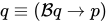

- If a reflexive reasoner of type 4 [see below] believes , they will believe . This is a parallelism of Löb's theorem for reasoners.

- Rewritten in de re form, this is logically equivalent to:
- This implies that:
- This shows that a conceited reasoner is always a stable reasoner (see below).
![{\displaystyle {\mathcal {B}}[\neg \exists p(\neg p\wedge {\mathcal {B}}_{c}p)]\quad {\text{or}}\quad {\mathcal {B}}[\forall p({\mathcal {B}}_{c}p\to p)]}](https://wikimedia.org/api/rest_v1/media/math/render/svg/9e5a36b404e7eb2f8ac9c7542724a2eb5aa13f9f)
![{\displaystyle \forall p[{\mathcal {B}}({\mathcal {B}}_{c}p\to p)]}](https://wikimedia.org/api/rest_v1/media/math/render/svg/8003183ded56745a08e8edc0997525af291ad9e3)

- Unstable reasoner:[1][4] An unstable reasoner is one who believes that they believe some proposition, but in fact does not believe it. This is just as strange a psychological phenomenon as peculiarity; however, an unstable reasoner is not necessarily inconsistent.

- Stable reasoner:[1][4] A stable reasoner is not unstable. That is, for every if they believe then they believe Note that stability is the converse of normality. We will say that a reasoner believes they are stable if for every proposition they believe (believing: "If I should ever believe that I believe then I really will believe "). This corresponds to having a dense accessibility relation in Kripke semantics, and any accurate reasoner is always stable.


- Modest reasoner:[1][4] A modest reasoner is one for whom for every believed proposition , only if they believe . A modest reasoner never believes unless they believe . Any reflexive reasoner of type 4 is modest. (Löb's Theorem)

- Queer reasoner:[4] A queer reasoner is of type G (see below) and believes they are inconsistent—but is wrong in this belief.
- Timid reasoner:[4] A timid reasoner does not believe [is "afraid to" believe ] if they believe that belief in leads to a contradictory belief.

Increasing levels of rationality
[edit]- Type 1 reasoner:[1][2][3][4][5] A type 1 reasoner has a complete knowledge of propositional logic i.e., they sooner or later believe every tautology/theorem (any proposition provable by truth tables):
- The symbol means is a tautology/theorem provable in Propositional Calculus. Also, their set of beliefs (past, present and future) is logically closed under modus ponens. If they ever believe and then they will (sooner or later) believe :
- This rule can also be thought of as stating that belief distributes over implication, as it's logically equivalent to
- .
- Note that, in reality, even the assumption of type 1 reasoner may be too strong for some cases (see Lottery paradox).


- Type 1* reasoner:[1][2][3][4] A type 1* reasoner believes all tautologies; their set of beliefs (past, present and future) is logically closed under modus ponens, and for any propositions and if they believe then they will believe that if they believe then they will believe . The type 1* reasoner has "a shade more" self awareness than a type 1 reasoner.


- Type 2 reasoner:[1][2][3][4] A reasoner is of type 2 if they are of type 1, and if for every and they (correctly) believe: "If I should ever believe both and , then I will believe ." Being of type 1, they also believe the logically equivalent proposition: A type 2 reasoner knows their beliefs are closed under modus ponens.


- Type 4 reasoner:[1][2][3][4][5] A reasoner is of type 4 if they are of type 3 and also believe they are normal.
![{\displaystyle {\mathcal {B}}[\forall p({\mathcal {B}}p\to {\mathcal {B}}{\mathcal {B}}_{c}p)]}](https://wikimedia.org/api/rest_v1/media/math/render/svg/bb9b98d089392538e275441e553ba10c6481ab88)
![{\displaystyle {\mathcal {B}}[\forall p({\mathcal {B}}({\mathcal {B}}_{c}p\to p)\to {\mathcal {B}}_{c}p)]}](https://wikimedia.org/api/rest_v1/media/math/render/svg/f1f23ba62b2567deb7bae0dddb19f62e146a5177)
Self-fulfilling beliefs
[edit]For systems, logicians define reflexivity to mean that for any (in the language of the system) there is some such that is provable in the system. Löb's theorem (in a general form) is that for any reflexive system of type 4, if is provable in the system, so is [1][4]

Inconsistency of the belief in one's stability
[edit]If a consistent reflexive reasoner of type 4 believes that they are stable, then they will become unstable. Stated otherwise, if a stable reflexive reasoner of type 4 believes that they are stable, then they will become inconsistent. Why is this? Suppose that a stable reflexive reasoner of type 4 believes that they are stable. We will show that they will (sooner or later) believe every proposition (and hence be inconsistent). Take any proposition The reasoner believes hence by Löb's theorem they will believe (because they believe where is the proposition and so they will believe which is the proposition ). Being stable, they will then believe [1][4]


See also
[edit]
References
[edit]- ^ a b c d e f g h i j k l m n o p q r s t Smullyan, Raymond M., (1986) Logicians who reason about themselves, Proceedings of the 1986 conference on Theoretical aspects of reasoning about knowledge, Monterey (CA), Morgan Kaufmann Publishers Inc., San Francisco (CA), pp. 341–352
- ^ a b c d e f g h i j https://web.archive.org/web/20070930165226/http://cs.wwc.edu/KU/Logic/Book/book/node17.html Belief, Knowledge and Self-Awareness[dead link]
- ^ a b c d e f g h i j https://web.archive.org/web/20070213054220/http://moonbase.wwc.edu/~aabyan/Logic/Modal.html Modal Logics[dead link]
- ^ a b c d e f g h i j k l m n o p q r s t u Smullyan, Raymond M., (1987) Forever Undecided, Alfred A. Knopf Inc.
- ^ a b Rod Girle, Possible Worlds, McGill-Queen's University Press (2003) ISBN 0-7735-2668-4 ISBN 978-0773526686
Further reading
[edit]- Lindström, St.; Rabinowicz, Wl. (1999). "DDL Unlimited. Dynamic Doxastic Logic for Introspective Agents". Erkenntnis. 51 (2–3): 353–385. doi:10.1023/A:1005577906029. S2CID 116984078.
- Linski, L. (1968). "On Interpreting Doxastic Logic". Journal of Philosophy. 65 (17): 500–502. doi:10.2307/2024352. JSTOR 2024352.
- Segerberg, Kr. (1999). "Default Logic as Dynamic Doxastic Logic". Erkenntnis. 50 (2–3): 333–352. doi:10.1023/A:1005546526502. S2CID 118747031.
- Wansing, H. (2000). "A Reduction of Doxastic Logic to Action Logic". Erkenntnis. 53 (1–2): 267–283. doi:10.1023/A:1005666218871. S2CID 58939606.
Doxastic logic
View on GrokipediaIntroduction
Definition and Scope
Doxastic logic is a branch of modal logic that formalizes reasoning about beliefs, employing modal operators such as , interpreted as "the agent believes that ".[2] The term "doxastic" derives from the Ancient Greek word doxa, meaning "belief" or "opinion".[3] The scope of doxastic logic centers on subjective belief attitudes, which do not necessarily correspond to objective truth, allowing for the modeling of potentially false or incomplete doxastic states.[2] This distinguishes it from logics requiring veridicality, such as those for knowledge, and emphasizes beliefs as propositional attitudes in the philosophy of mind.[2] In epistemology, it examines properties like consistency and introspection of beliefs, providing tools to analyze justification and rationality without presupposing truth.[4] Applications extend to agent modeling, where it represents individual or collective belief structures in multi-agent systems, aiding in the simulation of decision-making and interaction dynamics.[2] The primary motivation for doxastic logic lies in capturing how agents reason about their own beliefs and those of others, independent of empirical verification, thus enabling the study of belief formation, revision, and higher-order attitudes in normative and descriptive frameworks.[4] Unlike epistemic logic, which ties operators to factual knowledge, doxastic approaches permit non-factive beliefs to explore irrationality, transparency, and group belief phenomena.[2]Relation to Epistemic Logic
Doxastic logic and epistemic logic both belong to the broader field of modal logics that model mental attitudes, but they differ fundamentally in their treatment of belief versus knowledge. In epistemic logic, the knowledge operator is factive, meaning that if an agent knows , then must be true in the actual world ().[2] In contrast, the doxastic belief operator in doxastic logic does not entail truth; agents can hold false beliefs, allowing the logic to capture scenarios where belief diverges from reality.[2] This non-factive nature of belief enables doxastic logic to represent subjective attitudes that may lack evidential support or justification.[2] Despite these differences, the two logics overlap significantly in their formal structures and applications. Both employ Kripke-style semantics with accessibility relations—epistemic relations for knowledge and doxastic relations for belief—where epistemic relations are often equivalence relations (reflexive, symmetric, transitive) for the S5 system, and doxastic relations are serial, transitive, and Euclidean for the KD45 system, supporting introspection properties.[2] A common bridge between them is the implication that knowledge entails belief (), reflecting the intuition that one cannot know something without believing it.[2] Historically, the terms "epistemic logic" and "doxastic logic" were introduced by G. H. von Wright in his 1951 work An Essay in Modal Logic, with Jaakko Hintikka's seminal 1962 book Knowledge and Belief advancing both by providing possible-worlds semantics to model and distinguish belief from knowledge.[5] This relation has profound implications for modeling human reasoning. Epistemic logic's emphasis on truth and justification suits formal analyses of rational inquiry and distributed systems, whereas doxastic logic's allowance for partial or irrational beliefs better accommodates psychological and decision-theoretic contexts, such as modeling uncertainty or cognitive biases without requiring veridicality.[6] Together, they form a spectrum for analyzing attitudes ranging from strict knowledge to tentative belief, influencing fields like artificial intelligence and philosophy of mind.[2]Historical Development
Origins in Modal Logic
Doxastic logic traces its etymological roots to the ancient Greek term doxa, meaning opinion or belief, as discussed by Aristotle in his works on cognition and rhetoric, where he distinguished doxa from scientific knowledge (epistēmē) as a form of rational but fallible judgment.[7] This philosophical distinction influenced later explorations of belief, though formal logical treatment remained undeveloped until the medieval period. Medieval logicians advanced theories of supposition (suppositio), which analyzed how terms refer in context within syllogisms, providing early tools for understanding propositional attitudes that prefigured modern modal approaches to mental states.[8] However, these ideas were not systematically applied to belief until the 20th century, when they converged with emerging formal logics. The formal origins of doxastic logic emerged in the 1950s and 1960s as an extension of modal logic, which initially focused on abstract notions of necessity and possibility. Saul Kripke's development of possible worlds semantics during this era provided a foundational framework, interpreting modal operators through accessibility relations between worlds, thereby enabling rigorous modeling of epistemic and doxastic attitudes. Early modal logics treated modalities in a general, non-psychological sense, but this semantic apparatus facilitated a transition toward applying them to mental states like belief. This shift crystallized around 1962, when Jaakko Hintikka adapted modal techniques to formalize belief in his seminal work, distinguishing it from knowledge while using possible worlds to represent an agent's doxastic alternatives.[5] Initial motivations for doxastic logic arose from the need to model incomplete information and subjective probabilities in decision-making and game theory, where agents' beliefs about others' actions influence strategic choices.[1] Hintikka's approach, in particular, highlighted how belief operators could capture rational deliberation under uncertainty.[9]Key Figures and Milestones
The development of doxastic logic began with G.H. von Wright's 1951 monograph An Essay in Modal Logic, which introduced the terms "epistemic logic" for knowledge and "doxastic logic" for belief as extensions of alethic modal logic. This was advanced in the 1960s by Jaakko Hintikka's seminal 1962 book Knowledge and Belief: An Introduction to the Logic of the Two Notions, which introduced belief operators within a possible-worlds framework, distinguishing them from knowledge operators and laying the groundwork for formal analysis of doxastic attitudes.[10] This work formalized belief as a modal operator, enabling rigorous study of properties like positive and negative introspection in idealized agents.[2] In the 1980s, Richmond H. Thomason addressed key paradoxes, such as those arising from self-referential beliefs analogous to the Liar paradox, highlighting limitations in assuming logical omniscience for belief systems, while others extended doxastic frameworks to multi-agent settings.[11] These contributions, including explorations of belief consistency in group contexts, paved the way for handling distributed reasoning about others' beliefs. Major milestones include the 1960s formalization of basic doxastic systems inspired by modal logic, the 1980s refinements of axiomatic structures—such as Wolfgang Lenzen's critiques and proposals for adjusted belief axioms to avoid paradoxes like the Moore paradox—and the 1990s integration with dynamic logics, exemplified by Ronald Fagin, Joseph Y. Halpern, Moshe Y. Vardi, and Yoram Moses's Reasoning About Knowledge (1995), which incorporated belief revision into multi-agent epistemic models.[2] As of 2025, ongoing developments emphasize applications in AI ethics and belief revision, with recent works (as of 2024) exploring an ethics of AI belief, including doxastic wronging by AI and recognition of AI as epistemic authorities, alongside probabilistic doxastic logics to model uncertain beliefs in autonomous systems for ethical decision-making. These advances address real-world scenarios like AI-mediated norm compliance and cognitive agent interactions.[12][13]Formal Framework
Syntax and Language
Doxastic logic builds upon the foundation of classical propositional logic, utilizing a set of atomic propositions, typically denoted as , which represent basic declarative statements. These are combined using standard Boolean connectives: negation , conjunction , disjunction , material implication , and biconditional . This propositional base allows for the construction of compound formulas without modal elements, such as or .[1] The distinctive feature of doxastic logic is the introduction of a unary modal operator , which applies to any formula to form , interpreted as "the agent believes ." This operator enables the expression of beliefs about propositions and can be nested to represent higher-order beliefs, such as (the agent believes that they believe ) or (the agent believes they do not believe ). In multi-agent settings, the operator may be indexed by agents, as in for agent 's belief in , though single-agent formulations often omit the subscript.[5][1] The full language of doxastic logic is defined recursively, ensuring closure under the propositional connectives and the belief operator. Specifically, the set of formulas is the smallest set such that: (1) every atomic proposition is in ; (2) if , then ; (3) if , then ; and (4) if , then . This recursive structure permits arbitrarily complex expressions, including nested modalities, and the language is interpreted semantically in models detailed elsewhere.[5][1] Examples of well-formed formulas include , expressing that the agent believes the atomic proposition , and more complex instances like , which illustrates the distribution property over implication (though its validity depends on the chosen axiomatic system). Such formulas capture the inferential structure of beliefs while adhering strictly to the syntactic rules.[5]Kripke Semantics
Kripke semantics provides a model-theoretic interpretation for doxastic logic using possible worlds frameworks, where beliefs are represented as necessities relative to an agent's accessible worlds. A Kripke structure for doxastic logic is a tuple , where is a nonempty set of possible worlds, is a nonempty set of agents, each is an accessibility relation for agent (not necessarily reflexive, transitive, or symmetric), and is a valuation function assigning to each proposition letter the set of worlds where it is true.[14] This setup extends the general Kripke semantics for modal logic, originally developed by Saul Kripke, to model doxastic attitudes by interpreting belief operators over agent-specific relations. The truth definition for the belief operator at a world in model , denoted , holds if and only if is true in every world accessible from via ; that is, for all such that , .[14] This captures belief as truth in all doxastically accessible worlds, distinguishing it from factual truth (which requires ) and allowing for false beliefs since need not include the actual world itself.[5] For atomic propositions , if and only if ; the definition extends to Boolean connectives in the standard way and to other modalities recursively.[14] Frame conditions on correspond to specific doxastic properties. Positive introspection, expressed semantically as the validity of , requires to be transitive: if and , then .[14] Negative introspection, corresponding to , requires the Euclidean property: if and , then .[14] These conditions tailor the frames to idealized rational beliefs, though basic doxastic systems like KD impose only seriality (for every , there exists with ) to ensure consistency.[5] The semantics ensures soundness for basic doxastic systems: if a formula is a syntactic theorem in the logic (e.g., derived from axioms and modus ponens), it is valid in all corresponding Kripke models, meaning true in every world of every frame satisfying the relevant conditions.[14] For instance, the KD45 system for doxastic logic is sound (and complete) with respect to serial, transitive, and Euclidean frames, aligning semantic entailment—where if for all models and worlds —with syntactic provability.[14] This correspondence theorem underpins the adequacy of Kripke semantics for reasoning about belief structures.[5]Axiomatic Systems
Core Axioms
Doxastic logic's core axioms provide the minimal framework for formalizing belief using the unary belief operator , forming what is known as system K in the doxastic setting. This system extends classical propositional logic with modal principles that ensure beliefs behave as a normal modal operator, capturing basic rational closure properties without assuming truth or perfect introspection. These axioms are justified semantically through Kripke models where the accessibility relation represents an agent's belief alternatives, with no structural constraints in the minimal case.[15] The foundational components include the doxastic tautologies, which comprise all substitution instances of classical propositional tautologies in the extended language. For instance, schemas like or hold, ensuring that beliefs preserve the validity of propositional truths regardless of their content. This axiom schema guarantees that the logic of belief is propositionally sound and that trivial equivalences carry over under the operator.[16] A central axiom is the distribution axiom (K axiom):This principle encodes the closure of belief under known implications: if an agent believes implies , and believes , then the agent must believe . It reflects an idealization of rational deduction in belief formation, preventing arbitrary gaps in inferential reasoning.[15] Complementing the axioms is the necessitation rule: if , then . This rule stipulates that all logical truths are believed, aligning with the assumption of logical omniscience in idealized agents who accept the consequences of valid inferences. Together with modus ponens (from and , infer ), these elements generate the theorems of the system.[16] Unlike epistemic logics for knowledge, core doxastic logic does not standardly include factivity (), as beliefs may be false; however, a weak consistency condition (or equivalently ) is optionally added to rule out believing contradictions, corresponding to seriality in Kripke semantics.[15] These core elements enable derivations of further belief closures. For example, the distribution over conjunction (and similarly for ) follows from the axioms and rules. To sketch the proof: since , necessitation yields . The distribution axiom then gives . Assuming , two applications of modus ponens yield . This derivation illustrates how the core axioms enforce deductive coherence without additional premises.[16]
Standard Doxastic Logics
Standard doxastic logics extend the minimal axiomatic systems for belief operators by incorporating principles of introspection, yielding complete characterizations of idealized belief states. The most prominent among these is the KD45 system, which builds upon the core axioms of distribution (K) and consistency (D) by adding axioms for positive introspection (Bφ → BBφ) and negative introspection (¬Bφ → B¬Bφ). This framework models belief as a consistent, introspectively aware attitude that an agent holds toward propositions, without requiring that beliefs be factive.[17] The semantic properties corresponding to KD45 arise from Kripke frames where the accessibility relation is serial (ensuring consistency via the D axiom), transitive (from the 4 axiom), and Euclidean (from the 5 axiom). These properties capture plausible aspects of belief, such as closure under logical consequence and self-awareness of one's doxastic states, making KD45 the dominant formalization for non-factive belief in single-agent settings. The system is sound and complete with respect to the class of such frames, as established through standard modal logic techniques. An alternative system, KT45, modifies KD45 by incorporating the truth axiom (T: Bφ → φ), which enforces factivity and corresponds to reflexive accessibility relations. This variant is suitable for modeling "stable" or factive beliefs, where an agent's belief implies the truth of the proposition, though it diverges from the standard non-factive conception in doxastic logic. Both KD45 and KT45 achieve completeness relative to their respective semantic classes, with KT45 validating equivalence relations (reflexive, transitive, Euclidean) that align more closely with knowledge operators in epistemic logic. The full Hilbert-style axiomatization for KD45 consists of the following axioms and inference rules: Axioms:- All propositional tautologies.
- K:
- D:
- 4:
- 5:
- Modus Ponens: From and , infer .
- Necessitation: From , infer .
- Uniform Substitution: Replace propositional variables uniformly.