Hubbry Logo
DumleDumleMain
Open search
Dumle
Community hub
Dumle
logo
8 pages, 0 posts
0 subscribers
Be the first to start a discussion here.
Dumle
Dumle
from Wikipedia
Dumle
Product typeConfectionery
OwnerFazer
CountrySweden (1945–1975)
Finland (1975–present)[1]
Introduced1945
MarketsEuropean Union, Norway
Previous ownersMazetti AB
Websitewww.fazer.com/our-brands/dumle/
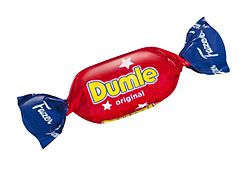
Dumle soft toffees in salty liquorice (purple wrapper), orange-mango (orange) and caramel (red) flavours.

Dumle is a brand of chocolate-covered toffees marketed and manufactured by Fazer.

The toffees were first manufactured in 1945 by Mazetti, a chocolate and confectionery producer in Malmö, Sweden.[2] The original sweet consisted of a hard toffee lollipop coated in chocolate, but was not branded Dumle until 1960,[3] possibly as a reference to children's television series Humle och Dumle [sv], one of the first broadcast on Swedish television.

The manufacturer was acquired by Fazer in 1975,[4] and in 1987 Fazer released a new product with a softer toffee covered in chocolate and packaged in a candy wrapper, which is now named Dumle original. They are manufactured in Vaarala [fi], Vantaa, Finland.[1]

The brand now contains a range of chocolate-covered caramels and toffees, including a range of chocolates and ice creams.[5][6][7] A number of variations and limited editions have been produced, including apple, salty liquorice, mint, lemon, salted caramel, pear, brownie, gingerbread, mango-orange, cranberries, banana, lime and chocolate-flavoured soft toffees, often with distinguishing colours on their wrappers.

References

[edit]
[edit]
Revisions and contributorsEdit on WikipediaRead on Wikipedia
from Grokipedia
Dumle is a popular Nordic brand featuring soft, chewy centers coated in smooth , manufactured by the Finnish company .
The product originated in in 1945 as a hard lollipop produced by the company Mazetti in . It was officially branded as Dumle in 1960. In 1975, acquired Mazetti, incorporating Dumle into its portfolio and relocating production to . The brand gained widespread popularity in the with the introduction of its signature soft variant enrobed in , which remains the core offering today.
Dumle Original, the flagship product, consists primarily of glucose syrup, sugar, fully hydrogenated coconut fat, whole milk powder, , whey powder (), cocoa mass, skimmed milk powder, salt, emulsifier (soy lecithin), and flavorings ( and ). It contains a minimum of 30% in the and is free from , colorings, preservatives, and , though it includes allergens such as , soy, and , and may contain traces of nuts, almonds, and . Nutritionally, a 100g serving provides 1975 kJ (474 kcal), with 21g fat (17g saturates), 67g carbohydrates (54g sugars), 3.1g protein, and 0.3g salt. Marketed as a joyful, mood-boosting treat ideal for sharing, Dumle has become a beloved classic across generations in , evoking fun and togetherness. emphasizes sustainable sourcing, with the cocoa in Dumle adhering to its Cocoa Vision initiative for responsible production. Variants include seasonal editions and the original , though production of the latter ceased in due to declining demand.

History

Origins in Sweden

Dumle was initially manufactured in 1945 by Mazetti, a prominent chocolate and confectionery producer based in Malmö, Sweden. The company, founded in 1888 by Danish immigrant Emil Mazetti-Nissen as Malmö Chokolad och Konfektfabriks Aktiebolag, had established itself as a key player in Sweden's confectionery industry by producing a range of chocolate products and sweets. This launch coincided with Sweden's post-World War II economic boom, during which the neutral nation experienced rapid industrial recovery, rising consumer spending, and expansion in food manufacturing as wartime shortages eased. The original Dumle took the form of a flat, chewy lollipop coated in and mounted on a stick, specifically targeted at children as an affordable treat. This design reflected the era's emphasis on simple, playful confections amid Sweden's rebuilding efforts, where such items provided a of normalcy and in everyday life. The product rapidly gained popularity in post-war , becoming a familiar sight in local shops and homes as families embraced emerging leisure goods during the period of economic optimism. For its first 15 years, the sweet lacked the "Dumle" branding and was simply known as a generic chewy lollipop from Mazetti. In , it was officially rebranded as Dumle. This naming aligned with the growing cultural influence of television in Swedish households, helping to cement the product's appeal to its primary demographic of children.

Transition to Fazer Ownership

In 1975, the Finnish confectionery company acquired Mazetti, the Swedish manufacturer of Dumle, thereby transferring production of the brand to and integrating it into Fazer's expanding portfolio of sweets. This move marked a pivotal shift for Dumle, aligning it with Fazer's expertise in and production while relocating operations to facilities in , near . Under Fazer's ownership, the brand underwent significant evolution, including the launch in of a new variant featuring softer, chewy pieces—distinct from the original form—coated in and packaged in twist-wrapped bags for easier sharing. This recipe modification, developed at Fazer's Vaarala factory, enhanced the product's appeal by emphasizing its chewiness and chocolate integration, allowing for broader distribution within Fazer's lineup alongside brands like and chocolate. Fazer further expanded production capabilities in the ensuing years, scaling up output at its Finnish plants to meet growing demand across the Nordic region; by the , Dumle had become a staple in these markets, with campaigns highlighting its joyful, shareable qualities as a fun accompaniment to social moments. Production of the original variant continued until 2021, when it was discontinued due to challenges with maintaining the outdated . This period solidified Dumle's modern identity, positioning it as an enduring Finnish classic within 's global offerings.

Product Characteristics

Composition and Ingredients

Dumle Original consists of a soft toffee center encased in a coating of Fazer . The toffee, which comprises approximately 73% of the product, is primarily made from , sugar, fully hydrogenated vegetable fat (coconut), salt, and emulsifiers. The coating includes sugar, cocoa mass, , whole milk powder, whey powder (from ), , emulsifier (soy lecithin), and flavouring. The full ingredients are: , sugar, fully hydrogenated vegetable fat (coconut), whole milk powder, , whey powder (from milk), cocoa mass, skimmed milk powder, salt, emulsifier (soya lecithin), flavourings (, ). The contains a minimum of 30% . This combination results in a chewy interior with a smooth, creamy exterior, providing a contrasting texture that emphasizes the product's signature "stick together" appeal. Since the 2010s, has used 100% responsibly sourced cocoa in its products, including Dumle, as part of broader sustainability commitments, adhering to its Cocoa Vision initiative. The product is free from palm oil, colorings, preservatives, and gelatin. Nutritionally, Dumle Original is high in sugars and fats, with 474 kcal (1975 kJ) per 100g, derived mainly from carbohydrates (67g per 100g, including 54g of sugars) and fats (21g per 100g, of which 17g are saturated), along with 3.1g protein and 0.3g salt. A standard 120g bag contains individually wrapped pieces. The product contains milk, lactose, and soy as allergens. It may also contain traces of nuts, almonds, and cereals containing gluten.

Variants and Flavors

The original Dumle features a soft center coated in and is available in various formats, including bags of 120 g, 200 g, and 220 g, as well as solid bars. This standard version forms the core of the product line, emphasizing the classic combination of chewy and smooth chocolate coating. Flavored variants extend the original formula with distinct taste profiles. The salty licorice edition incorporates a licorice-infused wrapped in , offering a savory-sweet balance popular in Nordic markets. Another variation, Dumle Smooth , enhances the toffee's richness with a soft filling while maintaining the milk chocolate exterior. Seasonal flavors, such as those in the Summer Mix with , , and salted , or the Winter Mix featuring mint, , and mandarin, provide temporary extensions available in 180 g bags. Special editions introduce textural or assortment elements. Dumle Snacks, launched in the , adds crunchy biscuits to the and chocolate for a contrasting bite, available in 160 g bags and 40 g bars. The Dumle Mix offers an assortment of original, licorice, and chocolate-coated toffees in 200 g or 295 g bags, catering to varied preferences in a single package. Recent innovations include protein-enriched bars in original (), mint, and licorice flavors, launched in 2025, targeting health-conscious consumers. Discontinued or regionally limited options highlight the product's evolution. The original lollipop form, featuring the toffee-chocolate core on a stick, was produced from the mid-20th century until production ceased in March 2021 due to outdated machinery; as of 2025, only limited residual stock may be available in some Nordic areas. A standalone variant appears primarily in select Nordic markets, often bundled in mixes rather than sold independently.

Manufacturing and Distribution

Production Process

The production of Dumle occurs primarily at Fazer's confectionery factory in Vaarala, Vantaa, Finland, where the brand's twist-wrapped toffee caramels have been manufactured since the 1980s. This facility handles the bulk of output, producing around 380 million units of Dumle Original annually (as of 2017) to meet demand across over 40 countries. The process relies on automated production lines to maintain high efficiency and product uniformity, incorporating advanced machinery for mixing, cooking, coating, and packaging. Production is planned to transition to a new chocolate factory in Lahti, Finland, by 2028. The initial stage focuses on creating the soft toffee center through batch or continuous cooking. , sugar, and milk-based components are combined in heated vessels or pipelines, where the mixture is boiled under controlled conditions to caramelize the sugars and develop the chewy consistency characteristic of Dumle. Stirring ensures even heat distribution and prevents scorching, while vacuum cooking may be employed to reduce moisture content without excessive browning. The soft toffee variant was launched in 1987. Next, the coating is prepared via tempering, a critical process that involves the to 45–50°C to fully liquefy it, then cooling it to 27–29°C while agitating to form stable beta crystals. This step ensures the final coating is glossy, contracts properly upon cooling, and resists fat bloom. The pre-formed pieces are then enrobed by passing through specialized machines, where they are either bottom-dipped or fully showered with the tempered , achieving a uniform layer. Excess chocolate is vibrated or blown off to minimize waste and ensure even coverage. The enrobed pieces proceed to cooling tunnels, maintained at 10–15°C with controlled humidity, to solidify the without introducing or texture defects. Once set, the candies are fed into high-speed wrapping machines that apply the iconic twist wrappers, followed by secondary into bags or boxes. Throughout the line, automated quality controls—such as vision systems for defect detection and metal detectors—enforce consistency, with adherence to regulations like HACCP protocols. Fazer's operations emphasize , particularly through full of cocoa supplies from farm to factory, sourced exclusively from third-party verified sustainable origins to support ethical farming and reduce environmental impact. This includes partnerships for responsible sourcing that align with global standards, ensuring the component meets criteria for deforestation-free and fair labor practices.

Market Availability

Dumle is primarily available throughout the Nordic region, with strong presence in and , where it is stocked in major supermarkets such as ICA in and K-Market in . It is also distributed in convenience stores and grocery chains across and , reflecting its status as a regional staple since its introduction in the mid-20th century. Internationally, Dumle has expanded to over 40 markets through Fazer's export network, reaching via distributors and primarily through food sections, where it has been offered as a Swedish-style treat. Availability in is supported by platforms and select importers, though it remains more niche outside . Seasonal variants, such as gingerbread-flavored packs, appear during holidays in these regions, contributing to sales peaks. The product is sold in various formats, including resealable for sharing in sizes like 200g and 220g, as well as individually wrapped single-serve pieces for . Smaller 120g and holiday multipacks are common for gifting. Pricing typically ranges from €1.50 to €2 for a 120g in European markets, with bulk options available online for international buyers. As one of Fazer's top-selling confectionery items, Dumle maintains consistent demand, having been the most popular fudge-style in its domestic markets for decades, with sales boosted during holiday seasons. Post-2010 e-commerce growth has broadened accessibility, enabling direct sales through platforms like Amazon and specialty sites such as Swedish Candy Store and Nordic Expat Shop.

Cultural Impact

Popularity and Reception

Dumle has maintained enduring popularity as an iconic Nordic confection since its naming and commercialization in 1960 by the Swedish company Mazetti, evoking nostalgic and joyful associations for generations of consumers in and . Acquired by in 1975, it has become one of the company's flagship products, with annual production reaching approximately 380 million pieces as of 2017 at the Vaarala factory in , , underscoring its strong market presence and high sales volumes in the Nordic region. Its status as a top-selling item is reflected in consistent demand. Consumer reviews frequently praise Dumle's creamy toffee texture and the harmonious balance of chewiness and sweetness provided by its coating, often describing it as an irresistible and fun treat. On retail platforms, it garners high average ratings, such as 4.8 out of 5 from over 40 reviews on Fazer's official site, highlighting its broad appeal. Some critiques point to its high content as a drawback for health-conscious eaters, though this is common among similar confections. Dumle has received recognition in Nordic candy evaluations, ranking as the top Swedish candy in taste tests conducted by publications, particularly among younger demographics for its playful flavor profile. In the 2020s, earned sustainability accolades for its cocoa sourcing practices, with all Dumle products featuring 100% responsibly produced cocoa verified through third-party standards emphasizing environmental and social criteria. The appeals across demographics, from children drawn to its chewy, -coated fun to adults appreciating its nostalgic , making it a favored for sharing in social settings throughout .

Marketing and Branding

Dumle's branding has evolved significantly since its origins as a Swedish produced by Mazetti in 1945, initially targeting children with simple, playful packaging and advertisements focused on the novelty of the flat, -coated treat renamed Dumle in 1960. Following Fazer's acquisition of Mazetti in 1975, the brand shifted toward -oriented promotion with the 1987 launch of the soft variant, emphasizing sharing and everyday joy rather than solely youthful indulgence. This transition aligned with broader marketing efforts to position Dumle as a versatile confection for social moments, moving from localized ads to wider Nordic campaigns highlighting its chewy texture and coating. Under ownership, Dumle has been themed as a "joyful companion" since the 1980s, underscoring fun, togetherness, and mood-boosting indulgence in friendships across generations. The brand's identity revolves around the slogan "Let’s stick together!" to evoke shared experiences, with packaging and promotions consistently featuring vibrant, uplifting designs that reinforce its role as an accessible treat for . This theme has been central to maintaining Dumle's appeal in over 30 countries, blending with modern relatability. Fazer's promotional strategies for Dumle have included traditional TV advertisements in the and , often depicting friends or families sharing the candies in casual, lighthearted scenarios to highlight communal enjoyment. In the 2010s, expanded via , such as the 2018 "Dumle Play with Words" campaign on , which featured interactive with anagrams and games on wrappers, culminating in competitions for prizes like PlayStation consoles. More recent efforts incorporate TikTok ads, like a 2023 Danish campaign generating 3.94 million impressions and a 2.3% engagement rate, alongside 3D animations for seasonal TV spots and social content promoting variants such as summer banana flavors. Holiday tie-ins, including limited-edition winter mixes and calendars, further amplify festive sharing themes. Innovative activations, such as a live commercial in Finnish movie theaters, have also boosted brand visibility by integrating Dumle into experiential entertainment. Partnerships have enhanced Dumle's global reach, notably through collaborations with , where it serves as a staple in sections across stores worldwide, replacing items like Daim bars to provide broader exposure in international markets. In the , eco-friendly rebranding efforts underscore , with a mid-2024 recipe update removing entirely and aligning with Fazer's Cocoa Vision for responsibly sourced cocoa. The 2023 packaging refresh by Kinship Creative modernized the visual identity with bold graphics and a "joyful connection" motif, improving shelf standout while retaining iconic elements, supported by consumer research in and . These changes reflect Fazer's overarching commitments, including palm oil-free formulations across Dumle novelties.

References

Add your contribution
Related Hubs
User Avatar
No comments yet.