Hubbry Logo
DurantaDurantaMain
Open search
Duranta
Community hub
Duranta
logo
8 pages, 0 posts
0 subscribers
Be the first to start a discussion here.
Duranta
Duranta
from Wikipedia

Duranta
Scientific classification Edit this classification
Kingdom: Plantae
Clade: Tracheophytes
Clade: Angiosperms
Clade: Eudicots
Clade: Asterids
Order: Lamiales
Family: Verbenaceae
Genus: Duranta
L.[1]
Species

Duranta is a genus of flowering plants in the verbena family, Verbenaceae.[1] It contains 17 species of shrubs and small trees that are native from southern Florida to Mexico and South America. They are commonly cultivated as hedges and ornamental plants.

Duranta is registered as an invasive weed by many councils of Australia. It is a prolific, fast growing weed that is spread by birds from domestic areas to natural reserves. It was introduced and marketed as a hedge plant some years ago. Many people now fight to keep this thorny pest under control. It is highly ranked in the most invasive weeds in Australia. [1]

Selected species

[edit]
[edit]

References

[edit]
Revisions and contributorsEdit on WikipediaRead on Wikipedia
from Grokipedia
Duranta is a genus of approximately 20 to 30 species of evergreen shrubs and small trees in the Verbenaceae family, native to tropical and subtropical regions of the Americas from southern Florida and Mexico southward to Brazil and Argentina. The genus is characterized by fast-growing plants producing clusters of small, tubular flowers in shades of blue, violet, or white, followed by glossy, yellow-to-orange berries that persist on the plant. The most widely recognized species, Duranta erecta (synonym Duranta repens), is extensively cultivated as an ornamental for its attractive blooms that draw pollinators and its colorful, berry-laden branches, though the fruits and leaves contain toxins such as duroic acid and saponins that can cause severe gastrointestinal distress or death if ingested by humans or pets. While valued in horticulture for hedges, borders, and containers in warm climates, certain species exhibit invasive tendencies in non-native habitats, outcompeting local flora in disturbed areas, riparian zones, and scrublands, prompting restrictions in regions like parts of Australia and Hawaii.

Taxonomy

Etymology and history

The genus Duranta derives its name from Castore Durante (1529–1590), an Italian botanist and physician who served as a papal doctor in Rome and published the herbal Herbario novo in 1585, describing numerous medicinal plants. Linnaeus selected this eponym to honor Durante's contributions to botany, adapting the surname directly into New Latin nomenclature without alteration. Carl Linnaeus formally established the genus Duranta in the first edition of Species Plantarum, published on May 1, 1753, initially comprising two species: D. erecta L. and D. repens L., both typified by collections from tropical . These descriptions drew from earlier polynomials by Plumier and others, reflecting European encounters with flora during colonial explorations. Linnaeus placed Duranta within the family, a classification that has endured despite subsequent refinements in verbenaceous taxonomy. Early post-Linnaean works, such as those by de Jussieu in 1789, retained this familial assignment while expanding species counts based on herbarium specimens from the . Taxonomic history reveals ongoing debates over species delimitation, with 19th-century botanists like Bentham and Trimen proposing mergers or splits amid limited material; for instance, D. erecta and D. repens were sometimes synonymized due to morphological overlap. A comprehensive revision in by Atkins and colleagues recognized 17 , incorporating molecular data to resolve phylogenetic relationships within tribe Duranteae, confirming Duranta's in but highlighting hybridization potential that complicates field identification. These updates underscore the genus's neotropical origins and , with no major reclassifications to other families proposed to date.

Classification and species

Duranta is classified in the family , order , class Magnoliopsida, phylum Tracheophyta, kingdom Plantae. The genus comprises shrubs and small trees primarily adapted to tropical and subtropical environments, with all species exhibiting characteristics typical of the , including opposite leaves, zygomorphic flowers in racemes or panicles, and drupaceous fruits. A comprehensive taxonomic revision based on morphological analyses recognizes 31 accepted species in the genus, resolving prior uncertainties where estimates ranged from 4 to over 50 taxa. These species are exclusively natives, distributed from through , , the , and into as far south as and . Key diagnostic traits distinguishing species include variation in leaf margin serration, inflorescence structure, corolla size and color (often blue, violet, or white), and morphology, with berries ranging from yellow to black. Notable species include Duranta erecta L., the described by Linnaeus in 1753, which features erect stems, abundant blue-violet flowers, and golden-yellow berries; it is widely cultivated and has naturalized beyond its native range in the . Other accepted taxa encompass D. arida Britton & P.Wilson, endemic to and with arid-adapted foliage; D. stenostachya Tod., restricted to the and characterized by narrow inflorescences; and D. xalapensis Kunth, found in with seasonally dry tropical affinities. Synonyms such as D. repens L. are subsumed under D. erecta, reflecting nomenclatural stabilization efforts. The genus lacks infrageneric subdivisions in current treatments, though phylogenetic studies suggest potential clades based on and traits.

Description

Morphological characteristics

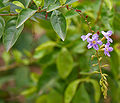
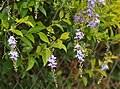
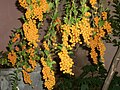
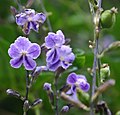
Duranta species are primarily shrubs or small trees, typically erect or scandent in habit, reaching heights of 1.8 to 6 meters, with spreading, drooping, or trailing branches that may become subscandent. Mature stems often bear sharp axillary thorns, which are absent on younger growth, and the bark is light brown and slightly furrowed. The growth form is , multi-stemmed, and sprawling, with vigorous branching from leaf axils contributing to a dense structure. Leaves are , simple, and ovate to lanceolate or rounded, measuring up to 5-7 cm in length and 2-4 cm in width, with entire margins or serrations toward the apex; they are shiny green, sometimes variegated or golden, and lack spines. Inflorescences consist of terminal or axillary racemes or panicles, 10-15 cm long, bearing zygomorphic flowers with a tubular corolla, five lobes, and colors ranging from , lavender, violet, to or , blooming primarily from summer to fall. Fruits are globose drupes, 6-15 mm in diameter, turning glossy to orange upon maturity, each containing four to five two-seeded pyrenes enclosed by an adherent, accrescent calyx; they occur in drooping clusters following flowering. The is distinguished morphologically by these drupes and the calyx persistence, alongside the thorny habit in many .

Growth and reproduction

Duranta erecta displays rapid growth, attaining heights of 2 to 6 meters as a multi-stemmed or small in favorable conditions, with dense, ovate foliage that remains semi-evergreen in subtropical climates. Optimal growth requires full sun exposure to maximize branching and flowering density, though partial shade results in leggier habits and fewer blooms; the plant thrives in moist, well-drained soils and demonstrates once established. after flowering encourages renewal and prevents woody overgrowth, as the responds vigorously to cutting back, often producing new shoots within weeks. Reproduction in D. erecta encompasses both sexual and asexual mechanisms, with flowers emerging continuously on current-season stems in warm environments, typically featuring lilac to violet corollas that attract pollinators such as bees and butterflies. Pollination yields golden-yellow berries enclosing multiple seeds, which serve as the primary means of sexual propagation; viable seeds germinate within 1 to 2 months under warm conditions around 21°C (70°F), provided they are sown in a light, sterile medium. Vegetative propagation via semi-hardwood stem cuttings, ideally 15 cm (6 inches) long and taken during summer, achieves high success rates—often over 80% with rooting hormone application—rooting in 4 to 6 weeks in humid, well-aerated substrates. This method preserves varietal traits more reliably than seeding, which can exhibit genetic variability.

Distribution and ecology

Native range and habitats

The genus Duranta comprises approximately 23 species of shrubs and small trees native to the tropical and subtropical regions of the , extending from southern (including and ) southward through , the , and into northern as far as . Species such as D. erecta are documented from the northward to southern , with broader distribution encompassing the , , and . In their native habitats, Duranta species typically occupy open, disturbed sites such as edges, roadsides, and coastal thickets in seasonally dry tropical biomes, where they tolerate full sun exposure and well-drained, often sandy or rocky soils. They favor warmer, moister microhabitats within these areas, including inland disturbed lands and subtropical zones with moderate rainfall, though they exhibit resilience to periodic once established. This adaptability contributes to their presence in both coastal and inland ecosystems, from up to elevations supporting .

Ecological interactions

Duranta species engage in mutualistic interactions with pollinators, primarily through their tubular flowers that produce , attracting a range of and birds. In particular, D. erecta draws bees such as Melipona beecheii, , sphinx moths (serving as host plants for their larvae), and hummingbirds, which facilitate cross- via legitimate visitation. However, by certain , which pierce floral tubes without contacting reproductive structures, reduces ; studies on D. erecta demonstrate a negative between longer corolla tubes and robbing frequency, as robbers prefer shorter-tubed variants, indirectly favoring legitimate in longer-tubed populations. Seed dispersal occurs mainly via frugivory, with birds consuming the golden-yellow berries and excreting viable seeds, a mechanism observed in both native tropical American habitats and introduced ranges. This ornithochorous enhances and establishment in disturbed or forest-edge environments where Duranta thrives as an . Herbivorous interactions include damage from and possibly vertebrates, though specific native antagonists remain understudied; in ecosystems, Duranta provides forage that may influence local dynamics, but its chemical defenses, including glycosides in leaves and fruits, deter generalist herbivores. Overall, these interactions position Duranta as a resource provider in networks and webs within biodiverse tropical settings.

Cultivation

Requirements and propagation

Duranta species, particularly D. erecta, thrive in full sun for optimal growth and flowering, though they tolerate partial shade with reduced bloom production and more leggy habits. They require well-drained, fertile soil with , preferring loamy textures over heavy or water-retentive clays to prevent . Water needs are moderate; keep soil consistently moist during establishment, then allow the top inch to dry between waterings once mature, as plants exhibit in suitable conditions. Temperature preferences align with tropical origins, with ideal ranges of 65–85°F (18–29°C) for vigorous growth and flowering; they withstand brief dips to 28°F (-2°C) but suffer damage below 40°F (4°C), necessitating indoor overwintering in containers outside USDA zones 9–11. Regular fertilization with a balanced, slow-release formula supports heavy blooming, applied every 4–6 weeks during the growing season. Propagation primarily occurs via semi-hardwood stem cuttings taken in summer, using 6-inch (15 cm) segments from healthy growth; remove lower leaves, dip in rooting hormone, and plant in a moist, sterile mix of , , and under high and indirect , rooting in 4–6 weeks at 70–75°F (21–24°C). Seeds can be sown fresh in warm, moist medium at 75–80°F (24–27°C) with bottom heat, germinating in 2–4 weeks, though cuttings yield more uniform faster than seed variability allows. Layering or division of rooted suckers provides additional options in established plantings.

Varieties and ornamental uses

, the primary species in cultivation, features numerous cultivars selected for diverse ornamental traits including flower color, foliage , and compact growth. Notable varieties include 'Alba', which bears clusters of white flowers instead of the typical blue-violet, and 'Gold Mound', a dwarf form reaching approximately 24 inches in height and width with chartreuse to bright foliage providing year-round color contrast. 'Cuban Gold' and similar dwarf cultivars exhibit golden leaves and are suited for smaller spaces, while 'Golden Edge' offers foliage with yellow margins on green leaves. These selections enhance visual appeal in tropical and subtropical landscapes, with some like 'Sheena's Gold' emphasizing upright growth and persistent golden hues. Ornamentally, Duranta species are employed in hedges, borders, and as specimen shrubs due to their rapid growth, profuse flowering, and tolerance for full sun and well-drained soils. Dwarf varieties serve as groundcovers or edging , while larger forms can be pruned into small trees or trained as screens and backdrops, creating barriers with their dense foliage. The attract pollinators such as and bees with their tubular blooms, and fruit-bearing cultivars draw birds, supporting in gardens. Container cultivation allows versatility for patios or indoor use in cooler climates, where they function as summer annuals with good once established.

Risks and impacts

Toxicity

All parts of Duranta erecta, particularly the leaves and berries, contain toxins that render the plant poisonous to humans and many animals. Ingestion of berries or leaves can lead to severe gastrointestinal irritation, , , and in extreme cases, , with poison severity rated as high. Documented cases include fatalities in children and pets from berry consumption, as noted in historical reports such as a presumed 1895 poisoning incident. In animals, particularly dogs and cats, exposure has caused drowsiness, hyperaesthesia, ataxia, and collapse, as observed in four incidents involving nine dogs and one . Symptoms in pets may also include drooling, seizures, and lethargy following ingestion. The toxic principles remain unidentified in some analyses, though the berries pose the greatest risk due to their appeal to children and animals. Notably, songbirds consume the berries without apparent harm, suggesting differential across , while mammals are highly susceptible. Contact with the plant may irritate or eyes, and medical attention is advised for any suspected ingestion.

Invasiveness

, the most widely cultivated in the genus, exhibits invasive behavior in several regions beyond its native tropical American range, primarily due to prolific seed production, bird-dispersed fruits, and vegetative suckering from roots. In , it is classified as an environmental weed in and northern , where it ranks among the top 50 most invasive plants, invading moist , riverbanks, and riparian zones, often forming dense thickets that outcompete native . Similarly, it naturalizes aggressively in , , , and parts of and , spreading via discarded garden waste and escaped ornamental plantings into scrublands and disturbed habitats. The plant's invasiveness stems from its rapid growth—reaching up to 6 meters in height—and high fecundity, with each infructescence producing dozens of yellow-orange berries containing multiple viable seeds that germinate readily in warm, humid conditions. Birds facilitate long-distance dispersal, while root suckers enable local clonal expansion, exacerbating infestations in waterways and coastal areas. In , the University of Florida's IFAS assessment predicts high invasion risk, advising against its use except under strict management, as it persists in subtropical climates and tolerates a range of soils. Ecological impacts include reduced through shading and resource competition, particularly in sensitive riparian ecosystems where it alters and provides unsuitable for native pollinators. In , it has become a declared pest in some districts, requiring mechanical removal or application for control, as remain viable in for extended periods. Despite these risks, not all introduced populations become problematic; invasiveness varies with climate and , being less severe in arid or temperate zones lacking protection.

References

Add your contribution
Related Hubs
User Avatar
No comments yet.