Hubbry Logo
DymaxionDymaxionMain
Open search
Dymaxion
Community hub
Dymaxion
logo
8 pages, 0 posts
0 subscribers
Be the first to start a discussion here.
Contribute something
Dymaxion
Dymaxion
from Wikipedia
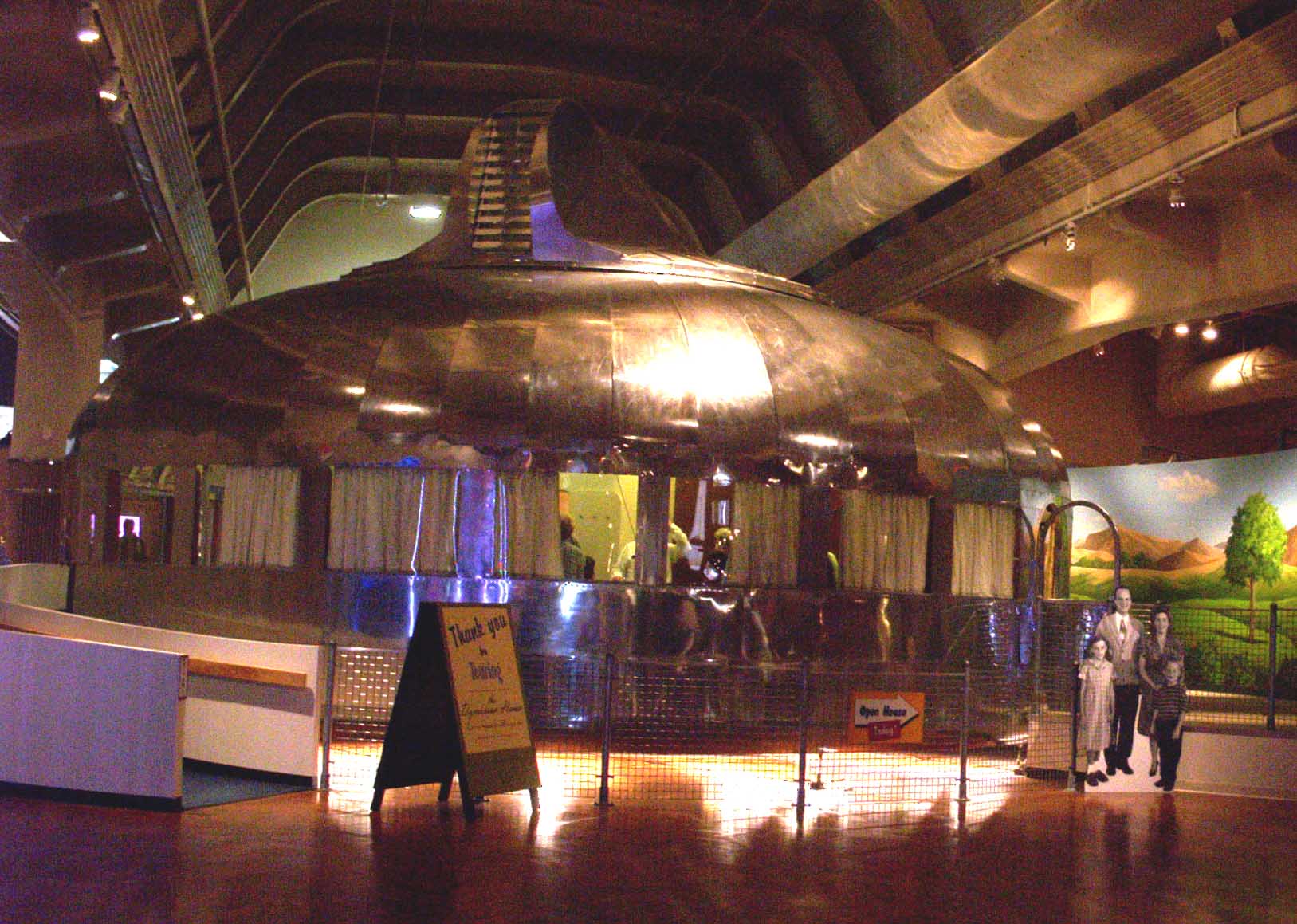
Dymaxion House as installed in Henry Ford Museum

Dymaxion is a term coined by architect and inventor Buckminster Fuller and associated with much of his work, prominently his Dymaxion house and Dymaxion car. A portmanteau of the words dynamic, maximum, and tension,[1] Dymaxion sums up the goal of his study, "maximum gain of advantage from minimal energy input".[2]

Description

[edit]

A name was needed for the display of Fuller's first architectural model, later to be known as the Dymaxion house, at the Marshall Field's department store in Chicago. To create the name, wordsmith Waldo Warren was hired by Marshall Field's[3] and spent two days listening to Fuller, getting a feel for his idiosyncratic use of language—later playing with the syllables typical of Fuller's speech until he and Fuller agreed on the word Dymaxion.

Fuller used the word for many of his inventions during the decades to follow, including the Dymaxion house, the Dymaxion deployment unit, the Dymaxion car, and the Dymaxion world map. Dymaxion also came to describe a polyphasic sleep schedule he followed, consisting of four 30-minute naps throughout the day.

Fuller eventually renamed his elaborate journal—a highly specific, highly detailed self-documentation of his life—as the Dymaxion Chronofile.

References

[edit]
Revisions and contributorsEdit on WikipediaRead on Wikipedia
from Grokipedia
Dymaxion is a portmanteau term coined in 1929 by an advertising consultant for an exhibition of R. Buckminster Fuller's model house at in , blending "dynamic," "maximum," and "ion" (referring to tension) to symbolize Fuller's philosophy of maximizing performance and efficiency while minimizing resource use. Fuller, an American architect, inventor, and visionary thinker (1895–1983), enthusiastically adopted "Dymaxion" as a for his innovative designs, which sought to address pressing global challenges like housing shortages, transportation inefficiencies, and environmental sustainability through anticipatory, technology-driven solutions. The term became synonymous with several landmark projects that exemplified Fuller's commitment to ""—the principle of accomplishing ever more with ever less. The Dymaxion House, first conceived in the late 1920s and developed in the 1940s, was a prefabricated, hexagonal dwelling made from lightweight aluminum, suspended from a central mast for easy assembly, transport via , and energy-efficient living; it weighed just 3 tons (versus 150 tons for a traditional home) and was designed for to provide affordable post-World War II. The Dymaxion Car, prototyped in 1933, featured a streamlined, teardrop-shaped body on three wheels with rear steering, enabling tight turns and fuel economy up to 30 miles per gallon while carrying 11 passengers; only three units were built before production ceased due to economic and safety concerns. Additionally, the Dymaxion Map (1943) unfolded the globe onto an net, preserving accurate proportions of continents and oceans with minimal distortion—unlike traditional Mercator projections—to promote a holistic view of as "one island in the sea." Beyond these, Dymaxion influenced ancillary inventions like the Dymaxion Bathroom (a compact, preassembled unit for efficient plumbing) and broader concepts in Fuller's oeuvre, including geodesic domes that applied similar tensile principles for lightweight, expansive structures used worldwide from the onward. Though many Dymaxion projects faced commercial hurdles during the and beyond, they laid foundational ideas for modern , , and , inspiring generations to prioritize human welfare through resourceful innovation.

Origin and Philosophy

Etymology

The term "Dymaxion" is a portmanteau derived from "dynamic," representing motion and change; "maximum," signifying efficiency gains; and "tension," denoting structural integrity. This linguistic construction encapsulated Buckminster Fuller's emphasis on innovative, resource-efficient design principles. The word was coined in by Waldo Warren, an advertising specialist employed by department store in , to promote Fuller's 4D architectural model displayed there. Warren developed the term after listening to Fuller discuss his ideas for two days, selecting syllables from Fuller's preferred concepts to create a memorable brand for the prototype. This exhibition occurred amid the onset of the , positioning the Dymaxion name as a symbol of forward-thinking, economical solutions to and shelter challenges. Initially used in promotional materials for Fuller's early prototypes, the term quickly evolved into a registered in Fuller's name during . It thereafter served as a branded identifier for his subsequent projects, reflecting a consistent of maximizing performance through in design.

Philosophical Principles

The Dymaxion , coined by , embodies the principle of achieving maximum gain for minimum energy input, encapsulated in his concept of , which describes the process of doing through technological advancement and efficient design. This idea posits that humanity can progressively enhance performance while reducing material and energy requirements, drawing from observations of industrial where innovations like combinations in automobiles enabled greater durability and efficiency with fewer resources. Fuller's approach emphasized rational, systemic thinking to optimize outcomes in social and industrial operations, prioritizing universal access to benefits over profit-driven or militaristic applications. Developed in the and amid Fuller's personal and economic crises, including the Great Depression's acute housing shortages and resource constraints, the philosophy stemmed from his background in , , and industrial , where he witnessed inefficiencies in traditional building methods. Influenced by pioneers like Henry Ford's assembly-line efficiencies and natural patterns such as closest-packing spheres, Fuller rejected political solutions in favor of technology to address scarcity, viewing the world as an interconnected system limited by finite resources. This era's challenges, including widespread and inadequate shelter, reinforced his commitment to designs that could scale globally without exacerbating waste or environmental strain. Central to Dymaxion applications are principles like , which balances tension and compression to create lightweight, resilient structures that mimic biological efficiencies, such as in cellular frameworks. Prefabrication techniques further enable rapid assembly with minimal on-site labor and materials, promoting by curbing and in response to growing global challenges like and waste accumulation. Fuller's broader crystallized in the "Spaceship Earth" metaphor, portraying the planet as a closed, self-sustaining vessel where inhabitants must manage limited supplies collaboratively to ensure survival, underscoring the philosophy's focus on holistic, regenerative systems over isolated exploitation.

Housing and Shelter Designs

Dymaxion House

The , designed by , featured a circular layout with a of approximately 36 feet, providing about 1,017 square feet of living space in a single-story structure. It was supported by a central mast from which the floors and walls were suspended via tension cables, utilizing an aluminum frame constructed from surplus aircraft materials for lightweight durability, totaling around 3 tons in weight. This engineering emphasized earthquake and storm resistance, capable of withstanding winds up to 180 miles per hour, while incorporating features like a 33-foot picture , a compact gallery , two bedrooms with en-suite bathrooms, and integrated mechanical systems for ventilation and utilities. The round shape minimized surface area to reduce heat loss, aligning with Fuller's philosophy of maximum efficiency through minimal resources. Fuller first conceived the concept in the as the "4D House," a visionary prefabricated dwelling, but it evolved significantly during . Between 1944 and 1946, he collaborated with Beech Aircraft Corporation in , leveraging wartime expertise to refine the into a viable prototype. Beech produced two prototypes in 1945, though the project stalled due to postwar economic shifts; in 1948, investor William Graham acquired and combined elements of both into the "Wichita House," which was displayed at that year's to promote the concept. Intended as a mass-produced solution to the post-World War II housing shortage, the was priced at $6,500—comparable to a at the time and equivalent to roughly $90,000 in 2025 dollars—making it accessible for widespread adoption. It was designed for easy transport by truck, packing into a single metal tube for global shipping, and assembly in just two days by unskilled labor, with self-contained utilities including downdraft ventilation for complete air changes every six minutes, natural heating and cooling, and water recycling systems to promote independence from urban infrastructure. Only the two prototypes were ever built, and commercial production never materialized due to financing challenges and market resistance to the unconventional design. The surviving Wichita House, restored by in 2001 at a cost of $1 million using advanced materials analysis, now stands as the sole example on display at the in , exemplifying through its minimal material use—contrasting sharply with the 150 tons of an average contemporary home—and energy-efficient features that reduced operational costs.

Dymaxion Deployment Unit

The Dymaxion Deployment Unit (DDU) was a portable shelter designed by Buckminster Fuller in 1940–1941, adapted from industrial grain silos to provide rapid, low-cost housing for military personnel during World War II. Drawing briefly from concepts in his earlier Dymaxion House designs, the DDU emphasized efficiency, modularity, and minimal resource use, utilizing existing manufacturing processes from the Butler Manufacturing Company to repurpose corrugated steel grain bins into habitable structures. The unit featured a 20-foot-diameter circular layout formed by bolted corrugated walls, with porthole-style windows for , built-in , , shelves, and hooks for furnishings. Its round form, resembling an oil tank or , required no internal structural members, making it fireproof, - and termite-resistant, watertight, and resilient to hurricanes, earthquakes, and fragments. The structure included a segmented with ventilators, could be divided into rooms using curtains, and housed facilities like a and ; fully furnished, it weighed about 4 tons and was 200% more heat-efficient than conventional rectangular homes. Shipped flat-packed in sections for easy transport, it could be assembled top-down on a simple foundation by unskilled labor in a day or two, with the raised via a collapsible mast and walls bolted in place. Developed in collaboration with Manufacturing in , the DDU was intended for at up to 1,000 units per day, with each unit costing around $1,500 including all fixtures—affordable enough for defense housing, army barracks, or post-war civilian applications like beach bungalows. However, only a limited number were produced before wartime steel and the end of halted manufacturing in the early 1940s; estimates suggest a few hundred units were made overall. The design allowed Butler to use pre-existing production dies without retooling, enabling quick scaling for military needs. During , DDUs were deployed globally by the U.S. military, including in the region where American and mechanics and airmen used them as housing while ferrying aircraft to Russia via the program. Additional units served in the Pacific Theater for operations and medical facilities, valued for their lightweight, air-transportable nature and quick setup. Post-war, some were repurposed for civilian use, though the design's utilitarian aesthetic limited broader adoption. Production ceased after the due to shifting priorities and material shortages, preventing the DDU from achieving Fuller's vision of widespread . Remnants of the units, long thought lost, were rediscovered in the early at the decommissioned Camp Evans Army base in , where about 12 survive in various states of decay; preservation efforts by local nonprofits have restored at least one for use as an exhibit and art studio, highlighting the design's enduring innovative legacy.

Mobility Innovations

Dymaxion Car

The was a groundbreaking three-wheeled automobile designed by inventor and architect in the early 1930s, embodying his philosophy of maximum efficiency through innovative engineering. Featuring a streamlined teardrop-shaped body approximately 20 feet long, the vehicle drew on aerodynamic principles from aircraft and boat construction, including collaboration with naval architect Starling Burgess, to minimize drag and weight. Powered by a rear-mounted 3.6-liter Ford V8 engine producing 85 horsepower, it employed and rear-wheel steering for enhanced maneuverability, allowing tight turns such as U-turns within its own length. The design achieved notable performance metrics, including a top speed of 90 miles per hour and fuel efficiency of 30 miles per gallon, while accommodating up to 11 passengers in its lightweight aluminum and fabric structure. Development began with Fuller's conceptualization in , but the first prototype was realized in through the 4D Dymaxion Corporation, a company he founded in , with initial funding from philanthropist Anna Biddle. Completed on July 12, , the vehicle incorporated repurposed Ford components and experimental features like a for visibility and . It debuted publicly at the Chicago World's Fair, where it was promoted as the "car of the future" for its potential as an omni-medium transport vehicle adaptable to land, air, or water with future modifications. Over the next two years, two additional prototypes were constructed, refining aspects like the and , but the total remained limited to three units due to escalating costs exceeding $8,000 per car. Testing revealed both praises and criticisms for the Dymaxion's handling. Early demonstrations, including a 90-mile-per-hour run at Roosevelt Field in August 1933, highlighted its stability at high speeds and exceptional turning radius, with the rear wheel capable of 90-degree pivots. However, reviewers noted challenges with low-speed stability and rapid tire wear due to the unconventional three-wheel configuration. A fatal incident on October 27, 1933, involving prototype #1 during a promotional drive near the Chicago World's Fair—where driver Francis T. Turner was killed in a rollover collision—intensified scrutiny over safety. Although the crash was attributed partly to evasive maneuvers around another vehicle, it eroded investor confidence, including from potential backer Walter Chrysler. In 1934, further evaluations exposed design flaws like poor braking and vulnerability to crosswinds, leading to the project's abandonment amid funding shortages and safety concerns; the 4D Company dissolved shortly thereafter. Of the three original prototypes, only #2 survives intact, preserved at the in , after restoration efforts. Prototype #1 was repaired post-crash but destroyed in a 1943 fire, while #3 was reportedly scrapped for metal during . Several replicas have since been built, including a faithful recreation at the Lane Motor Museum and a 2010 version by architect Norman Foster, demonstrating the design's enduring appeal and influence on modern aerodynamic vehicles.

Mapping and Visualization

Dymaxion Map

The is a polyhedral projection that maps the Earth's surface onto the 20 equilateral triangular faces of an , which is then unfolded into a two-dimensional plane to create a flat representation of the globe. Developed by inventor and architect R. Buckminster Fuller, this method was first proposed in 1943 as a means to minimize distortions in area, shape, distance, and direction that plague conventional map projections, such as the Mercator, which exaggerates polar regions. By distributing distortions more evenly across the map, the Dymaxion projection provides a more accurate visual of the planet's , as an that preserves the relative sizes of land areas and oceans accurately. A defining feature of the Dymaxion Map is its portrayal of Earth's continents as one continuous landmass encircled by a single , avoiding the artificial separations and interruptions common in other projections. This configuration emphasizes the planet's inherent unity, showing how landmasses like , , the , and connect without the need to split them across map edges. Unlike cylindrical or conic projections, it is an equal-area map that maintains proportional sizes— for instance, appears realistically smaller relative to — while allowing the map to be refolded into a or reconfigured into different flat layouts for various viewing perspectives. The map's development began with Fuller's 1943 publication in Life magazine, where it was introduced as the "Dymaxion Airocean World" using a cuboctahedral projection, evolving from his earlier experiments with cuboctahedral projections, patented in 1946 (U.S. No. 2,393,676), to the icosahedral form refined in 1954 in collaboration with cartographer Shoji Sadao, incorporating great-circle routes for more precise global connectivity and integrating it into his broader design principles. This iteration was specifically designed to support simulations in Fuller's World Game, a participatory exercise for analyzing global resource trends and solving planetary problems through comprehensive anticipatory . In applications, the Dymaxion Map has been employed in educational settings to foster a holistic understanding of Earth's interdependence, challenging geopolitical narratives rooted in divided, Eurocentric projections that reinforce nation-state boundaries. It has influenced discussions on global unity by visually demonstrating how resources and populations are interconnected, aligning with Fuller's of treating the as a single "." Modern adaptations include interactive digital versions, such as those enabling dynamic unfolding and data visualization in tools like Wolfram Demonstrations, which allow users to explore real-time global scenarios without distortion biases.

Personal Practices

Dymaxion Chronofile

The represents R. Buckminster Fuller's meticulous effort to archive his life comprehensively, initiating around 1920 and continuing with entries every 15 minutes until his death in 1983. This vast collection encompasses correspondence, sketches, bills, newspaper clippings, and other ephemera, amounting to approximately 270 feet of paper across hundreds of volumes. Fuller established the Chronofile to monitor his productivity and the practical application of ""—the concept of achieving more with fewer resources—in everyday activities, using it as a primary resource for developing his writings, inventions, and self-analysis as part of his broader life experiment. This archive is widely recognized as the most extensively documented account of an individual's life, providing unparalleled insight into personal and intellectual evolution over six decades. Organized as a chronological scrapbook, the materials are grouped into sections aligned with key life phases, such as the 1922–1927 period that revealed emerging patterns of efficiency and resource optimization in Fuller's endeavors. Since 1999, the entire collection has been preserved at the Department of Special Collections in Libraries, where it forms the core of the R. Buckminster Fuller papers. Access to the Chronofile supports ongoing digitization initiatives, with elements like thousands of slides already available as digital , enabling researchers to examine Fuller's creative processes and through original documents. This archival approach exemplified Fuller's commitment to Dymaxion by transforming personal record-keeping into a systematic tool for self-improvement.

Dymaxion Sleep Schedule

The Dymaxion sleep schedule, an experimental regimen devised by , involves four 30-minute naps taken every six hours, resulting in a total of two hours of per 24-hour period. Fuller initiated this approach in the early , drawing inspiration from industrial efficiency studies and observations of natural patterns in animals, aiming to maximize human productivity by minimizing downtime. He conducted the trial from 1932 to 1933, during which the schedule enabled approximately 22 hours of daily wakefulness dedicated to work and creative pursuits. Fuller reported experiencing unprecedented levels of , alertness, and overall vigor while adhering to the regimen, with his verified as robust by life-insurance physicians. These outcomes were publicly detailed in a 1943 Time magazine article, where Fuller described the method as replenishing his primary energy reserves without depleting secondary ones, leading to heightened productivity during the two-year experiment. However, no comprehensive long-term physiological data from Fuller's trial exists, limiting direct validation of these claims. As a subset of broader research, the Dymaxion schedule aligns with efforts to fragment sleep into multiple short episodes rather than consolidated nighttime rest, potentially targeting rapid entry into restorative stages. Contemporary scientific studies, however, highlight significant risks associated with such extreme patterns, including chronic sleep deficiency, disrupted circadian rhythms, elevated , impaired cognitive performance, and increased vulnerability to health issues like cardiovascular strain and metabolic disorders. A 2021 review in Reviews concluded that polyphasic schedules generally yield adverse outcomes, with no evidence supporting sustained benefits over monophasic sleep for most individuals. Adoption of the Dymaxion schedule remained limited, as Fuller's business associates preferred conventional sleep norms, ultimately prompting him to discontinue the practice despite its personal success. In 1943, he suggested it as a wartime efficiency strategy to help the win , but it saw minimal uptake beyond experimental circles. The concept has since influenced modern biohacking and enthusiasts, who adapt similar nap-only protocols in pursuit of enhanced productivity, though experts caution against their long-term use due to health risks. This sleep experiment complemented Fuller's personal efficiency initiatives, such as the systematic logging of daily activities in his Chronofile.

Legacy

Influence on Modern Design

Buckminster Fuller's Dymaxion concepts, emphasizing efficiency, modularity, and resource optimization, have profoundly shaped contemporary architectural practices, particularly in prefabricated and sustainable housing. The Dymaxion House's vision of mass-produced, lightweight, transportable homes laid foundational principles for modern prefabricated designs, influencing the development of modular systems that prioritize affordability and environmental efficiency. This legacy is evident in today's tiny home movement, where compact, prefabricated structures often draw on Fuller's ideas of streamlined, low-impact living to address housing shortages and promote sustainability. Additionally, Fuller's innovations in structural engineering, such as geodesic domes derived from Dymaxion principles, inspired large-scale environmental projects like the Eden Project in Cornwall, England, whose biomes utilize hexagonal framing for efficient, expansive enclosures that mimic natural ecosystems. The Dymaxion Deployment Unit (DDU), a portable shelter prototype, further contributed to advancements in emergency housing by demonstrating rapid assembly and durability, ideas that informed subsequent designs for temporary relief structures used in humanitarian efforts. In transportation, the Dymaxion Car's pioneering aerodynamic form—featuring a teardrop shape and rear-engine layout for minimal drag—advanced principles of and that resonate in modern vehicles. These concepts, focused on maximizing performance with minimal energy, have influenced the engineering of electric vehicles, where low-drag bodies enhance range and sustainability, echoing Fuller's emphasis on "doing more with less." The three-wheeled configuration and lightweight chassis of the Dymaxion also prefigured experimental urban mobility solutions, promoting compact, efficient transport in line with contemporary goals for reduced emissions. Fuller's Dymaxion Map, a projection that unfolds the without distorting continental sizes or shapes, continues to impact and visualization tools, fostering a holistic view of planetary interconnectedness. Integrated into (GIS) software like , it enables accurate for environmental monitoring and resource mapping. In environmental education, the map promotes awareness of global interdependence, serving as a tool to illustrate ecological unity and challenge traditional Mercator biases, which has supported climate activism by visualizing threats like and on an equitable scale. Its icosahedral design encourages "one-world" thinking, aiding simulations for sustainable . Beyond specific applications, Dymaxion ideas have permeated broader cultural and innovative spheres through exhibitions, literature, and recent technological revivals. The 1941–1942 Museum of Modern Art (MoMA) exhibition of the Dymaxion Deployment Unit introduced Fuller's portable housing to a wide audience, sparking early discussions on industrialized, sustainable living. Fuller's extensive writings, including over 30 books like Operating Manual for Spaceship Earth, popularized terms and philosophies central to sustainable design, such as ephemeralization—achieving more with fewer resources—shaping global movements toward ecological responsibility. In the 2020s, these principles have seen revival in 3D-printed habitats, where modular, on-site construction for space exploration by NASA echoes Dymaxion's prefab efficiency, adapting in-situ resources for resilient, low-waste environments.

Challenges and Criticisms

The Dymaxion House, intended as an affordable, mass-producible dwelling, faced significant production hurdles that limited it to just two prototypes, both constructed in and , due to high costs, shortages, and complex assembly processes that deterred widespread adoption during the post-World War II economic climate. Similarly, the Dymaxion Car project, which aimed to revolutionize transportation with its streamlined, three-wheeled design, was abandoned after only three prototypes were built, primarily because of escalating development expenses and investor withdrawal following a high-profile accident in 1933 that killed the driver and injured passengers. Safety concerns further undermined the feasibility of several Dymaxion initiatives; the car's unconventional handling, including a tendency to fishtail at low speeds and instability during sharp turns, contributed to the fatal crash at the and subsequent public distrust, despite investigations clearing the design as the direct cause. The Dymaxion sleep schedule, involving four 30-minute naps every six hours totaling two hours per day, has been critiqued by sleep researchers as unsustainable and harmful, with polyphasic patterns like it linked to , increased accident , and long-term health issues such as weakened immunity and cardiovascular problems, based on studies showing no benefits and consistent adverse outcomes. Philosophically, Fuller's Dymaxion philosophy drew accusations of utopianism, portraying as a for societal ills in ways that overlooked economic and social barriers of the 1930s and 1940s, rendering many projects visionary yet impractical amid the and wartime constraints. The Dymaxion Map, while designed to minimize distortions and challenge north-up cultural biases in traditional projections, faced criticism for inherent subjectivity in its unfolding choices, which could still prioritize certain geopolitical perspectives and reflect the designer's worldview rather than achieving true neutrality. Posthumously, as of 2025, Dymaxion concepts have seen renewed interest in discussions, yet early media portrayals often dismissed Fuller's over-optimism as eccentric or unattainable, contributing to initial commercial failures. The Estate has engaged in legal battles to protect Dymaxion trademarks, including disputes over unauthorized use of the name in products like "buckyballs" toys, resulting in court rulings affirming exclusions in coverage for such infringements.

References

Add your contribution
Related Hubs
Contribute something
User Avatar
No comments yet.