Hubbry Logo
Dynamic modulusDynamic modulusMain
Open search
Dynamic modulus
Community hub
Dynamic modulus
logo
7 pages, 0 posts
0 subscribers
Be the first to start a discussion here.
Dynamic modulus
Dynamic modulus
from Wikipedia

Dynamic modulus (sometimes complex modulus[1]) is the ratio of stress to strain under vibratory conditions (calculated from data obtained from either free or forced vibration tests, in shear, compression, or elongation). It is a property of viscoelastic materials.

Viscoelastic stress–strain phase-lag

[edit]

Viscoelasticity is studied using dynamic mechanical analysis where an oscillatory force (stress) is applied to a material and the resulting displacement (strain) is measured.[2]

  • In purely elastic materials the stress and strain occur in phase, so that the response of one occurs simultaneously with the other.
  • In purely viscous materials, there is a phase difference between stress and strain, where strain lags stress by a 90 degree ( radian) phase lag.
  • Viscoelastic materials exhibit behavior somewhere in between that of purely viscous and purely elastic materials, exhibiting some phase lag in strain.[3]

Stress and strain in a viscoelastic material can be represented using the following expressions:

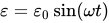
  • Strain:
  • Stress: [3]

where

where is frequency of strain oscillation,
is time,
is phase lag between stress and strain.

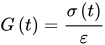
The stress relaxation modulus is the ratio of the stress remaining at time after a step strain was applied at time : ,

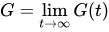
which is the time-dependent generalization of Hooke's law. For visco-elastic solids, converges to the equilibrium shear modulus[4]:

.

The Fourier transform of the shear relaxation modulus is (see below).

Storage and loss modulus

[edit]

The storage and loss modulus in viscoelastic materials measure the stored energy, representing the elastic portion, and the energy dissipated as heat, representing the viscous portion.[3] The tensile storage and loss moduli are defined as follows:

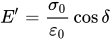
  • Storage:
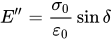
  • Loss: [3]

Similarly we also define shear storage and shear loss moduli, and .

Complex variables can be used to express the moduli and as follows:

[3]

where is the imaginary unit.

Ratio between loss and storage modulus

[edit]

The ratio of the loss modulus to storage modulus in a viscoelastic material is defined as the , (cf. loss tangent), which provides a measure of damping in the material. can also be visualized as the tangent of the phase angle () between the storage and loss modulus.

Tensile:

Shear:

For a material with a greater than 1, the energy-dissipating, viscous component of the complex modulus prevails.

See also

[edit]

References

[edit]
Revisions and contributorsEdit on WikipediaRead on Wikipedia
from Grokipedia
The dynamic modulus, often denoted as EE^*, is a complex-valued that characterizes the stress-strain relationship in linear viscoelastic materials subjected to sinusoidal or oscillatory loading, capturing both elastic and viscous responses under dynamic conditions. It is defined such that its magnitude |EE^*| is the ratio of the peak stress amplitude to the peak strain amplitude, |EE^*| = σ0/ϵ0\sigma_0 / \epsilon_0, and serves as a fundamental measure of material in time-dependent deformation scenarios. The dynamic modulus comprises two key components: the storage modulus EE', which is the real part and quantifies the elastic energy stored and recovered during each cycle of deformation, and the loss modulus EE'', which is the imaginary part and represents the energy dissipated as heat due to viscous damping. The magnitude E|E^*| provides the overall stiffness, while the phase angle δ\delta (where tanδ=E/E\tan \delta = E'' / E') indicates the relative contributions of elastic and viscous behaviors, with higher δ\delta values signifying greater viscous dominance. These components are frequency- and temperature-dependent, reflecting the material's relaxation and retardation processes in viscoelastic models like the Maxwell or Kelvin-Voigt elements. Dynamic modulus is commonly measured using techniques such as (DMA), which applies controlled sinusoidal strains or stresses over a range of frequencies (typically 0.01 Hz to 100 Hz) and temperatures to generate master curves via time-temperature superposition principles. In applications, it is essential for characterizing materials like , mixtures, and biological tissues, informing design in fields such as pavement engineering, where it predicts rutting and under traffic loads, and polymer processing, where it guides formulation for optimal mechanical performance. For instance, in hot-mix asphalt, dynamic modulus values decrease with increasing temperature and rise with loading frequency, influencing mechanistic-empirical pavement design.

Fundamentals

Definition

The dynamic modulus EE^* is a complex-valued measure of a material's mechanical response to oscillatory or sinusoidal loading, characterized by the ratio of the complex stress amplitude to the complex strain amplitude, which accounts for phase differences between stress and strain waveforms. Its magnitude is given by E=σ0ϵ0|E^*| = \frac{\sigma_0}{\epsilon_0}, where σ0\sigma_0 represents the peak stress amplitude and ϵ0\epsilon_0 the peak strain amplitude under linear viscoelastic conditions. This characterization is particularly relevant for materials subjected to cyclic deformations, such as in (DMA). Unlike the static modulus, which quantifies material stiffness under steady-state loading and neglects time-dependent behaviors like creep or relaxation, the dynamic modulus captures the viscoelastic nature of materials that exhibit both elastic recovery and viscous dissipation during oscillation. Static tests, such as those following Hooke's law with constant strain, provide a time-independent elastic constant, whereas dynamic testing reveals the material's frequency-sensitive response. The value of the dynamic modulus depends on the loading frequency and temperature, as these factors influence the balance between elastic and viscous contributions in viscoelastic materials, which display both instantaneous elastic deformation and time-delayed viscous flow. For instance, higher frequencies typically increase the modulus by promoting elastic-like , while elevated temperatures enhance viscous effects and reduce overall .

Relation to viscoelasticity

Viscoelasticity describes the mechanical behavior of materials that exhibit both viscous and elastic characteristics under deformation, where the elastic component enables energy storage and reversible deformation akin to a spring, while the viscous component results in dissipation and time-dependent flow similar to a . This dual nature arises because the relationship in such materials depends on the rate and duration of loading, leading to phenomena like creep (continued deformation under constant stress) and (decreasing stress under constant strain). Dynamic modulus quantifies the viscoelastic response under cyclic loading by capturing how materials respond to oscillatory forces. Foundational models for understanding the dynamic response of viscoelastic materials include the Maxwell model and the Kelvin-Voigt model, which idealize these behaviors using combinations of springs (elastic elements) and (viscous elements). The Maxwell model, consisting of a spring and dashpot in series, represents materials that show fluid-like flow over long timescales, such as melts, and is useful for analyzing relaxation processes that influence dynamic properties under . In contrast, the Kelvin-Voigt model, with a spring and dashpot in parallel, models solid-like materials that resist instantaneous deformation but exhibit delayed recovery, providing insight into creep and the time-lagged response in oscillatory conditions typical of rubbers and gels. These models serve as building blocks for more complex representations of dynamic , highlighting how internal friction and elasticity interact during periodic loading. Viscoelastic analysis can be conducted in the time domain, focusing on transient responses like step loading, or in the frequency domain, which examines steady-state behavior under harmonic oscillations where material properties vary with oscillation frequency. In the frequency domain, dynamic modulus applies specifically to sinusoidal inputs, revealing how viscous dissipation increases at higher frequencies while elastic storage dominates at lower ones, a shift critical for materials subjected to vibrations. This approach contrasts with time-domain methods by leveraging Fourier transforms to interconvert responses, enabling the study of periodic deformations without solving full transient equations. The concept of dynamic modulus emerged in mid-20th century research on polymers and rubbers, driven by efforts to characterize their time-dependent behaviors under practical loading conditions. Early foundational work, such as that by Herbert Leaderman in the , focused on creep and recovery in high polymers like filaments and plastics, laying the groundwork for understanding oscillatory responses in these materials. Leaderman's investigations, detailed in his 1943 on elastic and creep properties, highlighted the need for frequency-dependent measures to model real-world applications in and .

Mathematical Formulation

Complex modulus

The complex modulus, denoted as E(ω)E^*(\omega), is a fundamental quantity in the frequency-domain analysis of viscoelastic materials, expressed as E(ω)=E+iEE^*(\omega) = E' + i E'', where EE' is the real part, EE'' is the imaginary part, and ω\omega is the angular frequency. This representation arises from applying the Fourier transform to the time-dependent stress σ(t)\sigma(t) and strain ϵ(t)\epsilon(t), transforming the convolution integral of the linear viscoelastic constitutive equation into a simple algebraic relation in the frequency domain: σ^(ω)=E(ω)ϵ^(ω)\hat{\sigma}(\omega) = E^*(\omega) \hat{\epsilon}(\omega), where σ^(ω)\hat{\sigma}(\omega) and ϵ^(ω)\hat{\epsilon}(\omega) are the Fourier transforms of stress and strain, respectively. For harmonic oscillations, such as ϵ(t)=ϵ0cos(ωt)\epsilon(t) = \epsilon_0 \cos(\omega t), the corresponding stress is σ(t)=σ0cos(ωt+δ)\sigma(t) = \sigma_0 \cos(\omega t + \delta), leading to E(ω)=σ0ϵ0eiδE^*(\omega) = \frac{\sigma_0}{\epsilon_0} e^{i \delta}. The magnitude of the complex modulus, E=(E)2+(E)2|E^*| = \sqrt{(E')^2 + (E'')^2}
Add your contribution
Related Hubs
User Avatar
No comments yet.