


Community hub
Recent from talks
Contribute something
Nothing was collected or created yet.
Eagle Summit
View on Wikipedia
| Eagle Summit | |
|---|---|
 | |
| Overview | |
| Manufacturer | Mitsubishi Motors |
| Production | 1989–1996 |
| Body and chassis | |
| Class | Subcompact Compact MPV (wagon) [1] |
| Chronology | |
| Predecessor |
|
| Successor |
|
The Eagle Summit is a line of subcompact cars produced for two generations by Mitsubishi and sold by Eagle from 1989 until 1996. It was marketed as a captive import by the Jeep-Eagle sales division that was established after Chrysler Corporation purchased American Motors Corporation (AMC) in 1987.
Overview
[edit]Use of the Eagle model name originated with the innovative all-wheel-drive AMC Eagle introduced for the 1980 model year.[2] Production continued even after Chrysler purchased AMC, but both the AMC brand and the original Eagle line were discontinued after 1988.[3] The replacements were "badge-engineered products designed, Chrysler said, to compete with hot-selling import cars."[3]
The Eagle Summit joined the Dodge Colt and Plymouth Colt starting in 1989 as Chrysler wound down the assembly of the subcompact Plymouth Horizon and Dodge Omni twins.[4] The introduction of the Summit coincided with the release of the Mitsubishi Mirage's third generation.
The Eagle Summit was positioned as a subcompact automobile model in the product mix for Jeep-Eagle dealers.[5] Previously, this position was held by the Renault Alliance until it was discontinued following Chrysler's acquisition of AMC from Renault in 1987.
The Eagle Summit line continued through the extent of the Mirage's fourth generation, which ended in 1996. The somewhat related Eagle Summit Wagon (a compact MPV) was marketed from 1992 through 1996 and was based on the Mitsubishi RVR.
The Chrysler Neon was introduced in January 1994 and distributed through Dodge and Plymouth dealers. Chrysler officials declared that an Eagle version of the Neon was not planned.[6] This decision meant that Eagle dealers had no competitor to the Neon and, combined with the Summit's Mitsubishi heritage, made the Eagle line expendable.[1]
Year-to-year changes
[edit]First generation (1989–1992)
[edit]| First generation | |
|---|---|
 | |
| Overview | |
| Production | 1989–1992 |
| Assembly |
|
| Body and chassis | |
| Body style | |
| Layout | FF layout |
| Related | |
| Powertrain | |
| Engine |
|
| Transmission | |
| Dimensions | |
| Wheelbase |
|
| Length |
|
| Width | 65.7 in (1,669 mm) |
| Height |
|
| Curb weight |
|
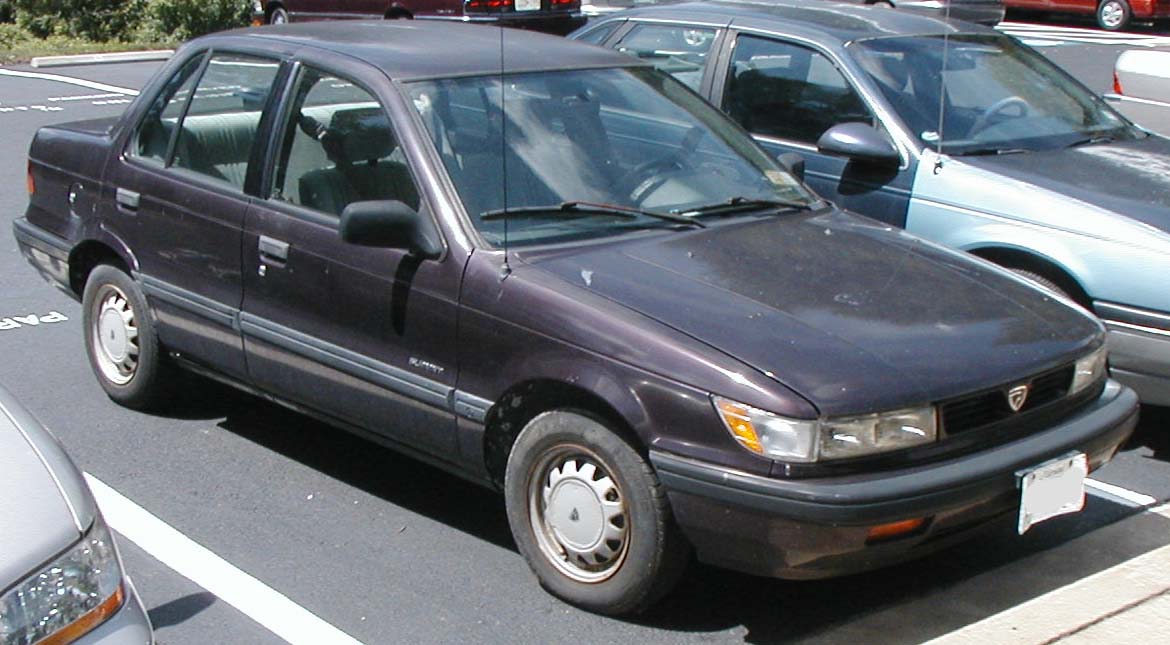
The Summit was a badge engineered version of the Mitsubishi Mirage. In a pairing of the Japanese-built Mitsubishi Mirage and the identical Eagle Summit to test if Lee Iacocca's theory was true regarding the preference of a Japanese to an American brand on similar cars, Popular Mechanics found that American consumers were "not sold on Japanese cars. Quite the opposite. They want to "Buy American," but the Japanese manufacturers seem to offer more of the type of cars Americans need and at a better price, and from more cooperative dealers."[8] The Summit was originally manufactured in Japan. Starting with the 1991 model year, the Eagle Summits were also built by Diamond-Star Motors (DSM), a joint-venture between Chrysler and Mitsubishi, in Normal, Illinois.[9]
- 1989: Summit was introduced as a sedan in DL and LX trim, both powered by a 1.5-liter 8-valve four-cylinder engine with 81 hp (60 kW). The LX could have a 1.6-liter 16-valve DOHC engine with 123 hp (92 kW). The 100.7 cubic feet (2.85 m3) of interior volume classified the Summit into the compact car class, while most of its competitors were still subcompacts. The Summit was also noted for its generous rear legroom. Sales started in August 1988.
- 1990: A low-cost base model was added to the bottom of the Summit line. Added to the top was a new ES, which paired the 1.6-liter engine with a sport suspension, 4-wheel-disc brakes, and 14-inch (360 mm) alloy wheels with P195/60R14 tires. All models received all-capital lettering on the back.
.jpg)
- 1991: The 1.5-liter engine output increased to 92 hp (69 kW; 93 PS) due to 4 additional valves (for 12 total). The ES models returned to 13-inch (330 mm) wheels and disc brakes on only the front. New was the 2-door Summit hatchback; both it and the sedan was available in base and ES trims. The manual transmission was a 4-speed on the base hatchback and a 5-speed on all others; the automatic was a 3-speed on hatchbacks and a 4-speed on sedans. All models featured a new front grille.
- 1992: The Summit Wagon joined the line, and it was a completely different vehicle featuring a high roofline and sliding rear side door. This "crossover" design was actually a rebadged Mitsubishi RVR, thus not related to the Mirage-based Summits. The Wagon was available in DL and LX trims, as well as in a four-wheel drive (AWD) version. The new Summit Wagon was marketed as blending the maneuverability of a small car with the roominess of a minivan with its interior offering high seating positions and removable rear seats.[10] It was designed to attract young families with seating for five.[11]
- Production Figures:
| Sedan | Hatchback | Yearly Total | |
|---|---|---|---|
| 1989 | 27,213 | - | 27,213 |
| 1990 | 13,772 | - | 13,772 |
| 1991 | 9,257 | 8,363 | 17,620 |
| 1992 | 3,348 | 6,881 | 10,229 |
| Total | 53,590 | 15,244 | 68,834 |
Second generation (1993–1996)
[edit]| Second generation | |
|---|---|
 | |
| Overview | |
| Also called | Wagon: Mitsubishi Space Runner (Europe) [13] |
| Production | 1993–1996 |
| Assembly | Japan: Kurashiki, Okayama (coupé & sedan) |
| Body and chassis | |
| Body style | |
| Layout | Front engine, front-wheel drive |
| Related | |
| Powertrain | |
| Engine |
|
| Transmission | |
| Dimensions | |
| Wheelbase |
|
| Length |
|
| Width |
|
| Height |
|
| Curb weight | Wagon: 2,700 lb (1,225 kg) |
The 1993 model year Summits were completely new and featured more room on the inside as well as weighing less than before.[14] The Summit was now based the fourth generation Mitsubishi Mirage 'CC' chassis platform featuring a multilink rear suspension and the body was given a rounder shape.
The hatchback body design was dropped in favor of a two-door coupe version, while a four-door sedan joined the Summit lineup.[14][1]


The Summit Wagon, a rebadged Mitsubishi RVR was classified as a compact minivan,[15] or a compact MPV.[16]
- 1993: As with the Mirage and both Colts, the base 1.5-liter engine remained, paired to a 5-speed manual or 3-speed automatic. New was a 113 hp (84 kW; 115 PS) 1.8-liter SOHC engine, whose optional automatic was a 4-speed. The Summit was offered in sedan and coupe body styles, in both DL and ES trim lines. The RVR-based minivan version, marketed as the Summit Wagon, replaced the Canada-only Eagle Vista wagon.
- 1994: All Summits featured a driver's side airbag, replacing one of the motorized seatbelts. The lower-end DL sedan was rebadged LX and inherited the 1.8-liter engine, which was now an option for the ES coupe as well. The ES sedan upgraded to larger 14-inch (360 mm) wheels.
- 1995: A passenger's side airbag on all Summits replaced the other motorized seatbelt, and ES models were renamed ESi. More significantly, the 1994 demise of both Colts left the Summit as the only remaining Mirage clone, and the cancellation of the Mirage sedan at the end of 1994 left the Summit as the only four-door offering.
- 1996: Summit models entered its last model year with new paint colors and seat fabrics.[17]
Trim levels overview
[edit]- 4-door sedan (1989-1996)
- DL - 1989-1990; 1993
- LX - 1989-1990; 1994–1996
- base - 1990-1992
- ES - 1990-1994
- ESi - 1994-1996
- 2-door coupe/hatchback (1991-1996)
- base - 1991-1992
- ES - 1991-1994
- DL - 1993-1996
- ESi - 1994-1996
References
[edit]- ^ a b c Mateja, Jim (22 March 1993). "Inside Story On '93 Eagle Summit: Plenty Of Space, Few Safety Features". Chicago Tribune. Retrieved 11 October 2015.
Summit may be ranked as a subcompact based on exterior dimensions, but it has interior room most midsize cars would envy.
- ^ Hunting, Benjamin (22 November 2021). "The AMC Eagle Invented the Crossover 20 Years Too Soon". InsideHook. Retrieved 5 December 2021.
- ^ a b Foster, Patrick (15 March 2021). "Seeking the Summit". Old Cars Weekly. Retrieved 5 December 2021.
- ^ McCosh, Dan (November 1990). "Global Designs for Compact Sedans". Popular Science. Vol. 237, no. 5. p. 92. Retrieved 11 October 2015.
- ^ Dunne, Jim (June 1988). "Inside Detroit". Popular Mechanics. p. 43. Retrieved 11 October 2015.
- ^ Vijverman, Bruno (5 December 2023). "Book of the Dead — Eagle (Part Two)". driventowrite. Retrieved 31 December 2024.
- ^ Mateja, Jim (17 May 1991). "New Line Of Work For Chrysler Plant: Subcompact To Replace Full-size Cars At Belvidere". Chicago Tribune. Retrieved 11 October 2015.
- ^ Taylor, Rich (November 1990). "Blind Taste Test". Popular Mechanics. Vol. 167, no. 11. pp. 41–125. Retrieved 11 October 2015.
- ^ Taylor, p. 46.
- ^ Winternitz, Felix (October 1991). "Hot Wheels '92". Cincinnati Magazine. Vol. 25, no. 1. p. 108. Retrieved 11 October 2015.
- ^ "What's new for '92? Check these models". Kiplinger's Personal Finance. Vol. 45, no. 10. October 1991. p. 107. Retrieved 11 October 2015.
- ^ Flammang, James M. (1999). Standard catalog of American cars, 1976-1999. Ron Kowalke (3rd ed.). Iola, WI: Krause Publications. ISBN 0-87341-755-0. OCLC 43301709.
- ^ Martin, Murilee (12 February 2014). "Junkyard Find: 1993 Eagle Summit Wagon". The Truth About Cars. Retrieved 11 October 2015.
- ^ a b Allen, Mike (October 1992). "Drive Report: Eagle Summit". Popular Mechanics. Vol. 169, no. 10. p. 39. Retrieved 11 October 2015.
- ^ Gillis, Jack (1996). The Car Book. Tilden Press. ISBN 9780062732828. Retrieved 11 October 2015.
- ^ Lilienthal, Andy (20 April 2009). "Nostalgic Subcompact: Tall wagon triplets—Mitsubishi Expo LRV, Eagle Summit Wagon, and Plymouth Colt Vista". Subcompact Culture. Retrieved 11 October 2015.
- ^ Edmunds Used Cars and Trucks Summer 2001. Edmund Publications. 2001. pp. 166–67. ISBN 978-0-87759669-1.
External links
[edit]
| Owners |
| ||||
|---|---|---|---|---|---|
| Vehicles |
| ||||
| Related | |||||

Eagle Summit
View on GrokipediaDevelopment and background
Origins and market positioning
The Eagle brand was established by Chrysler Corporation following its acquisition of American Motors Corporation (AMC) in 1987, primarily to secure the profitable Jeep division while repurposing AMC's dealer network and existing lineup.[5] This move created Jeep-Eagle as a new division, with Eagle serving as Chrysler's first standalone brand since DeSoto in 1961, drawing on the legacy of AMC's Eagle four-wheel-drive models to appeal to import-oriented buyers seeking American-branded alternatives.[5] The brand's rationale centered on filling gaps in Chrysler's portfolio by transitioning away from aging Renault partnerships—such as the underperforming Alliance and Encore subcompacts—and introducing more competitive Japanese imports to maintain market presence in the entry-level segment.[5] To address the subcompact void left by the Renault models, Eagle introduced the Summit in August 1988 as a 1989 model year vehicle, rebadging the Mitsubishi Mirage platform to provide an affordable, fuel-efficient option built on a proven Japanese design.[4] Positioned as an entry-level car for budget-conscious young buyers and urban commuters, the Summit emphasized practicality, value, and everyday reliability derived from the longstanding Chrysler-Mitsubishi partnership, which dated back to the early 1970s and allowed Eagle to leverage Mitsubishi's engineering without fully domestic production.[5] Marketing campaigns highlighted the vehicle's American identity under the Eagle banner, portraying it as a smart, no-nonsense choice that combined import quality with accessible ownership, despite its foreign assembly.[4] The base DL model debuted with an MSRP of $8,229, making it competitively priced against rivals like the Honda Civic and Toyota Corolla in the subcompact market, where it aimed to capture sales through superior interior space and feature content relative to its cost.[6] This strategy targeted first-time buyers and fleet operators seeking economical transportation, positioning the Summit as a gateway to the Eagle lineup and broader Chrysler ecosystem.[5]Platform and production
The Eagle Summit utilized a shared platform with the Mitsubishi Mirage, employing the third-generation Mirage chassis for the first generation (1989–1992) and the fourth-generation Mirage's CC chassis, introduced in 1993, for the second generation to support an updated structure. It adopted a front-wheel-drive configuration with independent MacPherson strut suspension at the front and a torsion beam setup at the rear, providing a balance of ride comfort and handling efficiency typical of subcompact designs. The first-generation models featured a 93.7-inch wheelbase for both sedan and hatchback variants, while the second-generation sedan extended to 98.0 inches to accommodate refined proportions and improved interior space.[7] The Eagle Summit sedan and hatchback were produced at Mitsubishi's Okazaki plant in Aichi, Japan, from 1989 to 1996. The Summit Wagon variant was assembled at the Diamond-Star Motors (DSM) joint-venture facility in Normal, Illinois, beginning with its introduction for the 1993 model year.[8][9] Assembly processes for the U.S. market incorporated specific adaptations, such as enhanced emission controls and fuel system tweaks to comply with Environmental Protection Agency (EPA) standards, including catalytic converters optimized for American fuel formulations and odometer calibrations aligned with federal requirements. These modifications ensured the Summit met stringent emissions and safety criteria without altering core engineering. Production estimates indicate approximately 68,834 units for the first generation, reflecting a focused output during its introductory phase, while the second generation ranged from 50,000 to 60,000 units based on available market data, with gaps in official Chrysler documentation after 1992 complicating precise tallies.[10]First generation (1989–1992)
Design and body styles
The first-generation Eagle Summit was introduced for the 1989 model year as a badge-engineered version of the third-generation Mitsubishi Mirage, built on a subcompact platform with boxy, angular styling typical of late-1980s Japanese economy cars.[11] The exterior featured a upright greenhouse, rectangular headlights, and a simple grille, prioritizing functionality over aerodynamics while maintaining compact dimensions for urban use. Initially available only as a four-door sedan, the lineup expanded for 1991 with the addition of a three-door hatchback, both body styles seating five passengers with practical interior space, including 100.7 cubic feet of passenger volume and generous rear legroom for the class. The sedan measured 170.1 inches in length, 65.7 inches in width, and 52.8 inches in height, with a 93.9-inch wheelbase; the hatchback was shorter at 158.7 inches long and 51.9 inches high. Trims included the base DL and upscale LX for 1989, transitioning to base and performance-oriented ES for 1990–1992, with higher trims offering standard air conditioning, power accessories, and cloth upholstery.[1] The interior emphasized affordability and reliability, with a straightforward dashboard layout, manual windows in base models, and optional AM/FM radio. Safety features were basic for the era, including three-point seatbelts but no driver-side airbag or ABS until later models in the lineup. Production occurred at the Diamond-Star Motors facility in Normal, Illinois, a joint venture between Chrysler and Mitsubishi. Minor updates over the years included revised badging and interior materials, but no major facelifts. Fuel efficiency was a key selling point, with the lightweight design (curb weights around 2,200–2,300 pounds) aiding maneuverability.[12]Powertrain and specifications
The first-generation Eagle Summit was powered exclusively by inline-four engines from Mitsubishi, focusing on economy and reliability for entry-level buyers. The base 1.5-liter SOHC engine, with eight valves in 1989 producing 81 horsepower at 5,500 rpm and 88 lb-ft of torque at 3,000 rpm, was updated to a 12-valve version for 1990–1992 yielding 92 horsepower and 97 lb-ft.[13] The ES trim featured a 1.6-liter DOHC 16-valve engine delivering 113 horsepower at 6,000 rpm and 105 lb-ft at 5,000 rpm for improved performance. Both engines used multi-point fuel injection for better efficiency and emissions compliance. Transmissions included a five-speed manual as standard, with a three-speed automatic optional on base models and a four-speed automatic available on ES variants; all models were front-wheel drive. The 1.5-liter manual achieved EPA estimates of 28 mpg city and 34 mpg highway, with 0-60 mph times around 10 seconds and a top speed of 105 mph.[14] Curb weights ranged from 2,205 pounds for the hatchback to 2,271 pounds for the sedan, contributing to responsive handling. Final drive ratios were geared for economy, with the 1.5-liter providing adequate low-end torque for city driving.| Component | 1.5L SOHC I4 (Base, 1989) | 1.5L SOHC I4 (Base, 1990–1992) | 1.6L DOHC I4 (ES) |
|---|---|---|---|
| Displacement | 1,468 cc | 1,468 cc | 1,597 cc |
| Horsepower | 81 hp @ 5,500 rpm | 92 hp @ 5,500 rpm | 113 hp @ 6,000 rpm |
| Torque | 88 lb-ft @ 3,000 rpm | 97 lb-ft @ 3,000 rpm | 105 lb-ft @ 5,000 rpm |
| Fuel System | Multi-point injection | Multi-point injection | Multi-point injection |
| Transmission Options | 5-speed manual; 3-speed automatic | 5-speed manual; 3-speed automatic | 5-speed manual; 4-speed automatic |
| 0-60 mph (manual) | ~10.5 seconds | ~9.8 seconds | ~9.0 seconds |
| Top Speed | 105 mph | 110 mph | 115 mph |
| EPA MPG (manual, city/highway) | 28/34 | 28/34 | 26/32 |
| Curb Weight Range | 2,200–2,300 lb | 2,200–2,300 lb | 2,250–2,350 lb |
| Drive Type | FWD | FWD | FWD |
| Final Drive Ratio (manual example) | 4.217:1 | 4.217:1 | 4.058:1 |
Second generation (1993–1996)
Design and body styles
The second-generation Eagle Summit, introduced for the 1993 model year, underwent a complete redesign based on the Mitsubishi CC platform shared with the fourth-generation Mirage, resulting in a lighter and more spacious vehicle compared to its predecessor. The exterior adopted a rounded, aerodynamic styling with curved surfaces, a raked windshield, and a slightly curved roofline to enhance airflow and efficiency.[15] This jellybean-like design featured narrow headlights with rounded upper edges and corner-mounted turn signals, giving the subcompact a sleeker, more modern appearance while maintaining compact proportions.[16] Available in three body styles, the lineup included a two-door coupe measuring 171.1 inches in length, a four-door sedan at 174.0 inches, and a five-door wagon at 168.5 inches, all with widths around 66 inches and heights varying from 51.4 inches for the coupe and sedan to 62.6 inches for the wagon.[17][18][19] The coupe replaced the hatchback variant from the prior generation, offering a sportier profile, while the sedan provided practical family transport, and the wagon catered to utility needs with an optional all-wheel-drive system for better traction.[20] The wagon's design emphasized multi-purpose vehicle (MPV) functionality, featuring a single sliding passenger-side door for easier access and flexible interior configurations with folding and removable rear seats to accommodate cargo or passengers.[21] Interior updates focused on improved ergonomics and comfort, with a dashboard incorporating rounded lines and soft edges for a more inviting cabin that seated up to five occupants.[15] Optional air conditioning was available across trims, while higher-end models like the ES and ESi added power windows, power door locks, and an optional AM/FM cassette stereo player for enhanced convenience.[3] Safety features evolved over the run; a driver's-side airbag became standard starting in 1994, replacing one of the motorized seatbelts, with dual airbags added for 1995.[22] Minor year-to-year revisions kept the lineup fresh, including a 1995 update that introduced dual front airbags as standard and simplified trim options to DL for base models and ESi for uplevel variants.[23] While no major exterior facelift occurred, the wagon was positioned as a versatile compact MPV with up to 79 cubic feet of maximum cargo space when the rear seats were folded or removed, underscoring its practicality for small families or light hauling.[19] The aerodynamic refinements contributed to respectable fuel efficiency, with base 1.5-liter models achieving up to 40 mpg on the highway per EPA estimates.[24]Powertrain and specifications
The second-generation Eagle Summit (1993–1996) utilized two inline-four engines with single overhead camshaft (SOHC) designs, both derived from Mitsubishi engineering and emphasizing efficiency for subcompact performance. The base 1.5-liter engine produced 92 horsepower at 5,500 rpm and 93 lb-ft of torque, providing adequate power for urban commuting while maintaining low-end responsiveness.[25] In the ESi trim, a larger 1.8-liter SOHC I4 engine delivered 113 horsepower at 6,000 rpm and 116 lb-ft of torque, offering improved mid-range acceleration for highway merging and overtaking.[26] Both engines featured sequential multi-port fuel injection for precise fuel delivery and better emissions control compared to earlier carbureted systems.[15] Power was routed through a five-speed manual transmission standard, with automatic options varying by engine: a three-speed automatic for the 1.5L base models or a four-speed automatic for the 1.8L, with front-wheel drive as standard across sedan and coupe body styles. The 1.5-liter model with the manual transmission achieved 0-60 mph in 9.2 seconds and a top speed of 110 mph, balancing peppy low-speed response with economical operation.[27] Curb weights varied from 1,900 to 2,300 pounds depending on body style and equipment, contributing to nimble handling and reduced rolling resistance.[15] The EPA-rated fuel economy for the 1.5-liter manual was 32 mpg city and 40 mpg highway, underscoring the model's appeal for fuel-conscious buyers.[24] The wagon variant was equipped with the 1.8L engine (FWD) or a 2.4L SOHC I4 (136 hp, 145 lb-ft; AWD only), and introduced optional all-wheel drive (AWD) on the 2.4L model, employing a viscous coupling unit in the transfer case to distribute torque between the front and rear axles for enhanced traction on slippery surfaces without constant engagement.[28] This system added approximately 200 pounds to the curb weight but maintained similar performance metrics to front-wheel-drive counterparts. Final drive ratios were tuned for efficiency, with the automatic transmission using a 4.058:1 ratio to optimize gear spacing and engine revs at cruising speeds. Torque delivery peaked early in both engines, with the 1.5-liter providing steady pull from 2,000 to 4,000 rpm for smooth city driving, while the 1.8-liter offered a broader curve extending to 5,000 rpm for more versatile performance.[29]| Component | 1.5L SOHC I4 (Base, sedan/coupe) | 1.8L SOHC I4 (ESi, sedan/coupe/wagon FWD) |
|---|---|---|
| Displacement | 1,468 cc | 1,834 cc |
| Horsepower | 92 hp @ 5,500 rpm | 113 hp @ 6,000 rpm |
| Torque | 93 lb-ft @ 3,000 rpm | 116 lb-ft @ 4,500 rpm |
| Fuel System | Sequential multi-port injection | Sequential multi-port injection |
| Transmission Options | 5-speed manual; 3-speed automatic | 5-speed manual; 4-speed automatic |
| 0-60 mph (manual) | 9.2 seconds | 8.5 seconds |
| Top Speed | 110 mph | 115 mph |
| EPA MPG (manual, city/highway) | 32/40 | 27/34 |
| Curb Weight Range | 1,900–2,100 lb | 2,000–2,300 lb |
| Drive Type | FWD | FWD |
| Final Drive Ratio (automatic example) | 4.058:1 | 4.058:1 |