
Recent from talks
Earring
Knowledge base stats:
Talk channels stats:
Members stats:
Earring
Earrings are jewelry that can be worn on one's ears. Earrings are commonly worn in a piercing in the earlobe or another external part of the ear, or by some other means, such as stickers or clip-ons. Earrings have been worn across multiple civilizations and historic periods, often carrying a cultural significance. They are for both men and women.
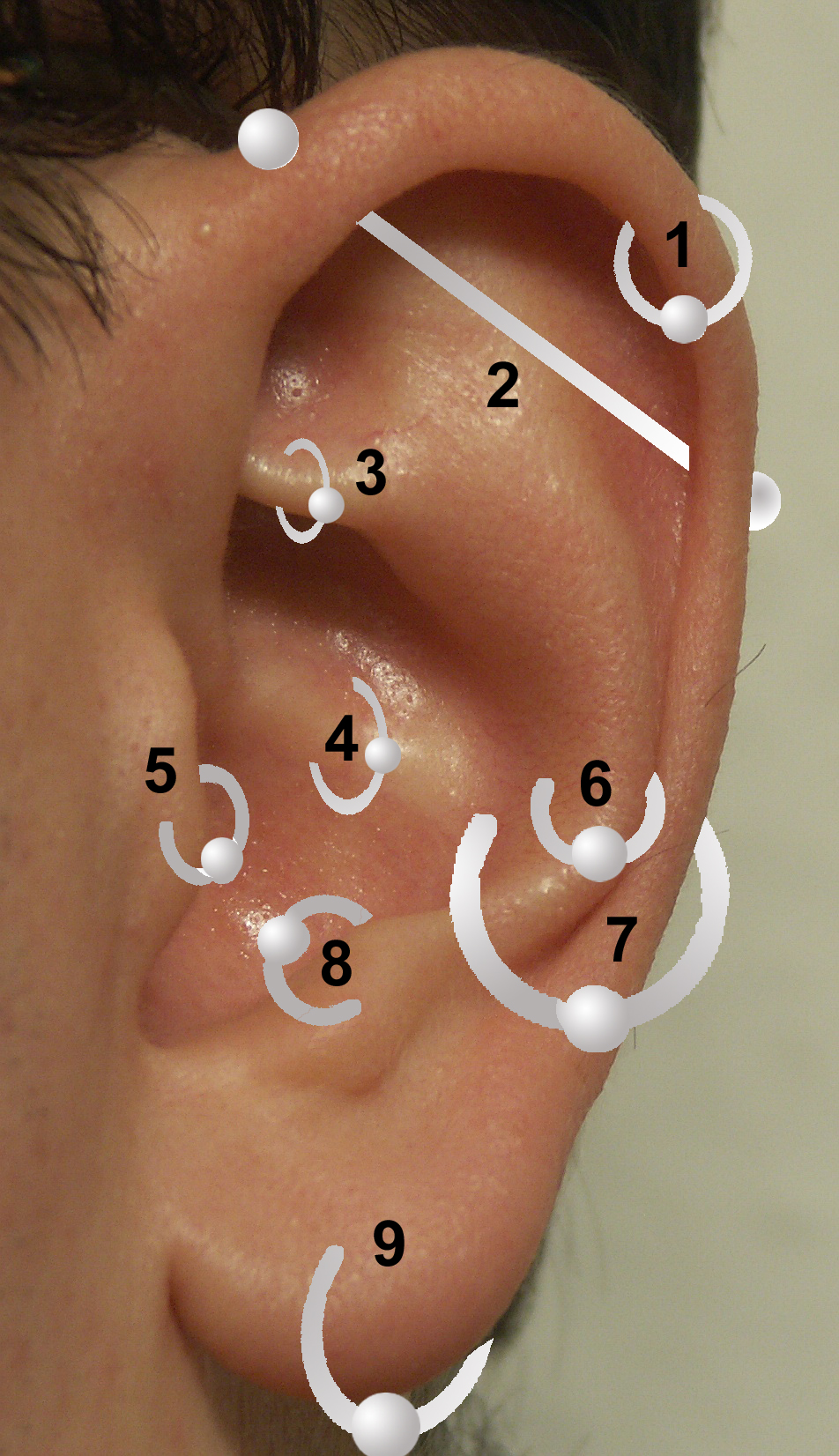
Locations for piercings other than the earlobe include the rook, tragus, and across the helix (see image in the infobox). The simple term "ear piercing" usually refers to an earlobe piercing, whereas piercings in the upper part of the external ear are often referred to as "cartilage piercings". Cartilage piercings are more complex to perform than earlobe piercings and take longer to heal.
Earring components may be made of any number of materials, including metal, plastic, glass, precious stone, beads, wood, bone, and other materials. Designs range from small hoops and studs to large plates and dangling items. The size is ultimately limited by the physical capacity of the earlobe to hold the earring without tearing. However, heavy earrings worn over extended periods of time can lead to stretching of the piercing; ear stretching can also be done intentionally.
Ear piercing for the purpose of wearing earrings is one of the oldest known forms of body modification, with artistic and written references from cultures around the world dating back to early history. Gold earrings, along with other jewelry made of gold, lapis lazuli, and carnelian were found in the ancient sites in Lothal, India, and Sumerian Royal Cemetery at Ur from the Early Dynastic period. Gold, silver and bronze hoop earrings were prevalent in the Minoan Civilization (2000–1600 BCE) and examples can be seen on frescoes on the Aegean island of Santorini, Greece. During the late Minoan and early Mycenaean periods of Bronze Age Greece hoop earrings with conical pendants were fashionable. Early evidence of earrings worn by men can be seen in archeological evidence from Persepolis in ancient Persia. The carved images of soldiers of the Persian Empire, displayed on some of the surviving walls of the palace, show them wearing an earring.
Howard Carter writes in his description of Tutankhamun's tomb that the Pharaoh's earlobes were perforated, but no earrings were found inside the wrappings, although the tomb contained some. The burial mask's ears were perforated as well, but the holes were covered with golden discs. This implies that at the time, earrings were only worn in Egypt by children, much like in Egypt of Carter's times.
Other early evidence of earring-wearing is evident in the Biblical record; gold earrings were a sign of wealth, but ear piercing was also used on slaves. By the classical period, including in the Middle East, as a general rule, they were considered exclusively female ornaments. During certain periods in Greece and Rome also, earrings were worn mainly by women, though they were popular among men in early periods and had resurfaced later on, as famous figures like Plato were known to have worn them.
The practice of wearing earrings was a tradition for Ainu men and women, but the Government of Meiji Japan forbade Ainu men to wear earrings in the late-19th century. Earrings were also commonplace among nomadic Turkic tribes and Korea. Lavish ear ornaments have remained popular in India from ancient times to the present day. And it was common that men and women wear earrings during Silla, Goryeo to Joseon.
In Western Europe, earrings became fashionable among English courtiers and gentlemen in the sixteenth century during the English Renaissance. Revealing of attitudes at the time, and commenting on the degeneracy of his contemporaries, Holinshed in his Chronicle (1577) observes: "Some lusty courtiers and gentlemen of courage do wear either rings of gold, stones or pearls in their ears, whereby they imagine the workmanship of God to be not a little amended." Among sailors, a pierced earlobe was a symbol that the wearer had sailed around the world or had crossed the equator.
Hub AI
Earring AI simulator
(@Earring_simulator)
Earring
Earrings are jewelry that can be worn on one's ears. Earrings are commonly worn in a piercing in the earlobe or another external part of the ear, or by some other means, such as stickers or clip-ons. Earrings have been worn across multiple civilizations and historic periods, often carrying a cultural significance. They are for both men and women.
Locations for piercings other than the earlobe include the rook, tragus, and across the helix (see image in the infobox). The simple term "ear piercing" usually refers to an earlobe piercing, whereas piercings in the upper part of the external ear are often referred to as "cartilage piercings". Cartilage piercings are more complex to perform than earlobe piercings and take longer to heal.
Earring components may be made of any number of materials, including metal, plastic, glass, precious stone, beads, wood, bone, and other materials. Designs range from small hoops and studs to large plates and dangling items. The size is ultimately limited by the physical capacity of the earlobe to hold the earring without tearing. However, heavy earrings worn over extended periods of time can lead to stretching of the piercing; ear stretching can also be done intentionally.
Ear piercing for the purpose of wearing earrings is one of the oldest known forms of body modification, with artistic and written references from cultures around the world dating back to early history. Gold earrings, along with other jewelry made of gold, lapis lazuli, and carnelian were found in the ancient sites in Lothal, India, and Sumerian Royal Cemetery at Ur from the Early Dynastic period. Gold, silver and bronze hoop earrings were prevalent in the Minoan Civilization (2000–1600 BCE) and examples can be seen on frescoes on the Aegean island of Santorini, Greece. During the late Minoan and early Mycenaean periods of Bronze Age Greece hoop earrings with conical pendants were fashionable. Early evidence of earrings worn by men can be seen in archeological evidence from Persepolis in ancient Persia. The carved images of soldiers of the Persian Empire, displayed on some of the surviving walls of the palace, show them wearing an earring.
Howard Carter writes in his description of Tutankhamun's tomb that the Pharaoh's earlobes were perforated, but no earrings were found inside the wrappings, although the tomb contained some. The burial mask's ears were perforated as well, but the holes were covered with golden discs. This implies that at the time, earrings were only worn in Egypt by children, much like in Egypt of Carter's times.
Other early evidence of earring-wearing is evident in the Biblical record; gold earrings were a sign of wealth, but ear piercing was also used on slaves. By the classical period, including in the Middle East, as a general rule, they were considered exclusively female ornaments. During certain periods in Greece and Rome also, earrings were worn mainly by women, though they were popular among men in early periods and had resurfaced later on, as famous figures like Plato were known to have worn them.
The practice of wearing earrings was a tradition for Ainu men and women, but the Government of Meiji Japan forbade Ainu men to wear earrings in the late-19th century. Earrings were also commonplace among nomadic Turkic tribes and Korea. Lavish ear ornaments have remained popular in India from ancient times to the present day. And it was common that men and women wear earrings during Silla, Goryeo to Joseon.
In Western Europe, earrings became fashionable among English courtiers and gentlemen in the sixteenth century during the English Renaissance. Revealing of attitudes at the time, and commenting on the degeneracy of his contemporaries, Holinshed in his Chronicle (1577) observes: "Some lusty courtiers and gentlemen of courage do wear either rings of gold, stones or pearls in their ears, whereby they imagine the workmanship of God to be not a little amended." Among sailors, a pierced earlobe was a symbol that the wearer had sailed around the world or had crossed the equator.
Recent media