Hubbry Logo
EarringEarringMain
Open search
Earring
Community hub
Earring
logo
8 pages, 0 posts
0 subscribers
Be the first to start a discussion here.
Contribute something
Earring
Earring
from Wikipedia
Earrings
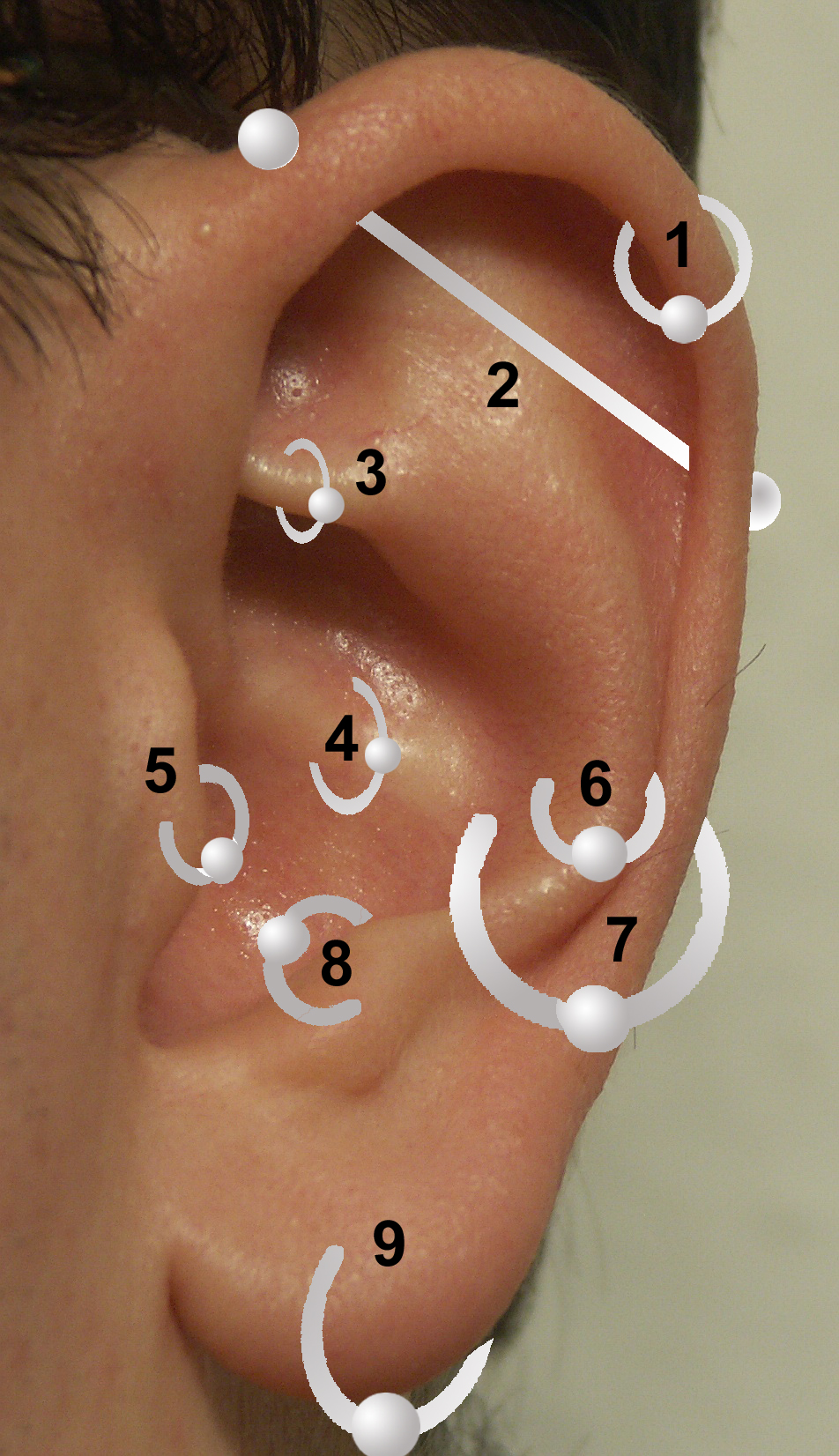
Earring locations on image: 1: helix; 2: industrial; 3: rook; 4: daith; 5: tragus; 6: snug; 7: conch; 8: anti-tragus; 9: earlobe
LocationEar
JewelryCaptive bead ring, barbell, circular barbell, flesh plug
Healing6–12 months

Earrings are jewelry that can be worn on one's ears. Earrings are commonly worn in a piercing in the earlobe[1] or another external part of the ear, or by some other means, such as stickers or clip-ons. Earrings have been worn across multiple civilizations and historic periods, often carrying a cultural significance. They are for both men and women.

Locations for piercings other than the earlobe include the rook, tragus, and across the helix (see image in the infobox). The simple term "ear piercing" usually refers to an earlobe piercing, whereas piercings in the upper part of the external ear are often referred to as "cartilage piercings". Cartilage piercings are more complex to perform than earlobe piercings and take longer to heal.[2]

Earring components may be made of any number of materials, including metal, plastic, glass, precious stone, beads, wood, bone, and other materials. Designs range from small hoops and studs to large plates and dangling items. The size is ultimately limited by the physical capacity of the earlobe to hold the earring without tearing. However, heavy earrings worn over extended periods of time can lead to stretching of the piercing; ear stretching can also be done intentionally.

History

[edit]
Ancient Egyptian earrings, reign of Thutmose III, 15th century BCE
Greco-Bactrian sphinx earring, 2nd century BCE
Golden Indian earrings (Satavahana, 1st century BCE)
Silla-period Korean earrings (6th century)
11th century Iranian earrings with pendant chains. Iranian origins confirmed by the reflexive-spiral terminal. Khalili Collection
Catalan herring earrings made of precious metals and gems, 19th century AD
Coin of Phraates V of Parthia, 2-4 AD
A fresco depicting an elegantly dressed woman with hoop earrings from Akrotiri, Thera (Cyclades) Greece, c. 1650-1625 BCE[3]

Ear piercing for the purpose of wearing earrings is one of the oldest known forms of body modification, with artistic and written references from cultures around the world dating back to early history. Gold earrings, along with other jewelry made of gold, lapis lazuli, and carnelian were found in the ancient sites in Lothal, India,[4] and Sumerian Royal Cemetery at Ur from the Early Dynastic period.[5][6][7] Gold, silver and bronze hoop earrings were prevalent in the Minoan Civilization (2000–1600 BCE) and examples can be seen on frescoes on the Aegean island of Santorini, Greece. During the late Minoan and early Mycenaean periods of Bronze Age Greece hoop earrings with conical pendants were fashionable.[8] Early evidence of earrings worn by men can be seen in archeological evidence from Persepolis in ancient Persia. The carved images of soldiers of the Persian Empire, displayed on some of the surviving walls of the palace, show them wearing an earring.

Howard Carter writes in his description of Tutankhamun's tomb that the Pharaoh's earlobes were perforated, but no earrings were found inside the wrappings, although the tomb contained some. The burial mask's ears were perforated as well, but the holes were covered with golden discs. This implies that at the time, earrings were only worn in Egypt by children, much like in Egypt of Carter's times.[9]

King George III of Imereti depicted wearing earring. Teramo Castelli, 1630s

Other early evidence of earring-wearing is evident in the Biblical record; gold earrings were a sign of wealth, but ear piercing was also used on slaves.[10] By the classical period, including in the Middle East, as a general rule, they were considered exclusively female ornaments. During certain periods in Greece and Rome also, earrings were worn mainly by women, though they were popular among men in early periods and had resurfaced later on, as famous figures like Plato were known to have worn them.[11][12][13]

The practice of wearing earrings was a tradition for Ainu men and women,[14] but the Government of Meiji Japan forbade Ainu men to wear earrings in the late-19th century.[15] Earrings were also commonplace among nomadic Turkic tribes and Korea. Lavish ear ornaments have remained popular in India from ancient times to the present day. And it was common that men and women wear earrings during Silla, Goryeo to Joseon.

In Western Europe, earrings became fashionable among English courtiers and gentlemen in the sixteenth century during the English Renaissance. Revealing of attitudes at the time, and commenting on the degeneracy of his contemporaries, Holinshed in his Chronicle (1577) observes: "Some lusty courtiers and gentlemen of courage do wear either rings of gold, stones or pearls in their ears, whereby they imagine the workmanship of God to be not a little amended."[16] Among sailors, a pierced earlobe was a symbol that the wearer had sailed around the world or had crossed the equator.[17]

Piercing the ears for wearing earrings is practical for two main reasons: first, wearing earrings in pierced ears for prolonged periods is far less uncomfortable than alternative means of attachment to the earlobe (such as clips), and second, the fastenings are generally more secure, which means that the risk of losing an earring is lower. However, styles and attitudes in the late 19th and the first half of the 20th century dictated that piercing one's ears was considered primitive, barbaric, or to be practised only within certain ethnic groups; thus earrings during this period were predominantly clip-ons. In 1951 Queen Elizabeth II had her ears pierced so that she could wear a pair of earrings given her as a wedding present, perhaps prompting many other women to follow suit. By the late 1950s or early 1960s, the practice of piercing the ears re-emerged in the Western world, among young women who wished to identify with the anti-materialist youth culture, and as an act of generational rebellion, especially those who had travelled to more distant or exotic locations.[18] Teenage girls held "ear-piercing parties", where they performed the procedure on one another. By the mid-1960s, with the invention of more modern ear-piercing devices, physicians began to offer ear piercing as a service;[19] simultaneously, Manhattan jewelry stores were some of the earliest commercial, non-medical locations for having one's ears pierced.[citation needed]

By the late 1960s, ear piercing began to make inroads among men through the hippie and gay communities, although they had been popular among sailors for decades (or longer).[20]

An ear cuff
A lobe and industrial piercing

By the early 1970s, ear piercing had become fairly widespread among women, thus creating a broader market for the procedure. Throughout the United States, department stores would hold ear-piercing events, sponsored by manufacturers of earrings and ear-piercing devices. At these events, a nurse or other trained person would perform the procedure, using the ear-piercing device to pierce customers' earlobes with sharpened and sterilized starter earrings.

In the late 1970s, multiple piercings became popular in the punk rock community, and by the 1980s the trend for male popular music performers to have pierced ears helped establish a fashion trend for men; this was later adopted by many professional athletes. British men started piercing both ears in the 1980s, with George Michael of Wham! as a prominent example. By the early 21st century, it had become widely accepted for teenage boys and men to have either one or both ears pierced.

Newborn baby girl with triple ear piercings – Costa Rica 2012

Multiple piercings in one or both ears first emerged in mainstream America in the 1970s. Initially, the trend was for women to wear a second set of earrings in the earlobes, or for men to double-pierce a single earlobe. Asymmetric styles with more and more piercings became popular, eventually leading to the cartilage-piercing trend from the 1990s onwards. Double ear piercing in newborn babies is a phenomenon in Central America, particularly in Costa Rica.

By the 1990s, boutique jewelry stores, such as Claire's and Piercing Pagoda, had become a mainstay of shopping malls in the United States, with inexpensive ear piercing via a multiplicity of styles of starter earrings as their primary offering, usually performed in plain view so as to demystify the procedure and present it as a quick, simple, exciting, and even enjoyable experience rather than as a painful ordeal, as it had often been characterized. This further popularised ear piercing, attracting both male and female customers, parents with younger children wanting their ears pierced, and encouraging repeat visits for multiple piercing, with teenage girls and young women as the primary target segment. Claire's claims it has performed over 100 million ear piercings, more than any other retailer.

From the 1990s onwards, with the increasing popularity of body piercing, a variety of specialized piercings in the ear other than the lobe had become popular; these require professional piercers who are trained with piercing techniques using bevelled piercing needles and specialised piercing jewellery rather than conventional ear-piercing instruments and basic starter studs. Such ear piercings include the tragus piercing, antitragus piercing, rook piercing, industrial piercing, helix piercing, orbital piercing, daith piercing, and conch piercing. In the 21st century this has further developed into the concept of ear curation, in which multiple piercings are "designed" for each customer to complement their ear shape, any existing piercings, and their desire for unique and personalised ear piercings and jewellery. Such designs are often referred to as "constellations", and some piercers have become renowned for their work with celebrities and influencers; as such, ear piercing has moved from the mainstream to having become a form of haute couture as it involves specialist practitioners, intricate designs, high-quality materials, and custom fitting.

In addition, earlobe stretching, while common in indigenous cultures for thousands of years, began to appear in Western society in the 1990s, and is now fairly common. However, this form of ear piercing is still infrequent compared to standard ear piercing, and may still be considered countercultural by some.

Types of earrings

[edit]

Modern standard pierced earrings

[edit]

Barbell earrings

[edit]

Barbell earrings get their name from their resemblance to a barbell, generally coming in the form of a metal bar with an orb on either end. One of these orbs is affixed in place, while the other can be detached to allow the barbell to be inserted into a piercing. Several variations on this basic design exist, including barbells with curves or angles in the bar of the earring.

Claw earrings

[edit]

The claw, talon or pincher is essentially a curved taper which is worn in stretched ear lobe piercings. The thickest end is generally flared and may be decorated, and a rubber o-ring may also be used to prevent the talon from becoming dislodged when worn. Common materials include acrylic and glass. A similar item of jewelry is the crescent, or pincher, which as the name suggests, is shaped like a crescent moon and is tapered at both ends. Talons and claws may also be quite ornamental (e.g.: carved in the form of a serpent or dragon). Consequently, they may prove to be an impractical choice of jewelry as they may snag on hair, clothing, etc.

Statement earrings

[edit]
Chandbali earrings, Asansol, West Bengal, India

Statement earrings can be defined as "earrings which invite attention from others by demonstrating bold, original, and unique designs with innovative construction and material combinations". They include one or more of the following design features:[21]

  • Dangles
  • Tassels
  • Sparkles
  • Bold or striking colours
  • Hoops

Stud/minimal earrings

[edit]
A pair of Studex System 75 starter stud earrings

The main characteristic of a stud earring is the appearance of floating on the ear or earlobe without a visible (from the front) point of connection. A stud earring features a gemstone or other ornament mounted on a narrow post that passes straight through a piercing in the ear or earlobe, which is held in place behind the ear by means of a removable friction back or clutch (sometimes referred to as a butterfly or scroll fitting).[22] To prevent their loss, the posts of some more expensive stud earrings made of precious metals or containing precious stones, such as solitaire diamonds, are threaded, allowing a screw back to hold the stud securely in place.

Heart earrings

[edit]

Heart earrings are earrings in the form of the heart. They can be in the normal wearing degree and also they can be in a rotation of 180° wearing degree.

Hoop earrings

[edit]
8 mm diameter stainless-steel hoop earring

Hoop earrings are circular or semi-circular in design and look very similar to a ring. Hoop earrings generally come in the form of a hoop of metal that can be opened to pass through the ear piercing. They are often constructed of metal tubing, with a thin wire attachment penetrating the ear. The hollow tubing is permanently attached to the wire at the front of the ear, and slips into the tube at the back. The entire device is held together by tension between the wire and the tube. Other hoop designs do not complete the circle, but penetrate through the ear in a post, using the same attachment techniques that apply to stud earrings. A variation is the continuous hoop earring. In this design, the earring is constructed of a continuous piece of solid metal, which penetrates through the ear and can be rotated almost 360°. One of the ends is permanently attached to a small piece of metallic tubing or a hollow metallic bead. The other end is inserted into the tubing or bead, and is held in place by tension. One special type of hoop earring is the sleeper earring, a circular wire normally made of gold, with a diameter of approximately one centimeter. Hinged sleepers, which were common in Britain in the 1960s and 1970s, comprise two semi-circular gold wires connected via a tiny hinge at one end, and fastened via a small clasp at the other, to form a continuous hoop whose fastening mechanism is effectively invisible to the naked eye. Because their small size makes them unobtrusive and comfortable, and because they are normally otherwise unadorned, sleepers are so-called because they were intended to be worn at night to keep a pierced ear from closing, and were often the choice for the first set of earrings immediately following the ear piercing in the decades before ear-piercing guns using studs became commonplace, but are often a fashion choice in themselves because of their attractive simplicity and because they subtly call attention to the fact that the ear is pierced.

Drop earrings

[edit]
Jasper drop earrings

A drop earring attaches to the earlobe and features a gemstone or ornament that dangles down from a chain, hoop, or similar object. The length of these ornaments vary from the very short to the extravagantly long. Such earrings are occasionally known as droplet earrings, dangle earrings, or pendant earrings. They also include chandelier earrings, which branch out into elaborate, multi-level pendants.

Chandelier earrings

[edit]
Diamond chandelier earrings

Chandelier earrings have an appearance similar to that of chandeliers, with a design that dangles below the ear and is wider at the base than the top.

Dangle earrings

[edit]
A selection of dangle earrings

Dangle earrings (also known as drop earrings) are designed to suspend from the bottoms of the earlobes. Their lengths vary from a centimeter or two, all the way to brushing the wearer's shoulders. A pierced dangle earring is generally attached to the ear with a thin wire passing through the earlobe. It may connect to itself with a small hook at the back, or in the French hook design, the wire passes through the earlobe piercing without closure, although small plastic or silicone retainers are sometimes used on ends. Rarely, dangle earrings use the post attachment design. There are also variants that attach without piercing.

Huggy earrings

[edit]

Huggy earrings are hoops that closely follow the curve of the earlobe, instead of dangling down beneath it as in regular hoop earrings. Commonly, stones are channel set in huggy earrings.

Ear thread

[edit]

Ear thread, or earthreader, ear string, or threader earrings, are a chain that is thin enough to slip into the ear hole, dangling down at the back. Sometimes, people add beads or other materials onto the chain, so the chain dangles with beads below the ear.

Jhumka earrings

[edit]

A type of dangling bell-shaped traditional earrings mostly worn by women of the Indian subcontinent.[citation needed] A jhumki is a traditional earring commonly worn in South Asia, especially in India and Pakistan. It features a bell-shaped design and is usually crafted from metals such as gold, silver, or brass, often adorned with detailed patterns and gemstones.

Body piercing jewelry used as earrings

[edit]
A navel curve used as an earring with a green gemmed ear stud above it

Body piercing jewelry is often used for ear piercings, and is selected for a variety of reasons including the availability of larger gauges, better piercing techniques, and a reduced risk of healing complications.

  • Captive bead rings – Captive bead rings, often abbreviated as CBRs and sometimes called ball closure rings, are a style of body piercing jewelry that is an almost 360° ring with a small gap for insertion through the ear. The gap is closed with a small bead that is held in place by the ring's tension. Larger gauge ball closure rings exhibit considerable tension, and may require ring expanding pliers for insertion and removal of the bead.
  • Barbells – Barbells are composed of a thin, straight metal rod with a bead permanently fixed to one end. The other end is threaded, either externally or tapped with an internal thread, and the other bead is screwed into place after the barbell is inserted through the ear. Since the threads on externally threaded barbells tend to irritate the piercing, internal threads have become the most common variety. Another variation are threadless barbells or press-fit jewelry, with a hollow post, a fixed back disk and a front end that is attached with a slightly bend pin that is inserted into the post.[23]
  • Circular barbells – Circular barbells are similar to ball-closure rings, except that they have a larger gap, and have a permanently attached bead at one end, and a threaded bead at the other, like barbells. This allows for much easier insertion and removal than with ball closure rings, but at the loss of a continuous look.
  • Plugs – Earplugs are short cylindrical pieces of jewelry. Some plugs have flared ends to hold them in place, others require small elastic rubber rings (O-rings) to keep them from falling out. They are usually used in large-gauge piercings.
  • Flesh tunnels – Flesh tunnels, also known as eyelets or bullet holes, are similar to plugs; however, they are hollow in the middle. Flesh tunnels are most commonly used in larger gauge piercings either because weight is a concern to the wearer or for aesthetic reasons.

Gauges and other measuring systems

[edit]

For an explanation of how earring sizes are denoted, see the article Body jewelry sizes.

Clip-on and other non-pierced earrings

[edit]
Modern lobe earring screwed onto the lobe

Several varieties of non-pierced earrings exist.

  • Clip-on earrings – Clip-on earrings have existed longer than any other variety of non-pierced earrings. The clip itself is a two-part piece attached to the back of an earring. The two pieces closed around the earlobe, using mechanical pressure to hold the earring in place.
  • Ear screws – Screwed onto the lobe, these can be adjusted for a more comfortable fit for those who find clip-on earrings otherwise too painful after prolonged wear. Ear screws may also be part of a clip design.
  • Magnetic earrings – Magnetic earrings simulate the look of a (pierced) stud earring by attaching to the earlobe with a magnetic back that hold the earring in place on by magnetic force.
  • Stick-on earrings – Stick-on earrings are adhesive-backed items which stick to the skin of the earlobe and simulate the look of a (pierced) stud earring. They are considered a novelty item.
  • Spring hoop earrings – Spring hoops are almost indistinguishable from standard hoop earrings and stay in place by means of spring force.
    • An alternative which is often used is bending a wire or even just using the ring portion of a CBR to put on the earlobe, which stays on by pinching the ear.
  • Ear hook earrings – A large hook like the fish hook that is big enough to hook and hang over the whole ear and dangles.
  • The hoop – A hoop threads over the ear and hangs from just inside the ear, above where ears are pierced. Mobiles or other dangles can be hung from the hoop to create a variety of styles.
  • Ear cuffs – Wrap around the outer cartilage (similar to a conch piercing) and may be chained to a lobe piercing.

Permanent earrings

[edit]

Where most earrings worn in the western world are designed to be removed easily to be changed at will, earrings can also be permanent (non-removable). They appear today in the form of larger gauge rings which are difficult or impossible for a person to remove without assistance. Occasionally, hoop earrings are permanently installed by the use of solder,[24] though this poses some risks due to toxicity of metals used in soldering and the risk of burns from the heat involved. Besides permanent installations, locking earrings are occasionally worn due to their personal symbolism or erotic value.

Ear piercing

[edit]

Pierced ears have had one or more holes or "piercings" created in the earlobes or the cartilage portion of the external ears for the wearing of earrings. Piercings become permanent when the tract around the starter earring epithelializes[25] during the healing period following the initial piercing, and are sometimes mischaracterised as a fistula. The piercings do not form fully if the starter earrings are removed prematurely, or if earrings are not worn in the piercings for a longer period, depending on the recency with which the ear was pierced.

Conch piercing

[edit]

A conch piercing is a perforation of the part of the external human ear called the "concha", the hollow next to the ear canal, for the purpose of inserting and wearing jewelry. Conch piercings have become popular among young women in recent decades as part of a trend for multiple ear piercings.[26]

Helix piercing

[edit]

The helix piercing is a perforation of the helix or upper ear cartilage for the purpose of inserting and wearing a piece of jewelry. The piercing itself is usually made with a small gauge hollow piercing needle, and typical jewelry would be a small diameter captive bead ring, or a stud.[27]

Sometimes, two helix piercings hold the same piece of jewelry, usually a barbell, which is called an industrial piercing.

Like any other cartilage piercing, helix piercings may be painful to receive, and bumping or tugging on them by accident during healing can cause irritation. When they are left alone and not being irritated or touched, there is typically no discomfort. Piercers recommended avoiding unnecessary touching of helix piercings during healing, which can take 6 to 9 months.

Snug piercing

[edit]

A snug (or antihelix) piercing is a piercing which passes through the anti-helix of the ear from the medial to lateral surfaces.[28]

Spiral piercing

[edit]
Ear spirals made out of glass

An ear spiral is a thick spiral that is usually worn through the earlobe. It is worn in ears that have been stretched and normally held in place only by its own downward pressure. Glass ear spirals are shown but many materials are used. Some designs are quite ornate and may include decorative appendages flaring from the underlying concentric pattern.

Piercing techniques

[edit]

A variety of techniques are used to pierce ears, ranging from "do it yourself" methods using household items to medically sterile methods using specialized equipment.

A long-standing home method involves using ice as a local anesthetic, a sewing needle, a burning match or rubbing alcohol for disinfection, and a semi-soft object, such as a potato, cork, bar of soap, or rubber eraser, to hold the ear in place. Sewing thread may be drawn through the piercing and tied, as a device for keeping the piercing open during the healing process. Alternatively, a gold stud or wire earring may be directly inserted into the fresh piercing as the initial retaining device. Home methods are often unsafe and risky owing to improper sterilization and poor placement.

Another method for piercing ears, introduced in the 1960s, was the use of sharpened spring-loaded earrings known as self-piercers, trainers, or sleepers, which gradually pushed through the earlobe. However, these could easily slip from their initial placement position, often resulting in considerable discomfort, and often would not penetrate fully through the earlobe without additional pressure being applied. This method fell into disuse owing to the popularity of faster and more successful piercing techniques.

An ear being pierced with an ear-piercing instrument
Healed pierced earlobe with a stud earring

Ear-piercing instruments, sometimes called ear-piercing guns, were originally developed for physicians' use, but became widely used in retail settings.[29] Today more and more people in the Western world have their ears pierced with an ear-piercing instrument in specialty jewellery or accessory stores, in beauty salons and in pharmacies; however, some choose to do it at home using disposable ear-piercing kits. An earlobe piercing performed with an ear-piercing instrument is often described as feeling similar to being pinched, or being snapped by a rubber band. Piercing with this method, especially for cartilage piercings, is not recommended by many piercing professionals, as it is claimed by some to cause blunt-force trauma to the skin, and that it takes longer to heal than needle piercing. In addition, the external housing of most ear-piercing instruments is made of plastic, which cannot be sterilized in an Autoclave, potentially increasing the risk of infection. Piercing the cartilage of the ear with an ear-piercing instrument has been known to shatter the cartilage and lead to more serious complications.

An alternative method that has been growing in popularity since the 1990s is the use of the same hollow piercing needles that are used in body piercing. Some piercers may use a forceps or clamp to hold the earlobe during the piercing, while others pierce the ear freehand. After the desired placement of the piercing has been marked, the piercer positions the needle tip at the desired place and angle, and quickly pushes the needle fully through the earlobe. Immediately after the piercing, a cork can be placed on the needle tip behind the earlobe; if a cannula has been used, the needle is withdrawn, leaving the plastic sheath in place through the new piercing. Depending on the type of starting earring the client has selected, the piercer then inserts the jewellery into the end of the needle or cannula sheath, and guides it through the new piercing either forwards or backwards, and finally attaches either a clasp (for a standard earring post) or labret stud (if a flatback labret has been used). The piercer then disinfects the newly pierced lobe again. Once the piercing has been completed, the used needles and cannulas are then disposed of.

Regardless of whether their ear piercing is to be performed with an ear-piercing instrument or a needle, the client will first select their desired piercing jewellery, sign any consent forms, and is usually seated so that the piercer is able perform the piercing with ease. Ear-piercing practitioners normally disinfect the earlobe with alcohol prior to piercing, and mark the intended point of piercing, providing the client the opportunity to confirm that the position is correct, or to have the mark repositioned. Once the client agrees upon the intended placement of the piercing on the ear, the piercing is usually completed within a few minutes.

In tribal cultures and among some neo-primitive body-piercing enthusiasts, piercings are performed using other tools, such as animal or plant organics.

Initial healing time for an earlobe piercing is typically six to eight weeks. Subsequently, earrings can be changed, but if the piercing is left open for an extended period of time, there is some risk that it may close, requiring re-piercing. Piercing professionals recommend wearing earrings in newly pierced ears continuously for at least six months, and sometimes up to a year. Cartilage piercings require more healing time (up two to three times as long) than earlobe piercings. Even after fully healing, earlobe piercings tend to shrink in the prolonged absence of earrings, and may in some cases close.

Health risks

[edit]

For ear piercing in general, it is now widely considered that the use of sterilized hollow piercing needles reduces both the trauma to the tissue and the chances of contracting a bacterial infection, and should be chosen as a method if it is available or practical (this may not be the case for younger children). As with any invasive procedure, there is a non-zero risk from ear piercing of infection from blood-borne pathogens such as hepatitis and HIV; however, modern piercing techniques make this risk extremely low. While there has never been a documented case of HIV transmission via piercing or tattooing, there have been instances of hepatitis transmission.[30]

With conventional earlobe piercing, there are common, but usually minor health risks that can be minimised if proper piercing techniques and hygienic procedures are observed. One study found that up to 35% of persons with pierced ears had one or more complications, including minor infection (77% of pierced-ear sites with complications), allergic reaction (43%), keloids (2.5%), and traumatic tearing (2.5%).[31] Tearing or splitting of the earlobe can be avoided by not wearing earrings during activities in which they are likely to become snagged, such as while playing sports. Hence, such activities should be avoided during the healing period following the piercing. Torn earlobes may require surgical repair.[32]

With cartilage piercing, it is commonly believed that piercing with a conventional piercing instrument and ear-piercing studs, which are not as sharp as bevelled piercing needles, can cause trauma to the cartilage, make healing more problematic. Further, because there is less blood flow in ear cartilage than in the earlobe, infection can become much more serious. Regardless of the piercing method, however, infections of the upper ear are commonly reported resulting following cartilage piercing.

Nickel in earrings worn in pierced ears is a significant risk factor for contact allergies,[33] and there is a correlation between the piercing of young girls' earlobes and the subsequent development of nickel allergies.[34][35][36]

Certain people have a predisposition to the formation of keloids following ear piercing, which often require dermatological intervention to address.

Religious and cultural use

[edit]

According to Hindu dharma tradition, most girls and some boys (especially the "twice-born") get their ears pierced as part of a Dharmic rite known as Karnavedha before they are about five years old. Infants may get their ears pierced as early as several days after their birth.

Similar customs are practiced in other Asian countries, including Nepal, Sri Lanka, and Laos, although traditionally most males wait to get their ears pierced until they have reached young adulthood.

See also

[edit]

References

[edit]

Further reading

[edit]
[edit]
Revisions and contributorsEdit on WikipediaRead on Wikipedia
from Grokipedia
An earring is an ornament for the ear, especially the , typically consisting of a ring, stud, or other decorative piece secured by a post passing through a piercing or fastened with a clip or screw. Archaeological evidence indicates that earrings originated in ancient around 2500 BCE, where Sumerian examples were crafted from hoops and inlaid with materials such as and , signifying wealth and status among the elite. These early adornments evolved across civilizations, including and Persia, where they served both aesthetic and symbolic purposes, often denoting social hierarchy or ritual importance. Earrings encompass diverse types, including studs, hoops, dangles, and chandelier styles, fashioned from metals like and silver, as well as gems, , beads, and synthetic materials in modern variants. Culturally, they have functioned as markers of identity, , and heritage; for instance, among Fulbe women in , large earrings symbolize family wealth and are inherited matrilineally. In various societies, from ancient nomads to nomadic groups in , earrings reflect cross-cultural exchanges, spiritual beliefs, and adaptations to social changes, persisting as enduring elements of personal expression despite shifts in fashion and technology.

Fundamentals

Definition and Functional Aspects

An earring is an ornament worn on the , typically the , consisting of a decorative piece attached via piercing, clip, or other means. The term derives from ēarhring, combining ēare () and hring (ring), reflecting its historical form as a looped or circular fastened to the . Earrings are usually produced in pairs for symmetrical wear, though asymmetrical or single designs exist, and they vary in size from small studs to elaborate dangling forms. Functionally, earrings serve primarily as aesthetic enhancements, accentuating facial features and allowing personal expression through , , and style choices. In social contexts, they function as signals of identity, status, or affiliation; for instance, certain styles historically denoted , rank, or tribal membership in various cultures. Beyond decoration, some traditional uses included protective symbolism, such as warding off spirits via amuletic designs or materials believed to hold spiritual power. Modern applications emphasize and projection, with wearers selecting earrings to complement attire or convey , though no inherent physiological utility exists beyond occasional niche adaptations like lightweight frames for hearing aids. Empirical observations confirm their role remains ornamental, with cultural functions rooted in social convention rather than causation.

Materials and Manufacturing Processes

Earrings are primarily constructed from metals, gemstones, and organic materials, selected for durability, aesthetics, and biocompatibility, particularly for skin-contact components like posts and wires. Precious metals dominate high-end production: , alloyed with , silver, , or to achieve hardness (e.g., 14-karat is 58.3% pure ), provides tarnish resistance and luster; silver, typically sterling (92.5% pure alloyed with ), offers affordability but requires plating to prevent oxidation; , nearly pure (95-98%) and denser, excels in properties and holds settings securely due to its high of 1,768°C. Base metals like , , or alloys underpin for cost efficiency, often electroplated with or silver for appearance, though they risk skin irritation without proper finishing. Hypoallergenic options prioritize (Grade 23 or ASTM F-136 surgical grade) and for posts and hooks, minimizing nickel-induced reactions affecting up to 20% of wearers; these metals' inertness stems from layers forming on exposure to air. Gemstones such as , sapphires, or emeralds are incorporated via settings, while organic materials like pearls ( nacre layers on mollusks) or shells add natural but demand gentle handling to avoid cracking. Synthetic alternatives, including , or , enable lightweight, inexpensive designs but lack the permanence of metals. Manufacturing begins with design, often via CAD software for precision, followed by prototyping through 3D printing or milling, which allows complex geometries unfeasible in traditional carving. , a core technique since antiquity but refined industrially, involves injecting into rubber molds from master models, assembling wax trees, investing in , burnout at 700-800°C to create voids, and centrifugal pouring of molten metal (e.g., at 1,060°C) to replicate details down to 0.1 mm. Post-casting, pieces undergo grinding to remove sprues, filing for smoothness, and for assemblies like adding earring backs (e.g., or screw types from 14-gauge wire). Stamping suits simple forms like hoops: is die-struck under hydraulic presses at 100-500 tons of force, then pierced and tumbled for finishing. Hand fabrication, using or wire wrapping, crafts custom or artisan earrings, while modern automation incorporates for seamless joins and (e.g., 2-5 microns of ) for corrosion resistance. setting—prong, , or pavé—secures stones via mechanical clinching, with quality checks ensuring hold strength against 10-20 N forces. Final via buffing wheels achieves mirror finishes, with yields averaging 90-95% from in ethical operations.

Historical Development

Prehistoric and Ancient Origins

The earliest archaeological evidence for ear adornment appears in prehistoric contexts, with perforated shell beads dating to approximately 142,000 years ago discovered in Morocco's Bizmoune Cave, though their specific use as earrings remains speculative as they represent general body ornamentation rather than ear-specific piercing. More conclusive indications of ear piercing emerge from burials at , , around 11,000 years ago (circa 9000 BCE), where stone and labrets and ear ornaments were found positioned near the ears and chins of interred individuals, providing the oldest direct evidence of intentional body piercings for adornment. In the period, the mummified remains of the Iceman, dated to approximately 3300 BCE in the , reveal stretched ear piercings measuring 7-11 mm in diameter, suggesting the use of removable bone or wooden plugs or earrings that were not preserved. This indicates that ear piercing for adornment was practiced in by the late Copper Age, likely for status or ritual purposes, as similar piercings appear in contemporaneous sites across . Ancient civilizations formalized earring use with metalworking advancements. In (), gold hoop earrings dating to 2600-2450 BCE were excavated from the royal tomb of Queen Puabi at , featuring large crescent-shaped designs crafted from hammered gold sheets, signifying elite status and early mastery of jewelry techniques. These represent among the oldest metal earrings, worn by both men and women in high society. In , earrings proliferated during the New Kingdom (1550-1070 BCE), with gold hoops and disk forms appearing in tomb art and artifacts, often depicting deities or animals, and adopted by pharaohs, nobility, and even sacred animals like cats. By this era, earrings symbolized wealth, protection, and cultural identity across the Near East and Nile Valley, with trade facilitating material exchange for fabrication.

Classical Antiquity to Medieval Periods

In , earrings emerged as prominent adornments during the Archaic period (c. 800–480 BCE), with archaeological finds from sites across , Asia Minor, and revealing gold examples featuring spherical or boat-shaped designs often suspended from wires or hooks. These were typically worn by elite women, as evidenced by and votive offerings at sanctuaries, symbolizing wealth and devotion to deities such as ; representations on and further depict pierced ears adorned with dangling ornaments. By the Classical and Hellenistic periods (c. 480–31 BCE), designs grew more intricate, incorporating motifs like animal heads (e.g., lions, bulls) and airborne figures such as Eros, Nike, or Zeus's eagle, crafted via techniques including and to emphasize luxury and narrative symbolism. Roman adoption of earrings intensified from the 1st century BCE onward, influenced by Hellenistic and Eastern imports, with elite women favoring gold pieces inlaid with gems like emeralds, garnets, pearls, and opals; styles ranged from simple hoops and studs to elaborate drops, including the "navicella" (little boat) form and crotalia types featuring pearls. Excavations at sites like Pompeii and Roman cemeteries have yielded such artifacts, often buried with wealthy females, underscoring their role in displaying status amid a preference for bold, gem-accented simplicity over excessive ornamentation. Men occasionally wore single earrings, potentially linked to naval or gladiatorial contexts, though evidence remains sparser. Transitioning into the early medieval period, earring use persisted in the , where gold basket-bead designs prevailed from the 10th to 12th centuries, reflecting continuity with late Roman opulence and integration of Eastern influences. In , however, earrings largely waned after the CE, supplanted by brooches, necklaces, and rings amid shifting Christian aesthetics that prioritized covered hair and modest adornment; textual and artistic sources associate pierced ears with infamy, oriental exoticism, or moral laxity, particularly for men, contributing to their rarity until sporadic elite revivals. Archaeological scarcity supports this decline, with medieval jewelry hoards emphasizing hierarchical symbols like over ear ornaments.

Renaissance to Industrial Revolution

During the (c. 1400–1600), earrings reemerged in after declining in the , driven by classical influences and shorter hairstyles that exposed the ears. Women adopted them as markers of beauty and wealth, typically featuring simple pearl drops or jeweled pendants hung from pierced lobes. In and , by the , they gained popularity among and courtiers of both sexes, with men occasionally piercing ears as a sign of amid sumptuary regulations limiting extravagance. The saw further revival as high ruffs yielded to open-necked styles, allowing earrings to frame the face; designs remained modest drops or studs, often gold-set pearls or enamels, reflecting elaboration in courtly portraits across and . By the 18th century's era, earrings expanded in scale and complexity, with women favoring heavy , hoop, and girandole types incorporating diamonds, foils, and colored gems like amethysts, weighing up to several ounces per pair in aristocratic circles. wear persisted among sailors and military officers for purported health benefits, such as improved eyesight, though this was marginal compared to female prevalence. The (c. 1760–1840) introduced mechanized production, enabling cheaper alloys, , and stamped designs that democratized access beyond elites. Early 19th-century Victorian styles shifted toward lighter, smaller studs and dormeuse sleepers—thin wires with pearls to maintain piercings—facilitating everyday wear amid rising middle-class prosperity, though elaborate drops endured for formal occasions. Innovations like machine-engraved reduced costs, with production hubs in Birmingham, , outputting thousands of pairs annually by 1830.

20th Century to Present

In the early 20th century, earrings in Western fashion favored simple designs such as small studs and hoops, reflecting a shift toward understated elegance amid associations with immigrants and perceived moral looseness that had diminished their popularity in the United States. Screw-back fastenings emerged around this period, providing a secure alternative to piercing, and gained prominence in the 1920s-1930s Art Deco era with geometric motifs in platinum and diamonds. Post-World War II trends revived earlobe piercing, particularly among young women through informal "piercing parties," while clip-on and screw-back earrings dominated for those avoiding piercings, often featuring pearls or gemstones in the glamorous 1940s-1950s styles. The and marked a cultural resurgence driven by movements, with multiple piercings symbolizing rebellion; rock and punk musicians popularized hoop and dangling styles, extending acceptance to men who began wearing earrings in Western contexts from the late onward. By the 1980s, earring stacking emerged among punk and rock subcultures, evolving into broader with layered lobe piercings, while materials expanded to include affordable alternatives like alongside traditional , silver, and gems. The late 20th and early 21st centuries saw "ear curation," where individuals customized multiple piercings across the ear's for personalized , influenced by celebrities and . Contemporary designs emphasize versatility, from minimalist studs to oversized statement pieces, with sustainable materials like recycled metals gaining traction; body modification trends, such as stretched lobes using flesh tunnels, persist in niche communities but remain marginal compared to mainstream lobe-focused styles.

Attachment and Design Classification

Non-Piercing Methods

Clip-on earrings represent the most traditional non-piercing attachment method, employing a hinged clasp with a padded interior that applies spring-loaded to grip the without penetration. This mechanism, often featuring variations such as paddle backs for broader contact or U-shaped simple clips for adjustability, originated in the early and gained widespread popularity by the as an alternative to piercing, which was then uncommon for many due to social norms or health concerns. Paddle back designs, prevalent in pieces, distribute weight evenly to reduce discomfort during extended wear. Screw-back closures for non-pierced ears, introduced around the , utilize a threaded mechanism that tightens a clamp against the via rotation, providing adjustable tension without requiring holes. These were particularly favored through the mid-20th century for their security on heavier earrings, though modern iterations often adapt the design for pierced ears; the non-piercing variant relies on friction from the screw-tightened pad rather than a post insertion. Magnetic earrings function by placing two small magnets—one attached to the earring front and another backing—on opposite sides of the , held in place by magnetic attraction without any physical clamping or threading. This method offers advantages including ease of application for sensitive skin and versatility for temporary wear, but disadvantages encompass potential slippage under heavy designs, pinching from excessive force, and unsuitability for individuals with pacemakers due to risks. Magnets must be or similar strong types to maintain hold, though they can become brittle over time. Ear cuffs and wraps constitute friction-based or clip-style alternatives that adhere to the upper ear cartilage or via tension grips or adhesive elements, bypassing the lobe entirely. These gained traction in contemporary for their non-invasive nature and compatibility with lobe-free aesthetics, often using flexible metal or for secure, pinch-free positioning. Converters, such as attachable clips or adhesives, enable of pierced earring styles for non-pierced use, though they may stability for dangling varieties. Overall, non-piercing methods prioritize accessibility and reversibility, historically driven by cultural aversion to piercing until the late when ear piercing normalized.

Piercing-Compatible Designs

Piercing-compatible earring designs rely on a penetrating element, such as a post, wire, or bar, inserted through a pre-existing hole in the , , or other tissue to anchor the ornament. These designs emerged prominently in the mid-20th century as piercing gained popularity in Western cultures, supplanting clip-on styles for many wearers. The most basic form is the stud earring, featuring a small decorative element—often a single , , or motif—affixed to a straight post typically measuring 6 to 12 mm in length and 0.8 to 1 mm in diameter (18-20 gauge) for standard lobe piercings. Securing mechanisms for the post vary by design and intended security level. Friction or push-back backs, commonly known as butterfly or clutch backs, slide onto the post and grip via flexible wings, providing simple retention suitable for lightweight studs but prone to slippage under pressure. Screw backs thread onto the post for a tighter fit, recommended for heavier or dangling elements to reduce loss risk, with studies on jewelry retention indicating higher efficacy in active scenarios. Lever or latch backs, hinged mechanisms that snap closed, offer enhanced stability for drop styles and are favored in professional settings for their quick-release functionality. Hoop earrings form a circular or semi-circular wire passing through one or more piercings, often with a hinged clasp or continuous loop design; huggie hoops, measuring 8-12 mm in diameter, hug the closely for minimal protrusion. Dangle and drop earrings extend from a pierced anchor point, suspending s, beads, or motifs downward, with post lengths adjusted to 10-15 mm to accommodate swing without tissue irritation. Threader earrings use a thin threaded through the piercing for a delicate, linear drape. For cartilage piercings, flat-back labret studs employ a shorter post with a customizable disc backing to conform to contoured tissue, reducing pressure points. Materials for these designs prioritize to mitigate or allergic risks, particularly during . Initial piercing jewelry standards from the Association of Professional Piercers mandate implant-grade (ASTM F-136 compliant), ASTM F-138 stainless steel, or solid 14k or higher free of and , as lower alloys increase incidence by up to 10-15% in susceptible individuals. Post-healing, similar materials persist, though may be used cautiously despite higher and reaction rates. Gauges range from 18g for lobes to 14g or thicker for industrial bars spanning multiple piercings.

Permanent Implantation Variants

Microdermal implants represent a primary variant of permanent implantation for earrings, involving the surgical insertion of a biocompatible —typically crafted from ASTM F-136 —beneath the dermal layer of the ear. The features a broad footplate for tissue integration and a post that pierces the , allowing interchangeable decorative tops such as gem-set studs or flat discs to be threaded onto the exposed end, simulating fixed earring attachments without full tissue . These are distinct from traditional piercings, as the base lies parallel to the skin surface, promoting a low-profile embedment suitable for auricular sites like the , tragus, or where surface area limits conventional options. The implantation procedure utilizes a dermal punch or to excise a small tissue core, followed by anchor placement into the subcutaneous pocket and approximation of the overlying , often with sutures or adhesive under . Initial healing spans 4-12 weeks for epithelial tract formation around the post, with full stabilization potentially requiring 3-6 months; during this phase, patient compliance with aftercare—such as saline cleanses and avoidance of trauma—is critical to prevent encapsulation failure. Jewelry tops can be swapped post-healing, enabling customization, though excessive manipulation risks disrupting integration. Transdermal implants offer an alternative, featuring elongated posts or threaded bases that extend through the skin to support more elaborate earring structures, such as lightweight chains or scaffolds mimicking industrial piercings but with embedded fixation. These are less common in ears due to thinner but have been documented in practices for anti-tragus or lobule augmentation. Empirical data underscores elevated risks, including migration (up to 30% in non-medical settings), chronic inflammation, and necessitating surgical excision, as evidenced by clinical reports of infections and impingement from procedural inconsistencies. Mainstream medical sources classify these as elective modifications with suboptimal long-term retention compared to piercings, advising against them absent therapeutic necessity due to paucity of randomized outcome studies and higher revision rates versus standard adornments.

Stylistic and Regional Varieties

Core Geometric and Structural Types

Core geometric types of earrings primarily encompass studs, hoops, drops, and dangles, each defined by distinct shapes and attachment dynamics that influence wear and visual impact. Studs feature a simple, compact form where a or motif rests directly on the , secured by a post or , creating a minimalist point-like that minimizes protrusion. Hoops form a continuous circular or loop, typically ranging from small under 1 cm in diameter to larger arcs exceeding 5 cm, enabling rotation and a balanced, symmetrical profile. Drops extend vertically from the in teardrop or linear shapes, usually 1-3 cm in length, providing elongation without excessive motion. Structural variations build on these geometries through multi-element assemblies or modular designs. Dangles incorporate chains, links, or fringe elements that swing freely, often exceeding 5 cm to amplify movement and , contrasting the static of studs. styles escalate this with tiered, branching frameworks resembling inverted trees, featuring multiple pendants for layered depth, historically documented in 18th-century European portraiture but persisting in modern iterations up to 10 cm in span. Clusters aggregate small studs or beads into spherical or polygonal arrays, approximating organic or geometric solids like spheres or hexagons, with diameters from 0.5-2 cm for dense, textured effects. Beyond basic forms, earrings incorporate abstract geometric motifs such as triangles, squares, or polygons, often in angular studs or hoop segments, enhancing modularity for stacking or face-shape complementarity—angular designs suiting round faces by adding perceived length. Threaders employ fine wires or chains threaded through piercings, forming linear or serpentine paths up to 10 cm, while jackets surround central studs with framing arcs, creating composite geometries akin to framed panels. These structural types prioritize empirical stability, with heavier drops requiring reinforced hooks to counter gravitational torque, as verified in jewelry engineering standards.

Culturally Specific Forms

In Indian tradition, chandbali earrings consist of tiered, crescent moon-shaped structures adorned with gems and , tracing origins to Mughal court jewelry of the 16th century, where they symbolized lunar motifs and royal elegance. Jhumka earrings feature elongated, bell-like drops with dangling elements that produce a subtle chime, derived from ancient temple carvings as early as the 2nd century BCE in regions like , representing and marital prosperity in Hindu customs. Among the Māori of , kapeu ear ornaments are slender, curved pendants carved from (greenstone), typically 5-10 cm long, suspended from pierced lobes to denote rank and mana (prestige), with examples dating to pre-European contact periods before 1840. Kuru pendants, oval-shaped greenstone drops, were worn similarly for both ears and necks, valued for their rarity and spiritual protection properties in traditional cosmology. Mako variants incorporate shark teeth at the base, affixed with , signifying status and used as talismans against harm as documented in 19th-century collections. Native American Southwest tribes, such as the and , historically fashioned earrings from shell, , and plugs prior to 1500 CE, evolving into stamped silver motifs post-1860s under Spanish influence, though pre-contact forms emphasized natural materials for ceremonial balance with nature. In West African Fulani culture, large silver hoop earrings, often 5-10 cm in diameter, are forged with twisted wires and beads, worn by nomadic women to signify and , a practice persisting from at least the amid pastoral traditions. These differ from broader tribal hoops by incorporating inlays for durability in mobile lifestyles.

Recent Fashion Evolutions

In the , earring styles emphasized bold statement pieces and , with mismatched pairs gaining popularity around as a playful departure from uniformity, though this trend began to wane by the late decade. Natural textures and crystal embellishments also featured prominently, reflecting a blend of organic and sparkling influenced by broader minimalist yet expressive jewelry movements. The 2020s marked a nostalgic revival of early Y2K elements, particularly large hoop earrings, driven by cultural references in hip-hop, , and platforms amplifying retro aesthetics. Hoops, including huggie and oversized variants, dominated sales as timeless yet versatile options, consistently ranking among top-selling designs alongside studs for their everyday wearability. This shift coincided with market expansion, as the global earring sector grew from approximately $25 billion in 2023 to projected $38 billion by 2032, fueled by demand for affordable, mixable pieces in mixed metals and sustainable materials. By 2025, trends evolved toward sculptural and organic forms, with earrings featuring soft, nature-inspired curves, floral motifs, and elevated mermaidcore details like pearls and seashells, often in statement sizes for visual impact. Oversized, colorful gemstone drops, tassels, and chain-link designs emerged in spring collections, emphasizing movement and personalization, while two-tone combinations extended the mixed-metal popularity into bolder, '80s-reminiscent palettes. These evolutions prioritize versatility for layering with multiple piercings, aligning with empirical sales data favoring adaptable, high-revenue styles like hoops and sculptural studs over fleeting novelties.

Ear Piercing Procedures

Anatomical Locations and Variations

Ear piercings are performed on distinct anatomical regions of the auricle, the visible portion of the external ear, which comprises soft tissue and covered by skin. The , the inferior, non-cartilaginous portion attached to the face, supports the most common piercings due to its vascular supply from branches of the posterior auricular artery and relative ease of , typically 4-6 weeks for standard placements. Variations include single, multiple, or stacked lobe piercings, with upper lobe sites positioned closer to the cartilage junction for aesthetic clustering. Cartilage piercings target the firmer, avascular forming the auricle's framework, including the —the prominent outer rim extending from the to the superior auricle—and the , its inner parallel ridge. piercings can vary along this curve, with forward helix sites nearer the face and orbital placements at the helix root above the lobe; healing extends 3-12 months due to poorer supply. Inner auricular sites encompass the tragus, a small eminence anterior to the external auditory guarding the canal, and the opposite it; the , the central cavity, allows inner (cymba) or outer (cavum) variants; while the daith pierces the crus helix fold into the , and the rook targets the antihelix-helix junction. Anatomical variations influence suitability, such as ear shape—narrow auricles favoring lobe stacking, broader ones accommodating helix multiples—and tissue thickness, which affects jewelry stability and migration risk. Stretched piercings, or gauging, enlarge healed sites progressively using tapers or plugs, commonly in lobes to diameters exceeding 1 inch (25 mm), though cartilage stretching risks perichondritis from inadequate vascularity. Industrial piercings connect distant cartilage points, like helix to antihelix, with a single barbell, demanding symmetric anatomy for tension balance. All sites necessitate assessment for sufficient tissue depth to avoid vital structures, though external ear piercings generally spare major nerves or vessels.

Techniques, Tools, and Standards

Ear piercing techniques primarily involve freehand insertion of a sterile hollow needle through the or , followed by immediate placement of jewelry. This method, preferred by professional piercers, uses a single-motion puncture to create a clean channel, reducing tissue trauma compared to blunt-force alternatives. The process begins with marking the entry and exit points, applying a clamp such as to stabilize the tissue, inserting the needle, and threading biocompatible jewelry through the hollow bore. Piercing guns, which propel a stud earring using mechanical force, are discouraged by bodies like the Association of Professional Piercers (APP) due to risks of excessive , incomplete sterilization, and higher rates from tissue shearing and jewelry embedding. Guns cannot be fully autoclaved, and their studs often lack FDA-approved implant-grade materials, leading to prolonged healing and complications such as hypertrophic scarring. Empirical observations from assessments confirm guns cause more acute and delayed recovery than needle methods, particularly in where precise angling prevents blowouts. Essential tools include disposable hollow needles gauged 14-20, with 16g common for professional lobe piercings and finer 18-20g for initial gun use, though pros favor thicker for durability. , receiving tubes, and sharps containers ensure precision and disposal; reusable items undergo sterilization at 121-134°C under 15-30 psi for 15-30 minutes per CDC guidelines adapted for piercing. Gloves, barriers, and disinfectants like alcohol or maintain . Standards mandate training in bloodborne pathogens, client consent, and aftercare education, with APP members adhering to protocols screening for allergies, anticoagulants, or infections. Studios require single-use needles, validated sterilization logs, and jewelry from ASTM F-136 or similar implants. Regulations vary, but OSHA and health departments enforce hygiene to curb transmission risks, estimated at 1-5% higher with non-professional methods per infection control studies. For minors, and age minimums (often 6+ for lobes) apply, emphasizing professional over retail settings.

Health and Risk Factors

Empirical Complications and Evidence

Infection represents the most frequently documented complication following ear piercing, with empirical studies reporting local rates ranging from 10% to 35% across pierced sites. Among individuals presenting with complications, minor infections constituted 77% of cases in a survey of 1,200 piercings, often resolving without intervention but occasionally requiring antibiotics. piercings, due to greater , exhibit lower infection incidence compared to cartilage sites, where probable infection rates reached 41.4% in a cross-sectional of females, attributed to reduced blood supply impairing immune response. Cartilage-specific risks include perichondritis or chondritis, an inflammatory condition that can lead to cartilage necrosis if untreated. Systematic reviews of transcartilaginous piercings identified infectious complications in the majority of analyzed cases, with Pseudomonas aeruginosa implicated in 87.2% of infections, often linked to biofilm formation on jewelry or poor aftercare. Risk escalates with piercing guns or non-sterile techniques, as evidenced by outbreaks where 4% of 186 piercings yielded confirmed P. aeruginosa infections. In pediatric cohorts, 65% of piercing-related presentations involved local infections, with embedded earrings in 79%, highlighting mechanical trauma as a causal factor. Allergic contact dermatitis, primarily from nickel in inexpensive earrings, affects 8-10% of the general population, rising to 15-16% in women, with piercings serving as a common pathway. Patch testing confirms as the leading in pierced ears, persisting despite regulatory limits on release rates, due to direct metal-skin contact during healing. Keloid or hypertrophic scarring occurs in roughly 2% of ear piercings, with higher propensity in individuals of African or Asian descent due to genetic factors influencing activity. Post-excision recurrence rates exceed 45-100% without adjunct therapies like or steroids, as keloids represent pathologic excessive deposition beyond the wound margins. Age at piercing influences risk, with keloids more likely after age 11 (80% vs. 23.5% in younger children), possibly reflecting maturational changes in dynamics. Severe outcomes, such as abscesses, hematomas, or systemic , remain infrequent (<1% in large cohorts), though underreporting in self-resolved cases limits precise incidence. Most data derive from retrospective clinical series or self-reports, introducing toward symptomatic presentations; prospective studies underscore that proper sterile technique and aftercare mitigate risks causally linked to bacterial ingress or trauma.

Mitigation Strategies and Empirical Best Practices

piercers employing single-use, sterile needles and autoclaved jewelry reduce tissue trauma and risks compared to piercing guns, which can cause irregular wounds and higher rates due to multi-use components. Empirical data from pediatric cases indicate that complications like local s, occurring in up to 65% of symptomatic children, are mitigated by strict adherence to aseptic techniques during the procedure. Post-piercing aftercare emphasizing twice-daily cleaning with sterile saline solution (0.9% ) promotes healing by removing debris without disrupting tissue regeneration, unlike or alcohol, which delay epithelialization. Association of Professional Piercers guidelines, supported by clinical observations, recommend avoiding manipulation of jewelry, submersion in water, and contact with irritants for 4-6 weeks in lobe piercings, correlating with rates as low as 2.8% in monitored cohorts. piercings, prone to perichondritis, benefit from extended aftercare up to 8-9 months, with early intervention for signs of preventing formation in 98% of uncomplicated cases. Selection of initial jewelry from nickel-free materials such as implant-grade or ASTM F-136 minimizes , which affects up to 10-20% of pierced individuals due to leaching. Peer-reviewed analyses confirm that low-nickel-release or pure 14-18k reduces sensitization risks when verified by migration testing standards like EN 1811, outperforming in long-term wear. For those with known sensitivities, or plastic posts serve as interim options during healing to avoid chronic irritation. Ongoing monitoring involves daily self-inspection for , discharge, or swelling, with prompt medical evaluation for persistent symptoms to avert rare systemic infections like outbreaks linked to contaminated antiseptics. Empirical best practices also include avoiding heavy earrings post-healing to prevent lobe , as biomechanical stress from prolonged weight exceeds tissue tensile strength, leading to elongation in susceptible lobes.

Sociocultural and Symbolic Roles

Religious and Traditional Meanings

In Hinduism, ear piercing, known as karnavedha, constitutes a Vedic rite of passage performed on infants, symbolizing the opening of inner ears to receive sacred sounds and facilitating spiritual awakening. This practice, rooted in ancient texts like the Vedas, is believed to enhance focus, protect against diseases via acupressure points in the ear, and connect the wearer to celestial realms, with divine figures such as Lord Shiva depicted wearing earrings to embody power, wisdom, and balanced energies. Both male and female children undergo the ritual, often prioritizing the right ear for boys, underscoring its role in identity and ritual purity across Hindu traditions. Within , earrings carry no inherent positive religious symbolism but are subject to prohibitions, particularly for men, where wearing them, including clip-on or fake varieties, is deemed haram as a form of feminine adornment or imitation of women (tashabbuh bil-nisa'), violating principles of gender distinction and . This prohibition, with no general exception for non-piercing methods, centers on the act of adorning the ears in a feminine manner, based on authentic hadiths where the Prophet Muhammad (peace be upon him) cursed men who imitate women. Women may wear earrings provided they align with modesty guidelines, though excessive display risks contravening Islamic teachings on restraint in ornamentation. Biblical references portray earrings as common adornments without explicit condemnation, appearing in contexts like gifts (e.g., to Rebecca in Genesis 24:22) and communal offerings (e.g., for the in Exodus 35:22), though their use in idolatry, such as the (Exodus 32:2-3), highlights risks of material distraction from spiritual devotion. Christian interpretations vary, with mainstream views affirming no scriptural ban on earrings for either gender, emphasizing inner character over external jewelry (1 Peter 3:3-4), while some conservative sects associate male earrings with unmanliness or worldly rebellion absent direct biblical mandate. In , earrings evoke themes of servitude, as the prescribes ear piercing for a Hebrew slave electing permanent bondage (Exodus 21:6), symbolizing exclusive devotion to rather than ; this rite underscores remembrance of slavery's rejection, with Talmudic explanations linking it to the ear's role in hearing commandments at Sinai. Historical evidence indicates both men and women wore earrings in ancient , though modern Orthodox perspectives often discourage non-essential body piercings as unnecessary modifications, prioritizing natural form. Traditional African cultures attribute earrings to social signaling, where elaborate designs among Fulani women of denote wealth, , and identity, crafted from coins or beads to reflect economic prosperity and . In East African tribes like the Maasai or Turkana, oversized earrings signify maturity, tribal affiliation, and rites of passage, serving as visible markers of personal achievement and community standing. Among Native American tribes, earrings embody spiritual and historical narratives, crafted from shells, quills, or silver to represent resilience, ancestral teachings, and social rank, worn by both genders in ceremonies to invoke and affirm intertribal connections. For instance, Plains tribes used quilled earrings in rituals denoting warrior status or spiritual quests, integrating materials like dentalium shells for their talismanic properties against misfortune.

Gender Norms, Identity, and Evolutionary Perspectives

In numerous historical cultures, earring wearing transcended strict binary gender norms, with men frequently adorning their ears to signify status, warrior identity, or cultural affiliation. For instance, in , both males and females wore earrings crafted from gold and precious stones to denote wealth and social standing, reflecting a gender-neutral approach to personal adornment. Similarly, Biblical accounts describe Israelite men, including , utilizing gold earrings for ritual purposes, indicating their commonplace use among males in ancient Near Eastern societies. Among indigenous groups like the , men incorporated earrings made of beads, , or shells into their attire alongside other jewelry, underscoring adornment's role in male cultural expression rather than . In Western contexts, gender norms shifted markedly during the 19th and early 20th centuries, associating earrings primarily with women due to Victorian ideals of feminine delicacy, while male wear became stigmatized as unmasculine or linked to marginalized groups such as sailors and prisoners. This perception persisted until mid-20th-century countercultural movements, where men adopted earrings to challenge conventional masculinity, with subcultures using them for identity signaling—such as gay men in the 1950s-1960s or rock musicians in the 1970s. By the 1980s, informal "earring codes" emerged in some American communities, where a single earring in the right ear connoted homosexuality among males, illustrating adornment's function in sexual orientation signaling amid rigid norms. Contemporary acceptance of male earrings reflects cyclical fashion and broadened identity expression, though surveys indicate lingering associations with nonconformity or youth rebellion in conservative settings. From an evolutionary standpoint, earrings and similar body s likely originated as costly signals facilitating mate selection and social competition, with evidence of shell beads—precursors to pierced earrings—dating to approximately 130,000 years ago in , used for of group identity or status. Evolutionary psychologists posit that such enhancements exploit perceptual biases for and resource investment, enhancing perceived mate value through intersexual selection, where both sexes employ but with sex-differentiated emphases: females often prioritizing aesthetic appeal for male choosiness, and males using conspicuous displays for intrasexual . Archaeological and anthropological suggest adornments like earrings reinforced ingroup cohesion and outgroup distinction, predating modern gender constructs and rooted in ancestral environments where visible modifications signaled health, genetic quality, or alliance reliability. In human societies, unlike sexually dimorphic displays in species like peacocks where males predominate, bilateral adornment patterns vary culturally but consistently tie to reproductive fitness via status signaling, with piercing's pain and permanence acting as honest indicators of resilience. These practices inform modern , where earrings enable individuals to negotiate biological -based norms through stylistic choices, such as masculine-leaning hoops for men reclaiming historical precedents or delicate studs challenging perceived . Empirical studies on reveal motivations blending self-expression with to peer groups, often amplifying rather than subverting evolved preferences for differentiated sexual signaling. While academic sources may overemphasize fluidity due to institutional biases favoring constructivist views, cross-cultural historical data affirm earrings' adaptive role in identity without necessitating reinterpretation of innate differences.

Debates, Controversies, and Market Dynamics

Debates persist regarding the appropriate age for ear piercing, particularly for infants and young children, balancing cultural traditions against concerns over , pain, and health risks. Critics argue that piercing babies' ears constitutes unnecessary without the child's ability to , potentially leading to s, allergic reactions, or improper healing as lobes grow and stretch the piercings out of alignment. In 2015, a garnering thousands of signatures called for a ban on parental ear piercing of children under 16 due to these inability-to-consent issues, framing it as akin to other irreversible procedures. Proponents, including some pediatric guidelines, counter that the procedure carries low risk when performed sterilely by professionals, with the noting minimal complications if aftercare is thorough, though recommending delay until the child can manage cleaning to avoid parental overreach into . Empirical from clinical reviews highlight higher rates in non-medical settings like malls using guns, versus needle methods, underscoring technique as a causal factor over age alone. School dress codes have sparked controversies over earring restrictions, often intersecting with gender norms and enforcement disparities. In the UK, a 2024 case saw a mother fined and facing court after her daughter was isolated from lessons for wearing stud earrings necessary to prevent infection during healing, prompting accusations of indirect sexism incompatible with human rights standards. Similarly, a 14-year-old girl in another UK incident was barred from classes for fresh piercings, with her parent decrying the policy as discriminatory against biological females' common practices. For males, bans have led to legal wins; in Ireland, a 16-year-old boy received €9,000 in 2025 compensation for gender-based discrimination after a school punished him for a single ear stud while permitting girls' piercings, with the Workplace Relations Commission ruling the policy indirectly discriminatory under equality laws. These cases reveal causal tensions between uniform safety rationales—such as reducing snagging risks—and empirical evidence of uneven application, where policies rooted in traditional gender expectations disadvantage one sex. Among adults, men's earring adoption continues to challenge residual cultural stigmas tied to perceptions of or , though acceptance has grown since the 1980s-1990s when right-ear studs were colloquially linked to in Western contexts—a convention now largely disputed and faded. resistance persists in conservative sectors, with surveys indicating some employers view male earrings as unprofessional, potentially signaling nonconformity over competence; however, broader societal normalization, evidenced by celebrities and trends, has eroded such biases without evidence of performance impacts. Religious debates, particularly in conservative Christian circles, frame male earrings as blurring gender distinctions biblically proscribed, though this lacks uniform doctrinal consensus and ignores historical precedents of male adornment in non-Western cultures. The earrings segment drives jewelry market growth amid rising demand for personalized and sustainable accessories, with global earrings valued at approximately $25 billion in 2025 and projected to expand at a 7% CAGR through 2033, fueled by fashion versatility and trends. Broader jewelry dynamics reflect post-2022 recovery from , with the U.S. market reaching $78.4 billion in 2024 at a 3.72% CAGR, where earrings benefit from e-commerce penetration and male consumer entry, though counterfeit prevalence—often containing unregulated metals like lead—poses quality risks in low-end segments. Empirical shifts include premiumization toward hypoallergenic materials like to mitigate nickel allergies, alongside controversies over fast-fashion environmental impacts, prompting brands to emphasize recycled gold despite greenwashing skepticism in industry reports. Overall, market expansion correlates causally with urbanization and disposable income rises in emerging economies, outpacing mature markets where saturation tempers volume growth.

References

Add your contribution
Related Hubs
Contribute something
User Avatar
No comments yet.