Hubbry Logo
Edge contractionEdge contractionMain
Open search
Edge contraction
Community hub
Edge contraction
logo
8 pages, 0 posts
0 subscribers
Be the first to start a discussion here.
Edge contraction
Edge contraction
from Wikipedia
Contracting the edge between the indicated vertices, resulting in graph G / {uv}.

In graph theory, an edge contraction is an operation that removes an edge from a graph while simultaneously merging the two vertices that it previously joined. Edge contraction is a fundamental operation in the theory of graph minors. Vertex identification is a less restrictive form of this operation.

Definition

[edit]

The edge contraction operation occurs relative to a particular edge, . The edge is removed and its two incident vertices, and , are merged into a new vertex , where the edges incident to each correspond to an edge incident to either or . More generally, the operation may be performed on a set of edges by contracting each edge (in any order).[1]

The resulting graph is sometimes written as . (Contrast this with , which means simply removing the edge without merging its incident vertices.)

Contracting an edge without creating multiple edges.

As defined below, an edge contraction operation may result in a graph with multiple edges even if the original graph was a simple graph.[2] However, some authors[3] disallow the creation of multiple edges, so that edge contractions performed on simple graphs always produce simple graphs.

Formal definition

[edit]

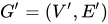
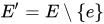
Let be a graph (or directed graph) containing an edge with . Let be a function that maps every vertex in to itself, and otherwise, maps it to a new vertex . The contraction of results in a new graph , where , , and for every , is incident to an edge if and only if, the corresponding edge, is incident to in .

Vertex identification

[edit]

Vertex identification (sometimes called vertex contraction) removes the restriction that the contraction must occur over vertices sharing an incident edge. (Thus, edge contraction is a special case of vertex identification.) The operation may occur on any pair (or subset) of vertices in the graph. Edges between two contracting vertices are sometimes removed. If and are vertices of distinct components of , then we can create a new graph by identifying and in as a new vertex in .[4] More generally, given a partition of the vertex set, one can identify vertices in the partition; the resulting graph is known as a quotient graph.

Vertex cleaving

[edit]

Vertex cleaving, which is the same as vertex splitting, means one vertex is being split into two, where these two new vertices are adjacent to the vertices that the original vertex was adjacent to. This is a reverse operation of vertex identification, although in general for vertex identification, adjacent vertices of the two identified vertices are not the same set.

Path contraction

[edit]

Path contraction occurs upon the set of edges in a path that contract to form a single edge between the endpoints of the path. Edges incident to vertices along the path are either eliminated, or arbitrarily (or systematically) connected to one of the endpoints.

Twisting

[edit]

Consider two disjoint graphs and , where contains vertices and and contains vertices and . Suppose we can obtain the graph by identifying the vertices of and of as the vertex of and identifying the vertices of and of as the vertex of . In a twisting of with respect to the vertex set , we identify, instead, with and with .[5]

Repeated contractions

[edit]

Given a finite set of edges, the order in which contractions are performed on a graph does not change the result (up to isomorphism). The result reduces to showing that is isomorphic to for two edges of . [6]

Applications

[edit]

Both edge and vertex contraction techniques are valuable in proof by induction on the number of vertices or edges in a graph, where it can be assumed that a property holds for all smaller graphs and this can be used to prove the property for the larger graph.

Edge contraction is used in the recursive formula for the number of spanning trees of an arbitrary connected graph,[7] and in the recurrence formula for the chromatic polynomial of a simple graph.[8]

Contractions are also useful in structures where we wish to simplify a graph by identifying vertices that represent essentially equivalent entities. One of the most common examples is the reduction of a general directed graph to an acyclic directed graph by contracting all of the vertices in each strongly connected component. If the relation described by the graph is transitive, no information is lost as long as we label each vertex with the set of labels of the vertices that were contracted to form it.

Another example is the coalescing performed in global graph coloring register allocation, where vertices are contracted (where it is safe) in order to eliminate move operations between distinct variables.

Edge contraction is used in 3D modelling packages (either manually, or through some feature of the modelling software) to consistently reduce vertex count, aiding in the creation of low-polygon models.

See also

[edit]

Notes

[edit]

References

[edit]
[edit]
Revisions and contributorsEdit on WikipediaRead on Wikipedia
from Grokipedia
In , edge contraction is a fundamental operation applied to a graph GG by selecting an edge ee with endpoints uu and vv, deleting ee, and merging uu and vv into a single new vertex that inherits all edges incident to either original vertex (with multiple edges between the same pair reduced to simple edges if the graph is simple, and loops removed). This results in a contracted graph GeG \cdot e (or G/eG/e) with exactly one fewer vertex and one fewer edge than GG, preserving the number of connected components. The operation is reversible in certain contexts through graph expansion but is primarily used to simplify graphs while retaining structural properties for analysis. Edge contraction plays a central role in , notably in Kirchhoff's matrix-tree theorem, where the number of spanning trees T(G)T(G) in a graph satisfies the deletion-contraction recurrence T(G)=T(Ge)+T(Ge)T(G) = T(G - e) + T(G \cdot e) for any edge ee, enabling recursive computation and proving that T(Kn)=nn2T(K_n) = n^{n-2} for the on nn vertices. Similarly, it underpins the recursive evaluation of chromatic polynomials via πk(G)=πk(Ge)πk(Ge)\pi_k(G) = \pi_k(G - e) - \pi_k(G \cdot e), where πk(G)\pi_k(G) counts the proper kk-colorings of GG, facilitating determinations of chromatic numbers and colorability. In connectivity and flow theory, repeated edge contractions help prove by reducing path-disjointness problems: the maximum number of internally vertex-disjoint paths between two vertices equals the minimum number of vertices whose removal separates them, with contractions preserving this duality in both undirected and directed graphs. For structural , edge contraction is essential to the minor relation, where a graph HH is of GG if HH can be obtained from GG by deleting edges and vertices and contracting edges; this framework supports Wagner's theorem and Kuratowski's theorem, characterizing planar graphs as those excluding K5K_5 or K3,3K_{3,3} as minors. Beyond these, edge contraction appears in algorithms for graph connectivity by shrinking components to accelerate computations on smaller instances. In topological contexts, variants ensure topology-preserving simplifications, maintaining types during contractions for applications in simplification and . Overall, the commutativity under successive contractions of non-incident edges and its role in matroid theory extend its utility across algebraic and algorithmic graph studies.

Definition and Fundamentals

Formal definition

In , edge contraction is a fundamental operation on graphs. Let G=(V,E)G = (V, E) be a graph and e={u,v}Ee = \{u, v\} \in E an edge of GG. The contraction of ee, denoted G/eG / e, is the graph obtained by deleting uu and vv from VV, adding a new vertex ww to replace them, and forming the edge set E=E{e}E' = E \setminus \{e\} where every edge originally incident to uu or vv (other than ee) is now made incident to ww instead. Formally, the vertex set of G/eG / e is V=(V{u,[v](/page/V.)}){w}V' = (V \setminus \{u, [v](/page/V.)\}) \cup \{w\}, and the edges in EE' connect ww to any vertex xV{u,[v](/page/V.)}x \in V \setminus \{u, [v](/page/V.)\} if xx was adjacent to uu or vv in GG, with the multiplicity preserved if xx was adjacent to both. This operation may produce multiple edges between ww and another vertex (if that vertex was connected to both uu and vv) or loops at ww (if uu or vv had a self-loop in a setting), even if GG was simple; thus, G/eG / e is generally a . For example, consider the path graph P3P_3 with vertices labeled 1, 2, 3 and edges {1,2}\{1,2\} and {2,3}\{2,3\}. Contracting the edge e={1,2}e = \{1,2\} replaces vertices 1 and 2 with a new vertex ww, removes ee, and reattaches the edge {2,3}\{2,3\} as {w,3}\{w,3\}, yielding P2P_2 (a single edge between ww and 3).

Vertex identification

Vertex identification generalizes the concept of edge contraction by allowing the merger of any two vertices u,vV(G)u, v \in V(G) in a graph G=(V,E)G = (V, E), regardless of whether they are adjacent. The resulting graph G/{u,v}G / \{u, v\} has a new vertex ww that replaces uu and vv, with ww adjacent to the union of the neighbors of uu and vv. Any edge between uu and vv is removed to prevent a loop on ww; if no such edge exists, the operation simply combines their incident edges without adding a new one between the merged pair. This process handles multiple edges by either retaining them as a multigraph or combining parallels into weighted edges, depending on the context. In the broader framework of graphs, vertex identification arises from partitioning the vertex set VV into equivalence classes and contracting all vertices within each class to a single representative. The graph G/πG / \pi, where π\pi is the partition, has vertices corresponding to the blocks of π\pi, and an edge between two blocks if at least one pair of vertices from those blocks is adjacent in GG. This construction preserves adjacency information across partitions without specifying edge removals, allowing for mergers of non-adjacent vertices. Edge contraction is a special case of this, corresponding to a partition with exactly two vertices in one block (the endpoints of the contracted edge) and singletons elsewhere, ensuring the merged block connects to the common neighbors while removing the original edge. A key difference from strict edge contraction is that vertex identification can introduce effective new connections indirectly through merged incidences, without requiring an preexisting edge between uu and vv. For non-adjacent mergers, this may lead to incident to ww if uu and vv share neighbors, necessitating representations or edge weights to sum parallel incidences (e.g., weighting an edge by the number of original connections it subsumes). In contrast, edge contraction always starts with an edge and explicitly removes it, avoiding such parallels from the contracted pair itself but potentially creating them elsewhere. For example, in the C4C_4 with vertices labeled aa-bb-cc-dd-aa, identifying non-adjacent vertices aa and cc into ww produces a graph with vertices w,b,dw, b, d and edges ww-bb, ww-dd (each arising from two original incidences, potentially weighted as 2 if parallels are combined), and no edge between bb and dd, yielding a of length 2. This operation simplifies the structure while preserving the overall connectivity pattern across the partition.

Vertex cleaving

Vertex cleaving, also known as vertex splitting, is the inverse operation to vertex identification, the merging step in edge contraction. Given a graph GG with a vertex ww, cleaving splits ww into two new vertices uu and vv, and partitions the edges incident to ww into two sets: one assigned to uu and the other to vv. This redistribution ensures that each original edge now connects to exactly one of the new vertices, preserving the connections to the rest of the graph. The operation applies naturally to multigraphs, where the partition may result in multiple edges between a neighbor and one of the new vertices if several incident edges are assigned to it. In simple graphs, the partition is selected to prevent multiple edges, typically by ensuring no neighbor receives more than one reassigned edge to the same new vertex. Vertex identification, the forward operation, merges two adjacent vertices into one while removing the connecting edge. As the reverse of edge contraction, vertex cleaving often introduces a new edge between uu and vv to restore the original structure and maintain connectivity, effectively expanding the graph. This added edge compensates for the edge removed during the prior contraction. For instance, in the complete graph K3K_3 (a triangle with vertices aa, bb, cc and edges abab, bcbc, caca), contracting edge abab yields a multigraph with vertices ww, cc and two parallel edges wcwc (from acac and bcbc). Cleaving ww into aa and bb assigns one wcwc edge to acac and the other to bcbc, then adds edge abab to recover the original K3K_3.

Variants and Extensions

Path contraction

Path contraction extends the concept of single-edge contraction to an entire path in a graph, effectively simplifying linear structures while preserving overall connectivity. Given a path P=v1e1v2ek1vkP = v_1 - e_1 - v_2 - \dots - e_{k-1} - v_k in an undirected graph G=(V,E)G = (V, E), the operation contracts all edges {e1,,ek1}E\{e_1, \dots, e_{k-1}\} \subseteq E, merging the vertices {v1,,vk}\{v_1, \dots, v_k\} into a single new vertex vv. Any edges incident to the original vertices in PP but not part of PP (external edges) are reattached to vv, with multiple edges between the same pair of vertices typically retained or simplified according to the specific graph model (e.g., simple graphs may remove multiples). This process identifies the vertices along PP and updates the adjacency structure accordingly. This standard form, often called full path contraction to a vertex, completely merges internal vertices with the endpoints, reducing the path to a point in the contracted graph G/PG/P. It serves as a building block in algorithms for graph simplification and minor testing, where linear substructures are collapsed to analyze global properties. For paths of length 1, it coincides with single-edge contraction. A variant, known as path reduction or contraction to an edge, preserves the endpoints v1v_1 and vkv_k by replacing the entire path with a single edge (v1,vk)(v_1, v_k), removing the internal vertices v2,,vk1v_2, \dots, v_{k-1}. This applies specifically to maximal paths where internal vertices have degree exactly 2 (no external edges incident to them), ensuring no loss of connectivity information during reduction. In such cases, no reattachment is needed, as there are no branches from internals; the operation shortens the path while maintaining the graph's spanning tree or embedding properties. If external edges exist on internal vertices, the operation is not directly applicable without additional rules for reattachment (e.g., distributing them to endpoints based on proximity), though standard definitions restrict to branch-free paths to avoid ambiguity. Implementing path contraction in adjacency list representations takes O(P)O(|P|) time for the basic merge-to-vertex variant, involving sequential vertex unions along the path and updating neighbor lists for external connections (assuming bounded degrees or lazy updates to avoid full graph traversal). For the edge-preserving variant on degree-2 paths, the time is similarly O(P)O(|P|), as it involves deleting internal vertices and adding the direct edge. As an illustrative example, consider a 4-by-4 grid graph where a horizontal path of length 3 (four vertices in a row) is contracted to a single vertex using the full variant. The resulting graph merges the row segment into one supernode, with vertical edges from the original vertices now incident to the supernode, thereby simplifying horizontal connectivity and reducing the grid's complexity for subsequent analyses like shortest-path computations.

Twisting

Twisting is a variant of vertex identification in the context of edge contraction, where the merger of vertices involves reassigning or interchanging the roles of the identified vertices in the incident edges of one subgraph, thereby preserving key structural properties such as the cycle of the graph. This operation is particularly relevant in matroid theory and is used to demonstrate that different graph configurations yield isomorphic matroids despite not being isomorphic as graphs themselves. Consider two disjoint graphs G1G_1 and G2G_2, with vertices u1,v1V(G1)u_1, v_1 \in V(G_1) and u2,v2V(G2)u_2, v_2 \in V(G_2). The standard identification forms graph GG by merging u1u_1 with u2u_2 to create vertex uu and v1v_1 with v2v_2 to create vertex vv. In the twisting GG' of GG with respect to the vertex set {u,v}\{u, v\}, the mergers are crossed: u1u_1 is identified with v2v_2 and v1v_1 with u2u_2. This reassignment ensures that GG and GG' have the same cycle matroid, allowing for equivalent combinatorial properties under contraction-like operations. More generally, twisting arises in graphs with a 2-separation {X,Y}\{X, Y\} where V(G[X])V(G[Y])={u,v}V(G[X]) \cap V(G[Y]) = \{u, v\}. The twisted graph GG' is obtained by interchanging the labels of uu and vv in every edge of the induced subgraph G[X]G[X], effectively permuting the attachments of incident edges while reconnecting the subgraphs. This preserves cycles and bonds between GG and GG', though degrees may differ; for instance, in a graph where one vertex has degree 2 and the other degree 3 in GG, twisting may yield degrees 4 and 1 in GG'. In the mathematical formulation for edge contraction, let G/eG/e be the graph obtained by contracting edge e={u,v}e = \{u, v\} to a new vertex ww. A twisting applies a permutation σ\sigma to the edges incident to ww (derived from the unions of incidents to uu and vv), reassigning their labels or attachments to maintain properties like orientation in oriented or labeled graphs. This is analogous to the 2-separation twist and extends vertex identification by allowing flexible relabeling post-merger.

Repeated contractions

Repeated edge contractions involve applying the edge contraction operation sequentially to a graph, either on a set of disjoint edges or on edges that may share vertices. Formally, for a graph GG and a set of edges E={e1,e2,,ek}E(G)E' = \{e_1, e_2, \dots, e_k\} \subseteq E(G), the contraction G/EG / E' is defined as the graph obtained by contracting the edges in EE' one by one, denoted G/e1/e2//ekG / e_1 / e_2 / \dots / e_k, where each step merges the endpoints of the contracted edge into a single vertex while preserving adjacency to other vertices. This process replaces each connected component of the subgraph G[E]G[E'] with a single vertex, which becomes adjacent to all vertices outside EE' that were adjacent to any vertex in that component. Alternatively, multiple contractions can be viewed through a vertex partition where each part induces a connected subgraph to be contracted to one vertex, yielding the same result under compatible conditions. Repeated contractions on a set EE' correspond to contracting each connected component of G[E]G[E'] to a single vertex. The operation of repeated contractions exhibits commutativity when contracting distinct edges, meaning that contracting edges in any order produces graphs, as (G/e)/f(G/f)/e(G / e) / f \cong (G / f) / e for distinct edges ee and ff. This property holds because distinct edges do not interfere in a way that alters the final structure up to isomorphism, allowing the sequence to be reordered without changing the result. Associativity in repeated contractions follows from commutativity for distinct edges, ensuring that (G/e1)/e2G/(e1,e2)(G / e_1) / e_2 \cong G / (e_1, e_2). This makes the notation G/{e1,e2}G / \{e_1, e_2\} well-defined, independent of the contraction sequence. In general, for a set of edges, the final graph is determined by the connected components they induce, rendering the overall process associative under partition-based equivalence. A representative example occurs when contracting all edges in a TT with nn vertices. Since TT is connected and acyclic, repeated contraction of its n1n-1 edges merges all vertices into a single vertex, resulting in the trivial graph K1K_1, regardless of the order due to the absence of cycles. This illustrates how repeated contractions can simplify structures while preserving essential connectivity properties.

Properties

Structural properties

Edge contraction influences several key structural properties of graphs, particularly regarding connectivity, vertex degrees, cycles, and the emergence of multiple edges. In undirected graphs, contracting an edge may reduce the vertex connectivity by at most 1. For instance, if the contracted edge is part of a minimal vertex cut, the merger can create a new cut vertex in the resulting graph, lowering the overall connectivity; however, the operation never decreases connectivity by more than 1, as the new graph retains paths that avoided the merged vertices. In directed graphs, edge contraction preserves strong connectivity: if the original digraph is strongly connected, any directed path between vertices can be preserved or shortened by routing through the newly merged vertex, ensuring reachability in both directions remains intact. The degrees of vertices are directly affected by contraction. When contracting an edge uvuv to form a new vertex ww, the degree of ww in the resulting multigraph is given by deg(w)=deg(u)+deg(v)2\deg(w) = \deg(u) + \deg(v) - 2, as the contracted edge is removed and its endpoints merged without adding new incidences. This formula holds because each incident edge to uu or vv (except uvuv) becomes incident to ww, but the mutual connection via uvuv is eliminated. Adjacent vertices to both uu and vv may see their degrees unchanged in the multigraph, though simplification to a simple graph could adjust degrees further by suppressing parallels. Regarding cycles and paths, contraction preserves acyclicity: a graph is acyclic if and only if its contraction along any edge is acyclic, since introducing a cycle via contraction would require a cycle in the original graph. Cycles containing the contracted edge e=uve = uv are transformed into shorter cycles in the contracted graph, effectively reducing their by 1 while maintaining the cyclic structure. Similarly, paths traversing ee are shortened by merging uu and vv, but the existence of paths between non-contracted vertices is preserved or simplified. The operation frequently leads to multigraphs, where parallel edges emerge between the new vertex ww and any common neighbor of uu and vv, reflecting multiple original paths or edges to the pair. Loops may form if there were multiple edges between uu and vv originally, though the single contracted edge itself does not produce a loop. In applications requiring simple graphs, these multiples are typically suppressed by retaining a single edge per pair, and loops are deleted, which may alter degrees but simplifies the structure for further analysis.

Invariants under contraction

Edge contraction preserves certain graph properties or maintains specific relations with them, particularly those associated with minor-closed families and embedding characteristics. For the chromatic number, denoted χ(G)\chi(G), the operation satisfies χ(G)χ(G/e)1|\chi(G) - \chi(G/e)| \leq 1 for any edge ee, meaning the chromatic number changes by at most one under contraction. This follows from the fact that a proper coloring of G/eG/e can be extended to GG by assigning the same color to the endpoints of ee if possible, or using an additional color otherwise, implying χ(G)χ(G/e)+1\chi(G) \leq \chi(G/e) + 1; conversely, contracting an edge reduces the chromatic number by at most one, as established in studies of critical graphs. Equality often holds when the edge is not critical for coloring, such as in graphs where the endpoints share no conflicting color constraints beyond their adjacency. Minor-closed properties, such as planarity and vertex connectivity, exhibit preservation under edge contraction in the sense that if GG belongs to a minor-closed family, then so does G/eG/e. For planarity specifically, if GG admits a planar , then G/eG/e does as well, since the embedding can be adjusted by merging the incident faces around the endpoints of ee without crossings. This preservation extends to the reverse operation of edge expansion (splitting a vertex into two adjacent vertices), ensuring that planarity is maintained bidirectionally. Similar behavior holds for kk-connectivity: contracting an edge preserves kk-connectivity under certain conditions, such as when the endpoints are not articulation points, though the precise relation ties into via contracted paths. The of a graph, defined as the minimum genus of a surface on which GG embeds without crossings, does not increase under contraction: γ(G/e)γ(G)\gamma(G/e) \leq \gamma(G). This follows from the ability to modify an of GG on a surface of genus γ(G)\gamma(G) by collapsing the edge ee along its embedding curve, potentially reducing handles if the edge "cuts" a handle, but never requiring additional ones. Contraction also preserves the χ(G)=V(G)E(G)+F(G)\chi(G) = |V(G)| - |E(G)| + |F(G)| in cellular embeddings, where V|V| and E|E| each decrease by 1 while the number of faces F|F| remains unchanged, maintaining χ(G/e)=χ(G)\chi(G/e) = \chi(G) and thus the orientable genus via the formula g=(2χ)/2g = (2 - \chi)/2. Other clique-related invariants show conditional preservation. The clique number ω(G)\omega(G), the size of the largest clique, satisfies ω(G/e)=ω(G)\omega(G/e) = \omega(G) if ee is an induced edge (i.e., its endpoints have no common neighbors, so ee lies in no clique larger than size 2); in this case, no new cliques form upon merging, and existing ones remain intact. If ee belongs to a larger clique, contraction typically reduces ω\omega by 1, as the merged vertex replaces two in the clique structure. In contrast, the independence number α(G)\alpha(G) may change under contraction, often decreasing since the merged vertex cannot replace both original endpoints in an independent set (as they are adjacent), though it can sometimes stay the same if the endpoints were not both selectable in maximal independent sets.

Applications

Combinatorial recurrences

Edge contraction is fundamental to deletion-contraction recurrences, which provide recursive methods for computing various graph invariants, particularly those involving counting structures like spanning trees and proper colorings. These recurrences express the value of an invariant on a graph GG in terms of its value on the graph obtained by deleting an edge ee (denoted GeG - e) and on the graph obtained by contracting ee (denoted G/eG / e). For the number of spanning trees τ(G)\tau(G) in a connected multigraph GG, the deletion-contraction recurrence is τ(G)=τ(Ge)+τ(G/e)\tau(G) = \tau(G - e) + \tau(G / e). Here, τ(Ge)\tau(G - e) counts the spanning trees of GG that avoid ee, while τ(G/e)\tau(G / e) counts those that include ee (by contracting ee into a single vertex, the trees using ee biject to trees in the contracted graph). This relation holds for any edge ee, including loops and multiple edges, and was first established by Kirchhoff. Base cases include: edgeless graphs have τ=1\tau = 1 if they consist of a single vertex and τ=0\tau = 0 otherwise (as they are disconnected for multiple vertices); graphs containing loops have τ=0\tau = 0, since spanning trees are acyclic and cannot include loops. A related application appears in the matrix tree theorem, also due to Kirchhoff, which states that τ(G)\tau(G) equals any cofactor (principal minor) of the LL of GG, where L=DAL = D - A with DD the and AA the . Many proofs of this theorem demonstrate that such a cofactor satisfies the same deletion-contraction recurrence as τ(G)\tau(G), together with matching base cases, implying their equality by induction on the number of edges. The chromatic polynomial P(G,k)P(G, k), which counts the number of proper vertex colorings of GG using at most kk colors, obeys a similar but signed recurrence: for a non-loop edge ee, P(G,k)=P(Ge,k)P(G/e,k)P(G, k) = P(G - e, k) - P(G / e, k). In GeG - e, colorings are unrestricted by ee, while in G/eG / e, the endpoints of ee must receive the same color, subtracting the invalid cases where they differ. This recurrence, introduced by Whitney, enables recursive computation of P(G,k)P(G, k) with base cases P(Kn,k)=k(k1)n1P(K_n, k) = k(k-1)^{n-1} for the KnK_n and P(G,k)=0P(G, k) = 0 if GG has a loop. As an illustrative example, consider the CnC_n for n3n \geq 3. Applying the spanning tree recurrence, CneC_n - e is a path on nn vertices, which is a and thus has τ=1\tau = 1; meanwhile, Cn/eCn1C_n / e \cong C_{n-1} (accounting for multiple edges in the case n=3n=3). This yields the relation τ(Cn)=1+τ(Cn1)\tau(C_n) = 1 + \tau(C_{n-1}). Starting from τ(C3)=3\tau(C_3) = 3 (verified directly as the three edges of the ), the recurrence inducts to τ(Cn)=n\tau(C_n) = n.

Graph minor theory

In graph theory, a graph HH is a minor of a graph GG, denoted HGH \preceq G, if HH can be obtained from GG by a sequence of vertex deletions, edge deletions, and edge contractions. Edge contraction is fundamental to this process, as it merges the endpoints of an edge into a single vertex while preserving adjacencies to other vertices, effectively allowing the formation of denser substructures that capture essential connectivity. This operation, combined with deletions, enables the modeling of graph embeddings where contracted edges represent paths or clusters in the original graph. Minors often arise through repeated contractions, facilitating multi-step reductions to identify forbidden configurations. Wagner's theorem provides a seminal characterization of planar graphs using minors: a graph is planar if and only if it contains neither K5K_5 nor K3,3K_{3,3} as a minor. The theorem refines Kuratowski's earlier result on subdivisions by incorporating edge contractions, which allow proofs to handle more general transformations while establishing the equivalence between topological and minor-based forbidden subgraphs. Contractions are crucial in the constructive aspects of the proof, demonstrating how non-planar graphs can be reduced to these forbidden minors through targeted mergers of vertices. The Robertson–Seymour theorem, a of graph minor theory, asserts that every minor-closed family of graphs—that is, a family closed under taking —has a finite set of forbidden . This result, proved over a series of twenty papers, shows that the minor relation well-quasi-orders the set of all finite graphs, implying no infinite antichains under the minor partial order. Edge contractions are central to the theorem's structural proofs, enabling the decomposition of graphs excluding a fixed into tree-like arrangements of bounded complexity, which underpin the finiteness argument. A concrete example illustrates the role of contraction in minor formation: the complete graph K6K_6 contains K5K_5 as a minor, obtained by contracting a single edge, which merges its two endpoints into one vertex adjacent to the remaining four, yielding the on five vertices. This simple reduction highlights how contractions preserve completeness in dense graphs, a property exploited in forbidden minor characterizations.

Algorithmic and practical uses

Edge contraction can be implemented efficiently using a union-find to manage vertex mergers, allowing a single contraction to be performed in O(|V| + |E|) time by updating adjacency lists and redirecting edges to the representative vertex of the merged supernode. This approach is particularly useful in algorithms requiring repeated contractions, such as Karger's randomized algorithm, where contractions help identify the global min-cut by iteratively merging vertices until few remain, with the probability of success analyzed probabilistically. In the context of the , edge contractions preserve the capacity, enabling reductions from s-t min-cut problems to global min-cut computations via flow networks transformed into undirected graphs for contraction-based solvers. A key application in graph simplification involves contracting all edges within each (SCC) of a to a single vertex, yielding the condensation graph—a (DAG) that preserves and simplifies analysis of topological structure and dependencies. This process, computable in O(|V| + |E|) time using algorithms like Tarjan's SCC finder followed by edge redirection, reduces complex networks to a more manageable form for tasks such as computation or modular . In compiler optimization, coalescing in merges non-interfering nodes in the interference graph—representing live ranges connected by move instructions—eliminating redundant copies while preserving colorability for register assignment. This technique, as in iterated register coalescing, balances code quality and allocation feasibility by selectively merging to minimize spills without increasing chromatic number. For 3D , iterative edge contraction is a cornerstone of simplification, where edges are repeatedly contracted to optimal positions based on error metrics like , reducing count while approximating the original surface geometry for rendering efficiency. The quadric error metrics method prioritizes contractions that minimize squared distance errors, enabling real-time applications in level-of-detail rendering. In VLSI design, edge contraction facilitates wire length minimization during hierarchical partitioning, as in multilevel coarsening schemes where matched edges are contracted to form supernodes, allowing recursive optimization of placements that reduces estimated half-perimeter wire lengths by clustering connected components early in the process. For instance, tools like METIS apply this in chip floorplanning to merge logic gates into modules, yielding layouts with shorter interconnects compared to flat partitioning.

References

Add your contribution
Related Hubs
User Avatar
No comments yet.