


Community hub
Recent from talks
Contribute something
Nothing was collected or created yet.
Édith Piaf
View on Wikipedia
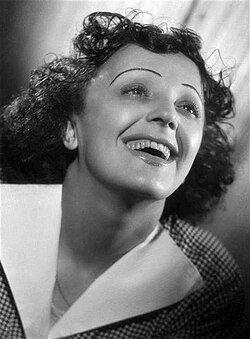
Édith Giovanna Gassion (19 December 1915 – 10 October 1963), known as Édith Piaf (French: [edit pjaf]), was a French singer and lyricist best known for performing songs in the cabaret and modern chanson genres. She is widely regarded as France's greatest popular singer and one of the most celebrated performers of the 20th century.[1][2]: xi
Key Information


Having begun her career touring with her father at age fourteen, she was discovered in 1935 in Paris by night club owner Louis Leplée, and achieved her first successes in the "Theatre de l'ABC" among others with the song "Mon Légionnaire". Owner of the ABC music hall Mitty Goldin also wrote songs for her, e.g. "Demain",[3] and produced some of her songs.[citation needed] Her fame increased during the German occupation of France, shortly after which (in 1945) she wrote the lyrics to her signature song, "La Vie en rose" ('life in pink'). She became France's most popular entertainer in the late 1940s, also touring Europe, South America and the United States, where her popularity led to eight appearances on The Ed Sullivan Show.
Piaf continued to perform, including several series of concerts at the Paris Olympia music hall, until a few months before her death in 1963 at age 47. Her last song, "L'Homme de Berlin", was recorded with her husband Théo Sarapo in April 1963. Since her death, several documentaries and films have been produced about Piaf's life as a touchstone of French culture.
Piaf's music was often autobiographical, and she specialized in chanson réaliste and torch ballads about love, loss and sorrow. In addition to her signature song, her most widely known songs include "Non, je ne regrette rien" (1960), "Hymne à l'amour" (1949), "Milord" (1959), "La Foule" (1957), "L'Accordéoniste" (1940), and "Padam, padam..." (1951).
Early life
[edit]Édith Piaf's birth certificate indicates she was born in Paris on 19 December 1915, at the Hôpital Tenon.[4]
Her birth name was Édith Giovanna Gassion.[5] The name "Édith" was inspired by British nurse Edith Cavell, who was executed 2 months before Édith's birth for helping French soldiers escape from German captivity during World War I.[6] Twenty years later, Édith's stage surname Piaf was created by her first promoter, based on a French term for 'sparrow'.[1]
Édith's father Louis Alphonse Gassion (1881–1944) was an acrobatic street performer from Normandy with a theater background. Louis's father was Victor Alphonse Gassion (1850–1928) and his mother was Léontine Louise Descamps (1860–1937), who ran a brothel in Normandy and was known professionally as "Maman Tine".[7] Édith's mother, Annetta Giovanna Maillard (1895–1945) was a singer and circus performer born in Italy who performed under the stage name "Line Marsa".[8][9][10] Annetta's father was Auguste Eugène Maillard (1866–1912) of French descent and Édith's grandmother was Emma (Aïcha) Saïd Ben Mohammed (1876–1930), an acrobat of Kabyle and Italian descent.[11][12][13][14] Annetta and Louis divorced on 4 June 1929.[15][16]
Piaf's mother abandoned her at birth,[17] and she lived for a short time with her maternal grandmother, Emma (Aïcha), in Bethandy, Normandy.[18] Her father enlisted with the French Army in 1916 to fight in World War I. By the end of the war, she was in the care of his mother, at her brothel in Bernay, Normandy.[2]: 7 There, prostitutes helped look after Piaf.[1] The bordello had two floors and seven rooms, and the prostitutes were not very numerous – "about ten poor girls", as she later described. In fact, five or six were permanent while a dozen others would join the brothel during market days and other busy days. The sub-mistress of the brothel was called "Madam Gaby" and Piaf considered her almost like family; later, she became godmother of Denise Gassion, Piaf's half-sister born in 1931.[19]
From the age of three to seven, Piaf was allegedly blind as a result of keratitis.[2]: 9 According to one of her biographers, she recovered her sight after her grandmother's prostitutes pooled money to accompany her on a pilgrimage honouring Saint Thérèse of Lisieux.[20] Piaf claimed this resulted in a miraculous healing.[21][2]: 10
Career
[edit]Early years (1929–1939)
[edit]At age 14, Piaf was taken by her father to join him in his acrobatic street performances all over France, where she first began to sing in public.[22] The following year, Piaf met Simone "Mômone" Berteaut,[23] who became a companion for most of her life. In a memoir, Berteaut later falsely represented herself as Piaf's half-sister.[2]: 63–64 Together they toured the streets singing and earning money for themselves. She and Berteaut rented their own place.[1] Piaf took a room at the Grand Hôtel de Clermont in Paris and worked with Berteaut as a street singer around Paris and its suburbs.[24]
Piaf met a young man named Louis Dupont in 1932 and lived with him for a time; she became pregnant and gave birth to a daughter, Marcelle "Cécelle" Dupont, on 11 February 1933, when Piaf was seventeen.[2]: 27-28ff After Piaf's relationship with Dupont ended, Marcelle, who had been living with her father, contracted meningitis and died in July 1935, aged two.[2]: 38
In 1935, Piaf (then still known by her birth name of Édith Gassion) was discovered by nightclub owner Louis Leplée.[5][1][7] Her singing when she met Leplée has been described as "Comme un moineau" ("Like a Sparrow").[2]: 42–43 Leplée persuaded Piaf to sing despite her extreme nervousness. This nervousness and her height of only 142 centimetres (4 ft 8 in),[4][25] inspired Leplée to give her the nickname La Môme Piaf,[5] which is Paris slang for "The Sparrow Kid". Leplée taught Piaf about stage presence and told her to wear a black dress, which became her trademark apparel.[1]
Prior to Piaf's opening night, Leplée ran an intense publicity campaign, resulting in the attendance of many celebrities.[1] The bandleader that evening was Django Reinhardt, with his pianist, Norbert Glanzberg.[2]: 44–45 Her nightclub gigs led to her first two records produced that same year,[25] with one of them penned by Marguerite Monnot, a collaborator throughout Piaf's life and one of her favourite composers.[1]
On 6 April 1936,[26] Leplée was murdered. Piaf was questioned and accused as an accessory, but acquitted.[5] Leplée had been killed by mobsters with previous ties to Piaf.[27] A barrage of negative media attention now threatened Piaf's career.[4][1] To rehabilitate her image, she recruited Raymond Asso, with whom she would become romantically involved.[28] He changed her stage name to "Édith Piaf", barred undesirable acquaintances from seeing her, and commissioned Monnot to write songs that reflected or alluded to Piaf's previous life on the streets.[1]
Second World War (1940–1944)
[edit]In 1940, Piaf co-starred in Jean Cocteau's one-act play Le Bel Indifférent.[1]
Piaf's career and fame gained momentum during the German occupation of France in World War II.[29] She began forming friendships with prominent people, such as actor and singer Maurice Chevalier and poet Jacques Bourgeat. Piaf also performed in various nightclubs and brothels, which flourished between 1940 and 1945.[30] Various top Paris brothels, including Le Chabanais, Le Sphinx, One Two Two,[31] La rue des Moulins, and Chez Marguerite, were reserved for German officers and collaborating Frenchmen.[32] Piaf was invited to take part in a concert tour to Berlin, sponsored by the German officials, together with artists such as Loulou Gasté, Raymond Souplex, Viviane Romance and Albert Préjean.[33] In 1942, she was able to afford a luxury flat in a house in the upmarket 16th arrondissement of Paris area.[34] She lived above the L'Étoile de Kléber, a famous nightclub and bordello close to the Paris Gestapo headquarters.[19] She was persuaded to move from there prior to the liberation.[35]
In 1944, Piaf performed in the Moulin Rouge cabaret venue in Paris, where she worked with singer/actor Yves Montand and began an affair with him.[4][27]
Piaf was accused of collaborating with the German occupying forces and in October 1944[2]: 99 [a] she had to testify before an Épuration légale (post-war legal trial), as there were plans to ban her from appearing on radio transmissions.[2]: 99 One source suggests that she was blacklisted for a period.[35] However, her secretary Andrée Bigard, a member of the French Resistance, spoke in her favour after the Liberation.[19][36] According to Bigard, she performed several times at prisoner-of-war camps in Germany and was instrumental in helping a number of prisoners escape.[37] In particular, at the beginning of the war, Piaf had met Michel Emer, a Jewish musician famous for the song L'Accordéoniste. Piaf paid for Emer to travel into France before German occupation, where he lived in safety until the liberation.[37][38][39] Following the trial, Piaf was quickly back performing in benefit concerts.[2]: 100 In December 1944, she performed for the Allied forces in Marseille, alongside Montand.[2]: 100
Post-war (1945–1955)
[edit]
Piaf wrote and performed her signature song, "La Vie en rose" in 1945.[1] This song was entered into the Grammy Hall of Fame in 1998.[40]
In 1947, she wrote the lyrics to the song "What Can I Do?". It was premiered and recorded by her former lover Montand. Within a year, Montand became one of the most famous singers in France.[1]
During this time, she was in great demand and very successful in Paris[5] as France's most popular entertainer.[25] After the war, she became known internationally,[5] touring Europe, the United States, and South America. In Paris, she gave Argentinian guitarist-singer Atahualpa Yupanqui – a central figure in the Argentine folk music tradition – the opportunity to share the scene, making his debut in July 1950.[41] Piaf also helped launch the career of Charles Aznavour in the early 1950s, taking him on tour with her and recording some of his songs.[1] At first she met with little success with American audiences, who expected a gaudy spectacle and were disappointed by Piaf's simple presentation.[1] However, after a glowing review by influential New York critic Virgil Thomson in 1947,[42][1] her popularity in the U.S. grew to the point where she eventually appeared on The Ed Sullivan Show eight times, and at Carnegie Hall twice (in 1956 and 1957).[7]
Later years (1955–1963)
[edit]Between January 1955 and October 1962, Piaf performed several series of concerts at the Paris Olympia music hall.[4] Excerpts from five of these concerts (1955, 1956, 1958, 1961, 1962) were issued on vinyl record (and later on CD), and have never been out of print. In the 1961 concerts, promised by Piaf in an effort to save the venue from bankruptcy, she first sang Non, je ne regrette rien.[4] In early 1963, Piaf recorded her last song before her death, titled L'Homme de Berlin.[43]
Personal life
[edit]
During a tour of America in 1947, Piaf met French boxing champion Marcel Cerdan and fell in love.[44] They had an affair, which made international headlines since Cerdan was the former middleweight world champion, and at the time was married with three children.[4] In October 1949, Cerdan boarded a flight from Paris to New York to meet Piaf. While on approach to land at Santa Maria in the Azores for a scheduled stopover, the aircraft crashed into a mountain, killing Cerdan and the other 47 people on board.[45] In May 1950, Piaf recorded the hit song "Hymne à l'amour" dedicating it to Cerdan.[46]
Piaf was injured in a car accident that occurred in 1951. Both Piaf and singer Charles Aznavour (her then-assistant) were passengers in the vehicle, with Piaf suffering a broken arm and two broken ribs. Her doctor prescribed the drug morphine as a treatment for arthritis,[47] which became a dependency alongside her alcohol problems.[1] Two more near-fatal car crashes exacerbated the situation.[7]
In 1952, Piaf married her first husband, singer Jacques Pills (real name René Ducos), with Marlene Dietrich performing the matron of honour duties. During their marriage, on three occasions Pills succeeded in having Piaf attend a detox clinic.[1] Piaf and Pills divorced in 1957.[48]
In 1962, she wed Théo Sarapo (Theophanis Lamboukas), a singer, actor, and former hairdresser who was born in France of Greek descent.[49] Sarapo was 20 years younger than Piaf[50] and, although latterly separated, the two remained married until Piaf's death.[49]
Death
[edit]
In early 1963, soon after recording "L'Homme de Berlin" with her husband Théo Sarapo, Piaf slipped into a coma due to liver cancer.[51] She was taken to her villa in Plascassier on the French Riviera where she was nursed by Sarapo and her friend Simone Berteaut. Over the next few months she drifted in and out of consciousness, before dying at age 47 on 10 October 1963.[49]
Her last words were "Every damn thing you do in this life, you have to pay for."[52] It is said that Sarapo drove her body from Plascassier to Paris secretly, so that fans would think she had died in her hometown.[1][31]
Piaf's body is buried in Père Lachaise Cemetery in Paris, where her grave is among the most visited.[1]
Funeral and 2013 Requiem Mass
[edit]Shortly after her death, Piaf's funeral procession drew tens of thousands of mourners onto the streets of Paris,[53] and the ceremony at the cemetery was attended by more than 100,000 fans.[31][54] According to Piaf's colleague Charles Aznavour, Piaf's funeral procession was the only time since the end of World War II that the traffic in Paris had come to a complete stop.[31]
However, at the time, Piaf had been denied a Catholic Requiem Mass by Cardinal Maurice Feltin, since she had remarried after divorce in the Orthodox Church.[55] Fifty years later, the French Catholic Church recanted and gave Piaf a Requiem Mass in the St. Jean-Baptiste Church in Belleville, Paris (the parish into which she was born) on 10 October 2013.[56]
Legacy
[edit]French media have continually published magazines, books, plays, television specials and films about the star, often on the anniversary of her death.[2]: 232 In 1969, her longtime friend Simone "Mômone" Berteaut published a biography titled "Piaf."[21] This biography contained the false claim that Berteaut was Piaf's half-sister.[2]: 415–416 In 1967, the Association of the Friends of Édith Piaf was formed,[57] followed by the inauguration of the Place Édith Piaf in Belleville in 1978.[58] Soviet astronomer Lyudmila Georgievna Karachkina named a small planet, 3772 Piaf, in her honor.[59]
A fan and author of two Piaf biographies operates the Musée Édith Piaf, a two-room museum in Paris.[31][60] The museum is located in the fan's apartment and has operated since 1977.[61]
A concert titled Piaf: A Centennial Celebration was held at The Town Hall in New York City on 19 December 2015, to commemorate the 100th anniversary of Piaf's birth. The events was hosted by Robert Osborne and produced by Daniel Nardicio and Andy Brattain. Performers included Little Annie, Gay Marshall, Amber Martin, Marilyn Maye, Meow Meow, Elaine Paige, Molly Pope, Vivian Reed, Kim David Smith, and Aaron Weinstein.[62][63]
At the 2024 Olympic Summer Games opening ceremony, Canadian singer Celine Dion performed "L'Hymne à l'amour".[64]
Biographies
[edit]Piaf's life has been the subject of numerous films, including:
- Piaf (1974), directed by Guy Casaril, depicted her early years[65]
- Édith et Marcel (1983), directed by Claude Lelouch, Piaf's relationship with Cerdan[66]
- Piaf ... Her Story ... Her Songs (2003), by Raquel Bitton[67]
- La Vie en Rose (2007), directed by Olivier Dahan, starring Marion Cotillard who won an Academy Award for Best Actress[68]
- The Sparrow and the Birdman (2010), by Raquel Bitton[69]
- Edith Piaf Alive (2011), by Flo Ankah[69]
- Piaf, voz y delirio (2017), by Leonardo Padrón.[70]
- Monsieur Aznavour (2024), by Mehdi Idir, co-starring Marie-Julie Baup as Édith Piaf[71]
Documentaries about Piaf's life include:
- Édith Piaf: A Passionate Life (24 May 2004)[72]
- Piaf: Her Story, Her Songs (June 2006)[73]
- Édith Piaf: Eternal Hymn (Éternelle, l'hymne à la môme, PAL, Region 2, import, 2007) ISBN 978-83-246-0314-5[74]
- Piaf: La Môme (2007)[75]
- Édith Piaf: The Perfect Concert and Piaf: The Documentary (February 2009)[76]
In 1978, a play titled Piaf (by English playwright Pam Gems)[77] began a run of 165 performances in London and New York.[78]
In 2023, Warner Music Group (WMG) announced a new biopic of Piaf that would be narrated by an artificial intelligence program that has been trained to replicate Piaf's voice. The project has been conducted in partnership with the Piaf estate, which supplied the recordings used in the process.[79][80]
Discography
[edit]In the pre-LP era Piaf recorded singles for Polydor,[81] Columbia Graphophone[82] and Decca.[83]
The following titles are compilations of Piaf's songs and not reissues of the titles released while Piaf was active.
- Edith Piaf: Edith Piaf (Music For Pleasure MFP 1396) 1961
- Potpourri par Piaf (Capitol ST 10295) 1962
- Ses Plus Belles Chansons (Contour 6870505) 1969
- The Early Years: 1938–1945, Vol. 3, (DRG Records – 5565), original release date: 1989
- The Voice of the Sparrow: The Very Best of Édith Piaf (Capitol - P4 96632), original release date: June 1991
- Édith Piaf: 30e Anniversaire, (EMI France – 827 1002), original release date: 5 April 1994
- Édith Piaf: Her Greatest Recordings 1935–1943, (ASV – CD AJA 5165), original release date: 15 July 1995
- Hymn to Love: All Her Greatest Songs in English, (EMI – 07243838231 2), original release date: 4 November 1996
- The Very Best of Édith Piaf, (EMI – 8565212), released 1997
- Gold Collection, (Fine Tune – 1117-2), original release date: 9 January 1998
- The Rare Piaf 1950–1962, (DRG Records – 5570), released 28 April 1998
- La Vie en rose, ( ASV – CD AJA 5307), original release date: 26 January 1999
- Montmartre Sur Seine (soundtrack import), (The Soundtrack Factory – SFCD33544), original release date: 19 September 2000
- Love and Passion (boxed set), (Proper Records – P1237-P1240), released 2001
- Éternelle: The Best Of, (EMI – 7243 5 35553 2 0), released 29 January 2002
- 75 Chansons (Box set/import), (Disky – FMP 645202), original release date: 22 September 2005
- 48 Titres Originaux (import), (CD - Intense #224033), September 2006
- Édith Piaf: L'Intégrale/Complete 20 CD/413 Chansons, (EMI – 0946 3872182 6), original release date: 27 February 2007
- Édith Piaf: The Absolutely Essential 3 CD Collection/Proper Records UK, (Big3 – BT3043), original release date: 31 May 2011
- Édith Piaf: Symphonique (featuring Legendis Orchestra), (Warner Music France – 5054197665400), original release date: 13 October 2023
Filmography
[edit]See also
[edit]Notes
[edit]- ^ The date of the Épuration légale is given as 1945 according to Looseley[35]
- ^ A single-act play (monologue) performed at the Théâtre des Bouffes-Parisiens in Paris
- ^ In the film, Piaf performs a Spanish version of "La Vie en rose".
References
[edit]- ^ a b c d e f g h i j k l m n o p q r s t Huey, Steve. Édith Piaf biography at AllMusic. Retrieved 22 December 2015.
- ^ a b c d e f g h i j k l m n o Burke, Carolyn (2012). No Regrets: The Life of Edith Piaf. Alfred A. Knopf. ISBN 978-0-307-26801-3 – via books.google.
- ^ "Song: Demain written by Marguerite Monnot, Mitty Goldin, Edith Piaf, Marcel Achard | SecondHandSongs". secondhandsongs.com. Retrieved 1 August 2025.
- ^ a b c d e f g "Biography: Édith Piaf". Radio France Internationale Musique. Archived from the original on 27 February 2003. Retrieved 3 September 2009.
- ^ a b c d e f Rainer, Peter (8 June 2007). "'La Vie en rose': Édith Piaf's encore". The Christian Science Monitor. Boston. Archived from the original on 10 May 2020. Retrieved 3 September 2009.
- ^ Vallois, Thirza (February 1998). "Two Paris Love Stories". Paris Kiosque. Archived from the original on 14 July 2007. Retrieved 9 August 2007.
- ^ a b c d Ray, Joe (11 October 2003). "Édith Piaf and Jacques Brel live again in Paris: The two legendary singers are making a comeback in cafes and theatres in the City of Light". Vancouver Sun. Canada. p. F3. Archived from the original on 11 December 2012. Retrieved 18 July 2007.
- ^ Souvais, Michel. Arletty, confidences à son secrétaire [Arletty, confidences to her secretary] (in French). Editions Publibook. ISBN 978-2-7483-8735-3.
- ^ "Monique Lange (auteur de Les cabines de bain)". Babelio (in French). Archived from the original on 16 July 2023. Retrieved 20 February 2023.
Elle a écrit deux biographies : ... et "Histoire de Piaf "(1988)
- ^ Monique Lange et Edmonde Charles-Roux à propos d' Edith Piaf | INA [Monique Lange and Edmonde Charles-Roux on Edith Piaf at INA] (in French), archived from the original on 20 February 2023, retrieved 20 February 2023
- ^ "Édith Giovanna Gassion dite Édith Piaf" [Édith Giovanna Gassion known as Édith Piaf]. Larousse (in French). Archived from the original on 1 September 2024. Retrieved 1 September 2024.
- ^ "Biographie d'ÉDITH PIAF (1915-1963)". Encyclopædia Universalis (in French). Retrieved 28 May 2025.
- ^ Denise Gassion, Robert Morcet (1988). Edith Piaf Secrète et publique. FeniXX. p. 18. ISBN 2-307-43637-5.
- ^ Death certificate Year 1890, France, Montluçon (03), 1890, N°501, 2E 191 194
- ^ Her grandmother, Emma Saïd Ben Mohamed, was born in Mogador, Morocco, in December 1876, " Emma Saïd ben Mohamed, d'origine kabyle et probablement connue au Maroc où renvoie son acte de naissance établi à Mogador, le 10 décembre 1876 ", Pierre Duclos and Georges Martin, Piaf, biographie, Éditions du Seuil, 1993, Paris, p. 41 ISBN 9782020164535
- ^ Bret, David (1998). Piaf: A Passionate Life. Robson Books. p. 2. ISBN 9781906217204.
Her mother, half-Italian, half-Berber
- ^ "Edith Piaf | Biography & Facts | Britannica". www.britannica.com. 23 May 2025. Retrieved 2 June 2025.
- ^ "Edith Piaf : part of the French heritage - Travel Blog | France Just For You". www.france-justforyou.com. Retrieved 2 June 2025.
- ^ a b c Belleret, Robert (2013). Piaf, un mythe français [Piaf, a French myth]. Fayard. ISBN 9782213668819.
- ^ "Paris' Daughter: The Raw Truth Behind Edith Piaf's Legend". TEYXO Style. 29 March 2025. Archived from the original on 21 January 2025. Retrieved 12 May 2025.
- ^ a b Berteaut, Simone (1970). Piaf, a biography. Allen & Unwin. ISBN 978-0060103132. Retrieved 18 May 2025 – via books.google.co.uk.
- ^ Willsher, Kim (12 April 2015). "France celebrates singer Edith Piaf with an exhibition for the centenary of her birth". The Guardian. ISSN 0261-3077. Archived from the original on 2 March 2020. Retrieved 15 August 2017.
- ^ "BEING PIAF – All About the Stage". allaboutthestage.com. Retrieved 18 May 2025.
- ^ "Edith Piaf's Paris". The Telegraph. 19 December 2015. Archived from the original on 12 February 2016. Retrieved 6 June 2024.
- ^ a b c Fine, Marshall (4 June 2007). "The soul of the Sparrow". Daily News. New York. Archived from the original on 26 March 2009. Retrieved 19 July 2007.
- ^ "Édith Piaf and the Murder of Louis Leplée". The Travel Geek | Explore. Be Curious. 10 October 2019. Retrieved 1 June 2025.
- ^ a b Mayer, Andre (8 June 2007). "Songbird". CBC. Archived from the original on 18 January 2010. Retrieved 19 July 2007.
- ^ "Last Words: Edith Piaf". bytesdaily.com.au. 27 October 2013. Archived from the original on 22 June 2024. Retrieved 12 May 2025.
- ^ Alan Riding (19 October 2010). And the Show Went On: Cultural Life in Nazi-occupied Paris. Knopf Doubleday Publishing Group. ISBN 9780307389053.
- ^ Véronique Willemin (2009). La Mondaine, histoire et archives de la Police des Mœurs [La Mondaine, history and archives of the Morality Police]. hoëbeke. p. 102.
- ^ a b c d e Jeffries, Stuart (8 November 2003). "The love of a poet". The Guardian. United Kingdom. Archived from the original on 27 June 2023. Retrieved 19 September 2007.
- ^ "Die Schließung der 'Maisons closes' lag im Zug der Zeit" [The closure of the 'Maisons closes' was in keeping with the times]. Frankfurter Allgemeine Zeitung (in German). 15 October 1996.
- ^ Sous l'œil de l'Occupant, la France vue par l'Allemagne, 1940–1944 [Under the Eye of the Occupier, France as Seen by Germany, 1940–1944]. Paris: Éditions Armand Colin. 2010. ISBN 978-2-200-24853-6.
- ^ "Edith Piaf: la Môme, la vraie" [Edith Piaf: La Môme (the kid), the real one]. L'Express (in French). 21 August 2013. Archived from the original on 30 January 2023. Retrieved 20 February 2023.
- ^ a b c d Looseley, David (1 April 2016). "3- A singer at war". Édith Piaf: A Cultural History. Liverpool University Press. p. 0. Archived from the original on 12 May 2023. Retrieved 2 June 2025 – via academic.oup.com.
- ^ Myriam Chimènes; Josette Alviset (2001). La vie musicale sous Vichy [Musical life under (the) Vichy (regime)]. Editions Complexe. p. 302. ISBN 978-2-87027-864-2.
- ^ a b "Edith Piaf". Music and the Holocaust. Archived from the original on 9 July 2021. Retrieved 5 July 2021.
- ^ Prial, Frank (29 January 2004). "Still No Regrets: Paris Remembers Its Piaf". The New York Times. ISSN 0362-4331. Retrieved 20 February 2023.
- ^ MacGuill, Dan (19 October 2017). "Did Edith Piaf Make Fake Passports to Help Prisoners Escape from Nazi Camps?". Snopes. Archived from the original on 29 January 2023. Retrieved 20 February 2023.
- ^ "GRAMMY Hall Of Fame | Hall of Fame Artists | GRAMMY.com". www.grammy.com. Archived from the original on 19 December 2022. Retrieved 11 December 2023.
- ^ Guiñazú, Graciela (8 October 2021). "Edith Piaf, su deslumbramiento con Atahualpa Yupanqui y la conexión con la Argentina" [Edith Piaf, her fascination with Atahualpa Yupanqui and the connection with Argentina]. Clarín (in Spanish). Retrieved 1 June 2025.
- ^ Thomson, Virgil (9 November 1947). "La Môme Piaf" [The Little Piaf]. New York Herald Tribune.
- ^ David, Samantha (15 February 2022). "From poverty to glory: Life of legendary French singer Edith Piaf". Connexion France. Archived from the original on 22 April 2024. Retrieved 6 June 2024.
- ^ "Soldes Marcel Cerdan Héritage et Soldes Tenue de Boxe" [Marcel Cerdan Heritage Sales and Boxing Outfit Sales]. La Chaussure et Les Hommes (in French). 26 June 2011. Archived from the original on 14 February 2025. Retrieved 9 May 2025.
...La vie de Marcel Cerdan est extraordinaire... ses conquêtes féminines, Edith Piaf, sa mort tragique...
[...Marcel Cerdan's life is extraordinary... his female conquests, Edith Piaf, his tragic death...] - ^ "Marcel Cerdan's tragic disappearance (1949)". Marcel Cerdan Heritage. Archived from the original on 23 April 2008. Retrieved 7 March 2008.
- ^ Cramer, Alfred W. (2009). Musicians and Composers of the 20th Century. Vol. 4. Salem Press. p. 1107. ISBN 9781587655166.
- ^ "La vie secrète et tourmentée d'Edith Piaf" [The Secret and Tormented Life of Edith Piaf]. Stars Insider (in French). 4 February 2025. Archived from the original on 9 February 2025. Retrieved 13 May 2025.
- ^ Piaf, Edith (2004). The Wheel of Fortune: The Autobiography of Edith Piaf. Peter Owen. p. 107. ISBN 978-0-7206-1228-8. Retrieved 8 July 2023.
- ^ a b c "Quelle est la relation entre Edith Piaf et Theo Sarapo" [What is the relationship between Edith Piaf and Theo Sarapo?]. Les oubliés de l'Histoire (in French). 6 April 2025. Retrieved 2 June 2025.
- ^ Laume, Christie. "Theo Sarapo Biography". Christie Laume. Retrieved 8 July 2023.
- ^ "Edith Piaf continues to inspire, 50 years after her death". France24. 8 October 2013. Archived from the original on 11 July 2023. Retrieved 11 July 2023.
- ^ Langley, William (13 October 2013). "Edith Piaf: Mistress of heartbreak and pain who had a few regrets, after all". The Daily Telegraph. Archived from the original on 11 January 2022. Retrieved 13 June 2015.
- ^ "Massive Crowd Turns Out for Piaf Funeral". Real Time 1960s. 14 October 2023. Retrieved 2 June 2025.
- ^ "Édith Piaf funeral – Video". French TV (in French). 14 October 1963. Archived from the original on 20 December 2008. Retrieved 15 March 2008 – via INA.
- ^ "Parisians mourn Edith Piaf". The Guardian. 13 October 2008. Retrieved 4 February 2021.
- ^ "Tragic singer wins over Catholic Church, 50 years after death". The New Zealand Herald. 9 July 2023. Archived from the original on 9 July 2023. Retrieved 9 July 2023.
- ^ David Looseley (2016). "8- Remembering Piaf". Édith Piaf: A Cultural History. pp. 153–170. doi:10.5949/liverpool/9781781382578.003.0009. ISBN 978-1-78138-257-8. Retrieved 16 May 2025 – via academic.oup.com.
- ^ "In pictures: In the footsteps of Édith Piaf around Eastern Paris". Paris Lights Up (in French). 19 December 2020. Archived from the original on 27 September 2023. Retrieved 16 May 2025.
- ^ Schmadel, Lutz D. (2013). Dictionary of Minor Planet Names. Springer Berlin Heidelberg (published 11 November 2013). p. 496. ISBN 9783662066157. Retrieved 20 March 2024.
- ^ "Musée Édith Piaf". www.paris.org. Archived from the original on 9 May 2008. Retrieved 8 May 2005.
- ^ "Musée Edith Piaf, Paris". www.travelsignposts.com. Archived from the original on 22 April 2012.
- ^ Durell, Sandi (21 December 2015). "Piaf Centennial Celebration – Town Hall". Theater Pizzazz. Archived from the original on 20 February 2023. Retrieved 20 February 2023.
- ^ Holden, Stephen (20 December 2015). "Review: A Grand Tribute to the Little Sparrow Édith Piaf". The New York Times. ISSN 0362-4331. Archived from the original on 16 July 2023. Retrieved 20 February 2023.
- ^ Dickerson, Claire Gilbody (27 July 2024). "Celine Dion 'full of joy' after comeback at Paris Olympics opening ceremony". Sky News. Archived from the original on 11 August 2024. Retrieved 13 August 2024.
- ^ "Piaf: The Early Years de Guy Casaril (1974) - Unifrance". en.unifrance.org. Archived from the original on 21 May 2024. Retrieved 12 May 2025.
- ^ "Edith et Marcel de Claude Lelouch (1983) - Unifrance". en.unifrance.org. Archived from the original on 19 April 2025. Retrieved 12 May 2025.
- ^ "Piaf: Her Story, Her Songs (2003)". www.filmaffinity.com. Retrieved 12 May 2025.
- ^ "La vida en rosa (2007)". www.filmaffinity.com (in Spanish). Archived from the original on 14 January 2025. Retrieved 12 May 2025.
- ^ a b "Death in Hollywood: Edith Piaf, French Chanteuse, 1915-1963". emanuellevy.com. Archived from the original on 15 July 2023. Retrieved 18 May 2025.
- ^ L, R. (21 June 2018). "CRÍTICA del musical 'Piaf, voz y delirio'" [REVIEW of the musical 'Piaf, voz y delirio' ('Piaf, Voice and Delirium')]. topcultural.es/ (in Spanish). Archived from the original on 18 June 2024. Retrieved 12 May 2025.
- ^ "Monsieur Aznavour". Alliance Française French Film Festival. Retrieved 31 July 2025.
- ^ "Edith Piaf: A Passionate Life". www.palomitacas.com (in Spanish). 7 November 2014. Retrieved 12 May 2025.
- ^ "Piaf: Her Story, Her Songs". www.pbs.org. Retrieved 12 May 2025.
- ^ "Edith Piaf : Éternelle, l'hymne à la môme". Boutique La Bourse aux Livres (in French). Retrieved 12 May 2025.
- ^ Travers, James (2008). "Review of the film La Môme (2007)". frenchfilms.org. Retrieved 12 May 2025.
- ^ "Edit Piaf - The Perfect Concert & The Documentary DVD review | Cine Outsider". www.cineoutsider.com. Archived from the original on 21 January 2025. Retrieved 12 May 2025.
- ^ "Piaf". Concord Theatricals. Retrieved 12 May 2025.
- ^ "Piaf (Broadway Production, 1981) | Ovrtur: Database of Musical Theatre History". ovrtur.com. Retrieved 6 September 2025.
- ^ Beaumont-Thomas, Ben (14 November 2023). "Édith Piaf's voice re-created using AI so she can narrate own biopic". The Guardian. ISSN 0261-3077. Retrieved 15 November 2023.
- ^ "Creators of the Edith Piaf AI-Generated Biopic Speak Out: 'We Don't Want Her to Look Cartoonish' (EXCLUSIVE)". Variety. 22 November 2023. Archived from the original on 22 November 2023. Retrieved 22 November 2023.
- ^ "Edith Piaf Polydor Recordings". www.rockfiles.co.uk. Archived from the original on 8 June 2022. Retrieved 13 May 2025.
- ^ "Edith Piaf". 45cat. Archived from the original on 3 May 2019. Retrieved 13 May 2025.
- ^ "Encyclopédisque - Discographie : Édith PIAF". www.encyclopedisque.fr. Retrieved 13 May 2025.
- ^ Travers, James (2 March 2017). "Review of the film La Garçonne (1936)". frenchfilms.org. Retrieved 12 May 2025.
- ^ "Piaf and Cocteau". www.bbc.co.uk. Retrieved 12 May 2025.
- ^ "Star Without Light (1946)". www.filmaffinity.com. Retrieved 12 May 2025.
- ^ "Neuf garçons, un coeur - Film (1948)". SensCritique (in French). Archived from the original on 11 February 2013. Retrieved 12 May 2025.
- ^ "Paris Always Sings! de Pierre Montazel (1951) - Unifrance". en.unifrance.org. Archived from the original on 9 February 2025. Retrieved 12 May 2025.
- ^ "Boum sur Paris - Film (1953)". SensCritique (in French). Archived from the original on 28 January 2021. Retrieved 12 May 2025.
- ^ "Royal Affairs in Versailles (1954) ⭐ 6.8 | Comedy, Drama, History". IMDB. Retrieved 1 September 2025.
- ^ "French Cancan". The Criterion Collection. Archived from the original on 17 January 2025. Retrieved 12 May 2025.
- ^ "Música de siempre ( 1958 )". Peliplat. Retrieved 12 May 2025.
- ^ "Les Amants de demain (Marcel Blistène, 1957) - La Cinémathèque française". www.cinematheque.fr. Retrieved 12 May 2025.
Further reading
[edit]- Piaf, Édith; Dauvent, Louis-René (2003). Au bal de la chance (Originally published: Paris, Jeheber, in 1958) (in French). Foreword by Jean Cocteau. Genève: Crét. ISBN 9782841875214 (English edition: The Wheel of Fortune: The Autobiography of Edith Piaf. Translated by Masoin de Virton, Andrée; Rootes, Nina. London: Peter Owen. 2004. ISBN 9780720612288)
- Bret, David (2015). Édith Piaf. Find Me a New Way to Die : the Untold Story. London: Oberon. ISBN 9781783199297.
- Bret, David (1993). Marlene Dietrich, My Friend: An Intimate Biography. London: Robson. ISBN 0-86051-844-2 (approved biography, with a whole chapter dedicated to Dietrich's friendship with Piaf)
- Bret, David (1998). Piaf: A Passionate Life. London: Robson. ISBN 1861052189 (revised, JR Books, 2007, ISBN 9781906217204)
- Bret, David (1988). The Piaf Legend. London: Robson. ISBN 0860515273.
- Bret, David (2021). Edith Piaf: Her Songs & The Stories Behind Them Translated Into English: Volume One: The Polydor Years 1935-1945. Independently published.
- Burke, Carolyn (2012). No regrets: the life of Edith Piaf. Chicago: Chicago Review Press. ISBN 978-1-61374-392-8. OCLC 757473437.
- Crosland, Margaret (1985). Piaf. New York, NY: Putnam. ISBN 0-399-13088-8.
- Gassion, Denise; Morcet, Robert (1988). Édith Piaf: secrète et publique. Saint-Vallery-sur-Somme: Ergo Pr. ISBN 2-86957-001-5.
- Lees, Gene (1987). "The Sparrow – Edith Piaf". Singers & The Song. Oxford University Press. pp. 23–43. ISBN 9780195042931. insightful critique of Piaf's biography and music.
- Yates, Jim (2007). Oh! Père Lachaise: Oscar's wilde purgatory. Dublin: Édition d'Amèlie. ISBN 978-0-9555836-0-5.
External links
[edit]
- Newsreel on Édith Piaf's Life on YouTube
- Édith Piaf at IMDb
- Edith Piaf and her Paris
- Édith Piaf discography at Discogs
- Falling down the rabbit hole with Edith Piaf, in Bernay – childhood in Normandy.


| International | |
|---|---|
| National | |
| Academics | |
| Artists | |
| People | |
| Other | |

Édith Piaf
View on GrokipediaEarly Life
Birth and Family Background
Édith Piaf was born Édith Giovanna Gassion on December 19, 1915, at Hôpital Tenon in Paris, though she later claimed a street birth in Belleville for dramatic effect.[2] Her father, Louis Alphonse Gassion, worked as a street acrobat and contortionist of partial Algerian descent, while her mother, Annetta Giovanna Maillard (stage name Line Marsa), was a 17-year-old café singer of partial Italian origin from Livorno, afflicted by alcoholism that impaired her caregiving.[3] The parents' unstable, itinerant existence in poverty led to immediate neglect, with Annetta abandoning the infant shortly after birth and Louis providing only sporadic involvement.[4] [5] Louis initially placed Édith with her maternal grandmother, Emma David (known as Aïcha), in Bernay, Normandy, for a brief period amid family disputes.[1] She was then transferred to her paternal grandmother, Louise-Justine Maillard, who operated a brothel in Belleville, Paris, where Édith spent her early years under the care of prostitutes who treated her as their own amid the district's cabaret and vice milieu.[6] [7] This environment offered no formal education or material privileges, exposing her from infancy to survival in urban underclass conditions without parental stability.[8] The Gassions divorced in 1929, formalizing their separation, but Édith's foundational years reflected the causal fallout of parental substance issues and nomadic trades, which prioritized personal pursuits over child-rearing responsibilities.[1] Such verifiable circumstances, drawn from biographical records rather than Piaf's embellished autobiography, underscore origins rooted in empirical hardship rather than mythologized romance.[4]Childhood Hardships and Recovery
Édith Piaf developed keratitis, an inflammation of the cornea typically resulting from bacterial or viral infection exacerbated by poor hygiene, around the age of three.[7] This condition caused acute blindness that persisted for nearly four years, until she was approximately seven.[7] Her recovery followed medical treatment with proper medication administered by a doctor, rather than unverified folk remedies or pilgrimages often attributed in anecdotal accounts.[7] Following her birth on December 19, 1915, in Belleville, Paris, Piaf was abandoned by her mother, a café singer, after about two months and initially placed with her maternal grandmother in conditions of neglect and filth that likely contributed to her vulnerability to infection.[7] She was then transferred to her paternal grandmother, who operated a brothel, where she received irregular care from the resident workers amid an environment of instability and moral precarity.[1] No records indicate formal schooling during this period, fostering early self-reliance in a setting devoid of structured support.[1] At age seven, Piaf joined her father, a street acrobat, in his circus caravan, embarking on travels across France and to Belgium that exposed her to performative routines and the rigors of itinerant life.[1] This nomadic existence honed her adaptive resilience, as she navigated survival through emerging street performance skills without consistent familial stability or education.[1]Initial Steps into Performing
Around 1929, at age 14, Piaf joined her father in his street performances across France, marking her initial foray into public singing as a means to contribute to their meager earnings during the early years of the Great Depression, which exacerbated urban poverty in Paris.[9] [10] By age 15, she had left her father and continued singing independently on Paris streets, often in areas like Pigalle, where her small stature and emotive voice drew small crowds and tips, reflecting a pragmatic adaptation to economic necessity rather than formal training.[11] [12] In her mid-teens, Piaf occasionally performed with companions, including a purported half-sister, forming informal duos to amplify appeal and income amid persistent hardship.[13] Around 1932, she began a relationship with Louis Dupont, a deliveryman, while continuing street performances; the couple lived together briefly, and in 1933, Piaf gave birth to their daughter, Marcelle.[1] [14] Marcelle's death from meningitis in July 1935, at age two, intensified Piaf's reliance on singing for sustenance, as the tragedy left her in acute financial distress—reportedly necessitating brief resort to prostitution to fund the funeral, a survival tactic tied to the era's socioeconomic pressures rather than choice.[15] [16] This loss, without familial support, sharpened her determination to pursue performance as the most viable path out of destitution, channeling personal adversity into vocal intensity.[1]Career
Pre-War Beginnings (1935–1939)
In 1935, at age 20, Édith Gassion was discovered singing on the streets of Paris's Pigalle district by Louis Leplée, owner of the upscale Le Gerny nightclub on the Champs-Élysées.[17][18] Leplée, recognizing her raw vocal talent despite her unpolished appearance, hired her to perform intimate sets in a simple black dress, dubbing her "La Môme Piaf"—"the kid sparrow"—a nickname derived from the Parisian slang for sparrow, piaf, evoking her small stature and streetwise resilience.[17][19] This marked her transition from informal street performances to professional cabaret work, where she sang popular tunes of the era, drawing initial crowds from the club's mixed clientele of elites and locals, though her act remained rudimentary and tied to her bohemian background.[18] Leplée's mentorship ended abruptly on April 6, 1936, when he was found murdered in his apartment, shot multiple times in what police linked to underworld figures connected to Piaf's prior street associates.[17][19] Piaf, aged 21, was briefly detained and questioned as a potential accessory due to her familiarity with criminal elements from her early life, enduring intense police scrutiny and media sensationalism that threatened to derail her nascent career.[17][20] She was ultimately cleared of involvement, with no evidence tying her directly to the killing, but the scandal underscored the opportunistic risks of her rapid ascent amid Paris's seedy nightlife undercurrents.[19][20] Following the incident, Piaf came under the influence of Raymond Asso, a songwriter and impresario who encountered her in 1936 and assumed a dominant role in shaping her professional image.[21] Asso, exerting firm control, composed lyrics for her early repertoire, enforced a disciplined stage persona—discarding the "Môme" prefix for simply "Édith Piaf"—and deliberately isolated her from former street companions to cultivate a more refined, marketable artist.[21] This restructuring propelled her debut at the prestigious ABC Music Hall on February 9, 1937, where she performed to enthusiastic audiences, marking her breakthrough into larger music-hall venues.[22] That same year, she recorded her initial commercial successes, including tracks like "Les Mômes de la cloche" and "Mon légionnaire," which highlighted her emotive delivery of working-class narratives.[23] By 1938–1939, Piaf had solidified her presence in Paris's cabaret scene, particularly in Left Bank establishments like those in the Latin Quarter, where her authentic, gravel-voiced interpretations of chansons resonated with bohemian and proletarian crowds amid the interwar cultural ferment.[22] Her rising fame attracted imitators and sparked professional jealousies, as copycat performers emulated her style, yet Asso's strategic guidance—though criticized for its possessiveness—enabled her to navigate these challenges through targeted bookings and song selections tailored to her strengths.[21] This period tested her ascent, blending genuine talent with calculated opportunism in a competitive milieu prone to scandal and transience.[19]Wartime Performances (1940–1944)
During the German occupation of France, Édith Piaf maintained her cabaret performances in Paris venues such as those frequented by mixed French and German audiences, prioritizing her career amid wartime constraints.[24] She continued recording for labels active under occupation conditions, including the 1940 hit "L'Accordéoniste," written by Michel Emer and released as her first major commercial success, capturing themes of longing adapted to the era's shortages and separations.[25] These activities reflected pragmatic decisions for professional survival, as Piaf expressed initial sympathy toward the occupiers while avoiding overt political alignment.[24] Piaf performed for German soldiers in occupied Paris nightclubs and similar settings, which granted her privileges like access to prisoner-of-war camps for photo sessions; she later claimed these images were forged into identity papers aiding escapes, though contemporary verification remains limited to her postwar accounts supported by associate Andrée Bigard.[26] No independent records confirm direct Resistance involvement during 1940–1944, with her engagements instead evidencing career-focused opportunism in a milieu blending French patrons, collaborators, and occupiers.[24] Limited touring within France occurred, but primary activity centered on Parisian stages and studio work, sustaining her visibility without disruption until liberation.[27] Following Paris's liberation in August 1944, Piaf faced collaboration allegations tied to her wartime performances for Germans, prompting testimony before the Épuration légale purge committee in October 1944.[26] She was cleared after detailing her activities, including the disputed photo sessions as mitigation, allowing resumption of her career without formal penalties, though the proceedings highlighted tensions between artistic pragmatism and postwar accountability.[28] This scrutiny underscored the occupation-era ambiguities for performers like Piaf, who navigated survival through continued public engagements rather than verifiable anti-occupation actions.[24]Post-Liberation Ascendancy (1945–1950)
Following the liberation of France, Édith Piaf experienced a surge in popularity, marked by the composition of her signature song "La Vie en Rose" in 1945, with lyrics penned by Piaf and music by Louiguy. The track was released as a single in 1947, achieving immediate commercial success with millions of copies sold and frequent radio play, reflecting the era's demand for uplifting post-war anthems that Piaf delivered through her raw, emotive vocal style honed by years of street performing and cabaret grit.[29] In 1945, Piaf discovered and mentored the young singer Yves Montand, inviting him to open for her shows and providing rigorous coaching on phrasing and stage presence, which propelled his early career while she toured extensively across Europe to capitalize on renewed demand for live entertainment amid reconstruction. Despite emerging vocal strain from grueling schedules, Piaf innovated by emphasizing deeper emotional intensity in her delivery, adapting to audience cravings for authentic catharsis rather than polished perfection, a technique that distinguished her from contemporaries and solidified her as France's preeminent interpreter of chanson réaliste.[30] Piaf made her United States debut in October 1947 at New York's Playhouse Theater, where initial reviews praised her dramatic intensity but noted challenges in captivating American audiences accustomed to jazz and swing, though her persistence led to growing acclaim by the tour's end. The death of her lover, boxer Marcel Cerdan, in a plane crash on October 28, 1949, inspired "Hymne à l'amour," with music by Marguerite Monnot and lyrics by Piaf, first performed in late 1949 and released in 1950, channeling personal grief into a poignant ballad that resonated widely and underscored her ability to transform adversity into artistic output through disciplined collaboration and rehearsal.[31][32]Global Recognition and Final Years (1951–1963)
Piaf achieved significant international acclaim during the 1950s through extensive tours, particularly in the United States, where she performed at Carnegie Hall on January 4, 1956, and returned for another sold-out concert on January 13, 1957.[33][34] These engagements, marked by her raw emotional intensity, drew large crowds and enhanced her global reputation as a premier interpreter of chanson.[35] Her repertoire in this period included enduring hits such as "Milord," released in 1959, and "Non, je ne regrette rien," recorded in 1960, which became anthems symbolizing resilience and became staples in her international performances.[36][37] Piaf persisted in touring and recording despite rheumatoid arthritis diagnosed in the early 1950s and ulcers necessitating surgery in 1959, conditions that caused chronic pain but did not halt her productivity.[38][7] In 1952, Piaf married singer Jacques Pills, a union intended to provide emotional stability amid her demanding career, though it dissolved by 1956.[21] She wed performer Théo Sarapo in October 1962, reflecting a personal companionship in her later years.[39] Exhaustion from health struggles led to her stage retirement following the live recording at L'Olympia on September 27, 1962, yet her final studio efforts preserved the vocal power that influenced audiences worldwide.[40]Personal Life
Romantic Relationships and Mentors
Raymond Asso, a songwriter and impresario, entered Piaf's life in 1935 and became both her romantic partner and professional mentor from January 1937 onward, exerting significant influence over her early career development.[41] He refined her stage persona, adopting the name "Édith Piaf" permanently, composed lyrics for her repertoire, and managed her performances, which helped transform her from street singer to music hall artist; however, their relationship, lasting until around 1942, grew possessive, with Asso restricting her independence and ending amid tensions over control.[42] This dynamic provided Piaf with artistic structure amid her chaotic personal circumstances but also reinforced patterns of dependency on dominant male figures for stability and advancement.[43] In 1944, Piaf began a romantic affair with emerging singer Yves Montand while performing at the Moulin Rouge cabaret, where she served as his mentor, co-starring in shows and films that propelled his rise to stardom.[44] Their two-year liaison offered mutual professional elevation—Piaf's established fame lent Montand visibility, while his youth and energy complemented her wartime performances—but it concluded as Montand pursued solo success, highlighting Piaf's role in nurturing talent that later overshadowed her own circle.[45] Piaf's most intense non-marital romance commenced in 1947 during a U.S. tour, when she met married boxer Marcel Cerdan, initiating a passionate affair conducted in secrecy to avoid scandal over his existing family.[46] Cerdan provided emotional anchor amid Piaf's professional pressures, inspiring songs like "Hymne à l'amour" that drew from their bond, yet the relationship's constraints—his reluctance to divorce—fostered instability; his death on October 27, 1949, in the crash of Air France Flight 009 en route to reunite with her in New York precipitated severe grief, exacerbating her vulnerabilities without yielding long-term stability.[47] [48] Following Cerdan's death, Piaf engaged in shorter affairs, including with cyclist André Pousse around 1951, reflecting a recurring pursuit of physically robust partners for protection and companionship amid her growing independence and health strains.[49] These relationships, often involving athletes or performers, offered transient support but underscored a pattern where romantic ties served as countermeasures to isolation, frequently entangling professional risks like the 1951 car accident with Pousse that injured Piaf and delayed her work.[50] Overall, such partnerships advanced her career through mentorship and inspiration but perpetuated emotional volatility, as Piaf navigated fame's demands without sustained relational security.[7]Marriages and Family
Édith Piaf married singer Jacques Pills on September 20, 1952, in New York City, following a four-month courtship.[51] Marlene Dietrich served as matron of honor at the ceremony.[52] The couple divorced in 1956 after four years, with no children born from the union; incompatibilities in lifestyle and ambitions contributed to the dissolution.[4] Piaf's second marriage occurred on October 9, 1962, when she wed Théo Sarapo, a singer and former hairdresser 26 years her junior, in a civil ceremony in Paris's 16th arrondissement, followed by a Greek Orthodox rite.[53][54] This relationship offered companionship amid her declining health and career demands, lasting until her death the following year and remaining childless.[4] Neither marriage produced offspring, aligning with Piaf's sole parental experience: the brief care of daughter Marcelle, born February 1933 to early partner Louis Dupont and deceased at age two from meningitis in 1935.[55] Piaf sustained minimal contact with her estranged mother, Annetta Maillard, a street singer who abandoned her in infancy, while paternal ties to acrobat Louis-Alphonse Gassion faded post-childhood as professional independence grew.[38] Her choices consistently favored immersive artistic commitments over sustained family-building or reproduction.[4]Struggles with Health and Substance Abuse
Piaf experienced chronic health problems including ulcers and, from the early 1950s onward, rheumatoid arthritis that caused swelling and severe pain in her joints, conditions aggravated by the relentless physical strain of her touring lifestyle.[56][38][57] After the 1949 plane crash death of boxer Marcel Cerdan, her longtime companion, she escalated use of alcohol and morphine—initially prescribed for pain relief—despite emerging dependencies that medical professionals had warned against.[7][38] This self-medication pattern, rooted in both physical ailments and emotional distress, reflected deliberate choices amid available alternatives, including periods of abstinence she later abandoned.[4] She underwent multiple rehabilitation efforts for morphine and alcohol dependencies, including treatment in the United States following serious automobile accidents in 1951 that heightened her reliance on opioids.[22][58] While some contemporaries noted her distaste for unprescribed hard drugs, favoring morphine from doctors, evident overdoses, withdrawals, and relapses produced observable instability, such as inconsistent daily functioning, underscoring her repeated prioritization of substances over sustained recovery.[59][7] Prolonged alcohol consumption and opioid use inflicted progressive liver damage, culminating in cancer that proved fatal; she died on October 11, 1963, at age 47 from this condition, compounded by prior hepatitis and self-induced organ stress rather than solely genetic factors.[38][56][60] Her dependencies paralleled those in her impoverished family background but were intensified by fame's access to excess, where she ignored counsel from physicians and associates urging moderation.[13][21]Controversies
Allegations of Collaboration During Occupation
During the German occupation of Paris from June 1940 to August 1944, Édith Piaf maintained her career by performing in cabarets and venues frequented by both French civilians and occupying forces, registering with the German Propaganda Department and submitting her song lyrics for approval, a requirement for artists seeking to work under the regime.[24] She sang for high-ranking German officers and audiences, actions that aligned with pragmatic career continuation amid shortages and censorship, though some contemporaries viewed them as accommodating the occupier.[61] These performances fueled post-liberation scrutiny, as épuration committees investigated entertainers for collaboration, prioritizing ideological purity over mere survival strategies in an era when refusing work risked starvation or arrest.[62] In October 1944, shortly after Paris's liberation, Piaf faced an épuration légale trial to determine if her wartime activities constituted collaboration, testifying before authorities who examined her ties to German patrons and stage appearances.[63] She was cleared without formal charges or penalties, resuming performances—including for Allied troops in Marseille by December 1944—but the proceedings highlighted the absence of documented proactive Resistance involvement prior to late 1944, with records showing compliance rather than sabotage until opportunities arose post-invasion.[62] Critics, including wartime observers, argued her appeal to Nazis stemmed from mutual admiration rather than coercion, evidenced by encouraged bookings and lack of overt opposition in her repertoire, which avoided anti-occupation themes despite subtle critiques possible in popular song.[24] [64] Defenders cite alleged aid to prisoners of war, claiming Piaf performed in German camps (such as Stalag camps in 1943–1944), posed for photographs with detainees as "permission" rewards, and forged these into identity documents enabling escapes for dozens or up to 120 individuals; her assistant Andrée Bigard, a Resistance member, reportedly facilitated shelter for Jewish associates and document forgery under Piaf's cover.[26] [65] However, primary evidence for systematic forging remains anecdotal, originating largely from Piaf's post-war biographies and testimonies without corroborating archives, suggesting embellishment to recast opportunism as heroism amid épuration pressures; Holocaust-era analyses note no demonstrated ideological devotion to Resistance causes, with personal letters hinting at pragmatic empathy toward individual Germans rather than collective defiance.[26] [66] Empirical assessments prioritize Piaf's wartime conduct as survival-driven amid occupation hardships—food rationing, black market reliance, and Vichy collaborationist culture—over partisan narratives, with her post-1944 patriot image emerging via benefit concerts and selective memoirs that downplayed ambiguities; while Bigard's underground role provided plausible deniability, Piaf's own actions evince careerism over altruism until liberation incentivized alignment with victors.[62] [67] This duality reflects broader French divisions, where entertainers navigated gray zones without clear ideological commitment, rendering claims of subtle Resistance aid unverifiable against documented compliance.[66]Scandals Involving Mentors and Associates
In April 1936, Louis Leplée, the nightclub owner who had discovered Piaf in 1935 and launched her career by billing her as "La Môme Piaf" at his Gernika venue, was found murdered in his Paris apartment on the sixth of the month, shot multiple times in a crime linked to his own underworld connections.[17] Piaf, then 20, was detained and interrogated by police for over a week due to her frequent associations with Leplée's circle of shady figures from Parisian low life, including pimps and criminals she had encountered in her street-singing days, though she was ultimately cleared of involvement after providing an alibi and no evidence implicated her.[17] [19] The scandal temporarily halted her budding fame, forcing her to perform under pseudonyms and highlighting the vulnerabilities of her reliance on mentors embedded in criminal networks, which exposed her to police scrutiny and public suspicion despite her innocence.[8] Post-war, Piaf's intense mentorships of rising talents like Yves Montand, whom she discovered in 1945 and groomed into stardom through shared performances and romantic entanglement, bred tensions as protégés sought independence; Montand later distanced himself, crediting Piaf's influence but resenting the possessive dynamics that mirrored her earlier dependencies on figures like Leplée. Such relationships occasionally spilled into public view amid Piaf's escalating substance issues, including morphine dependency shared with lovers and associates, leading to erratic behaviors that strained professional ties without formal charges. Media amplification of these personal flaws, such as unsubstantiated claims of her teenage prostitution—contradicted by accounts confirming she rejected such paths despite proximity to brothels and street hustlers in her youth—further sensationalized her circle's influence on her image, perpetuating myths that overshadowed verified career risks.[68]Debates Over Myth-Making in Biographies
Édith Piaf's 1958 autobiography Au bal de la chance, dictated to journalists and later translated as The Wheel of Fortune, advanced a romanticized narrative of her early life, portraying her as born in a Paris gutter amid destitution, while downplaying calculated opportunism in her ascent from street singing to stardom.[43] [69] This self-crafted image, echoed in her posthumous 1964 memoir Ma vie, emphasized victimhood and innate talent over agency, with Piaf claiming discoveries like her 1935 encounter with impresario Louis Leplée occurred spontaneously on the streets, though evidence suggests more proactive networking.[70] [43] Biographers have since scrutinized these accounts for distortions, with Carolyn Burke's 2011 No Regrets: The Life of Edith Piaf sifting through the memoirs' exaggerations to highlight Piaf's complex humanity beyond the "self-destructive waif" cliché, attributing mythic elements to Piaf's deliberate persona-building amid post-war France's demand for resilient underdog tales.[71] [43] Similarly, Alain-René Lesage's 2013 biography Piaf, un mythe français debunks specifics like childhood blindness and gutter birth—verified as hospital delivery on December 19, 1915—arguing such fabrications served Piaf's branding as an authentic voice of the marginalized, yet obscured her strategic alliances with mentors and lovers.[72] [73] The 2007 biopic La Vie en Rose, directed by Olivier Dahan and starring Marion Cotillard, has drawn criticism for amplifying the victim-hero trope through nonlinear depictions of Piaf's tragedies, prioritizing emotional spectacle over factual nuance and thereby perpetuating hagiographic myths in popular media.[74] Critics contend this approach, while cinematically effective, reinforces an overemphasis on suffering—such as morphine addiction and lost loves—at the expense of Piaf's proactive role in curating her image and navigating scandals.[71] Centenary events in 2015, including exhibitions at the Bibliothèque nationale de France, revived Piaf's legend but sparked debates on authenticity, with scholars like David Looseley framing her "realness" as a social construct shaped by postwar cultural needs rather than unvarnished truth, prompting French commentators to view her as a dated icon whose mythic biographies eclipse substantive innovation in chanson réaliste.[41] [75] Such reassessments underscore how biographies, from Piaf's own to cinematic retellings, often prioritize inspirational narratives over empirical scrutiny, ignoring causal factors like her exploitation of media sympathy for career gains.[68]Death
Final Illness and Decline
Piaf's health, long undermined by chronic alcohol abuse and morphine dependency, reached a critical point in 1962 when she was diagnosed with liver cancer. These addictions, stemming from earlier injuries and pain management needs, had progressively damaged her liver, accelerating the disease's onset.[38] Despite the severity, Piaf opted against aggressive medical interventions, favoring morphine for pain relief to sustain her performing schedule, which included concerts accompanied by on-site nurses. By early 1963, her condition worsened dramatically; after recording with Sarapo, she entered a coma attributed to the advancing cancer but briefly recovered.[76] Increasingly frail and immobile, her final public appearance occurred in February at the Bobino theater, where she performed defiantly despite evident physical decline and required assistance.[77] She then withdrew to her villa in Plascassier on the French Riviera, becoming wholly dependent on her husband Théo Sarapo and friend Simone Berteaut for daily care amid mounting organ failure. Piaf succumbed to primary liver cancer on October 10, 1963, at the age of 47, in Plascassier, her decline hastened by decades of substance-related complications rather than solely the malignancy itself.[78] [38]Circumstances of Passing
Following her death from liver cancer on October 10, 1963, at her villa in Plascassier near Grasse, Édith Piaf's body was transported overnight to Paris by ambulance at the direction of her husband, Théo Sarapo.[79] A doctor issued a backdated death certificate recording the event as occurring on October 11 in Paris, preserving the public perception of Piaf as inextricably linked to the city.[79] This maneuver occurred amid immediate media attention and public mourning, with news of her passing prompting widespread reports and gatherings.[80] The official cause of death was listed as liver cancer, consistent with her prior diagnosis and health decline, though no autopsy was performed.[38][60] Rumors of a drug overdose circulated, fueled by Piaf's documented history of morphine and alcohol dependence, but these were countered by statements from associates attributing her end to the cancer.[60] Piaf's funeral procession to Père Lachaise Cemetery drew thousands of mourners who lined Paris streets, with up to 40,000 fans converging on the site despite initial intentions for restraint.[80][81] The Roman Catholic archbishop of Paris denied a requiem mass, citing her multiple extramarital relationships and divorces as incompatible with church standards.[82] In contrast, a commemorative mass marked the 50th anniversary of her death in 2013 at a Paris church, reflecting evolving ecclesiastical perspectives.[83][84]Legacy
Artistic Influence and Enduring Songs
Piaf's contributions to chanson réaliste emphasized unvarnished portrayals of proletarian hardship, prostitution, and loss through her gravelly, untrained timbre shaped by street singing and personal destitution, synthesizing cabaret traditions with social realism in a manner that prefigured confessional songwriting.[85] This style, rooted in early 20th-century influences like Aristide Bruant, prioritized narrative authenticity over melodic complexity, with Piaf's recordings from the 1930s onward—such as "Les Mômes de la claquette" (1938)—exemplifying terse, dialogue-driven lyrics delivered in a contralto register strained by lifestyle factors including alcohol and morphine use.[86] Her approach contrasted with the era's operatic divas, favoring visceral projection that resonated in working-class venues like the ABC theater, where she debuted professionally in 1935. Signature tracks like "La Vie en Rose" (composed 1945, released 1947) achieved commercial breakthroughs, selling over 1 million copies in France by the 1950s and establishing a template for romantic optimism amid postwar recovery, while "Non, je ne regrette rien" (recorded November 1960) topped charts for weeks upon release, embodying stoic defiance with its orchestral swell and peaked at number one in multiple European markets.[87] These anthems' structural simplicity—repetitive refrains amplifying emotional crescendos—influenced resilience motifs in anglophone pop, as seen in their adaptation for motivational contexts, though Piaf's versions derived causal force from her lived marginality rather than contrived sentiment. Empirical endurance is evident in aggregate disc sales exceeding 2.6 million albums worldwide by official tallies, underscoring sustained replay value in France where her catalog remains a staple on radio and compilations.[88] Piaf actively shaped successors by mentoring performers like Yves Montand, whom she encountered in 1944 and featured in her revue acts, providing vocal coaching and stage exposure that propelled his transition from Marseilles obscurity to international stardom by 1946.[89] Similarly, she guided Charles Aznavour in the mid-1940s, refining his phrasing during joint tours and recordings, which informed his later synthesis of chanson with global idioms. Cross-genre reach manifests in covers: Madonna incorporated "La Vie en Rose" into 1987 and 2015-2016 tour sets, blending it with electronic arrangements for 86 documented performances, while Lady Gaga's 2018 rendition in A Star is Born integrated it into narrative arcs of artistic rebirth, amassing over 100 million streams.[90][91] Technical appraisals highlight limitations: Piaf's range spanned roughly an octave and a half, constrained by physiological wear from chain-smoking and health decline, prioritizing raw timbre and interpretive fervor over bel canto precision or dynamic versatility evident in peers like Maurice Chevalier.[92] This reliance on affective intensity—vibrato-heavy sustains evoking desperation—yielded authentic pathos but invited critique for lacking innovation in harmony or timbre modulation compared to contemporaries like Django Reinhardt's jazz infusions, confining her stylistic evolution largely to orchestral backing swells post-1950. Nonetheless, this emotive primacy ensured cultural persistence in France, where her output outsold many formally trained artists in raw units, validating causal efficacy through listener attachment rather than pedagogical metrics.[88]Cultural Representations and Biopics
The 2007 biographical film La Vie en Rose (original French title La Môme), directed by Olivier Dahan and starring Marion Cotillard as Piaf, depicts her rise from street singing to stardom, emphasizing personal hardships and relationships, with Cotillard winning the Academy Award for Best Actress in 2008.[93] The film has been critiqued for its nonlinear structure and selective focus, presenting a fragmented narrative that prioritizes dramatic vignettes over chronological accuracy, such as compressing timelines of her addictions and romances.[94] Earlier cinematic portrayals include the 1974 French-Italian production Piaf: The Early Years, which covers her childhood and discovery by nightclub owner Louis Leplée, though it remains less internationally known.[95] Stage tributes have sustained Piaf's image through performative reenactments of her persona. The 1981 Broadway production Piaf, starring Jane Lapotaire, dramatized her life and songs, earning Tony Award nominations and highlighting her resilience amid turmoil.[96] More recently, Piaf! Le Spectacle (also known as Piaf! The Show), premiered in Paris in 2015 to mark the centenary of her birth, features performer Nathalie Lermitte channeling Piaf's vocal style and stage presence in a multimedia tribute incorporating her hits and biographical elements, described by Piaf's associates as a faithful recreation of her career arc.[97] Institutional representations include the Musée Édith Piaf, a private collection in Paris's 11th arrondissement at 5 Rue Crespin du Gast, housing artifacts such as photographs, letters, costumes, and recordings donated by her circle, accessible by appointment since its informal establishment in the 1970s by fans and preserved through the Amis d'Édith Piaf association.[98] The 2015 centenary prompted temporary exhibitions, notably "Piaf" at the Bibliothèque Nationale de France, displaying over 400 items including manuscripts, posters, and her black stage dress, which drew crowds and underscored her cultural persistence despite earlier domestic overfamiliarity contributing to a mid-1960s dip in new French productions before international revivals.[75] These efforts often amplify Piaf's tragic persona—marked by poverty, loss, and defiance—over analytical focus on her compositional techniques or songwriting collaborations, shaping public memory toward emotional archetype rather than artistic precision.[99] In the U.S., tributes like touring versions of Piaf! The Show scheduled for New York in 2026 extend her appeal, contrasting with France's post-war saturation that briefly tempered local enthusiasm until film-driven renewals.[100]Critical Reassessments and Persistent Myths
In recent biographical scholarship, Édith Piaf's portrayal as an eternal victim of poverty, addiction, and misfortune has been critically reassessed, revealing a more ambitious and resilient figure who actively shaped her career trajectory. Carolyn Burke's 2011 biography No Regrets: The Life of Edith Piaf debunks several self-perpetuated myths, such as Piaf's claim of being born on the streets of Paris, instead documenting her birth on December 19, 1915, in a Belleville hospital to a circus performer father and singer mother, followed by early abandonment but subsequent street performing that honed her entrepreneurial instincts.[101] [73] This analysis counters romanticized narratives of passive suffering by emphasizing Piaf's causal agency in navigating scandals and relationships to secure mentorships and stage opportunities, portraying her as an opportunist survivor whose drive for fame often outweighed victimhood.[102] Burke's work, drawing on primary documents, avoids idealizing flaws like drug dependency while highlighting how Piaf's individualism—rooted in working-class grit—propelled her from cabarets to international stardom, challenging left-leaning hagiographies that prioritize collective pathos over personal ambition.[103] Piaf's domestic influence in France waned post-1963 due to public saturation with her persona, increasingly viewed as emblematic of outdated sentimentality amid cultural shifts toward modernism, though her appeal endured stronger abroad where linguistic barriers amplified her universal emotional resonance without cultural baggage. By the 1970s and 1980s, French critics and audiences associated her with clichéd "Parisian" tropes, leading to a temporary decline in relevance as newer genres eclipsed chanson réaliste.[104] [105] In contrast, international reception sustained her as a symbol of defiant individualism, with American tours in the 1940s and 1950s establishing her as France's first global export, unencumbered by local reevaluations of her as "old-fashioned."[76] Scholarly reassessments, such as David Looseley's cultural history, underscore this divergence, arguing that Piaf's myth resists collective national narratives by embodying personal reinvention over state-sanctioned victimhood.[41] Biopics and revivals since the 1960s have perpetuated over-mythologizing, prioritizing dramatic suffering to sustain icon status despite critiques of historical inaccuracy. The 2007 film La Vie en Rose, while praised for Marion Cotillard's portrayal, amplifies Piaf's tragedies into operatic excess, lending itself to further legend-building rather than empirical scrutiny of her strategic careerism.[106] Such representations, echoed in earlier plays and media, counter reassessments by Burke and others that prioritize verifiable ambition—evident in Piaf's post-war U.S. breakthroughs and scandal recoveries—over opportunistic or ethically ambiguous maneuvers, though detractors note her associations sometimes exploited vulnerabilities for advancement.[107] These persistent myths, critiqued for diluting causal realism with populist melodrama, highlight tensions between Piaf's self-made achievements and biographical tendencies to retroactively impose victim archetypes.[108]Works
Discography
Édith Piaf began recording in 1936 with Polydor, issuing early singles that captured her raw street-singer style, though specific titles like potential debuts remain sparsely documented in primary catalogs.[109] By 1940, amid wartime constraints, she achieved a breakthrough with the single "L'Accordioniste," written by Michel Emer, which sold over a million copies and established her as a recording artist capable of blending melancholy narrative with popular appeal.[109] Her output emphasized 78 rpm singles and EPs rather than full albums, totaling over 100 original singles across labels like Pathé and Columbia, with recordings spanning chanson réaliste themes of love, loss, and resilience.[110] Postwar hits solidified her commercial dominance. "La Vie en Rose," released as a single in 1947, became an enduring original composition co-credited to Piaf, topping French sales charts and achieving international recognition through English adaptations.[109] "Hymne à l'amour" followed in 1950, a poignant tribute to boxer Marcel Cerdan that resonated widely in France for its emotional intensity.[109] Her career culminated with "Non, je ne regrette rien" in 1960, an original anthem of defiance that reached number one in France and marked one of her last major releases before health decline.[111] Piaf's album discography was modest, with approximately five primary studio or themed LPs amid a sea of compilations. Notable entries include the 1956 release Chante les hommes, focusing on male-centric narratives, and live recordings from her 1962 Olympia concerts, issued posthumously as capturing her final vocal prowess.[109] These works prioritized her signature interpretations over instrumental innovation, reflecting the era's 10-inch and 12-inch formats.[109]| Year | Key Release | Format | Significance |
|---|---|---|---|
| 1940 | "L'Accordioniste" | Single | Wartime million-seller; early hit.[109] |
| 1947 | "La Vie en Rose" | Single | Signature song; global breakthrough.[109] |
| 1950 | "Hymne à l'amour" | Single | Emotional tribute; chart-topper in France.[109] |
| 1956 | Chante les hommes | Album | Themed studio collection.[109] |
| 1960 | "Non, je ne regrette rien" | Single | Final anthem; number one in France.[111] |
| 1962 | Olympia live recordings | Live album | Posthumous; career endpoint.[109] |
Filmography
Piaf's involvement in cinema was modest, with acting roles primarily serving as vehicles for her musical performances rather than showcasing dramatic prowess. Between 1941 and 1959, she appeared in roughly a dozen French films, often in cameo capacities or as singers within musical or dramatic contexts, which helped extend her visibility during and after World War II but remained ancillary to her concert and recording success.[112] Postwar opportunities in American films were negligible, limiting her screen presence to domestic productions.[112] Her debut came in Montmartre-sur-Seine (1941), a drama directed by Georges Lacombe depicting bohemian life, where Piaf played a supporting role amid the Montmartre setting. In 1946, she starred in Étoile sans lumière (Star Without Light), directed by Marcel Blistène, a semi-autobiographical piece loosely based on her early struggles and discovery as a street singer, marking one of her more prominent acting efforts. A standout later role was in Jean Renoir's French Can-Can (1955), where she portrayed the real-life cabaret singer Eugénie Buffet, performing alongside Jean Gabin in this Technicolor musical celebrating 19th-century Parisian nightlife. Other appearances included brief or musical interludes in films such as Versailles (Royal Affairs in Versailles, 1954), as a commoner girl; Boum sur Paris (1954); Paris chante toujours (Paris Still Sings, 1956); and Les amants de demain (The Lovers of Tomorrow, 1959), her final credited role as Simone.[112] These roles drew varied reception, with some critics observing Piaf's on-screen presence as earnest yet constrained by her vocal focus, underscoring acting's subordinate place in her oeuvre.[113]| Year | Title (English) | Role | Director |
|---|---|---|---|
| 1941 | Montmartre-sur-Seine | Supporting | Georges Lacombe |
| 1946 | Étoile sans lumière (Star Without Light) | Lead (semi-autobiographical) | Marcel Blistène |
| 1954 | Versailles (Royal Affairs in Versailles) | Une fille du peuple | Sacha Guitry |
| 1954 | Boum sur Paris | Singer/cameo | Maurice Labro |
| 1955 | French Can-Can | Eugénie Buffet | Jean Renoir |
| 1956 | Paris chante toujours (Paris Still Sings) | Singer | Henri Verneuil |
| 1959 | Les amants de demain (The Lovers of Tomorrow) | Simone | Marcel Blistène |