
Recent from talks
Edwardine Ordinals
Knowledge base stats:
Talk channels stats:
Members stats:
Edwardine Ordinals
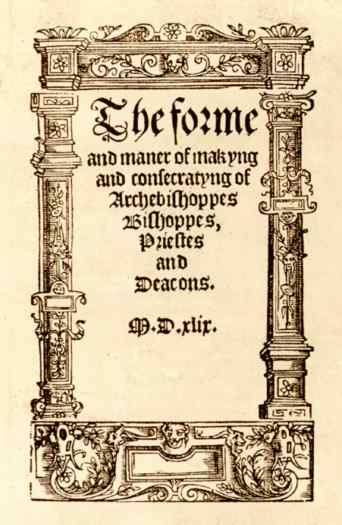
The Edwardine Ordinals are two ordinals primarily written by Thomas Cranmer as influenced by Martin Bucer and first published under Edward VI, the first in 1550 and the second in 1552, for the Church of England. Both liturgical books were intended to replace the ordination liturgies contained within medieval pontificals in use before the English Reformation.
The 1550 ordinal was authorized the year following the first Book of Common Prayer's introduction. The 1552 ordinal's introduction coincided with that of the second Book of Common Prayer. Both prayer books were also largely prepared by Cranmer. The ordinals provided the basis for most Anglican ordination rites until the 20th century and contributed to the development of the Anglican priesthood from "sacerdotal" and "intercessory" into a "preaching, catechizing, and protestant ministry". They also formed the basis for both the Vestiarian Controversy and, much later, some of the debate over the validity of Anglican holy orders and the subsequent 1896 papal bull Apostolicae curae where they were declared "absolutely null and utterly void" by the Catholic Church.
The word ordinal in the medieval period, rather than applying to a liturgical book containing the rites of ordination, was the title given to a text associated with the recitation of the canonical hours that was eventually assimilated into the breviary. While it is the typical modern name in reference to texts containing ordinations, it was probably not until John Bramhall's 1636 The Consecration and Succession of Protestant Bishops Justified that ordinal was used in this context.
Prior to the English Reformation, the liturgies of ordination–for the conferral of holy orders–in the Latin liturgical rites were contained within several versions the pontifical, most prominently the Roman Pontificals of the Roman Rite and the Sarum Pontifical of the Sarum Use. These ordination liturgies were a matter of debate between Rome and Reformers; 17th-century scholar Jean Morin summarized the Catholic Church's position that the contemporary Roman Pontificals "omit[ted] nothing that was present in the older" pontificals, while Anglicans have suggested that the laying on of hands by consecrators were variously deleted or obscured by other rituals.
The Gallican ordination liturgies, which had influenced broader Roman Rite practices in the early medieval period, were ritually complex but also possessed clear moments of ordination. For priestly ordination, the bishop laying of hands on a candidate would say it was "the blessing of the presbyterate". The anointing of a priest's hand with chrism appeared within Gallican and Roman liturgies, including the 11th-century Leofric Missal.
As early as the 10th century, English pontificals would build upon Gallican practices with a litany that accompanied ordination liturgies. These medieval texts–besides containing the rituals for ordinating deacons, priests, bishops–also included means for conferring minor orders such as the subdiaconate. Medieval pontificals gradually included and emphasized the conferral of the vestments and other items associated with their new offices, among these being stoles, patens, and chalices, in a custom known as the "tradition of elements" (Latin: traditio instrumentorum). In 1439, this practice was identified by Pope Eugene IV as an essential part of ordination. These medieval practices and their convoluted nature–duplicated actions were common within the ordination Masses–were the result of Roman and Gallican rites being conflated with local permutations. It was not uncommon for elements to be inserted into ordination liturgies that were associated with neither the formal texts nor the liturgical actions.
With the English Reformation and independence of the Church of England from Rome, Henry VIII mandated that the oath of obedience to the pope be deleted from the Sarum and Roman pontificals still in use; these modifications can be seen in some preserved copies of these texts. In 1547, a meeting between parliament and convocation resulted in an act of convocation that permitted clerical marriage in the Church of England. However, no wholly revised ordinal immediately accompanied the 1549 Book of Common Prayer and the Church of England continued to use the Sarum ordination form for the first year of the prayer book's authorization.
German reformer Martin Bucer–who had been exiled to England in 1548–drew on the discussions that had already occurred among his fellow reformed countrymen in Germany regarding the role of the priesthood and compiled an ordination liturgy in Latin, De ordinatione legitima ministrorum ecclesiæ reuocanda, for the English reformers to study. Thomas Cranmer, the Archbishop of Canterbury and liturgist behind the 1549 prayer book, would perform an ordination with Nicholas Ridley, the Bishop of London and Westminster, at St Paul's Cathedral in 1549 according to the ritual soon to be legally requested.
Hub AI
Edwardine Ordinals AI simulator
(@Edwardine Ordinals_simulator)
Edwardine Ordinals
The Edwardine Ordinals are two ordinals primarily written by Thomas Cranmer as influenced by Martin Bucer and first published under Edward VI, the first in 1550 and the second in 1552, for the Church of England. Both liturgical books were intended to replace the ordination liturgies contained within medieval pontificals in use before the English Reformation.
The 1550 ordinal was authorized the year following the first Book of Common Prayer's introduction. The 1552 ordinal's introduction coincided with that of the second Book of Common Prayer. Both prayer books were also largely prepared by Cranmer. The ordinals provided the basis for most Anglican ordination rites until the 20th century and contributed to the development of the Anglican priesthood from "sacerdotal" and "intercessory" into a "preaching, catechizing, and protestant ministry". They also formed the basis for both the Vestiarian Controversy and, much later, some of the debate over the validity of Anglican holy orders and the subsequent 1896 papal bull Apostolicae curae where they were declared "absolutely null and utterly void" by the Catholic Church.
The word ordinal in the medieval period, rather than applying to a liturgical book containing the rites of ordination, was the title given to a text associated with the recitation of the canonical hours that was eventually assimilated into the breviary. While it is the typical modern name in reference to texts containing ordinations, it was probably not until John Bramhall's 1636 The Consecration and Succession of Protestant Bishops Justified that ordinal was used in this context.
Prior to the English Reformation, the liturgies of ordination–for the conferral of holy orders–in the Latin liturgical rites were contained within several versions the pontifical, most prominently the Roman Pontificals of the Roman Rite and the Sarum Pontifical of the Sarum Use. These ordination liturgies were a matter of debate between Rome and Reformers; 17th-century scholar Jean Morin summarized the Catholic Church's position that the contemporary Roman Pontificals "omit[ted] nothing that was present in the older" pontificals, while Anglicans have suggested that the laying on of hands by consecrators were variously deleted or obscured by other rituals.
The Gallican ordination liturgies, which had influenced broader Roman Rite practices in the early medieval period, were ritually complex but also possessed clear moments of ordination. For priestly ordination, the bishop laying of hands on a candidate would say it was "the blessing of the presbyterate". The anointing of a priest's hand with chrism appeared within Gallican and Roman liturgies, including the 11th-century Leofric Missal.
As early as the 10th century, English pontificals would build upon Gallican practices with a litany that accompanied ordination liturgies. These medieval texts–besides containing the rituals for ordinating deacons, priests, bishops–also included means for conferring minor orders such as the subdiaconate. Medieval pontificals gradually included and emphasized the conferral of the vestments and other items associated with their new offices, among these being stoles, patens, and chalices, in a custom known as the "tradition of elements" (Latin: traditio instrumentorum). In 1439, this practice was identified by Pope Eugene IV as an essential part of ordination. These medieval practices and their convoluted nature–duplicated actions were common within the ordination Masses–were the result of Roman and Gallican rites being conflated with local permutations. It was not uncommon for elements to be inserted into ordination liturgies that were associated with neither the formal texts nor the liturgical actions.
With the English Reformation and independence of the Church of England from Rome, Henry VIII mandated that the oath of obedience to the pope be deleted from the Sarum and Roman pontificals still in use; these modifications can be seen in some preserved copies of these texts. In 1547, a meeting between parliament and convocation resulted in an act of convocation that permitted clerical marriage in the Church of England. However, no wholly revised ordinal immediately accompanied the 1549 Book of Common Prayer and the Church of England continued to use the Sarum ordination form for the first year of the prayer book's authorization.
German reformer Martin Bucer–who had been exiled to England in 1548–drew on the discussions that had already occurred among his fellow reformed countrymen in Germany regarding the role of the priesthood and compiled an ordination liturgy in Latin, De ordinatione legitima ministrorum ecclesiæ reuocanda, for the English reformers to study. Thomas Cranmer, the Archbishop of Canterbury and liturgist behind the 1549 prayer book, would perform an ordination with Nicholas Ridley, the Bishop of London and Westminster, at St Paul's Cathedral in 1549 according to the ritual soon to be legally requested.
Recent media